New Zealand's Australia Problem
Wendover Productions
0:00 If anything can concisely summarize the present predicament facing New Zealand,
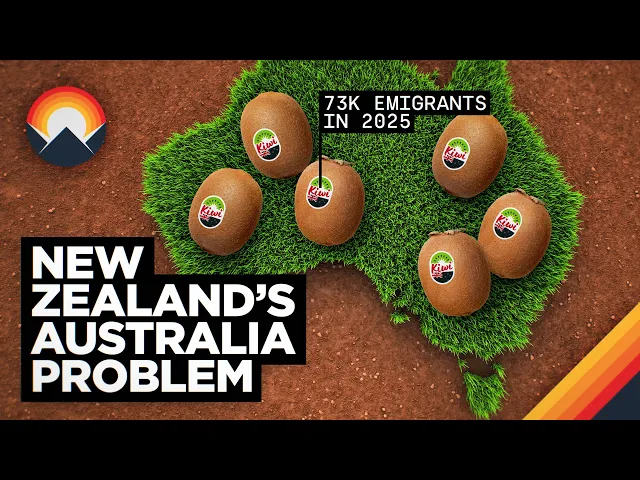
0:04 it's this single number, 73,852.
0:09 In the 12 months leading up to August 2025, 73,852 Kiwis immigrated.
0:15 In other words, 73,852 is the number of Kiwis that packed their bags and booked
0:21 one-way tickets out of the isolated island
0:23 nation to build a new life somewhere else.
0:26 Broken down, that's 202 people a day,
0:29 nearly enough to fill an Air New Zealand A321 aircraft.
0:32 More than doubling the number of Kiwis lost in both World Wars,
0:36 or ranking as the country's ninth largest if it were a city.
0:39 This number by itself is a major concern.
0:42 Making the problem only more glaring is that more than
0:44 a third of those leaving are aged 18 to 30 years old,
0:48 making the problem only more structural.
0:50 Long-term immigration by New Zealand citizens has
0:52 been steadily rising for more than a decade.
0:55 From 2015 to 2025, the cumulative total is at 454,000,
1:00 a number larger than all New Zealand cities aside from Auckland.
1:04 73,852 is not a fluke, but rather a sign of the times.
1:11 Now, there are plenty of theories informing why Kiwis are leaving,
1:14 but simply consider where this diaspora is
1:16 headed and a clearer picture takes shape.
1:19 Australia.
1:20 With the vast majority of these departures headed across the Tasmin Sea,
1:23 it's the recently established extremely close relationship between these two
1:28 countries that's sitting at the center of this developing demographic disaster.
1:33 across the entire English-speaking world,
1:35 even within the core five nations of the Anglophere,
1:37 the US, Canada, UK, Australia, and New Zealand,
1:40 all of which sharing British heritage,
1:41 democratic structures, and close economic relationships,
1:44 no two nations are nearly as culturally, politically,
1:48 and economically aligned as Australia and New Zealand.
1:51 Culturally, just as an unaccustomed outsider may confuse
1:54 an American and a Canadian because they sound similar,
1:57 they listen to mostly the same music,
1:58 they both watch the same professional sports leagues that span the two nations,
2:02 an outsider may do the same with a Kiwi and an Aussie.
2:05 They're both likely to care about rugby,
2:07 they're both probably proud of their Pavlova desserts.
2:09 They share a lot of popular culture,
2:11 and they too sound similar to the untrained ear.
2:14 But culture only acts as the visible surface
2:16 level of the closeness between the two countries.
2:19 If a New Zealand citizen wants to visit Australia, no problem.
2:22 All one needs is a passport.
2:24 Again, not so different from the US Canada experience.
2:27 But if that same Kiwi wants to stay for a while and work, again, no problem.
2:31 They just need a passport.
2:33 Should they want to live in the country for a while, well, that's fine, too.
2:36 Just a passport.
2:38 Only until a Kiwi wants to begin being considered
2:40 for state benefits does a visa come into question.
2:42 And should they eventually decide they want to become a citizen,
2:45 they simply need to be present in the country
2:46 for four years and a full-time resident for one.
2:50 In fact, flipping between the two and becoming a citizen is
2:52 seen as such a small deal in the scheme of things
2:54 that a note on the government website asks those pursuing citizenship to make
2:58 sure that they aren't already by law an Australian without knowing it.
3:02 For Aussies and Kiwis, it's easier to work and move between the two
3:06 than it is for a Canadian and an American.
3:08 And it's easier to become a naturalized citizen than
3:10 it is for anyone moving between countries in the EU.
3:13 This unique closeness carries over to business, too.
3:17 Whereas trade across the US Canada border is paperwork intensive,
3:21 increasingly politicized, and subject to tariffs,
3:23 business between New Zealand and Australia functions
3:26 almost as if there's no border at all.
3:28 working towards a fully integrated international
3:31 economic understanding called the single economy market.
3:34 Trade and business relations between the two
3:36 resemble what you'd see across American states
3:38 or the UK without the historical baggage that may
3:40 inform how a Scott thinks of a Brit.
3:43 Whether it's relocating, naturalizing, working, or doing business,
3:46 there's really no two large developed countries outside
3:49 Europe where the movement between them is as seamless.
3:52 All this is relatively new.
3:55 In the 1890s, these six British colonies comprising present- day
3:58 Australia began the process of coming together as a country.
4:02 An Australian national identity had begun to develop.
4:04 Concerns over defense had heightened and frustrations
4:07 over the economic inefficiencies of not
4:09 having a single national market for foods and services had become too much.
4:13 At the first of a series of conferences hammering out the details,
4:16 New Zealand sent delegates at home.
4:18 They began floating the idea of joining this developing Commonwealth.
4:22 Ultimately though, they chose not to.
4:25 And while much is often made of the fact that Australia's
4:27 1901 constitution ultimately left room for New Zealand to join,
4:31 less is made of the fact that they didn't want to.
4:34 Their own independently governed colony
4:35 with a fruitful trade relationship with Britain.
4:38 New Zealanders believe their culture to be too different.
4:40 Their policies towards indigenous people to in congress with Australia's
4:43 and their economies not yet potential allies but rather export rivals.
4:48 For much of the early 1900s,
4:49 New Zealand maintained its distance from Australia and benefited from it.
4:53 With the aid of refrigerated shipping,
4:54 a temperate climate ideal for animal husbandry, and a wildly prosperous trade
4:58 relationship with the ever resource-hungry Britain,
5:01 the New Zealand economy, on the back of raw agricultural exports, soared.
5:05 By the 1950s, by GDP per capita,
5:08 New Zealand had become the world's third most productive, prosperous economy.
5:12 But then came the60s, and with it change in the form of synthetic
5:16 wool and Britain entering the European economic community.
5:19 Suddenly, a one-trick pony economy had to diversify.
5:23 New Zealand built factories.
5:24 It explored exporting to other markets like the US and Asia.
5:27 It expanded state services.
5:29 And ultimately, it faltered.
5:31 In the age of global liberalization of Reagan and Thatcher,
5:34 New Zealand underwent its own process
5:36 of difficult right sizing through Rogeromics.
5:39 By this point, in the 1980s,
5:41 Australia's economy had surpassed the productivity of New Zealand's for good.
5:44 And with few other promising options,
5:46 New Zealand came to the table with their neighbor to figure
5:48 out a trade relationship that would mirror those taking shape in Europe.
5:52 First came the closer economic relations agreement in 1983.
5:56 With tariffs and quantified restrictions between the two countries phased out,
6:00 a new trading partnership bloomed, growing by 500% over 20 years.
6:06 It was a watershed moment.
6:08 The fruitful agreement was taken further.
6:10 In 1998, the two agreed that products
6:12 that passed inspection and testing and became legally available
6:15 to consumers in one country could now be
6:17 sold in the other without any questions asked.
6:20 This was then extended to the workforce.
6:22 Anyone who obtained lensure in most any field in one
6:24 country was able to perform the same work in the other.
6:27 The relationship was further crystallized
6:30 with the single economic market agreement of 2009.
6:33 This has made it even easier for businesses to work
6:36 across the Tasmin Sea by setting up TransT Tasmin
6:38 regulatory bodies and essentially turning the hard borders between
6:41 the two countries into something closer resembling ever permeable dotted lines.
6:46 For both nations, coming together in a time of real uncertainty
6:49 in the 1980s has been a major success and stabilizing factor.
6:53 But recently for New Zealand, it's begun to show some difficult downsides.
6:59 What's killing New Zealand is that such a permeable border between
7:02 two nations is allowing Australia's gravitational
7:05 pull to impact New Zealand's population.
7:07 There are two simple metrics that inform
7:09 the critical differences between the two countries,
7:12 population and GDP per capita.
7:14 At 27.2 million people, Australia's about five times the size of New Zealand.
7:19 And in GDP per capita, Australia's at 12th in the world with $66,000,
7:24 while New Zealand lags behind at 25th with $49,000.
7:29 These two Gulfs have real consequences for New Zealand.
7:32 Just take any Auckland kid about to make
7:34 a decision on where to go to college, for example.
7:36 Because the two nations are now so closely tethered,
7:39 any graduating Kiwi has the opportunity to cross
7:41 the Tasmin and study in Australia without
7:43 a student visa while paying the domestic
7:45 rate for university rather than the international fee.
7:48 Of course, it should be said the same
7:50 exists for an Aussie looking toward New Zealand.
7:52 But let's say a student from either of these countries is looking
7:54 for a bigger campus with a larger range of paths of study.
7:58 In New Zealand, there are six universities that boast a student body over
8:02 20,000 with University of Auckland far
8:04 and away the largest with 45,000 students.
8:07 In just the Australian state of Victoria, there are seven such universities.
8:11 In New South Wales, another nine.
8:14 And should this student be a high achiever,
8:16 it's four Australian universities versus zero New Zealand
8:19 schools cracking the US News top 50 list.
8:22 And it's not until number 10 before you find a New
8:24 Zealand university in the top regional universities across the two countries.
8:28 For a prospective student,
8:29 Australia just provides more opportunities and for the high achiever,
8:32 more prestigious pathways.
8:34 Furthering the hypothetical,
8:36 let's say this postcol student is interested in getting into investment banking.
8:40 In Sydney, there's the big international names.
8:42 There's Goldman Sachs.
8:43 There's Morgan Stanley right across the street.
8:45 Right below it is UBS and a few blocks down there's JP Morgan.
8:49 There are also offices of Barkley, City Bank, and Bank of America.
8:52 In Auckland, there's barely any investment banking.
8:56 While City Bank does technically have a presence with an office here,
8:59 banking of any sort in New Zealand is dominated by A&Z, ASB,
9:02 Bank of New Zealand, and Westpak New Zealand,
9:05 three of which are subsidiaries of banks in Australia,
9:07 the fourth originally founded in New South Wales.
9:10 So should someone want to get into investment banking,
9:12 their best bet would be to attend university
9:14 within the collection of the group of eight,
9:16 the region's most selective universities,
9:18 all of which located in Australia, then head to Sydney.
9:21 For banking or anything finance related, it just makes sense to base operations
9:25 out of Australia as the infrastructure already exists,
9:28 the currency is more international, the markets just bigger.
9:32 While intuitive, this in turn stunts any
9:34 potential development for New Zealand's financial industry,
9:36 as it just makes far more sense to simply
9:38 go to Australia and quite potentially never come back.
9:42 Now, in New Zealand's culture,
9:43 it may not be the end of the world to be losing its finance bros,
9:46 but losing their tax dollars and their subsequent
9:48 local spending cost the nation's economy.
9:52 This trend exists beyond the finance and white collar hypotheticals, too.
9:55 In 2021, this advertisement ran in the New Zealand Herald,
9:59 sponsored by the state of Queensland.
10:01 They were looking to pull registered nurses
10:03 across the ditch to fill vacancies across a host of facilities with the promise
10:06 that the state had a reasonable working conditions,
10:08 livable cities, and warm weather.
10:11 The timing was opportunistic as New Zealand healthcare workers had gone
10:14 on protest just a month earlier demanding better working conditions and pay.
10:18 Those who followed the advertisement west reported back
10:21 that the jobs lived up to the promise.
10:23 They had fewer patients per nurse and they got paid better.
10:26 By March of 2024, of the 38,000 nurses registered in Australia that year,
10:31 10,000 hailed from New Zealand.
10:33 With such asymmetrical opportunity in education and employment,
10:36 New Zealand is hemorrhaging able workers in a classic case of brain drain.
10:41 The country is able to raise middle and high-income workers,
10:44 but is increasingly unable to keep them,
10:46 their skills, and their dollars at home.
10:49 Of course, with such open borders and similar cultures, people go both ways.
10:53 Australians invest their time and money in New Zealand, too.
10:56 But it looks different.
10:58 On average, if an Australian is planning to go to New Zealand,
11:01 it's either to visit, to retire, or to check on their real estate investment.
11:05 All of which brings money across the Tasmin,
11:07 but money that does less to grow the economy
11:09 and money that has a complicated impact on the nation's direction.
11:13 Tourism, for instance, is a major part of the New Zealand economy.
11:16 It employs some 10% of the population, at least indirectly.
11:19 It accounts for about 7.5% of the nation's GDP.
11:22 And with between a third and half of all tourists hailing from Australia,
11:26 the entire industry relies on its neighbors to keep it afloat.
11:29 In a place like Queenstown with beautiful
11:31 waterways abudded by dramatic snowcapped mountains,
11:34 tourism does an amazing job of commercializing
11:36 what would otherwise be some pretty inhospitable landscapes.
11:39 In this way, tourism does a lot for a rather rugged and rocky nation.
11:44 The thing is, tourism is a difficult industry to turn into a career.
11:48 One can work at one of the two ski resorts near Queenstown,
11:51 but it's only a seasonal job from June to October.
11:54 It's a job that won't likely require a degree,
11:56 and one that will count on young adventure oriented employees,
11:59 and thus will not pay well.
12:01 The same limitations will go for a raft guide, a luxury hotel employee,
12:04 a server at the popular restaurant in the heart of town.
12:07 Employment will probably be seasonal.
12:09 Pay will be at the whims of visitation trends well beyond their control.
12:12 Jobs will perpetually remain entry level.
12:14 Career advancement will be limited, and benefits will be non-existent.
12:17 Australians will come visit, spend their money,
12:20 stimulate the economy for the moment,
12:22 but ultimately perpetuate a system with fairly limited long-term viability.
12:26 The same goes with Australians that make the move permanent,
12:28 those that retire there.
12:30 While they're moving in, stimulating the real estate market,
12:32 spending their disposable funds at local businesses,
12:35 they're bringing little to the table when
12:36 it comes to growing the country's economic output,
12:38 benefiting its age pyramid, and simply by buying into the markets,
12:41 only making the housing crisis just a touch worse for the average Kiwi.
12:46 What's easy to lose sight of when considering New Zealand
12:48 and Australia is that while they're both extremely isolated island nations,
12:52 one is far smaller and more isolated than the other.
12:56 That informs some important push factors.
12:58 If Kiwis are pulled to Australia, they're also pushed by the fact that life
13:02 is just generally more expensive and less convenient.
13:06 For a lot of products, New Zealand status on the very edge
13:08 of global trade routes doesn't matter too much.
13:11 Take imported Twinnings tea or Cadbury chocolate bars.
13:14 They're fairly similar priced in both Australia and New Zealand.
13:16 And when compared to those available in the US, they're actually cheaper.
13:20 Global shipping has figured products like this out.
13:22 They're shelf stable, small, easy to handle,
13:24 and thus cheap to move and cheap to buy.
13:27 But when there are blips in this system,
13:29 New Zealand's far more likely to lose out.
13:31 Take a fresher and more difficult product, orange juice.
13:35 In 2024, orange juice prices started to rise at every Kiwi's local Woolworths.
13:39 Then the cartons began to disappear entirely.
13:42 This was on account of a faraway cyclone in Brazil that set
13:45 the global orange juice supply behind on account of a lack of orange juice.
13:48 In Australia though, the shortage was minimized by the fact
13:51 that there's a fairly strong orange industry domestically,
13:53 a benefit of the country spanning three climate zones from aid to tropical.
13:57 Even in things that New Zealand is well equipped to produce,
14:00 goods are expensive.
14:01 Take beef.
14:02 If a Kiwi is going to buy ground beef,
14:04 it's going to be largely at the global going
14:06 rate as beef is a major export for the country.
14:09 That means when beef is in tight demand and the market rate rises globally,
14:13 for Kiwis to entice New Zealand producers to sell locally,
14:16 they have to roughly match the rate.
14:18 Buying beef at the international rate though is expensive for the average New
14:21 Zealander because their purchasing power is hamstrung
14:24 by a less and less productive economy.
14:26 By monthly cost of living,
14:27 which considers everything from rent to grocery bills,
14:30 New Zealand's in the world's top 25 most expensive,
14:33 while by purchasing power parody,
14:35 New Zealand's at 36th near countries where the price of living is much lower.
14:40 No matter how much a Kiwi may love their home country,
14:42 this massive disparity between purchasing power
14:45 and price of living is crippling.
14:47 It's simply a massively difficult place to make ends meet.
14:51 While Australia is even more expensive on a cost of living basis,
14:54 its PPP ranking is a whole 40 spots higher.
14:57 Rent will be higher, but so will wages and earning potential.
15:01 Increasingly, as more and more Australian companies come to establish
15:04 important holdings and provide important services in New Zealand,
15:07 whether it's the banks, the grocery stores like Woolworths and Kohl's,
15:10 the gas stations like Ample, or the food distributor Goodman Fielder.
15:14 And as more New Zealanders look to access
15:15 opportunity in the wider world through moving to Australia,
15:18 the relationship between the two feels less and less equal.
15:22 It feels not like the interaction between two
15:25 sovereign self-interested countries and more so the interaction
15:28 of a far-flung down at its luck state
15:30 and the prosperous nation within which it resides.
15:33 On balance, the softening of borders between Australia and New
15:36 Zealand seems to benefit the former far more than the latter.
15:41 Australia receives access to new markets, a host of hungry young professionals,
15:44 and a beautiful and convenient destination to travel.
15:48 New Zealand, in turn, has an important economic ally,
15:51 a market to send its goods,
15:52 and an army of tourists to pump at least some money into the country.
15:56 It's an uneven agreement,
15:57 and one that's costing New Zealand far more than it's costing Australia,
16:00 is an imbalance informed by size and geography beyond the control of either.
16:05 But it's ultimately an imbalanced deal that likely isn't going anywhere soon.
16:10 Ask a Kiwi and they're not likely to harbor
16:12 any bitterness towards Australia and this imbalance of benefits.
16:15 Ask a New Zealand politician and you'll get much the same.
16:18 There's little to no animosity toward the nation
16:20 taking some of its best and brightest.
16:22 Immigration is a real problem,
16:24 but immigration is a consequence of a deal that New Zealand relies on.
16:28 Remove Australia from the equation and New Zealand is only in more trouble,
16:32 more isolated, and left with fewer prospects.
16:35 A colonial enterprise from the beginning,
16:37 New Zealand is a global nation with global ambitions.
16:40 And to act on such ambitions as the most
16:42 isolated major nation in the world comes with real trade-offs.
16:47 Trade-offs and difficult decisions, though,
16:49 should not be defining your shaving routine.
16:52 Far too long in my own life, I've had to weigh the decision between growing out
16:55 some stubble or inevitably irritating my skin with any
16:58 and every razor that just seemed to maul
17:00 my face and always make the routine an unpleasant one.
17:03 But all that changed when I gave Hensen Shaving,
17:05 the sponsor of this video, a try.
17:07 For years, I've used razors that could give me a fine enough,
17:10 close, clean looking shave.
17:11 But not until I gave Hensen a shot did they actually feel good.
17:14 That's because Henen has been designing around the feel
17:16 and experience of the shave as well as the look.
17:19 And they've come up with the Hensen razor.
17:21 These are made in an aerospace machine shop.
17:23 They're all aluminum, and everything from the angle of the razor
17:26 blade to its blade support was designed
17:28 to turn shaving from an irritating hassle
17:30 into just another part of your morning routine.
17:32 In a space where marketing gimmicks, subscription models,
17:34 and a whole lot of plastic waste has become the norm,
17:36 Henson has quietly innovated and my mornings are better because of it.
17:40 If you'd like to give their product
17:41 a shot and support a company that's supporting us,
17:43 head to hensenshaving.com/wendover and enter Wendover at checkout
17:47 to get 100 free blades with your purchase.
17:49 It's a switch that I really think you're going to appreciate making.