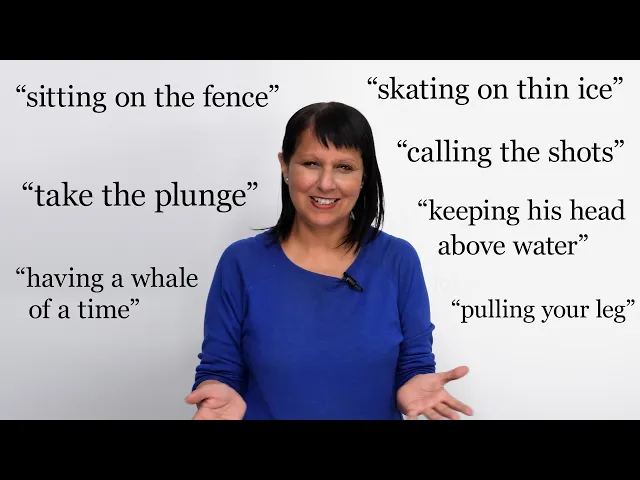
Do you know these English idioms?
Learn English with Rebecca · engVid
0:00 In this lesson, you'll learn seven very
0:02 common idioms that you might hear anywhere.
0:05 You could hear them when you're out with your friends,
0:07 you could hear them at school, you could hear them at work, okay?
0:11 So, let's learn what they are so that when people use them,
0:14 you'll understand what they're saying,
0:16 and perhaps after that, you'll go to the next step
0:19 and you'll also start to use some of them yourself.
0:22 They're not very hard, okay?
0:24 So, let's see what they are.
0:26 So, first of all, there are about seven of them on the board,
0:30 and they can be used in this way.
0:33 So, before any of them, okay,
0:35 you need to put the name of a person or you need to use a pronoun,
0:40 because they all start with kind of a verb.
0:43 So, we need to say, for example,
0:45 "I'm sitting on the fence", "He's sitting on the fence",
0:48 "She's sitting on the fence", "We're sitting on the fence",
0:51 "They're sitting on the fence", "Are you sitting on the fence?" Okay?
0:55 Like that.
0:55 So, you need to put a subject here before that, okay?
1:00 So, let's get started with the first one, alright?
1:03 I just put these at the top so that we can use them in our examples.
1:07 So, the first one is "He's sitting on the fence".
1:11 So, what does that mean?
1:13 And first of all, what's a fence anyway?
1:16 Well, first of all, if they're idioms,
1:18 you don't have to know the exact meaning of each word,
1:21 you have to know the overall meaning, but just for you to understand.
1:25 So, let's suppose you have two houses and they're divided by something,
1:29 by some sort of a structure.
1:31 That structure is usually a fence,
1:33 it might be made of wood or metal or something else, right?
1:37 That's a fence.
1:38 So, if somebody's sitting on the fence,
1:42 it means that he is undecided, he's not sure which way to go.
1:47 This way?
1:48 That way?
1:49 He can't decide, okay?
1:51 So, somebody is sitting on the fence when they are undecided.
1:56 For example, let's say somebody is sitting on the fence
2:00 about who they're going to vote for, okay?
2:03 In an election.
2:04 Or they're sitting on the fence about which university to join,
2:08 or which boy or girl to go out with, okay?
2:12 They're sitting on the fence, they're unsure,
2:14 they're thinking still, they're not sure.
2:17 Sitting on the fence means being undecided, okay.
2:21 The next one, she's having a whale of a time, okay?
2:26 She's having a whale of a time means having a wonderful time,
2:30 an exceptional time, a great time, a really fun, marvelous, superb time, okay?
2:37 So, if you say I'm having a whale of a time, I'm having a beautiful time.
2:40 So, let's say when you go on holiday,
2:42 if somebody's on their honeymoon or something like
2:45 that, they're having a whale of a time, they're having a wonderful time, okay?
2:49 Alright, the next one.
2:52 If we say, oh, he's pulling your leg, okay,
2:56 this doesn't actually mean that somebody's pulling your leg.
3:01 It's an idiom, which means that somebody's kidding you,
3:04 somebody's joking with you, okay?
3:06 They're not- don't take them seriously.
3:09 So, brothers and sisters, you know, do this a lot to each other.
3:13 Let's say the brother says to the little sister,
3:16 oh, there's a spider in your bed, or there's a mouse in your closet,
3:19 and the sister goes, oh my gosh, okay, whatever.
3:22 Or the other way around, okay?
3:24 So, they're not being serious, they're telling a lie, but not in a serious way,
3:30 it's just to joke with somebody or to kid someone.
3:34 So, when that happens,
3:35 we say that she's pulling your leg or he's pulling your leg, okay?
3:40 Not serious.
3:42 Alright.
3:42 The next one.
3:44 If we say, he's calling the shots.
3:47 He's calling the shots.
3:49 That means that he is in charge, he's in control,
3:53 he's the one who's making the important decisions, okay?
3:59 So, we could say the manager's calling the shots,
4:01 the general manager's calling the shots, the director's calling the shots, okay?
4:06 So, usually, it's talking about somebody who
4:08 is in charge and making the important decisions.
4:12 So, that's the meaning of calling the shots.
4:15 Let's go back over the other ones for a minute.
4:18 Sitting on the fence, it means what?
4:20 You're undecided.
4:23 Having a whale of a time, having a wonderful time.
4:27 Pulling your leg, teasing you, joking with you, okay?
4:32 And calling the shots, being in control, making the important decisions.
4:37 Alright.
4:38 Let's go on.
4:40 Let's use the example of "he" here because I've used this word here.
4:44 He's keeping his head above water, okay?
4:48 So, let's suppose this is the water.
4:49 If you're keeping your head above water, that's good, that's safe.
4:54 But if you go under the water, it's not so safe.
4:57 So, this expression kind of means that somebody's in an okay situation,
5:04 but just managing, okay?
5:07 They're not in a great position.
5:09 So, for example, if we ask somebody,
5:11 let's say he opened a new restaurant, it's not doing so well.
5:15 He's a little bit concerned about the restaurant,
5:18 but he's- so, when you ask him, "How's business?" he says, "It's okay,
5:22 I'm keeping my head above water", but that's about it.
5:27 So, he's just managing, but he hasn't gone under, okay?
5:31 He's still surviving, the business is still open,
5:35 but he's just surviving, he's not thriving.
5:38 Thriving is when you're doing really, really well at something, okay?
5:42 Just keeping your head above water.
5:45 The next one, skating on thin ice.
5:48 She's skating on thin ice.
5:50 Okay, so what does it mean to skate?
5:53 Well, if you watch ice hockey, all those players wear skates, right?
5:58 They wear skates and they're skating on the ice.
6:01 So, if you're skating on thin ice, that's not a good thing.
6:05 That's dangerous, because what can happen?
6:07 You can fall inside, okay?
6:09 So, what this idiom means, when someone is skating on thin ice,
6:14 they're doing something dangerous, risky, okay?
6:18 Not a good idea.
6:20 Something dangerous.
6:21 So, or they're in a dangerous situation, and they're doing something dangerous.
6:26 For example, if somebody was cheating on an exam, okay, or lying to- in court,
6:33 or lying to the police, that would be an example of skating on thin ice.
6:38 Not recommended, dangerous, okay?
6:41 Alright.
6:42 Alright.
6:42 And the last one is called taking the plunge, alright?
6:47 If we say he's taking the plunge.
6:50 So, the plunge is like a deep dive, a deep jump or dive into the water.
6:57 So, when you take the plunge, in English,
7:00 that idiom means that after a long time of thinking it over and over,
7:06 somebody finally decided to do something, okay?
7:10 He's taking the plunge.
7:11 For example, if somebody was thinking for a long time about getting married,
7:15 and finally he decided to do it, then we say he's decided to take the plunge.
7:20 Or somebody wanted to, I don't know, apply for a very high position,
7:25 but was always nervous, and finally they did it,
7:29 then they were taking the plunge, okay?
7:31 So, it's like to take a big step after a lot of thinking, and so on, okay?
7:36 So, those are the seven idioms that we've learned today.
7:40 Again, I'll review the last few.
7:43 Keeping your head above water, just managing,
7:46 not doing very, very well, but managing.
7:50 Even if you were talking about, for example, at university,
7:53 and somebody's- the student's not doing too well, but he's alright, okay?
7:58 So, he's keeping his head above water.
8:00 Or skating on thin ice, doing something very dangerous and tricky and risky.
8:06 And taking the plunge, making a decision to do something.
8:09 Usually, this is a positive thing that the person wants to do,
8:13 but maybe is a little bit afraid of, and finally decides to do it, okay?
8:18 Now, I'm going to come back in a second to see if you were paying attention,
8:22 and whether you remember some of these words that are part of these idioms.
8:26 Okay.
8:27 So, what happened?
8:28 Well, I took away some of the words to see if you can remember them, okay?
8:32 So, let's go over them together and see if we can do that.
8:36 And this time, let's not go in order, let's mix it up a little bit.
8:39 So, what's the expression that you would use
8:41 if you want to say that somebody's in control?
8:45 If you want to say she's in control,
8:47 she's in charge, she's making the important decisions, she's doing what?
8:54 She's calling the shots, okay?
8:58 She's calling the shots.
9:00 Good.
9:01 Alright.
9:02 Suppose somebody decided to get married after thinking about it,
9:05 and thinking about it, and thinking about it, and finally has decided to do it.
9:10 What is he doing?
9:11 He's taking the plunge.
9:15 Right.
9:17 Good.
9:18 Okay?
9:18 So, we've got those.
9:20 Alright.
9:22 Someone's having a wonderful time, an amazing time.
9:26 What's that?
9:27 Having a whale of a time.
9:30 What's a whale, anyway?
9:32 A whale is like that large, very,
9:34 very large mammal or animal that's in the water, that's in the ocean, okay?
9:39 It's like the biggest mammal that there is, a whale.
9:43 Having a whale of a time.
9:45 Okay.
9:45 If somebody's teasing you, he's kidding you, not serious,
9:49 he's telling you a lie, but it's just to joke with you.
9:54 What's that person doing?
9:55 He or she is pulling your leg.
10:00 Yes.
10:01 Okay.
10:02 And if you're not sure who to vote for in the next election,
10:06 I don't know, I'm sitting on the what?
10:10 Sitting on the fence.
10:12 Good.
10:13 Okay.
10:13 Got that one.
10:15 Anything left?
10:16 Yes.
10:17 Okay.
10:18 If somebody has done something which is quite dangerous,
10:21 what is that person doing?
10:23 He or she is skating on thin ice.
10:29 Very good.
10:30 Okay?
10:30 And the last one, you're keeping your something above water.
10:36 What is it?
10:37 Your head.
10:39 Okay?
10:40 Keeping his head above water means he's surviving,
10:43 he's managing, not doing extremely well, but managing and surviving.
10:48 Okay?
10:48 So, these are seven idioms.
10:50 As I said, the more you can- the more idioms you can learn,
10:53 the more comfortable you'll feel in English, because we hear them everywhere.
10:57 They're in the movies, they're on television, okay?
11:00 They're on the street, and when we go into a store,
11:03 when we overhear a conversation in a coffee shop,
11:06 you'll hear these idioms everywhere, okay?
11:08 So, practice them, go to our website, www.EngVid.com.
11:14 There you can do a quiz on them and really learn them well,
11:17 make sure you understand the meaning,
11:19 and perhaps you can even start using them one by one, okay?
11:23 And don't forget to subscribe to my YouTube
11:26 channel for lots of other useful English lessons, okay?
11:30 So, I'll see you next time.
11:32 Bye for now.