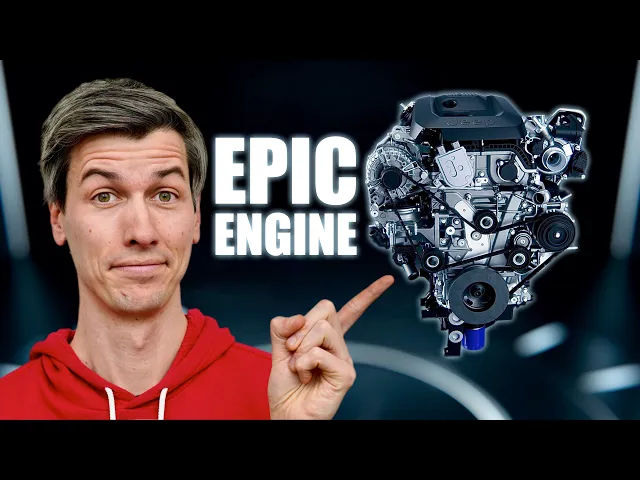
Jeep's New Hurricane 4 Engine Is Insane!
Engineering Explained
0:00 One of the most technically advanced four-cylinder engines ever just launched.
0:05 This engine has a passive pre-chamber with turbulent jet ignition,
0:10 just like what is done in Formula 1.
0:13 So, it can make boatloads of power without using much fuel.
0:17 It uses two spark plugs per cylinder.
0:20 It's running the Miller cycle.
0:22 It uses plasma spray cylinder liners, dual fuel injection, electric cam phasing,
0:28 and a variable geometry turbo with up to 35 psi of boost pressure.
0:34 Oh, and it's made by Jeep.
0:36 Yep, the first company making modern F1 engine tech mainstream is Jeep.
0:43 I did not have that on my bingo card,
0:46 but maybe I should have considering Maserati in the same Stellantis family
0:50 as Jeep introduced this tech to production cars with the MC20's Nettuno engine.
0:56 But, it is Jeep that will bring this tech to mainstream pricing.
1:00 Now, at this exact moment, history nerds are furiously typing.
1:04 Um Jason, Honda was making pre-chamber engines in the 1970s.
1:09 Go on, get it out.
1:11 Get it out.
1:15 [sighs] Feels good, doesn't it?
1:16 Okay.
1:17 This is quite different.
1:19 We're moving on.
1:19 All right.
1:20 So, I had a fascinating chat with Jeep's
1:22 engineering to learn all about this Hurricane 4 engine.
1:26 And so, we're going to dive deep into understanding how it works,
1:29 starting with a quick review of how turbulent jet ignition works.
1:33 All right.
1:33 So, like any four-stroke gasoline engine,
1:36 we start things off with our intake stroke, pulling in air and fuel.
1:39 In this case, we are using port injection
1:41 as well as direct injection for the fuel.
1:44 Then, we of course have our compression stroke.
1:46 So, we compress that air and fuel.
1:48 Some of that air and fuel goes within this little pre-chamber,
1:51 which Jeep was kind enough to send me one to check out.
1:53 And so then, we have our power stroke.
1:56 So, our spark plug within this pre-chamber ignites the air and fuel
1:59 mixture within that, which shoots out
2:01 these turbulent jets as that combustion occurs,
2:04 that pour out into the main chamber.
2:06 And so, as these turbulent jets shoot out into the main chamber,
2:10 you have very fast, very complete combustion.
2:13 This reduces the likelihood of knock,
2:15 and because of that, you get more power, and you get better efficiency.
2:19 So, looking at the specifications of Jeep's engine here,
2:22 the Hurricane 4, this is a 2-liter inline four turbocharged engine.
2:27 It's producing 324 horsepower and 332 pound-feet of torque.
2:33 It is using a variable geometry turbo,
2:35 and it has a max boost pressure of 35 PSI.
2:39 Yes, that is gauge pressure.
2:41 Yes, it is bonkers high.
2:43 And it is using a 12:1 compression ratio,
2:46 which is quite high for a turbocharged engine.
2:48 Now, when you start to think about designing this little pre-chamber,
2:51 there are a lot of variables that come into play.
2:54 So, you have to think about the surface area to volume ratio.
2:57 You have to think about the number of holes.
2:59 In this case, there are eight radial holes and one central hole.
3:03 You also have to think about the diameter of these holes.
3:05 So, in this case, Jeep is using about 1-mm holes for the radial ones,
3:09 and then the one in the center is about half a millimeter.
3:12 Now, why would you have different size holes?
3:14 Well, you need to think about the energy of these jets,
3:17 the energy that's going to come pouring out of these jets.
3:20 So, if it was too high, if it was too much energy coming out of these jets,
3:23 and it was pointed directly at your piston,
3:25 you could literally melt that piston.
3:27 So, you really have to think about this design.
3:29 You have to think about the angle that you
3:30 have and the size of those holes, right?
3:32 If you go too small,
3:33 you're not going to have quite as much energy, it's restricted.
3:36 Or if you go too big,
3:37 it's not going to have quite as much energy, you have too much space, right?
3:40 And so, it's kind of this perfect center spot of where do we
3:43 get this to ensure that we have
3:44 the ideal combustion characteristics we're looking for.
3:47 Now, as far as why the center hole
3:49 is smaller than the radial holes on the pre-chamber,
3:53 we're looking at the distance that that flame has to travel, right?
3:56 So, if your piston is right underneath this pre-chamber,
3:59 you don't want a really strong jet just blasting right into it.
4:02 So, you use a smaller hole in the center of the pre-chamber,
4:05 and then where you have a further distance to travel in the main chamber,
4:09 then these radial holes are larger, so they have more energy in those jets.
4:13 Now, you might wonder,
4:14 how do they ensure these pre-chamber holes don't clog up with carbon deposits?
4:19 Two comments.
4:20 First, remember every time we have our compression stroke,
4:23 we're pressing air and fuel back into this pre-chamber.
4:25 So, you can benefit from the fuel's
4:27 cleaning properties as it goes into the pre-chamber.
4:30 But second, and more importantly,
4:32 the temperatures in this pre-chamber get so hot,
4:35 you literally just burn everything off of it.
4:38 So, it's something you are designing for, but ultimately
4:41 something Jeep says is not an issue.
4:44 This portion of the video is sponsored by Motive,
4:46 who sent me their AI Dash Cam Plus.
4:49 This advanced dash cam is designed as a safety and operations aid,
4:54 packed with useful features for use in fleets.
4:57 For example, two front-facing cameras provide stereo vision.
5:01 This enables precise forward collision warnings.
5:04 The front zoom lens supports automated license plate recognition,
5:08 capturing evidence in the event of a hit-and-run.
5:11 Sensor fusion combines sensor data to record important events.
5:15 Say it hears the sound of broken glass,
5:18 it knows to record in case of a vehicle break-in.
5:21 And it can provide prompts to the driver to help save on costs.
5:25 For example, if the engine is unnecessarily idling.
5:28 And helping enable all of this is a powerful
5:31 processor that can handle over 30 precise AI models simultaneously,
5:36 ensuring critical moments are captured accurately
5:39 in real time with minimal latency.
5:41 To learn more, check out gomotive.com/dashcam,
5:45 or hit the link in the video description.
5:47 Now, this engine is running the Miller cycle and it
5:49 is doing so by closing the intake valve early.
5:53 So, what does that mean?
5:54 Well, as the piston is on its way down during the intake stroke,
5:58 you are closing that intake valve before the piston reaches bottom dead center.
6:02 So, you're closing that intake valve early
6:04 and then the piston is still traveling downward.
6:06 Why do you do this?
6:07 Well, one of the ways is it
6:09 increases your expansion ratio versus your compression ratio.
6:15 Another thing that it does is it reduces your pumping losses.
6:18 So, let's look at a low load example.
6:20 Let's say we're at partial throttle, we're trying to make a little bit of power,
6:24 and so during this, we're going to have a short cam duration.
6:27 This is Miller cycle all the time on this engine.
6:30 It is always running early intake valve closure.
6:33 You do have variable cam timing,
6:35 but it's always going to be closing that intake valve early.
6:38 Now, what happens is you close it early and so
6:41 that means you have a less time to fill up the cylinder.
6:44 Well, if you have less time to fill up that cylinder,
6:46 that means you have to open your throttle a little
6:49 bit more in order to get sufficient air in it.
6:51 So, the more you open the throttle, that reduces your pumping losses.
6:55 So, you're forcing the engine to operate at a higher
6:57 throttle than it normally would have to, and in doing so,
7:00 that improves pumping losses.
7:02 Amazing.
7:02 Now, by running the Miller cycle in combination with TJI,
7:06 this means we can run a higher compression ratio.
7:08 Again, 12 to 1 for a turbocharged engine is quite high,
7:11 especially considering how much power this is making,
7:14 and overall that high compression ratio means we get better efficiency.
7:18 And that really gets into the heart of why this engine is so impressive.
7:22 It isn't simply because it makes a lot of power.
7:25 And don't get me wrong,
7:26 324 horsepower is a lot for a mainstream mass-market 2-liter.
7:32 But, there are some niche 2-liters out there making more power.
7:36 What makes Jeep's engine so impressive is not
7:40 only does it make a boatload of power, but it does so very efficiently.
7:45 And so this brings up BSFC or brake specific fuel consumption.
7:50 All right, so brake specific fuel consumption is a ratio of how much
7:54 fuel do you have going in versus how much power is coming out.
7:58 So the lower the number the better because
8:00 that means you're making more power with less fuel.
8:03 So brake specific fuel consumption here you have
8:06 the math if you're curious where the units come from.
8:09 You have your mass flow rate over your brake horsepower.
8:12 That's grams per hour over kilowatts or grams per kilowatt hour.
8:15 So we're looking at a graph here of our brake
8:17 specific fuel consumption versus how much power our engine is making.
8:21 And so this is like a big scatter plot, right?
8:23 And I could take an engine and say
8:25 if this engine is making 100 kilowatts of power,
8:27 what is its efficiency that it's operating at?
8:29 And then you would get a little point on this plot right here.
8:32 And so if you do this for all the four cylinders out there or a lot
8:35 of the mainstream four cylinders out there
8:37 which Jeep did and they provided this plot,
8:40 you can get this range that you can see these four cylinders tend to fall
8:43 within as far as their brake specific
8:45 fuel consumption versus how much power they're making.
8:48 And what's really impressive about Jeep's engine is that it
8:51 basically just traces the bottom line of this plot.
8:54 So it means it's as efficient as possible compared to today's modern
8:58 engines in terms of efficiency for making a certain amount of power.
9:02 All right, let's look at this plot and just grab
9:05 an example to get a bit of a better understanding of it.
9:07 So let's say we want to understand what our brake
9:09 specific fuel consumption is when our engine is producing 100 kilowatts.
9:13 So we just go to this line right here and that's our point.
9:16 And so that gives us based on this plot that Jeep provided about
9:19 211.5 grams per kilowatt hour as far as our brake specific fuel consumption.
9:24 So how do we convert this into thermal
9:27 efficiency so we can understand what that number means.
9:30 How efficient is this engine really?
9:32 Well, efficiency power out divided by the energy that you're
9:35 putting in, the rate at which you're putting in energy,
9:37 or one over our brake specific fuel
9:39 consumption multiplied by the lower heating value.
9:42 We do the math right there,
9:43 and that gives us an efficiency thermal efficiency for this engine
9:46 while producing 100 kilowatts of power of about 40.5%.
9:51 Now, there are a couple of assumptions
9:53 that go with this assuming that plot is accurate,
9:55 and then assuming the lower heating value of gasoline mixed
9:58 with a 10% ethanol is about 42 megajoules per kilogram,
10:02 but this number right here, 40.5% is very,
10:06 very, very good for a gasoline engine.
10:09 It is incredibly efficient for a gasoline engine.
10:12 And just to further reiterate how impressive what this engine is doing is,
10:17 it's using 10% less fuel while making 20% more power
10:23 than Jeep's 2-liter turbo they're currently using in the Wrangler.
10:27 And versus the Jeep Grand Cherokee using the 3.6-liter V6 engine,
10:32 this has more power, more torque, better fuel economy rating across the board,
10:37 and it's about a full second quicker zero to 60.
10:40 It's just better.
10:41 Okay, so now let's move on to why it
10:43 has dual spark plugs as well as dual fuel injectors, starting with the plugs.
10:48 All right, so let's get an understanding of the overall layout.
10:51 If you were to shrink yourself down and stand on top
10:53 of this piston and look up at this cylinder head,
10:56 you would see of course your two intake valves,
10:58 your two exhaust valves, then there in the center you would see the pre-chamber,
11:01 and of course housed within this pre-chamber is one of your spark plugs.
11:05 You also have another spark plug that is firing for the main chamber.
11:08 Then you have a direct injection here on the left,
11:11 and you also have port injection.
11:13 So, two fuel injectors, two spark plugs, why do you use two spark plugs?
11:18 Well, a couple of rules here.
11:19 We're going to look at a plot of torque versus engine rpm and see
11:23 when do we use each of the spark plugs, but a couple rules.
11:25 First of all, the pre-chamber spark plug is always firing.
11:29 Second of all, you always want some stagger between when
11:33 you fire one plug and when you fire the other.
11:35 That's because you want to have some leading form of combustion.
11:37 You want to have something predictable.
11:39 You want to, you know,
11:40 choose what mechanism do I have that is igniting this air-fuel mixture.
11:44 You're not firing both at the same time and then having them battle it out.
11:47 So, you're always going to have the pre-chamber firing,
11:50 but when it fires differs and you want
11:52 to make sure that these fire at different times.
11:54 So, let's work in some of the scenarios.
11:56 If we're at a low load here and, you know,
11:59 various engine RPM or you're heating up your catalyst,
12:02 for example, well, then you're going to have the main chamber lead.
12:05 And so, at these low loads,
12:07 you don't have a ton of air and fuel in this mixture, right?
12:10 In this chamber that's all mixed up.
12:12 So, and it could be inconsistent and you're relying on that mixture getting
12:16 inside of this tiny little pre-chamber
12:18 and then hoping that you have consistent combustion.
12:21 So, because of that, you just use the main chamber spark plug to fire it,
12:24 then shortly after you fire the pre-chamber spark plug.
12:28 That gives you better consistency, better catalyst heating,
12:31 and you don't have to worry about the emissions
12:32 aspect of the consistency of that pre-chamber firing.
12:36 Now, as you start to get into higher loads,
12:39 then you start to have plenty of air and fuel
12:41 mixing and you have plenty get within this pre-chamber,
12:43 so it's no worries, and then you have the pre-chamber leading and then
12:47 shortly after you have that main spark plug for the main chamber firing.
12:51 And so, the main mechanism for igniting the mixture, of course,
12:53 in that scenario is the pre-chamber rather than the main chamber plug,
12:57 which we had at lower loads.
12:59 And finally, we get to the high load scenario.
13:01 So, when you're trying to make as much torque as possible,
13:04 you're just using the spark plug within
13:06 the pre-chamber to ignite that air-fuel mixture.
13:09 You are not using that main plug at all.
13:12 So, why?
13:13 Well, there's a couple of reasons for this.
13:15 Remember, one thing that we always have to do is have some
13:17 delay between when one spark plug fires and when the other fires.
13:21 But, at these really high torque scenarios,
13:24 we're having this air-fuel mixture ignite very quickly.
13:27 And so if you have just a small delay,
13:30 well it means you've already got really high
13:32 heat and really high pressure within the cylinder
13:34 and then this spark plug is firing against
13:37 that really high heat and really high pressure.
13:39 And so because of that, it actually reduces the life of that plug.
13:43 It's not a great scenario to have that plug igniting.
13:46 And so there's minimal benefit first of all
13:48 because the pre-chamber's going to do a great
13:50 job of igniting all of that air and fuel mixture and then second of all,
13:53 you can damage your main plug if you have it
13:56 igniting in these really high temps and really high pressures.
13:59 So, no reason to use it in that scenario,
14:01 so it is just reliant on that spark plug within the pre-chamber.
14:05 All right, moving on to fuel injection.
14:06 Why are they using both port and direct injection?
14:09 So, we're going to look at a similar plot here of torque
14:11 versus engine rpm and just work through some of the scenarios.
14:14 When you first start up that engine,
14:16 so you want to heat up your cat, that's the most important priority,
14:20 well then you're going to be having late combustion and in doing so,
14:22 direct injection gives you better control.
14:25 So, in that scenario,
14:25 they're going to be using more direct injection, less port fuel injection.
14:29 Then once your engine is warmed up and you're just idling or at very low loads,
14:34 then you're just going to be running with port fuel injection.
14:36 Port fuel injection is at a much lower pressure.
14:39 As a result, you don't have to hear that direct
14:41 injection pump and so the engine runs much quieter.
14:44 So, when you're just sitting there idling at a stoplight or at a stop sign,
14:47 whatever it may be, the engine will be
14:49 really quiet while using just port fuel injection.
14:52 And as you get into your highest loads,
14:54 you start to become more dependent on direct
14:56 injection and less dependent on port fuel injection.
14:58 And that's because direct injection
15:00 improves the knock characteristics of combustion
15:03 and so you can have more power and more power at greater efficiency.
15:07 So, there's a lot of innovative technology used
15:09 on this engine and on the subject of innovation,
15:12 Porsche launched a new 911 Turbo in 2006, which was the first time a gasoline
15:18 production car used variable geometry turbos.
15:21 And now, 20 years later,
15:23 we get to see that tech make its way down into mass market engines.
15:27 How cool is that?
15:29 All right, so a quick review of how variable geometry turbos work.
15:32 So, within the exhaust portion of the turbocharger,
15:35 you have these vanes, and these vanes can open or close.
15:38 And so, as you close them up, you're creating restriction.
15:41 And so, by doing so, you're speeding up those exhaust gases,
15:45 and thus you're going to spool up that turbocharger
15:48 very quickly as the exhaust velocity is very high.
15:51 Now, that is at the cost of reducing your exhaust flow.
15:54 So, if you want to reduce the restriction in the exhaust,
15:57 you open up these vanes.
15:58 And so, then it acts much like a large turbo,
16:01 rather than acting like a small turbo.
16:03 And so, in this case,
16:04 you have less energy going into spooling up that turbocharger.
16:07 And in fact, you can use variable geometry turbos.
16:10 I did not know this.
16:11 You can use them without wastegates,
16:13 because you can essentially just use the direction that the vanes
16:16 point towards in order to determine how much boost you set.
16:20 So, you don't have to rely on a wastegate to bleed off excess pressure.
16:23 They still do use a wastegate in this scenario on the Jeep engine,
16:27 but it is purely for heating up the catalytic converter.
16:30 So, when you just start off the engine, you have that wastegate fully open,
16:33 you bypass [clears throat] your turbo essentially,
16:35 and have that exhaust just go straight to the catalytic converter,
16:38 rather than putting energy into the turbo.
16:40 So, there is a wastegate, but you don't need it at these high loads.
16:45 And those cases, you just open up the vanes fully.
16:47 And if you were to open them fully,
16:49 you're basically just going to have so much exhaust
16:51 flow that you're restricting the speed of that turbo,
16:54 and thus your boost comes down.
16:55 Now, I mentioned this engine has a peak boost pressure of 35 psi,
17:01 which, yes, is bonkers high.
17:03 But, there's some context that you need here,
17:05 because that is the peak pressure that the engine will ever see.
17:09 That is going to be very,
17:10 very rare that the engine would actually be running with that much boost.
17:14 First of all, because you're not always flooring it, but second of all,
17:17 let's say you're at sea level and it's cool ambient temperatures,
17:20 you don't need 35 PSI of boost to make that 332 pound-feet of torque.
17:25 So, as you start to go into higher elevations where the air is thinner,
17:29 or as temperatures really climb up, and again,
17:31 you don't have as much oxygen going into the engine, well,
17:34 then you can compensate with this engine by increasing the boost,
17:38 and by increasing the boost, you make more power.
17:40 So, at sea level, cold temperatures, no, you're not going to be hitting 35 PSI.
17:44 That is the peak in scenarios where
17:46 it can't otherwise make the desired torque output.
17:50 Now, I just want to close out with a fun anecdote,
17:53 because when I was in college, one of my roommates had a Jeep Cherokee XJ,
17:58 which had a 4-liter inline six-cylinder engine that made 190 horsepower.
18:05 And here we are with an engine half that size making 70% more power.
18:11 I mean, this is quite cool.
18:13 Another example, my other roommate, I guess they just like Jeeps,
18:17 my other roommate had a Jeep Grand Cherokee, which had the 4.7 liter V8 engine.
18:23 A V8 engine which was making 235 horsepower.
18:27 So, this four-cylinder is making nearly 100 horsepower more than the Jeep
18:32 Grand Cherokee back in the early 2000s with the 4.7 liter V8.
18:38 Unreal.
18:39 And for those wondering, yes,
18:41 this new engine has the structural enhancements to handle the additional power.
18:45 And worth mentioning, even though this is making a lot of power per liter,
18:50 it's still significantly lower power per liter
18:53 than its relative in the Maserati MC20, which is also using TJI.
18:57 The Jeep engine is focusing on efficiency as much as it is focusing on power,
19:02 and it does a great job at both.
19:05 Crazy, crazy.
19:06 If you have any questions or comments, feel free to leave them below.
19:09 Thanks for watching.