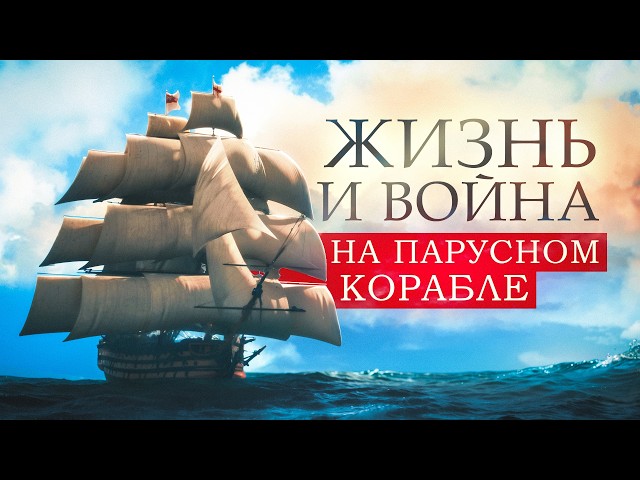
Жизнь и война на парусном корабле
Эпичная История
0:05 Linear sailing ships were the embodiment of sea power
0:08 in the era of the dominance of the sailing fleet.
0:11 They represented a “sea shield” that protected coasts from invasion,
0:16 destroyed enemy trade and protected allied ships,
0:22 both during the Napoleonic Wars and at other times.
0:29 Battleships were the largest and most complex military vehicles of the time.
0:33 Britain had about 140, more than any other country.
0:39 But its advantage lay not so much in the number or better design of the ships,
0:45 but in the qualities of the people who controlled them.
0:49 Brave and experienced commanders.
0:52 Disciplined and energetic sailors.
0:55 They were all full of self-confidence and accustomed to winning.
1:13 At the height of the Napoleonic Wars,
1:18 approximately 145,000 men served in the British Royal Navy,
1:22 a figure comparable to the size of European field armies of the period.
1:27 Battleships like HMS Victory required huge crews...
1:31 not so much to control the ship, but to man the heavy guns.
1:38 During the Battle of Trafalgar in 1805,
1:42 there were 820 people on board the ship, slightly less than the required 850.
1:49 Of these, only 15 were officers: 1 admiral in command of the fleet.
1:55 1 captain who controlled the ship.
1:59 Nine naval lieutenants and four Royal Marines officers.
2:02 Then the Chief Warrant Officers: The Ship's Master, in charge of navigation.
2:07 Senior gunner, who was in charge of ship guns,
2:12 small arms, gunpowder and cannonballs.
2:15 The boatswain, in charge of the sails and rigging,
2:18 and his assistants supervised all work on deck.
2:22 Two ship carpenters who were involved in keeping
2:25 the ship afloat and performing repair work.
2:28 Battalioner, who was responsible for the ship's provisions...
2:31 A doctor who took care of the physical health of the crew.
2:40 And a chaplain responsible for the spiritual well-being of the team.
2:42 There were also 21 midshipmen on board.
2:43 These were young officer cadets,
2:44 some of whom began their naval careers at just 13 years of age.
2:48 They completed a six-year seafaring apprenticeship,
2:52 learning seamanship, sailing, navigation, mathematics and trigonometry.
2:57 They could then qualify to take the lieutenant's examination,
3:02 a rigorous test before a panel of naval captains.
3:06 Further promotion to commander and then captain depended on merit,
3:11 and, equally important, on social and political connections.
3:15 For those without powerful backers, the process could be extremely grueling,
3:21 as depicted in a cartoon by the famous illustrator George Cruikshank.
3:25 Some naval officers came from aristocratic families,
3:29 but most came from what we would today call the middle class.
3:36 There were also 43 clerks, orderlies,
3:40 stewards and servants on board HMS Victory, all of whom assisted the officers.
3:44 69 junior warrant officers, petty officers and their assistants,
3:49 holding various positions such as Master of Arms, Gunsmith and Sailing Master.
3:55 212 experienced sailors, veterans of naval service.
3:59 193 ordinary sailors who served for at least a year.
4:06 87 recruits, suitable only for work on rigging.
4:10 142 Royal Marines- soldiers who fought on ships,
4:15 led amphibious operations and maintained discipline.
4:21 And 31 cabin boys, many of whom were orphans
4:27 rescued from poverty and doomed to life at sea.
4:33 Each was assigned a specific place to perform the maneuver: the top sailors,
4:39 the strongest and bravest sailors, controlled the sails high above the deck;
4:43 the forecastlemen, seasoned sailors,
4:45 worked on the anchors and bowsprit sails; waist,
4:50 shank and poop workers were engaged in managing gear in their areas.
4:57 The team was divided into two watches- “left” and “right”.
5:01 They took turns on duty, except in emergency situations,
5:05 when everyone was called on deck.
5:08 In addition, they were divided into teams,
5:11 each commanded by a lieutenant who was responsible
5:14 for the welfare and conduct of his men.
5:17 The crew of HMS Victory,
5:19 like most British warships, were surprisingly cosmopolitan.
5:24 Most were from Great Britain and Ireland, but about 10% were foreigners,
5:32 including Americans, Italians, Dutch, Maltese and West Indians.
5:37 Approximately half the crew were volunteers.
5:41 The rest were forcibly recruited through
5:43 the notorious "war patrols"- naval recruiting teams.
5:47 These patrols scoured ports and passing
5:51 ships for suitable men for compulsory service.
5:55 The recruitment process was not always peaceful.
5:59 Military patrols aroused fear and hatred among civilians.
6:06 They often took in men who were not at all
6:09 fit for service or who were not even British,
6:12 although most were subsequently released if they could prove their identity.
6:18 However, there were restrictions.
6:20 Contrary to popular myth,
6:22 the Navy did not recruit vagrants or To achieve maximum efficiency from a ship,
6:41 the captain had to have intimate knowledge of both his crew and his ship.
6:47 Each ship had an optimal course relative to the wind.
6:51 For HMS Victory this was a direction within one or two points astern.
6:57 This is how the ship developed its maximum speed- about 10 knots.
7:03 However, large ships could not move strictly in a straight line due
7:06 to drift- the demolition of the hull under the influence of the wind.
7:11 This had to be handled by the helmsman,
7:15 who controlled the ship using the steering wheel.
7:19 The officer of the watch, usually a lieutenant,
7:22 was in charge of the ship during his watch
7:25 and gave orders to set or furl the sails.
7:29 If the situation required, he called the captain.
7:34 In strong wind conditions, the ship could sail only under the topsails,
7:38 sometimes supplemented by a jib and a flying jib.
7:46 In a light wind, he could add more sails by setting the foresail,
7:53 mainsail and topsails, as well as boom topsails.
7:58 Sometimes additional yards were extended to install flying sails called foxes.
8:06 This mode of sailing was called “going under
8:09 full sail.” But if the wind got stronger,
8:12 the foxtails and booms had to be removed urgently,
8:15 since the yards and sails could be damaged or torn off by a sudden strong gust.
8:22 Not a single sailing ship could sail strictly against the wind.
8:26 For Victory, the course closest to the wind was 6 points.
8:30 This mode was called “downwind” or “close-hauled”.
8:34 There were two methods for moving against the wind.
8:39 The first is a tack.
8:42 This zigzag maneuver required precise handling of the sails
8:46 and placed significant stress on the yards and rigging.
8:50 The alternative was to gybe- an easier maneuver to perform, but slow,
8:57 as it required bending around the wind on the leeward side.
9:03 Anchoring a large warship was a complex and demanding process.
9:10 The depth was measured with a lot- a lead weight
9:13 tied to a rope with marks every 1.8 meters (one fathom).
9:21 The preferred anchorage depth was up to 72 meters,
9:27 although the ship could anchor at greater depths if necessary.
9:33 At first the ship slowed down, removing the sails.
9:37 When the movement stopped,
9:38 the anchor was lowered into the water by attaching a buoy to it.
9:44 Under the influence of the current and the sails filled with the headwind,
9:47 the ship began to slowly move stern back, and the anchor cable was unwound using
9:54 a length three times the depth of the sea.
9:59 It was the enormous weight of this powerful cable,
10:02 not inferior to the anchor itself, that reliably held the ship in place.
10:07 Depending on the weather, currents and the nature of the seabed,
10:10 it may have been necessary to use several anchors to securely anchor the ship.
10:18 A lesser-known but important coastal maneuver was called verping.
10:23 It was a way to move a ship against
10:26 the wind or current using the sheer strength of the crew.
10:29 A light rope anchor was transported on a ship's boat,
10:44 which was moved forward along the course of the ship
10:44 and the anchor was dropped into the water.
10:45 Then the crew began to rotate the capstan, pulling the ship towards the anchor.
10:46 This labor-intensive process was repeated as many times
10:49 as necessary to move the vessel into position.
10:54 There was another option- constriction.
10:56 In this case, the ropes were attached to a stationary object,
11:01 such as a strong tree on the shore, and the ship was pulled towards it.
11:19 In a naval battle, the first thing that was always
11:22 taken into account was the direction and strength of the wind.
11:25 The ship, which was in a windward position, had the advantage.
11:30 He could choose when and under what conditions to start the battle.
11:34 While the ship in a leeward position had
11:38 to fight the wind to get closer to the enemy.
11:42 Ships of all countries sometimes flew a false flag-
11:45 the flag of another power- to hide their affiliation.
11:49 This was considered an acceptable tactic.
11:51 However, opening fire on the enemy without first
11:55 raising your real flag was considered an unforgivable crime.
12:01 Before the start of the battle, the captain gave the order:
12:07 “Everyone in place!” To the beat of drums, the ship was preparing for battle:
12:15 All temporary cabins on the battery decks were dismantled and put
12:19 into the hold so that the crews could work without interference.
12:24 The infirmary was cleared,
12:26 and all the wounded and sick were transferred to the cockpit.
12:30 The galley stove was extinguished to avoid the risk of fire.
12:34 Cannonballs, buckshot and powder charges were lifted
12:37 from the cellars to the battery decks.
12:40 The ship's boats were launched and towed astern.
12:44 There they were less at risk of being shattered by enemy
12:48 fire and were fully prepared in case of an emergency.
12:54 Sand was scattered on the deck to prevent slipping,
13:03 and an anti-fragmentation net was stretched over it,
13:07 protecting people from falling debris from the spars
13:08 or gear knocked down by enemy cannonballs.
13:09 Each took his place in the battle: The captain and officers,
13:12 in full dress uniform, were located on the quarterdeck.
13:15 The Martian sailors were aloft, ready to work on the sails.
13:19 Sharp shooters took up positions on combat mars.
13:22 The carpenter's team was stationed in the forecastle,
13:26 ready to repair holes below the waterline.
13:28 The gunners' assistants worked in the hook chamber,
13:32 preparing additional charges.
13:34 The surgeon was in the cockpit, ready to receive the wounded.
13:37 Three quarters of the crew occupied combat posts on the battery decks,
13:44 serving the ship's 104 guns.
13:46 This colossal firepower made her one of the most
13:52 formidable warships in the world for her time.
13:54 Its most powerful guns are the 32-pounder cannons on the lower battery deck.
14:00 At close range they could penetrate about 60 cm of solid oak.
14:05 Each gun was held in place by trousers and gun hoists,
14:10 which contained the powerful recoil.
14:12 Without them, a four-ton gun with a carriage could
14:16 break loose and rush across the deck after being fired.
14:19 Each gun was served by a team of 10–14 people,
14:23 which was divided in half if the ship fired on both sides.
14:27 The crew was commanded by the gun commander, who was responsible for guidance.
14:31 His team moved the massive weapon using guns, crowbars and wedges.
14:41 Once the target was acquired,
14:41 the gun commander either held the fuse to the ignition hole or, as shown here,
14:44 pulled a trigger cord connected to a flintlock to fire the shot.
14:55 To reload, one of the crew first covered the ignition hole with his thumb
15:01 or a plug to prevent sparks from entering the barrel during loading.
15:06 The barrel was then cleaned (or, as they called it in the Navy,
15:10 "banned") to extinguish any embers, and then re-cleaned to remove any residue.
15:17 A powder charge in a bag was introduced through
15:20 the muzzle and hammered into it with a ramrod,
15:23 then the cannonball was loaded, followed by a wad that fixed the contents.
15:29 After this, the gun was rolled into firing position,
15:32 and a pickle was inserted into the ignition hole to pierce the bag of gunpowder.
15:38 The gun commander added gunpowder from the powder
15:42 horn to the ignition hole and the priming flange.
15:45 Now the gun was ready for the next shot.
15:50 This process took the experienced crew about 90 seconds.
15:54 Generally, trained gunners were faster
15:56 and more accurate than less experienced crews.
16:00 However, as the battle wore on, the rate of fire
16:04 decreased noticeably due to fatigue and casualties among the crew.
16:08 Conditions on the battery decks during
16:11 the battle were unbearable: deafening noise,
16:14 thick smoke, heat and terrible injuries caused by cannonballs,
16:18 flying wood chips and accidents.
16:23 Battles usually began with a salvo- a sequential firing of all guns on one side.
16:32 For greater effect, the first salvo could be
16:37 double- each gun was loaded with two shells.
16:43 To be guaranteed to penetrate the hull of an enemy ship,
16:45 the distance had to be less than 460 meters.
16:50 Many captains preferred an extremely close range- to fight side by side.
17:00 The most destructive maneuver was to take a position
17:05 for enfilade fire- a salvo along the enemy ship, hitting its bow or stern.
17:11 The cannonballs flying across the entire length
17:14 of the ship destroyed everything in their path, causing chaos and huge losses.
17:20 French ships often fired high, on the rise,
17:24 aiming at masts and rigging to immobilize the enemy.
17:28 British ships, on the other hand,
17:31 fired low on the hull to disable their guns and crew.
17:36 Over a long distance, about 1.6 kilometers or more,
17:39 the cannonballs could ricochet across the water,
17:42 like pancakes bouncing across the surface of a pond.
17:48 The cannonball, made of cast iron, was the most common type of ammunition.
17:53 Specialized projectiles, such as chain or regular clips,
18:00 were used to destroy masts and rigging.
18:06 At close range, buckshot, filled with many small shells,
18:11 turned a cannon or carronade into a giant shotgun
18:16 and was used to wreak havoc on the enemy's deck.
18:22 The captain could decide to end the battle by boarding the enemy ship.
18:27 The boarding teams assigned for this purpose were armed with muskets,
18:31 pistols, sabers and half-pikes.
18:34 An enemy ship was pulled in with grappling grenades,
18:38 and grenades and stinking bombs,
18:41 an early form of tear gas, were dropped onto its deck.
18:46 The boarding teams then rushed onto the enemy deck.
18:49 In such battles, morale, pressure and swiftness were decisive.
18:55 Despite their brutality, such battles usually ended quickly.
19:13 Naval battles were relatively rare,
19:16 and major fleet engagements such as Trafalgar and the Nile were even rarer,
19:24 occurring only on a few days throughout the twenty years of war.
19:29 Weeks or months could pass between encounters with the enemy.
19:33 At this time, life on the ship was subject to a strict maritime routine,
19:37 and the passage of time was counted by the strikes of the ship's bell.
19:43 The sea day began at noon,
19:44 which officers determined using sextants by observing the sun.
19:50 The moment when the sun reached its highest
19:53 point was considered the beginning of the afternoon watch.
19:56 The ship's hourglass was turned over,
19:59 and the bell was struck eight times, indicating its beginning.
20:03 After half an hour, measured by the half-hour hourglass,
20:09 the bell was struck once; after another half hour- twice, and so on.
20:16 Thus, five strokes of the bell during the afternoon watch corresponded to 14:30.
20:22 Eight strokes of the bell signaled the beginning of a new watch.
20:26 At this point, half the crew went down
20:29 to the lower decks to rest or perform other tasks,
20:32 and the other half began their duties.
20:36 There were seven watches in total,
20:38 with the 1st and 2nd half-watches lasting only two hours.
20:43 This allowed the crews to rotate so that no
20:46 one group remained on the night watch constantly.
20:48 Senior officers slept on hanging bunks.
20:50 For everyone else, the bed was a hammock suspended from the ship's beams.
20:56 Most of the sailors slept on the middle or lower battery decks,
21:01 their hammocks suspended between the guns only 50 cm apart.
21:07 But since most ships operated on a two-watch system,
21:11 half the crew was on duty and the other half was resting,
21:14 so at any given time about half the hammocks were empty.
21:19 Under normal conditions, only part of the watch was needed to control the ship.
21:24 Others performed various tasks,
21:26 including maintaining order on the ship- washing decks,
21:30 polishing brass and painting wooden surfaces.
21:33 It was a matter of maintenance,
21:36 but also of pride in the appearance of the vessel.
21:40 The crew fed three times a day, but only lunch—at noon—was hot.
21:46 The crew was organized into ship's mess halls of eight people,
21:50 and each took turns going to the galley for ready-made
21:54 food to eat at a table suspended between the guns.
21:58 Sea food was not particularly sophisticated, but it was quite sufficient,
22:03 even for people who worked long hours.
22:06 In addition to significant supplies of corned beef, pork, and biscuits,
22:10 the ship regularly took on fresh provisions,
22:13 including livestock, fresh vegetables, and water at every opportunity.
22:21 Most of the crew probably ate better at sea than in civilian life.
22:30 In addition to the daily routine determined by the sound of the ship's bell,
22:35 there were weekly rituals:
22:37 Clothes and hammock were washed and hung out to dry once a week,
22:42 if the weather permitted...
22:43 Shooting practice by command...
22:48 And on Sundays a church service was held,
22:51 led by the ship's chaplain, if there was one, or captain.
22:56 At least once a month there was a public reading of the Articles of War,
23:00 a set of rules that governed conduct and discipline at sea.
23:06 The articles listed 36 crimes, ranging from drunkenness,
23:09 theft and cowardice to assault on an officer and mutiny.
23:14 Half of these crimes were punishable by death.
23:17 In some cases this was the only possible punishment.
23:24 British discipline at sea was known for its brutality.
23:28 Crimes for which a sailor was not hanged usually
23:31 resulted in punishment with the cat-o'-o-o-n-tails—flogging using this whip.
23:41 Drunkenness was the most common crime,
23:42 and it was often related to the daily alcohol limit: In home waters,
23:44 sailors were allowed about 4.5 liters of beer per person,
23:48 and abroad- about 240 ml of rum or other spirits.
23:54 Rum was diluted with water in a ratio of 1
23:57 to 4 and lemon or lime juice was added to prevent scurvy.
24:02 This simple but legendary drink was called grog.
24:07 Anyone caught drunk or sleeping on watch could receive 12 lashes from the whip,
24:13 administered by the boatswain's mate in front of the entire assembled crew.
24:18 Serious crimes such as desertion could result in 200 strokes or more,
24:24 punishment that was so cruel that it sometimes
24:27 resulted in the death of the convicted person.
24:30 Some naval captains were cruel tyrants...
24:33 but most knew that severe punishment should be applied sparingly.
24:38 British sailors did not expect an easy life,
24:41 but they did expect to be treated fairly and with dignity.
24:44 Otherwise problems could arise.
24:47 In 1797, there was a large mutiny in Spithead involving 16 Royal Navy ships.
25:01 In essence, it was a strike demanding higher wages,
25:11 since sailors had not received a pay increase for over a hundred years.
25:14 The mutiny was settled without violence,
25:14 and the sailors largely got what they wanted.
25:14 The second mutiny at Nore made more radical demands,
25:15 and some of the crew threatened to desert to France.
25:18 This time the authorities decided to set an example and hanged 29 instigators.
25:26 Despite harsh discipline and hard service,
25:29 the sailors of the sailing fleet over time became experienced,
25:33 reliable and united thanks to the years spent at sea.
25:37 It was precisely such people that commanders
25:40 could rely on at the decisive moment.
25:44 A strong navy, well manned and equipped, supported by a developed economy,
25:50 played a key role in securing control of the seas during the Napoleonic Wars.
25:59 British dominance at sea and victories of Russian and coalition
26:03 forces on land led to the defeat of the French emperor.
26:13 HMS Victory was placed into naval reserve at the end of the war.
26:18 Narrowly escaping sinking, she became the flagship of Port Admiral
26:22 Portsmouth on the south coast of England,
26:25 and later the flagship of the Commander-in-Chief of the Royal Navy.
26:30 After extensive repairs, Victory began a new life as a museum ship,
26:35 opening to the public in 1928.
26:43 Today, it is undergoing another major renovation to overcome
26:47 the many challenges facing the 250-year-old wooden ship.
26:54 This will allow it to exist for a long time
26:57 as a unique monument to this dramatic era of naval warfare.
27:06 Thanks for watching.
27:07 If you liked this video, please subscribe to our channel,
27:11 like it and be sure to share it with your friends.
27:15 We have a telegram channel, a VKontakte group and Zen,
27:18 links will be in the description.
27:21 Subscribe, there we will post interesting materials on history,
27:24 as well as inform you about the release of new videos.
27:27 And if you issue subscribe to Boosty, you will get early access to new videos,
27:31 as well as a mention at the end of the video.
27:35 Special thanks to Ivan Semkov, John Vladimirov, Josef Bozic and Anton Antonov.