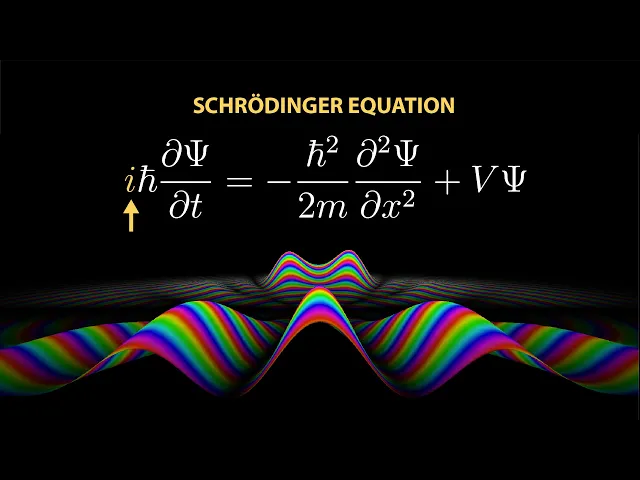
What is the i really doing in Schrödinger's equation?
Welch Labs
0:00 in early 1926 Irwin Schrodinger published
0:03 a series of papers that completely reshaped
0:05 physics over the previous three decades
0:08 it had become increasingly clear that existing
0:10 physics approaches simply didn't work at very small scales the equation
0:15 at the core of shinger papers effectively
0:17 replaced Newton's Second Law at the atomic
0:19 scale describing the behavior of particles
0:22 like electrons incredibly accurately scher's equation
0:25 is very similar to the Heat and wave equations from classical physics
0:30 with one exception the imaginary number I what is the I doing
0:35 here shorting your's equation critically and controversially
0:38 replaces the notion of a particle
0:40 with a wave and says that for a given point in Space
0:44 the value of this matter wave changes in time proportionally to the curvature
0:47 of the wave in space this proportionality makes a ton of sense
0:51 for the heat equation it tells us that for example in regions
0:54 that quickly change from cold to hot to cold the hot area will
0:58 become cooler as the heat spreads out but in Schrodinger's equation the time
1:02 derivative is multiplied by the imaginary number I how does multiplying by I
1:07 turn a heat equation into an incredibly accurate description of matter itself
1:12 imaginary numbers would go into to play a central role in quantum
1:16 physics what makes imaginary numbers so useful in one of our most fundamental
1:20 and successful theories of nature in 1925 Einstein published this paper where
1:26 he referenced a recent PhD thesis from an obscure Frenchman named new Le
1:30 de Bry 20 years before in 1905 Einstein and Max plank famously
1:34 showed that light comes in discret packets that we now call photons
1:38 and that the energy of each photon is related to its frequency
1:41 by Plank's constant in his thesis de Bry showed that if he treated matter
1:45 not as discret particles but instead as waves and extended the plank
1:49 Einstein relation to these matter waves he could accurately predict the behavior
1:53 of the hydrogen atom when Einstein's
1:56 paper reached the physicist Irwin Schrodinger he
1:58 quickly realized that de bry's work was a more elegant and general version
2:01 of his own investigations into guge Theory and became obsessed with the idea
2:06 that matter might actually be a wave after giving a talk under
2:10 Bry matter waves at his home University of Zurich in November sher's colleague
2:14 Peter Dubai remarked that this way of thinking was childish and that if
2:18 matter waves were real there would have to be a matter wave
2:22 equation this comment stuck with schinger and when he left for winter holiday
2:26 in the Swiss Alps a few weeks later he brought along his papers
2:29 and books to work on the problem in his room in the mountains
2:33 shinger sat down and tried to find the wave equation for matter
2:37 shinger began with the classical wave equation and worked to modify it
2:41 to be compatible with de bry's matter wave results in this one-dimensional
2:46 classical wave equation Y is a function of position and time that represents
2:50 the displacement of the wave for example the position of a point
2:54 on a vibrating string above or below its resting position and V
2:57 is the speed of the wave a common approach to solving the classical
3:01 wave equation is to break apart its spatial and time components resulting
3:05 in two new differential equations one that depends only on position and one
3:09 that depends only on time the position equation roughly says that the curvature
3:14 of the wave should be proportional to the negative displacement of the wave
3:18 this makes a lot of sense in our vibrating string example
3:21 a point with high positive displacement corresponds to a high negative curvature
3:25 and vice versa mathematically the position equation says that should be some
3:30 function of X that when differentiated twice is equal to itself times
3:34 some negative constant both s and cosine
3:37 have this property the second derivative
3:39 of s of K* X is equal to minus k^ 2 time the original function sin of KX exactly
3:46 satisfying our differential equation importantly for Schrodinger
3:50 when we fix the ends of our string setting F equal to Z
3:53 at xal 0 and xal L the length of our string only
3:57 very specific values for the constant k will work visually this just
4:01 means that we can fit half of a sine wave between the fixed
4:04 ends of our string or a whole sine wave or a sine
4:07 wave in a half and so on but nothing in between this behavior
4:11 is what gives vibrating strings a very pure tone musically the frequencies
4:16 of vibration are simple multiples
4:18 of the fundamental frequency this Behavior was critical
4:21 for sher's attack plan like the vibrating string the hydrogen atom produces
4:25 energy but only at very specific frequencies however for the the hydrogen atom
4:30 these frequencies are not at simple even spacings scher's Hope was
4:34 that if he modified the classical wave equation using dy's matter wave approach
4:39 the solutions to his new wave
4:40 equation would match the observed emission spectrum
4:43 for hydrogen first switching to the Greek letter s to represent the matter
4:47 wave and rewriting the wave number K in terms of wavelength shinger
4:52 then substituted into bry's formula that relates the wavelength of a matter wave
4:56 to its momentum expressed as mass time velocity the constant term
5:00 in the classical wave equation now depends on the mass of the matter wave
5:04 squared times the velocity of the matter wave squared from classical physics
5:08 kinetic energy is equal to 1 12 mass time velocity squared so we
5:12 can rewrite our numerator as 8 pi^ 2 m* the kinetic energy
5:16 of the wave finally taking the total energy e as the kinetic energy
5:20 plus the potential energy V Shoring your solve for the kinetic energy
5:24 and substitute it the hydrogen atom has one proton and one electron Shing
5:29 your assume that the proton was fixed
5:31 creating an electric potential for the electron
5:33 of the charge of the electron e^ s divided by the distance
5:36 R between the electron and proton atoms are of course three-dimensional so
5:41 we need to expand our spatial derivative to include X Y and Z
5:45 from here schinger needed to find the solution to his matter wave
5:48 equation just as we found earlier that s of KX was a solution
5:51 for the vibrating string the math is of course trickier here referencing
5:56 his mathematics books and with some
5:57 helpful correspondence from the mathematician Herman while
6:00 shinger was able to solve his wave equation for hydrogen like our solution
6:05 to the vibrating string problem where K could only take on very
6:08 specific values shinger showed that the energy term e in his equation
6:12 was also quantized and that the spacing of these energy values approximately
6:17 matched The observed emission spectrum for hydrogen
6:20 shinger submitted his results for publication
6:22 in this paper on January 27th 1926 the response from the scientific
6:27 Community was quick and positive Robert
6:30 Oppenheimer later called Schrodinger's result perhaps
6:32 the most perfect most accurate and most lovely theories that man has discovered
6:37 and the physicist Paul dur remarked
6:39 that Schrodinger's result contains much of physics
6:41 and in principle all of chemistry the orbital electron patterns that you
6:45 may have learned in chemistry class are the solutions to Schrodinger's equation
6:51 now up until this point none of Schrodinger's mathematics required the use
6:54 of imaginary numbers this would change in the summer of 1926 when shinger
6:59 expanded his approach to include systems
7:01 that change over time getting the details
7:05 right on complex topics like this requires a ton of research here's
7:09 all the books I reviewed when writing the script for this video spending
7:12 this amount of research time would not be possible without the support
7:15 of this video sponsor private internet access please take a minute to consider
7:20 if Pia might be a good fit for you it really helps
7:23 me out there are many good reasons to use a VPN and Pia
7:26 is the VPN that I use personally Pia takes your privacy really
7:31 seriously they don't keep any logs of their users activity and this no
7:35 log policy has held up in court and been independently audited I
7:38 was impressed to learn from the audits that this even includes your typical
7:41 error and debug logs that could in some cases contain user data
7:45 when you connect to a VPN like Pia you're effectively using the internet
7:49 from a Pia server of your choice Pia encrypts your traffic between
7:53 your machine and the Pia server and hides your IP address this layer
7:58 of privacy has a broad range of uses from keeping your data
8:01 more secure when using public Wi-Fi networks to not allowing your internet
8:05 service provider at home to track and potentially sell your browsing data
8:09 being able to use the internet from any of Pia's servers in 911
8:12 countries and all 50 US states also allows you to get around
8:16 Regional restrictions I find this especially
8:18 useful when traveling internationally I can hop
8:21 on a Pia server back home and quickly access the right version
8:24 of Amazon and other sites and get around region blocking to access the same
8:28 streaming content than I normally could my wife and I are planning
8:31 a trip to Italy next year we love catching up on shows when
8:34 we're vacationing don't judge us but we still haven't made it all
8:37 the way through Game of Thrones however it's not available in Italy with Pia
8:41 I know I can just hop on a US server and watch
8:44 this also works for other streaming services like Netflix using the URL pn.
8:49 cwelch laabs you can get 83% off of Pia that comes
8:53 out to Just Around $2 a month plus an additional 4
8:57 months free all with a 30-day money back back guarantee if
9:00 you're looking to either start using a VPN or to switch VPN
9:03 providers this is a great deal and also helps me continue
9:06 making great content you'll also find the url in the description
9:09 below huge thank you to Pia for sponsoring this video and helping
9:13 make all this research possible now back to exactly how imaginary
9:17 numbers snuck into Schrodinger's equation
9:20 in Schrodinger's initial approach he started
9:22 with the part of the classical wave equation that only depends
9:25 on position to completely solve our vibrating string example we have
9:29 to multiply our spatial Solutions F by our Solutions in time G
9:33 to compute the final position y of each point on the string
9:36 as a function of position and time in the classical wave
9:39 equation the spatial and time components are the same differential equation
9:44 just with different constants so the Solutions in time are also just
9:47 s and cosine waves a helpful mathematical trick used by physicists
9:51 including schinger is to express these Solutions using complex exponentials so
9:57 instead of writing the cosine of Omega* t is a solution
10:00 we instead write e to the power of I* Omega T
10:04 by oil's formula the real part of e to the power
10:07 of I* Omega T is exactly equal to our original cosine solution
10:12 differentiating complex exponentials is simple we just drop down the exponent
10:17 so the first time derivative of e to the I Omega T
10:20 is just I Omega times our original function and our second
10:24 derivative is just i^ 2* Omega 2* our original function this shows
10:28 that e to the I Omega T is a valid solution
10:31 to our differential equation importantly up until this point in physics
10:36 although complex numbers were used frequently like this in computation
10:40 the final answer was always just the real part of the result
10:43 and everything physical in the problem like the displacement of the string
10:47 corresponded to the real part of complex exponentials to expand his equation
10:52 into the time domain shinger started with a complex exponential representation
10:56 of the wave function as usual assuming he would be able
10:59 to take the real part once he was done calculating since
11:02 the energy of a matter wave is proportional to its frequency
11:05 by the plank Einstein relation we can rewrite this complex exponential
11:09 in terms of the total energy e of the wave differentiating we
11:13 can show that the energy of the wave times the wave function
11:16 is proportional to I times the derivative of the wave function now
11:20 returning to Schrodinger's time independent equation we can isolate e* the wave
11:25 function and substitute obtaining the final
11:28 modern version of the the Schrodinger
11:30 equation Schrodinger found this path early on but hesitated to publish
11:34 it writing to the physicist Hendrick Lorent what is unpleasant
11:38 here and indeed directly to be objected to is the use
11:41 of complex numbers Sai is surely fundamentally a real function the I
11:48 explicitly showing up next to the time derivative in shing's equation
11:51 means that purely real wave functions will not work the wave function
11:55 itself has to be made from complex numbers as we'll see
11:59 the complex wave function and multiplication of the time derivative by I
12:03 turned out to be a feature not a bug it allows
12:07 Shing your's equation to elegantly describe the behavior of matter let's
12:11 consider how shinger equation applies to a free particle in one
12:14 dimension such as an electron far away from any other particles
12:18 in this case our potential energy V is zero let's temporarily
12:22 combine our constants together into a single constant that we'll call C
12:26 and set it equal to 0.1 and assume a very simple
12:29 starting configuration for the wave function with a value of one
12:33 surrounded by zeros we can estimate the second spatial derivative
12:36 at our central location numerically by adding
12:39 together the adjacent wave function values
12:41 and subtracting two times the wave function at our central location
12:45 so 0- 2+ 0= -2 we can keep track of each part
12:50 of shing's equation over time using a table at time T equals
12:54 0 we set our initial wave function value to one and we
12:57 just estimated our second spatial derivative to be minus 2
13:01 from here all that's left to do is to compute DC DT
13:04 using shing's equation multiplying our estimate
13:08 for the spatial derivative by 0.1*
13:10 I we compute a complex number with zero for the real
13:14 part and minus 0.2 for the imaginary part now shorting your's
13:18 equation says that this value is equal to how much the wave
13:22 function will change in time again taking a numerical approximation approach
13:27 we can add DDT to to our current value of s
13:30 to get the value of s at our next time step
13:34 so our wave function now equals 1us 0.2 I on the complex
13:39 plane taking the second spatial derivative was equivalent to multiplying s
13:43 by minus 2 which flips it across the origin on the complex
13:46 plane we then multiplied by 0.1 scaling our result now
13:52 importantly before we add this result to update our current value
13:55 of s sher's equation tells us to multiply by I which
13:59 on the complex plane rotates our vector by 90° to the left
14:04 we then add this Vector to our current value of s
14:07 to compute the next value of s repeating this process we
14:12 estimate the second spatial derivative of our new wave function which
14:15 again flips s across the origin we again scale and rotate
14:19 by 90° and update sigh with our new value of D
14:23 SI DT after a few more steps a clear Trend emerges
14:28 our spatial d derivatives are pushing our wave function around the complex
14:32 plane on a curved or circular path in the classical wave function
14:36 we can think of the spatial curvature as pushing the wave
14:39 up and down in time while in Schrodinger's equation the spatial
14:43 curvature of the wave is pushing the complex wave function
14:45 in circles around the complex plane we can get a broader sense
14:50 for this Behavior over space and time by considering a simple
14:53 solution to sher's equation known as a plane wave this wave function
14:57 is a complex exponential in terms of both position and time visually
15:02 This Plane wave looks like a real cosine and imaginary sign traveling
15:05 to the right as time advances thinking of each point
15:09 in our one-dimensional space as a little complex plane the real cosine part
15:13 of our wave moves left and right and the imaginary sign
15:16 part of our wave moves up and down taken together these components
15:20 form a complex number that moves around the unit circle
15:23 As Time advances just as we saw numerically differentiating our plane wave
15:29 twice with respect to position gets us minus k^ 2times our original
15:33 plane wave sign so just as we saw numerically this spatial
15:37 derivative is directly across the origin from our wave function value
15:40 on the complex plane and its magnitude depends on the spatial
15:43 frequency K of our plane wave remember that sher's equation tells
15:48 us to multiply this value by I to get DC DT which
15:52 rotates our spatial derivative by 90° and it's this Vector
15:56 that effectively pushes our wave function around the complex plane larger values
16:01 of K mean our plane wave oscillates more rapidly in space increasing
16:05 the curvature of the wave function and increasing the second derivative which
16:09 following shinger equation pushes our wave function around the complex plane
16:13 faster in time plugging in the full plane wave into sher's equation
16:19 we can show that the plane wave is a solution and recover
16:21 the exact relationship between spatial frequency K and frequency and time
16:26 Omega this is the relationship that shinger started with from De
16:29 bry's matter waves so our plane wave looks like spirals
16:33 on a series of complex planes and shing's equation connects the behavior
16:37 of these spirals in space and time now how are these complex
16:42 valued matter waves at all a reasonable description of physical particles
16:46 like electrons aside from including the imaginary number I another important
16:51 feature of Shing your's equation is that the wave function and its
16:55 derivatives are not raised to any powers this makes sure equation
16:59 linear it means that if we have two wave functions let's
17:02 call them s 1 and S 2 if we add them together
17:06 s 1 plus S 2 is also a valid solution to shing's
17:10 equation this means that shing's equation will work for any combination
17:14 of plain waves for example if we had an identical second
17:18 spiral wave function but shifted in Space by half of a wavelength
17:22 the sum of these wave functions would exactly cancel out resulting
17:26 in an overall wave function that equals zero everywhere the ability
17:30 of wave functions to interfere like this is critical to the wav
17:33 likee properties of matter we see in situations like the double
17:36 slit experiment firing a stream of electrons through a single narrow
17:41 slit into a detector we see a smooth distribution of detections where
17:46 the most likely place for an electron to land is directly
17:48 behind the slit with this probability dropping off smoothly as we
17:52 move further away from the slit now if electrons were simply
17:56 particles when we opened a second slit we would expect the distributions
18:00 for the first and second slit to just add together resulting
18:03 in an overall detection pattern that looks very similar to the pattern
18:06 for a single slit however in practice this is not the behavior
18:11 we see as first demonstrated with electrons by Davidson and germer
18:15 in 1927 we instead see a wavy pattern where electrons almost
18:20 never arrive at certain locations on the detector we can make sense
18:24 of this strange behavior of matter by using Schrodinger's matter waves
18:28 we'll repres the electron as a little packet of waves this little
18:32 packet is also a valid solution to shing's equation and we'll
18:35 switch from thinking in one spatial Dimension to two in two
18:39 Dimensions it's more difficult to think of each point in space
18:42 as a little complex plane so let's switch to visualizing the amplitude
18:46 of our complex wave function as the height of our surface
18:49 and we'll represent the angle of our complex number using the color
18:52 of the surface if we close one of our slits
18:55 and pass our matter wave through we see the matter wave sprad
18:58 spr out evenly after passing through the slit running our experiment
19:02 again with the other slit we see similar results now before we
19:07 run our experiment with both slits open let's have a closer
19:10 look at how our two patterns line up notice that the amplitudes
19:14 of our wave functions are smooth curves as we expect from particle
19:18 like Behavior but the angles of the complex numbers that make
19:21 up our wave function change across the surface of our detector
19:25 and the colors from one experiment to the other do not
19:27 always line up meaning that our matter waves are out
19:30 of phase at certain locations this means that when we open up
19:34 both slits we expect destructive interference
19:36 at these locations running our experiment
19:40 with both slits open this is exactly the behavior we see
19:43 with the electrons matter wave canceling itself out at these locations
19:47 on the detector matching the behavior we see experimentally so the angles
19:51 of our complex numbers in our wave function also known
19:54 as the phase store important information about the matter wave of the electron
19:59 causing the wave to interfere with itself destructively at locations
20:02 in space consistent with experimental results a few days after shinger submitted
20:07 the final paper in his groundbreaking series The physicist Max Bourne
20:11 submitted this paper including what today we call the borne rule which
20:15 with some caveats states that the square of the amplitude
20:18 of the wave function is equal to the probability of finding the particle
20:21 at a certain location in space following the borne rule
20:25 the amplitude of the wave function allows us to figure out where
20:28 the particle is likely to be in space while the angle
20:31 of the complex wave function captures how matter waves interfere with themselves
20:35 and other matter waves there are other ways we can accomplish
20:39 this Behavior mathematically but complex numbers
20:41 are very convenient here and it's
20:43 interesting that imaginary numbers fall out of the classical wave equation
20:47 when we combine it with de bry's simple matter wave relationship
20:50 as Schrodinger did if we place our 2D wave packet
20:54 in a box the potential energy term in shing's equation will cause it
20:57 to reflect off the borders and interfere with itself resulting
21:01 in a set of discret fixed wave patterns this behavior is analogous
21:06 to the quantized energy levels Shing are found when applying his equation
21:09 to the hydrogen atom in three-dimensional space it's remarkable that the same
21:14 complex valued wave function can describe the behavior of a free
21:17 electron in the double slit experiment and the quantitized energy levels we
21:20 see for bound electrons in atoms years later in a lecture
21:25 in 1970 the great Quantum physicist Paul dur had this to say
21:29 about the wave function so if one asks what is
21:32 the main feature of quantum mechanics I feel inclined now to say
21:36 that it is the existence of probability amplitudes which underly all
21:40 Atomic processes now a probability amplitude is related to experiment but only
21:46 partially the square of its modulus is something we can observe
21:50 that is the probability which the experimental people get but besides
21:54 that there is a phase a number of modulus Unity which we
21:57 can modify without affecting the square of the modulus and this phase
22:01 is all important because it is the source of all interference
22:05 phenomena but its physical significance is obscure so the Real Genius
22:09 of Heisenberg and Schrodinger you might say was the discovery
22:13 of the existence of probability amplitudes
22:15 containing this phase quantity which is
22:18 very well hidden in nature and it is because it was
22:21 so well hidden that people hadn't thought of quantum mechanics much earlier
22:26 the phase durak is referring to here is the angle
22:29 of the complex numbers that make up the wave function imaginary and complex
22:33 numbers give us an elegant tool for representing and working
22:36 with this phase which is an integral part of how we understand
22:39 matter to work on these small scales the rise of quantum
22:43 mechanics is such an astounding chapter in the story of imaginary numbers
22:47 the physicist Freeman Dyson writes that imaginary numbers showing up
22:50 in wave mechanics is one of the most profound jokes of Nature
22:54 and that the square root of minus1 in Shing your's equation
22:57 means that nature works with complex numbers and not real numbers there's
23:01 some debate to be had about just how essential complex numbers
23:04 are here shinger himself seems to have never fully accepted a truly
23:08 complex valued wave function although he would go on to use
23:11 it in his work and Communications what's absolutely all inspiring to me
23:16 is that the numbers we rejected for so long as impossible
23:19 or imaginary ended up showing up so profoundly in one
23:23 of our deepest and most accurate theories of nature if you
23:28 liked this video I really think you'll enjoy the shringer equation chapter
23:32 in my imaginary numbers book the figures came out great
23:36 from the detailed numerical walkthrough to the plane wave analysis to the wave
23:39 packets and double slit experiment I wasn't sure how all
23:42 these detailed animations would translate to book format it took some trial
23:46 and error but I'm really happy with the results I love
23:49 video but I always struggle with how much detail to include
23:52 and how fast or slow to move no matter what I
23:56 know that my videos will be too fast and lose some people
23:58 and be too slow and bore others one thing I love
24:02 about reading books is being able to go at the exact right
24:04 pace for myself so whether you're an expert looking for a different
24:07 angle on a topic you know well or just picking up
24:10 this stuff for school work or fun I really think you'll
24:13 enjoy the book there's also exercises including a numerical walkthrough of Shing
24:18 your's equation that you can compute your way through yourself huge
24:21 thanks to everyone who pre-order the book it'll be shipping out
24:24 in just a few weeks over the past few months I've
24:26 landed on what I think is a really nice type setting
24:29 with extra wide margins for notes and figures and I found
24:32 a great book printer that prints on this really nice heavyweight paper
24:35 with great color and fine detail reproduction the book starts
24:39 with an introduction to imaginary numbers and works up to remon surfaces Oilers
24:42 formula and finally Schrodinger's equation
24:45 every chapter includes exercises with Solutions
24:47 in the back my initial print run is 70% sold out order
24:51 yours today to get it in time for the holidays it
24:54 also makes a great gift finally thanks to everyone who has reached
24:57 out about internet national shipping I'm still only able to offer
25:00 us shipping right now but I'm planning to expand internationally next year