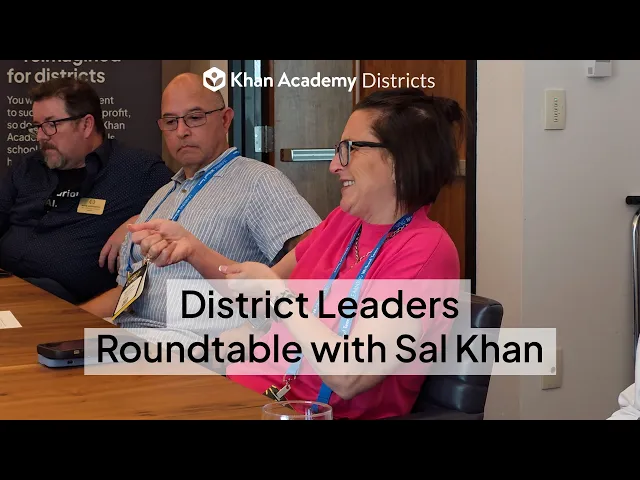
Dismantling the “Teach to the Test” Mindset | Sal Khan & CA District Leaders
Khan Academy
0:00 How do we use educational technology?
0:03 How do we use innovation to then give teachers
0:06 permission to dismantle that mindset of teaching to the test?
0:12 Because I think once we dismantle the mindset of teaching
0:15 to the test and teaching in that silo-based thinking of education,
0:20 then it's gonna give teachers the agency
0:23 to then just integrate everything into the core curriculum.
0:27 And we're gonna have a new way of thinking.
0:30 And a new way of teaching.
0:31 And that's what I think is gonna be a big shift that needs to happen
0:34 because we've been teaching the same way forever
0:36 and ever and ever and ever and ever.
0:38 Where do you think the teachers are getting that signal
0:40 to like get narrow and teach to the test?
0:43 Is that historically the leadership's been
0:45 doing it or they just implicitly assume?
0:48 I think there's been so much pressure on school districts to raise test scores.
0:57 That's how we're evaluated.
0:59 In the dashboard.
1:00 And I think there's been maybe a lack of innovative leaders, maybe.
1:08 I know Amy, you're such an innovative leader that you give
1:11 that agency to your leaders to say it's okay to be innovative,
1:15 but not everybody has that because they're scared at what they're going to get.
1:20 And maybe they're afraid at giving or maybe pulling...
1:26 They're so tight with the ranks that there's, you know, if they give a little,
1:30 they might not get what they're going to, you know what I mean?
1:34 So I think that we're afraid of loosening the ranks--
1:37 And your thesis is if you actually lose it a little bit,
1:40 give a little more autonomy, that your scores won't actually suffer.
1:42 In fact, it might improve because we're a little more engaged.
1:45 Yes.
1:46 Yes.
1:46 And the cognitive demand of that type of work is higher as well.
1:48 So the lab measure would hopefully reflect that.
1:52 But I don't think we're training our teachers to do that because we are...
1:59 We're just not there yet, right?
2:00 We're not training our teachers because we're training
2:02 our teachers to do the test right now.
2:05 So how do we fix that?
2:06 Well, we're still training our teachers to do best first instruction.
2:08 And like this one size fits all, I hold all of the knowledge and it's my job
2:14 to give it to you in one way, to everyone.
2:17 I mean, the philosophy behind all that is just really...
2:21 Antiquated- Antiquated, yeah.
2:23 I feel like education knows it doesn't work, but, I mean,
2:27 am I very limited two years of experience behind the curtain.
2:31 It just feels like there's so many other
2:34 pressures between unions and curriculum and textbook vendors.
2:40 And there's so many other external drivers
2:44 that don't allow for change to happen.
2:47 So there's a recognition that it's not working, but...
2:51 Might I add too, we're a profession of apprenticeship.
2:53 So we've seen somebody do our job for 16 years prior to now having our job.
2:58 So I put forward potentially models of excellence.
3:02 How often are teachers exposed to these integrated learning opportunities,
3:07 with a high cognitive demand, and have real world relevance.
3:11 I've seen somebody doing my job for 16 years,
3:14 it's going to be a challenge to adjust,
3:18 and what are the structures in our system that provide the support?
3:23 So even as a teacher,
3:24 if I recognize all I have in my toolbox is what I was exposed to prior,
3:28 what access do I have to new tools and how to use those?
3:32 Well, that, to me, that causes an equity issue, right?
3:34 Because if the question is what access do I have of the tools,
3:38 you're automatically assuming that it's the teacher's role to be
3:41 the primary person that gives the access to the students.
3:45 And so the other teacher that really likes that tech,
3:47 and likes Khanmigo and is into it,
3:49 then those students are gonna benefit from it,
3:51 which is a very small percentage of the total teachers in the district.
3:56 So if I'm unlucky enough to have a teacher
3:59 who doesn't like that, who is afraid of AI,
4:02 and won't use Khanmigo, then it's an equity problem.
4:04 I am now, because I'm dependent upon a teacher to let me use it,
4:08 I don't get the benefit from the tech.
4:11 And how sad for that.
4:12 And how sad for that.
4:13 Right?
4:13 I mean, that's the thing about what I feel like we've
4:16 seen across the AI and tech vendors is it's all so still,
4:20 no model teacher centered.
4:22 All the control lies with the teacher,
4:23 and until we somehow miraculously give PD to every single teacher to show
4:27 them how amazing it will be if they could differentiate with AI,
4:31 and personalize with AI, our kids are suffering as a result because
4:35 we're just aren't able to upskill them that quickly.
4:39 And we could provide PD to a lot of teachers,
4:41 but if they're still hesitant, are they going to use it?
4:44 So how do we change that?
4:46 Right, because PD's not sufficient to change behavior,
4:48 you have to do the behavior,
4:50 lifetime of behavior, adjust behavior, see the behavior model.
4:54 Behavior change is complex, right?
4:56 So simple professional development.
4:58 We're almost doing what we're asking teachers not to do.
5:01 We're professing and then asking them to apply or mimic,
5:04 which, how well does that work?