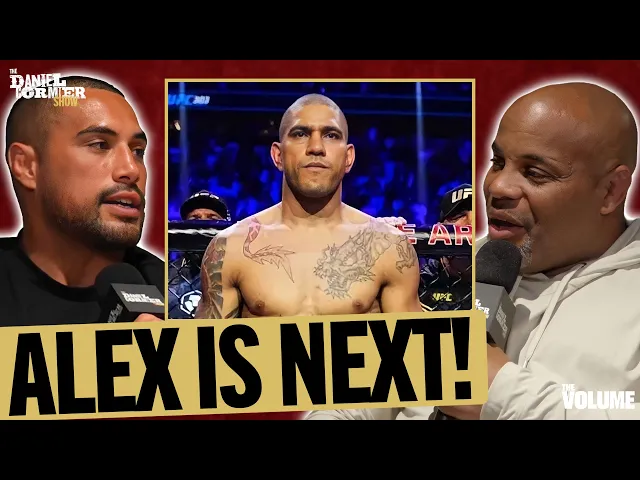
Carlos Ulberg CALLS OUT Alex Pereira after BEATING Jiri Prochazka for UFC belt | Daniel Cormier Show
Daniel Cormier
0:00 Daniel, you once said that you were going to be
0:11 the best in the world if you're going to do this.
0:13 Now that you are, what's next?
0:15 Is there a certain person you'd like to see stare across that octagon from you?
0:20 Is there this desire to see Pereira there as the guy that people Well, he's not,
0:26 you know, like you said,
0:26 he might not be the world champ because Pereira's out there.
0:29 Is there a desire for you to see that?
0:31 Is there a world where we see Carlos Goldberg at heavyweight?
0:34 Like what's next for you uh as you, you know, get on this journey to recovery?
0:38 Yeah, I think uh I think definitely Pitt is someone who
0:41 you'd want to fight cuz he's he's the man right now,
0:43 you know, and if you can if you can beat that guy, then you're the man.
0:46 So, uh he's definitely one guy that that I'd
0:50 love to to fight and I respect the guy.
0:52 I think he's he's done great in what he's done and that's why,
0:54 you know, I want to fight him.
0:56 Um, and then there's other guys in the division
0:58 that I think are pretty good, too.
1:00 So, we'll see how this thing goes.
1:02 I think, you know, the the overall thing is that it's
1:05 it's it's on a positive where we're going to I
1:08 think it's going to be a quick recovery a lot
1:11 faster than what normal ACRs are going to be, I think.
1:13 And I I think it's just more mentality
1:15 and from here and and then how I look after
1:17 the the rehab that's that that I get at the PI
1:20 and then how I deal with it going back home.
1:22 So, I'll be here in Vegas for a couple weeks,
1:25 then I go home and do the same thing.
1:27 And uh I think and I believe that it's going
1:30 to heal a lot faster than what most ACL injuries are.
1:33 Carlos, you are now the UFC champion.
1:35 I saw you at Wrestlemania.
1:37 You're on the first row.
1:38 You got involved in the show.
1:40 Was that stage?
1:41 Don't lie, Carlos.
1:42 Was that stage?
1:43 Did they call you before and go, "Hey, CM Punk's going to take your Olaf."
1:46 Oh, no way, man.
1:47 Honestly, man, I just um when he when he come to me,
1:51 he looked at me and I thought, "Ah,
1:52 he's going to do something to me cuz he looked me right in the eye
1:54 and then and then I thought he was just going to grab me like this." So,
1:58 he grabbed he I think he grabbed this and then
2:00 he he pulled the fella off and I was like, "Ah, yeah." But I thought, "Okay,
2:04 this could be a good opportunity." Like, maybe maybe take it.
2:07 I know Roman's going to kick your ass.
2:09 I know.
2:10 I know that Roman Reigns I just felt like because the whole way
2:13 that it was swinging it was like uh Roman Reigns was was was beating
2:17 him and then and then and then uh CM Punk was getting him
2:21 and then I felt like there was going to be a switch after that.
2:23 So I was like okay it's going to come back.
2:25 It's going to come back.
2:26 So I just left it at that and and and um and even even when
2:29 we were watching I was like a he's going to he's going to kick his ass.
2:32 He looked directly at you from inside the ring.
2:36 Yeah.
2:36 And it's like he recognized you.
2:37 Oh, Carlos Loberg, I'm going to go grab his Zulfala.
2:40 And then he runs out there and he grabs it.
2:42 And I was like, "Oh my GOD,
2:43 I ALMOST REACHED OUT TO GRAB IT FOR YOU TO TRY TO STOP HIM." It was crazy.
2:47 Yeah, it was crazy.
2:48 Was so cool, man.
2:49 Um, at the same time, I was just like, "Wo,
2:51 this is this is happening." Because it was the first time
2:54 I've been to a Wrestlemania or any kind of wrestling match,
2:57 and I was just in awe the whole time.
2:59 And when it he made his way, I was more just like,
3:02 "Oh, star struck like what's happening?" So, um, yeah,
3:06 I kind of just let it all be and it's such Yeah,
3:08 it's cool that that I was able to just
3:10 be there and and and experience that whole that show.
3:15 Not only be there or be there like that, you know,
3:18 you got to keep that belt because life you can't go back rows now.
3:22 It would be hard to go back rows after watching it the way it was, right?
3:26 100%.
3:26 Yeah, you have to.
3:27 And and you got to do what it takes to make sure you keep that belt.
3:30 Yeah.
3:31 Yeah.
3:31 You seem to be on the right path to do that.
3:33 Carlos, last question.
3:35 I ask everybody that's in here, same thing.
3:38 When it's all said and done,
3:39 what do you want people to remember about Carlos
3:43 Alberg from your fans to your children to your life?
3:47 Like, what do you want people to remember about Carlos Alberg?
3:55 Uh, I I have three sons.
3:59 I have three sons and I just want them to be like that's my dad.
4:07 That's you know what I mean?
4:08 So it's it's more about it's more about
4:10 my sons their sons their sons and their sons
4:13 and daughters and just passing that on and being that being that God for them.
4:19 Yeah.
4:19 Yeah.
4:21 I think people will remember that you did it your way.
4:24 I think people will remember that you are a guy
4:26 that carried a lot of expectation because of where you came from.
4:32 I think people will remember that you were a guy that did
4:36 it the way that you had to kickboxing and became a world champion.
4:40 There's a lot to your story that most people may not know.
4:43 So, I want to go all the way back to Auckland, right?
4:46 New Zealand, a place where people are known for fighting.
4:50 What about your upbringing makes you so different?
4:54 Talk to me about what growing up in Auckland was like.
4:57 Uh, growing up in Oakuckland, um, man, uh, what I say it's, uh, well,
5:04 I grew up through foster care and boys homes and it was always like
5:09 the where the part that I grew up in was just a lot of um,
5:15 we got into a lot of mischief.
5:16 It was a lot of shift and uh we wanted some some some form of
5:21 uh outlet to to I guess just to release what it what it was for us.
5:28 How did that how did that cuz I was going to bring that up obviously you
5:31 know when everybody comes up in foster care
5:34 uh that's a massive part of their story.
5:37 What do you recall about that time?
5:39 Like I know you said you guys were in a lot of mischief,
5:41 but how did you end up in that system?
5:46 Uh so from the age of four up to about 13 years old,
5:50 I was just going back and forth through different um different families,
5:54 different different uh foster carees, boys homes and stuff like that.
5:58 Man, I just like look at the way I look at it now is I I was able to adjust
6:03 to different families living in different hair homes and to see
6:07 how one particular family would live compared to another family.
6:11 So you might live with a family that is quite well off and teach you manners,
6:16 teach you this and that and then maybe like a few months later
6:19 you might move into another place that has the total opposite of that.
6:22 So you were in different um you were just
6:25 in a contrast of life and and and that's
6:28 how I I viewed my life growing up and it
6:31 was just that constant for the for the years.
6:34 Carlos was there a time where when you were going
6:37 through that you like your parents like what happened there?
6:41 Do you do you remember?
6:42 I still have a like relationship with my parents at the time,
6:44 but um you know with the New Zealand system and everything,
6:46 it's just uh I think they just found that it was better for me to be
6:50 in in in the in the um in the system and growing up through the social welfare.
6:57 Uh so yeah, I mean like uh as a kid, you know,
7:01 as a kid growing up like that, you do feel sorry for yourself and you you know,
7:04 you cry every every night, cry yourself to sleep,
7:06 but when you get older and you realize,
7:08 oh wow, this is was was more of a blessing than anything else.
7:11 Do you think that your parents made
7:12 the decision because they were trying to protect you?
7:15 Uh, it could be.
7:16 Yeah.
7:16 I mean, like, it was more the Yeah,
7:18 I guess it was more just the um it was better off for me to be in this.
7:25 I think the with the uh Yeah, it was better off for me to be in this in this um
7:32 in in this system that we had there
7:34 because of the trouble that I got myself into.
7:36 It was You were hard for your parents to raise.
7:38 I was hard, man.
7:39 I was Yeah, definitely.
7:40 Yeah.
7:40 You know, I uh you talk about the welfare system and I remember
7:45 my parents were you they were we were using some of that the food
7:50 stamps and all those things to try to live and I remember
7:52 my parents made a choice to try to do it without it, right?
7:55 And it really did uh it really did help me, right?
8:00 Sometimes parents have to make decisions for us
8:03 that we don't necessarily recognize because
8:06 when we stop taking the government assistance,
8:08 it got a little harder and things got a little tighter.
8:12 But then I understand today as a man and being the person
8:15 that I am and my willingness to work for everything that I have,
8:19 but it was the right decision cuz they showed me
8:20 that I could try to do it on my own.
8:22 And possibly that's what was happening with you.
8:25 But I can't imagine as a young boy the feeling of God man this uh this is tough.
8:33 It was tough but at times I was I felt like I was in um um
8:36 you went with some rich people.
8:38 Yeah.
8:38 You Yeah.
8:39 Like different homes.
8:40 You'd have like rich families.
8:41 You'd stay with rich families but then you which taught you different manners,
8:45 different um views of life, different you know waking up and having
8:49 to fold your clothes or things like that.
8:50 So it just taught you different um things in life right?
8:54 whereas some other families were just and it made me understand
8:58 that not everyone's going to every family is going to be the same.
9:01 Everyone's going to have their own flaws and their own um amazing life.
9:06 But but um I think that's what's built me
9:09 into what I am today and my belief system.