The Math Exam That Stumps Literal Geniuses
Gohar Khan
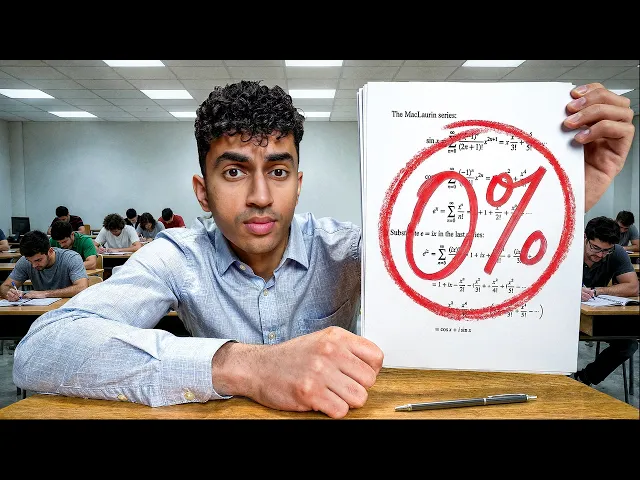
0:00 This right here is the Putinham, one of the hardest math exams in the world.
0:03 The median score on this exam is a two
0:06 out of 120 and the average score an eight.
0:10 The Putnham is a math competition that 4,000 college
0:13 students from across the US and Canada take each year.
0:15 They have 6 hours to answer 12 problems in categories such as calculus,
0:19 number theory, and linear algebra.
0:21 The exam is known for its deceivingly hard questions.
0:24 Although some seem straightforward,
0:26 most of them require an exceptional degree of intuition and creativity.
0:30 The top five individual scorers are known as the Putinham Fellows,
0:33 a lifelong title in the math community.
0:36 And the school with the number one team wins $25,000.
0:39 In recent years, the school that has dominated
0:41 the rankings is none other than my alma mater, MIT.
0:45 Not only did they place first every year from 2024 to 2021,
0:49 but it also had all five Putnham fellows.
0:52 So, who are these students crushing the Putinham?
0:54 How do they train?
0:56 And most importantly, what makes the exam so difficult?
0:59 Right now, we're in building 2, which is home to the MIT math department.
1:03 We're soon about to head up to meet with Dr.
1:04 Henry Conn, a mathematician specializing in discrete math,
1:08 coding theory, and combinatorics.
1:10 In other words, he's brilliant, which makes him the perfect fit for running
1:13 a course known as 18A34 or the Putinham Seminar.
1:17 This course trains firstear undergrads for the platinum competition,
1:20 but it's not open to everyone.
1:21 This course is only intended for those with previous
1:24 competition experience and we're about to get an inside look.
1:27 So, okay, what we're going to be talking about today is number theory,
1:31 and this is something that doesn't come up that much on the exam.
1:34 You don't need to have taken a course
1:36 in number theory in order to do these problems.
1:39 As Professor Cohen delivers today's lesson, I see students scribbling notes,
1:43 collaborating on problems, and asking each other questions.
1:46 Meanwhile, I'm just in the back wondering what all the squiggles mean.
1:48 But the students in this room know a thing or two about tricky math problems.
1:53 So I did like the AMC Amy.
1:55 I did USAMO as well and then also
1:58 some smaller math competitions like statewide on the side.
2:00 I did EGMO which is the European girls math olympiad
2:04 and also MIMO which is the middle European mathematical olympiad.
2:08 I did the IMO for 2 years and now it's
2:12 like the natural college version of everything that I've done before.
2:16 And then if you don't mind me asking, how did he perform in the IMO?
2:20 I got two gold medals.
2:22 These are freshmen taking the Putinham for the first time tomorrow.
2:25 Yet, they don't seem that nervous at all.
2:27 Maybe it's because of all the insane
2:29 practice they've gotten through the seminar.
2:31 So, it's a bunch of problems, like usually 40 or something.
2:33 So, we solve like maybe five of those on our own,
2:36 and then we write up solutions for a few of them, and then on Wednesdays,
2:39 we have an hour where we each present a problem that we really liked.
2:42 But what does a Putin problem actually look like?
2:44 The thing is, they're hard.
2:46 If you sort of take a look at the platinum and say, "Oh,
2:48 yeah, I can solve all 12 of these problems quickly, you're deluding yourself.
2:53 And if your first attempt ends up in failure,
2:57 it doesn't mean you're not cut out to be a mathematician.
3:00 I mean, it's a skill that you develop over time."
3:03 Unlike many math competitions which test what you know,
3:05 the Putinham tests how you think.
3:08 I did a lot of math competitions in high school as well,
3:11 but I think the Putinham is just different.
3:13 like you have to think very deeply for them.
3:16 Students get six hours to answer 12 questions worth 10 points each.
3:20 The questions span topics such as algebra,
3:22 number theory, combinatorics, geometry, and real analysis.
3:26 Simple stuff, you know.
3:27 The exam is split across two sessions,
3:29 session A and session B with questions A6 and B6 being notoriously difficult.
3:35 The tricky part about the exam is
3:37 that students can't brute force these problems.
3:39 Each one requires a creative almost unexpected insight.
3:43 I was on the committee that writes the problems from 2014 to 2016.
3:48 Part of the thing is you want the problems
3:51 to be different from what people have seen before.
3:55 In 2022, um I saw problem B5,
3:58 which is like a problem about like combinatorics and probability.
4:01 My solution involved like some like integration.
4:04 So it's like very unexpected and I I'm glad I was able to pull that off.
4:08 This is Mark, a TA for the Putinham seminar.
4:11 The Putinham problem he mentioned is this one right here.
4:13 Pause to take a look.
4:15 Wow, you paused for that long.
4:16 Well, I don't blame you.
4:18 So, let's break down what this question asks in simpler terms.
4:21 Let's say you have a handful of unfair coins.
4:23 They're weighted so they mostly land on tails and rarely land on heads.
4:27 The twist is that you can write any number you want on these coins.
4:30 A five on the first, a -10 on the second, a th00and on the third, and so on.
4:35 You then flip all the coins at once and add
4:38 up all the numbers on the coins that come up heads.
4:40 The question here is how rare does heads have to be
4:44 so that no matter what numbers you write on the coins,
4:47 the most likely final score is zero.
4:50 Now, if you're stumped, don't worry because roughly 15 out of 3,400
4:54 test takers received full points on this question.
4:57 The fact that Mark was able to discover a calculus-based approach
5:00 to this problem is incredibly impressive
5:03 considering the official solution has zero calculus.
5:06 I think the most important thing is that like
5:08 look for like small bits of the problems.
5:11 For example, like if a problem has small cases you
5:13 can play with, you can just like try to play with.
5:15 If the problem ask you for the answer,
5:17 try to guess what the answer look like before attempting to prove it.
5:20 That will be like helpful.
5:22 Persistence is really definitely necessary because a lot of these problems
5:25 like the Putinham style problems you'll try lots of different techniques
5:28 and like none of them work and maybe it's like you
5:31 know the fifth strategy you try is the one that works.
5:33 So it's important to just keep trying strategies
5:36 and not getting discouraged because a lot of these problems
5:39 the solution kind of hinges on making some clever connection
5:42 between one topic and another that doesn't initially look related.
5:45 But also it happens very often that I can kind of like dig into my mind
5:50 and find something that's similar and just have
5:52 a general idea and which direction to start,
5:55 what to try cuz we have a lot of tools.
5:57 So sometimes it reminds me of one of them and I just try it.
6:00 And once you see like one path, you get this like jolt of like understanding
6:05 the whole thing and that feels really nice.
6:09 Speaking of having the right tools in your arsenal,
6:11 let me tell you about the sponsor of this video, Manis AI.
6:14 Manis is the world's first general AI agent.
6:17 And I want to be clear about what that means.
6:19 It's not a chatbot.
6:20 It doesn't just give you instructions.
6:22 It actually does the work.
6:24 You give it a goal and it autonomously plans your steps,
6:27 organizes your tasks, tracks the deadlines, and hands you a finished output.
6:31 So, watch this.
6:32 I'm going to type in I'm a college student juggling five classes,
6:36 a research project, and three club commitments.
6:38 Build me a dashboard to track everything.
6:41 And just like that, Manis gets to work.
6:43 It's not asking a dozen follow-up questions.
6:46 It's planning, building,
6:47 and within a few minutes gets back to me with a fully functional dashboard.
6:51 This has deadlines, reminders, and everything in one place.
6:54 Now, that's the difference between a tool that just talks and one that delivers.
6:58 I've been genuinely impressed by how far it goes without me having to guide it.
7:02 It's the kind of tool I could have used in college, especially around finals.
7:05 Check out Manisai through the link in my description.
7:08 The more I speak with the students,
7:10 the more I realize the way they approach the platinum problems is how I approach
7:14 problems in middle school algebra and high
7:16 school calculus and in college level discrete math.
7:18 Although it feels like they're using wizardry to tackle these problems,
7:22 it comes down to incessant practice and an intuition that they build over time.
7:27 It's not like people are sort of born
7:29 with mathematical techniques baked into their brains.
7:32 If you've never thought about math before, you're going to be in over your head.
7:37 Not because you're not talented or don't have a lot of potential,
7:40 but just because you've got to get used to these ideas and how
7:44 they fit together and get comfortable
7:45 manipulating these sorts of abstract objects.
7:48 In order to build up your intuition,
7:50 you need to practice a lot and persist through your practice problems
7:56 and that eventually builds your intuition which
7:58 you can apply to like more problems.
8:00 So, it's kind of a loop and that loop leads to these results right here.
8:03 This sheet of paper is the Putinham announcement
8:05 of winners for 2024 and what inspired this entire video.
8:10 Actually, it wasn't just this.
8:12 I was also inspired by the announcement of winners for 2023, 2022, 2021.
8:17 I think you get the point.
8:19 This announcement reveals the highest scoring individuals and teams
8:22 with teams consisting of each school's top three scorers.
8:26 The top five individuals are known as the Putnham Fellows and receive 2500 each.
8:31 And the institution with the top team receives $25,000.
8:36 Okay?
8:36 And get this, MIT's team has not only come in first for the past 5 years,
8:41 but it has also had all five Putnham fellows,
8:45 one of the most honorable distinctions in the math community.
8:48 students would be lucky to receive this distinction once,
8:50 but three current MIT students have received it three times.
8:55 In 2024, MIT also had the top scoring woman who finished
8:59 in the top 25 and earned the $1,000 Elizabeth Lel Putnham Prize.
9:04 And if all of this isn't crazy enough, that same year,
9:07 69 MIT students scored within the top 100 among nearly 4,000 contestants.
9:13 In 2022, I got top 25.
9:15 And in 2020, I did not as well.
9:17 So, I only in top 100.
9:19 And then 2024, I was a bit lucky.
9:21 I got top 15.
9:22 To be in the top 15 in 2024, you had to score a 71 or higher out of 120.
9:28 And the highest score that year was a 90 with the median being a two.
9:33 Mind you, the students taking this exam are often math
9:35 majors brave enough to sign up in the first place.
9:38 I think just participating is a huge accomplishment in and of itself.
9:42 But what makes MIT particularly special?
9:45 Lots of universities have seminars and it's not like MIT has some sort
9:49 of secret sauce that makes the MIT seminar different or better than other ones.
9:55 I think partly it's the students that come
9:57 to MIT and partly also the synergy between students.
10:01 If you're in an environment where lots of other people are doing something,
10:05 you're encouraged to do it yourself.
10:07 I did Matt Matt olympiad before like I was
10:11 from Thailand so I represented Thailand in the international
10:14 matt Olympiad and then yeah I come to MIT
10:17 and I think Patnham is like a nice continuation.
10:20 I started the EMC8 in fourth grade and after
10:24 that I've just been always on the math competition track.
10:29 So it was kind of natural for me like cuz I'm from Hungary so
10:32 national competitions kind of like grew into like
10:34 international Olympiads as I was in school.
10:36 But to quote Richer Agarwal, president of the Global Talent Fund,
10:40 recruiting the most talented students is only the beginning.
10:43 A top tier university education with excellent professors, supportive mentors,
10:48 and an engaging peer community is key to unlocking their full potential.
10:52 I think partly of it as a celebration
10:55 of mathematical problems that it's a chance for thousands
11:00 of people to sit down in December and think
11:02 about some really fun problems and enjoy the experience.
11:07 Does doing well in the Putinham have its material benefits?
11:10 Of course, you get the title, the resume boost, and even a cash prize,
11:14 but these aren't the primary incentives that draw students to the competition.
11:17 With math competitions, I think the main thing is to try to find joy in them.
11:23 Honestly, I just think it would be fun.
11:24 Like, it's fun math problems and a lot of them have like really cool solutions.
11:28 So, it's just an excuse to spend a day doing fun, interesting math problems.
11:33 It makes me really sad when I see people who feel very
11:37 stressed out about this, feeling like
11:40 their intellectual worth is being judged here,
11:43 or worse yet, their value as a human being, which is ridiculous.
11:47 I'm not like super stressed cuz I view it as like
11:50 a opportunity to like do math and discuss with other people.
11:54 There were like a lot of people at MIT who were taking platinum.
11:56 That's like really large community.
11:58 So, it's fun to like be engaged and being part of it.
12:01 Instead, the important thing is to enjoy the beauty of mathematics,
12:06 the beauty of surprises, the way puzzles get under your skin.
12:11 And doing well on contests has its rewards.
12:14 It can get you recognition or prizes, but on the other hand,
12:18 it's a pretty low hourly rate of return
12:21 for the effort of actually learning mathematics
12:24 that basically if you want to do well
12:27 on contests because you want to be a winner,
12:30 there are probably easier ways to be a winner in life.
12:33 And then if it leads to rewards and recognition, that's great.
12:38 And if it doesn't, at least it's a springboard to success
12:42 doing or using mathematics in ways that go well beyond contests.