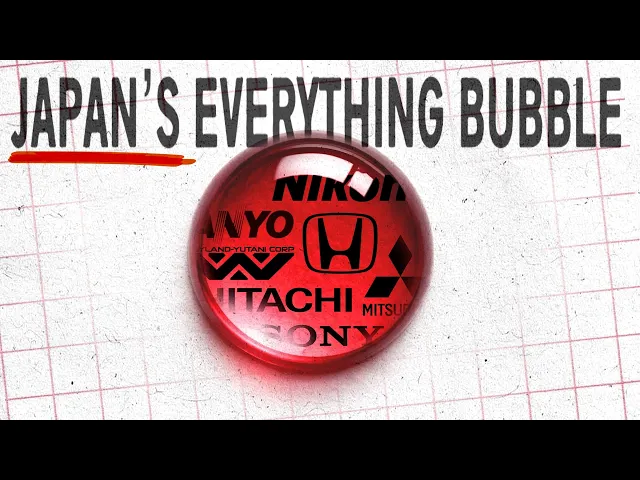
The Economic Crisis We Learned Nothing From
How History Works
0:00 On the 29th of December 1989, the Nikki,
0:02 Japan's primary stock index, closed at a record high of 38,915.
0:07 After accounting for inflation, it would never again reach this level.
0:12 At this time, Japan was quickly becoming
0:15 the preeeminent economic force in the world.
0:18 Its highly innovative companies were churning out world-class technology.
0:21 Investors were doubling or even tripling their money every other year.
0:25 And all of this was creating some of the highest incomes anywhere on the planet.
0:30 But even during these good times,
0:32 there were problems bubbling away under the surface.
0:35 A long period of easy money and low interest
0:38 rates grew a roster of underperforming and inefficient businesses.
0:42 Speculation ran rampant as people were expecting the technology
0:46 of the day to continue dominating into the future.
0:49 Companies and households loaded up on debt.
0:52 Market returns and loose lending standards like 50-year
0:55 mortgages fueled a real estate bubble that made
0:58 innovation centers like Tokyo and Kyoto some
1:00 of the most expensive places on the planet.
1:03 All of these vulnerabilities were then tested
1:05 by a radical shakeup in global trade relations,
1:08 an aging population, and oh no, I've done it again.
1:11 You're all going to start to think I am mixing
1:13 up these tapes just to make some kind of statement.
1:16 Let's just uh There we go.
1:18 Japan never recovered from the crash that followed.
1:21 For the past 35 years,
1:22 the country has stagnated by almost every conceivable metric.
1:25 Its innovation is lackluster.
1:27 Incomes haven't budged, and the real estate that caused all of these problems.
1:32 Some of those homes are now worth just 1% of what
1:35 they were during what are now known as the bubble years.
1:39 So, you might be thinking,
1:40 "Hang on, a lot of these economic warnings sound very familiar today.
1:44 I know where this is going." This is going to be
1:47 another video talking about how we haven't learned anything from history.
1:51 Right?
1:52 Wrong.
1:52 Japan's lost decades may have been the crisis we refused to learn from.
1:57 But there are some big differences between then
2:00 and now that almost render this comparison completely irrelevant.
2:04 The only problem is those big differences probably aren't in our favor.
2:08 The Bank of Japan pursued an expansionary monetary policy
2:12 which led to a speculative boom in real estate
2:15 and equities which gave rise to fierce competition
2:17 in the banking sector which in turn fueled reckless lending practices.
2:22 Jensen Invidia is making a hundred billion investment in OpenAI.
2:26 The real estate in Tokyo was so expensive
2:29 that people were taking out 100year home loans.
2:32 East PaloAlto was once a pocket of affordability,
2:35 a place where you didn't need tech money or even
2:38 two incomes to live comfortably and raise a family.
2:40 With more than 19 million people crammed into the greater metropolitan area,
2:44 Tokyo is not only one of the most densely populated cities in the world,
2:48 but one of the priciest real estate markets anywhere.
2:50 When Japan surrendered in 1945,
2:53 most of the country wasn't just damaged, it was unusable.
2:57 Factories were turned into rubble.
2:59 Farmland was scorched.
3:00 Ports were in ruin and destruction wasn't limited to a few industrial centers.
3:05 The Allied bombing campaign had effectively
3:07 dismantled the economic backbone of the nation.
3:10 Four in five ships were gone.
3:13 1/3 of all industrial machinery had been destroyed
3:16 along with a quarter of all trains and cars.
3:20 Of course, two cities in particular are remembered in the history books.
3:24 But in the grand scheme of Japan's devastation towards the end of the war,
3:28 they were barely a rounding error.
3:31 64 additional major cities were destroyed by firebombs,
3:34 leaving almost half of all urban areas completely useless.
3:38 Tokyo lost 65% of all its homes.
3:41 Osaka lost 57% and Nagoya, the country's third largest city,
3:46 had lost 89% of habitable dwellings and infrastructure.
3:49 By the end of the war,
3:52 five of the 7 million residents of Tokyo had left the ruined city.
3:57 In total, around 2.75 million Japanese citizens had died during the war,
4:02 and almost 9 million were left homeless afterwards.
4:04 This was not the kind of destruction someone bounces back from.
4:08 You don't lose most of your houses, your shipping fleet,
4:11 your factories, and millions of people,
4:14 and simply just rebuild through willpower.
4:16 Japan's survival required massive outside intervention.
4:19 And the only country with a plan to rebuild it was
4:22 the same country whose previous plan had been to level it.
4:27 Now, the United States didn't rebuild Japan because it felt guilty.
4:31 It rebuilt the country because it found it to be incredibly useful.
4:35 The next battle America set its sight on was fighting communism.
4:38 And to understand why Japan suddenly became the most
4:41 valuable piece of real estate in this battle,
4:43 you only have to look at what was happening across Asia in 1945.
4:48 Immediately after Japan's surrender,
4:50 the Soviet Union was quick to act on the broken empire,
4:54 carving out enormous influence in Manuria and northern Korea,
4:58 territory that Japan held claim to for over a decade.
5:01 Stalin wasted no time filling the vacuum Japanese forces left behind.
5:05 In China, the Communist Party under Maoadong controlled large rural
5:09 territories and was gaining momentum in the Chinese Civil War.
5:12 A war that would end with China becoming a communist state by 1949.
5:17 Other Asian countries such as Indonesia, Malaysia, Thailand, Burma,
5:21 the Philippines, and Vietnam all saw communist factions gain prominence.
5:26 From Washington's perspective, if Japan was lost to communism,
5:29 the consequences would have been enormous.
5:32 Yes, Japan itself had been destroyed.
5:34 But while their industrial capacity was gone, its industrial potential was not.
5:40 They still had one of the highest skilled,
5:43 most technical workforces in the world.
5:45 A destroyed factory can be rebuilt,
5:47 but a skilled workforce is much harder to replace.
5:51 Japan's ports, shipyards, and urban infrastructure were ruins,
5:54 but they were strategically placed ruins on the doorstep of the Pacific.
6:00 Washington understood that if Japan ever recovered,
6:02 it would once again become the most advanced manufacturing center in Asia,
6:07 which meant Japan was simply too important
6:10 for the US to abandon and too dangerous to lose.
6:13 And so, the United States began one of the most
6:16 ambitious nation building projects it had ever undertaken.
6:19 The Supreme Commander for the Allied powers,
6:22 effectively an American military government with the Allied partners kept
6:25 in the loop just enough to say it was a collective effort,
6:28 took control of Japan following the terms of surrender.
6:32 The operation was led by General Douglas MacArthur,
6:34 who was given sweeping authority to reshape Japan.
6:38 He oversaw Japan's new constitution,
6:40 expanded political freedoms, and introduced new civil liberties.
6:44 He did however introduce the Civil Censorship Departments,
6:48 an organization dedicated to restricting Japanese media,
6:52 and crucially to suppress information about
6:54 the human cost of the atomic bombings.
6:57 I suppose it's easy to grant civil liberties when
7:00 you're the one deciding what people are allowed to know.
7:04 Anyway, there were changes introduced to reshape the Japanese economy as well.
7:09 As cold war priorities took shape,
7:11 Washington shifted from punishing Japan to rebuilding it as quickly as possible,
7:16 the Allies pushed to dissolve the Zybatsu, a family-owned monopoly,
7:20 into many different firms called Keretsu with many different shareholders.
7:25 Land reform broke apart the huge landlord estates,
7:29 creating millions of small landowning farmers
7:32 and injecting income into rural Japan.
7:35 Labor reforms legalized unions, strengthened worker protections,
7:38 and helped shape the cooperative corporate
7:41 culture that would later define Japanese industry.
7:44 Tax reforms were introduced to dilute concentrated
7:47 wealth and encourage corporate reinvestment over financial hoarding.
7:51 The United States also rebuilt Japan's financial system from the ground up,
7:56 stabilizing the Bank of Japan and allowing
7:58 American banks to operate inside Japan.
8:00 Modern industrial policy began taking shape as well.
8:04 MacArthur encouraged targeted investment in sectors like steel, ship building,
8:09 chemical and machinery,
8:10 industries that would eventually fuel Japan's exportdriven boom.
8:13 At the same time, the US shipped in food, fuel, medical supplies,
8:19 and raw materials, preventing famine and giving
8:21 Japan the breathing room it needed to rebuild.
8:24 All of this laid the groundwork.
8:26 But the true turning point came in 1950
8:29 when the Korean War erupted and transformed
8:32 Japan from a recovering nation into the industrial
8:35 engine of the United Nations war effort.
8:38 When the Korean War erupted in 1950,
8:42 the recovering Japan unfortunately found itself in the center
8:46 of the most important geopolitical crisis in the early cold war.
8:50 And although Japan never sent any troops,
8:53 it became the primary logistical hub for the entire United Nations war effort.
8:58 The United States guaranteed Japan security
9:00 through the 1951 US Japan security treaty,
9:04 which allowed American bases and the proverbial
9:07 American nuclear umbrella to anchor Japan's economic revival.
9:11 American ships were repaired in Japanese shipyards.
9:13 American aircraft were serviced in Japanese hangers,
9:16 and American purchase orders poured into Japanese
9:19 factories at a scale no one had predicted.
9:22 This influx of military demand reignited
9:24 industries that had been idle since 1945.
9:28 America needed factories to produce its military equipment,
9:31 and Japan was a perfect manufacturing hub for its weapons in the Pacific.
9:36 Major firms like Mitsubishi, Sumi-tomo,
9:38 and Mitsui were revived by enormous US procurement orders
9:42 for everything from ships and pharmaceuticals to oil, uniforms, and beer.
9:48 By 1953, these special procurement payments amounted to $800 million a year,
9:54 equaling 27% of Japan's total export trade.
9:58 Japan's economy was roaring again with the economy
10:01 growing 10% per year and manufacturers that had
10:05 been making goods for the US military
10:07 started importing other goods back into the US.
10:10 By the mid 1960s, Japan had moved far beyond recovery.
10:13 It was now one of the fastest growing economies on the planet.
10:17 Factories that had once supplied American forces
10:20 in Korea were now exporting to the entire world.
10:24 Japanese radios, cameras, ships, cars,
10:26 and steel were becoming global benchmarks for quality.
10:30 And this success reignited a national confidence
10:33 in Japan that this growth would be sustained forever.
10:37 Growth wasn't just expected.
10:39 It was assumed, baked into corporate plans,
10:42 household budgets, and government policy.
10:44 Japan's technology firms were at the cutting edge.
10:48 Sony, Panasonic, and Sharp were churning out
10:52 worldclass electronics that reshaped global consumer markets.
10:55 From the Walkman in people's pockets
10:57 to stereos in living rooms around the world,
11:00 investors and households convinced themselves
11:03 that Japan's technological rise was permanent.
11:06 The idea that growth could go on forever became so normal
11:10 that it stopped feeling like optimism and started feeling like geometry.
11:13 Green line goes up and to the right.
11:16 Now, it's easy to see how ridiculous this is in hindsight,
11:20 but how many of you have a retirement plan that you're
11:23 quietly assuming will return 10% every year for the next 40 years?
11:29 Anyways, for ordinary people,
11:30 the best way to own a piece of the miracle was to own a piece of Japan itself.
11:35 So, real estate prices surged far beyond anything connected to local wages.
11:41 Large cities like Tokyo, Asaka,
11:44 and Kyoto became some of the most expensive places on the planet.
11:47 Not because there was no more land,
11:49 but because everyone believed land prices would never fall.
11:53 Luxury consumption exploded.
11:55 European fashion houses became household names, and expensive watches,
11:58 handbags, and designer clothing turned into normal status symbols.
12:02 Japan developed one of the largest secondhand luxury markets in the world,
12:07 which goes to show how many people could afford to buy in the first place.
12:11 The banking system amplified all of this.
12:14 Japanese banks were flush with deposits
12:16 from the country's massive trade surplus, and cheap lending became normal.
12:21 Loans flowed to households, corporations,
12:23 and speculative property developers with almost no restraint.
12:26 If you wanted to build it, buy it, or flip it,
12:29 there was a bank ready to help you do it.
12:31 When the first signs of trouble appeared after the Plaza Accord in 1985,
12:35 which we will discuss soon, the government of Japan didn't slow things down.
12:40 They doubled down, terrified of throttling growth
12:43 and losing their dominant position in the global economy.
12:46 Interest rates were cut even lower.
12:49 Loans were given out faster.
12:51 Asset prices went higher.
12:52 And every policy decision was designed to fuel the fire that everyone could see,
12:57 but nobody wanted to extinguish.
13:00 Between 1985 and 1989, the decay more than tripled.
13:04 In 4 years, stock valuations detached from underlying profits.
13:08 But as long as the index number on the evening news kept climbing,
13:13 nobody really cared to ask questions.
13:15 Now, if things are starting to sound a bit familiar,
13:19 there are some differences that I should point out.
13:22 Workers were paid pretty well,
13:24 job benefits were strong, and social cohesion was high.
13:27 The top 1% didn't have nearly the wealth
13:30 that they do here in the United States today,
13:33 and ordinary households felt like participants in the economic miracle.
13:36 Households were also very good at saving.
13:39 Families had cash buffers in bank accounts.
13:42 Their system was not built on maxed
13:44 out credit cards and financing Door Dash orders.
13:48 If a bubble burst, households had cushions.
13:50 Businesses had reserves.
13:51 To the outside world,
13:53 it looked like Japan had found an entirely new economic model.
13:57 A model that combined technology, stability, high savings,
14:00 and a formula that looks like infinite prosperity.
14:04 American executives were flying to Tokyo to study management techniques.
14:08 Economists wrote bestsellers predicting Japan would overtake
14:11 the United States by the early 2000s.
14:14 Japan is often held up by economists and historians as a cautionary tale
14:18 of where we might one day end up if we are not too careful.
14:22 But there is the argument that if we look under the surface just a little bit,
14:26 we are already there.
14:27 And in fact, we may have been there
14:30 for years at this point without even realizing it.
14:33 So, it's time to learn how history works to find out
14:36 if Japan's economic crash would even be that bad by today's standards.
14:40 Today's episode is sponsored by Brilliant.
14:42 Brilliant is a powerful learning platform built around the idea
14:45 that the best way to understand something is to do it.
14:48 With thousands of interactive lessons in maths, science, and computer science,
14:52 it helps you build real intuition through problem solving, not passive watching.
14:57 One course that really stood out to me is scientific thinking.
15:00 It digs into how we form models of the world,
15:04 test ideas, and challenge assumptions.
15:05 Basically, the same tools historians and scientists
15:08 use to make sense of the past.
15:10 It's not a history course,
15:11 but it sharpens the kind of thinking that history actually depends on.
15:15 I've been working through it myself and it's
15:17 made me look at historical analysis differently.
15:20 You start with basic logic puzzles and end up evaluating evidence,
15:24 spotting bias, and asking smarter questions.
15:26 It's surprisingly relevant and honestly pretty addicting.
15:29 And the best parts, you can do it on your own time.
15:33 Whether you've got 5 minutes between errands or an hour to dig deep,
15:37 Brilliant fits around your schedule.
15:38 So, if you're curious about how we learn
15:41 from the past or just want to level up your thinking,
15:44 Brilliant is a great place to start.
15:46 To learn for free on Brilliance, go to brilliant.org/how history works.
15:49 Scan the QR code on screen or click on the link in the description.
15:55 Brilliance also given our viewers 20% off an annual premium subscription,
16:00 which gives you unlimited daily access to everything on Brilliant.
16:03 The turning point in Japan's miracle came
16:06 in 1985 when leaders from the United States, Japan, West Germany, France,
16:11 and the United Kingdom gathered at the Plaza Hotel in New
16:14 York and signed what became known as the Plaza Accord.
16:17 The agreement was designed to push the Japanese
16:20 yen higher and the US dollar lower.
16:23 The United States had started to become
16:26 frustrated with its ballooning trade deficit,
16:28 and Japanese exports were a major political target.
16:32 Strengthening the yen was the diplomatic way
16:34 to ease that pressure without launching a trade war.
16:38 A stronger yen meant Japanese products would cost more
16:41 in the United States and American products would cost less in Japan.
16:45 This effectively meant that Japan was making it harder on themselves to export.
16:50 So why the would they do this to themselves?
16:54 Well, for Japan, signing the agreement maintained good relations with the US
16:59 and was a responsible power in a system the US dominated.
17:03 30% of all exports from Japan were purchased by the United States,
17:07 their largest buyer at the time.
17:09 The problem for Japan, though, was that their economy relied
17:12 heavily on exporting highquality manufactured goods,
17:15 and a stronger yen made those exports more expensive internationally.
17:19 This shift placed an immediate strain on Japan's industries.
17:23 But despite the pressure, the economy kept chugging along.
17:26 A more valuable yen increased Japan's purchasing power abroad,
17:30 making overseas travel, asset purchases, and investments more accessible.
17:34 Japanese firms began purchasing highprofile properties around the world.
17:39 Japanese policy makers were reluctant to let this momentum fade,
17:43 so they responded to export challenges
17:45 by lowering interest rates and expanding credit.
17:49 Their goal was to support domestic demand while exporters adjusted.
17:54 This created an environment of extremely cheap money.
17:58 Banks increased lending.
18:00 Developers expanded projects and corporations
18:03 took advantage of readily available credit.
18:06 Years of optimism were now paired with unusually loose financial conditions.
18:11 Real estate values accelerated far beyond income levels,
18:14 and some parcels of land in Tokyo
18:17 reached valuations that were more symbolic than economic.
18:20 The numbers no longer reflected a future expected return.
18:24 They reflected an expectation of endless appreciation.
18:27 Their stock market followed the same pattern.
18:31 Between 1985 and 1989, the NK rose to levels that had
18:35 no meaningful connection to company earnings or growth.
18:39 Prices were driven by liquidity, confidence, and momentum.
18:43 By the late 1980s, speculation had become
18:46 the defining feature of the Japanese economy.
18:48 It was visible in property, in stocks,
18:51 in corporate borrowing, and in household expectations.
18:54 Japanese policymakers started to get concerned by this irrational exuberance.
18:58 And the central bank decided to shift course and raise interest rates.
19:03 Their goal was to cool the most overheated parts of the economy.
19:08 However, just a slight uptick in interest rates was all it took
19:12 to expose the vulnerabilities that ran
19:14 far deeper than anyone cared to acknowledge.
19:17 Property developers struggled to service loans.
19:19 Corporate expansion plans stalled and projects that only worked
19:22 under low interest rates no longer made financial sense.
19:26 Asset prices began declining.
19:27 Land values fell sharply and the decay started to fall from its peak.
19:33 In some regions, real estate prices collapsed
19:35 by 70 to 90% over the following years.
19:38 The bubble had finally burst,
19:40 but it was the aftermath that would define the next several decades.
19:44 Japan had entered a period of deflation.
19:47 Prices were falling, wages remain stagnant,
19:49 and earnings expectations kept declining.
19:52 For what it's worth, these conditions are very rare in advanced
19:57 economies and are extremely hard to reverse.
20:00 Deflation discouraged investment in the Japanese economy.
20:02 Prices and revenue were likely to fall.
20:05 Businesses delayed expansion plans, postponed hiring, and avoided taking risks.
20:10 Households had postponed major purchases, reducing demand even further.
20:14 The banking sector deteriorated under the weight
20:17 of bad loans accumulated during the bubble years.
20:20 Many borrowers couldn't repay their debts, but banks avoided writing them off,
20:25 which weakened the financial system for years.
20:27 Policymakers attempted various forms of stimulus and reform,
20:30 but responses were cautious and incremental.
20:32 None of the measures were aggressive enough to break the deflationary cycle.
20:37 Japan remained stable on the surface.
20:39 There was no sovereign debt crisis,
20:42 no hyperinflation, and no political collapse.
20:44 But the country was stuck in a prolonged period
20:47 of stagnant growth that became known as the lost decades.
20:51 Economic activity fell into a long low frequency drift.
20:55 Living standards plateaued, consumptions remained weak,
20:58 and the optimism that defined the boom years never fully returned.
21:02 By now, you might be thinking, "Okay, so this is where we're going to hear about
21:08 how we're basically going to become Japan." And yes, but also not really.
21:14 Because one important thing to remember here
21:16 is that Japan's lost decades happened under conditions
21:19 that were in many ways far more stable and forgiving than what we have today.
21:25 Japan ran into deflation, a world where prices fell gradually over time.
21:29 Sure, this is bad if you own a home and a mortgage and your salary decreases,
21:34 but I don't even need to go into why that's not an issue for us.
21:38 That is bad for growth and terrible for investment.
21:41 But at least people aren't waking up to find that rent, food,
21:45 and energy are 15% more expensive than they were a year ago.
21:49 Our problem today is inflation where the price of almost
21:53 everything essentially has jumped and wages haven't kept up.
21:56 Tariffs don't help with that because a tariff is a tax on imported goods
22:01 which gets pushed into higher costs
22:03 for businesses and then higher prices for consumers.
22:07 Typically, a 2% inflation rate is considered
22:09 healthy because it encourages people to spend
22:12 and invest today and it makes existing debt slowly easier to pay off over time.
22:17 But once inflation stays above that range,
22:20 it stops being healthy and starts being I can't afford to live anymore.
22:24 And when that happens,
22:26 people do what people always do when the cost of living outruns their income.
22:30 They finance the gap.
22:32 Japan has one of the strongest household saving cultures in the world.
22:35 Even during the asset bubble, families still put aside significant cash.
22:39 When the bubble popped, they lost paper wealth, but they still had actual money.
22:44 In America, we took the borrowing part from the Japanese story,
22:48 but completely forgot the savings part.
22:51 Households carry record levels of debt
22:54 and have almost nothing in reserve for emergencies.
22:58 Even food is now being financed through buy now, pay later services like Clana.
23:04 Japan entered its stagnation with balance sheets
23:07 that could survive decades of low growth.
23:10 We are entering ours with balance sheets that can barely survive a month.
23:16 Inequality is another major difference.
23:18 Japan's wealth distribution is far flatter
23:20 than almost any other developed economy.
23:23 During the boom, the gains actually reached ordinary workers.
23:27 People didn't feel locked out of prosperity.
23:30 In fact, they very much felt included in it.
23:33 When the bubble burst, the pain spread across a broad middle,
23:37 not concentrated among people who already had the least.
23:40 In highly unequal societies,
23:42 the same stagnation became a social pressure cooker.
23:45 Economic problems turn into political ones very quickly.
23:49 Corporate culture played a stabilizing role as well.
23:52 In Japan, layoffs are never a go-to solution for struggling economies.
23:57 Firing an employee is seen as a last resort,
24:00 not a clever way to appease shareholders.
24:03 In America, layoffs are the first lever companies will pull.
24:07 If a stagnation hits this system,
24:09 the pain spreads directly into the labor market and then the political system.
24:14 Japan also had a far more equitable wealth system.
24:17 They have heavy inheritance taxes.
24:19 So, as wealth transfers between generations,
24:22 a meaningful portion is reinvested back
24:25 into the economy instead of hoarded in asset values.
24:29 This slows the creation of permanent
24:31 dynasties and keeps inequality from getting worse.
24:35 In countries where inheritance taxes are weak, politically untouchable,
24:38 or easy to avoid, wealth compounds upwards and stays there.
24:42 Over decades, that creates economic pressure points Japan didn't face.
24:47 And then there's the public infrastructure.
24:49 Japan used its boom years to build systems that actually function well.
24:54 reliable public transport, accessible health care,
24:57 and social services that don't collapse under mild stress.
25:01 When growth slowed, those systems remained in place.
25:05 People could still get to work.
25:07 They could still see a doctor.
25:09 They still had institutions they could depend on.
25:11 If you run a similar stagnation through countries where the trains barely run,
25:16 hospitals are overloaded,
25:17 and basic administration is held together with duct tape,
25:20 the outcome looks very different.
25:22 And finally, there's something Japan never had to worry about.
25:26 The global demand for the US dollar.
25:29 For decades, the American consumer has been effectively subsidized by the rest
25:33 of the world because everyone needs dollars and US assets to trade,
25:37 borrow, and store wealth.
25:39 That foreign demand allows the US to run
25:42 enormous trade deficits without collapsing its currency.
25:45 In practical terms, it means the US can import far more
25:49 than it produces because everyone else is willing to hold the IUS.
25:53 If that demand ever weakens, the subsidy ends and Americans suddenly pay
25:58 the cost of what they actually consume.
26:00 So yeah, when people warn that we don't want to become Japan,
26:04 what they usually mean is we don't want slow growth.
26:08 But Japan went through slow growth with high savings,
26:11 low inequality, employment stability, and functioning public systems.
26:15 It wasn't ideal, but it was survivable.
26:18 If something similar hit America today,
26:20 we'd be facing it with record debt, low savings, high inequality,
26:26 fragile public systems,
26:27 and political institutions that struggle with normal years,
26:31 let alone a lost decade.
26:33 Japan had guard rails while we've been quietly removing ours for years.
26:38 Which leads to the uncomfortable conclusion.
26:41 Japan's lost decades, the scenario everyone treats as a nightmare,
26:44 might actually have been a soft landing.
26:47 And if that was the soft landing, what does the hard landing look like?
26:53 Japan made major investments into public transport,
26:55 healthcare, and social services,
26:57 guardrails that the US simply does not have today.
27:01 If something similar happened in America, the fallout would look very different.
27:06 Now, is a Japan style stagnation guaranteed?
27:09 Maybe not.
27:10 We've gotten very good at avoiding economic crisis, or at least delaying them.
27:16 But the more we avoid small downturns,
27:18 the more pressure we build into the system.
27:21 And when you suppress every tiny burn,
27:24 the whole forest saves its anger for one giant meltdown.
27:27 If you want to see how we got to a world where
27:31 recessions barely happen and why that might actually be making everything worse,
27:34 go watch our video on how we forgotten how to have a healthy recession.
27:38 And don't forget to like and subscribe to keep on learning how history works.