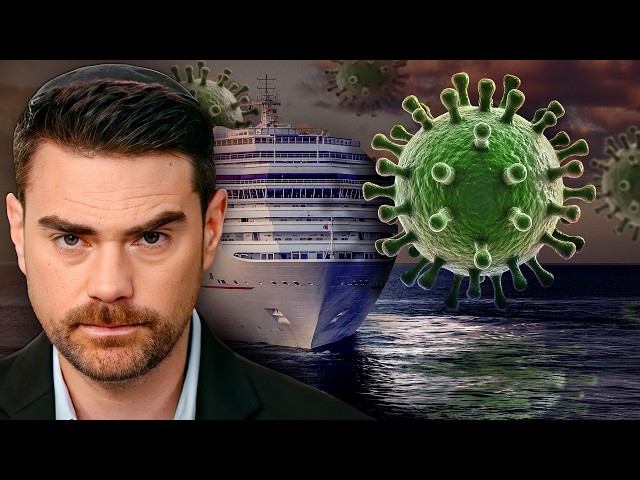
Is Hantavirus the Next Global Pandemic?
Ben Shapiro
0:00 Should you be masking up?
0:00 No.
0:01 Should you be worrying about shutting down your business?
0:02 No.
0:02 Should you be worried about sending your kids to school?
0:04 No.
0:04 You should go about your life.
0:05 The media have an incentive to act as though every
0:08 new antivirus or disease is going to turn into COVID.
0:12 So, I want to begin with antivirus.
0:14 I know there are people who are freaking out about antivirus.
0:16 Lots of headlines.
0:17 Is it the new co?
0:18 No, it's not the new co.
0:20 Stop it.
0:20 Just stop.
0:21 Okay.
0:21 So, what happened is that there is a cruise ship called the MV Hondas.
0:26 And according to the WHO,
0:27 and I know the minute I say the World Health Organization,
0:29 you throw up your hands and start screaming like
0:31 a banshee because they did such a horrible job on CO.
0:34 Agreed.
0:35 Agreed.
0:36 But here is the information we have thus far.
0:38 Eight cases have been reported, including three deaths.
0:42 Five of the eight cases were confirmed as havirus.
0:45 So the hivirus involved is the Andes virus.
0:48 This is the only species known
0:50 to be capable of limiting transmission between humans.
0:53 It's linked to close and prolonged contact.
0:55 Typically antivirus is transmitted by somebody ingesting rat poop.
1:00 Basically, apparently the way this started is that some
1:02 of the people who are aboard this cruise
1:03 ship got off the cruise ship in Argentina and they went to a dump to bird watch.
1:08 Folks, don't go to places where there's tons of poop.
1:11 It's just not a great thing to do.
1:12 It's just not great.
1:13 Anyway, so people got back on the ship and tragically there were some
1:16 people who had hands virus and it started passing person to person apparently.
1:22 Now, this Andes strain apparently has a mortality rate of something like 40%,
1:28 which is super scary, right?
1:29 The COVID mortality rate was extremely low.
1:31 The Andes strain of antivirus has a mortality rate of 40%.
1:35 Meaning, if 10 people get it, four will die.
1:38 However, according to the CDC and the WHO,
1:42 hirus has a reproduction number of less than one.
1:44 Now, again, I know this brings back bad memories.
1:47 We all have PTSD from the COVID days.
1:50 The R rate is the rate at which a disease spreads.
1:53 If it is less than one, it will die out.
1:55 If it is more than one, it may slightly grow.
1:57 The flu is like 1.2.
2:00 CO was like four at times,
2:03 like the less strains of CO, meaning it spread really, really fast.
2:06 Now, there's a weird thing about viruses,
2:08 which is the more deadly they are, typically speaking,
2:10 the lower the reproduction rate because you die
2:13 before you can pass it on to other people.
2:16 And very often you only get a a very deadly
2:21 form of a disease from a person who is symptomatic.
2:24 That is true of antivirus.
2:26 The incubation period is something like 1 to 8 weeks anywhere in there.
2:29 But during that incubation period when it's just kind of growing in your body,
2:32 it is not contagious.
2:34 So only when it starts to manifest, which is pretty severe, is it contagious.
2:41 So you're not going to be going
2:42 out to birthday parties typically with antivirus, right?
2:45 But once it starts to actually harm you,
2:47 once you start to be really, really sick, you're going to be in a hospital,
2:50 you're going to be stuck in your bedroom, right?
2:52 You are not going to be out there partying it up.
2:54 A cruise ship is a different story
2:56 because obviously even as you become symptomatic,
2:58 you're in close contact for prolonged periods of time with other human beings.
3:02 The audience effect is simple.
3:04 When people know they're being watched, they change their behavior.
3:06 They become more cautious, more performative, less free.
3:09 Now, here's the reality.
3:10 Online, you are being watched.
3:11 Your ISP tracks what you do, where you go, how long you stay there.
3:14 Private browsing doesn't stop it.
3:16 If you don't like the idea of somebody looking
3:17 over your shoulder every time you open your browser, there is a solution.
3:20 Use ExpressVPN the way I do.
3:22 ExpressVPN rroots my internet activity through secure encrypted servers.
3:26 Translation: My ISP can't see what I'm doing,
3:28 which means actual privacy, not just the illusion of privacy.
3:32 Again, I use ExpressVPN.
3:33 I'm always on the road, unfortunately.
3:35 And that means that I'm using public Wi-Fi.
3:38 Public Wi-Fi is just a hacker's paradise.
3:40 ExpressVPN hides my IP address.
3:42 That's the digital ID.
3:43 data brokers use to track you, build profiles on you, sell your information.
3:47 Let's be honest, those companies don't deserve your trust.
3:49 One major breach, expose the personal data of billions of humans.
3:52 ExpressVPN works on any device.
3:54 One click, you're protected up to 14 devices all at once.
3:56 They've also just launched Express Mail Guard.
3:58 It works with any email provider,
4:00 shielding your real email address wherever you sign up online.
4:02 The result, a cleaner inbox and tougher defense against
4:05 spam and fishing without changing how you use your email.
4:07 Find out how you can get up to four
4:08 extra months by scanning that QR code on screen,
4:11 clicking the link in the description box below,
4:12 or by heading on over to expressvpn.com/benshapiroshow.
4:16 From 1993 to 2003, there were about 890
4:19 cases of antivirus reported in the United States.
4:22 About 35% of those resulted in death.
4:24 Again, that those were mostly not humanto human.
4:28 So, here is a timeline of what happened here.
4:30 March 20th, the ship departed Argentina.
4:34 By April 6th, the first passenger had started getting sick.
4:37 The ill passenger, who was 70 years old, died on board.
4:40 The ship then docked in St.
4:42 Helena and 23 passengers got off.
4:45 Then the wife of the dead passenger also died.
4:47 Again, close contact for prolonged period of time.
4:49 And then a third passenger, a British man,
4:51 became seriously ill and was medically evacuated in South Africa.
4:55 A German woman died on board and a British
4:57 man became the first to test positive for Hivirus.
5:00 That is full on a month later.
5:04 And then the ship denied docking at Cape
5:06 Verie and the Dutch woman's body tested positive.
5:09 And then a departed passenger tested positive in Switzerland.
5:12 Some people got on planes, they flew.
5:15 The ship is now headed for the Canary Islands.
5:17 Okay.
5:18 But the chances that this is like
5:21 a pandemic level virus that it's human to human
5:24 contact that somebody went to a birthday party
5:26 and spread it everywhere very very very low.
5:29 So again, I always hesitate now because of the poison that is
5:32 the WHO in the public discourse to bring sources from the WHO.
5:37 That's how bad they are at their jobs and how
5:39 horribly they abuse the trust of the American people.
5:41 But here is the WHO director of pandemic prevention,
5:43 a woman named Maria Van Kirkov.
5:48 This is not corona virus.
5:50 Uh this is a very different virus.
5:52 We know this virus.
5:53 Hunter viruses have been around for quite a while.
5:56 There's a lot of detail that we know.
5:58 I'm going to ask Naise to come in and say
5:59 this, but I want to be unequivocal here.
6:01 This is not SARS KV2.
6:03 This is not the start of a COVID pandemic.
6:05 This is an outbreak that we see on a ship.
6:07 There's a confined area.
6:09 We have five confirmed cases so far.
6:13 Okay.
6:13 So, should you be masking up?
6:15 No.
6:15 Should you be worrying about shutting down your business?
6:17 No.
6:18 Should you be worried about sending your kids to school?
6:19 No.
6:20 You should go about your life.
6:21 The media have an incentive to act as though every
6:25 new antivirus or disease is going to turn into CO.
6:29 And let's be real, even CO wasn't CO.
6:32 Meaning the way that the media portrayed CO
6:34 that it had an exorbitantly high death rate.
6:37 That it was going to kill legitimately millions of people,
6:40 particularly young people.
6:42 It turned out that a lot of that was exaggerated,
6:44 particularly in the United States.
6:46 The early estimates were just wrong.
6:48 There was so much bad data and it abused the trust of the American people.
6:51 Anthony Fouchy abused the trust of the American people.
6:53 Hell, Fiser in its initial statements about the the efficacy
6:57 of the vaccine and stopping transmission
6:59 abuses the trust of the American people.
7:01 Do not be taken in by the media panic that is
7:04 currently happening about pantairus because there is no evidence at this point.
7:08 Now the evidence can change but at this point there is
7:10 zero evidence that you should be freaked out about this antivirus.