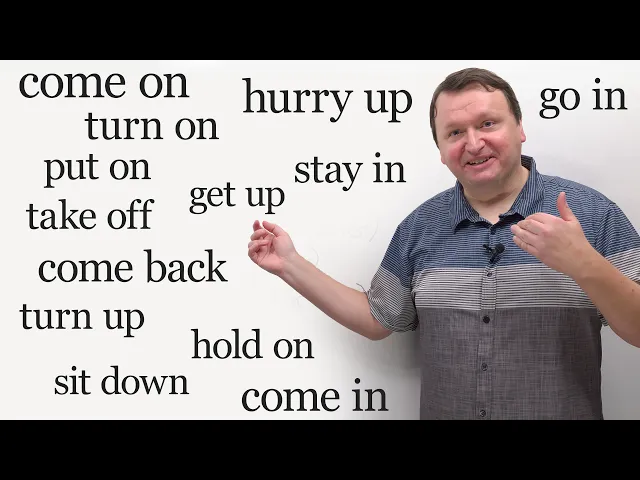
23 Easy English Phrasal Verbs for Beginners
English with Alex · engVid
0:00 Come in.
0:01 Hello, I'm Alex, and today we are going
0:05 to learn 23 phrasal verbs that are perfect for
0:10 English beginners.
0:11 Why are phrasal verbs important?
0:14 We hear phrasal verbs everywhere.
0:17 At the bank, at the grocery store, at the mechanic.
0:23 Yes, phrasal verbs can be a challenge, but I promise
0:28 that the phrasal verbs in this video are good
0:33 for your level.
0:35 So let's go.
0:36 I said let's go.
0:39 Another way to say let's go is come on.
0:44 So come on means come with me or follow me.
0:50 So you can say
0:52 come on to your friends if you want to leave
0:57 a place.
0:58 Another easy command phrasal verb,
1:02 easy command phrasal verb is hurry up.
1:07 Hurry up.
1:08 This means go faster.
1:10 Say it.
1:12 Hurry up.
1:15 Okay, so hurry.
1:16 Maybe your friend is in the
1:18 bathroom.
1:18 I don't know why I'm writing.
1:21 Your friend is writing a book in the bathroom, and
1:25 you want your friend to finish in the bathroom.
1:29 You say, hey, hurry up.
1:32 Go faster.
1:33 Finish faster.
1:35 So repeat hurry up.
1:39 Next, at the beginning of the video, I said come
1:44 in.
1:45 Come in means enter.
1:47 This one is very logical.
1:50 Come, come in, inside.
1:52 So when you open the door
1:55 to a person, you can say, ah, come in.
1:59 Come in.
2:01 You say it.
2:04 Come in.
2:05 Finally, hold on.
2:08 Okay, so hold on.
2:11 This means wait or stop.
2:14 So if your friend is walking very quickly, you can say, hold
2:22 on.
2:23 Hold on.
2:24 Because you want them to wait for
2:27 you or you want them to stop because you want to
2:33 catch them.
2:34 Catch, catch them.
2:35 So you can say,
2:38 repeat after me.
2:40 Hold on.
2:41 Okay, good.
2:43 It's okay?
2:45 Okay, I told you these are good for your level.
2:52 Let's continue.
2:53 The next two phrasal verbs are
2:56 wake up and get up.
2:58 We use these phrasal verbs
3:00 to talk about the morning when we open our
3:04 eyes and when we leave our bed in the morning.
3:10 So repeat after me.
3:12 I wake up at six o'clock.
3:20 Wake up.
3:21 I stop sleeping.
3:23 I open my eyes.
3:26 Next, repeat after me.
3:29 I get up at six o'clock.
3:35 So get up means you leave the bed.
3:39 Sorry if I didn't give you enough time to say it.
3:44 So you can use this one or this one.
3:48 People use both to talk about the time they stop sleeping
3:53 in the morning.
3:54 So me, I wake up at 5.50 in the
3:59 morning, but I get up at six o'clock.
4:04 How about you?
4:06 Tell me in the comments.
4:08 The next two phrasal verbs are used to talk about clothes
4:13 and other things that you put on your body.
4:19 For example, rings or earrings or necklaces
4:24 or watches for the time.
4:27 So you can put something
4:30 on your body or take something off your body.
4:37 For example, repeat.
4:39 Put your shoes on.
4:43 Take off your coat.
4:51 Good.
4:52 Now here you will notice I put your shoes
4:57 in the middle of put and on.
5:01 This is because many phrasal verbs in English can be separated.
5:09 Many can't, but many can.
5:12 For now, just know
5:14 at the beginner level, just know some phrasal
5:19 verbs you can separate.
5:21 Okay?
5:21 So you can say
5:23 put on your shoes or put your shoes on.
5:29 You can say take off your coat or take your coat off.
5:37 Is that okay?
5:38 Okay, you are doing great.
5:41 Let's continue.
5:42 Next, we have four phrasal verbs
5:46 that use the verb turn.
5:49 We will go one by one.
5:52 So the first example says turn on the light,
5:57 please.
5:58 So we can use turn on to mean start something, start a machine or something
6:06 electronic.
6:07 You can turn on your phone, turn on
6:11 your TV.
6:12 You can turn on the light in a room.
6:16 For example, the opposite of turn on is that's
6:22 right, turn off.
6:23 So listen to this example.
6:27 Could you please turn off the light?
6:30 This is a question.
6:32 It is a request.
6:33 And I need to put a
6:36 question mark with that.
6:38 Sorry, if it looks
6:40 a little funny.
6:42 So turn on, start, turn off,
6:46 close, close or like end.
6:48 So turn off the TV,
6:51 turn off your computer, turn off the light.
6:56 Next, we have turn up and turn down.
7:00 So this means to increase something, turn up or decrease
7:07 something, turn down.
7:09 For example, can you turn
7:13 up the volume?
7:15 I can't hear the TV.
7:17 Can you turn up the volume so I can hear the TV better?
7:25 Next, please turn down the heat.
7:29 It is very hot in this
7:33 room.
7:34 You have the heat on.
7:37 Please turn down, reduce, turn down the heat.
7:42 Is that okay?
7:44 Okay, just to make sure, please repeat after me.
7:48 Turn on the light.
7:53 Turn off the TV.
7:58 Turn up the volume.
8:06 Turn down, turn down the heat.
8:11 Good.
8:11 So far, so good.
8:14 Let's continue.
8:15 Now, I want to talk about some physical actions.
8:20 Maybe you know these actions.
8:23 If you don't, it's
8:25 okay.
8:25 The first physical action is sit down.
8:29 Sit down.
8:30 This is a comfortable chair.
8:33 I am sitting down.
8:35 Are you sitting down while you are
8:40 watching this video or are you standing up?
8:45 So repeat after me.
8:48 You can sit down on the couch.
8:56 Couch is another word for sofa, right?
8:59 A big seat in the living room.
9:02 And the next one,
9:04 repeat after me.
9:06 I should stand up.
9:10 This is true for me.
9:13 At home, at work, I sit down a lot.
9:19 I type on my computer, and I should stand up more.
9:25 Now, I am standing up.
9:27 It's hard.
9:28 It's very hard.
9:31 Okay, next, pick up your socks.
9:34 So, to pick up
9:36 is to lift something from a surface.
9:41 I don't have socks.
9:43 Ah, there is a water bottle on the floor.
9:48 I will pick up the water bottle.
9:52 So, I picked up
9:54 the water bottle from the floor.
9:57 The opposite of pick up is to put down.
10:02 So, to put down something
10:04 is to place it on a surface.
10:08 So, repeat after me.
10:10 Put down your phone.
10:14 Okay, now both pick up and put down.
10:18 You need an object, okay?
10:20 So, you need to pick up something.
10:25 You can say, "Pick it up." Right?
10:29 Remember, we can separate some phrasal verbs.
10:33 Pick it up.
10:35 You can also command someone, "Put it down."
10:41 Put it down.
10:42 I will put down this water bottle,
10:47 and we will continue with the lesson.
10:51 These phrasal verbs we use to talk about going inside
10:57 a place or going outside a place.
11:01 So, for example, "Let's go in." Right?
11:06 So, "Let's go in" means
11:09 let's enter.
11:10 Let's go in to the restaurant, for example.
11:15 Next, "Do you want to go out?"
11:20 Go out means to leave your home, usually for a
11:25 fun social activity like coffee with your friend
11:30 or a movie, or to go shopping just for fun.
11:35 So, "Do you want to go out?" And then the person
11:40 answers, "No, I want to stay in." So, "Stay in"
11:47 means stay at home.
11:49 I want to stay here.
11:52 So, "Do you like to go out or stay in on Friday night?" Tell me in the comments.
12:03 Remember, in the comments, what time do you wake up and do
12:09 you like to go out or stay in on Friday night?
12:15 Finally, we have two phrasal verbs.
12:19 They both mean return.
12:21 You can go back to a place or come
12:26 back to a place.
12:28 Now, "Go back" means from here
12:32 to there, and "Come back" means from there to
12:38 here.
12:38 Okay?
12:39 Go and come.
12:41 That's the difference.
12:43 So, for example, "I want to go back home."
12:49 Right?
12:50 I want to leave this place.
12:53 I want to go from here to my home.
12:57 So, repeat after me,
13:00 "I want to go back home." Good.
13:04 And repeat after me, "What time will you come back?"
13:14 So, maybe your roommate, your friend went to the store, and you say, "Ah, okay.
13:23 Well, I need the car in one hour.
13:26 What time will you
13:28 come back?" From the store to our apartment,
13:33 for example.
13:34 Okay.
13:35 Go in, go out, stay in, go back, come back.
13:41 Just two more.
13:43 The final two phrasal verbs are about public
13:47 transportation.
13:48 Entering public transportation and leaving or exiting public transportation.
13:57 Usually, this is about buses, trains, and subways.
14:04 Boats as well.
14:05 Big boats.
14:06 So, if you use a big
14:08 form of public transportation, you can use the
14:13 phrasal verbs "get on" to mean enter the form of
14:18 public transportation, and "get off" to exit or
14:23 leave the form of public transportation.
14:27 So, repeat after me, "Let's get on the bus."
14:35 "I think I hear a bus outside.
14:38 Do you hear it?
14:40 Or is the microphone okay?"
14:43 And finally, repeat after me, "We must get off at the next stop."
14:55 Good.
14:56 Like the next station, the bus stop, the subway stop, for example.
15:02 That was a lot, but you did it.
15:06 So, what can you
15:08 do now?
15:09 You can do the quiz on EngVid.
15:12 Just click the link that is attached to this video.
15:17 I hope you enjoyed practicing phrasal verbs with me.
15:22 I know they are a challenge, but with videos
15:27 like this, with practice like this, all the time,
15:32 regularly, you can improve and you will improve
15:37 your English.
15:38 Just one more thing.
15:40 If you want to learn more about phrasal verbs, I have a book.
15:46 It's called 100 Practical English Phrasal Verbs.
15:50 You can get it in a PDF or a physical format from
15:54 Amazon.
15:54 Just check out the link that is attached
15:58 to this video.
15:59 Until next time, I hope that you will keep learning and keep practicing.