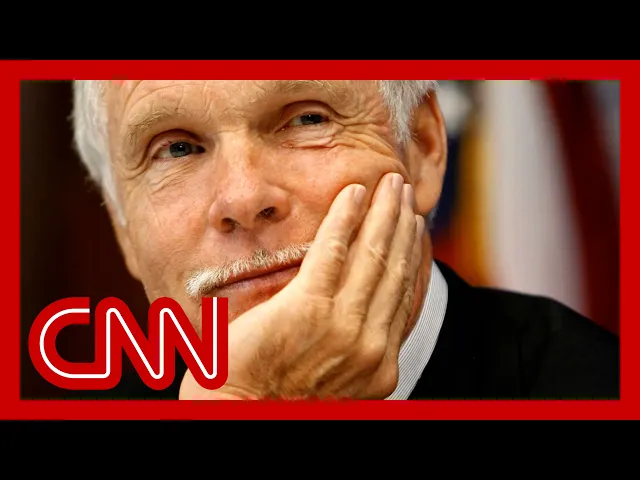
CNN founder Ted Turner dies
CNN
0:00 He broke every mold.
0:01 He changed the world.
0:03 Known as the mouth of the South and Captain Outrageous,
0:06 Ted Turner built a media empire that changed cable news forever.
0:10 I didn't have any upper limits to how far we could go.
0:15 Champion, philanthropist, environmentalist.
0:17 I don't know how to quit.
0:20 It's not in my genes.
0:23 But growing up wasn't easy for Ted.
0:26 Born in Cincinnati, Ohio in 1938,
0:28 his parents sent him to boarding school when he was just four years old.
0:33 I didn't like boarding school.
0:34 I wanted to be home.
0:36 Ted's little sister, whom he adored, died of lupus at 17.
0:41 About 2 years later, Ted dropped out of Brown University.
0:45 He'd been studying classics until his father cut off the money.
0:49 He thought I was wasting my time.
0:52 So, he went to work for his dad's billboard company.
0:55 But tragedy struck again when his father killed himself.
0:59 He went against uh everything that he that he taught me,
1:04 you know, be courageous and u hang in there.
1:07 Ted took over the family business and coped
1:10 with the loss by working even harder.
1:13 He said, uh, set your goals so high
1:15 that you can't achieve them in your lifetime.
1:18 When Ted wasn't working, he turned to the sport he loved, sailing.
1:22 We got to go fast as we can here.
1:25 And won the sport's top race, the America's Cup.
1:28 I had worked very hard.
1:29 It took me a number of years to become a champion.
1:33 He put that same drive into expanding the business.
1:36 In 1970, Ted bought a struggling TV station.
1:39 It was a broken down UHF television station in Atlanta.
1:44 He was going to transform UHF television
1:46 into uh this new world of satellite television.
1:50 Ted renamed the station WTBS and it became the country's first super station.
1:56 What Ted made happen uh was just as important
2:00 as the internet revolution of the '9s and 2000s.
2:03 But starting out, Ted needed content.
2:06 He bought the Atlanta Braves and broadcast their games nationwide.
2:09 The Atlanta Braves.
2:11 The Braves became America's team.
2:13 When we bought them in 1976, they were terrible.
2:17 By 1995, Ted and his team were World Series champs.
2:21 As he built the Super Station,
2:24 he set his sights even higher on a 24-hour news channel.
2:28 I I worked till 7:00 and when I got home, the the news was uh was over.
2:34 So, I missed television news completely.
2:36 And I figured there were lots of people like me.
2:40 People did look upon that as a foolish uh idea that was uh destined for failure,
2:46 but they underestimated Ted Turner.
2:48 Most of the leaders of the world thought Ted was nuts.
2:52 We signed on on June 1, and barring satellite problems,
2:56 in the future, we won't be signing off until the world ends.
3:01 We'll be on.
3:02 We will cover it live.
3:05 I dedicate the news channel for America, the cable news network.
3:10 Take 11.
3:11 Mike Kum.
3:12 CNN aired its first broadcast on June 1st, 1980.
3:17 Good evening.
3:17 I'm David Walker.
3:18 And I'm Lois Hart.
3:19 Now, here's the news.
3:21 It took 5 years to turn a profit.
3:23 I lived for 20 years in my office.
3:25 He was a one of us.
3:27 I mean, he would be in his house,
3:29 coat down having breakfast in the Hard News Cafe.
3:31 and we'll get better by the end of the week.
3:34 Critics called it chicken noodle news.
3:36 Hello, Baghdad.
3:36 But the Gulf War would give CNN the respect it deserved.
3:39 You're going to hear the bombs now.
3:42 They are hitting the center of this city.
3:44 It was the first time a war was broadcast
3:47 live on television and it was only on CNN.
3:50 I still believe that was the greatest scoop in the history of of journalism.
3:55 You can see her there.
3:56 She's Ted didn't care as much about ratings as he
4:00 did about being the most trusted name in news.
4:04 Ted also cared about the world.
4:06 Over a 10-year period, he donated a billion dollars to the United Nations.
4:11 I'm no poorer than I was 9 months ago, and the world is a lot better off.
4:16 And he expanded his empire,
4:18 launching networks like TNT and Turner Classic Movies.
4:21 In his personal life, Ted was married and divorced twice with five
4:26 children before he finally met his match, Jane Fonda.
4:30 She agreed to have dinner with me.
4:32 For me, it was love at first sight.
4:35 I can't ever forget the reasons that made me fall in love with him.
4:39 I've never met any human being that thinks the way Ted does.
4:43 Ted was a visionary, a titan, even Time magazine's man of the year.
4:49 But in 1996, he sold his networks to Time Warner.
4:53 He got almost $8 billion.
4:55 I said, Ted, if you sell, you will no longer be captain of your own ship.
5:02 Ted Turner.
5:03 Ted.
5:03 5 years later, Time Warner merged with AOL and Ted was out.
5:09 Ted used the description, I've been fired.
5:12 Ted got shafted and it hurt.
5:14 It was more than just a company to me.
5:17 It was u it was a way of life.
5:21 He lost his empire and the love of his life.
5:24 After 10 years of marriage, he and Jane parted ways.
5:28 But you love her still.
5:30 Yeah.
5:30 To this very day.
5:32 To this very day.
5:34 But Ted never gave up.
5:36 His final act saving the planet.
5:38 He created the UN Foundation and the Nuclear Threat Initiative.
5:43 On his Montana ranch, he made it his mission to save the bison.
5:48 Hi.
5:49 Well, you never go home, do you?
5:51 I know.
5:52 And he opened restaurants to ensure their survival.
5:54 Ted's love of the outdoors has made him
5:58 perhaps the number one environmentalist that I've ever known.
6:02 Before his 80th birthday,
6:04 Ted revealed he had Louisbody dementia, a progressive disease.
6:09 He spent his final years treasuring private moments, his ranch, and his family.
6:14 He wants to know that when he goes out,
6:18 it will be with the love of his children and grandchildren.
6:21 You can never take away what he created and what he did.
6:25 We have never seen a man quite like Ted Turner before on this planet,
6:30 and I don't think we'll ever see another one like him again.
6:36 There's the amazing American success story, the businessman,
6:40 the visionary, the revolutionary who created really a media revolution.
6:43 And you know, every single thing that followed him,
6:46 anything in the 247 genre started with Ted Turner.
6:49 Everything was a copy, if I dare say so myself, and not the best copies.
6:54 He was the original.
6:55 And he made us all proud and he made us all hopeful
6:59 and he made us all strive for his vision of a better world.
7:03 whether it was in news or whether it was in the philanthropy.
7:06 He was the first of the modern-day
7:08 philanthropists after the Carnegies and the Melons
7:10 and the Rockefellers of their generation as Wolf
7:13 just pointed out when he gave a billion dollars
7:15 to the UN Foundation and then Bill Gates
7:17 and then Warren Buffett and then Michael Bloomberg
7:19 and all the others joined in uh
7:22 to to to follow in that incredibly noble pursuit.
7:25 Uh he was big huge on climate and that's a global issue.
7:29 Obviously, he was way ahead of the uh
7:32 curve on on climate and climate mitigation.
7:34 And I remember asking him in one of my last interviews with him,
7:38 what would you say to the young people who look up
7:40 to you and who want to make their own first billion dollars?
7:43 How would you suggest they do that now?
7:45 And he said, climate, green technology, the green economy.
7:48 He was so sure and he was always so absolutely right.
7:52 And as as Wolf was saying, you know,
7:55 he was somebody who believed in breaking down
7:58 the barriers between peoples and and between nations.
8:01 I remember when I was still, you know,
8:03 in 1980s in New York and I was climbing up the ranks.
8:06 I started in September 1983 in Atlanta and I remember
8:09 when he banned the word foreign and I was absolutely devastated.
8:13 I wanted to be a foreign correspondent like Edward Arrow and all those people
8:17 and he brought the word international and it wasn't just a little thing.
8:21 It was because he didn't want to drive,
8:23 you know, a wedge into people by calling them foreign.
8:26 And he didn't want to have separation.
8:29 Imagine that kind of leader uh and what
8:31 we're left with right now when everything's about,
8:34 you know, weaponization of identities and beliefs and all the rest of it.
8:39 He was exactly the opposite.
8:40 When he took CNN in international in 1985,
8:43 what he did was not just be the first ever global TV 247 uh behemoth network,
8:51 but he also chipped down the walls
8:55 of state and authoritarian uh regulated media.
8:58 So all these nations where the people could only
9:02 see what they were fed by their authoritarian leaders,
9:04 and I'm now talking about that part of the world.
9:07 um you know he gave them something else.
9:09 He opened their eyes to the rest of the world.
9:11 And I thought that was absolutely fundamental.
9:13 And he said to us when we were in the Gulf War, he said, "Look,
9:18 I'm not going to force anybody to be in Baghdad,
9:21 which of course was the enemy capital for the United States.
9:24 We had been reporting in Saudi Arabia and around.
9:27 And we also had distinguished ourselves as CNN, the reporters there in Baghdad.
9:32 But when it came to the war, you had the president, you had the, you know,
9:36 chairman of the joint chiefs,
9:38 you had all these people call Tom Johnson, our president,
9:40 and say, "You better get your people out
9:42 of Baghdad because it's going to be real
9:44 and they might get killed." And Tom basically
9:47 went to Ted and said what he had heard.
9:49 And Ted said, "Look, I'm not going to force anybody.
9:53 It'll be volunteer, but we must be in Baghdad." In other words,
9:57 we must um tell all sides of the story.
10:02 And how incredibly important is that in today's world
10:06 when when we tell all sides of the story, we can be accused of taking sides.
10:10 No, we're telling all sides of the story without fear nor favor,
10:13 whether it's in the Middle East,
10:15 whether it's, you know, on climate, whatever it might be,
10:17 whether it's in the United States and elsewhere.
10:20 So, look, um, remember when giants stroed the world?
10:22 Ted Turner was a giant and he risked his life in many occasions
10:27 including in his you know swashbuckling sailor
10:29 days winning the America's Cup but also
10:32 the fastnet race one of the most dangerous ever around the aisle of white
10:35 the one the race he won that year there was more than a dozen
10:39 people killed in a massive storm there so he was brave he was
10:43 I was going to say ballsy but he was really um he said it
10:47 like it was and like it is and we were his willing foot
10:51 soldiers and I He changed not just the world but all of our lives