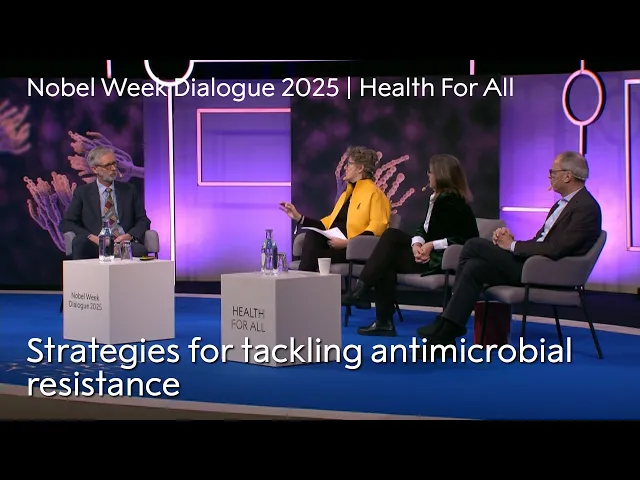
Strategies for tackling antimicrobial resistance | Nobel Week Dialogue 2025 | Health For All
Nobel Prize
0:00 I I was very struck by that slide of what
0:02 we need to do because it doesn't focus on drug discovery,
0:05 which is sort of the knee-jerk reaction to how
0:08 we combat the antibiotic crisis that we need more antibiotics.
0:11 But that wasn't what you were emphasizing.
0:13 No, I I did however mention access
0:16 to effective antibiotics and we do need effective antibiotics.
0:19 But if we get new drugs, unless we take on board all those other issues,
0:24 the same thing will happen to them.
0:26 So whilst of course we need to invest in drug discovery,
0:30 any drug that we develop will become resistant.
0:33 That's what happens and I've seen it happen over and over again in my clinical
0:38 practice also in my public health role and also in kind of networks of research.
0:43 Anytime we introduce a new one, it will become resistant.
0:47 So we do need drug discovery of course and also um drug discovery not just
0:51 for bacteria but also for the glooming um
0:55 problem of antifungal resistance that we're also facing.
0:58 But unless we understand those fundamentals,
1:01 it doesn't matter what drug comes on board because we still need to make
1:05 sure that we use it minimally and effectively to to maintain its effectiveness.
1:11 So fundamentally to look after the agents that we've got or any future agents we
1:16 need to take care of what I what
1:18 I've said and recognize the role of vaccination.
1:21 Thank you very much indeed.
1:22 In a second I'm going to come back to the question of developing new drugs.
1:25 But first Sally to engage all the different stakeholders
1:30 that have been mentioned in Allison's talk is a huge job.
1:34 You have to get all of society on board in this effort.
1:38 Um, I suppose the questions might be how do you do
1:41 that and how far along the road to doing so have we got?
1:46 Well, clearly not far enough.
1:48 Um, I think a lot of people see this as a development issue,
1:52 but let me remember my own godaughter who died two years ago of AMR.
1:58 I've been working on this for nearly 15 years
2:01 and she had cystic fibrosis but died of a drugresistant microacterium.
2:07 So, it hits all of us and I can tell you
2:11 plenty of other stories from our hospitals as of course can Allison.
2:16 So, the most fun one and then I'll tell
2:19 you another which is also fun is our musical.
2:23 So, we've got a musical that started um its uh life as the story
2:28 of penicellin and um Fleming discovering it and the impact it made.
2:33 And then it was called um the mold that made the world, saved the world.
2:38 But we've changed it and now it's
2:40 called lifeline because antibiotics protect modern medicine.
2:44 They are our lifeline.
2:46 And it is not only the story of penicellin and fleming.
2:50 Entwined in that is a real life story of a young man aged 29
2:56 who had bowel cancer and the operation was a success but he died of AMR.
3:02 We've transferred it from the states across
3:05 to Scotland so it all meshes and the way
3:08 we make this work is by having a professional cast and it is one health.
3:14 There's a wonderful song about they're in the water, they're in the air,
3:17 they're everywhere, you know, about antibiotics and the food chain.
3:21 But actually the chorus every week we
3:24 have a new chorus and there school teachers,
3:28 um, scientists, doctors, nurses, health professionals who join in as the chorus.
3:36 And we even got a p a paper published in nature um medicine
3:41 about the impact it had on them becoming AMR ambassadors in their communities.
3:46 We've played it um off Broadway um for the month that of September
3:53 24 when we had the high level meeting at the UN.
3:57 We even got um them singing two songs on the floor
4:00 of the general assembly and the previous singers to do that were ABBA.
4:06 So it's fabulous and it's coming to London if you want
4:09 to pop over the end of March um until midMay for six weeks.
4:13 Lifeline.
4:14 Another one I've done with support actually from the welcome trust.
4:18 Thank you.
4:18 Are youth summits and we've done three so far.
4:21 We've been in touch with and involved over 35,000
4:27 people under the age of 25 in three challenges.
4:32 Bringing them together, talking about AMR,
4:35 what's the important question that they as youth in low
4:39 and middle inome countries will run campaigns on in their own communities.
4:44 And the first was washing hands, the second was biocurity.
4:49 And the third is which we'll announce the winners though they're all known
4:53 to me um is uh on behavior and it is amazing in the first one
5:00 500 teachers were involved 300 parents 190 schools they had games they had all
5:06 sorts of things it is just wonderful how you can mobilize across the world.
5:11 Thank you.
5:12 Those are amazing stories of engagement.
5:14 And then you have the for instance the last
5:18 in 2024 the UN high level meeting with with WHO.
5:22 So that was trying to engage stakeholders that are rather
5:24 not just WH they think they look after all of this.
5:28 It's one health the food and agriculture organization
5:32 are food securityities at risk because of um
5:36 resistance um to uh to the treatments
5:40 and the overuse of antibiotics in the food chain.
5:43 I was just going to ask how successful do you think it
5:45 is being and this is one to um you also Allison and then
5:49 I'm going to come to you Jean how successful it's being engaging people
5:53 at high level as well as people who go to musicals or youth.
5:56 So um I'm I'm going to extend a little bit on what Sally said
6:02 because um Sally was talking about some
6:05 of the informal education in involving youth.
6:08 One of the things that was highlighted
6:09 at the UN General Assembly was this is something
6:12 that needs to be embedded in education and the young need to be aware of it just
6:17 like climate change and be um have some kind
6:20 of literacy about it and one of the things that was u highlighted as a gap was
6:25 that making sure that's in the curriculara globally.
6:28 So it needs to be you know whether you're in Sri Lanka
6:32 or whether you're in Gabon you you it it needs to be um part
6:36 of the curriculara but learning from countries that have got the most amazing
6:40 engagement projects already and for that to work
6:43 have to work with education leaders.
6:45 So it's really important that the leaders
6:47 that you are working with and influencing are
6:50 not within science and public health and drug
6:52 discovery but also leaders within um education.
6:55 And that actually has been incredibly successful and a program is being is
6:59 being rolled out formal education
7:01 and the informal engagement that um Sally described.
7:05 All this dovetailes very nicely with the um trust
7:08 in science discussions we were having earlier in the day.
7:11 Okay.
7:12 come maybe come back to the the the the high level
7:14 stakeholders but um Jean on on the um question of models
7:19 to encourage the financing of new initiatives to develop antibiotics
7:25 I know that you've been doing quite a lot of work
7:26 at that in Tulus on that in Tulus of course the problem
7:30 with antibiotics is that it's hard to make money from them
7:33 and so you need incentives to get people to work on them
7:37 so would you like to talk a little bit about that
7:39 well as you say we we have too little incentive I mean we
7:42 we can try to persuade and that's a good thing to get people
7:45 to engage uh but there are few incentive actually not to consume antibiotics
7:52 um you know the cost is a standard externality the cost is born
7:56 by other people not you and that is compounded by you at the international
8:01 level by the fact that everybody wants like would like other countries
8:05 to develop the new medicines the new antibiotics uh to exercise stewardship ship
8:12 um and basically they free ride on each other just like in climate change.
8:16 So we have this situation where we have a lot
8:18 of AMR and there's very little in the pipeline.
8:23 Um and we need to develop the new the new anti
8:26 antibiotics which are going to prevent the next the next contagion.
8:31 Um and for that the thing we have tried in Europe was to have a cash price.
8:36 So basically you you try to estimate how
8:39 much is needed to bring bring about innovation.
8:43 Maybe one 1 billion euros2 billion euros.
8:46 Is this really a medical thing?
8:48 The economist has nothing to say about that.
8:50 You just you just think what will be the benefit the social benefit
8:54 of this of this innovation and then we are
8:58 going to pay the inventor um 1 billion euros.
9:02 Say the problem with that is that it hasn't worked.
9:05 It doesn't work because countries free ride on each other.
9:09 So they they each hope that the the other countries are
9:12 going to do it and they won't they won't do it themselves
9:16 and as you know in Europe we have you know for fiscal
9:19 matters you we have the union rule that's why in climate change we
9:23 have a tradable emission permit system but we don't have a carbon
9:28 price a carbon tax in Europe for exactly that reason so what
9:33 has been tried what is being proposed now by the European Parliament
9:36 and the commission is is an indirect mechanism which is called a voucher.
9:42 So voucher means that if you're in Gutterberg and you
9:46 find this antiotic and it's perfectly good and etc.
9:52 Um then you are not given one 1 billion euros
9:56 you are given a voucher and this voucher is tradable.
10:01 So the voucher is an extension of exclusivity uh for say 6 months or a year.
10:07 We could discuss if whether it's a good thing
10:09 or not but you know it's basically an ex
10:12 extension of exclusivity meaning that in a sense
10:15 the patent is extended for one year on something.
10:18 Now the inventor often doesn't have a patent
10:21 which is valuable enough to benefit from that.
10:24 So that's why it's tradable.
10:25 So you can you can sell it to fiser or whatever and then you get
10:30 you you and if fiser is willing to pay 1 billion euros here you are.
10:36 Um so in practice that means that uh the blockbuster
10:41 will uh will buy the voucher and will pay for it.
10:45 Now is that a good idea or not?
10:47 Actually when we started this research with Pier Dubu and Paul
10:51 we thought huh not great because it's true that you don't
10:55 have to you save taxpayer money but then you you're going
10:59 to end up with more monopoly power on the blockbuster drug.
11:03 So instead of being 10 or 12 year of exclusivity,
11:06 there will be one more year of monopoly regulated monopoly profit.
11:11 But so were you thinking though that it may or may not be a good idea,
11:14 but it's the only idea that we've got because the other ideas working
11:18 both actually.
11:19 Yes, that's the only idea we have got because we cannot get the cash price.
11:22 Yes.
11:23 But then what we as economists did was to try to think how costly it was.
11:27 And to our surprise we found that actually the voucher was not that expensive.
11:33 And the story behind that is that actually
11:37 you know when the exclusivity is not extended
11:41 then the price should go down because you
11:43 should have generics and bio equivalent coming in.
11:47 But the truth is that in Europe they don't come in at a low price.
11:52 And so there is there are entry costs there is collusion with with a branded
11:58 drug and so on and in the end so we did a computation and actually
12:02 at least all the big countries in Europe that includes the UK in in our sample
12:09 um basically um preferred a voucher to to a to a cash price.
12:15 Okay.
12:15 Thank you.
12:16 I'd like both of you to come in on this please Sally first.
12:19 So in the UK we have tried a different method and it's called pull incentive.
12:24 We have put in place a subscription mechanism.
12:27 So a company can come to us and say I've got some an innovative anti-infective.
12:33 At the moment it is antibiotics but it in the future it'll be antifungals.
12:38 It could be fagee whatever.
12:40 And we score it well nice our national institute
12:43 of clinical excellence scores it against a transparent agreed scoring
12:48 for innovation what it kills the importance so it's like
12:52 a health technology assessment but with a societal assessment beside it
12:58 and we give it a grading and if it is
13:00 at the top level then England gives 20 million a year
13:05 for three years extendable for another 15 and the other
13:10 um parts of Great Britain give 4 million a year.
13:13 The great thing being that they can
13:15 they have guaranteed income and we will steward
13:20 and try not to use much of it but they'll give us as much as we want.
13:25 We have conditions on this too.
13:27 One that they must steward that drug everywhere else they sell it.
13:32 So they must look after it as Allison
13:34 was talking about everywhere else they sell it.
13:36 And the second is that in manufacturing they must have a BFSI
13:41 standard for manufacturing effluent so they're
13:45 not poisoning the environments where they are.
13:48 Now our payments relate to our fair share back of the envelope um of G7 uh GDP.
13:58 So if all of G7 joined in then farmer tell us
14:02 that would be a big enough incentive to be back in the business.
14:07 Okay.
14:07 So there's promise there.
14:09 Yes.
14:09 And Sweden's doing a very similar program except ours
14:13 is pulling innovation and theirs is getting access making
14:17 sure that it will that new drugs will go
14:21 through the regulatory process and be available to Swedish citizens.
14:25 Thank you.
14:27 I would like to talk about some other drugs that are uh um linked
14:32 to this argument and well linked to this dialogue
14:35 which is are phenomenal advances in imunotherapy,
14:41 imunosuppression, advances in oncology transplantation,
14:45 the management of autoimmune diseases etc.
14:48 which you know are really challenged.
14:52 immunosuppression is really challenged by antibiotic resistance
14:57 and you know transplant programs have had
15:00 to close down in um certain parts of Europe because it's just too high risk.
15:05 So I think we also need to think about another part
15:09 of the um drug production industry in terms of of imunosuppression
15:14 and oncology because it will become increasingly worrying in terms of using
15:20 these agents and the inc as I said the incredible advances being
15:24 made in that aspect of medicine when actually it's too high
15:27 risk because the health care that you're going to receive your imunosuppression
15:32 will not be able to give you therapy that will be
15:35 able to treat the infection that you could very very likely get.
15:40 So the kind of tipping points need to be considered here.
15:44 Um and also to engage these other therapies that depend on us
15:49 being able to get on top
15:50 of infections either prophylactically or therapeutically.
15:53 So one in five cancer patients gets a really serious infection.
15:58 Latest data out of the states,
16:00 the infrastructure for cancer care, inpatient wards,
16:04 outpatients have a much higher level of AMR
16:07 than the rest of the hospital system.
16:10 If you get cancer, you should be worried in America, the global rich north.
16:15 If you get cancer in India or China and some of these other places,
16:20 your gut will have masses of AMR in it.
16:24 Pretty certain.
16:25 Bad news.
16:27 Sorry.
16:27 you.
16:28 No, I think we, you know,
16:30 the new anti diabetics will be a very good deal in a sense,
16:33 you know, given how much how costly it is, you know, in terms of of lies,
16:38 but also in terms of money, uh,
16:40 to have the next pandemics and then all those surgical operations and things
16:46 like that that that we cannot do because of that or cancer treatments.
16:50 Um so the the willingness to pay I mean that's an economist word
16:53 but the willingness to pay for new antibiotics as long as we do things right.
16:58 So we we we we economize them.
17:01 A good antibiotic is not meant to be used right.
17:06 uh it's unlike many other goods you needs to worship but at the same
17:11 time you know it's clear that the money should be there and the only
17:15 difficulty at this stage is really the free riding issue I was mentioning I
17:20 mean with all due respect even the UK is not big enough I mean of course it is
17:28 but what I find amazing is I've talked to a major
17:33 um farmer company who's free riding And I said,
17:36 "But don't your board want you to protect
17:39 your other product lines?" And they say, "No,
17:42 we don't need to." So I've started working
17:45 with investors to start to raise these questions.
17:49 And the questions in the in the food chain
17:51 through fast food chains and supermarkets and intensive farming,
17:56 but it also sorry,
17:57 return on investment is for every euro spent, you get 28 back.
18:02 So it's a no-brainer.
18:04 No, in I just wanted to mention about investing in prevention.
18:07 So yeah, of course we need to invest in drug discovery,
18:10 but the bang for buck in terms of investing in prevention is vaccines.
18:16 Yeah, in vaccine basic infection does all
18:19 of that stuff which we have at our disposal,
18:22 invest in it, it will pay dividends.
18:24 Thank you.
18:25 Jean mentioned uh at the start and we have just
18:28 a couple of minutes left but Jean mentioned that the the similarity
18:31 with climate change and you Allison mentioned the inequitable burden
18:34 of AMR um on those who um can least afford to pay.
18:40 Um, how do we approach that topic that basically it's
18:45 a it it's probably going to be serve solved from a rich
18:50 world perspective of of drug development at least and also
18:54 in many cases changing the way that the rich world behaves.
18:57 But the burden is is borne by the poor world mainly.
19:03 Well, it's every bit as complex.
19:06 It's a big jigsaw.
19:08 And we're talking just like climate change about global
19:12 public goods and how we provide clean water for everyone.
19:16 We provide antibiotics that people need.
19:20 And we know that progress on climate change is made by bottomup engagement
19:26 education and by politicians playing a lead
19:31 often because they've had a family member
19:34 affected or because actually the media have played a role and we really need
19:39 to get the media talking about
19:41 this much more about in constructively and frequently.
19:46 But um the high level meeting raised awareness but it
19:51 seems to have dissipated in a way it shouldn't have done.
19:53 I'm very disappointed.
19:55 So, um I hope that the EU will sort the TE
20:00 the voucher and that that is raising it up in the EU.
20:04 Thank you.
20:04 And last comments from Jean and Allison.
20:08 I'm just um have to put faith in the future and the intelligence of our young
20:16 and topic we have already mentioned several times today.
20:19 investments.
20:21 I mean we kind of live in the short run all the time you know
20:25 with climate change with pandemics and many other
20:28 things at the same time and at some
20:31 point we have to invest in the future and that's you know earth is a real
20:37 good health and climate change are very good
20:39 field in which you want to invest right
20:42 can I sorry can I just say one thing about investing in the future I just want
20:47 I don't want anybody to leave thinking it's
20:49 a problem for the future We're living it now.
20:52 It is a major challenge right now.
20:54 Investment now.
20:55 So they all of you the audience should rise up and say why
20:59 elders have you not sorted this and go for it and sort it.
21:04 Okay.
21:04 On that note, thank you all very much.