How social media fuels useless products
Matt D'Avella
0:01 Consumerism is getting out of hand.
0:04 Everyday, sophisticated marketing schemes flood
0:06 our feeds with newly created musthaves.
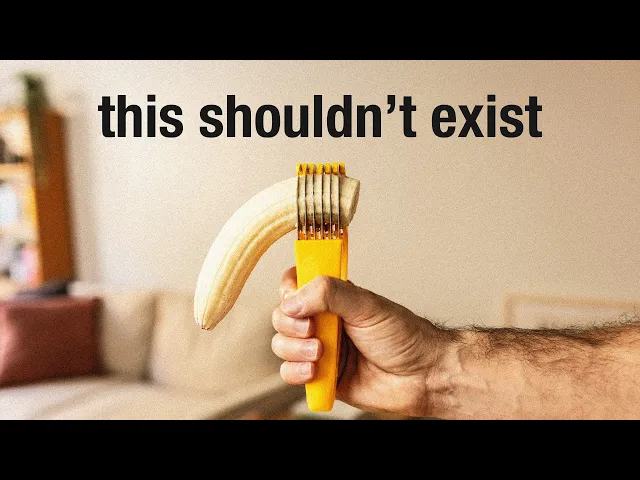
0:09 Handheld banana slicers, miniature keyboard vacuums, shower hair catchers.
0:13 They're cheap, they're novel,
0:15 they look useful for about 5 seconds and then they end up tossed in the trash.
0:19 A growing slice of social media has turned
0:21 into a 247 shopping channel where cheap products go viral,
0:25 clutter piles up, and the tactics used to hook us are getting harder to resist.
0:29 This video is sponsored by Squarespace.
0:31 I'll share more about why I use them for all my websites later.
0:34 You know, I don't use social media too much these days,
0:37 but sometimes my curiosity gets the best of me.
0:40 And recently, oh boy, did I get a real treat.
0:43 My algorithm took a hard turn into some of the most absurd,
0:47 useless, and wasteful products I have ever seen.
0:51 Suddenly, my feed was a parade of contraptions.
0:54 A designer cover for your trash bin,
0:55 a wheelspun bread cutter, detachable wine glass stems,
0:59 an egg yolk separator shaped like a basketball hoop,
1:02 and decorative toilet seat covers.
1:04 When I was a kid, it felt like they made something new every day,
1:08 like every day was Christmas.
1:09 This bed tent is the perfect way to get
1:11 more privacy and make date night more cozy.
1:13 This soap dispenser sticks to your wall and holds enough shampoo,
1:16 conditioner, and soap to last a year.
1:17 This is a wearable sleeping bag,
1:19 and it's great for staying warm whilst doing your daily tasks.
1:22 What the[ __] A wearable sleeping bag.
1:25 It's called a jacket.
1:27 You're looking for a jacket.
1:29 These products are the spiritual successors to the as seen on TV era.
1:33 Those infomercial gadgets that promise to solve
1:35 problems you didn't know you had.
1:37 Simply pour your favorite marinade into the flexible flavorizer.
1:40 Attach the needle, place into the flavor probe, and presto.
1:44 Back then, they were quirky, cheap, and sold through 2 a.m.
1:46 infomercials with a toll-free number.
1:48 And despite the terrible production value
1:50 and gimmicky sales techniques, they worked.
1:53 I couldn't believe how juicy these burgers came out.
1:56 I'm sorry.
1:57 This is one of my favorite clips.
1:59 I watched so many infomercials.
2:01 Something about this guy just kills me.
2:03 Like, this is a paid actor.
2:04 I can't believe how juicy these burgers came out.
2:07 I couldn't believe how juicy these burgers came out.
2:10 I can't believe how juicy.
2:11 Okay, I'm done.
2:12 On social media, that same formula works even better.
2:15 So-called internet entrepreneurs set up their phones, demo cheap products,
2:19 cut their videos to trending audio, and hit publish.
2:24 [Music] I got to say, you know, I was a skeptic at first,
2:33 but then I got this and I just realized how valuable this could
2:36 be for everyone from smoothie shop owners
2:38 to rabbis looking to increase their productivity.
2:41 These short clips are made for the algorithm.
2:44 They're unique, visual,
2:45 and pitch like magic solutions to frustrating problems in your life.
2:48 And the sellers hit every psychological trigger they can to get you to buy.
2:52 Novelty, scarcity, social proof, lowcost impulse buying,
2:56 and that oddly satisfying feeling that makes you want to watch again and again.
3:00 Short form, instant gratification, onepage checkouts,
3:03 Apple Pay, Google Pay, bundles, FOMO.
3:06 These are all the things that get people riing.
3:08 Boom.
3:08 Check out.
3:09 It's not that people are stupid.
3:11 These tactics are engineered to bypass our rational decision-making.
3:15 Okay, maybe people are a little bit stupid.
3:17 It turns out a swipeable video is far more powerful than a 30inute infomercial.
3:22 It's bite-sized, sharable, hypnotic to watch,
3:25 and since buying is easier than ever, this stuff is selling like hot cakes.
3:29 Speaking of hot cakes,
3:30 grab this portable hotcake maker now for 50% off in the next week.
3:33 These ads, they come in hard, they come in fast, they're very convincing.
3:37 So far in the last 2 hours,
3:39 I have purchased this car vacuum that has apparently NASA level suction.
3:45 This balance board cuz my balance sucks.
3:48 And this electric bird feeder which takes glamour shots
3:51 of the creatures in your backyard cuz they make it so easy.
3:54 It's just click click click click.
3:56 Then it's yours.
3:56 I didn't need any of this when I woke up this morning.
3:59 This constant stream of micro infomercials is making it
4:03 harder than ever to be intentional with our purchases.
4:07 And the views on these videos are insane.
4:10 Consider that electric crepe maker.
4:12 It pulled in 135 million views.
4:14 Click through to their profile and what you'll see is
4:17 that the same post has been uploaded over and over again.
4:20 They're fishing for another algorithmic hit.
4:22 For sellers, this is just a numbers game.
4:24 Most posts get tens of thousands of views.
4:27 Some take off and get millions.
4:29 And those kinds of numbers can translate into some serious money.
4:32 But who's really behind these accounts?
4:34 How do they make money?
4:35 And how does the whole operation actually work?
4:38 So, the internet has a long history of people turning to get-richqu
4:41 schemes to make a living all from the comfort of their bedroom.
4:45 Except now it's getting easier and easier to do.
4:48 And as the systems and tools for selling get easier,
4:50 more and more people are trying to strike
4:52 gold with cheap disposable products on social media.
4:55 There are a couple different models that people
4:56 are using to make money from these shitty products.
4:59 One of the lowest effort and easiest to get into is affiliate marketing.
5:03 With affiliate marketing, a seller shares a special link to a product and earns
5:06 a small commission each time someone uses that link to make a purchase.
5:10 Because that link uniquely tracks which sale came from them,
5:13 grabbing attention, views, and clicks becomes the heart of their business.
5:17 They create content designed to drive traffic and sales.
5:19 Whether it's a YouTube video, a blog post,
5:22 or a boosted Instagram reel, highlighting a product.
5:25 supposed benefits.
5:26 I've been doing affiliate marketing for a couple years now,
5:28 and without lifting a finger,
5:30 there's content that I've made a few years ago that's still making me
5:33 hundreds or thousands of dollars every month from a single piece of content.
5:38 Amazon runs the largest, most sophisticated affiliate program in the world
5:42 with over 900,000 affiliates globally.
5:44 In the right niche, those small commissions can add up.
5:47 Categories like home and beauty can pay rates of up to 8 to 10% per sale.
5:51 Take the Instagram account, The Sisters Shoppers.
5:54 With over 750,000 followers, their page is filled with nearly 800 posts,
5:59 each sharing a product they find on Amazon that are,
6:02 according to them, musthaves, like this nugget ice maker,
6:06 this pizza storage container, and this drink dispenser.
6:09 You know, musthaves,
6:10 because we've all felt the strain of lifting the milk out of the fridge,
6:14 twisting the cap, pouring it on our cereal, and putting it back in the fridge.
6:18 They post a new product almost every day.
6:20 Many of the videos rack up millions of views
6:22 with thousands of people in the comments asking for the link,
6:25 which by the way triggers an automated system that instantly
6:28 sends you a DM with the creator's unique affiliate link.
6:32 I don't think affiliate marketing by itself is inherently bad.
6:35 I use affiliate links sometimes when I recommend a book,
6:38 a product, or service that I find valuable.
6:41 Most creators that I know do the same as a way to earn supplemental income.
6:46 This year, I've made about $150 on average per month from it.
6:49 Most of it coming from a video I did in April
6:51 where I recommended one of my favorite self-help books of all time,
6:55 The Courage to be Disliked.
6:56 This income helps pay our grocery bills, but nothing crazy.
6:59 And that's because I don't push it or optimize for sales.
7:02 It's not my business model.
7:04 What's happening with these must-have accounts is different.
7:07 It's very unlikely that they're sharing products that they use or find helpful.
7:11 What's more likely is that they're actively hunting for items
7:14 that they think will go viral and generate commissions.
7:17 This is an entire system designed
7:20 not around recommending genuine products or sharing
7:25 things that you actually use and find
7:27 value in, but around manufacturing artificial needs,
7:32 trying to get people to buy things so then you can make money.
7:36 And this model is really just the tip of the iceberg for online sellers.
7:40 Affiliate marketing might get you a 10% cut,
7:42 but with a little extra effort, some sellers go even further.
7:46 They source cheap products from factories in China, set up an online store,
7:50 mark up the price 10, 20,
7:52 even 60 times the cost, and run the same viral playbook.
7:55 Welcome to the cutthroat world of drop shipping.
7:59 Drop shipping is an e-commerce model where you run an online store,
8:02 but don't keep any of the products in stock yourself.
8:05 When a customer places an order,
8:06 the details go to a third party seller who packs
8:09 and ships the product directly to the customer on your behalf.
8:12 You make money by charging the customer more than you pay the supplier.
8:15 Keeping the difference as profit.
8:17 You can literally run the entire operation
8:19 from your bedroom without ever touching inventory.
8:21 Here's how it typically works.
8:23 You find your next viral product by searching AliExpress.
8:26 Maybe this elegant toothpick dispenser.
8:28 You order a sample from the supplier to film content with.
8:31 Then you set up an online storefront.
8:33 From there, you launch content,
8:34 creating satisfying videos of the bird grabbing toothpicks with trending audio.
8:39 Most likely, you then boost it with paid advertising.
8:41 Next, you fulfill orders using a drop shipping app to send each
8:44 order automatically to the supplier who
8:46 ships the product straight to your customer.
8:48 And then finally, you repeat the same process with other shitty products.
8:51 This model takes some more upfront work,
8:53 building a website and creating a brand.
8:56 But the payoff can be much bigger.
8:58 The Instagram account Olivia finds with more than
9:00 391,000 followers promotes a different product in every post.
9:04 At first glance, the account looks similar
9:06 to the affiliate marketing example I showed earlier.
9:08 a handheld mop, a bed tucker, a rocking footrest.
9:12 Just place it under your desk and rest your feet on it.
9:15 The key difference with this model, though,
9:16 is that each of these products are sourced from AliExpress.
9:19 It took me about 2 seconds to find the original listed products.
9:23 So, Olivia sells the Ham Mop for $342, but it actually cost $168 on AliExpress.
9:30 The bed tucker sells for $14.94 and costs $3.13.
9:35 And the rocking footrest, man, that thing looks awesome.
9:37 that sells for $4941 but actually costs $7.31.
9:42 Those are some pretty big markups.
9:44 As one retired drop shipper, Thomas Despin put it in a Medium article.
9:48 We basically mark up a product anyone can find,
9:51 ship it slower than any one of the major e-commerce players,
9:54 and we call this a business.
9:55 Now, you might be thinking, "Come on, Matt.
9:58 People aren't actually buying this stuff.
10:00 There's no way.
10:01 I mean, it's obviously just a bunch of crap." But then you look at the comments
10:05 and you see so many people commenting
10:09 the word foot over and over and over again.
10:12 By the way, for a limited time, if you comment foot below this video,
10:15 I'll send you a picture of my foot.
10:16 At this point, you know that I'm not
10:18 a fan of useless products that serve no purpose.
10:21 So, if I were going to build a website using Squarespace,
10:24 my sponsor for this week's video, this is what I definitely wouldn't do.
10:28 I wouldn't invent a product called the self stirring spatula for times
10:32 when stirring your homemade curry is just too much for your wrist.
10:34 I wouldn't go to Squarespace to grab the brilliant domain stircatula.com.
10:39 I wouldn't use Squarespace's new blueprint AI
10:41 website builder to fill in the details
10:43 for this completely pointless product and have a full site set up in minutes.
10:46 And I definitely wouldn't set up an online store, launch a blog,
10:49 and manage analytics all while my dinner stirs automatically in the background.
10:53 Instead, I'd use Squarespace to build a website
10:55 that hosts my content, course, and links,
10:57 using it to help me run a business in a way that feels good to me.
11:00 If you want to do the same,
11:01 then go to squarespace.com to sign up for your free trial.
11:04 And then, when you're ready to launch,
11:06 go to squarespace.com/mattella to save 10% off
11:09 your first purchase of a website or domain.
11:12 Definitely don't use it to make a shitty product.
11:14 Please, please don't do that.
11:15 Now, before you get too excited, slap a logo on a banana phone cover,
11:18 and open up shop, there's something you should know.
11:20 While some drop shippers have reportedly made hundreds of thousands,
11:24 if not millions of dollars per year, more people end up going bust.
11:27 Consider some of the comments on the business subreddit about drop shipping.
11:31 You need to be a customer service black belt to drop ship.
11:34 Margins are low and volume has to be high.
11:36 You spend most of your time
11:37 fielding questions about products and late deliveries.
11:40 The enthusiasm is there for selling,
11:42 but so is the negativity and ability to adapt
11:44 to people's needs beyond a salesman's point of view.
11:46 Most people who make money from drop shipping aren't drop shipping at all,
11:50 but selling courses on how to do it.
11:52 The easiest way to spot these people, by the way,
11:53 is that they do a fast Zoom at the beginning of all their videos.
11:57 There are hundreds, if not thousands of people
11:59 teaching others how to build these kinds of businesses.
12:02 Michael Craig, founder of the co-working space dojo, said of these gurus,
12:06 "My main gripe is that you're selling a course for $6,000
12:09 to a person from middle America who's put all their funds
12:12 into this." And you're teaching them to sell avocado slicers
12:15 online with 40 other people who are also selling avocado slicers.
12:19 While free native content posted directly to Instagram or Tik
12:22 Tok can work for creators who already have an audience,
12:25 most newcomers start with zero followers and have
12:27 to pay for ads just to get their product seen.
12:29 That means that a 60 times markup on a toilet seat cover
12:32 starts to erode pretty quickly once you factor in things like ad spending,
12:36 payment processing, shipping fees, refunds, and customer service.
12:40 In the end, a few people sure end up winning big,
12:43 but the majority spend their time managing
12:45 unhappy customers and watching their margins disappear.
12:48 Underneath all this is the unspoken, slow spinning wheel of consumerism.
12:53 It's the undercurrent of the entire system.
12:56 The conversation in these communities is all about
12:58 making money and nothing about how they're making money.
13:00 It's never about ethics or what's right or the fact
13:03 that the ads they're buying are hunting people from sight to sight,
13:06 hammering them with ad after ad trying
13:08 to get them to buy another useless product.
13:11 Millions of products flood timu, Amazon, Alibaba, and AliExpress every year.
13:16 It's a constant conveyor belt of[ __] in,[ __] out.
13:20 It fills our homes, gives us a flicker of satisfaction,
13:23 and then gets shoved into a drawer or tossed in the trash.
13:26 As one expert in the documentary, By Now,
13:28 the shopping conspiracy pointed out, you can't just throw something away.
13:33 There's no magical place called away.
13:35 It all ends up somewhere, landfills, incinerators, or oceans.
13:39 But I also understand that some people watching this are
13:43 starting to feel a little bit jaded about saving the environment.
13:47 We don't really feel this need or personal
13:50 responsibility to save the planet when billionaires burn through
13:54 more CO2 in a weekend than we ever could
13:56 in a lifetime of purchasing cheap shitty products online.
14:00 I know I'm not perfect myself.
14:02 I mean, I bought a banana slicer as a prop for this video.
14:04 And you better believe that I'm going to return
14:06 that as a change of mind because Jeff Bezos.
14:09 But I think there's another more compelling
14:12 and slightly selfish reason to stop buying this crap.
14:16 And that's because it's all just a distraction.
14:19 It eats your money, your space, your attention,
14:21 and it trains you to chase the next
14:23 musthave instead of appreciating what you already have.
14:27 It's hard to live slowly and intentionally
14:29 when you're being hit from every angle.
14:31 But you still get to decide how you spend your time,
14:34 your money, and your attention.
14:36 Having less, and more importantly, wanting less,
14:38 frees up space in your home and in your mind,
14:41 making it a little easier to focus on what genuinely makes you happy.
14:44 Then again, that banana slicer looked pretty cool.
14:48 [Music] So, I've been having a lot of fun diving
14:56 into these topics and I'm going to do more of them.
14:59 I've got so many ideas,
15:00 but I also know that with the lack of time that I spend on social media,
15:05 I could use your help.
15:07 So, if you've got a video idea or a topic that you want me to cover
15:09 or something that you want me to look into, I've opened up a new tip line.
15:13 Just shoot me an email at just the tip@mattella.com.