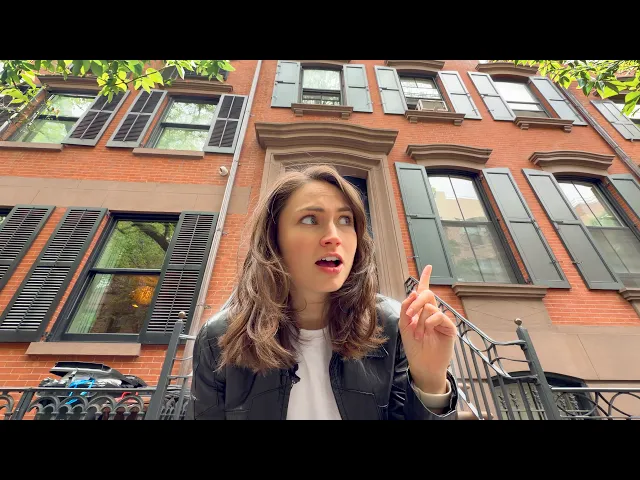
Why This NYC Neighborhood is So Expensive
Taylor Bell
0:00 New York City is expensive.
0:02 It's been expensive for decades,
0:04 but prices have accelerated sharply since the9s,
0:07 and in more recent years, things have got downright absurd.
0:10 The median asking rent in Manhattan is up 85% since 2021,
0:15 up from $2,700 per month to now almost $5,000 per month.
0:20 Major firms in tech and finance have left or reduced
0:22 their New York City footprint due to high costs.
0:25 And I sometimes look at how much more space I could get
0:28 in LA for what I pay to live here in New York.
0:30 It's saying something when I look at Los Angeles as a cheaper comparison.
0:34 But when I think about the extreme end of New York's high cost,
0:38 one neighborhood in particular stands above all others.
0:41 The neighborhood where it seems like everyone wants to live,
0:44 especially women in their 20s wearing this exact outfit.
0:47 More on that later.
0:48 The neighborhood with endless trendy and renowned restaurants,
0:51 cute bars selling $20 cocktails,
0:53 and photogenic baked goods with a one-hour line.
0:55 And the neighborhood with beautiful treeline
0:58 streets and low-rise quintessential brownstone charm.
1:00 It is none other than the West Village.
1:03 Now, New York is expensive, but the West Village a whole other level.
1:07 The median asking rent here is $6,000 per month,
1:11 a thousand more than the overall Manhattan average, which is already absurd.
1:16 But why?
1:16 Well, there are some obvious reasons.
1:18 It's beautiful and quaint, incredibly centrally located, and it has the scene,
1:25 but I figured that whatever makes the West Village
1:27 so expensive today must go deeper than just vibes.
1:30 And it does.
1:31 It goes all the way back to 1811 to a decision
1:35 about city urban planning that people didn't think would matter.
1:37 And a woman in the 1960s who fought
1:40 to save this neighborhood and accidentally made it unobtainable.
1:52 Let's discuss.
1:54 First, let's get oriented.
1:56 The West Village is located in the Manhattan burrow of New York City,
2:00 right here on the west side,
2:02 and it's technically a smaller part of the broader Greenwich Village.
2:06 The term West Village actually wasn't coined until
2:08 the 1950s to distinguish the quieter western portion
2:11 of Greenwich Village from the more heavily redeveloped eastern
2:14 sections of today near NYU and Washington Square Park.
2:18 What really stands out on this map is that the West
2:20 Village is a bunch of diagonal lines and triangles,
2:23 very different compared to the strict
2:24 90° angle grid like its surrounding neighborhoods.
2:27 After 5 years of living in New York, I rarely get turned around in the city.
2:31 But when I do, it is almost always
2:33 in the West Village because it's not on the grid.
2:36 But why isn't it?
2:36 Well, the 1807 act establishing the commissioner's plan,
2:40 which was finalized in 1811, was focused on organizing the future
2:44 development of Manhattan north of Hston Street.
2:47 So, for practical reasons,
2:49 the plan intentionally left out already established irregularly
2:52 shaped streets of lower Manhattan to reduce disruption.
2:55 This included not just the West Village, which was already populous at the time,
2:59 but also other dense established neighborhoods below House and Street,
3:02 including Chinatown and Little Italy.
3:04 Now, what was the West Village's significance at the time?
3:06 And why was it already populous?
3:08 Thanks for asking cuz I read a lot about it and it's super interesting.
3:11 During the late 1700s and early 1800s,
3:13 Greenwich Village was considered a safe rural retreat from yellow fever
3:17 outbreaks and what was often described as a nightmare of crowded,
3:21 filthy conditions in the southernmost tip of Manhattan.
3:23 what is now the financial district.
3:25 Residents would flee from disease epidemics up to Greenwich Village,
3:29 which by contrast was at higher elevation,
3:31 had fresher air, and just fewer people at the time.
3:33 Well, it didn't take long for this influx
3:35 of people escaping epidemics to transform
3:38 Greenwich Village from a quiet collection of farms
3:41 into a densely populated residential neighborhood itself.
3:43 And this is why it was already established enough to get left out
3:47 of the 1811 commissioner's plan that established the famous New York City grid,
3:52 leaving myself and millions of other New Yorkers to get
3:54 turned around in its cute little maze of triangles.
3:58 And if you've ever tried to apartment hunt in New York City,
4:00 you know that it's basically a part-time job.
4:02 You've got 17 street easy tabs open.
4:04 These days, you might have Craigslist and Reddit tabs open, too.
4:08 Desperate times.
4:09 You're trying to compare neighborhoods.
4:10 there's a walkability score you don't really trust and you're supposed to sift
4:13 through all of that while being ready to commit on the spot.
4:16 So, I built this a neighborhood comparison dashboard that puts rent,
4:20 walkability, and transit all side by side using emergent.
4:22 And here's why this is so great.
4:24 You can go over here and actually adjust these sliders
4:28 and then it dynamically changes
4:29 these different neighborhoods for you to consider.
4:31 Now, these are fancy schmancy ones.
4:33 So, let's lower the cost.
4:34 Nice.
4:35 So, when you actually click into one of these, let's
4:36 click into one of my favorites, East Village.
4:38 That's where I used to live.
4:39 You can see sort of a oneliner on what makes this neighborhood famous.
4:43 A few different tags, and I can vouch for all of these.
4:45 The average monthly rent for studio, one-bedroom, and two-bedroom,
4:47 you do not get this view in Street Easy, let me tell you.
4:51 The nearby subway lines and bus lines, and it just looks clean and chic.
4:55 Anyway, highly recommend trying Emergent for yourself, and it's so easy.
4:57 I literally described what I wanted in plain English,
5:00 and it just built it into this real web app.
5:03 Emergent lets anyone build a fully functional deployed web app from a plain
5:07 English prompt with the backend login and data all handled for you.
5:10 So if you have an idea for a little tool that will make your life easier,
5:14 you can just have it.
5:14 If you want to try it, there's a link in my description.
5:17 You can start from a blank prompt or honestly you
5:19 could just steal my idea and build your own neighborhood dashboard.
5:21 Now onto the historic culture of the West Village.
5:26 In the early 1900s, the West Village went
5:28 on to become the birthplace of American Bohemia.
5:31 home of the poets and peasants as the newspapers would report it.
5:35 Cheap rents attracted writers, artists,
5:37 and political radicals who wanted to live among the winding non-grid streets
5:42 that felt physically separate from the rest of the conformist industrial city.
5:45 The names of the people who called the village home
5:48 at one point or another almost reads like an American literature syllabus.
5:52 Mark Twain, Walt Whitman, Edgar Allan Poe, Isadora Duncan, William Faulner,
5:57 Eugene O'Neal, Jackson Pollock, and then later people like Andy Warhol,
6:00 Salvador Dolly, and importantly,
6:02 the earlier of these residents were not here because it was prestigious.
6:06 It's because they could afford to be.
6:08 After the early Bohemians came the 1930s through50s wave of jazz,
6:13 the beat generation, and folk musicians.
6:15 Farney Josephson opened Cafe Society in 1938 with the intent
6:18 of creating the first racially mixed jazz club in New York,
6:22 which at the time was a statement that this neighborhood didn't abide
6:24 by the rest of the segregationist rules
6:27 that govern the rest of the city's nightlife.
6:29 For its opening night,
6:30 he found a then unknown singer by the name of Billy Holiday.
6:33 The Village Vanguard opened in 1935 and is
6:36 the world's oldest continuously operating jazz club,
6:39 hosting icons like John Cold Train and Miles Davis.
6:41 Then came the key figures of the beat generation which
6:44 was a 1950s countercultural literary movement led by Jack Carowak,
6:49 Alan Ginsburg and William Esparrows who all met at a bar in the West Village.
6:53 Their works rejected postworld War II conformity,
6:56 materialism, and traditional literary forms.
6:58 Ideas that would go on to heavily influence the 1960s hippie counterculture.
7:02 And not long after this would folk musicians like Bob Dylan and Joan Bayz
7:07 be playing their guitars and coffee houses
7:08 for just a couple dollars to small crowds.
7:10 Now, let's stop for just a second to think
7:12 about the fact that these incredibly influential writers,
7:16 artists, musicians were coexisting and bouncing ideas off
7:19 of each other within just a few of these blocks.
7:21 Yes, over the course of the decades, but still, it is staggering.
7:25 Now, the culture that was born from these people
7:27 would of course evolve or devolve from some perspectives.
7:29 For example, Jack Carowak at the end of his life
7:33 famously despised the hippies and viewed them as a degenerate,
7:36 pretentious parody or corruption of the original beat generation.
7:39 But there is no denying that the West
7:41 Village created a social microcosm of post-war New York,
7:45 restless, idealistic,
7:46 and diverse that would go on to influence American counterculture from feminism
7:50 to civil rights to rock and roll for decades to come.
7:54 And finally, the historical culture of the West
7:56 Village is incomplete without the 1969 Stonewall riots.
8:00 When the police raided Stonewall Inn,
8:02 a gay bar in the village, the patrons fought back.
8:04 four nights of demonstrations that are now widely considered the single
8:07 most important catalyst of the modern LGBTQ rights in the United States.
8:12 In 2016, Stonewall became the first national
8:15 monument in the US dedicated to LGBTQ history.
8:18 As we can see, a place so steeped in culture
8:22 made the West Village a neighborhood worth fighting to preserve.
8:24 And someone did fight for it.
8:27 Here's what happened.
8:29 All right, going back to our original question.
8:33 Why is the West Village so expensive?
8:35 Well, this is where things get interesting.
8:37 In the 1960s, Robert Moses,
8:39 an urban planner who was responsible for developing many
8:41 of the highways and bridges in and around New York City,
8:45 not without plenty push back, but that's another video,
8:47 declared the West Village a slum to justify redevelopment.
8:51 Moses aimed to demolish the area for new construction,
8:54 including modern apartment towers and through traffic roads.
8:57 Well, as you can see, that didn't happen.
8:59 The West Village is one of the few places
9:01 in Manhattan that doesn't have any of those modern glass highrises.
9:05 So, what stopped Moses's plan?
9:07 An urban activist and author by the name of Jane Jacobs.
9:10 Jacobs, who was living on Hudson Street in the West Village at the time,
9:13 headed the committee to save the West Village in 1961,
9:17 claiming that Moses's plan would destroy the vibrant
9:20 neighborhood fabric and displace thousands of families.
9:23 Jacob's efforts were successful,
9:24 leading to the 1969 decision by the New York City Landmarks
9:28 Preservation Commission to designate the West Village as a historic district.
9:32 This landmark decision would preserve over 2,000 structures,
9:36 and redevelopment in the area became severely restricted.
9:38 You can probably see where this is going.
9:40 To this day, developers must preserve the main facade
9:44 and aesthetics of these historic buildings in the West Village,
9:47 even during renovation.
9:48 Can change them all you want on the inside, which they certainly do.
9:53 The outside has to say the same.
9:54 The result is a neighborhood that looks almost
9:57 identical to how it did 200 years ago.
10:00 The beautiful low-rise federal and Greek revival
10:03 row houses built in the 1820s and 1840s.
10:06 The original brownstone stoops, the cast iron railings,
10:09 the cornises, the cobblestone streets,
10:11 some of the oldest surviving architecture in Manhattan
10:15 left frozen exactly how Jane Jacobs left it.
10:18 I think that it is indisputably one
10:20 of the most beautiful places in New York City,
10:23 which is also one of the reasons why it
10:25 has become so expensive and unobtainable for most people.
10:30 Let's talk about it.
10:33 Since Jane Jacob's successful efforts to preserve the West Village,
10:35 there has been virtually no new construction.
10:38 Just three new construction filings have been made since 2013.
10:42 The median construction year for buildings in the West Village is 1938.
10:46 And get this, the West Village actually saw a net
10:49 drop in the amount of apartments through the decade until 2020,
10:53 losing between half a unit to six units per acre because so
10:56 many ultra rich residents have combined
10:58 apartments into single mega mansion town homes.
11:01 To put this lack of development into perspective,
11:03 Hudson Yards, Long Island City, the Greenpoint Waterfront,
11:06 and downtown Brooklyn have added up to 65 new units per acre in the same period.
11:12 The contrast is stark.
11:12 So, what happens when there is
11:14 severely restricted housing supply in a beautiful,
11:17 quaint little neighborhood,
11:18 plus a growing economy and New York City population with high income earners?
11:23 You guessed it, extremely high prices.
11:25 And this is the irony of it all.
11:28 Jane Jacobs herself advocated
11:30 for preserving older buildings specifically because
11:32 their lack of economic value made them affordable for poor residents.
11:37 In this regard, she saw these old buildings as guarantors of social diversity.
11:42 At the time, she found it unimaginable that her efforts
11:45 would be the exact ones to facilitate gentrification of the neighborhood.
11:48 This has led to a mixed bag of criticism towards Jacobs.
11:52 Some find her initial planning flawed because of course this would
11:55 happen when you restrict new development
11:57 in a highly desirable growing neighborhood.
11:59 Others are more forgiving,
12:00 remembering her good intentions to preserve a culturally rich,
12:04 diverse, picturesque neighborhood.
12:05 and this being an unfortunate but unexpected byproduct of that.
12:08 Regardless of where you fall on that matter,
12:10 what the West Village is today is almost unrecognizable,
12:14 save for the buildings themselves,
12:15 compared to the diverse neighborhood that Jacobs fought to protect.
12:18 What's left is a neighborhood that has become so expensive that it
12:22 selects for a specific type of person who can afford it.
12:25 So, who exactly are those people today?
12:30 Buckle up.
12:30 The modern culture of the West Village is notorious.
12:35 The recent viral article, It Must Be Nice to be a West Village girl,
12:39 swept the internet in social media,
12:42 seeding further videos, skits, discussions, Reddit threads,
12:44 all about how the neighborhood has become unbearably vanilla.
12:48 And I don't just mean white, although yes,
12:51 the West Village is 82% white compared to the overall city average of 31%.
12:56 but rather the pervasive monoculture of the 20something woman who
13:00 walks around wearing the West Village uniform, a white tank top,
13:04 lightwash baggie jeans and Adidas sambas or a matching workout set with an iced
13:08 matcha latte from Blank Street and hands
13:10 and hair sllicked back into a tight ponytail.
13:12 I did my best to dress the part for today.
13:14 I don't know if the leather jacket is part of the uniform,
13:17 but I improvised and I think I'm pretty close.
13:19 She works in finance, marketing,
13:21 or tech and often has active social media accounts on the side.
13:23 She has seemingly endless disposable income.
13:26 goes to Pilates classes, wears Cardier love bracelets,
13:28 goes to the hip restaurants and bars, and posts photos of the $20 apparel
13:32 spurses that she gets on her Instagram stories.
13:34 She moved to the West Village because girls that she knew from college
13:37 told her to, and she watched Sex in the City to prepare.
13:39 The West Village girlies are,
13:41 as one of them told the writer, totally unironically, proudly basic.
13:45 Of course, it's not just women.
13:48 There is also the stereotypical male equivalent who is typically a 20-something
13:53 finance bro who in his own way is just as uniform.
13:56 And then there's the other end of the market,
13:58 the celebrities and business people who own their West Village homes.
14:02 Hugh Jackman, Nicole Kidman, Sarah Jessica Parker, Taylor Swift, Julian Moore,
14:06 not to mention all the hedge fund owners and tech founders.
14:09 The West Village has become one of the most
14:11 celebrity dense neighborhoods in the entire country.
14:13 So that's who the West Village selects for today.
14:17 the affluent 20some and the A-listers.
14:19 But before I give you my take on all
14:20 But before I give you my take on all
14:20 But before I give you my take on all this, I was lucky enough to get a quick
14:22 chat with a resident who's lived here for over
14:24 50 years to hear how he thinks things have changed.
14:28 Here's my little microphone.
14:29 Here's my little microphone.
14:29 Here's my little microphone.
14:29 Tiny microphone.
14:29 Tiny microphone.
14:30 Tiny microphone.
14:30 Tiny microphone.
14:31 Tiny microphone.
14:31 Tiny microphone.
14:31 Gary, nice to meet you.
14:32 Gary, nice to meet you.
14:32 Gary, nice to meet you.
14:32 Nice to meet you.
14:33 Nice to meet you.
14:33 Nice to meet you.
14:34 And indeed, it has changed, but it's all
14:35 And indeed, it has changed, but it's all
14:35 And indeed, it has changed, but it's all there.
14:36 It's also remnants of everything that was.
14:38 When you get older, you you look back and you
14:41 think the sadness of so many things that are gone.
14:43 And I really mourn those things.
14:45 the best years of your life when you're very very young.
14:49 Everything is ahead of you and so at your age,
14:51 it must be a wonderful place to be in it must be a wonderful place to be in
14:53 it must be a wonderful place to be
14:54 in the village and it's still a wonderful place for me,
14:56 but I still I feel that it's past me and I mourn that but I'm really
15:01 mourning my youth is what I'm doing
15:03 and the village is a beautiful place to live.
15:05 It's gorgeous undoubtedly.
15:07 Unfortunately, it's so undoubtedly.
15:07 Unfortunately, it's so undoubtedly.
15:08 Unfortunately, it's so expensive and this, you know,
15:09 this used to be a very, very gay neighborhood, right?
15:12 And it's and there's still gay people here,
15:14 but things move, progress, different types of people move.
15:16 And unfortunately, this is just pretty much all white rich people,
15:20 but it sounds like the sort of the but it sounds like the sort of the
15:21 but it sounds like the sort of the beauty and the special charm
15:23 of the West Village that you loved
15:24 initially is still makes it worth living here.
15:27 Oh, it's wonderful place to live.
15:28 Oh, it's wonderful place to live.
15:28 Oh, it's wonderful place to live.
15:28 Absolutely.
15:29 Absolutely.
15:29 Absolutely.
15:29 There's lovely things to do here, There's lovely things to do here,
15:30 There's lovely things to do here, of course.
15:31 But what's gone?
15:32 I mean, you of course.
15:32 But what's gone?
15:32 I mean, you of course.
15:32 But what's gone?
15:33 I mean, you you wouldn't believe the restaurants it used to be really really
15:35 really and the affordability that it used to
15:37 and the affordability that it used to and the affordability that it used to be.
15:38 I appreciate getting your take.
15:39 I appreciate getting your take.
15:39 I appreciate getting your take.
15:39 It'll always be here.
15:40 It'll always be here.
15:40 It'll always be here.
15:40 Yeah.
15:40 Yeah.
15:40 Yeah.
15:40 Nice to meet you.
15:41 Nice to meet you.
15:41 Nice to meet you.
15:41 Yes.
15:41 Thank you so much.
15:42 It was nice Yes.
15:42 Thank you so much.
15:42 It was nice Yes.
15:42 Thank you so much.
15:43 It was nice meeting you.
15:43 Thank you so much.
15:46 Byebye.
15:46 Byebye.
15:46 Byebye.
15:46 All right.
15:47 As much as I enjoyed reading All right.
15:48 As much as I enjoyed reading All right.
15:48 As much as I enjoyed reading that article for entertainment
15:49 purposes and summarizing the West Village girly archetype to you,
15:53 I do think it's probably a little too easy to be snarky
15:56 towards these people or assume that they are inherently bland as people.
15:59 I'm more so of the opinion that every decade
16:01 has its own version of the aspirational young person flooding
16:05 the West Village and that people should just let
16:07 them have their fun without being so bothered by it.
16:10 And also, who can really blame them?
16:11 They just moved to the city from college.
16:13 They're starting to make a little bit of money
16:15 and or have parents who help them out.
16:16 And they want to live in the IT
16:18 neighborhood for the few years that they are here.
16:20 Story as old as time.
16:21 However, after reading a ton of Reddit threads,
16:24 there does seem to be one interesting difference this time.
16:26 In the Sex in the City era, you at least had four different archetypes to choose
16:31 from and then put your own spin on.
16:33 Carrie Bradshaw was a lot of things, but she was not a formulaic dresser.
16:36 Today, as someone in that Reddit thread pointed out,
16:39 everything gets averaged out to the most neutrally aspirational ideal.
16:43 Everything has its hard or weird edges sanded off.
16:46 Someone else noted that the West
16:48 Village girly is the tick-tockification of society,
16:50 a sort of flattening effect where a lot
16:53 of individuality has been lost in the process.
16:56 Hence, everyone wearing the same outfit and enjoying the same hobbies.
16:59 Interesting take though.
16:59 I kind of buy it.
17:01 And finally, there is an interesting irony that the article points out.
17:05 When everyone is the main character is anyone,
17:07 a neighborhood that was historically defined by radical individuality,
17:11 people who came here specifically to be different has become
17:15 the preferred backdrop for a content aesthetic that rewards sameness.
17:19 Will it last forever or is it cyclical?
17:21 Several longtime residents weighed in.
17:23 As one of them put it, I can't help but think that it's all cyclical
17:27 and that that sameness will eventually give way to more quirks and variety.
17:31 The West Village has reinvented itself before after all.
17:33 So, why is the West Village so darn expensive?
17:37 Because in 1811, it was left off the grid.
17:40 Because in 1961, someone fought to keep it exactly as it was.
17:44 Because those two things together made it beautiful,
17:47 scarce, and desirable all in the right order.
17:49 And then Carrie Bradshaw and the internet made sure everyone knew about it.
17:52 The neighborhood that was once too cheap for anyone except the Bohemians
17:56 to care about is now too expensive for almost anyone to afford.
18:00 But hey, it's beautiful to walk through.
18:02 What other New York City neighborhood should I investigate next?
18:04 Let me know in the comments.
18:05 And please hit subscribe if you enjoy this.
18:07 It's totally free.
18:08 Hit thumbs up, too, if you're feeling crazy.
18:10 I researched a lot for this video, so I would really appreciate it.
18:12 And until next time, turtle out.
18:17 We'll wait for that classic.
18:21 Say tick tockification 10 times fast.
18:24 Tik Tockification.
18:25 Tik Tockification.
18:26 Tik Tockification.
18:26 Tik Tok.
18:26 What's your word?
18:27 Are you Taylor?
18:28 Are you Taylor?
18:28 Are you Taylor?
18:28 Yeah.
18:28 Yeah.
18:28 Yeah.
18:29 Big fan.
18:29 Big fan.
18:29 Big fan.
18:30 Oh, thanks.
18:30 That's so nice.
18:31 Oh, thanks.
18:31 That's so nice.
18:31 Oh, thanks.
18:31 That's so nice.
18:32 Walking across Manhattan video.
18:32 Walking across Manhattan video.
18:32 Walking across Manhattan video.
18:33 Oh my.
18:33 I appreciate it.
18:34 Thanks for Oh my.
18:34 I appreciate it.
18:34 Thanks for Oh my.
18:34 I appreciate it.
18:34 Thanks for saying hi.
18:39 Hi.
18:41 Okay.
18:42 Okay.
18:42 Okay.
18:43 Not so quaint after all.
18:44 Is this dude on stilts?
18:48 That's so crazy.
18:49 Oh, only in New York.
18:52 Howdy.
18:52 If you enjoy this video, I would Howdy.
18:53 If you enjoy this video, I would Howdy.
18:53 If you enjoy this video,
18:54 I would bet at least $6,000 per month that you will also like this one.
19:00 Check it out.
19:01 I'm just waiting for Sarah Jessica Parker to pass me, but she hasn't yet.
19:08 Rude.