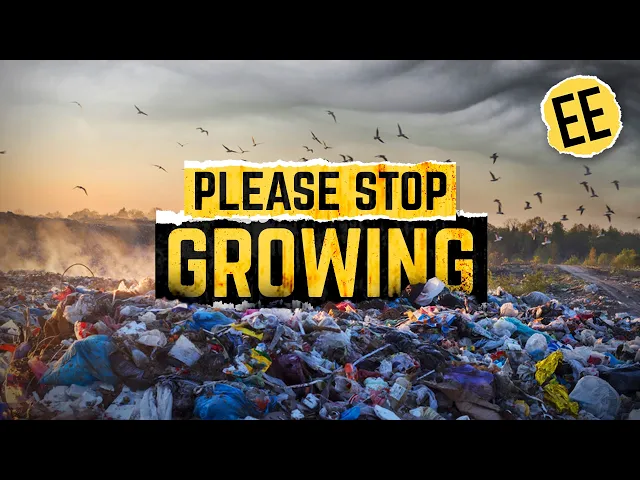
The Degrowth Paradox
Economics Explained
0:00 What if saving the planet means giving up on economic growth?
0:03 That's the trade-off now confronting governments, investors,
0:05 and voters worldwide because the global economy is at a crossroads where
0:10 the urgent fight against climate change
0:11 is clashing with economic growth ambitions.
0:14 On one hand, the world has never been more serious about climate change.
0:17 More than 145 countries that together account
0:20 for roughly 77% of global greenhouse gas
0:22 emissions have now set or are exploring net zero goals for the coming decades.
0:26 Cutting pollution has become a global priority,
0:28 not just for preserving the environment,
0:30 but for public health, energy security, and long-term economic stability.
0:34 But there's [music] a problem.
0:35 The quickest way to cut emissions is to reduce the activities that produce them.
0:39 This means using less coal and gas power, steel and cement,
0:42 aviation, shipping, fertilizer, petrochemicals,
0:44 and even parts of industrial agriculture.
0:47 And shrinking those sectors comes with a cost.
0:49 [music] They're some of the largest employers
0:50 and biggest sources of exports in the world.
0:53 So if you shrink them too quickly, you're not just reducing emissions,
0:56 you're also cutting jobs, wage growth,
0:58 and the pathways people use to climb the income ladder.
1:01 That uncomfortable tension is what has pulled degrowth,
1:03 a once academic concept, into mainstream climate discussions.
1:06 Degrowth argues that on a planet with finite resources,
1:09 countries should deliberately scale [music]
1:11 back resource inensive production and consumption.
1:13 In theory, that means smaller, slower,
1:15 and more sustainable economies with less waste,
1:17 reduced emissions, and a tighter focus
1:19 on well-being instead of endless GDP growth.
1:21 And as climate science has become more urgent, the idea has gained momentum.
1:25 Degrowth now shows [music] up in reports
1:27 from the intergovernmental panel on climate change,
1:29 a UN environment program, and the concept is becoming more mainstream.
1:32 Books like Cohido's Capital in the Anthroposine,
1:35 which sold over half a million copies in Japan,
1:37 have helped push degrowth into public conversation.
1:40 But while degrowth has gained attention,
1:41 the trade-offs it entails are becoming increasingly evident as well.
1:45 For example, Europe has cut its emissions
1:47 more than almost any region in the world,
1:48 down roughly 37% between 1990 and 2023, while its economy has almost tripled.
1:54 But the transition hasn't come without its costs.
1:57 Carbon pricing and energy reforms have pushed electricity prices higher,
2:00 squeezed factories, and contributed to protests
2:02 like France's yellow vest movement.
2:04 Japan shows that you can run one
2:05 of the lowest emission economies among advanced industrial nations
2:08 and still face decades of weak growth because
2:10 of deeper structural issues like a rapidly aging population,
2:13 low birth rates, and persistent deflation.
2:15 And all this is happening in a world where
2:17 nearly 700 million people still live in extreme poverty,
2:20 surviving on less than $2.15 a day.
2:23 For these people, talk of degrowth sounds less
2:25 like climate policy and more like a threat.
2:27 If rich countries stop growing,
2:28 does that also close the door on development for everyone else?
2:32 So, we're left with a dilemma.
2:33 We [music] know the planet cannot handle business's usual emissions.
2:36 We know rapid cuts will hit some workers and regions harder than others.
2:40 And we know that telling nearly a billion people who have never experienced
2:43 prosperity to just accept slower growth
2:45 is both tonedeaf and maybe politically explosive.
2:49 So, as always, we've got some important questions to answer.
2:52 If cutting emissions is unavoidable,
2:55 which parts of the economy actually have to shrink and which ones don't?
2:58 How are countries already living these trade-offs today?
3:01 And is there any realistic way to grow and decarbonize at the same time?
3:05 Or is some form of degrowth inevitable?
3:08 When putting together this video and almost every
3:10 other video on this channel covering current events,
3:12 we rely heavily on reporting [music] from The Economist,
3:14 which is why I am so proud to have them as an advertising sponsor.
3:17 The [music] Economist delivers insight that helps
3:19 you see the bigger picture through timely, thoroughly fact-checked,
3:22 and in-depth expert analysis on the big issues around the world,
3:25 like this very timely article about
3:27 the Netflix and Paramount merger from December
3:29 9th that laid out everything going on behind the scenes of this deal.
3:32 The Economist Sack not only covers their daily journalism,
3:35 but also includes subscriberonly podcasts, audio versions of their articles,
3:39 and longer video discussions with their editors.
3:41 As a viewer of Economics Explained, you get a special 35% off discount to enjoy
3:45 The Economist and all it has to offer for less.
3:47 Head over to their website at economist.com/explain to get started.
3:52 If you zoom out and look at where global
3:53 emissions actually come from, the picture is pretty simple.
3:56 Most of the world's emissions don't come
3:58 from plastic bags or people forgetting to recycle.
4:01 They come from the unglamorous backbone of modern life.
4:04 In other words, the stuff we rarely think [music] about,
4:06 energy, concrete, and steel, fuel, and food.
4:08 Together, these sectors account for the vast majority of global emissions.
4:12 [music] As it turns out,
4:13 they're also some of the biggest employers and largest exporters on the planet.
4:16 The heavy industry alone, which includes steel, cement,
4:19 and petrochemicals, produces about 22% of the world's CO2 emissions.
4:23 And if you zoom out further
4:24 and include the entire building and construction sector,
4:26 the share rises to roughly 37%.
4:29 To reach net zero, these industries can't just make a few minor improvements.
4:32 Some of them need to change so
4:34 dramatically that parts of them will inevitably shrink.
4:36 Take electricity.
4:37 If the goal is to fully decarbonize,
4:39 the world has to move away from coal and gas and toward renewables.
4:42 On paper, that sounds straightforward until you remember that in many places,
4:46 those fossil fuel plants are actually the economic anchors of entire regions.
4:50 When a coal plant shuts down early, it's not only workers who lose their jobs.
4:54 Contractors also lose work.
4:56 The local tax base shrinks,
4:57 and the towns built around that plant start to hollow out.
5:00 We can watch that tension playing out across the world in real time.
5:03 In the US, coal heavy states like West Virginia and Wyoming
5:06 face steep job losses as mines and plants scale down.
5:08 In India, coal still puts food on the table for millions of workers.
5:12 And in South Africa, where 80% of electricity still comes from coal,
5:15 [music] rolling blackouts are already a warning
5:16 sign of how fragile the system is.
5:18 In places like these, shutting plants down
5:20 too quickly risks destabilizing an entire region.
5:23 And yes, the energy sector as a whole is still growing.
5:26 Today, it employs around 76 million people with more
5:29 than 5 million new jobs added since 2019.
5:31 [music] But that growth doesn't land where coal plants are closing,
5:34 new energy jobs cluster around manufacturing hubs,
5:37 grid infrastructure, and clean tech supply chains,
5:39 often far from the regions built around fossil [music] fuels.
5:42 So even if renewables look cheaper on paper,
5:44 the real world transition is far from smooth.
5:47 Steel and cement, which account for 14% of the world's CO2,
5:50 are even tougher to decarbonize.
5:52 The problem is that unlike many other sectors,
5:54 they rely on both massive heat inputs
5:56 and [music] chemical processes that release CO2,
5:58 no matter how efficient the factory becomes.
6:00 For example, turning limestone into cement clinker releases about
6:03 0.6 tons of CO2 for every ton of cement produced.
6:07 To put that into perspective, producing enough cement to fill
6:09 an Olympic size swimming pool generates emissions
6:11 that roughly match the annual footprint of a [music] town of about 700 people.
6:15 So, until cleaner technologies scale, and we're not even close to that yet,
6:18 cutting emissions in those sectors often means producing less cement and steel.
6:22 And this has concrete human consequences.
6:25 The world now uses about 4.2 billion tons of cement per year.
6:30 Cut that supply and the effects cascade.
6:32 First, housing projects stall.
6:34 Then, roads and bridges get delayed.
6:36 And before long, contractors start laying people
6:38 off and jobs quietly disappear from supply chains.
6:40 In less developed countries, this has an even bigger impact.
6:43 Many are still in the middle of building the basics.
6:45 Anything from housing and hospitals to power plants and roads.
6:48 So, when materials become harder to get,
6:50 that stalls the infrastructure that's supposed to unlock jobs,
6:53 incomes, and higher living standards in the first place.
6:56 Aviation and shipping.
6:57 There are still no cheap, scalable,
6:59 zerocarbon fuels ready to replace kerosene or bunker fuel at global volumes.
7:03 So cutting emissions in these sectors today
7:05 requires things nobody wants, like flying less.
7:08 Right now, the world operates roughly 35 million commercial flights,
7:11 and the biggest emissions come from long
7:13 haul routes that tie economies together.
7:15 If we pull those back, we reduce emissions,
7:17 yes, but the effects compound quickly.
7:19 Some routes will disappear altogether.
7:21 There will be fewer connections,
7:22 and the flights that remain will become more expensive.
7:25 Shipping is no different.
7:26 More than 80% of global trade moves by sea,
7:28 powered largely by heavy fuel oil, one of the dirtiest fuels in the world.
7:32 Cleaner alternatives exist,
7:33 but they're still too expensive or not available at scale.
7:36 So cutting shipping emissions today mostly means shipping less stuff,
7:40 which raises prices not just for luxury items,
7:42 but for essentials like food, medicine, and building materials.
7:45 That hits developing countries the hardest as they
7:47 rely on maritime trade for the basics.
7:49 For them, higher costs or disrupted routes hit food security,
7:52 access to medicine, and economic stability directly.
7:55 And then there's agriculture.
7:57 On the farm alone, emissions from livestock, methane,
7:59 and fertilizer applied to soils make up almost 12% of global greenhouse gases.
8:04 But once you factor in everything that brings food from the field to your plate,
8:07 the entire agra food system is responsible for roughly 1/3 of global emissions.
8:12 The problem is that cutting these emissions
8:13 almost always makes food more expensive.
8:16 However you do it, using less fertilizer, raising fewer animals,
8:19 or changing how farms operate, food costs rise.
8:22 And no government wants to be blamed for making groceries unaffordable.
8:25 It's true that precision agriculture, regenerative farming,
8:27 and methane reducing cattle feed all show promise in reducing emissions.
8:31 But for now, they're still in early development, unevenly deployed,
8:34 and not yet capable of delivering
8:36 large-scale emissions cuts without higher costs.
8:38 So, this is the core dilemma.
8:40 Short-term affordability is at odds with long-term environmental stability.
8:44 And we've already seen what this looks like in practice.
8:46 In Europe, tighter carbon pricing helped cut emissions dramatically,
8:49 down roughly 37% between 1990 and 2023.
8:54 But the transition came with a price.
8:56 Higher carbon prices pushed up the cost of energy,
8:58 and that pressure landed hardest on industries
9:00 that depend on cheap electricity to stay competitive.
9:03 And yes, Europe's economy still tripled during this period,
9:05 but that headline number hides something important.
9:08 A big part of Europe's emissions drop came from shifting heavy industry abroad.
9:12 The EU still consumes huge amounts of steel, cement, [music] and chemicals.
9:15 it just produces fewer of them at home.
9:18 So those emissions didn't disappear.
9:20 They were just outsourced to countries like Turkey,
9:22 India, or China where production is often dirtier.
9:25 Now, in rich countries with diversified economies,
9:27 some of the changes that come from reducing emissions are manageable.
9:30 A shrinking coal sector in Denmark or the UK, for example,
9:33 can be absorbed by service industries, tech, finance, or renewables.
9:37 But in middle and low-income countries, it's a completely different story.
9:40 [music] Globally, about 8.5% of the world's
9:43 population still lives in extreme poverty.
9:45 Billions of people rely on jobs and the very
9:47 industries that climate policy says need to shrink.
9:50 And for them, any decline in activity is a direct hit to wages,
9:53 food security, and economic mobility.
9:55 So, yes, the world needs to decarbonize quickly.
9:57 But the mechanics of doing that means some sectors will shrink,
10:00 at least for a while,
10:01 and many economies aren't ready for what that actually looks like.
10:04 Some countries are already living different versions of this dilemma,
10:07 and their experiences show just how delicate
10:09 the balance between climate and growth really is.
10:12 Let's look at a couple case studies.
10:14 Take [music] Japan for example.
10:15 The country runs one of the most energy efficient economies in the developed
10:18 world with per capita emissions far lower than those in the US,
10:21 Canada, or Australia.
10:23 Japan has also cut its overall emissions
10:24 to their lowest level since national tracking began in 1990,
10:27 even with a large population and a major industrial base.
10:30 In other words, Japan already looks like the kind
10:32 of lowcarbon society many countries say they want to become.
10:36 So, let's look at the other side of the scale.
10:38 Japan's economy.
10:39 Japan has now lived through three decades of weak economic growth.
10:42 Since the mid1 1990s, wages have barely budged once you adjust for inflation.
10:46 On its own, that's a slow grind.
10:48 But paired with fewer stable career paths for younger workers,
10:51 the pressure starts to build.
10:52 And as the population ages, that pressure only compounds further with fewer
10:56 workers carrying more of the load.
10:58 It's true that Japan's economic challenges have
11:00 nothing to do with its emissions profile,
11:02 but Japan's trajectory does show that running a low emission,
11:05 highly efficient economy doesn't automatically guarantee dynamism,
11:09 rising wages, or upward mobility.
11:11 So, let's look at our second case study.
11:13 Because if Japan shows environmental success with economic stagnation,
11:16 Costa Rica shows environmental success with [music] economic opportunity.
11:20 Instead of shrinking its way to sustainability,
11:22 the Central American country built an economy around it.
11:24 In the 1980s, Costa Rica faced severe deforestation and environmental decline.
11:28 But instead of doubling down on extractive industries, it reversed course.
11:32 It restored its [music] forests, which now cover more than 50% of the country,
11:35 up from around 21% in the 1980s.
11:38 And it turned environmental protection into the backbone of its tourism economy.
11:42 But it didn't stop [music] there.
11:43 It also shifted almost entirely to renewable electricity
11:46 with over 98% of its energy coming from hydropower,
11:48 wind, and geothermal resources.
11:51 [music] Tech firms and service employers were drawn
11:52 to its political stability and clean energy infrastructure.
11:55 And while Costa Rica isn't a rich country by western standards,
11:58 it consistently produces higher life expectancy and stronger
12:01 institutions than many countries at its income level.
12:04 So yes, with early investment and the right strategy,
12:07 you can grow and get greener [music] at the same time.
12:09 But, and this is important,
12:11 Costa Rica is a small country with unique advantages.
12:14 Abundant hydropower, political stability, and a strong service economy.
12:18 Not every nation has those conditions.
12:20 So, you can't simply copy and paste Costa Rica's model onto India,
12:23 Nigeria, or Vietnam and expect the same outcome.
12:26 [music] While Japan and Costa Rica sit at opposite ends of the spectrum,
12:29 most of the world sits somewhere in between.
12:31 The majority of countries are trying
12:32 to transition fast enough to avoid environmental disaster,
12:35 but slowly enough to protect workers and the industries their economies rely on.
12:39 And that brings us to the big question.
12:41 Is there any path where the world can get cleaner without getting poorer?
12:45 The first piece of good news is this.
12:47 Not every part of the economy has to shrink.
12:50 In fact, some sectors will grow enormously.
12:52 Clean energy is now one of the fastest growing industries on Earth.
12:55 Last year alone, the world added a record 585 gawatt of renewable power,
13:00 more than 90% of all new electricity capacity.
13:02 At the same time, lithium ion battery manufacturing
13:05 crossed a milestone that was unthinkable a decade ago, the terowatt hour scale.
13:10 Together, these changes are reshaping how energy is produced,
13:12 stored, and used across entire economies.
13:15 And the money flowing into the space reflects that.
13:17 In 2024, global investment in clean energy hit $2.1 trillion,
13:22 nearly doubling what flowed into fossil fuels.
13:24 This means jobs, supply chains,
13:25 and industrial clusters forming around clean energy.
13:28 And it means parts of the economy really can expand even as emissions fall.
13:32 But growth in one place doesn't guarantee fairness everywhere.
13:35 Countries with cheap capital, strong institutions,
13:37 or advanced manufacturing like the US,
13:39 Europe, China, and South Korea capture most of the upside.
13:42 Meanwhile, countries that rely on legacy industries like steel, cement,
13:45 or fossil fuels face the risk of losing
13:48 jobs faster than new ones [music] arrive.
13:50 To pull off a transition that's both fast and fair, countries need three things.
13:54 First, large-scale retraining.
13:56 Workers in shrinking industries need realistic pathways into rising ones.
13:59 They need actual job placement in industries that pay similar or better wages.
14:03 Germany's Roar Valley, for example,
14:05 managed to replace part of its coal and steel
14:07 employment through decades of investment
14:08 in high-tech manufacturing and services.
14:11 But many regions haven't done that.
14:13 The second thing we need is targeted investment.
14:16 [music] The most successful transitions happen
14:17 when governments concentrate clean energy spending
14:19 in specific places so entire new industries can take root at once.
14:23 When manufacturing, infrastructure, and suppliers grow side by side,
14:27 they create entire local job ecosystems.
14:30 That makes it far easier for displaced workers to retrain,
14:32 switch roles, and stay put instead of starting over somewhere else.
14:35 The US Inflation Reduction Act is one example.
14:38 It poured hundreds of billions into domestic clean energy manufacturing,
14:41 which has already triggered more than
14:43 $110 billion in announced private sector investment.
14:46 China did something similar a decade earlier,
14:48 building a solar and battery industry that now dominates global supply chains.
14:52 But this kind of transition depends on deep capital markets,
14:55 strong institutions,
14:56 and room to absorb short-term pain, which many countries don't have.
14:59 And that brings us to the third requirement,
15:02 support for countries that can't afford slowdowns.
15:04 Low-income nations still need massive growth
15:06 to lift their residents out of poverty.
15:08 Telling them to slow down isn't realistic or fair.
15:11 If the global system demands rapid decarbonization,
15:13 then the global system must also help
15:15 finance it [music] through green infrastructure loans, technology transfers,
15:19 and climate finance commitments that actually get delivered.
15:22 Because without that support,
15:23 the countries least responsible for historical emissions
15:26 become the ones that pay the highest price.
15:28 And that brings us back to the core dilemma.
15:30 A rapid transition is essential for the planet.
15:33 A fair transition is essential for political stability
15:35 and a productive innovative transition is essential for economic opportunity.
15:39 In the end, the real challenge is cutting emissions
15:42 fast enough without breaking economies or leaving whole regions behind.
15:46 If you want to explore this further and see whether saving
15:48 the planet is even worth it from a purely economic perspective,
15:51 we've made an entire video on that exact thought experiment.
15:54 You should be able to click to that on your screen now.
15:56 Thanks for watching, mate.
15:57 Bye.