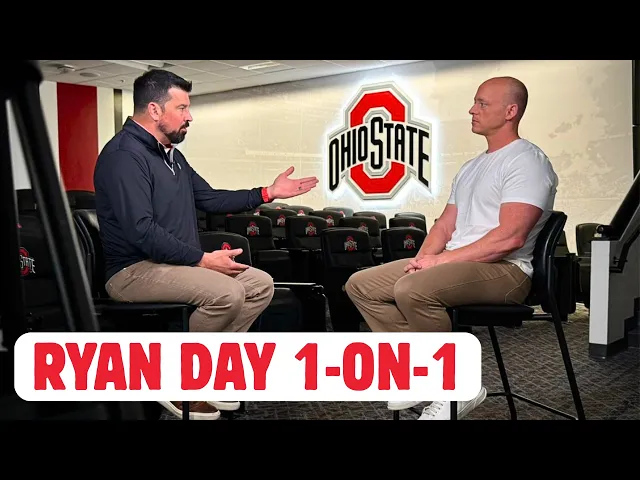
Ryan Day Joins Josh Pate - Pate State Speaker Series
Josh Pate's College Football Show
0:00 You and I were just sitting here talking.
0:01 We figured we'd just press record,
0:02 but there's all these things right now on the landscape.
0:06 There's like A, what do you think about the playoff?
0:08 B, what do you think about NIL in the portal?
0:10 Uh, C, what do you think about the rules and recruiting and stuff?
0:14 And we were just kind of talking like it's not just ABCDE,
0:17 it's it's an alphabet type thing.
0:19 If you talk about one, you got to talk about the other.
0:22 So, let's just let's just dive into this.
0:24 like your head holistically as the head coach
0:27 at Ohio State on this stuff is where right now.
0:30 I think it starts with the players.
0:32 I think that's the first thing that I think about is where are our guys right
0:36 now in all of this with all the change with all the things that are going on.
0:40 How is it affecting our our players?
0:42 Um and then from there it goes to the what's best for college football,
0:48 not just now but moving forward.
0:49 And I think when we start talking about these topics,
0:52 like you said, you almost in a silo, but um I think that's one of the challenges
0:57 we have right now in our game is that we're
0:59 we're looking at it that way as opposed to how
1:01 they all overlap and and interact with each other.
1:05 I look at it, this is my favorite thing on the planet.
1:07 College football is my favorite thing on the planet.
1:09 I'm the most passionate about it.
1:11 Like I I love talking about it.
1:12 I love covering it.
1:13 You get to coach it.
1:14 you get to run uh one
1:16 of the most highprofile visible organizations in the sport.
1:20 So like there's a lot of joy that comes out
1:22 of that, but then when you zoom in on it,
1:24 there's a lot of stuff that doesn't make you happy to talk about.
1:27 How do you find the balance of man, I get supreme enjoyment out of what I do,
1:31 but also I don't love this, this, and this right now.
1:35 I think the easy thing to do is just throw your hands up and just say,
1:39 well, this is all ridiculous.
1:40 But it still goes back to the people in the building.
1:43 it goes back to the um you know the families of the coaches
1:47 of the staff that we have in the building and then obviously it goes
1:49 to the players and their families and um and so we can't just do
1:53 that you know we have to figure out you know what it looks like
1:56 on a day-to-day basis and then where are we going here at Ohio State
2:00 what's the plan for us looking ahead 5 to 10 years because we sort
2:04 of fall into the you know the trap of just thinking about how do
2:07 we just get through this season and because of the world that we live man,
2:12 you know, we all got to win right now.
2:13 That's how it goes.
2:14 But we have to make sure we're looking out
2:16 ahead to figure out where are we going next.
2:19 Do you ever find yourself I'm asking you this cuz I
2:22 find myself doing this looking at the state of recruiting right now.
2:26 There's a ton of money involved.
2:28 There is a ton of visibility involved for an 18-year-old uh
2:31 the likes of which we've never seen probably in American society,
2:34 but especially in college football.
2:36 And on one hand, like I've listened to you talk about this.
2:39 You've never taken an anti-player making money stance,
2:42 but you've very much taken a pro, hey,
2:45 can we be a little bit smarter about this for when 10 years
2:50 down the road football may not be their main source of revenue anymore?
2:54 Like, yeah.
2:55 Like I talked about this with Dabau last week.
2:57 He's like, what are we doing to the 30-year-old
2:59 version of the 18year-old that we're recruiting right now?
3:03 But it's I'm asking you that to say it's kind of hard to talk about
3:06 it without a skeptic listening and saying what
3:10 what do you want to limit their freedoms?
3:12 You want to limit their earnings potential?
3:13 And it's never kind of been about that.
3:15 It's kind of been let's just be smarter about it.
3:18 I think college football's never been more exciting.
3:20 And I think when you look at the amount of money that it's generating,
3:24 um it's it's great to see coaches, players,
3:28 um you know, getting their share of that.
3:31 And I think we're all excited about that.
3:33 You know, I think here at Ohio State, you know,
3:36 what Julian Sain or Kenyatta Jackson or Jeremiah Smith means to this community,
3:43 you know, it it it means a lot to a lot of people around here.
3:46 And so to see them getting compensated for that is, you know, it's great to see.
3:52 But but I think we have to we have to look at, okay, what does that mean?
3:56 you know, when you watch these documentaries about um you know,
3:59 mankind and how things have changed.
4:02 Well, this is a major change.
4:04 And you know, I saw something recently that you know,
4:06 our young people process more information now than somebody
4:11 would like in the 1700s in in a whole lifetime.
4:14 So, what is that doing to our to our people?
4:17 What is that doing to our young people?
4:19 for our for this generation.
4:21 You know, I've had a chance to see it because my son is kind of going through
4:23 the process and he's at the same age
4:24 as a lot of these guys is that with social media,
4:27 with everything that's going on, these guys
4:29 get more attention now they've ever had before.
4:34 They and that and that's important in today's day
4:35 and age when you're on Instagram or Twitter or Tik Tok.
4:40 The the amount of followers,
4:41 the amount of people that follow this game because of the excitement,
4:43 because of how powerful the game is, it's a lot coming at them fast.
4:48 And so when they, you know, post something,
4:50 there's millions of people that are looking at that.
4:52 That comes with a price.
4:54 I think when you look at the amount of money that these guys are getting,
4:57 which again is is exciting for everybody.
4:59 It's our job as parents, it's our job as coaches,
5:02 it's our job as as mentors to help them
5:05 recognize what comes with that because we have wisdom.
5:08 Wisdom is intelligence through experience.
5:11 We've seen different things happen before,
5:13 but there's a reason why you don't drive until you're 16 years old.
5:16 I just took my my daughter out for a ride.
5:18 She's 15 and a half.
5:19 She's not ready to drive on a road.
5:20 She's 15 and a half.
5:21 There's a reason why you don't vote until you're 18.
5:24 There's a reason why you don't you're not allowed to drink alcohol till you're
5:26 21 because our their brains aren't developed yet to be able to handle that.
5:29 Yet, they're getting all this attention and all this money.
5:32 Some of them are making more than their teachers.
5:34 Some of them are making more than their coaches.
5:36 And so when you think about someone's normal trajectory
5:39 in a in a profession or a career, you know,
5:42 it starts as an entry- level job and you build
5:43 up into senior leadership and later on in your career,
5:46 you're typically making the most amount of money that you would make.
5:49 These guys now, some of them, they have to recognize and it's our job to help
5:53 them as parents and coaches because it's exciting for them.
5:56 They have an opportunity unlike anybody in the country.
5:59 They are so much further ahead than any American.
6:01 One, they're on scholarship.
6:03 People forget about that.
6:04 Most people graduate with debt.
6:06 Then you add on top the NIL opportunities.
6:09 If this money is invested right with the time value of money,
6:11 they're going to be ahead of everybody.
6:15 But the problem is not everybody's thinking about it that way.
6:18 It's our job as coaches and as teachers and as adults to help
6:21 them recognize that because football is going to be over at some point.
6:24 And when football's over, they need to figure out the next part of their life.
6:28 You know, I mentioned this to you before.
6:31 You know, when I looked at Tom Brady's contract when he was working with Fox,
6:34 he's making more money now per year than he
6:36 ever did any one year getting money in, you know,
6:38 playing quarterback in the NFL during his long career.
6:40 Made a lot of money, but I think it's like whatever,
6:43 you know, 37 some odd million dollars.
6:46 You look at, you know, the best corner to ever play the game or, you know,
6:49 we can argue that, but Deion Sanders, he's still coaching.
6:51 Like, so when when football's over, when their career is over,
6:55 like what's the plan for a lot of them?
6:57 And so when the trajectory of most careers sort
6:59 of go like this, some of these guys, you know,
7:02 their trajectory is going to be they're making all
7:04 this money now and it's going to come down like this.
7:06 And and my concern is that when football's over,
7:10 if they haven't made the right decisions,
7:11 if they haven't invested the money the right way, if they haven't um, you know,
7:15 been, you know, having a perspective,
7:17 a healthy perspective on everything that's going on, that this is just
7:20 a vehicle to help them set themselves up for the rest of their life.
7:23 they're going to be down the road 40 years old working 45 hours a week for a job
7:29 in a pay that they they think they're
7:31 above and that's going to affect their relationships.
7:33 It's going to affect their marriages and all those things.
7:35 So, um you know, roundabout way to say like we have to really do
7:40 a great job of recognizing that this is
7:43 a wonderful opportunity for these people.
7:45 This is a wonderful opportunity for them to set
7:47 themselves up for the rest of their lives.
7:49 We have to make sure it's our obligation to make sure that they do that.
7:52 when you got the job here like there's the football piece and you find
7:58 out am I equipped to be a head coach purely in terms of football
8:02 but I would imagine even then that's not that long ago really in the grand
8:05 scheme of things I would imagine even then you could have never known
8:09 what the future held for the sport and therefore how many of these conversations
8:13 or what portion of your time was going to be dedicated to these conversations.
8:18 What kind of learning process has it been just for you being
8:22 in this role and all of a sudden having to be a coach,
8:24 having to be a a mentor, having to be a life skills guy,
8:28 a financial uh decision maker, like all that kind of thing now.
8:32 Well, I I think the first thing for me here is like during
8:35 the whole transition and then we had COVID and then NIL the transfer portal,
8:40 it it's just been um every year there's a just
8:43 just a different challenge and they're going to be major challenges
8:45 and I think when you're dealing in a in an industry
8:48 that it's so competitive and there's so much at stake,
8:51 you're going to constantly see these massive changes.
8:52 Things aren't just going to stay the way they are status quo.
8:55 um you know and I hope someday we get there with a little bit more structure
8:58 that that a lot more structure but but as of right now we have to adapt.
9:03 We have to figure out what's going to happen.
9:05 Then we have to we have to recognize
9:06 that the natural order of the world is chaos.
9:09 The natural order of of college football
9:10 is chaos and then embrace that and figure
9:12 out um you know how to how to you know best adapt for us.
9:16 But it just goes back to the guys.
9:18 It goes back to the players.
9:19 And it goes back to that part of it because um winning allows us an opportunity
9:24 to continue to have an impact on people's lives and that's what a coach does.
9:27 It just depends on what level you're at.
9:30 But we have to make sure that we have guys
9:31 in our program that understand the obligation of being a Buckey guy,
9:34 what it means to so many people.
9:35 And as long as we keep that culture intact and we
9:38 make sure that everybody understands that when they walk in this building,
9:40 it's not about them.
9:41 It's not about how much NIL money they make.
9:44 It's not about their career.
9:44 It's about being a Buckeye here.
9:45 Now, if you do things the right way,
9:47 we have a great blueprint on how that could work out for you.
9:50 But make no mistake about it, when that block block O is on your chest,
9:53 you're doing this because of the people that have
9:55 come before and the people that care about Ohio State.
9:57 This time last year I was here, you guys coming off a national championship,
10:01 you still had the string of games against Michigan that hadn't gone your way.
10:05 Now, you've rectified that, not coming off a national championship.
10:09 The last two games I saw you play, you lost both of those.
10:12 So describe to me uh the difference in vibe
10:16 last spring to this spring the way things went here.
10:18 Well I remember when I first uh the first press conference
10:22 you know I said I understand the expectations and embrace them.
10:24 You got to win the rivalry game then you got to win every
10:26 game after that and you know two years two years two different contrast.
10:30 We didn't win that game won the national championship
10:32 this year won that game didn't win the national championship.
10:34 So it just is a great reminder got to win them all.
10:36 It's how it goes.
10:38 Um this off season, you know, there was um you know,
10:42 a huge influx of freshman that came in at midyear.
10:44 Um you know, we had some some transfer guys come in.
10:47 So um you know, we had to replace, you know, Caleb, you know,
10:52 Sunny was a reclass, but you know, he was in the class before.
10:56 Um Arll, Kaden McDonald, Carell Tate, those guys were all three-year guys.
11:01 So there was some holes in there that we had to address in the transfer portal,
11:04 which I think we did a really good job of.
11:06 But you can't just assume that all these guys
11:08 understand the culture when they walk in the building.
11:10 So, um, you know, this this offseason has been a huge emphasis
11:13 on that, making sure these guys understand what comes with being a Buck guy.
11:17 Yeah, I I ask this a lot and so I'll ask it of you, too.
11:20 There is a major difference between a guy
11:23 you recruited out of Cleveland for three
11:24 years and intimately became familiar with versus
11:28 a guy that you got out of the portal.
11:29 Now, in a perfect world, the guy you got out of the portal you once recruited,
11:33 it's not always the way it works.
11:35 So, like when when you get those guys here,
11:38 what are some of the early things you're looking for in spring
11:41 ball to make sure he's acclimating the way I want him to?
11:44 And also, what can you do before
11:46 that in that speed dating sort of thing to make sure
11:49 uh he he is for this place at a place where we openly say it's not for everyone?
11:55 Yeah.
11:55 I mean, that that has to be part of the the onboarding
11:57 process and understand that when you walk into building,
12:00 it's not like everywhere else.
12:01 And part of that is knowing a little background on them.
12:05 So when you look at um you know guys
12:07 that have come in, you know, you take, you know,
12:09 Quay and you take James and even Earl,
12:11 all those guys played with with Caleb their freshman year.
12:14 So Caleb had a little relationship there.
12:16 You know, Terry Moore came in with Mareri
12:18 uh when they were they worked at Duke together.
12:21 Cortez Hankton worked with um Kyle Parker when he was at LSU.
12:25 So um you know, and then we have a couple Ohio guys that came in.
12:28 And so if there's a common thread there, then we know who they are and we
12:32 knew know what we're getting when they get here.
12:35 But once they get here, they have to earn the respect of the team.
12:37 And that happens in one place.
12:38 That happens in the weight room around here.
12:39 I mean, you want to earn your stripes, then you grade out a champion.
12:43 Uh you become an iron buckeye.
12:45 And then that is how you get the respect of guys who are already in the program.
12:48 It's the guys who are in the program that need
12:50 to make sure that they understand what the culture that they
12:52 help understand for the for the young guys
12:54 and for the new guys in the building what the culture is,
12:56 what the expectation is.
12:57 And uh it's good to have some new guys who come
13:01 in uh who give you a little perspective of of another program.
13:04 So how do you compare?
13:06 You know, what are some things in common that um that they do?
13:09 What are some things that are different here?
13:10 So that that's always good to to get, but they have to buy into it really early
13:14 and and and but the number one thing is this can't be about you.
13:19 Like listen, there's a long hallway of guys that we've developed
13:21 that have gone on to be first rounders and all those things,
13:23 but the number one goal here is to beat
13:25 the team up north and to win a national championship.
13:27 And like you have to understand that and embrace that.
13:29 And if you do, guess what?
13:30 You're probably going to be on that wall someday.
13:32 When we get done with spring and I sit down with you
13:35 as a player and I'm having like my postspring evaluation period,
13:39 I'm I'm going to talk to strength coach.
13:42 I'm going to talk to position coach,
13:44 but like when I ultimately have the conversation with you,
13:47 what does that consist of?
13:49 Well, we talk about the the So,
13:51 everybody meets with their position coach and they
13:52 meet with Mick and they go through their positives,
13:55 negatives, things they need to improve and those those types of things.
13:58 And so, we kind of go through, you know,
13:59 what are the things that you see that you've done well?
14:01 What are the things you got to improve on?
14:03 And then where do we see this thing going in the summer?
14:05 What what needs to get done for you?
14:06 And each guy has their own challenges.
14:08 Each guys are in different points in their career.
14:10 Some guys, man, like you better get going fast
14:13 or you're going to be in that dang scout team again.
14:15 And if you are, you have to embrace that role.
14:18 But you're the one in control of that.
14:19 And here are the things you got to get done in order to change that.
14:21 If you don't like where you are in life,
14:23 you got to you got to work hard to get that thing done.
14:25 Or maybe I'm somebody that has come back for a, you know,
14:28 a senior year that needs to really do some some,
14:31 you know, hard work on how are they leading.
14:33 You know, it can't just be about you uh when you're an older guy.
14:36 And so, you know, I have to play at a certain level.
14:39 And also, if you know, even in this room right here, I mean,
14:42 the seniors sit in the front, the juniors, sophomores, freshman in the back.
14:46 Every year, you're coming down into a different seat, into a different role.
14:50 like the guy who just left that role was Will Howard,
14:53 you know, this guy who just left that that was Caleb DS.
14:55 So, you have to take on all that responsibility if you're moving into that seat.
14:59 So, each guy has a different Some guys are just freshman.
15:01 They're just trying to figure out where to go and what they're doing.
15:03 Um, so each guy has their own story,
15:05 but it's it's a it's a little bit of a connection
15:07 point for me to talk a little bit about where they are, where they need to be.
15:11 when you're covering a team or you're a fan of a team,
15:15 you read practice reports out of spring.
15:17 You may watch the spring game or whatever's on TV and you kind of like formulate
15:21 an opinion of depth chard and here's what
15:23 I think about this guy and it's pretty fixed.
15:26 My mind's not going to change over the summer.
15:28 I don't see those guys over the summer, but you do to a point and then you get
15:33 them back in the fall and you know the conversations
15:35 you've had with each individual player and you know which
15:38 specific parts of their game you know need to improve.
15:42 How common is it to get a guy back in the fall and really look at him and say,
15:46 "Wow, like that's above and beyond even what
15:49 I expected to get back in the fall."
15:51 Well, that's that's what you're pushing for.
15:52 That's the vision that you're trying to create when you come out of the spring.
15:56 Um, and so much of it is what happens in the summer.
15:59 Uh, but that's that's a really a transformational time.
16:02 When you get into the season, it's hard to transform.
16:05 You're sort of there.
16:06 You can make a move, you can practice better, you can do those things,
16:08 but when you're in the offseason, you focus on, you know,
16:11 the weight room and getting stronger and learning the offense,
16:14 learning the defense, and those types of things,
16:15 you can really take big move, you know, big big steps.
16:18 Um, and so that that's kind of we say
16:21 this is kind of the last transformational time that you have.
16:23 So, you got to really own that.
16:25 Um, and then and then and then it becomes about confidence to me, you know,
16:29 confidence to know what I'm doing and understand what
16:31 I'm doing better and then physically have enough confidence.
16:34 I've gotten this much faster.
16:35 I've gotten this much stronger.
16:37 Um, so all those things happen.
16:38 So, how often does that happen?
16:39 I mean, a decent amount.
16:41 I I think, you know, our what we what we do in the weight room is important.
16:45 I think probably what's more common is
16:48 the relationships that happen during the summer.
16:50 So when they come together in June and they come
16:52 in together in July and they go through preseason camp,
16:55 that's where the chemistry happens.
16:56 That's where the glue happens.
16:57 Um and so individually, sure, there's definitely growth,
17:01 but there's there in the summer,
17:02 there's a lot of growth that's made throughout the team.
17:05 When a freshman comes in, most of the time they're early enrolles now,
17:09 which means they've played their high school season.
17:12 They've gone through uh winter conditioning, spring ball,
17:16 like it's just been football non-stop for a year,
17:18 plus they're head swimming because they're
17:19 on campus at college for the first time.
17:22 And there's some different theories out there.
17:23 I wondered where you landed on the idea out
17:26 there that freshman should at least be somewhere two years
17:30 before all of the transfer portal stuff comes into play.
17:32 Where do you land on that?
17:33 Yeah, I feel pretty strong about that.
17:34 I I do.
17:35 And this goes back to, okay,
17:37 here's one conversation that we're just going to have.
17:39 This is where the alphabet.
17:40 Yeah, but there's there's a lot of things that come into play and so we make
17:43 these changes is what we do and and then
17:45 we see the ripple effect in other areas.
17:47 So there's a lot that needs to be in consider considered when it comes to this.
17:51 But if you're looking at the the the player who comes in at mid year now
17:54 there's a lot their season gets done like
17:56 you said they jump right into spring ball.
17:58 They have this season and during that freshman season
18:01 typically they're not playing as much as they'd like.
18:04 They're going through challenges.
18:05 Um you know they're failing but that's part of being a freshman.
18:09 You got to fail.
18:09 you got to fail to learn.
18:10 That's how that's how it works.
18:12 And so there's all these expectations in recruiting and then
18:15 when their freshman year doesn't go exactly the way they want,
18:18 they get done in December and January
18:20 and there's no cool cooling off phase right there.
18:22 It's just it's emotional.
18:23 It's raw.
18:24 Um a lot of times the season is still going on.
18:27 So to me, the ability to to say, "Okay,
18:30 I'm I'm going to go somewhere for two years.
18:32 I make a two-year commitment." Uh,
18:33 obviously there are extenduating circumstances,
18:35 a coaching change or something like that, but that allows them to, okay,
18:39 I come in, I work in the spring, I go through my freshman year,
18:42 I go through another spring, I go through my sophomore year,
18:45 and now I'm in a different place than I would have been before.
18:48 And you I think the mindset of saying,
18:50 you know, I'm I'm somewhere for two years,
18:53 like I'm not going to come up for a year and try to reassess this again.
18:56 Plus, you know, I just think overall it's good for for their overall
18:59 mental health knowing that I'm I'm I'm somewhere for two years.
19:03 And, you know, I I know I have to push
19:04 through adversity along the way and I got to grow.
19:07 And, you know, for a lot of us that went through
19:09 that where you had four years like you transferring wasn't an option.
19:12 You had to figure it out.
19:13 Uh that's a healthy thing.
19:15 Last year, there were a lot of coaching changes mid year.
19:18 A lot of guys lost their jobs and then coaching searches are going on.
19:22 Seems like five different things were
19:23 going on overlapping with the regular season.
19:26 That was just one of them.
19:27 And your offensive coordinator was involved in a coaching search.
19:31 So I I watched Oregon go through this two ways.
19:34 I watched&m go through this two ways.
19:36 You guys go through it.
19:38 What kind of impact did that have inside
19:40 the building preparation down the stretch, that sort of thing?
19:42 We always say nobody cares, so nobody does care.
19:45 Um, but you know, the truth is that, you know,
19:48 it it can be disruptive and and I thought Brian
19:50 handled that great and it had nothing to do with him.
19:52 It's just the way that it's set up right now,
19:54 which goes back to this conversation that I think we all need to figure out.
19:59 And that is like how is this all how does this all need to be structured,
20:03 not these one-off conversations about um,
20:06 you know, how many teams in the playoff, um, you know,
20:08 when should the season end, you know, when does the portal open?
20:11 like all of those need to come together as once and create this um this plan,
20:17 this this structure,
20:18 but we're just we're just picking and choosing right now and it makes it hard.
20:21 You think about leading up to to that game, you know,
20:24 on signing day, you know, Brian gets named the head coach of South Florida.
20:27 There was just a lot that went that with that.
20:29 Oh yeah, and by the way, we have, you know,
20:30 short yardage and goal line that we're trying to game plan for.
20:33 I mean, it was just um there was a lot going on.
20:35 But at the end of the day, nobody cares.
20:36 You got you got to produce.
20:37 And so, um, you know, we have to make sure that, you know,
20:40 we're always looking ahead and trying to figure out how to stay ahead of it.
20:43 And, um, but, yeah, there's no question when you look at not just us, just,
20:48 you know, the way things played out in a lot of different teams this year.
20:51 Um, you know, there's no other sport
20:53 that would go through something like this, right?
20:55 I mean, you don't see it really in any sport.
20:57 Um,
20:58 I guess, you know, when you look at a lot of these teams once the season's over,
21:03 you know, okay, now here here's where all the change can happen.
21:06 this is working.
21:06 We put the season to bed.
21:07 We all agreed that we were going to be on this team for this run.
21:13 Okay, once that's over, now it's time to go talk about the next year.
21:16 That's not the way it's set up right now.
21:18 You've got Arthur Smith and Matt Patricia here.
21:20 So, a pair of former NFL head coaches as your coordinators,
21:24 which is a pretty unique dynamic.
21:26 I want to know when you are looking to fill a role,
21:28 coordinator, wide receiver, coach, whatever.
21:31 Uh what are some of the specific staff traits that have
21:35 to be exhibited for a guy to get on the staff?
21:37 And without naming names, like what are some instances where you thought you
21:41 may be down the road on hiring a guy,
21:43 but then red flag here, red X there, nope thanks but no thanks.
21:48 Yeah, it's one of the things that people ask all the time.
21:50 What have you learned year after year?
21:52 And you got to make sure you make the right hires.
21:54 Um and you got to be thorough with them.
21:56 And I think for us, uh,
21:58 we're very fortunate in the fact that we
22:00 have two coordinators who, um, you know,
22:02 former NFL head coach, former NFL head coach,
22:05 and and that's important because we talk a lot about about our development here.
22:09 And when you come into our our building, I mean,
22:11 you're going to be coached like you're in the NFL.
22:13 The expectations are the same way schematically, just your approach.
22:16 And and these guys have that experience.
22:18 And then you you add on top of that the staff.
22:20 And um it's it's my job as a head coach to surround
22:23 these guys with the best the best strength coach in America,
22:26 you know, the best position coach in America, the best coordinators.
22:29 You start going with the best nutritionist,
22:31 you know, and if they're not the best, then we got to take a hard look
22:33 at that and figure that out because that is the expectation.
22:35 Um and just like, you know, for me,
22:37 I I every year got to take a hard look at what do
22:40 I need to do to make sure I'm the best in the country.
22:42 And so I challenge our guys with that every day.
22:44 But but that really is is the mindset that you know we
22:47 want to get the best and um you know during the during
22:51 the recruiting process of staff it's very similar to players is that you
22:55 have to embrace what Ohio State is and what comes with this place.
22:59 Um and you know it's been great to see someone
23:03 like Matt Patricia come in and just really embrace the culture,
23:06 embrace the fan base.
23:07 You're seeing his personality come out.
23:09 Um and and Arthur Smith is doing the same thing.
23:11 you know, he's really worked hard on building relationships right from when he
23:14 walked in a building u with the staff and then with the players,
23:18 whether it's a player or a coach that could be an addition here in the past,
23:25 what are some of the instances or examples where you realize
23:28 or they realize or you mutually realize that place is not for me?
23:33 What would that look like theoretically?
23:35 Well, I mean, you just go through the process and there sometimes there's,
23:40 you know, philosophical differences.
23:42 Sometimes, um, you know, there, you know,
23:46 part of it you have to you have to trust your gut on, you know,
23:50 people can do a good job with interviews.
23:52 They can, um, have a good resume, but, you know,
23:57 you have to do a good job of following through with the people that, uh,
24:00 have worked with them before, or maybe you have connections with them before.
24:04 you've seen how they work.
24:05 Um, you spend more time with these guys
24:08 during the season than you do with your family.
24:10 I mean, you're you're with them all the time.
24:12 So, and you know, they have to be aligned with how we want to do things here.
24:17 And during the process, like being very very clear about what
24:20 the expectations are and what comes with it,
24:23 um, you know, is part of the process.
24:25 And, and like you said,
24:27 there's just a lot of times where you go through that process.
24:29 You're like, this isn't a fit.
24:30 There's nothing wrong with that.
24:31 There's other places where they can go on and have success.
24:33 Yeah.
24:34 Um, and it's the same thing with maybe somebody leaving, you know,
24:37 like they come into the program and for whatever reason it's
24:41 just not working and then there's another opportunity for them somewhere else.
24:44 But we try to make sure that we align those things on a front end so we can
24:47 have guys stay for a long time because I
24:49 think stability is one of the things that separated us.
24:52 Um, you know, families recruits come in, they want to go to a place where
24:56 they know there's stability there with the position
24:58 coaches and obviously with the head coach.
25:00 You said a second ago, I expect the same thing out of myself.
25:04 I'm asking myself when I come out of a season or I'm asking myself every day,
25:08 like what parts of me do I need to improve?
25:12 How do you quantify that?
25:13 Like how do you decide?
25:14 This is an area of Ryan D me a head coach
25:17 at Ohio State or just the man I got to get better in.
25:20 Yeah.
25:20 Well, I think the first thing is are
25:22 surrounding everybody with the best like when they walk
25:24 in that door from when they to when they
25:26 leave are do they have the best around them?
25:28 That's the job of the head coach.
25:29 you've got to surround them with the best.
25:31 Um, and then making sure that the communication,
25:34 the expectations are clear every day when somebody walks
25:36 in a building and driving that culture every day.
25:38 Um, and and to me that that's what it comes down to.
25:41 Um, and and making sure that the communication is
25:44 clear on the vision and giving everybody, you know,
25:47 really clear uh directives and and then letting people
25:51 go do their job and then hold them accountable.
25:54 When you come out of a season and go into a season,
25:56 like from the outsers's perspective,
25:59 there's always a thing people are saying, they got to run the ball better.
26:03 Uh they got to defend the pass.
26:05 Like there just two or three sentences
26:07 that roll off the tongue that describes a team.
26:10 You don't obviously view your team that way,
26:12 but is there like a specific thing or the thing or two that you've
26:16 chosen to disproportionately drill on coming out
26:20 of last year coming into this year?
26:22 Yeah, I think it's a good question because there's so much that goes into it.
26:26 Um, and you have to rebuild your foundation every season.
26:29 It's not like you can just go and, you know, pick up from where you left off.
26:32 There's a lot of pieces that we got to, you know, um, replace this year.
26:37 And so, you know, that starts in the offseason.
26:39 But, uh, to me, it's it's it's about the leadership
26:43 and it's about everybody coming together as a group.
26:45 Uh, I think that that's going to be the most important thing this year.
26:48 when you look at our our schedule and and the teams that we play,
26:51 I mean, these games are going to go down to the fourth quarter.
26:53 And so, we got to be strong in the fourth quarter, we got to stick together.
26:56 We're going to have adversity along the way.
26:58 And if if and when that happens and and we work through the season,
27:02 by the time you get to the playoffs,
27:04 I mean, we will be playoff ready, but that schedule's going to be a bear.
27:07 And so, we're going to need to make sure that we're strong together as a group.
27:10 I know someday, you know, 100 years down the road, your career will be done.
27:15 You'll be able to look back on it in totality.
27:17 right now you're right in the middle of it.
27:18 I have I have no idea how much longer you'll coach.
27:21 Maybe you do, maybe you don't.
27:23 But like you're in it right now.
27:25 Do you ever view like your coaching progression in chapters?
27:31 Like I'll I'll look at my career so to speak and I'll think, all right,
27:35 uh once upon a time it was this and then for a little while
27:38 I was there and now I feel like I'm kind of in this season.
27:41 Here's how I would describe myself right now.
27:43 Do you view yourself in that way at all?
27:45 I I I don't know.
27:46 I I think to me like every every year like like the focus
27:51 is to win every game like and go as hard as you possibly can.
27:54 So to start taking a step back and looking at all
27:57 that to me um you know it's not something I've done.
28:00 Um it's go go go go go and win every game.
28:03 Start with the the opener.
28:04 We got to go to Texas and like that's that's the focus
28:07 and then putting this recruiting class together
28:09 and making sure that we're set up.
28:10 Now, I do think the conversations on where are we going in the next three
28:14 to five years at Ohio State and everything
28:16 like that are are part of these conversations.
28:18 You can't just live yeartoear.
28:19 So, I totally get that part of it.
28:21 But, like that has to be the mindset because it's too competitive.
28:25 There's too much at stake in every single game.
28:27 And so, to me, like that that is it right there.
28:30 And then at some point, you come up for air.
28:32 But every year you learn.
28:34 And I look at pictures of even where I was, you know, 3 to 5 years ago.
28:38 I'm I'm much different than I was back then just because you
28:41 learn your your some of your experiences and you know had some success,
28:44 had some failures, but you got to you got to you got to learn from those.
28:47 You got to grow from those and that hopefully that experience
28:49 is going to now pay off because you've been through
28:51 this before and communicating that to the players and the staff
28:54 on what the expectations are and then holding to those those expectations.
28:58 But um it all comes down to our identity, man,
29:00 like who we are as a team and what we're going to grab on to.
29:03 And so, um, you know, we we we talk about that a lot here
29:07 and and I think we have the right people in place,
29:09 but you know, every every year is its own journey
29:11 and just because we've had success in the past, it means nothing.
29:15 You know, winning is not just something that's pre-ordained around here.
29:18 We got we got we got to grind for everything that we get.
29:20 Um, and so I I think a big part of our our recruiting
29:25 is is bringing in the same type of people that have the same mindset.
29:28 when you walk into this place like you're coming
29:30 I've said it before you're coming to be a first
29:32 or second round draft pick not every we know not
29:34 everybody's going to be that way but it's the mindset when
29:35 you're a coach you're coming in here to to to win
29:38 the rivalry game and win national championships that's the expectation
29:41 so it's easy to say but take Arthur Smith
29:44 for example or Matt Patricia like they've never won a national
29:47 championship before like when you're in the when you're
29:49 in the NFL winning 10 games is a great year
29:51 and you win a couple you know games in the playoffs
29:53 that's great well that's not good enough around here we
29:55 got to win them all and So that mindset
29:58 is something that is important that everybody has to understand
30:01 and as the head coach I have to make sure
30:02 that everybody in the building embraces that doesn't just say it.
30:06 I remember last year we sat down after we were done you were talking
30:09 about preparation methods and at the time you had just won a national title.
30:14 So then the only negative left to focus on was the Michigan thing and I remember
30:18 you saying to me look the preparation it's
30:21 not that we don't take the thing serious enough.
30:23 Of course, we're taking it serious,
30:25 but we got to look at different ways to synchronize our preparation and the way
30:29 we treat the leadup to that versus the way we treat every other game.
30:32 We're playing at plenty high enough level in every other game.
30:35 And so then you fast forward several months down the road, you play the game,
30:38 you win the game, and afterwards, I've heard you talk a few times,
30:41 but I'd like you to go a little more
30:43 in depth on it on just subtle changes that you made
30:47 to the leadup and the way you handled preparation for that game
30:50 that still respected it for what it was as a rivalry,
30:53 but also ensured that you played at the highest level you could.
30:57 Well, again, it starts day one of recruiting when you walk in this building,
31:00 what what number one goal is.
31:02 And so, everybody understands that and that's clear from the jump.
31:07 But what you have to do is you got to look
31:09 at it and figure out like what what is going wrong here?
31:11 I mean, what what is it?
31:12 Especially the one two years ago, 20 point favorites and lose.
31:16 It's like everything that could go wrong
31:17 went wrong with with a really good team.
31:20 And you just, you know,
31:22 you just you got to bang your head against the wall trying to figure it out.
31:25 And to me, one of the things that, you know,
31:29 we would put so much into it from our off season to, you know,
31:35 I can't even tell you what we would do.
31:36 And and I think the game itself, you have Thanksgiving, you have, you know,
31:43 for us on Sunday night, the band used to come in and do their deal.
31:46 Uh we would we would get in the bus and drive up there.
31:49 Why?
31:49 Because that's what they've always done here.
31:51 And I just said, "Well, we have to keep this more like a normal week
31:54 and make it normal." And if we continue to build every week,
31:58 then we'll be ready for that game at the end
32:00 of the season because the guys know how important it is.
32:02 You can hear it when when they talk.
32:04 So, you know, we we did the band thing during the by-week.
32:08 Um we we flew up instead of drove up, you know,
32:10 we just tried to keep everything consistent the best
32:12 we could and and I think it allowed the guys
32:15 to focus on the game more and not as much
32:17 about all the other things that come with it.
32:19 Um because if we can master what we do on a week-
32:22 toeek basis and be really really good at, you know,
32:25 doing our job and preparing and practicing
32:28 at a high high level and then performing on Saturday,
32:30 that's ultimately what it comes down to.
32:32 Um we know the emotions going to be there.
32:34 We know what comes with that game.
32:35 We know how much it means to everybody.
32:37 But um sometimes when when you spend so much
32:39 on it and it's been a couple years, three years,
32:42 four years where it's not going well, there can be so much on it that you
32:45 almost become paralyzed when things don't go well.
32:47 And we didn't want that to happen.
32:48 And I thought it was a good example of that is, you know,
32:50 we threw the pick early in the game
32:52 and then we came right back and just kept playing.
32:54 Uh it it didn't it didn't affect us like maybe had in the past.
32:58 I remember a couple of years ago, it still stands out to me vividly.
33:01 I was here and everyone in this building, you included, talked about, all right,
33:05 we've got an expanded playoff,
33:06 which means we're going to have to potentially play more games.
33:10 It could be the longest season anybody in this building has ever had
33:13 to go through and we got to make sure we peak at the right time.
33:17 got to make sure we're able to play our best football at the right time.
33:20 And you did.
33:21 Even even in the process of losing that game, you ultimately did.
33:23 You won a national title.
33:25 Then you come into this year.
33:27 You just mentioned the schedule you got to play.
33:29 What is the balance of trying to make sure
33:31 we're structuring stuff where we peak at the right time?
33:33 However, if we peak at the right time,
33:35 but we've got three losses in route to it,
33:37 we may not even get the chance to peek at the right time.
33:40 How do you structure basically the preparation like the calendar,
33:43 the the leadup to the season, the way you practice during the season?
33:46 How much of that has to come into play?
33:48 No, it's it's a great question.
33:49 I mean, I think there there are probably some clubs in the NFL that, you know,
33:53 they're, you know, they're getting started in September.
33:56 Uh they find their identity in October and then
33:58 and then they turn it on in November, December.
34:00 U you can't do that in college football.
34:02 It doesn't work that way.
34:02 First off, these guys are young players.
34:04 Uh they needed to continue to develop and they they got a lot
34:06 of football ahead of them and you can't afford to lose games.
34:09 Um now, now more than you could before,
34:12 but still the margin of error is just like really really close.
34:15 So that's the first thing.
34:17 I think the second thing is though like how
34:19 are you getting better week after week after week
34:22 and that's the job of the coaches to figure
34:24 out what are the things our guys do well.
34:27 Um and and for them to understand that that it is
34:30 a long season and that you know it's these series of sprints
34:33 that we have to win each game as they focus
34:35 on each game but knowing that each week we've got to improve.
34:39 You know I use it like the iPhone.
34:41 Um you know the iPhone what's your iPhone now?
34:43 like the 15 or something.
34:44 I got like a 19.
34:45 I don't know.
34:46 Right.
34:46 19.
34:46 It's it's it's recent.
34:47 The 11 doesn't even work anymore.
34:49 Right.
34:49 It doesn't work.
34:50 That the the five certainly doesn't work.
34:51 Like each week you've got to continue to upgrade.
34:54 And when with that with your body, with your mind, with your soul,
34:57 and and and that's part of it because
35:00 what you put on film the week before, yeah,
35:02 there's certain things you're going to do,
35:03 but there's also things that, you know,
35:05 teams are going to they're going to scheme up
35:07 and that you have to be a step ahead.
35:08 And so, u you know, over other are the days where you
35:11 can just kind of run the same things over and over again.
35:13 Now, that being said, what's your identity?
35:15 Because you have to have an identity.
35:16 And I think that's where um you know,
35:19 the best coaches can allow their guys to play fast,
35:22 play simple with their identity and and win the game in the fourth quarter.
35:26 And I think that that to me is something
35:28 that is going to really challenge us this year.
35:30 We've been in games in the past where, you know,
35:32 the third quarter and the fourth quarter have been three and four score games.
35:36 It's not going to be the case this year.
35:37 You know, we're going to have to win the game in the fourth quarter this season.
35:39 And you know, part of that is running the football and stopping
35:43 the run when it matters the most most in the fourth quarter,
35:45 but then also it's going to be winning in a two-minute drill.
35:47 And so, um, I think that's going to allow us to learn a lot
35:51 about ourselves and then be ready to make that playoff run late in the season.
35:55 I mean, everybody tries to quantify draft attrition,
36:00 u guys, and what they did last year.
36:03 And I mean, I don't know what the formula is for that.
36:06 we can try as hard as we can,
36:07 but then you've got the whole leadership aspect as well,
36:10 which is really non-quantifiable.
36:12 But yet, you know that you gota you got
36:14 to backfill that or else you'll have a really talented
36:17 team that doesn't have any leadership and it just
36:20 it goes inexplicably nine and three or eight and four.
36:23 Um, but there's no like microwave process to that either.
36:27 And so as you go through spring and it's the wait room,
36:31 it's on the field, it's it's in the meeting room, it's like all of that stuff.
36:35 How do you start to see that manifest itself
36:37 without you trying to like force it to happen?
36:40 Well, it happens in the weight room for sure
36:41 and and how we design our offseason and all that because
36:44 we we force guys into the roles and guys got
36:47 to have the courage to step up and speak up.
36:48 I mean, just setting a standard is not leading.
36:51 It's just doing your job really really well and setting an example.
36:54 That's fine.
36:54 But you're not taking anybody with you.
36:56 You got to take people with you.
36:57 How do you take people with you?
36:58 By inspiring, by challenging, by demanding,
37:01 you know, and each opportunity is different.
37:04 If I'm in the field, we don't have time to have a conversation.
37:06 I got to bark at you or, you know, we need to get this thing done.
37:09 We need to get this thing done.
37:10 You got to take control.
37:12 But there's also times where you got to connect with these guys.
37:14 You got to put your arm around them and you got to show them the way.
37:17 And it all comes down to who you are in terms of your character,
37:20 your connection with other people, and then the competency to do your job.
37:23 And so, if we focus on those things, then we can get guys into leadership role.
37:27 And um it's something that, you know, we spend an inordinate amount of time on.
37:31 We have our leadership committee.
37:32 We have a whole plan on how we try to implement this during the offseason
37:34 and uh we're counting on that to to make a difference in the end.
37:38 You and I are talking.
37:38 I mean, we are fresh off of me looking at my phone and their headlines.
37:42 Your son who's been going through the recruiting process, he commits.
37:45 And I've also been places this spring where I'm talking to head coaches
37:50 who had you in their buildings on visits and they interacted with you.
37:55 But as a recruiting process,
37:59 what what did you learn throughout that whole thing?
38:01 like like what exposure did that give you to other places
38:04 and other staffs that maybe otherwise you never would have seen?
38:06 Well, I I think the first thing is I I owed it
38:08 to my son to try to make it as normal as possible,
38:10 even though that that's not really the case.
38:13 Um, you know, it hasn't been normal for him from the jump,
38:17 but uh he's obsessed and so I wanted to make sure that I did everything I could.
38:21 I didn't want you know, my my position has affected a lot of things in his life.
38:26 I wanted this to try to not affect this a ton.
38:29 And I I give the coaches a lot
38:30 of credit from the different places that I visited
38:32 just um they have sons and I think
38:34 that there's um you know they understand what that means
38:37 and I think if it was their son they'd want the same thing and so we tried
38:40 to do the best we could to uh to keep
38:42 it as professional and I'm really excited for him.
38:44 Um I think he found a great spot.
38:46 I think they have a great staff there and it's it's exciting for him to go,
38:50 you know, find that next journey.
38:51 But going through the process has really opened up my eyes to a lot of things.
38:54 And man, I can tell you like the number one thing is like
38:58 you want to send him to a head coach that when he's making decisions,
39:00 he's making that decision knowing that the number
39:02 one thing is how would they want their son treated and you know that, but when
39:06 you actually have a son going through it, it makes you remind you of that.
39:10 Um, and that's it.
39:11 And and so I think you said you asked
39:14 the question about what is the number one thing you recognized.
39:17 I I think there's a lot of weight rooms,
39:21 there's a lot of stadiums, there's a lot of like cool facilities,
39:24 but at the end of the day, it comes down to the people in the building.
39:27 That's what it comes down to.
39:29 And who's pouring into your son, who's going to drive them,
39:32 who works at it, and then the culture that's in the building.
39:35 Um it's the people.
39:37 Something we always knew.
39:38 Uh shoot Woody said it a long time you win with people but that's it.
39:42 Um because you know there's nothing that you know again you
39:47 know a cold tank or a dining room or anything like
39:50 that can overcome when when you're sending your son or you're
39:53 sending you know a recruit or a prospect to a place.
39:56 It's going to come down to the people.
39:57 Uh I'll get you out of here on this.
39:59 So it's the time of year where people aren't going to see you a whole lot.
40:02 They'll see you probably media days is
40:04 the next time that most people will see you.
40:06 So, you don't have a ton of free time, but relatively speaking,
40:09 you've got more time that can be free this time of year than normal.
40:13 What are some of the things you do?
40:14 Like when you just totally check out,
40:16 what are some of the things you do outside of football?
40:20 Yeah.
40:20 Um, I try to do a little bit of traveling different places.
40:24 Um, I try to connect with the family
40:26 and and and my wife and and um and and then, you know, spend time, you know,
40:32 getting away from the game where it it just gives you a different perspective.
40:36 So, getting around folks who um, you know, they might be a CEO of a company,
40:41 not football, but just watching how they do things.
40:44 Um, I think that helps a lot.
40:46 You know, even when I'm at home, you know,
40:48 you watch documentaries on history and different things.
40:50 It gives you a perspective of how, you know,
40:53 humankind has changed over time and we're in this world of change,
40:57 you know, that that's happening at a rapid pace.
40:59 And um, you know, we just kind of live in here where you
41:03 get tunnel vision of just the Woody and the players and the coaches.
41:06 It is good to step away a little bit and get around um, you know, your family.
41:11 Make sure that you're investing in that obviously.
41:13 Uh but then also, you know,
41:14 just people who are also um high achievers who share some of the same things.
41:20 You know, I'm not a huge golfer, but I had an opportunity to u play golf
41:24 with some like really high-end people and just listen
41:26 to how they go about building their staffs and some
41:29 of their visions and some of their day-to-day practices.
41:31 Um but it's even that that question you just asked me,
41:35 I asked them, what are some things that are important to you?
41:38 And uh I won't give names, but you know,
41:40 one of them was like I I have white space on my calendar,
41:43 which means like there's just an hour
41:45 during the day where there's nothing on there
41:48 and it allows me to be in my thoughts and think about what's best.
41:51 Um and when I leave that, I I kind of take a step
41:54 away and and I have a better perspective on the rest of the day.
41:56 And just things like that in very very high,
41:59 highly competitive uh intense jobs like this one
42:02 is um so you can do your job better.
42:06 Do you ever um like there's a there's a place in Nashville.
42:09 It's out in the middle of nowhere.
42:10 It's south of town.
42:11 It's next to a a major rail line.
42:13 I love just sitting there watching the trains go by, watching the deer.
42:16 It's out in the middle of the wilderness
42:18 and you can sit there in silence and think, do do you have Well,
42:21 we live we're in the middle of a major city here,
42:23 so it's a little bit different.
42:25 But like when your mind just wanders,
42:26 when you whites space it for a little while, where's your mind going?
42:30 So, I I get in the car and just turn off the radio
42:32 and put my phone aside and then just whatever whatever comes to your mind,
42:36 whatever God's putting on your thoughts like and just it goes.
42:39 And it's interesting when you're just kind of with your thoughts where it goes.
42:42 We're always on our phones and I see young people on their phones all the time.
42:45 I just want to say, "Put your phone down and just think for a second.
42:47 Stop and think." Um, but I try to do that in a car as many times as I can.
42:52 You saw that microplastics documentary right there.
42:54 I like I like the different documentaries, man.
42:56 There's there's a lot going on out there and um yeah,
43:00 I I I watched the one on the dinosaurs.
43:01 I watched the one on the the five families
43:03 and the mafia which I was mentioning you before just recommendation.
43:07 Well yeah how they adapted over time from pro prohibition to all the way
43:11 to now and yeah there's all kinds of stuff going on out there but it
43:15 is good sometimes to just you know turn your brain off and watch something
43:18 for about an hour and then then go back and make a bunch of recruiting calls.
43:21 Yeah, leave Euphoria alone.
43:22 Don't even mess with season 3.
43:24 It's not worth it.
43:24 Just take it from me.
43:25 Ryan Day, we appreciate it, man.
43:26 You got it, brother.
43:27 Thank you.
43:29 Yeah.