A Short Story About Why You Cannot Buy A House
Economics Explained
0:00 For most of the 20th century,
0:01 a typical house cost about 3 times the typical households income.
0:05 People could buy a place with 3 years of pay and that used to be normal.
0:08 But of course, it's changed.
0:10 A global study looked at 95 major cities and found that not
0:14 a single one is considered affordable anymore.
0:16 Even the so called normal cities have slipped
0:19 out of reach.
0:20 Across these centres,
0:20 the average home now costs more than 5 times what a typical
0:24 household earns and in places like Hong Kong,
0:26 Sydney and Vancouver, that number isn't 5,
0:28 it's 9, 10, even 14 times income.
0:31 And they aren't even the worst.
0:33 In Beijing and Shanghai,
0:35 price to income ratios routinely exceed 20 or even 30 times,
0:39 showing just how far the
0:41 gap can stretch in the world's most pressured markets.
0:43 So yes, it's official.
0:44 The dream of owning a home is dying, not in one country, but in all of them.
0:49 And when that dream disappears,
0:50 a lot of other things start disappearing with it.
0:53 As homes turn into investment opportunities
0:55 instead of places to live,
0:56 people put off having kids because they can't afford the space,
0:58 they turn down better jobs because moving costs too much,
1:01 and younger generations stop
1:02 saving altogether,
1:03 because what's the point of saving for something that you'll never be
1:06 able to afford anyway?
1:07 The result of this shift is a strange economy where the people who build
1:11 our cities teach our kids and keep everything running
1:13 can't afford to live in the very places
1:15 they keep alive.
1:16 So how did we get into this mess?
1:18 If people can't afford to populate these cities,
1:21 can prices really get any worse?
1:23 And finally, what would it actually take to fix it?
1:27 Have you ever started writing an email to a client
1:30 or colleague and just not known where to begin?
1:32 Between scripting, emailing and going back and forth with collaborators,
1:35 writing is all I do,
1:36 and getting started can be the most challenging part.
1:39 That's why I use Grammarly.
1:40 It's an AI writing partner that helps professionals with
1:43 all their writing needs from start to finish,
1:45 providing personalised suggestions that sound like you.
1:47 I've been using their AI chat to help me
1:50 get past my writer's block and straight into writing.
1:52 It also has a humaniser tool that helps
1:54 your writing sound more natural by adding
1:56 warmth and making your words more natural,
1:58 but on top of that it can examine your
2:00 writing and provide topic specific feedback with its
2:02 expert review feature which uses feedback inspired by experts
2:05 in the field to help elevate your writing.
2:07 Another cool thing is how you can download
2:09 Grammarly on your phone and send those last-minute
2:11 emails to your team on the go.
2:13 If you want to improve your writing and ideation, whether it's
2:15 for work, side projects or just for clearer communication,
2:18 sign up and upgrade to Grammarly
2:20 Pro to level up your productivity.
2:21 You can use my link for 20% off-pro.
2:24 Thanks again to Grammarly
2:25 for sponsoring this video.
2:27 Every year, Chapman University releases the Demografia International
2:30 Housing Affordability Report,
2:31 one of the most detailed looks at living costs anywhere.
2:35 It compares house prices to household incomes across 95 cities like Sydney,
2:39 Toronto, London and San Francisco,
2:40 and it shows where the dream of home
2:42 ownership still exists and where it's completely gone.
2:45 Researchers use something called the Median Multiple,
2:47 the price of a typical home divided
2:48 by a typical household's yearly income.
2:50 In a healthy market, that number sits around
2:53 three, but this year something unprecedented happened.
2:55 For the first time in the report's
2:58 21-year history, not a single market was considered affordable.
3:02 While conditions vary, most of the 95 cities now fall
3:06 into the seriously or severely unaffordable categories,
3:09 meaning a typical home costs more than four
3:11 to five times what a typical household earns.
3:13 And in 12 of them, things have gotten so bad, they added a new label.
3:19 Impossibly unaffordable,
3:20 where the median home costs more than nine times the median income.
3:23 At the top of this list is
3:25 Hong Kong at 14.4 times income, and Sydney isn't far behind at 13.8.
3:30 Then comes San Jose, Vancouver
3:32 and Los Angeles.
3:33 And once you start looking beyond those cities,
3:35 you realise the same pattern repeats
3:37 across entire countries.
3:38 Homes in Australia's average city are now near 10 times median income,
3:42 even small markets like Perth or Brisbane are now less affordable than New York.
3:47 In Canada, affordability has been collapsing since the mid-2000s.
3:50 Vancouver has ranked amongst the
3:52 fourth least affordable cities on earth for 18 years straight,
3:55 and Toronto isn't far behind.
3:57 Greater London homes now sit at nine times median income,
3:59 while the UK average has crept to 5.6,
4:02 which is roughly double what it was in the 1990s.
4:05 Even the United States,
4:06 one known for its sprawling suburbs and cheaper housing,
4:08 has climbed from 3.9 before the pandemic
4:10 to 4.8 today.
4:11 For context, Pittsburgh, the most affordable city on the list, sits at 3.2.
4:16 That used to be normal, now it's a miracle.
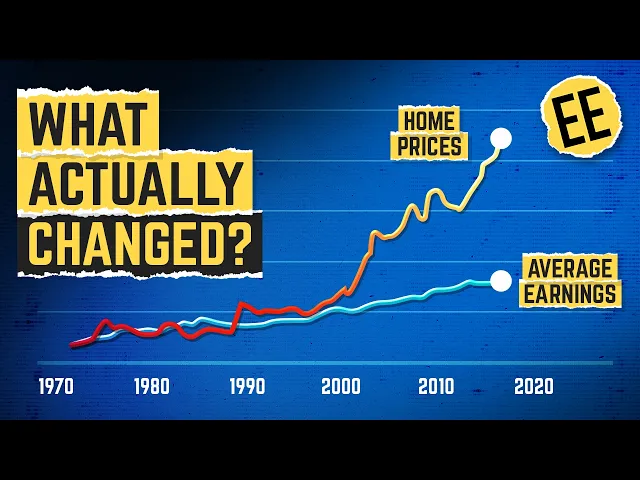
4:19 Just 30 years ago, nearly all these cities were affordable.
4:22 Home prices rose roughly in line with incomes,
4:24 but today they've completely split apart.
4:26 The report's authors call this an
4:28 existential threat to middle income households,
4:29 and you don't need
4:30 to be a researcher to see why.
4:32 When home prices rise faster than wages, the effects spread far
4:35 beyond the housing market.
4:37 Families delay having kids, workers turn down better jobs because they
4:40 can't afford to move,
4:41 and younger generations lose access to what used to be the cornerstone
4:44 of middle class life, owning a home.
4:46 Which raises the bigger question, if this wasn't a problem
4:49 30 years ago, what changed?
4:51 30 years ago, a house was a shelter, it was a basic need.
4:55 Today, it's part of a global investment strategy,
4:58 but this isn't just about housing.
5:00 Over the last few
5:01 decades, almost everything that counts as an asset has shot up in price.
5:05 Not just homes, but
5:06 land, stocks and even art.
5:07 Why?
5:08 Because rich people, corporations and big funds have more cash than ever,
5:12 and they all want a safe place to park it.
5:14 When the wealthy get more money, they don't buy more
5:16 groceries.
5:17 They buy assets.
5:18 Housing got hit the hardest because it's both essential and one of
5:21 the easiest assets to own, rent out or borrow against.
5:25 It became the perfect target.
5:26 This artificially boosted demand,
5:28 while at the same time we were arbitrarily limiting supply.
5:31 It began with good intentions,
5:33 protecting green space, controlling sprawl, preserving
5:35 neighborhood character, but over time,
5:37 those good intentions turned into zoning limits,
5:40 height caps, parking minimums, endless approvals,
5:42 all of which slow construction and drove up the
5:44 cost of land that could be developed.
5:47 As those restrictions tightened, housing stopped behaving
5:49 like a normal market.
5:51 Prices no longer reflected the cost of bricks and labour, they reflected
5:54 policy-made scarcity.
5:55 As interest rates fell and global cash supplies surged, more capital
5:59 chased the same limited number of homes.
6:01 Investors, funds and even pension systems realised that real
6:04 estate offered steady returns and safety from inflation.
6:07 If you could borrow at 3%, your property
6:09 rose 7% a year, you didn't need to live in it, you just needed to own it.
6:14 This shift turned homes
6:15 into financial products,
6:16 institutional buyers started purchasing single-family homes in bulk,
6:19 foreign investors traded a property as a storehouse of wealth,
6:21 and even regular households began to
6:23 see real estate as something that always went up.
6:25 That wave of money flowed straight into the
6:27 cities already at the top of Demografia's list,
6:30 where limited supply sent prices through the roof.
6:32 In markets like these,
6:33 the more valuable housing became, the more capital attracted,
6:36 creating a feedback loop between scarcity and speculation.
6:39 Meanwhile, wages stopped keeping
6:41 up.
6:41 For most of the 20th century, income and house prices moved together.
6:44 As workers became more productive, they earned more,
6:47 and as cities grew, they added more homes.
6:49 But in the 1990s,
6:50 those trajectories diverged.
6:51 Trade, automation and offshoring put a lid on middle-income wage
6:55 growth, even as living costs rose.
6:57 In the US, median real wages have risen only around 10% in
7:00 the last 20 years, while home prices have doubled,
7:04 tripled or even quadrupled in the same period.
7:06 A few decades ago, a single income could buy a family home,
7:09 and if a second earner joined the
7:11 workforce, that meant a bigger house or a better neighbourhood.
7:14 But once everyone had two incomes,
7:16 sellers knew it and prices climbed to keep pace.
7:19 Instead of making homes more affordable,
7:20 dual incomes just made the same homes cost twice as much.
7:24 And as prices rose faster than pay,
7:26 something else happened.
7:27 People stretched further into debt.
7:28 People would end up spending more of
7:30 their income on a mortgage,
7:32 banks would keep lending because rising prices made the market
7:34 look safe, and every time lenders approved bigger loans,
7:37 buyers could bid higher, pushing prices
7:39 up again.
7:39 It created a feedback loop that kept feeding itself.
7:42 But then the pandemic hit and
7:44 the whole system started to wobble.
7:45 Remote work scattered demand into smaller cities,
7:47 but it didn't fix the core problem.
7:50 Construction costs exploded, supply chains broke, inflation
7:53 sent material prices soaring, and labour shortages slowed projects everywhere.
7:56 When interest rates finally rose, borrowing got expensive,
7:59 but prices didn't crash because nobody wanted to sell.
8:03 Millions of homeowners were locked into
8:05 ultra-low-rate mortgages and refused to move,
8:08 so supply froze.
8:09 Governments tried to help, but mostly in the wrong way.
8:11 They rolled out even more tax breaks,
8:14 grants and subsidies to first home buyers.
8:15 The problem is that when you can't build more homes,
8:18 giving people more money doesn't make prices fall,
8:20 it just makes buyers fight harder over the
8:23 same ones.
8:23 So, if you trace it back,
8:25 the answer to what changed isn't one thing, it's a chain
8:28 reaction.
8:28 We restricted land, we flooded the system with cheap money,
8:31 we let wages stagnate while
8:33 asset prices took off,
8:34 and when the foundations of that whole system started to crack, we doubled
8:37 down with short-term fixes,
8:38 piling bricks on top and just hoping gravity would take the day off.
8:42 That's how we ended up with impossibly unaffordable places to live,
8:45 and why today, the world's richest cities now top the list
8:48 of the least affordable places on earth.
8:50 So, what does that actually mean for the people living in them?
8:53 For millions of middle-income families,
8:55 it means home ownership is no longer part of the plan.
8:57 In cities like Los Angeles, Sydney and New York,
9:00 a large share of renters now spend about 30 to
9:02 35% of their income just keeping a roof over their heads,
9:05 right above the threshold economists
9:07 unaffordable.
9:07 The average first-time home buyer is now in their late 30s or early 40s,
9:12 a full decade older than their parents were,
9:14 and when the people can't afford to live where their jobs are,
9:16 they stop moving for opportunity.
9:18 In the US and Canada, people are leaving major cities for small
9:21 towns, a trend economists call counter-rebonisation.
9:23 And while that might sound like a good thing for
9:26 regional growth, it often means the most productive cities lose
9:28 the very workers that keep them running,
9:30 teachers, nurses, tradespeople, hospitality staff.
9:32 A locked housing market becomes a locked
9:35 labour market.
9:36 Productivity slows, innovation spreads more slowly, and inequality deepens.
9:41 Because while renters and first-time home buyers are falling behind,
9:44 existing homeowners keep getting richer.
9:45 Every year their homes gain value, not because they
9:48 worked more hours or invented something new,
9:50 but because scarcity made their property worth more.
9:53 Globally, the total value of real estate now sits at
9:55 around three and a half times the world's annual
9:57 GDP.
9:57 And even for people who are lucky enough to grab onto the ladder,
10:01 buying in at such elevated
10:02 prices feels like a gamble, high debt, high risk,
10:05 and the constant fear that one economic shock
10:07 could knock everything off balance.
10:09 So, is there any way to stop this?
10:11 Some countries are starting
10:12 to try.
10:13 New Zealand launched a plan called Going for Housing Growth in 2023,
10:17 which forces major
10:18 city councils to zone enough land for 30 years of housing demand.
10:21 Their goal is simple– make
10:23 land supply predictable so prices can't spiral out of control.
10:26 In the US, cities like Minneapolis
10:28 and states like California have begun loosening single-family zoning.
10:31 That means duplexes and
10:33 small apartment blocks can be built in neighborhoods
10:35 that once allowed only one house per lot.
10:37 This opens up supply where people actually want to live.
10:40 Singapore is taking a completely different
10:42 approach.
10:42 There, nearly 90% of households own their homes thanks to massive public housing
10:47 program managed by the Housing and Development Board.
10:49 The government buys land, builds at scale,
10:51 and sells apartments directly to citizens at subsidized prices.
10:53 So yes, this shows that if you
10:56 treat housing as infrastructure, like roads or schools,
10:59 you can achieve near-universal ownership.
11:01 Then there are countries tackling speculation instead of supply.
11:03 Hong Kong and Wales both
11:05 tax second homes heavily.
11:06 In Wales, local councils can charge up to 300% council tax premium.
11:11 Taiwan packs its property sold within two years at up to 45%,
11:14 discouraging fast flips and speculative buying.
11:17 And in the Netherlands, some municipalities
11:19 have banned investors from buying in certain
11:21 neighborhoods to keep homes for locals.
11:23 The US is now exploring a similar idea with
11:25 the End Hedge Fund Control of American Homes Act.
11:28 This act would stop hedge funds and other
11:30 big real estate firms from owning single-family
11:31 homes altogether.
11:32 So yes, to fix this crisis, we need more homes.
11:35 But we also need to rethink
11:37 who's buying them, where they're built,
11:39 and what kind of economy they're fueling.
11:41 Because at its core, it's the same old story.
11:43 A tidal wave of money flowing into a handful of
11:46 assets and drowning the middle and low-income classes in the process.
11:49 And unless certain balance changes,
11:50 no amount of zoning reform or new construction will make homes truly affordable.
11:55 If you want to understand why inequality is now
11:56 reaching a tipping point and how we got here,
11:58 we've already made an entire video on that exact
12:00 topic and you should be able to click
12:01 that on your screen now.
12:03 Thanks for watching mate, bye.