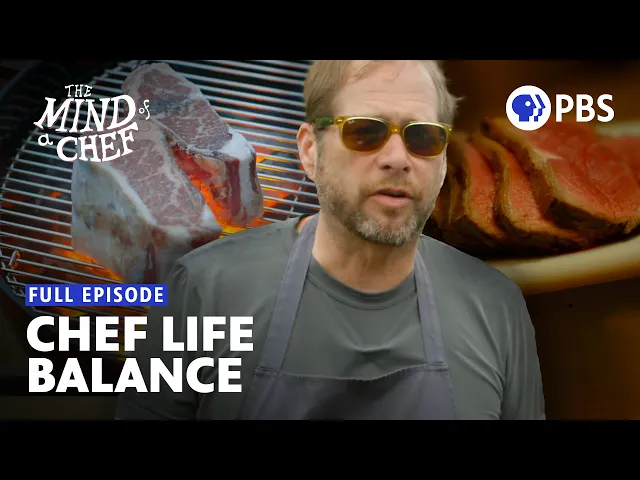
How Chef David Kinch Finds Work-Life Balance | Anthony Bourdain's The Mind of a Chef | Full Episode
PBS Food
0:01 Viewers like you make this program possible.
0:03 Support your local PBS station.
0:07 (traffic whooshing past) (van door opens) (sizzling) ANTHONY BOURDAIN:
0:20 For chef David Kinch,
0:21 balance means occasionally stepping out from behind the line.
0:24 (ordering in Spanish) BOURDAIN:
0:28 Even the things you are most passionate about can
0:30 wear you out if you don't take a break.
0:33 KINCH: Let's go, let's go!
0:34 What's missing?
0:36 BOURDAIN: Growth comes from exploration, collaboration and experimentation,
0:39 both inside and outside of the kitchen.
0:42 KINCH: Doesn't look bad.
0:44 BOURDAIN: Enter The Mind of a Chef.
0:46 KINCH: The sun is an ingredient.
0:49 Mmm...
0:49 this is the fun part in cooking.
0:51 Cheers.
1:03 (sniffing) KINCH: Finding some sort of balance
1:37 between your personal and professional life,
1:42 that's really hard to do in our industry, because it's so relentless.
1:46 Let's go, let's go!
1:47 What a lot of chefs talk about at some point in time in their career,
1:50 they say, "I've been doing this, I work till 1:00 in the morning.
1:53 "My feet hurt, I don't have a personal life...
1:58 What can I do to get out?" And they're leaving something
2:03 that they've been very passionate about for the majority of their young life.
2:08 I guess I understand to learn your craft,
2:11 sometimes you have to go through these systems.
2:12 It's like military, you know, a level of discipline,
2:16 and working long, long, long hours.
2:19 But to get away and to unwind and to relax is very important.
2:24 (wind whooshing) (gulls calling) It's funny how you take a break
2:40 and you get really isolated and you end up cooking.
2:44 There's something very appealing about that.
2:51 I used to have chefs ask me to make them
2:52 omelettes to see if I could get a job or not.
2:54 I don't think it happens anymore.
2:56 KINCH: It doesn't happen anymore.
2:57 I mean, what would you do for a cook?
2:59 What would you have them make, you know,
3:00 if you want to see if they can walk the walk?
3:03 I make them open oysters.
3:04 KINCH: Oh, no punctured bellies?
3:06 Oysters and clams.
3:08 KINCH: Carlo Mirarchi is the chef and owner of Blanca and Roberta's in Brooklyn.
3:13 He's a very good friend of mine.
3:15 I wanted him to come out to California and show
3:17 him a little bit about where I've been, where I'm from.
3:21 I had a humbling experience about five, six years ago.
3:24 Visiting chef— I had Alain Passard come and cook at my restaurant.
3:27 And every night at the end of the service, he'd be,
3:29 like, "Make me dinner," and I'd have to cook him dinner.
3:31 And one night he says, "Make me an omelette." I made him an omelette and I
3:34 was about ready to go out and his sous-chef was,
3:36 like, "Oh, no-no-no-no-no."- (chuckling) They proceeded to show me how to do it.
3:41 And it's really, really brilliant and it kind of flies in the face,
3:45 I think, that you and I were always shown how to make an omelette.
3:48 And omelettes were always one of those things where there was a way to do it,
3:52 and this is how it's done, and...
3:53 Mm-hmm.
3:54 KINCH: You know, if you do it other ways,
3:55 like a frittata or you fold it over to the side, then it's something different.
4:02 But an omelette is an omelette is an omelette.
4:05 It's a perfect representation of what can
4:07 happen to eggs when they're cooked perfectly.
4:11 Eggs at room temperature, not cold out of the fridge.
4:14 I'm going to do three whole eggs...
4:17 Because I like to do three whole eggs and then one yolk.
4:19 KINCH: Okay, let's do that.
4:20 We don't have to do that.
4:21 KINCH: Let's do that.
4:23 All right, okay.
4:24 KINCH: Just a touch of water.
4:27 I use a fork instead of a whisk,
4:29 because you don't want to incorporate air into it.
4:31 Essentially you just want to homogenize it.
4:32 You want to bring it together.
4:34 It starts to lighten up a little bit in color...
4:37 Now, to me, this is ready to go.
4:39 And I have not added any salt into this at all.
4:45 There we go.
4:52 (shaking pan) You want it to all come together, no color on the bottom.
5:05 They're not runny on the inside.
5:07 Really kind of the beauty of the whole thing is it's just eggs and butter,
5:11 but by technique, it kind of really elevates it to a really beautiful texture.
5:22 This is key.
5:23 So it's shaped...
5:31 Just give it a little bath in homemade salted butter,
5:36 just enough to make it shine.
5:38 The only salt that's been added to it we're adding to it right now.
5:43 To me, that's a good omelette.
5:46 This is delicious.
5:47 KINCH: Would you hire me?
5:49 I would.
5:49 You can be the junior breakfast cook.
5:51 The omelette bar.
5:53 KINCH: Yeah, that's what I mean.
5:55 (laughing) (motorcycle engine whirring) (bleating) KINCH:
6:25 This is raw goat's milk here.
6:27 I'm going to try and make a real simple fresh farmer's cheese.
6:36 The cheese picks up a bit of a smoky flavor.
6:38 I'm going to really dig it.
6:42 As fresh as you can get right there.
6:46 Some fresh cream, not a lot.
6:50 And I'm going to put a little cow's milk in just to enrich it a little bit.
6:55 Some sea salt.
6:58 Going to warm this up.
7:00 This is the first time I've ever done it on a wood fire,
7:03 but I think it's going to work.
7:08 Starting to form a skin, so it's ready.
7:13 Throw me the knife.
7:15 Knife?
7:15 (Mirarchi laughing) KINCH: Thank you, chef.
7:17 (Mirarchi laughing) KINCH: What an amazing pot.
7:23 Something very goth about it.
7:28 KINCH: It's getting really close to a boil.
7:38 And I'm going to let it continue to drain.
7:46 I'm fascinated by pizza.
7:49 I think the relationship between the person who's
7:52 making the pizza and the oven is really important.
7:55 The best pizza I ever had are people who are really fanatical about their ovens.
8:01 There's people who make it, who just chase it their whole life and they
8:05 still don't feel that they got it down.
8:08 Mother Teresa said that she felt the presence of God once for five minutes.
8:13 Was she eating pizza?
8:15 And then she spent the whole rest
8:16 of her life dedicated to what that moment meant.
8:21 Maybe all it takes is one good slice.
8:27 KINCH: Evan Shively is a legendary character in Northern California,
8:30 original gangster at Chez Panisse, one of the greatest cooks I know.
8:35 I knew that Carlo and Evan would get along really well.
8:38 Do you want to give me a little chili flake?
8:40 Do you grow these chilis here?
8:41 Do you dry these here?
8:43 No, I have a day job.
8:45 (laughing) Some of that pecorino.
8:52 KINCH: Ooh, pecorino.
8:55 Tell me about this guanciale; it's amazing.
8:58 So this guanciale my dad and I make,
9:00 we dry in the basement of the house on Long Island.
9:04 KINCH: Onion petals.
9:06 That's the sweet spot.
9:14 Hot dough.
9:15 KINCH: That looks pretty good.
9:18 Hurry up and slice it.
9:23 KINCH: The dough is like another planet.
9:27 The guanciale is delicious.
9:30 KINCH: I don't know how we're going to top that one.
9:33 How about some fava beans?
9:35 Fava beans?
9:35 On a pizza pie?
9:38 Che pazzo!
9:43 KINCH: I'm going to take a look at my cheese.
9:46 Oh, yeah, look at that.
9:48 What is that, goat?
9:50 KINCH: It's goat.
9:52 This should be pretty good.
9:54 We have just a real quick farmer's-style ricotta made with goat's milk.
10:02 And these roasted fava beans with the cheese I think will be great.
10:07 Just walking around here, saw the savory.
10:09 Wasn't even thinking about putting savory on a pizza.
10:11 Yet here we are.
10:12 KINCH: And here we are.
10:14 Here we find ourselves.
10:14 Do you put the savory right on it?
10:16 KINCH: Mm-hmm.
10:17 Okay.
10:18 Good.
10:19 KINCH: Little bit too much.
10:20 Perfect, sorry, chef.
10:21 Please don't send me home.
10:26 KINCH: I think the mint would go really nice too,
10:29 though mint on a pizza sounds kind of odd.
10:31 I guess we're going to find out.
10:40 Oh, you have flowers?
10:41 KINCH: It's going to be a flower pizza.
10:44 Ohh...
10:45 Mamma mia!
10:47 KINCH: Do not laugh.
10:49 Apply the "gahnish." (both laughing) KINCH: Okay.
10:58 Sounding pretty good.
10:59 KINCH: See how it tastes.
11:01 Mmm.
11:03 That's just really beautiful.
11:05 That tastes pretty, too.
11:07 Sold.
11:09 (engine cranking) KINCH: Oh, it's not starting.
11:12 I think it needs a jump.
11:13 Do you want to bump-start it?
11:15 KINCH: Yeah.
11:16 Are you in neutral?
11:17 KINCH: It's in neutral.
11:23 Faster, Carlo!
11:27 (Carlo grunting and laughing)- I can't get it any more up that hill.
11:31 By myself.
11:35 (grunting) KINCH: Okay.
11:38 Stop.
11:39 All right, so what's the plan?
11:41 You going to go down this way?
11:42 KINCH: Yeah, down this way.
11:44 All right, ready?
11:50 (laughing) KINCH: Never turned.
11:53 All right, we need to jump it.
11:55 We're getting what we deserve right now.
12:01 All right, you're hooked up!
12:02 KINCH: Rev the engine!
12:04 (engine revving) (chugging lamely) (revving)- Got it?
12:14 (engine revving) So we're going to do this seaweed-sunchoke dish.
12:37 KINCH: Where did this dish come from?
12:38 It's vegan— it's a vegan dish.
12:39 Yeah, it ended up being.
12:41 We didn't really think about it but we
12:42 just finished it and we're like, "Oh, it's vegan,
12:44 by the way." KINCH: So you didn't create
12:45 a dish for a vegan scenario at the restaurant?
12:48 Yeah, it worked out that way.
12:49 We had bees on the roof so we had a lot of honeycomb,
12:51 and we had sea lettuces in from our Maine guy.
12:55 We wanted to do something with the honeycomb and the seaweed in a fun way.
12:58 And we just started fooling around.
13:00 It took, like, six months to figure this dish out.
13:02 Even though it's really simple, there was a lot of trial and error to find
13:06 the right seaweed that balances well with the honey.
13:08 KINCH: It was the balance of flavors that was the hardest thing?
13:11 Yeah, and the mouth feel, too,
13:12 is really important for this dish because there's a lot of texture.
13:16 Sunchokes I like a lot because they have a ton of inulin,
13:20 which, when they're stored, turns into sugar, which makes them really sweet,
13:25 but not being too starchy, which is nice.
13:28 KINCH: What am I doing, am I laying this out?
13:30 Lay those out flat because we're going to dehydrate that.
13:32 You're on the "de-hy" duty, chef.
13:34 KINCH: I know how to do this.
13:36 This is ulva, our sea lettuce.
13:37 It's harvested from Maine.
13:38 We get it in, we rinse it, and then dehydrate it overnight.
13:41 KINCH: It also has a lot of clinging salinity.
13:43 It does, it sure does.
13:45 Then the green almonds.
13:46 It's a fresh almond.
13:48 KINCH: An almond is actually the kernel of the almond fruit.
13:52 Are those hard to find on the East Coast?
13:54 Yeah, they don't exist on the East Coast.
13:56 KINCH: They come from here.
13:57 From California, yeah.
13:58 We're trying to get stuff from all over.
13:59 We have our own garden, we grow a lot of stuff that we use.
14:01 Probably 85% of what we use comes from the East Coast, but, you know,
14:05 sometimes something just needs something that every
14:07 once in a while you can't get.
14:09 I think that's okay.
14:11 KINCH: It is okay.
14:13 This is the sunchokes that we just cut.
14:16 Just working hard at this.
14:18 KINCH: They caramelize so fast.
14:20 Really, really nice and quick.
14:21 KINCH: That looks great.
14:22 Looks nice, right?
14:23 Like sunchoke cracklings.
14:24 I kind of want to eat it.
14:25 We're going to make the sauce now.
14:28 We add a little bit of soy milk here.
14:31 Then we'll add a little bit of the sunchoke stock.
14:35 So basically we'll just let this cook down for a little bit,
14:38 and then we'll purée it, pass it through a coffee filter.
14:41 KINCH: So it picks up the caramelized flavor.
14:42 Yeah, it does, yeah, but not too much.
14:44 Just enough to make it a little toasty, but nothing crazy.
14:45 It kind of just tastes like ice cream base at this point.
14:50 KINCH: Sunchoke makes a great ice cream because of all those sugars.
14:53 Mm-hmm.
14:54 All right, so we're right there, pretty much.
14:55 We'll put it in the Vita-Prep,
14:57 buzz it and then pass it through a coffee filter and that'll be our sauce.
15:00 Voilà!
15:03 The magic of television.
15:04 KINCH: Pretty fancy for a vegan dish.
15:06 Yeah, I know, right?
15:07 Oof, man.
15:08 KINCH: What do you start with first?
15:10 Sunchoke.
15:11 Then we'll do a little bit of the toasted seaweed.
15:14 The seaweed moves when you plate it— it looks really cool.
15:18 National Geographic right there.
15:20 Then we just do a little bit of the honeycomb.
15:25 And then for the green almond,
15:26 I like to actually open them up, squeeze the gel out.
15:30 KINCH: Oh, nice.
15:31 A little messy, but it looks nice.
15:32 KINCH: I bet it tastes good, too.
15:34 It's kind of aromatic.
15:37 How about some coriander flowers?
15:39 Ooh, do you have some?
15:40 Oh, boy.
15:44 It's done...
15:45 I think.
15:47 So, vegan surf-'n-turf.
16:00 KINCH: For me, a true vacation is just recharging everything.
16:06 Nothing else matters for a while.
16:09 And then you come back and you're almost like a different person.
16:15 There is a good stretch of 1
16:18 before San Francisco where you become completely disconnected.
16:24 Phones don't work, you get no signal of any kind.
16:28 And nowadays, that's going off the radar, that's a big deal.
16:33 And I like that.
16:34 You know, to me, when I want to get away,
16:36 it's really important that that happens.
16:39 I think as the restaurant has become more popular,
16:43 it's become more important to find the ability to drop away.
17:02 Make no mistake.
17:05 It's a meat-off.
17:07 There are no rules.
17:13 I've always associated great steak cook with Carlo.
17:17 Carlo's one of the first people that I heard about who was aging meat past
17:21 the norm to get more flavors and to get more nuance and character out of meat.
17:25 And always great sourcing.
17:27 I still don't know where he gets his beef from.
17:30 Your steak, definitely an animal with wagyu in it.
17:33 Yeah.
17:33 Just a really, really even pattern of marbling all along
17:37 as opposed to being grouped in certain areas and not evenly distributed.
17:41 KINCH: I have a West Coast source that I like very much,
17:43 but I also think it's really incredibly different.
17:46 Hence, the purpose for a meat-off.
17:47 Yeah, we're going to celebrate the difference.
17:50 Right?
17:50 KINCH: Yeah.
17:52 They're both strip loins, they're both on the bone.
17:58 You're taking it off the bone, David?
17:59 KINCH: I'm just taking this one bone out because I'm going to cut it thick.
18:07 There's many different ways to cook meat.
18:09 You can cook 'em slow, you can cook it really, really fast.
18:12 For this particular cut, I like to go a really,
18:16 really high heat but try and have as much control over it as possible.
18:20 On a grill this big, you want to have a really,
18:23 really super hot spot and another place that's not so hot,
18:28 so I can control the temperature by moving the meat on and off the heat.
18:32 Binchotan to me burns very, very clean, but it's tremendously hot.
18:37 It burns almost smokeless, but use the hard wood, because we're outdoors.
18:43 For beef I like it because it burns really, really hot but it burns really fast.
18:47 KINCH: Yeah.
18:51 I'm getting really close.
18:52 KINCH: Yeah, me too.
18:56 Looks like I'm using a lot of salt, but it's all going to cook right off.
19:02 KINCH: Looks amazing.
19:03 I salt probably not as much as other people do,
19:06 because I'm a big fan of salting it after it's cooked.
19:09 I don't put pepper on it at the beginning, either, because pepper burns.
19:14 When pepper burns, it gets really acrid and bitter.
19:18 So it's just meat and salt.
19:22 When people taste this, I tell them it tastes like
19:24 the steaks that your fathers and your grandfathers used to have.
19:28 You know, before animals were bred for efficiency.
19:32 Do you do those crosshatches?
19:34 KINCH: Yeah.
19:36 Whoo!
19:37 Still got it.
19:38 KINCH: That's right.
19:46 When those flames hit the beef, a little bit's okay, but a lot is not okay.
19:51 I think it starts making it taste like the charcoal.
19:58 How important is the char to you?
19:59 I like a nice one, but nothing crazy.
20:01 KINCH: You don't like that super crusty, like that 1400...
20:04 It doesn't work well.
20:06 You lose a lot of the nuance.
20:07 KINCH: It dries out.
20:07 Yeah.
20:10 The thing is, the loins are so big, you can age it for a really long time.
20:14 KINCH: And how long was that?
20:16 Three or four months.
20:17 30 days on this, you know, it's nothing.
20:20 You lose a little bit of water weight, but that's it.
20:23 KINCH: Look at that— amazing, huh?
20:25 It can get mesmerizing, can't it?
20:27 Just watching the fire.
20:33 Cooking outdoors, there's something relaxing about it.
20:38 Especially if you're working with an open fire.
20:41 It immediately becomes more rustic,
20:44 can put you much more attached to the act of cooking.
20:49 Usually it's not for an event.
20:51 You're cooking for yourself or friends,
20:52 so it's much more intimate, and it's much more personal.
20:57 You also don't feel a lot of pressure to analyze things.
21:02 It's more about eating well and having a good time.
21:06 Which is very important on a day off.
21:21 We're moving away from the period where it's just heads down,
21:24 work, work, work, work all the time, because it beats people up.
21:29 You have better longevity, you have more creative powers,
21:32 I think you live a more healthy life if you find that balance.
21:42 I've only had one restaurant.
21:44 And that is because I always like going to work.
21:48 I like working at night, cooking food, making people happy.
21:54 It's kind of what drives me.
21:57 And I've learned to accept that.
22:00 But how long is that going to happen?
22:03 It's just learning when to take time off,
22:05 learning when to recharge my batteries,
22:07 learning to delegate, which is really the last thing chefs learn to do.
22:12 "I can do it better than anybody that works for me,
22:14 so I'm going to do it," as opposed to just like
22:17 taking a deep breath and realizing that you've trained people and you
22:20 trust them and you're paying them to do the job
22:22 and to actually take a step back and let them do it.
22:26 To make that happen, you have to accept,
22:29 "I'm going to step away." And you know what you're going to find out?
22:34 Sometimes it runs even better.
22:36 Because that's part of balance, that's the part about how it happens.
22:43 (sniffing)