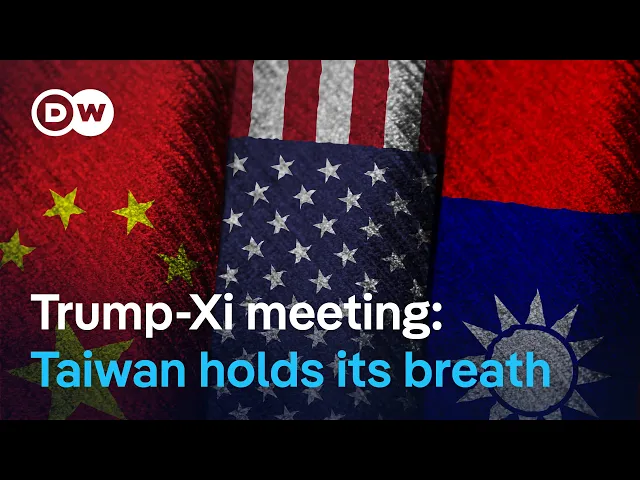
Trump-Xi meeting: Is Taiwan at risk of getting a raw deal? | DW News
DW News
0:00 Donald Trump, Xihinping, and Taiwan.
0:03 The leaders of two huge economies are meeting this week in Beijing.
0:08 And one of the things they're going to be
0:10 talking about is the tiny yet powerful for its size,
0:14 Taiwan, which lies off mainland China's coast.
0:17 So, I'm thinking, what could go wrong of its meeting for Taiwan?
0:21 a democracy that has long relied on the US for its security,
0:25 but is claimed by Beijing as part of China's territory.
0:30 Taiwan's number one fear has always been that it's going
0:32 to be relegated to the back burner on Washington's policy makers mind.
0:37 And um more specifically,
0:39 there's always this latent fear that US and China might somehow one day decide
0:44 to strike a quote unquote grand bargain uh
0:47 under which US perhaps make concessions on Taiwan,
0:52 maybe potentially abandoning Taiwan uh strategically in exchange
0:57 for major Chinese uh purchase orders of more American soybeans.
1:03 That is Wenty Sun.
1:04 He knows lots about Taiwan China dynamics
1:07 and I'll be talking with him in a minute.
1:10 Now, Taiwan is hoping to hear Mr.
1:13 Trump offer continued, if purposefully ambiguous, support,
1:18 ambiguous because of the decades old tightroppe of diplomatic speak known
1:23 as strategic ambiguity that has maintained
1:27 Taiwan's autonomy without outwardly declaring its independence.
1:31 But Donald Trump has never been an ambiguous person.
1:35 So, could he mess things up while
1:37 in the company of a powerful authoritarian leader this week?
1:41 But it looks like it's just a disease that we've had.
1:46 Wenti Sunung is a non-resident fellow
1:47 at the Atlantic Council's Global China Hub.
1:50 He works on the trilateral relationship between the US, China, and Taiwan,
1:55 which makes him the perfect person to talk to right now.
1:59 Thank you so much for joining us.
2:01 With so many major issues for Trump and she to talk about this week,
2:06 we've got the war in Iran, trade and tariffs, AI, the list goes on.
2:10 Just clarify for us, why is Taiwan going to be such an important
2:14 talking point in this meeting between the two leaders?
2:19 Yeah, I mean Taiwan, of course, as we all know,
2:22 uh is one of the most major potential flash points
2:26 in that relationship between the world's two leading superpowers, US and China.
2:30 And we know that for China,
2:32 China has always claimed Taiwan to be the crown jewel in China's quest
2:38 to uh towards what they call a great rejuvenation of a Chinese nation.
2:44 And for us on the other hand,
2:46 Taiwan has been a major success story in terms of democratization,
2:50 in terms of sharing liberal democratic
2:52 values as was democratic development and uh
2:55 so in that sense Taiwan is an indispensable part to the narrative
3:00 for the both uh leading superpowers of the world and that's
3:03 why it's such a major point of contention between the two sides.
3:07 Now the last time Trump and she met that was October 2025 in South Korea.
3:12 what are the main differences in the dynamic between the two um from then
3:19 to now and and and how could that sort of shifting dynamic affect Taiwan?
3:26 I think if I were to compare late last year to now mid 2026,
3:31 the main thing is that um the Iran war has happened.
3:34 Of course, in addition to the Venezuela decapitation strike,
3:37 but the Iran war is a one major issue here because
3:40 US is once again finding itself stuck in the Middle Eastern quagmire
3:45 that divert a lot of American resources and political attention as diplomatic
3:50 capital away from the Indo-Pacific theater
3:54 and towards the Middle Eastern theater.
3:56 And what that means is that um uh US is finding
3:59 itself to be a somewhat more tentative position going into this meeting
4:04 with China and China is finding itself to be enjoying Hong Kong
4:08 advantage now that the meeting is going to happen in Beijing as well.
4:12 So presumably Beijing also gets to set more uh gets to have a more
4:17 influence on setting agenda for the discussion
4:19 item as well as other logistical arrangements.
4:22 So in this sense uh China's feeling a bit more confident
4:25 this time around compared with late last year in their Korea meeting.
4:30 We the Iran war is obviously a major aspect of this meeting.
4:33 We will talk about that a little bit uh later in our conversation.
4:37 Can I ask you though what shifts in language or policy
4:41 she wants to get from Trump um in this meeting about Taiwan?
4:48 Yes.
4:48 So on Taiwan, one major thing that China has been trying to get
4:53 is to get America to make a different pronouncement about USS policy on Taiwan.
4:59 Currently the US position is that US does not support Taiwan independence.
5:04 And what Beijing want is to get Trump
5:06 to say instead that US opposes independence for Taiwan.
5:12 Now that may seem like a minor shift in semantic.
5:14 Of course, the gold does not support towards actively oppose.
5:19 But if China gets it, China would view it as a major win.
5:22 And China would definitely frame that slight shift in US rhetoric
5:26 as a sign that US is shifting towards a new president on Taiwan.
5:30 And China will frame it domestically as a major win uh for Chinese
5:34 leadership towards the Chinese people and internationally
5:37 they will use it of course
5:38 to pressure other party countries in the world to say hey if US
5:43 is softening on their posture on Taiwan maybe you guys should as well.
5:47 So that's one major thing that China has uh on its crosshair this time around.
5:52 I just wanted to ask you about the term strategic ambiguity.
5:56 That's what we hear, isn't it,
5:57 about um sort of the attitude, the policy uh towards Taiwan.
6:02 Can you just explain what that means and why that term is used?
6:08 Yeah.
6:09 So strategic ambiguity basically means that um US keep it
6:14 unclear keep it ambiguous that should China launch an invasion against
6:19 Taiwan will the US military will come to Taiwan's aid
6:23 or not that's the ambiguity when it comes this to this major
6:27 strategic issue of potential conflict between US and China
6:32 and by extension US China Taiwan and so US historically has
6:36 usually kept to a position of ambiguity that says US
6:41 may or may not come to Taiwan's aid and that has
6:45 the effect of what we call dual deterrence namely
6:48 that first it deter China from uh invading Taiwan because China
6:53 is going to be thinking what happened if US decide
6:56 to intervene that's going to make things so much more complicated
6:59 that's one deterrence and there's the second deterrence and that's
7:02 against Taiwan namely uh US lack of clarity on whether US
7:07 support Taiwan in a military showdown keeps Taiwan policy maker
7:11 from going too fast on moving towards more independence as well.
7:16 So this slows both sides down and that also kill initiative on the US side.
7:22 Let's talk about sort of specifics about Taiwan, what makes it so significant.
7:27 First of all, it's its geographical um position.
7:31 What what is it about where Taiwan is that makes it such a flash point?
7:37 Yes.
7:37 So language we often use is first island
7:40 chain namely that from American geopolitical planners perspective
7:45 in order to ensure that US enjoys continue
7:49 preeminence around the world's major geopolitical chalk points.
7:52 US will want to limit Chinese military spear action towards
7:57 uh the Indo-Pacific and not beyond the first island chain.
8:00 First island chains are a collection of states
8:04 uh along China's eastern and southeastern maritime periphery.
8:09 So we're talking about Japan, South Korea, Taiwan,
8:13 down to Philippines and by extension uh Malaysia and Singapore.
8:18 Uh these are the maritime states that are along
8:21 China's military on the eastern and southern end of China.
8:24 And so long these states remain
8:26 largely friendly towards the American side militarily,
8:30 it's going to make it very hard for China
8:32 to project military power beyond uh its immediate shores.
8:35 And hence that's why keeping Taiwan in the US friendly side
8:39 of the column is so important to America's military planners for sure.
8:44 And so that's one major part of first island chain.
8:46 I suspect you may have other questions come after this as well.
8:50 Mhm.
8:51 Talking about sort of economic issues,
8:54 I mean it's a it's a huge factor, isn't it?
8:56 But Taiwan produces 90% of the world's most advanced semiconductors.
9:01 I mean, how does that influence the situation?
9:06 Yeah.
9:06 So Taiwanese talk about this concept of the silicon
9:09 shield or high-tech shield which is basically saying that given
9:13 that Taiwan produces something in the 90 plus% of the world's
9:17 most advanced semiconductor chips and more than half of semiconductor
9:21 chips in general if Taiwan ever falls a the war
9:25 is going to so decimate global production capacity for high-end
9:29 semiconductor chips in general making the world's technology and innovation
9:34 have the economy grinding to will hold number one.
9:37 So that hurts everybody in general.
9:39 Now uh if let's say a invasion does happen uh between China
9:43 and Taiwan and China somehow takes over
9:46 Taiwan high-tech industries that's going to mean
9:49 that a major s of technology power in the world is going
9:53 to move from a more USfriendly camp towards more China friendly camp as well.
9:58 And that's going to have major implications in terms of America's
10:02 continued predominance in the global high-tech supply chain as well
10:07 if a major choke point uh that is Taiwan falls
10:10 toward uh falls into a Chinese column rather USfriendly column.
10:15 Okay.
10:15 So you're making very clear what the global
10:18 implications political and economic of this are.
10:22 Let's talk about now the two personalities in this meeting this week.
10:26 Trump and she.
10:27 Now, Trump is known, isn't he, for his transactional attitude,
10:31 his ability to zigzag, to reverse course.
10:34 What is the thing that Taiwan is going to be most worried about
10:39 this week uh uh as this uh this meeting is about to happen?
10:46 Yeah.
10:46 I mean Taiwan being a relatively smaller
10:49 power in this US China Taiwan trilateral relationship.
10:53 Taiwan's number one fear has always been that it's going
10:55 to be relegated to the back burner on Washington's policy makers mind.
11:00 And um more specifically,
11:02 there's always this latent fear that US and China might somehow one day decide
11:07 to strike a quote unquote grand bargain uh
11:10 under which US perhaps make concessions on Taiwan,
11:15 maybe potentially abandoning Taiwan uh strategically in exchange
11:20 for major Chinese uh purchase orders of more American soybeans,
11:25 more American agricultural produce or let's say
11:29 Boing uh aerospace and other major heavy industry
11:33 from the American side that is trade
11:35 for Taiwan essentially that's a fear on many Taiwanese
11:39 uh policy analyst mind as well now knowing
11:43 Trump knowing the current situation we're in I
11:47 think some Taiwan policy makers find some
11:50 solace in this particular timing of this US
11:53 China summit and that it may bode well for Taiwan in a sense that yes
11:59 President President Trump might be a transaction president
12:01 when it comes to diplomatic style but also
12:05 yes US is currently stuck in the whole
12:08 Iran conflict significantly which as we mentioned
12:12 earlier puts US in a less favorable
12:15 position when it comes to negotiating with China.
12:18 So even if Trump administration were trying to think about selling Taiwan out
12:23 uh it will want to sell Taiwan out uh when the pricing is high.
12:28 But now given the Iran quadma US find itself
12:32 in it would be harder than usual for US to sell out Taiwan at a high enough
12:37 price for it to be worth President Trump's while.
12:41 So I think there is definitely Taiwanese society
12:44 and Taiwanese uh policy community watching this Trump Z summit
12:48 with a wary eye but they find some reassurance
12:52 that timing may on the whole be on Taiwan's side.
12:56 Okay, let's talk about this more.
12:58 I mean as you said the war in Iran has essentially drained US munitions,
13:02 weapons uh stockpiles, shifted military resources away from East East Asia.
13:08 Those are the facts now.
13:10 So, you're saying that this is going to impact
13:12 America's um ability to to to support Taiwan's autonomy.
13:17 I'm curious though, I mean,
13:19 with China watching what is going on, what is it going to be
13:23 taking from the way the US is conducting its war against Iran?
13:32 Yeah.
13:32 So uh a couple of things I think first of all uh China is going to be
13:36 looking at Iran conflict and realize the continual
13:40 might and military superiority of the American military.
13:42 I think that's number one.
13:43 The fact that US has been able to launch effective decapitation strikes
13:48 against top level leaderships not just
13:50 once against Iran but twice against Venezuela.
13:53 So in that sense China's kind of look at it and feeling
13:56 a sense of humility uh in terms of military balance between the two sides.
14:01 Number one, not to mention that China
14:03 has been undergoing its own military purges over the last year or so when
14:07 we see China's top level military decision-making body,
14:10 the central military commission having a clearing house when the usually seven
14:15 member CMC uh now is down to essentially two well three members.
14:20 So that's one thing uh that is going to inject some level of humility
14:24 back into a Chinese leadership's uh mind when it come to military balance.
14:29 Number two of course is the depletion American stockpile
14:32 uh that um China is going to find that hey
14:36 America's defense industrial complex however mighty it might be
14:40 its resources its production capacity is not unlimited and they
14:44 were hearing um report analysis from more Washington based
14:48 policy community side that um US find itself significantly
14:53 overstretched when it comes to military supply mutation and what
14:56 have you especially uh with in the interpacific theater.
15:00 So put these two together, China may be looking at this Iran conflict
15:04 and think that a uh in terms of military quality,
15:08 US still enjoys significant edge over China,
15:12 but also b uh we are seeing some level
15:15 change in the armor in terms of US different industrial
15:18 compass capacity to keep up with so many commitments
15:21 and so many campaigns that US has militarily around the world.
15:25 So maybe if China just shows slightly more strategic patience at some point,
15:31 China's greater scale, China's defense industrial complex,
15:35 greater production capacity may be able to turn a tie
15:39 if not in quality than at least in quantity.
15:41 So that's one more reason why China may want to wait
15:44 just a bit more when it comes to doing anything drastic.
15:47 So Wy, in summary, I'm going to ask you to look into your crystal ball.
15:51 What do you think is going to happen?
15:52 What will we see this week when Trump and she meet?
15:59 Well, that's a million-dollar question, isn't it?
16:01 Uh, I think I'm going to expect that Trump
16:04 and Z are going to have a uh a pleasant
16:09 uh bilateral exchange that's going to create a kind
16:12 of positive visual atmospherics that's going to calm the water somewhat.
16:17 I think we're going to expect more um resumption
16:21 of cultural and people-to-people level exchanges between the two sides.
16:26 We given that um President Trump is reportedly bring a lot of American
16:32 um tycoons and business leaders to China for part of his delegation.
16:37 We're going to see China side issuing a lot
16:40 of business purchase deals uh internal buying American soybeans, aerospace,
16:45 maybe other major US businesses as well as a way
16:48 to create a good vibe between the two sides.
16:51 On uh Taiwan side, I don't expect major uh drastic
16:57 changes this time around when it comes to highly symbolic act.
17:01 What we might see is President Trump saying something that's going
17:05 to in his mind calm the water somewhat and lower temperature.
17:09 something perhaps to the effect of uh US will not find
17:13 it to be in American interest to see any major unilateral changes
17:18 uh from either side and that um nonetheless US will continue
17:23 to do uh US Taiwan bilateral relation in ways that US sees fit.
17:30 keep it something in the very ambiguous uh language territory so
17:36 that both sides Beijing and Taipei will find something that they like.
17:40 Taipei will find it to be hey US still sees
17:44 its own interest to be a priority and maybe US
17:47 Taiwan continue cooperation is something that's in US interest especially
17:51 thinking about how Taiwan just passed something like 25 26 billion
17:56 US dollars worth of defense purchases budget uh that's going
18:00 to be a bring a rainfall for American defense uh sector
18:04 China will also find something like enough from that kind
18:07 of loose ambiguous language as well China is going to Hey,
18:11 uh, President Trump continue to be happy, uh, continue to, rather,
18:16 President Trump continue to discourage any
18:19 major drastic changes from both sides, specifically from not specifically,
18:25 but China's going to interpret it to mean
18:27 that Trump is hinting at the Taiwan side.
18:30 And so both sack had enough potential ambiguity,
18:34 one would argue constructive ambiguity to work
18:38 with for their own domestic audience that maybe on the whole
18:42 we're going to see peacemail shift from from President
18:45 Trump that leaves all holders enough to work with.
18:51 Wenty Sun with the Atlantic Council Council's Global China Hub.
18:54 Thank you so much for your insights.
18:56 It's been really great talking to you.
18:59 Thank you.
19:02 Do you agree with Wenty Sunung?
19:04 Is China hoping for or even expecting
19:07 a policy shift from Donald Trump on Taiwan?
19:10 Or will Taiwan remain the first island chain to contain Chinese ambitions?
19:16 Let us know in the comments.
19:18 And if you haven't already, don't forget to subscribe.
19:20 I'm Manny Cooper McKinnon.
19:22 Thank you for watching.