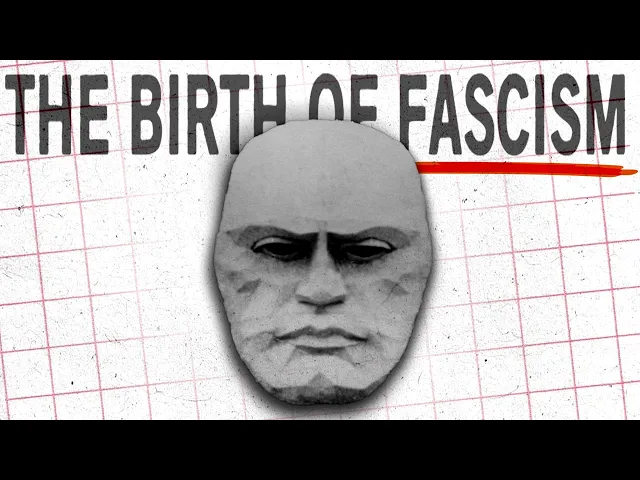
The Rise & Fall of Mussolini
How History Works
0:00 Before his unceremonious end,
0:02 Benito Amilcare Andrea Mussolini was the totalitarian prime minister of Italy
0:08 and later the uh somewhat unwilling duche of the Italian social republic.
0:13 On top of his official titles,
0:15 he was also infamously remembered by history as the founder of modern fascism,
0:20 or at the very least the first man
0:23 to put its ideology into practice on a national scale,
0:26 inspiring similar movements in Spain, Austria, Croatia,
0:29 China, the Netherlands, Japan, and of course, Germany.
0:33 Now, as students of history, you might be thinking that, wait a minute,
0:38 a lot of these groups ended up fighting one another.
0:41 But that was a feature of the system as well as a feature of the man himself.
0:45 By looking at his rise and fall,
0:48 it remains unclear how much he truly believed in his own
0:52 ideology and how much was just political opportunism that fell into place.
0:56 From relatively humble beginnings,
0:58 he was able to flip-flop his way into increasing positions
1:02 of power and influence by leveraging one talent above all others.
1:07 Mussolini was exceptionally skilled at getting attention
1:11 and using it to sew discontent with well,
1:15 whatever happened to be convenient at the time.
1:18 And conveniently for him at the time,
1:20 there was a lot to be discontent with in the nation
1:23 that he would come to rule with an iron fist.
1:26 As a young boy, Mussolini had a normal
1:30 home life with his siblings, ailing mother, and devout socialist father,
1:34 a setting that sewed the seeds for his early political fervor.
1:39 His father, Aleandro,
1:40 worked for a forge and preached socialism to anybody who would listen.
1:45 Young Bonito learned early that if you
1:48 could dominate a room with certainty and volume,
1:51 people started treating you like you had authority, even when you didn't.
1:55 By historic accounts, he was a bright child,
1:58 but ironically did not respond well to authority.
2:01 By his teens, he was collecting punishments, expulsions,
2:05 and a reputation for settling arguments with a knife.
2:09 At 18, he got a teaching credential and tried the respectable path for a moment,
2:14 then drifted away from it because Mussolini never
2:17 seemed interested in a quiet life where nobody clapped.
2:21 In 1902, he fled to Switzerland,
2:23 partly to dodge Italian conscription and partly because he
2:26 discovered that grievance could be turned into a job.
2:30 At the time, Switzerland had a swelling socialist scene.
2:34 He read obsessively, quoted big thinkers to look serious,
2:38 fought often, and slept around openly,
2:41 which fed an early legend of Mussolini as a reckless man of action,
2:46 long before he actually held any power.
2:48 Swiss police arrested him more than once for agitation and vagrancy,
2:53 and each arrest gave him something better than wages.
2:56 A story where he looked like the brave
2:58 outsider being silenced by a nervous system.
3:01 When he returned to Italy, he gravitated to an even bigger megaphone to get
3:06 his ideas out to the public, a newspaper.
3:09 This let him pick a villain every morning,
3:11 explain people's pain in simple terms,
3:14 and then watch the reaction like it was a scoreboard.
3:17 By 1912, the Socialist Party handed him their flagship paper.
3:23 Avanti and Mussolini ran it like a machine for attention,
3:27 pushing circulation up fast and obsessing over
3:30 reach as if breach was proof of truth.
3:33 Some accounts described the readership as doubling under him and other
3:37 numbers still showed a huge jump in a short time.
3:40 Either way, it trained Mussolini to think in audience
3:43 size the same way other politicians thought in votes.
3:46 If the crowd got bigger, he assumed he was right.
3:50 If the crowd got smaller, he rewrote the message until it grew again.
3:54 He also learned something about money and power that would keep repeating.
3:59 Turns out the people with factories and cash did not need to love your ideology.
4:04 They just needed to believe you could deliver a result they wanted.
4:08 Inside the socialist world,
4:10 he wrote like a revolutionary and acted like a performer.
4:14 always escalating, always polarizing,
4:16 and always positioning party elders as weak
4:20 men standing in the way of the people.
4:23 That tension sat there until Europe slid toward war,
4:27 and war turned every argument into a loyalty test,
4:30 where hesitation looked like betrayal.
4:32 When World War I erupted in 1914, Italy stayed neutral at first.
4:37 Mussolini followed the party line against intervention by arguing
4:41 the war was empires grinding workers into mud.
4:45 Then he pivoted hard,
4:46 arguing war could smash the old order and force a new Italy into being.
4:51 And he did it loudly enough that the socialist
4:55 party forced him out of Avanti and expelled him.
4:58 Within weeks, he'd launched Ilopo dalia, a paper for the people.
5:03 He kept the funding story vague on purpose because he liked the optics of being
5:09 a lone tribune even when in reality a handful
5:13 of wealthy backers were really paying the bills.
5:16 This was the Mussolini method in its early form.
5:20 Attract attention by any means necessary.
5:22 Attract a crowd, then quietly build a new
5:26 platform around them when the old one becomes inconvenient.
5:30 Once he crossed that line,
5:32 the ideological flip people now associate with him becomes easier to understand.
5:38 He could praise Markx one year and denounce marks the next and then
5:43 present each shift as if he had seen the truth before everyone else,
5:46 which made him look decisive even when he actually was just adapting.
5:50 Going from socialism to his own brand of fascism sounded like a wild leap.
5:55 But both of these two ideologies had far
5:57 more similarities than either side would like to admit.
6:00 especially when it came to how they gained popularity.
6:03 Both of these systems appealed to people who felt downtrodden by promising
6:08 a radical revolutionary break from policies
6:10 that benefited the entrenched elites.
6:13 They ultimately sold the idea of a stronger
6:16 state that could crush burdens on society.
6:18 They just disagreed on who counted as the burden.
6:22 Now, I already made a video on this just a few months ago,
6:25 so I am not going to pull out the ridiculous political compasses again.
6:28 But the point is that Europe at this time was struggling,
6:32 and someone that could confidently tell people how they
6:35 could bring back some longlost prosperity was extremely appealing,
6:39 no matter what brand of solution they were selling.
6:42 A lot of ordinary people followed Mussolini through
6:45 the flip because socialism had not delivered stability.
6:49 and Mussolini sold stability with a shortcut.
6:52 Follow me and the chaos stops.
6:55 World War I ended in 1918.
6:58 Italy technically stood among the victors,
7:00 but many Italians believed the peace deals treated Italy like an afterthought,
7:05 feeding a bitter nationalist story about
7:07 a victory that still felt like humiliation.
7:10 That resentment mixed with a brutal economy, inflation, unemployment,
7:16 and a country full of veterans who had earned a hard-fought
7:20 victory but still came home to find their homeland struggling.
7:24 In 1919 and 1920, strikes and factory occupation spread.
7:29 Land owners panicked and the fear of socialist
7:32 revolution felt real enough that even people
7:35 who disliked Mussolini started telling themselves that they
7:38 could live with him if he restored order.
7:42 Mussolini understood that fear created demand and he
7:45 also understood a newspaper could not seize streets.
7:48 So he built a movement that combined headlines with aggression.
7:53 In 1919, he launched the fascid compatimento, fighting bands.
7:58 The black shirts that grew out of it smashed union offices,
8:03 terrorized opponents, and treated politics like a street sport.
8:07 That violence kept working because local police often looked the other way,
8:11 and wealthy land owners and business leaders quietly supported it since
8:15 the black shirts were beating up the organized labor for them.
8:20 Mussolini stopped being a commentator on instability
8:23 and became a supplier of it.
8:25 Chaos made people desperate and desperation made them accept
8:29 things that they would have rejected in calmer times.
8:32 So, it's time to learn how history works.
8:34 To find out how a man who chased attention
8:37 as a socialist editor ended up holding power as a nationalist strongman.
8:41 It is better to live one day as a lion than a 100 years as a sheep.
8:47 See this quote?
8:48 When you're researching figures like Mussolini,
8:51 you quickly realize that language isn't just a tool.
8:54 It's part of how ideology, power, and culture actually spread.
8:59 Words don't mean the same thing everywhere,
9:01 even within the same country and time period.
9:04 That's why I really like learning languages through context,
9:07 and why I've been using Lingo Pie, who are kindly sponsoring today's video.
9:12 I've noticed I learn best when I'm
9:15 watching content from the place it comes from.
9:18 Documentaries, films, series, and understanding how language,
9:21 history, and culture all intersect.
9:24 That's exactly how Lingo Pie works.
9:27 You learn languages by watching real content made for native speakers,
9:32 not textbook phrases.
9:33 Lately, I've been watching a documentary on Lingo Pie called Wthering Heights,
9:38 which explores a modern Venezuelan reimagining of a tragic,
9:42 obsessive love that drives a man to the brink of madness, even after death.
9:47 What stood out to me is how much cultural nuance you
9:50 pick up just by hearing people speak about their own history.
9:54 Everything on the platform is interactive.
9:56 You can turn on double subtitles, click any word to see its meaning instantly,
10:00 save it as a flashcard, test yourself with quizzes,
10:04 and even practice pronunciation with the say it feature.
10:07 Personally, I love that it keeps the flow going.
10:11 You're learning without breaking immersion.
10:13 They have content across many languages,
10:15 and I naturally gravitate towards documentaries because you're learning
10:18 the language and the history at the same time.
10:21 If you want to try it,
10:24 Lingo Pie is offering a 7day free trial plus 55% off the annual plan.
10:30 The link is in the description.
10:32 Mussolini sold his rise as a promise to rebuild Italy into its former glory.
10:38 And he did it with a message that always tested well.
10:42 The system was broken.
10:43 The elites were incompetent.
10:45 And only a strong outsider could fix it.
10:48 He also stayed careful with the people who still held formal authority.
10:53 Italy was still a constitutional monarchy.
10:55 So the king's signature mattered even if Mussolini
10:59 wanted the king to feel like a background scenery.
11:02 In October 1922, the fascists marched towards Rome.
11:05 But Mussolini held himself at a distance.
11:08 He understood that if the king appointed him,
11:10 the whole thing would feel legal, even if the threat behind it was violence.
11:15 Prime Minister Luigi Factor wanted martial law,
11:18 but King Victor Emanuel III refused for fear of civil conflict
11:22 and uncertainty over whether the army would reliably fire on fellow Italians.
11:28 Instead, the king invited Mussolini to form a government.
11:33 The Italian establishment told itself this was a temporary fix.
11:37 the kind of strong hand you use to calm a crisis
11:40 before going back to normal politics once everyone had exhaled.
11:44 Mousolini became prime minister, but not the head of state, though,
11:48 and that distinction mattered because he had spent years presenting himself
11:51 as Italy incarnate while still governing under the crown's legal cover.
11:56 Victor Emanuel III stayed on paper as the ceremonial figure at the top
12:02 providing legitimacy while Mussolini filled
12:04 the real machinery of government with loyalists,
12:07 black shirts and officials who understood what side their careers depended on.
12:12 Italy stayed deeply divided and Mussolini had more enemies than voters.
12:16 So holding power required controlling which stories
12:20 Italians heard and what fear the Italians felt.
12:23 His publishing background made him perfectly suited
12:26 to this because he understood access, timing, headlines,
12:29 and the simple truth that if you controlled what people argued about,
12:34 you controlled what possibilities they imagined.
12:37 Friendly outlets got rewarded.
12:39 Opposition outlets got discredited, denied access, harassed,
12:42 or shut down under the claim that criticism harmed the state,
12:47 which was a very useful phrase to make dissent like sabotage.
12:51 In 1923, he pushed through an election rule that handed
12:55 a huge seat bonus to whichever party came first.
12:58 After Mousolini got it passed,
13:00 that rule gained a name of its own, the Acherbo law.
13:04 In the 1924 election,
13:06 fascists and their allies claimed victory amid violence and fraud accusations.
13:11 Then the socialist deputy Jako Matiote stood
13:14 up and said it out loud in parliament
13:16 which was brave in a way that only looks brave for about 10 days.
13:22 Matiote was kidnapped and murdered in June 1924.
13:26 And the scandal shook Italy because the regime's violence
13:29 was no longer a rumor at the edges of politics.
13:33 It sat at the center of national life.
13:36 Mussolini answered by treating outrage as a challenge.
13:40 On January the 3rd, 1925,
13:43 he dared his opponents to prosecute him while claiming responsibility as leader.
13:48 Here is where historians generally mark the shift into an open dictatorship.
13:53 After that, the crackdown accelerated.
13:56 Opposition parties got crushed,
13:57 unions got folded into state controlled structures,
14:00 and politics stopped being competitive in any meaningful way.
14:05 Mussolini's propaganda machine refined the strongman image with staged speeches,
14:10 staged photos, staged spontaneous crowds,
14:13 and a constant effort to make popularity feel like a substitute for legitimacy.
14:19 He treated criticism as sabotage,
14:20 and he treated applause as proof the country agreed with him,
14:24 which made it risky for ordinary Italians to speak out at all.
14:28 He claimed credit for wins and blamed failures on subversives,
14:32 foreign plots, and internal enemies.
14:34 Taking blame would have punctured the image that he alone delivered competence.
14:39 When Mussolini launched the battle for grain in 1925,
14:43 a propaganda push for wheat self-sufficiency.
14:45 It became another example of how he turned policy into personal branding,
14:50 even when ordinary Italians paid for the trade-offs.
14:54 When the regime drained and reclaimed parts
14:56 of the Pontine marshes and built new homes,
14:59 those projects got sold as miracles in photo spreads and speeches,
15:03 linking Mussolini to the idea that he could
15:07 bend nature if given enough authority and enough cameras.
15:10 Even the trains run on time line lived on because it worked as branding,
15:16 a myth of authoritarian efficiency that traveled
15:19 farther than the truth ever could.
15:21 In fascist Italy, the brand came with a simple demand for ordinary people.
15:27 Believe, obey, fight.
15:28 And it fit perfectly with Mussolini's
15:31 whole project of turning citizenship into loyalty.
15:35 Then in April 1926, Mussolini got handed
15:38 the kind of moment a showman never wastes when
15:42 Violet Gibson fired a revolver in Rome and grazed
15:46 his nose as he moved through a crowd.
15:50 Mussolini survived, kept the bandage visible in public,
15:53 and leaned into the imagery because it made him look hardened and fearless,
15:57 and it helped him sell the idea that he was under attack for saving the nation.
16:03 He used the attempt as another justification
16:06 for tightening controls because crackdowns sold better when
16:09 the leader looked personally threatened and when
16:12 the public were emotionally invested in his survival.
16:16 This stayed the deeper pattern.
16:18 Mussolini amplified division then sold himself as the only person strong enough
16:23 to manage the division with each crisis
16:26 becoming another reason to consolidate more power.
16:29 He also stayed a political opportunist and he
16:32 was less puritanical than Hitler about ideology.
16:35 This sometimes made him look pragmatic to people
16:38 who preferred their dictators with fewer explicit obsessions.
16:41 Mussolini had denounced the monarchy until the monarchy became useful.
16:45 So once he gained office, he leaned on King Victor Emanuel III's legitimacy
16:50 while steadily hollowing out the king's real influence.
16:53 He had attacked the church too.
16:55 But then in 1929, he signed the Lateran treaty and secured Catholic
17:00 legitimacy for the regime because Mussolini
17:02 preferred allies who made him look inevitable.
17:05 He talked about national discipline while living as an infamous philanderer,
17:10 and the regime's moral campaigns always seemed to land harder
17:13 on ordinary Italians than on the man who ran the state.
17:17 He also used minorities as political fuel when it helped.
17:21 While Mussolini did not begin with Hitler's obsessive racial ideology,
17:25 the Italian state still moved into racial policy when alliances,
17:29 empire, and blame demanded it.
17:32 In 1938, the regime introduced racial laws that targeted Jews and others,
17:37 restricting work, education, and public life.
17:39 A shift that showed how quickly prejudice
17:42 became paperwork once the state decided it should.
17:46 In the mid 1930s, Mousolini chased empire by invading Ethiopia in October 1935.
17:52 But the war brought international condemnation and sanctions which
17:57 pushed Italy towards a closer relationship with Nazi Germany.
18:01 Mussolini had mocked Hitler early on and resisted
18:04 German pressure over Austria at first,
18:07 but isolation changed incentives and Mussolini preferred
18:10 to stand beside power rather than argue with it.
18:14 In May 1939, Mussolini signed the pact of steel with Hitler,
18:19 formalizing their alliance.
18:20 Even though Italy lacked the economic strength to fight a long modern war,
18:26 when World War II began in 1939,
18:29 Mussolini hesitated because Italy was unprepared.
18:31 He wanted to enter when the winner
18:33 looked obvious so that the rewards were guaranteed.
18:36 In June 1940, with France collapsing,
18:39 Mussolini declared war on Britain and France,
18:43 gambling that he could join the victory parade late,
18:45 but still claim a large share of the spoils.
18:48 However, the war exposed the gap between speeches and capability.
18:53 Defeats piled up, shortages deepened, and the old promise of confidence started
18:59 looking like theater performed against a collapsing backdrop.
19:02 When the allies invaded Sicily in July 1943,
19:06 Mousolini support cracked and the fascist grand council moved against him.
19:11 King Victor Emanuel III dismissed him and ordered his arrest on July 25th, 1943.
19:17 Mussolini spent years using the king as a ceremonial stamp,
19:22 only for that stamp to become the lever that removed
19:26 him once the elite had decided the gamble had failed.
19:29 Mussolini was moved between places of detention
19:33 while Italy's new government negotiated in secret.
19:36 Germany responded by occupying much of the country
19:39 when Italy tried to exit the war.
19:42 Hitler refused to let Mussolini fade away.
19:45 On September the 12th, 1943, German commandos freed him in the Grand Sasso raid,
19:50 a rescue that became propaganda gold right
19:53 at the moment when Germany badly needed spectacle.
19:57 Mussolini returned to northern Italy as the head
20:00 of the Italian Social Republic based around Salo.
20:03 For the second time in his career, he ruled under someone else's shadow because
20:07 the German occupation held the real leverage.
20:10 By many accounts, Mussolini wanted to retire at this point
20:14 because he could see the end was coming.
20:16 He understood that myth could not stop an army.
20:19 Apparently, that annoyed Hitler, who had once looked up to him.
20:23 Hitler did not allow retirement.
20:25 Mussolini was still useful to Germany
20:27 as the face of fascist rule in northern Italy.
20:29 Even when he no longer controlled the situation,
20:32 northern Italy became a brutal civil war zone,
20:36 part occupation, part collaboration, partisan resistance.
20:39 with reprisals and executions that made the earlier promise of order
20:45 look like a sales pitch that expired the moment it got inconvenient.
20:49 In April 1945, as German forces collapsed,
20:53 Mussolini tried to flee towards Switzerland with Claraara Patachi,
20:58 but Italian partisans captured him near Lake Ko.
21:02 On April 28th, 1945, Mussolini and Pati were executed and their bodies
21:08 were taken to Milan where crowds gathered.
21:11 Their corpses were displayed at Pazali Lorto and hung
21:15 upside down in a public spectacle of revenge and finality.
21:20 Mussolini spent two decades building a cult around his body,
21:23 his posture, his uniforms, his strength.
21:26 And in the end, that same body became a warning sign,
21:29 dragged through the streets by the people that his regime claimed to represent.
21:33 Mussolini's life works as a biography of one man.
21:37 But it also shows how weak institutions, economic pain,
21:41 and a media ecosystem hungry for spectacle could
21:44 elevate a person who treated attention like oxygen.
21:48 Italy already had deep divisions before Mussolini's rise.
21:52 Mussolini just learned how to widen every crack and then
21:56 position himself in the middle as if he was the bridge.
22:00 He kept acting like headlines were reality and he
22:02 kept acting like crowds were mandates which was why
22:05 he chased the biggest audience he could even when
22:08 the script had to change to stay in the spotlight.
22:11 He showed how quickly politics turns into branding.
22:14 a single leader, a single story, a single set of enemies,
22:18 and a constant insistence that criticism was treason rather than disagreement.
22:22 Fascism did not rise up through one dramatic moment alone.
22:26 It rose through normal compromises made in the name of calmness, safety,
22:31 and stability right up until the temporary measures became the permanent system.
22:36 If you wanted to understand that system clearly,
22:39 you had to understand what fascism was in practice, how it worked daytoday,
22:43 and why people who thought they were
22:46 choosing order often ended up choosing a cage.
22:49 The Mussolini story made that confusion dangerous
22:52 because the whole project ran on people assuming
22:55 they understood the threat while still underestimating
22:58 how ordinary it could look from the inside.
23:01 So, if you want the deeper breakdown,
23:04 go watch what the actually is fascism because you hear the word
23:08 thrown around constantly and most people still don't know what it meant,
23:12 what it did, and how it sold itself as common sense.
23:15 And don't forget to like and subscribe to keep on learning how history works.