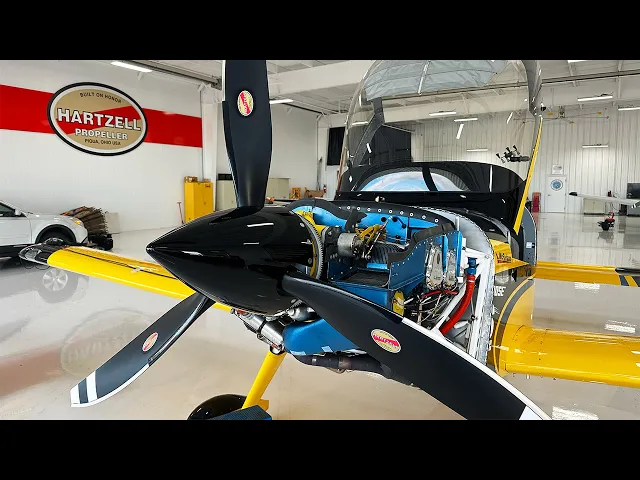
You Probably Didn’t Know this about Constant Speed Props.
FlightChops
0:00 I'm going to hug my prop.
0:01 A lot of fun hours I've spent behind this prop, but it's time for a change.
0:05 That's what today's mission is.
0:07 Heading to Hartzell to swap to the steel
0:09 shank version of the same prop that I have,
0:11 which is the Raptor, I think is what it's called.
0:14 It was one of the early ones when I got it 5 years ago.
0:17 It's crazy this airplane has been flying for 5 years.
0:19 It's got over 500 hours on the airframe now.
0:22 So, yeah, 500 hours on that prop and it's been great.
0:25 Lots of aerobatics, awesome performance, been a lot of fun flying this thing.
0:29 So, let's talk about why people would choose one of the other.
0:31 Okay, so there there are kind of two big factors.
0:34 You know, we offer a lot of different propellers because a lot
0:36 of people have a lot of different missions even for the same aircraft.
0:40 So, the first test has to be do I feel it when I add power?
0:43 Is there any P factor or torque?
0:45 With the installation complete,
0:46 I did a thorough test flight to check the differences.
0:51 And of course tested the full performance
0:52 envelope before heading home with the new prop.
1:00 This episode covers insights about modern propeller options and a bit
1:03 of a deep dive into how the constant speed governor and hub works.
1:08 I'll share the key parts of the post install test flight at the end,
1:12 but initially we'll focus on what I filmed at the Hartzell service
1:14 center hanger intercut with the flight behind the original prop to get there.
1:20 So, this is one of the reasons why I
1:22 fly IFR even on beautiful days cuz I'm blind.
1:27 Sun is right in my face.
1:29 And plus it's kind of hazy out there, so why not go IFR?
1:32 Perfect excuse to do it.
1:35 We're on the way to Hartzell and it's bittersweet
1:37 if this is the last flight with this prop.
1:40 It's been an awesome prop.
1:42 The only downside really has been that it's
1:44 light and this airplane after paint got tail heavy.
1:49 We gained 34 lb with paint and it moved the CG back almost
1:53 a whole inch and I only had like four to play with, so
1:56 Charlie Foxtrot Charlie's Alpha, contact Buffalo approach 121.0.
2:00 1210, Foxtrot Charlie Golf Alpha.
2:05 Buffalo approach, Foxtrot Charlie Golf Alpha, level 8,000.
2:09 Charlie Foxtrot, Charlie Golf Alpha, Buffalo approach, Erie altimeter 3018.
2:14 3018, thanks.
2:16 So, the problem is if I have a heavy passenger and full bags and full fuel,
2:20 which I need to keep the CG forward,
2:23 I will burn myself into aft CG by about 2 and 1/2 hours, which has been fine,
2:30 but I'd rather have more of a margin cuz I do
2:32 come in very tail heavy after burning myself that far back.
2:37 And uh the airplane feels pretty weird when it's
2:40 like right there on the edge of the aft CG,
2:43 like it's pitchy, and I feel like I have less rudder
2:47 authority cuz the arm for the tail weight is so big.
2:53 So, it yeah, as a taildragger,
2:54 it just it it's not fun to fly it when it's aft CG,
2:57 so changing the prop to the steel shank version
3:01 should give me that bit of weight on the nose.
3:04 I don't expect any other performance differences,
3:06 but I'm definitely going to fly the heck out of it if I
3:08 can before I leave the factory just to get a fresh impression of it.
3:11 I'll do some acro if I can and see if it feels the same during hammerhead
3:15 and things like that where the weight might be
3:17 different in terms of the torque and so on.
3:19 So, we'll see how much different it is,
3:21 but fundamentally, there's nothing wrong with this prop.
3:24 Like, I love it.
3:24 It's just light tin.
3:25 I think for a lot of people, that's what they want.
3:28 In my case, it was just a downside cuz I also have an EarthX battery,
3:31 so I lost firewall forward weight because of that as well.
3:34 All right, thank you for uh once again hosting me out here.
3:37 Happy to have you.
3:38 So, this was a bit of an adventure today.
3:40 I guess working backwards, the goal for me was to move the CG forward.
3:44 And the good news is we did.
3:45 We got ourselves a whole whopping third of an inch,
3:48 which doesn't sound like much,
3:49 but with such a small center of gravity window, it's a significant move.
3:53 So, does it feel much heavier?
3:55 Huh, a little bit.
3:57 So, the shanks go like what, this far into the blade or something?
4:00 I don't know.
4:01 Uh I don't know.
4:02 Perhaps they you can't see the shank there down here.
4:05 Oh, it's that close to the hub.
4:06 Okay.
4:07 Yeah, on the traditional ones you can see part
4:09 of the shank actually coming out uh of the hub.
4:15 Yeah.
4:15 But, this system you won't you don't see them at all.
4:18 And to confirm, these are the same carbon fiber blades,
4:20 it's just the shanks that are different.
4:23 Comparing the aluminum shank version to the stainless shank version,
4:25 there are there two primary differences.
4:28 One is the weight.
4:30 Aluminum is a lot lighter than stainless,
4:32 so the stainless adds some weight to the propeller,
4:34 roughly 6 to 8 lb depending on the individual propeller.
4:37 The other reason is that the stainless has
4:40 a higher fatigue capability than the aluminum does.
4:44 That's not to say that the aluminum version
4:46 is unsafe or that there's a problem with it.
4:48 There are limits to every system,
4:50 and we know that the stainless has a higher limit than the aluminum does.
4:55 Charlie Foxtrot Charlie Golf Alpha contact Columbus approach on.
4:58 It's going to be 1 1 in the country 134.45 3445.
5:05 13445 Foxtrot Charlie Golf Alpha.
5:08 Just when I was thinking about it, that's cool.
5:10 We're on the same page.
5:12 All right, back to traffic.
5:13 Columbus Columbus approach Charlie Foxtrot Charlie Golf Alpha level 8,000.
5:20 Charlie Foxtrot Charlie Golf Alpha Columbus approach today and altimeter 3016.
5:23 Let me know when you get the weather.
5:25 Yeah, just working on that now.
5:26 Charlie Golf Alpha.
5:27 There's no direct weather information available for my destination, however,
5:30 ForeFlight as well as the panel is populated with weather
5:33 info for the surrounding airports via SiriusXM aviation data.
5:38 So, it does look like it's going to be a crosswind.
5:40 It's 1707 to 15 kn crosswind on 26.
5:46 And approach is Foxtrot Charlie Golf Alpha.
5:47 I've got the weather cuz I'm talking about the approach.
5:50 Foxtrot Gulf Alpha, roger that.
5:51 And I missed the last part.
5:52 You said you're looking for the visual?
5:54 I'd like to set up for the RNAV just cuz the sun is in my eyes,
5:56 so it'll be RNAV 26 if able.
5:59 RNAV 26, let me know if you want to go direct to 6 for that.
6:03 Yeah, okay.
6:03 I can start working on that then.
6:04 Foxtrot Gulf Alpha.
6:07 Foxtrot Gulf the approach.
6:11 It'll be the RNAV 26.
6:14 Transition.
6:15 I'm going to let this play out in real time.
6:17 I make a bit of a mistake here,
6:18 but I'm curious as to what other instrument pilots would do.
6:21 I'm coming through.
6:22 And November 5329 contact Cincinnati Approach now on 123.7.
6:30 123.7.
6:30 Let's do that.
6:31 I shouldn't have ignored this hint.
6:34 No.
6:33 The avionics were trying to help me not make this mistake.
6:36 And approach Foxtrot Gulf Alpha,
6:38 I'm prepared to go to IMOSE for the RNAV 26 at the Pickwa.
6:42 I did that.
6:42 Direct IMOSE.
6:44 Direct IMOSE, Foxtrot Gulf Alpha.
6:46 Clearly I'm unsure about this course reversal
6:48 and ForeFlight is about to auto load it.
6:52 Load.
6:51 And activate, I guess.
6:54 All right, go direct IMOSE.
6:55 Let's make sure that is what we think it is.
6:59 Yeah, slight turn.
7:01 Stick around for when I get the clearance for the approach
7:02 to see how it plays out and there's more details in the description.
7:06 Yeah, this is beautiful, but I cannot see a thing out there.
7:10 So, that is definitely why I would fly an approach in a situation like this.
7:15 Completely blinded.
7:17 For me, the airplane has been great for cross
7:18 country and then I also fly aerobatics with it.
7:21 I've gotten pretty serious about that.
7:22 So, I've probably put more than 100 hours
7:24 of pretty serious aerobatics on it competing and so on.
7:26 Yeah, so you just got 16th, right?
7:28 Yeah, I did.
7:28 16th overall, yeah.
7:30 My personal best flight I got 10th, which was pretty cool.
7:33 It's been great.
7:33 The airplane has been so much fun for a lot of things.
7:36 Covers so many things well.
7:37 It doesn't do everything excellent,
7:39 but the fact that I can flip the fun switch after I get somewhere,
7:42 fly aerobatics, and then turn the fun switch back off,
7:44 and then go full IFR mode, which I'm going to do to go home from here,
7:47 and which I did to come here.
7:48 It's such a great cross country machine,
7:49 and the prop has been so smooth, and the performance is amazing.
7:53 It always amazes people how fast it gets off
7:54 the ground cuz it just goes like it's carbon fiber blades.
7:58 I guess because the inertia is different
8:00 than a heavy spinning steel or whatever aluminum.
8:03 Yeah, aluminum.
8:04 You get such a bite like as soon as you go.
8:07 Like I don't feel that twist or whatever you feel from torque of heavier props.
8:11 The other thing it might be worth talking about a little
8:12 bit is that this is still a a normal propeller, like a standard propeller.
8:16 It's not an aerobatic counterweighted propeller.
8:19 So, we get a question a lot of times of, "Well, I'm going to go do aerobatics.
8:23 Do I need an aerobatic propeller?" And that really comes down to what
8:26 aerobatics you're going to be doing and and how often you're doing.
8:29 As you're finding, you have a a standard normal dash one propeller,
8:33 and you don't run into any issues performing
8:36 aerobatics at the level that you are performing.
8:38 I'm in the sportsman class.
8:39 Yeah.
8:39 So, I don't do anything crazy.
8:40 No tumbles, no tail slides, no snap rolls.
8:43 So, where would you be in a situation where you want the counter balance?
8:46 When you change to a uh counterweighted prop,
8:48 what you're doing is you're changing
8:49 the direction that the prop is operating in.
8:52 So, this is a dash one oil to increase pitch.
8:55 We call the aerobatic one a dash four, which is a oil to decrease pitch.
8:59 Um and counterweights pulls it to high pitch.
9:02 So, in those maneuvers where you're likely to to lose
9:06 a bit a little bit of oil pressure or oil supply,
9:09 your prop is going to tend to under-speed rather than over-speeding.
9:13 It's those situations where you may be in an attitude
9:16 that results in that shuttle valve that's pouring the oil
9:18 back and forth not delivering the oil you need either
9:21 because you're moving too quickly for the valve to keep up,
9:25 or you're moving so minutely that the the shuttle
9:27 valve doesn't stay in a given position.
9:29 If it's kind of halfway between inverted and positive.
9:33 So, if you're doing a lot of tumbles and a lot of changes
9:35 in direction where your your force vectors are pointing all over the place
9:39 or you're going to do kind of lots of long periods of low
9:42 G type maneuvers like if you really floated it over the top a lot.
9:47 That's an instance where that valve might start
9:49 to to not keep up with what's happening in the propeller.
9:52 All right, let's brief this plate.
9:54 We're looking at the RNAV 26 for pickler.
9:55 I'm already talking to that frequency for approach.
9:58 The CTAF is going to be 123.0.
10:00 Let's put that on standby.
10:02 Falcon 18 was here across those three out
10:03 of both 3100 30 on 20 into right brothers.
10:08 It was me 1213.
10:16 And this is climb 2700 direct menu and it's in there.
10:22 menu Charlie Foxtrot Charlie Golf Alpha descend and maintain 6000.
10:29 Descend and maintain 6000 Charlie Golf Alpha.
10:39 I got really nice assist cuz we're on the way down.
10:42 Let's add some mixture in.
10:44 It'll take the speed.
10:46 I planned this so I'd be landing just after sunset.
10:48 So it would be in my eyes while I'm actually landing.
10:50 So let's see if that works out.
10:52 Yeah, sunset is 7:12 and it's got me arriving at 7:20.
10:56 So that should be nice.
10:58 Still not legal night, but I won't be blinded.
11:07 I didn't catch it happen, but it obviously loaded the approach that I put
11:10 in the panel into fourflight because I have them connected.
11:13 So that's seamless and beautiful.
11:16 Love it.
11:17 All right, let's go back to that plate.
11:22 I should be on the approach at 2600 at Zellwood.
11:27 And let's just review the runway specs.
11:29 Contact Charlie Golf Alpha descend and maintain 3000.
11:33 Descend and maintain 3000 Charlie Golf Alpha.
11:35 Maybe I'm not going down fast enough or All right.
11:40 Let's look at the runway specs.
11:43 4,000 by 75.
11:44 Not the easiest runway, but not bad.
11:47 In your case, because you have a an oil pressure to increase,
11:49 if you lose oil pressure or have a little burp in oil pressure,
11:53 it's going to tend to over speed.
11:55 Okay.
11:55 So, what I s- What stops it from going past redline?
11:58 Like there's a hard stop?
12:01 Nothing.
12:00 So, there is there is a hard stop.
12:01 There are two hard stops in any given propeller.
12:04 Um when we're talking about small recip engines,
12:06 there's a high pitch and a low pitch.
12:08 Whether it's a a dash one propeller or a dash four propeller,
12:11 you have the same stops, high pitch and low pitch.
12:13 It's just which situations do you get to those stops?
12:16 So, in an instance where the prop is not being told what to do,
12:23 because it's not getting oil pressure, something else happens.
12:27 So, in a dash one prop, there's a spring in there.
12:30 And you've got the aerodynamic forces
12:31 on the blade and centrifugal forces on the blade.
12:34 Those all in combination try to take the propeller to low pitch.
12:39 Your low pitch is set based on a very low flight speed.
12:42 So, you're going to end up with a very high RPM as a result
12:46 if you have that propeller pitch in a high air speed situation.
12:49 It's going to be the finest fixed pitch prop you've ever flown in your life,
12:53 which is why it's going to tend to over speed.
12:56 Which is why we have dash four props where instead of going to low pitch,
12:59 it goes to high pitch.
13:01 You still have the same centrifugal forces,
13:03 you still have the same aerodynamic forces,
13:06 but now we don't have a spring trying to shove us to low pitch,
13:09 and we have counterweights that are trying to pull us to high pitch.
13:12 And so, when it loses oil, those counterweights try to increase the blade angle,
13:15 which is going to tend to decrease your RPM rather than the other way around.
13:19 Okay, so I haven't I haven't seen that ever.
13:21 I the RPM stays where I leave it.
13:23 It seems pretty reliable.
13:23 I don't know my pressure it does drop a little bit at some of the figures,
13:27 but it seems like the prop didn't get it impacted.
13:29 Yeah, well you're you're talking about your your mains pressure, right?
13:32 You what you're seeing is an engine oil pressure.
13:34 So, the governor is a boost pump, and it's a pretty effective one.
13:38 So, it doesn't really care if it's getting 80
13:40 PSI or if it's getting 60 PSI or 40 PSI.
13:44 A lot of the times, because it's capability is above what is necessary,
13:48 it can take that small diminishment in what is supplied to it in terms
13:52 of pressure and boost that up to the pressure that's needed for the prop.
13:55 If you're feeding it 60 PSI and normal flight condition,
13:58 this is probably running 120 PSI on the prop,
14:02 and the governor is capable of putting out about north of 300.
14:06 So, you're well within what the pump is capable of doing.
14:09 It's more when those situations where the oil supply is interrupted.
14:13 It can't take air and turn it into hydraulic pressure.
14:18 Charlie Foxtrot Charlie Golf Alpha cross I most at or above
14:21 3,000 cleared the RNAV 26 approach at Pick One.
14:25 Okay, cross I most at or above 3,000 cleared for the RNAV 26 Pick One.
14:29 Foxtrot Charlie Golf Alpha.
14:31 So, I'm going to change frequencies or I'm going
14:35 to make the call in 7 minutes from All right, so how I'm doing this?
14:38 I'm going to I'm going to say monitor.
14:41 Enter and then swap.
14:43 So, I'm still monitoring him, but I'm going to talk to them.
14:46 Let's confirm that is the correct frequency.
14:48 Yes.
14:49 Pick One traffic Foxtrot Charlie Golf Alpha yellow RV is 7 minutes from us.
14:54 Starting the RNAV 26 via obvious switch would be about a 10-mi final for 26.
15:01 Foxtrot Charlie Golf Alpha Pick One.
15:06 All right, I'm going to keep monitoring
15:07 that, but I'm back to transmitting with him.
15:10 This is working out nice.
15:11 Oh, the sun is not blinding me as much.
15:17 That's when I go for the descent.
15:19 I'm putting this in approach mode cuz I got the clearance.
15:22 have done that immediately.
15:23 And regarding the course reversal,
15:24 I should have clarified with ATC if I had clearance to fly the straight-in.
15:28 Yeah, I'll do the final couple check in a minute.
15:30 We're going to leave things but gas is going to switch tanks to the fullest.
15:37 Pressure is stable.
15:38 Fuel over destination going to be 20 so lots of gas but uh should
15:42 have probably changed things a little earlier
15:43 just had a more balanced burn but whatever.
15:46 Still fine.
15:48 Set this to the chart.
15:52 All right, then we will bug the missed when
15:55 we are on the way down which is 2,700.
15:58 Okay, we're in approach mode.
15:59 GPS armed.
16:03 All right, yes.
16:05 Undercarriage mixture, that's done.
16:07 Prop to go.
16:08 Switches.
16:10 Let's do landing lights.
16:14 I'm secure.
16:16 And nobody's on board.
16:18 Uncontrolled airport.
16:19 We're in approach mode.
16:20 Junior now.
16:22 Sunset is working out just as planned.
16:27 Love it when a plan comes together.
16:31 Okay, sun is down.
16:32 Beautiful.
16:35 I'm not going to cancel until I actually see the airport.
16:38 I'll wait till I'm on final and I'll turn the lights on and cancel.
16:43 All right, I'm going to seat cast so I can make that call say I'm 10 mi final.
16:48 Piqua traffic, Fox Drive Charlie Alpha Alpha Yankee Oscar Victor is just
16:51 about to turn 10 mi final on the RNAV 26 Piqua, full stop.
16:56 I can see the airport beacon.
16:58 Yeah.
17:02 Vertical track.
17:04 Okay, so we just crossed Amus.
17:06 Charlie 50 Charlie Golf Alpha,
17:08 appreciate you changing to proof and don't
17:10 forget to cancel the IFR when you can.
17:12 Yeah, I was going to wait till I had the airport
17:13 for sure in sight and I'll cancel with you when I can.
17:17 Yep, I was going to wait till I had the airport
17:18 in sight and I was going to cancel it you most likely.
17:20 I should be in a minute.
17:21 Try to go around.
17:23 No runs.
17:25 Okay, so that was the way I caught myself.
17:28 Okay, we're back on that.
17:29 So, let's see if we can spotlights get turned on.
17:31 We are 7 mi final.
17:40 The technicians here are amazing to watch.
17:42 Raiden got the prop swap completed within a few hours.
17:45 Like safety wire at the best of times is difficult to do it there.
17:49 Yeah, that is such a talent.
17:51 Under normal conditions, the TBO for this propeller is 2400 hours,
17:54 but for aerobatics, it's reduced to 1,000.
17:57 Regardless, I confirmed later that the original
17:59 prop passed the bench test with no problems.
18:02 And then let's talk about maintenance.
18:03 So, I got 500 hours happily on the last prop.
18:06 It was great.
18:07 I really didn't need to change it.
18:08 It was just more for experimentation that we're doing this.
18:10 Bottom line is it didn't need much and each time I did that thing where
18:13 you hook up a grease gun and squirt
18:14 it would immediately move out the other side.
18:16 So, it like didn't, you know, need much.
18:18 So, it was always good.
18:19 Yeah.
18:19 Well, and it's important to know that we we tell
18:21 people you don't need grease to come out the other side.
18:23 There's a variety of reasons why your grease may not come out the other side.
18:26 The goal isn't pump grease until it comes out.
18:29 I know some mechanics say squirt it until you see it move.
18:31 I know that's not You can't just keep pumping.
18:33 So, I think the book says something like 1 oz or so.
18:36 fluid oz.
18:37 So, it's a very small amount.
18:39 Yep.
18:39 But, for me it was a hook it up,
18:40 start pumping, it would almost immediately move.
18:42 And that's after 500 hours.
18:43 So, it was great.
18:44 Dynamic balance is also something you can do
18:46 on your own if you've got access to the proper equipment,
18:49 but I was happy to have the skilled technicians get it done here.
18:53 Then we put the cowls back on and re-weighed the airplane
18:56 to update the weight and balance as a final step before test flying.
19:00 But, before that, let's finish this dusk approach with the old prop.
19:03 I was doing about 155 kn indicated as I got to the final approach fix.
19:07 So, that's kind of fast.
19:09 I was screaming.
19:10 Hard to go down and slow down.
19:15 And approach Foxtrot Alpha has the field in sight.
19:17 I'll cancel IFR and alerting at this time.
19:20 Ali Alpha Alpha, thanks.
19:21 Cancellation received.
19:22 Runway 18 was occupied before frequency change.
19:23 Have a good night.
19:25 Good night, Foxtrot Alpha.
19:29 I will stop monitoring this.
19:31 So, I'm curious to hear how many of you guys would have made
19:33 the mistake of flying this approach
19:35 as a straight in without the explicit clearance,
19:37 but ATC didn't seem to care this particular evening.
19:40 I was supposed to check my altitude at 12,000,
19:42 2,800, didn't do it or 2,600, busy.
19:44 But anyways, things look good.
19:45 We're lined up.
19:49 And I'm going to kill the autopilot and fly now.
19:55 Pick up traffic, Foxtrot Alpha 3-mi final 26 full stop Pick up.
20:02 Yeah, as I see the lights, they just aren't super strong.
20:06 Yes, undercarriage, mixture, let's do prop and switches.
20:10 This is a scary job.
20:13 One notch selected.
20:18 27 knots up here, that's why I'm getting blown off.
20:22 Let's see how much that drops as I get closer.
20:30 Yes, undercarriage, mixture, prop, switches, I'm secure.
20:34 And we'll stick with one notch.
20:35 Pretty nasty crosswind.
20:39 The 2.5, freaking crazy, really?
20:43 I don't know if I believe that.
20:46 Not grabbing that much.
20:48 I ended up sticking with one notch of flaps
20:50 and doing a bit of a tail low wheel landing here,
20:52 and it's not often to catch a near perfect landing at dusk, but this was close.
20:57 So, I'm going to stop talking and let
20:58 you hear it from the wing cam's perspective.
21:09 No no.
21:14 If you made it this far, thanks for watching.
21:16 And as promised, coming up are the key moments from the test flight,
21:19 starting with adding power fairly aggressively for the takeoff here
21:22 to see if I could notice any feel or performance differences.
21:28 How do you work?
21:37 And just like before, the airplane is off the ground in less
21:39 than 10 seconds with an impressive climb rate.
21:43 Columbus Approach, Foxtrot Charlie Golf Alpha.
21:47 Charlie Foxtrot Charlie Golf Alpha, Columbus what?
21:51 Hey there, I just departed Piqua just to the uh southeast of the town.
21:55 Wondering if I could get some uh flight
21:56 following for air work between 2 and 5,000.
21:59 Turn on problem.
22:00 What's the altitude of aircraft for Charlie Golf Alpha, please?
22:03 It's a uh Van's RV-14.
22:06 Roger.
22:06 And where will this uh photo mission take place?
22:09 It's not a photo mission.
22:10 I'm just doing some air work.
22:12 Um just uh testing a new prop and doing some aerobatics
22:14 just to see how it is for hammerheads and so on.
22:16 So, I'm not going to be uh moving very much,
22:17 just southeast of the town of Piqua.
22:21 Charlie Foxtrot Charlie Golf Alpha, squawk 5305.
22:26 5305, Charlie Golf Alpha.
22:30 Charlie Foxtrot Charlie Golf Alpha, you're radar contact position reported.
22:33 Maintain VFR with closest altimeter 3023.
22:38 3023 and I'll be with you in a couple miles of this position.
22:40 Thank you.
22:42 You're welcome.
22:45 Okay, set 2550.
22:47 Mixture rich, pump is off.
22:53 There's a good hole right there, not over any town.
22:57 A little more further this way.
23:03 Okay, hammerhead is the first pass.
23:13 Not really have a horizon but I can feel it.
23:16 You really need a good up-line for this to work and I wasn't quite on it.
23:19 So, that's why the kick didn't go smoothly.
23:25 Maybe not the best over the factory.
23:30 That felt good.
23:32 So, my thoughts were that hammerheads and spins were
23:34 probably the most likely figures to show if there were
23:37 any changes having a different weight prop because of the gyroscopic
23:41 effects and big attitude changes for those two figures.
23:44 Nice.
23:44 Yeah.
23:49 Probably 45.
23:51 For competition, we use 45 up-lines as a quick way to slow
23:54 down for a spin and not cover much ground while doing so.
24:04 1235385 flight heading 360.
24:07 And for competition, recovery from a spin is on a vertical down-line.
24:15 Another hammer.
24:28 Beautiful.
24:36 Spin to the right.
24:38 Spinning to the right is typically harder
24:39 because you're fighting against the engine rotation.
24:41 So, I was curious to see if the heavier prop would be noticeable doing that.
24:47 1235385 turn left heading 330 altitude 10,000.
24:51 Even after briefing myself to go right,
24:52 I almost went left here because that's my muscle
24:54 memory cuz it's just so much easier to spin left.
25:02 Caution, sink rate.
25:07 Going over to the right.
25:09 I'm going to try to recover after exactly 1 and 1/2 rotations
25:12 for this one just because that's the spin in one of the sequences this season.
25:21 Right.
25:20 1 and 1/2.
25:28 I'm a little over, but I'll take it.
25:32 Caution, sink rate.
25:42 5 and 1/2.
25:46 I'm going on my back.
26:00 10 approaches Fox Drive Charlie Golf Alpha.
26:04 Cali Fox is Charlie Golf Alpha, go ahead.
26:06 Thank you for the help.
26:06 I'm good to head back to pick her up from here.
26:10 The Charlie Golf Alpha, Roger radar service for Charlie Fox 354 10 squawk 36.
26:14 Thank you.
26:14 Charlie Golf Alpha.
26:17 So, the verdict is I don't feel a difference.
26:21 Pretty cool.
26:23 And I've got a couple more minutes here at the end
26:24 with some solid insights from Trevor regarding governor and pitch stop setup.
26:29 Yeah, I forgot to make note of what I got for static full power RPM,
26:32 but I'm pretty sure it was what I wanted, like 2650-ish.
26:34 Depending on how you've got it set it up,
26:36 that's going to be driven by the the prop low pitch or the governor.
26:40 You don't want it to be on the governor in that situation.
26:42 You want it to be on the low pitch stop.
26:45 Um so, your propeller low pitch stop affects that fixed pitch
26:49 angle that you get to if you have that failure mode,
26:51 which is a reason when you're setting up
26:53 experiment on airplane to maybe make a different choice.
26:56 We tend to recommend 2650, 2675 as a goal of a a maximum RPM.
27:02 If you're making a certified airplane,
27:03 you're allowed up to 103% of redline, so over 2700.
27:08 We recommend below that because it's indication to you as a pilot
27:11 that the system is working and also in that failure mode scenario,
27:14 you it will buy you a little bit.
27:16 So, you could trade some takeoff performance for some additional
27:22 safety of having a bit of a higher blade angle.
27:24 You know, if you raise the blade angle,
27:25 you raise the low pitch stop a little bit,
27:27 that's going to drag your takeoff RPM down.
27:29 It's going to drag your takeoff performance down a little bit,
27:32 but you're going to be at a slightly
27:33 higher angle in that failure mode situation.
27:36 And that's a choice that you get to make as an experimental builder.
27:39 Yeah, so how do I know again if it's
27:41 the governor or the physical stop getting it there?
27:44 It's these the phase of flight or um you have to do some tracking.
27:49 So, once you're up and away and flying, it's only the governor.
27:52 The the low pitch stop is not in effect.
27:55 You're up and away from it.
27:56 You can adjust it and it will make no changes to in flight.
27:59 You know, if you're at if you're at 100 plus knots,
28:01 you're you're off of the low pitch stop, guaranteed,
28:04 unless you've got the thing really cranked in there.
28:07 Um so, you note it in flight if you push your knob
28:10 all the way forward and you're getting something other than 2700 RPM,
28:13 that's when you adjust the governor high pit high stop.
28:16 When you're down on the ground,
28:18 depending on what the RPM is that what your your in flight RPM is,
28:22 that's how you make the the decision or the how you know whether
28:26 or not you're on the low pitch or on you're on the governor.
28:29 So, if I sit there with the brakes on full
28:31 power and I don't see like if I see 2650, then I know I'm good.
28:35 Not necessarily.
28:36 If you are in flight and you routinely get
28:39 2700 and you're on the ground and you see 2650,
28:42 yeah, you're you're off of the governor.
28:44 Got you.
28:45 Awesome.
28:45 I think that's everything I that I just learned stuff.
28:48 So, right on, man.
28:50 Thanks a lot.
28:51 Anytime.