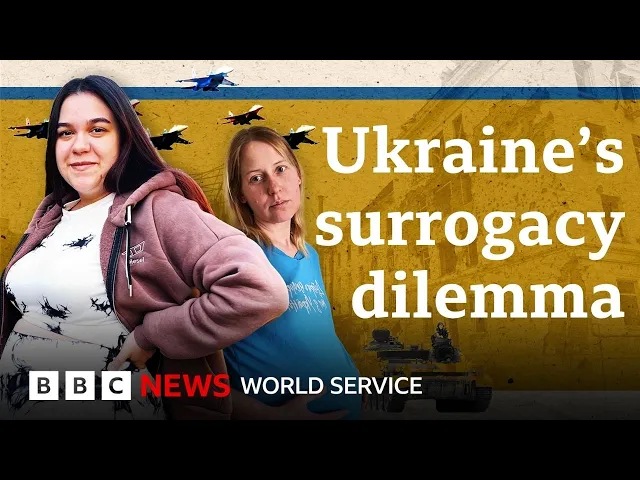
The new laws that could disrupt Ukraine's global surrogacy hub - Global Women, BBC World Service
BBC World Service
0:00 Right.
0:11 We just heard an air alarm, which means that all the babies are being taken.
0:18 The basement for safety.
0:25 In a country at war, couples from around the world are
0:29 still coming to have children through surrogacy.
0:35 Is this conflict pressuring vulnerable women to carry a child for someone else?
0:42 If there wasn't a war, I wouldn't have decided to go for surrogacy.
0:48 I am rgoing to do as many surrogate pregnancies as it takes,
0:51 long as it will allow my health.
0:55 This offers Black Friday sale in babies.
1:00 They are not hiding their outright saying
1:03 what they are doing there, selling babies.
1:06 And when deals go wrong, it's those babies who can pay the price.
1:12 Now, a new law could ban surrogacy in Ukraine for foreign parents.
1:18 But would that shut down one of the world's biggest surrogate markets?
1:24 And would it harm the women who depend on it?
1:31 It's a beautiful day, skies are blue,
1:35 sun is shining and we are very excited to meet our baby.
1:41 Elena and Igor have just crossed the border into Ukraine,
1:45 a country battered by four years of war.
1:48 It's very nice outside, quiet.
1:53 Quiet, no bombing.
1:54 No bombing.
1:57 They drove nearly 2,000 kilometres from Macedonia.
2:02 I was so scared to come, like,
2:04 everything that you see on the news, and it's a war.
2:07 We want to be parents, so we're going to do anything to become parents.
2:12 We're going move mountains to be parents.
2:16 This wasn't an easy choice.
2:19 Nine years trying to have a child,
2:21 multiple rounds of IVF and surgeries, surrogacy was their last resort.
2:28 And Ukraine offered something few countries could,
2:32 a legal, well-established and affordable system.
2:36 Even from afar, they tried to be part of the pregnancy.
2:40 Agora!
2:43 But Elena was never pregnant.
2:46 An embryo created from hers and Ego's genetic material was
2:50 implanted into a Ukrainian woman who carried their baby, a surrogate.
2:56 It's like, for example, you're making a muffin recipe.
2:59 You put all the ingredients and you put in another oven to bake.
3:03 Now, after nine months, they're meeting their son for the first time.
3:10 At some time I'm saying, okay, it's really happening, it happened, it is ours,
3:16 it just, you wish for so many years and then it came true.
3:23 It was the best thing that happened in our whole life.
3:33 Elena and Igor are not alone.
3:35 Every year, thousands travel to Ukraine for surrogacy.
3:40 Even when Russia invaded Ukraine,
3:43 the war disrupted the industry, but it didn't stop it.
3:47 We're inside one of the biggest surrogate agencies in the world.
3:51 There are at least 30 surrogate mothers,
3:54 each carrying a baby for a foreign couple.
3:57 For many of them, this has become a lifeline to make a living during the war.
4:03 Hello, nice to meet you.
4:04 This is our treasure.
4:06 This is the most valuable thing.
4:07 This is where we keep all the embryos that we have,
4:10 all the embryos that we use in our programmes and you can have a look.
4:18 So how many embryos do you have?
4:20 We have more than 10,000 embryos here.
4:23 And these are then transferred into surrogates.
4:25 Yes, exactly.
4:27 We are in our basement and we are happy that we
4:30 have the secure place for the embryos to be stored.
4:33 So in case of an attack, this is protected?
4:35 Yeah, yeah.
4:35 Yeah, this is the most protected place in our clinic.
4:45 I'm Karina, I'm 22 years old.
4:48 I'm carrying a child for a Chinese couple.
4:53 When Karina was 17, a Russian attack destroyed her home in Bakhmut,
4:59 leaving her homeless.
5:02 Was there a moment where you realised that you
5:05 needed to find another way to make money?
5:09 Yes, when you count the pennies to go buy bread.
5:12 And we started counting the pennies to really
5:14 feed the child the formula, on nappies.
5:19 And then I started to think that I need to do something.
5:22 Now she's being paid around $17,000 for the pregnancy.
5:27 I know it's not my child.
5:29 I love her, I talk to her, but when she hits me hard, I speak to her.
5:35 The payment was meant to be higher, but one of the babies didn't survive.
5:41 If it wasn't for the war, I wouldn't have gone for surrogacy.
5:47 Critics say stories like Karina's raise difficult questions.
5:53 Surrogacy clinics have been pretty open that they target poor women.
5:58 And with the war going on, the number of poor women is growing.
6:01 Even in the conditions of the war that Russia has been waging against Ukraine,
6:07 Ukraine stays one of the major hubs for surrogacy
6:10 because the number of women who are desperate,
6:13 who are destitute, who lost their livelihood, their jobs,
6:16 they want to survive and support their families.
6:19 And surrogate clinics offer them this opportunity because
6:23 Western couples want to buy babies on the cheap.
6:30 Surrogacy clinics don't see it this way.
6:33 They say they offer women a way to earn
6:37 money legally while helping others have a child.
6:41 But this is part of a multi-billion dollar global business.
6:46 Across websites and social media, clinics compete for clients.
6:52 Their marketing can be direct, even aggressive.
6:56 There are choices that demand a woman to be strong.
7:00 There is another choice, no less brave.
7:03 The gift of parenthood.
7:08 Another manipulative tear-jerker.
7:12 This offers Black Friday sale in babies.
7:17 So they are not hiding their outright
7:19 saying what they are doing there, selling babies.
7:26 The transactional aspect of these surrogacy agreements comes with consequences.
7:33 We found that in many cases,
7:35 intended parents are delayed in travelling to Ukraine to collect their newborns.
7:41 Some clinics even set up dedicated baby rooms where a team
7:45 of nurses and nannies look after babies around the clock.
7:51 What's the longest that a baby has
7:54 stayed here before their parents arrived in Ukraine?
8:00 It's can't answer that.
8:02 But you know, don't you?
8:03 Well, yes.
8:06 She can't say?
8:07 You can't tell.
8:08 We can't talk about it.
8:19 So we just heard an air alarm,
8:23 which means that all the babies are being taken to the basement for safety.
8:31 It's in this tense and high-risk environment
8:34 that intended parents sometimes leave their newborns.
8:39 In some cases, it's for months at a time.
8:48 This child was born through a surrogate mother over a month ago,
8:51 but is still not yet being collected.
8:57 How often are babies born through surrogacy left behind?
9:04 80% of the time.
9:06 At one point, Svitlana looked after twins for 11 months.
9:11 But don't you think that leaving their babies for nearly
9:14 a year is a bit selfish and a bit careless?
9:19 Well, it's not normal, but unfortunately we had some cases.
9:23 Not so long ago, the twins were collected It was stressful,
9:28 and I cried When I handed them over.
9:31 It hurts.
9:34 Because there the children were already treated as if they were their own.
9:39 But they grew up and you saw how they grow,
9:42 how they talk, and how their teeth hurt.
9:45 In short, don't go there, because it still hurts for me.
9:52 But not every baby is collected.
9:56 Wei was born through surrogacy in 2021.
10:00 He is such a special child to us.
10:03 us.
10:04 He loves Wei was born prematurely with a severe brain injury.
10:11 He cannot sit unaided, hold his head, or see properly.
10:17 When his intended parents were told about his condition,
10:21 they did not come for him.
10:24 So his biological parents just disappeared?
10:27 All I know is that he was born by a surrogate mother for foreigners.
10:32 They refused to take him when they learned he was born with a disability.
10:36 It’s painful.
10:37 It always hurts when a family abandons a child.
10:41 We put these concerns to the agency that handled wei's surrogacy.
10:46 Do you personally take any responsibility when a child is abandoned?
10:53 Partially, yes.
10:56 If somewhere we make a medical mistake and premature birth occurs,
11:01 or we fail to notice something,
11:03 and then the parents abandon the child, I partly consider it our fault.
11:11 You previously said that that child is more dead than alive.
11:17 Do you stand by that?
11:23 But at that moment I thought he wouldn't make it.
11:29 Did they do anything to help?
11:32 No, no.
11:34 No one from any clinic has called us to help this child.
11:41 But that could be about to change.
11:45 The Ukrainian parliament is debating a new
11:47 law that could ban surrogacy for foreign parents,
11:51 effectively shutting down one of the world's biggest surrogacy markets.
11:57 How often are children born through surrogacy left behind?
12:02 There is a lot of children that are left behind,
12:04 and it's not only children that're left behind.
12:07 We don't know where the children go from there.
12:09 As soon as they get picked up from this country, we don't what happens to them.
12:13 I think it's a concern for any resident of any country.
12:18 Surrogacy is one of the ways for children trafficking.
12:21 It is.
12:22 Would this law solve that problem?
12:25 We do believe that it will minimise that.
12:28 The goal of that bill is to have regulations
12:32 because we don't have them at this point at all.
12:36 We asked the health ministry for official data,
12:39 but no authority we contacted could provide any.
12:45 Politicians are also worried about falling birth rates,
12:49 driven by the exodus of many young Ukrainian women.
12:53 The argument, Ukraine should not export babies
12:56 to foreigners at a time of deep demographic crisis.
13:01 But for those women who choose to do it,
13:05 This is a lifeline in a country where war has stripped away their livelihoods,
13:10 Anastasia became a surrogate after her home in Kherson was
13:15 destroyed and her father was killed in a Russian drone strike.
13:19 I am totally against this bill.
13:26 Why take away the opportunity to earn relatively good money for Ukrainians?
13:30 NIt's your decision, no-one makes you become a surrogate mother.
13:34 And for many couples from all over the world,
13:38 this is what made their hard-fought dream of becoming parents come true.
13:45 I think it's totally...
13:47 Wrong.
13:49 It's unhuman.
13:50 Like this, we help them, they help us.
13:53 Without this, we will not have our Alexander here with us now.
14:04 I would like to to buy a house and make my wish come true.
14:09 I am ready to go through several for as long as my health allows.
14:19 We don't know what happens to the women after they hand over the babies.
14:22 As far as I know, there is no usual practise
14:26 to provide them psychological support or legal support or anything else.
14:32 And whatever medical issues they have as a result of surrogacy are
14:36 not the problem of the company and not the problems of the customers.
14:39 So women are left to pick up the pieces.
14:42 Surrogacy agencies told us they do not target vulnerable women
14:47 and that their surrogates are consenting
14:50 adults who want to help infertile couples.
14:53 Everything is good.
14:56 We are now heading back in the road
14:59 so Many countries have already banned or restricted surrogacy.
15:08 How long will this window of opportunity remain open?
15:14 It is now up to Ukrainians to decide the future
15:17 of surrogate with a vote on the proposed ban expected this year.
15:25 In two and a half years, unfortunately,
15:27 no one was interested in Wei, no one asked questions about him.
15:33 I think he has very, very little chance of being adopted.