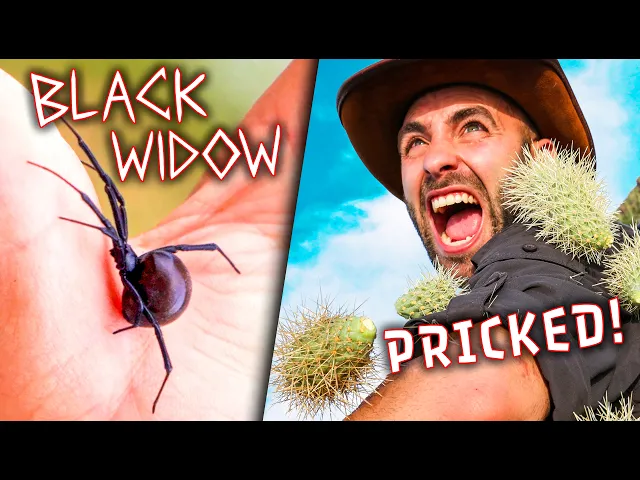
Would You Rather: Free-handle a Black Widow or Spiked by a Cactus?!
Brave Wilderness Top Videos
0:00 I'm Coyote Peterson and I'm about to freehandle the black widow spider.
0:05 Are you ready?
0:06 Let's do it.
0:08 Here we go.
0:10 1 2 3.
0:21 What's going on, guys?
0:22 Who's ready to catch some spiders?
0:24 I am.
0:24 Yeah.
0:25 Okay.
0:25 So, right now we are on location in Tucson, Arizona.
0:28 As you can see, we're right outside the house.
0:31 You know what lives on houses in Arizona?
0:33 Black widow spiders.
0:34 Right now, we're going to use this little
0:36 container and this stick and try to find one.
0:38 Are you ready?
0:40 Okay.
0:40 Now, you're probably thinking to yourselves, "Really, coyote?
0:43 You going to find a black widow spider
0:45 right outside your house?" I have seen webs everywhere.
0:49 You see this all up here in the edges of these rocks?
0:53 Those spiderw webs are most likely made by a black widow.
0:57 And what we're going to do is move all around the house,
1:00 look in the plants, look in the crevices, look by the gutters,
1:02 and I guarantee you it won't take me long to find one of these venomous spiders.
1:06 Come on, let's go.
1:08 Now, I could just start lifting up rocks like this, looking for them,
1:14 but I'm hoping to find one already naturally hanging out in its web.
1:19 And this real open rock structure like this is absolutely perfect for them.
1:23 So, coyote, why is it that we're not
1:25 like out in the desert looking for black widows?
1:28 Like, why are we looking around our house?
1:29 Black widows are actually drawn to houses.
1:32 Can you imagine why?
1:33 What do spiders eat?
1:35 Other bugs.
1:36 Bugs are drawn into lights.
1:37 So, where there are lights at night and the bugs
1:40 come in, the spiders have the chance for a feast.
1:42 That's why I'm looking right here around the edge of the house.
1:46 And that would worry a lot of people.
1:47 Oh, yeah.
1:48 Well, people, as we know, the fear of spiders, arachnophobia.
1:51 People are absolutely terrified of spiders and black
1:54 widows specifically because of the potency of their venom.
2:00 Look at this.
2:01 Oh, there's one.
2:03 Oh, did you see one?
2:04 Totally saw it.
2:05 There's no way you saw it.
2:06 This is definitely black widow web right here.
2:08 It was hanging just down on the edge of this rock.
2:10 Hold on.
2:11 They're actually really quick when they dart.
2:14 Yeah.
2:15 No, it's back up in there.
2:17 Yep.
2:17 100%.
2:18 That's a black widow hole right there.
2:19 Well, not actually on the house, but just a couple feet away from it.
2:22 All right, let's move down this way and keep looking.
2:24 We're going to get one.
2:25 Let's uh check out the fire pit here.
2:28 You were telling me you had a good feeling about the fire pit.
2:32 I see some webs.
2:34 Oh, I see one right there.
2:35 You got one?
2:36 Yep, yep, yep, yep, yep.
2:38 Oh, it's going back there.
2:39 Hold on a second.
2:43 Oh, there it is right there.
2:45 Look at that.
2:47 Okay, let me get it into the container.
2:48 Oh, it's going towards my thumb.
2:51 Okay, let's see if she'll walk right in there.
2:55 Go, go, go.
2:58 Yes, there we go.
3:00 Little bit of air.
3:01 Got her into the container.
3:02 And there you have it.
3:04 That is a female black widow.
3:05 Exactly what we were looking for.
3:07 Sure enough, right here in the fire pit.
3:09 It's kind of a dangerous spot to be uh leaving your web there.
3:13 Wow.
3:13 Okay.
3:14 Well, now I'm going to show you why this is an arachnne you
3:16 just need to admire from a safe distance and not necessarily be afraid of.
3:22 What I'm about to do here is prove that the black widow is not out to bite you.
3:28 I'm going to actually freehandle this spider.
3:31 Oh boy.
3:32 You guys ready for this?
3:33 You told us you were going to try this if we found a black widow.
3:36 Well, I didn't tell you at the beginning of the episode.
3:38 But I know I told you and I know I told Mario and I
3:40 said to really disprove that the black widow is just out there to bite you,
3:47 I'm going to let it walk on my hands
3:48 and on my arms and hopefully not take a bite.
3:51 Now you can see she's just laying on the bottom
3:53 there actually playing dead and rolled up in a little ball.
3:55 That is a defense mechanism, especially when there's nowhere to escape to.
3:59 I will note that there is no one in the past
4:02 10 years that has died from the bite of a black widow.
4:05 The bite is very painful, cause stomach cramping, cause vomiting,
4:08 it can cause dry mouth, lot of pain for several hours.
4:12 So, I do not want to be bitten.
4:14 Either way, I will admit that I am nervous.
4:17 I do not have arachnophobia, which we know is the fear of spiders.
4:21 But when you're looking at the widow, it definitely gets your heart racing.
4:27 I'm Coyote Peterson, and I'm about to freehandle the black widow spider.
4:33 Are you ready?
4:34 Let's do it.
4:36 Here we go.
4:38 1 2 3.
4:50 Oh my.
4:55 Right onto the edge of my finger.
4:57 Oh boy.
4:57 Okay, now she's gone down my arm.
4:59 She's actually spun a little thread of web like she's becoming secure to me.
5:05 Oh, I thought she was about to bite.
5:11 Now, one thing most people don't realize about the black
5:13 widow spider is that if it does inflict a bite,
5:17 that bite is oftent times just a warning and they aren't actually
5:21 injecting as much venom as they would into, say, a prey item.
5:25 They're not looking to kill you as a human.
5:27 They're simply looking to startle you so that they can ultimately get away.
5:32 Can you see that she is just tangling my arms up with web?
5:36 It's almost invisible to the eye, but I can feel it all over me, tangling me up.
5:45 Kind of makes me a bit nervous.
5:46 I'm getting covered in spiderweb right now.
5:49 Let me actually get her back onto the stick.
5:52 That looks dangerous.
5:53 I scared her there.
5:55 I'm going to get her on the stick here.
5:57 I got to get some of this webbing off of my arm.
6:01 There you go.
6:03 It's really sticky.
6:04 And every single time that I move my arm,
6:06 I can feel that web pulling and pulling her.
6:08 And what I'm afraid of is that she's
6:10 going to get startled and then inflict a bite.
6:13 Now, this is a female.
6:14 The females are larger than the males.
6:15 And they have that quintessential red hourglass shape on the abdomen.
6:19 That is the easiest way to identify one of these spiders.
6:22 You know, she's very dark in coloration.
6:24 Has that big bulbous abdomen.
6:27 You think she's calm enough to put back on your hand?
6:30 The question is, am I calm enough to let her get back on my hand?
6:33 Yeah.
6:33 Let's see.
6:35 So, why is the spider not biting you?
6:38 Spider is not biting me because I'm not applying any pressure to its body.
6:43 Ooh, now I can't see her.
6:44 Where is she?
6:45 Your thumb.
6:46 Going around that side.
6:47 And as long as I don't apply pressure,
6:52 hopefully she will stay calm and I will not be bitten.
6:56 All right, she feels very comfortable right there on the edge of my thumb.
6:59 I'm going to keep my hand incredibly still.
7:02 You may notice that the tone of my voice has slightly changed.
7:05 That is because she is right on the edge of my thumb.
7:09 You see that?
7:11 Mhm.
7:11 She feels hidden right there.
7:13 She's comfortable.
7:14 She's in the crevice of my thumb.
7:15 And without me talking real loudly next
7:18 to her, she's just thinking, "Okay, I'm hidden.
7:21 I was captured from my web.
7:23 Don't worry, sweetie.
7:24 We're going to put you right back in the web.
7:26 Nothing to fear." Now,
7:30 I would never recommend that you go out and try to pick up a black widow.
7:34 If you see a black widow outside of your house,
7:37 you do not need to be afraid of it.
7:39 Remember, these arachnids are eating the pest insects that are out there.
7:43 Could be mosquitoes, could be moths, whatever it is,
7:46 the spider has no interest in biting you.
7:48 Oftentimes, the way a bite happens is when
7:51 somebody grabs onto the spider accidentally and is bitten.
7:55 Now, let's say you walk through the web
7:57 of a black widow and you find it on your person.
7:59 Do not panic.
8:00 The best thing to do is to just remain calm, try to pick up a stick,
8:05 something like this, let the spider crawl onto the stick,
8:07 and then place it back into the environment.
8:10 Oh, I'm sure a lot of you out there who have arachnophobia are
8:13 watching me handle this spider right now and you're just cringing in your seats.
8:18 And um I will not lie, my mouth is getting dry and I'm trying my best to not
8:24 shake my hand right now despite the fact that I'm incredibly nervous.
8:28 I'm going to very slowly turn my hand.
8:31 There you go, sweetie.
8:33 Oh, don't move.
8:36 Look at that.
8:38 That is one of the most venomous spiders in the United States.
8:41 And it is just gently clutched right there on the edge of my hand.
8:45 Well, I would definitely say that this was pretty
8:48 intense freehandling the one and only black widow spider.
8:53 I'm Coyote Peterson.
8:54 Be brave.
8:56 Stay wild.
8:58 We'll see you on the next location.
9:01 I said it before and I can't say it enough.
9:05 Never attempt to freehandle a black widow.
9:08 Like all spiders, they are venomous and a bite
9:11 from this specific species is incredibly painful.
9:15 If you see a black widow hanging out in a web near your residence,
9:18 simply admire it from a safe distance and you will be just fine.
9:23 Okay, after getting the macro shots, the most important part,
9:27 letting the spider back into its web.
9:29 You ready?
9:31 Yep.
9:42 Go, go, go, go, go.
9:43 Stay.
9:43 Stay here.
9:43 Stay here.
9:44 Dude, he saw a tarantula hawk.
9:45 Did you see it?
9:46 I didn't see it.
9:47 No.
9:47 Oh my gosh.
9:48 I hope he gets it.
9:51 Careful.
9:57 He's going to get it.
9:59 Think he sees it.
10:01 Oh.
10:03 What happened?
10:04 Go, GO, GO.
10:10 Oh no.
10:12 What's wrong?
10:12 Did you catch it?
10:13 Yeah, I caught it.
10:15 Ah, but the bad news is I caught something else, too.
10:22 GOODNESS.
10:22 WORST choice spike I've ever seen.
10:24 Oh, hold on a second.
10:24 Hold on.
10:25 Hold on.
10:25 Hold on.
10:25 I don't want to get some of the tarantula hawk.
10:27 Oh, THEY'RE ALL OVER YOU, MAN.
10:29 HOLD ON A SECOND.
10:30 LET me get this under control.
10:31 Oh my gosh.
10:33 How you going to get all those off?
10:34 Hold on.
10:34 Hold on.
10:35 Cup him under there.
10:36 They're all over here.
10:38 Oh boy.
10:39 That was my god.
10:40 That was not good.
10:43 Hold on.
10:44 I'm like in them.
10:45 I'm I'm in them.
10:45 Back up.
10:46 Oh man.
10:46 They're Oh my gosh, man.
10:47 That was They're over my legs.
10:49 Oh my gosh.
10:49 They're everywhere, dude.
10:52 Okay.
10:51 Did you get the tarantula hawk at least?
10:53 I did.
10:53 I did.
10:53 I caught the tarantula hawk, but
10:57 they're all over me.
10:59 Oh my gosh.
11:00 That's the worst.
11:01 That's the worst attack I've ever seen.
11:04 Oh, guys, this is bad.
11:05 That's really bad.
11:07 How many are on my back?
11:09 A lot.
11:10 Yeah, maybe like 10.
11:14 One on your foot.
11:15 Oh man, the one in my arm is really hurting.
11:18 Well, you know, in that instance when you need to catch the animal,
11:21 you don't really think about it.
11:22 You just make the catch.
11:24 And I did.
11:24 I caught the tarantula hawk.
11:25 Where is it, by the way?
11:26 I wrapped it up.
11:27 It's in the net.
11:27 It's right over there.
11:29 Oh my gosh.
11:30 Okay.
11:30 Well, I guess there's a lesson to be learned here.
11:33 Always watch where you're going.
11:34 And you guys have seen me get pricricked in the hand before by a choya.
11:39 This might as well get a little education while we can.
11:43 This is a teddy bear choya.
11:45 Watch it.
11:45 You've got them on your feet.
11:47 There are jumping choya and there are teddy bear choya.
11:50 This is the teddy bear variety and it is not soft and cuddly like a teddy bear.
11:54 Um Mark, I got a multi-tool on the side of my pouch here.
11:58 All right.
11:58 Put your camera down.
12:00 Okay,
12:00 Chance, you keep filming this.
12:01 Mark, I'm gonna need your help, man.
12:02 I can't move my arm.
12:04 Get the multi-tool off of there.
12:11 I feel like a pin cushion right now.
12:13 If you're out here in the desert hiking and you wander into a choya,
12:18 they say you can use a hair comb to get Troya off of you.
12:21 But as we know, I don't have any hair, so I don't usually carry a comb with me.
12:25 But I do have a multi-tool.
12:27 And yeah, there we go.
12:28 I get these ones off my boots.
12:30 Yeah, those ones those don't hurt.
12:32 Those were into the rubber and the side of my keen.
12:35 If you guys thought getting quilled by a porcupine was bad,
12:38 this hurts so much worse.
12:41 Let's get the leg.
12:41 Oh, my leg.
12:43 I'm going try to do one.
12:44 What do YOU That hurts.
12:48 You ready?
12:49 That's one.
12:50 Oh, man.
12:53 This is like pulling off the worst band-aid ever.
12:59 Yeah.
13:02 Oh no.
13:05 Now it's in your hand.
13:07 Coyote.
13:08 Yeah.
13:07 Why do you always get me in these situations?
13:09 Sorry, man.
13:10 Take it.
13:11 Yeah.
13:11 Uh, okay.
13:12 Hold on.
13:14 Ah.
13:14 Nope.
13:14 Nope.
13:14 Don't shake them off.
13:15 You don't shake them off.
13:16 No.
13:16 No.
13:16 Don't shake them off.
13:17 You don't shake them off.
13:17 Here.
13:17 Why don't you put the mold?
13:18 Can you get it off yourself?
13:19 Yeah.
13:20 Yeah.
13:20 Hold on.
13:20 Hold on.
13:21 Oh, guys, we are Ah,
13:22 it gets getting worse like the own weight is like going in there.
13:25 Yeah.
13:25 It's not fun, is it?
13:27 All right.
13:27 Like a band-aid.
13:28 Like a band-aid.
13:32 Oh my gosh.
13:33 That hurts.
13:34 Can you imagine what I'm going through?
13:35 Oh my gosh.
13:36 I feel so much worse to you right now.
13:37 Oh, first blood.
13:38 First blood.
13:39 Okay, I'm going to be a little more careful now.
13:41 Okay, this is like nervous now.
13:44 One, two, THREE.
13:49 Let me hold on.
13:50 Let me explain to you guys why this hurts so much.
13:53 This is not just like a needle or a pin going into your skin.
13:57 The end of these spines and the spines
13:59 on the choya are nothing more than modified leaves,
14:02 but they have barbs.
14:04 Microscopic barbs on their ends.
14:06 So, every time we pull one off, it is yanking out chunks of skin and flesh.
14:11 Wow.
14:12 This one on my arm is going to hurt so bad.
14:14 It is so deep in there.
14:15 I almost can't squeeze my hand.
14:17 All right.
14:17 I think I got to get this.
14:18 I want I'm afraid you're going to get like hit in the face,
14:21 so I don't want that.
14:22 They're so sharp.
14:27 Did you get it?
14:27 Did it come off?
14:28 No.
14:29 Oh my gosh.
14:30 All right.
14:31 Ready?
14:31 Ready?
14:32 Yeah.
14:32 Yeah.
14:33 Oh no.
14:34 It just kind of fell down and stuck in again,
14:38 dude.
14:38 I'm so sorry.
14:44 Oh my What was that noise?
14:46 I don't know.
14:47 I don't know.
14:48 IT HURTS SO BAD.
14:49 THIS ONE'S GOING TO BE BAD.
14:50 I'm going to get this one.
14:53 Ow.
14:54 DID YOU GET IT?
14:55 YEAH, I GOT THAT ONE.
14:56 TRY TO GET THIS ONE.
15:00 All right, I'm going to get this one, I think, and then pull back at me,
15:03 I guess.
15:03 SO, YIKES.
15:08 I think we got to get this big one out first and that one
15:10 last because I'm afraid you might flick that one at my face.
15:14 Okay.
15:15 And I think this one's got to come out
15:16 because you can pull it that way and I can Can you just like put your arm out?
15:20 No.
15:20 No, he can't.
15:21 I can barely move my arm.
15:21 It's like it's hit a nerve.
15:23 I'm having trouble like squeezing my arm.
15:27 Big happy thoughts.
15:27 1 2 3.
15:35 Oh wow, that one hurt.
15:39 I'm glad we saved this one for last, though,
15:40 cuz I don't think this one's in there that deep.
15:42 Okay.
15:42 Not as deep as that one.
15:44 That was brutal.
15:46 All right.
15:47 Let's get this last one.
15:47 All right.
15:48 Last one.
15:48 Last one.
15:48 Let me turn it like that so you don't get it.
15:51 Don't hit my face.
15:55 Ah.
15:54 Get it.
15:55 AH.
15:56 NO.
15:57 That was in there.
16:01 Woo.
16:02 That was excitement.
16:05 Wow.
16:05 Guys, that was seriously intense.
16:09 But the good news, wait here.
16:14 Woo!
16:15 Come here, buddy.
16:18 You got it.
16:19 I got it in the net there.
16:21 That is a tarantula hawk.
16:24 Woo!
16:25 Be careful with my No.
16:26 Anyway, we got to be careful not to get stung.
16:28 Didn't expect to make this.
16:29 I mean, what are we going to call this?
16:30 An on location.
16:32 Yeah.
16:31 Yeah.
16:31 I guess this is a an on location.
16:33 Us out here trying to catch a tarantula hawk.
16:36 Made the catch but fell into a teddy bear.
16:39 Troya, someone hurt.
16:51 Nothing like having an epic ending to an awesome day here in the Sonoron Desert.
16:55 I'm Coyote Peterson.
16:57 Be brave.
16:58 Stay wild.
17:00 Stay away from the teddy bear choya.
17:02 We'll see you on the next location.
17:04 Woo!
17:05 WE GOT IT.
17:08 THERE IT IS.
17:11 WHAT?
17:11 Totally got that.
17:12 Ain't that crazy looking?
17:13 That's so gnarly.
17:14 It did not bite me, but boy did it make me jump.
17:17 Does the worm feel any different when it does that?
17:18 Yeah, I can feel its body like tense up.
17:20 There it goes again.
17:21 Oh, there it is.
17:24 It's a new one.
17:25 It's puking all over me.
17:33 Gross.
17:33 Oh, it stinks.
17:34 Oh, yeah, it does.
17:35 Oh, man.
17:35 Gross.
17:36 In most areas around the world, when the ocean tides recede,
17:40 they reveal a hidden coastline that is made up of shallow intertidal pools,
17:45 many of which are filled with colorful
17:47 plants and bizarrel looking marine creatures.
17:51 However, when the tide pulls back from the inlets and estuaries around Harpsell,
17:56 Maine, you are often left with an endless expanse of mud flats.
18:01 These exposed layers are formed when mud is deposited by the tide.
18:05 And while they may look like a barren wasteland,
18:07 they usually support a large population of wildlife.
18:12 Today, the Brave Wilderness team will be joined in the field by Anthony,
18:16 who is a professional licensed bloodworm digger.
18:19 For nearly 40 years, he has been ragging the mud flats of Maine.
18:23 And on a good day, he can haul in around 1,000 worms.
18:28 All right, guys.
18:28 So, we have multiple cameras going today.
18:30 And as you can see, it is still raining.
18:34 Not too bad right now, but it's going to be a slightly gritty episode,
18:37 which is perfect because today we are looking for blood worms.
18:40 It's going to be muddy.
18:41 It's going to be grimy.
18:43 And if we're lucky, we're going to find some of these worms
18:46 that are then probably going to end up biting me.
18:48 Isn't that right?
18:49 That's right.
18:50 Okay.
18:50 Well, we're going to leave the big cameras behind.
18:53 And what we have here, check this out.
18:56 This Whoa.
18:57 is a bloodworm digging rake.
18:59 And as I understand it, you kind of slam that into the dirt and mud.
19:04 Pull it back.
19:05 Well, yep.
19:06 Pull it back.
19:06 Flip it over.
19:07 Just They say it's all in the wrist.
19:10 All in the wrist.
19:11 Okay.
19:11 Now, you're coming, right?
19:12 You're not just going to stay underneath the edge of the car.
19:14 Uh I mean, I could stay back here.
19:16 No, no, no, no, no.
19:17 I can see that you've got your your water shoes on.
19:20 We're all getting muddy today.
19:21 We're all getting in it.
19:22 All right, you guys ready?
19:24 Let's do it.
19:24 Ready?
19:25 Let's go.
19:27 Yep.
19:26 Digging in mud flats is truly a dirty job.
19:30 And believe it or not, blood worming is a huge part of Maine's fishing economy,
19:34 as these marine worms are sold as bait.
19:37 So whether you are catching the prized
19:38 blood worm or the slightly bigger sand worm,
19:42 a heavy haul can equate to a pretty nice paycheck.
19:46 However, the good news for any and all worms we catch
19:50 today is that they will be released back into the wild.
19:54 Now it's just a matter of getting into the mud so we can start digging.
19:58 Well, you just let us know where you think the best spot is to start digging.
20:02 See, no one knows.
20:03 No one knows.
20:03 No one knows.
20:09 This is tough.
20:10 It's like you're walking on another planet.
20:13 It's crazy looking out here.
20:14 It's all kind of glassy looking.
20:17 Yeah.
20:18 And this is every day for you, huh?
20:20 Every day.
20:21 Every day.
20:23 How you doing, Mario?
20:24 I don't know.
20:25 It's a little intimidating.
20:26 I feel like I'm going to just like sink in.
20:30 This is cool.
20:31 I've never walked through anything like this before.
20:36 Oh, I fell.
20:42 Oh my gosh.
20:43 I thought you're used to this stuff being from the Everglades.
20:46 Uhhuh.
20:46 We don't have this in the Everglades.
20:48 You want to wash, bud?
20:50 Yeah.
20:50 Just wash and water.
20:52 Just push it around.
20:53 There you go.
20:54 There you go.
20:54 There you go.
20:56 Little better.
20:56 All right.
20:57 That's a little better.
20:58 Yeah.
20:58 Keep Yeah.
20:59 You need I'm serious.
21:01 I'm serious.
21:02 No, I'm serious, buddy.
21:03 I go through this all the time.
21:05 You're good.
21:05 Okay.
21:05 So, guys, check this out.
21:06 Hey, Anthony.
21:07 I see there's like a bit of a waterway going through here.
21:12 Yeah.
21:12 What sort of area are we looking for to start digging?
21:14 What?
21:14 I mean, look at Oh, look at this.
21:16 M.
21:16 Is that worms?
21:17 Are these worm trails?
21:18 No, that's that looks like um
21:20 Oh, this.
21:21 Yeah, it's a
21:22 Is that a snail?
21:23 That's a snail.
21:24 There's a snail.
21:26 Yep.
21:25 Okay.
21:26 So, not worm trails.
21:27 Well, I think this little area here looks like a good place to maybe start.
21:32 Sure.
21:31 Why don't you show me exactly what the method is for digging?
21:37 Ready?
21:38 Yeah.
21:39 Oh, wow.
21:39 It just peeled back like that.
21:40 Oh, there's a little worm.
21:41 Where's that stick?
21:44 Oh, it's heavy.
21:45 See how this goes?
21:46 Wow.
21:46 It just peels back.
21:50 Oh, I thought I saw one.
21:53 Oh, what's that?
21:54 Is that a tapeworm or is that That's a tapeworm.
21:56 That's a tapeworm.
21:57 Yeah, but they go Oh my goodness.
22:00 That's not what we're looking for.
22:01 That's a tapeworm.
22:02 That's a tapeworm.
22:03 Don't get that in your stomach.
22:04 All right, we're going to toss him back there in stuck.
22:09 This is like throwing 5 lb weights.
22:12 Every lump of mud is about 5 lb.
22:16 That's 5 lbs right there.
22:18 And Anthony is just throwing globs of mud effortlessly.
22:23 Let me tell you who you don't want to get in an arm wrestling competition with.
22:27 Anthony.
22:28 He's got Popeye forearms.
22:30 It's crazy.
22:33 It's tough cuz you step and you sink.
22:36 You try to move fast enough so that your feet don't sink.
22:39 See?
22:39 Like that.
22:43 You ready?
22:45 Winded.
22:45 Man, that is tough.
22:48 has a lot tougher than you guys could possibly imagine.
22:51 The mud is extremely heavy and as it pulls your legs down into it.
22:56 You're trying to balance with your feet.
22:58 My toes actually hurt from trying to keep myself webbed
23:02 on top of the mud surface as you sink down.
23:04 And there's nowhere to rest.
23:06 It's not like I could just lay down in this mud.
23:08 Well, I could, but then the environment would swallow me alive.
23:12 I'm sweating bullets right now.
23:16 Okay, let's follow Anthony.
23:17 We can't keep up with her.
23:20 My car right here.
23:23 Oh, what's up?
23:24 Oh, something big.
23:26 Get it.
23:29 Not a blood worm.
23:29 Is
23:29 that a sand worm?
23:31 WHOA, LOOK AT THAT.
23:32 That's a beast right there, but I don't know if it's a blood worm.
23:35 I don't see its head coming out.
23:37 Oo, I'm putting it in the bucket either way.
23:38 Big one.
23:39 You got a big one.
23:41 We're on them.
23:41 We found the sweet spot.
23:42 It's the honey hole.
23:45 Let me see.
23:46 Cowboys.
23:48 That's what I've been digging every day.
23:49 Yeah.
23:50 What do you got?
23:50 Let me see.
23:51 Yeah, that's that's crazy.
23:54 That's what I dig every day.
23:55 Worms like that.
23:57 Look at it.
23:58 Prooscus coming out.
24:00 Wa.
24:02 Alien, isn't it?
24:03 You can see Anony's excited.
24:05 That means this is a good worm right here.
24:07 Wow.
24:07 Look at that.
24:09 Woo.
24:09 Got four.
24:10 All right, we are getting closer to the honey hole.
24:12 Yeah.
24:13 I'm going to put this beast in the bucket.
24:15 Show Anthony what we found.
24:16 Oh, that's a sand worm.
24:18 That's a sandworm.
24:18 It's a sandworm.
24:19 They bite, too.
24:20 Wow.
24:20 Okay.
24:21 Well, at least we found a big one.
24:23 Woo!
24:24 Hey, somebody.
24:28 Blood worming on THE COAST, MAN.
24:31 BLOOD.
24:32 OH, THERE'S ANOTHER ONE.
24:33 You got one.
24:34 You got one.
24:36 Yes.
24:35 Oh, THAT'S A GOOD ONE.
24:36 A BIG ONE.
24:37 OH, MAN.
24:39 Got one.
24:40 Got one.
24:42 See, my blood worm and song brought him up from the mud.
24:45 Woo!
24:47 Little muddy, but it finally paid off.
24:49 I have slung probably 150 globs of mud, and I finally wa Don't drop me.
24:56 Finally found my first keepable blood worm.
25:00 All right, let me put it into the bucket.
25:04 Ready?
25:05 We got it.
25:07 Okay, we've got blood worms.
25:07 We have a sandworm.
25:09 At this point, I say we head back to a controlled
25:11 situation and get these worms up close for the cameras.
25:14 Woo!
25:14 This was awesome.
25:15 Oh, man.
25:16 I'm stuck in the mud.
25:18 Nice.
25:19 All right, guys.
25:20 So, we're back at base camp and what I have here are two buckets.
25:25 One that is filled with worms and another that just has some salt water.
25:30 What I'm going to have to do is dig
25:32 through all this gloppy mud that's filled with blood worms,
25:36 rinse them off, and then place them into this clear
25:39 container so that we can actually see them.
25:41 You see, look in there.
25:43 Oh, there's the big Oh, there's one of our big worms there.
25:48 Okay.
25:49 Is this salt water right here?
25:51 Yes, this is salt water.
25:52 This is a marine species of worm, which means that they live in salt water.
25:57 If I were to actually put these worms in fresh water, it would kill them.
26:01 So, we do need to be rather gentle with them.
26:03 Oh, there's a big one right there.
26:06 Oh, that is Oh, that's one of the big Look at this.
26:11 That's one of the big ones right there.
26:13 Oh, yeah.
26:14 Oh, boy.
26:14 Yeah, that could give you a good bite.
26:16 All right, get in there, buddy.
26:17 Okay, I'm going to move this bucket off right here.
26:21 Get rid of the water bucket.
26:22 And now, we're going to get up close with these worms.
26:25 Now, we do have a pretty decent size ragworm here.
26:33 Anthony also called these sandworms.
26:35 You see that?
26:38 I think it's crazy looking,
26:39 right?
26:39 Look at the iridescence to its skin.
26:41 And you can see if you zoom in there,
26:44 all these little legs on the side, those are called parapodia.
26:47 And that actually helps these marine worms not only swim but also burrow.
26:52 And this also will get extremely long.
26:57 But that's about its most shrunken up state right there.
27:01 All right, I'm going to go ahead and put this one back into the mud bucket.
27:06 Crazy.
27:07 What do we have next?
27:08 Man, the moment we've been waiting for, the blood worm,
27:13 which is exactly what we are going out after today.
27:15 I wasn't even aware that we would find other marine worm species.
27:19 And we got a whole container full of them.
27:24 Um, now I'm going to just dump the whole thing into my hand.
27:27 Okay, you ready?
27:27 Just so we can see what that looks like.
27:35 They really look a lot like earthworms.
27:37 Do they smell or anything?
27:40 Smell like mud.
27:42 They absolutely smell like mud.
27:43 And like most worms,
27:44 they'll just kind of stay completely limp in your hand like that.
27:50 And oh, I can feel them moving.
27:52 They don't seem to move as fast as an earthworm.
27:55 No.
27:55 All right, I'm going to just kind of single out the biggest ones.
27:58 Now, you may be wondering to yourselves, oh,
28:01 it's put out that one's put on its mouth.
28:04 Oh, that is a rather big one.
28:06 Okay, there are 1 2 3 4 five really good sized blood worms.
28:13 I think the biggest are these two right here in the middle.
28:17 So, we're going to pair this down.
28:21 I'm trying to let them get comfortable and expand out.
28:24 I also want to see if there's one that's going
28:26 to perform for us with what we're all waiting to see,
28:30 which is that weird alien looking head that they
28:33 shoot out of the front of their face.
28:34 I think that one that one you just seems to be the most lively.
28:37 Yeah, that one also seems to be the the largest in diameter.
28:42 All right, we're going to put these back.
28:45 Now, one thing that I must note up front,
28:48 I'm not going to intentionally try to be bitten by this worm,
28:52 but this is one of the only venomous worm species in the world.
28:56 There, right there.
28:57 You see that?
28:58 You see the head come out?
29:00 They have a proboscus that they shoot out of the front of their head,
29:05 which has four fangs.
29:07 Those fangs are made of copper and they're like this, right?
29:12 It's like a grappling hook.
29:13 Hold up.
29:13 Hold up.
29:14 Like metal.
29:15 Like metal.
29:16 Like the element copper.
29:18 And those
29:19 Oh, it has metal teeth.
29:20 It has metal teeth.
29:21 Like a bond villain.
29:22 Like a bond villain.
29:24 You got it.
29:24 Yes.
29:24 This is like one of the most bizarre creatures.
29:27 I didn't even know these things existed until
29:29 we got here to Maine and somebody said,
29:31 "You want to go looking for blood worms?" And sure enough,
29:34 this is that creature.
29:35 Now, this worm is a predator and when they're out hunting,
29:39 they'll kind of slink through the mud
29:41 and they're searching for crustaceans or small
29:43 invertebrates and they shoot this grappling
29:46 hook type head out of their proboscus.
29:48 Four fangs dig in and then with those fangs they inject venom.
29:52 That venom paralyzes and sometimes even stops the heart of its victim
29:56 and then they sit there and slurp up the inards like a slushie.
30:02 Now, okay, this is really cool.
30:03 You see how it's completely slinkedked out like this?
30:05 Notice that coloration.
30:07 You see how purple it is?
30:10 Yeah.
30:09 It's all peach colored here and purple here.
30:13 That's why they're called blood worms
30:14 because their insides are actually dark red
30:17 and the skin is semi-transucent and you
30:19 can see that coloration right through there.
30:22 Wow, that's cool.
30:24 You can see like little bubbles running through the body.
30:27 Yeah.
30:27 Isn't that wild?
30:28 Look down the side of its body there.
30:30 You see all looks like those spikes coming off?
30:32 Looks like hairs.
30:33 Yep.
30:33 Those are herapodia.
30:34 They're like little feet that help this creature to burrow
30:37 and also to keep its balance if it's in deep water.
30:40 All right, we got to get that proboscus to come out.
30:42 Let me see here.
30:43 I'm gonna kind of just lay the worm out in my hand here like this.
30:49 You can see, look, it's kind of curling around, probably.
30:53 Can you see that little nodule up front there?
30:57 What is that?
30:57 That's a sensory organ.
30:58 It's a little tentacle, and that's how this creature explores its environment.
31:03 It can sense chemicals in the water with that little front appendage.
31:09 Look at up here.
31:10 You see all that purplish coloration?
31:12 Oh, yeah.
31:12 And it has a lateral line that runs down the length of his body.
31:15 See that real distinct purple line?
31:18 That's how you can easily identify this as a blood worm.
31:23 Oh.
31:23 Oh, it went for my thumb.
31:24 Did you see that?
31:25 Totally got that.
31:27 It did not bite me, but boy did it make me jump.
31:29 Wow.
31:30 It shoots it OUT REALLY FAST.
31:32 THERE IT IS.
31:32 WA.
31:34 WHAT?
31:35 Ain't that crazy looking?
31:36 That's so gnarly.
31:37 I think this one's fangs are just too small.
31:39 Like it's coming all the way out.
31:40 I see them.
31:40 I mean, the fangs are pretty tiny,
31:42 so I don't think I'm going to get bitten by this thing.
31:46 What's it doing?
31:47 It's puking all over me.
31:54 Gross.
31:55 Oh, it stinks.
31:56 Does it?
32:00 Yeah.
31:58 Oh, yeah, it does.
31:59 Oh, man.
32:00 Gross.
32:01 Ah, disgusting.
32:04 Oh my gosh.
32:05 Did you film all that?
32:06 I got all of it.
32:08 Let me see.
32:11 Everything poops on you.
32:12 Oh my gosh.
32:13 Even blood worms poop on me.
32:16 Look how long its body is when it's slinkedked out like that.
32:19 And just like an earthworm, if this marine creature is cut in any
32:25 area above pretty much this line right here, it can regrow parts of its body.
32:31 Look at that.
32:31 You can actually see the colors going through its body.
32:34 Woo!
32:35 Did you try to bite me there?
32:36 I
32:37 think I was thinking about it.
32:42 Show me your proboscus.
32:47 OH, YAY.
32:48 DID IT BITE YOU?
32:49 HE GOT ME.
32:51 I GOT THAT.
32:51 HE got me.
32:52 I felt it.
32:53 It was a little pinch.
32:54 Let me see.
32:55 Where'd he get you?
32:56 Right there.
32:57 Right in the crux of my finger.
33:00 It was like a little pin prick.
33:02 Ah.
33:04 Does it hurt?
33:05 Yeah, a little bit.
33:06 A little bit.
33:06 It kind of itches actually.
33:09 Yeah.
33:10 Do you see that?
33:10 You think you got that?
33:11 Oh, I know I got it.
33:12 Oh, man.
33:13 It just kind of whooped around and nailed me.
33:16 Well, okay.
33:17 I was successfully bitten by the blood worm.
33:20 Definitely not as bad as a beasting.
33:22 Although, you know, if it was significantly bigger, it may have hurt more.
33:25 But ah, it kind of itches a little bit.
33:28 It's like a little mosquito bite.
33:29 Yeah.
33:29 Kind of like I It startled me more than anything.
33:32 But I could definitely feel it.
33:34 My heart's racing.
33:36 I saw you guys jump back.
33:38 You're not touching the uh No, no, no.
33:40 I mean, it it really didn't hurt, but it was it was a prick.
33:43 It definitely shot me backward.
33:45 That was funny.
33:46 Hey, Coyote.
33:47 Yeah.
33:47 You all right?
33:48 I'm all right, man.
33:49 Yeah.
33:50 Well, it was definitely one very wet, very muddy afternoon,
33:55 but we finally came across a whole bunch of blood worms.
33:58 I'm Coyote Peterson.
34:00 Be brave.
34:02 Stay wild.
34:04 We'll see you on the next adventure.
34:05 Ready to put them back out in the ocean?
34:07 Let's do it.
34:07 Sure.
34:07 You don't want to get bitten?
34:09 I'm good.
34:12 Okay.
34:12 At the start of this episode,
34:14 I honestly had no idea what to expect when
34:16 it came to digging in the mud for worms.
34:19 But here's what I learned.
34:21 First, it's incredibly difficult not only to walk across the mud flats,
34:26 but also to dig in the heavy wet mud.
34:33 Second, it's muddy, in case that wasn't completely obvious.
34:37 And third, it's actually a lot of fun.
34:40 Like looking for a needle in a hay stack,
34:42 or in this case, a blood worm in a mud flat.
34:46 There we go.
34:47 That's a pretty good size one right there.
34:52 Nice.
34:49 I'd say about as big as we found today.
34:54 All right, guys.
34:55 Time to let the blood worms and the sand worm back off into the ocean.
35:01 Now, you can release these creatures absolutely anywhere.
35:04 They live up and down the coast.
35:05 So, this isn't exactly where I found them,
35:07 but it doesn't matter because they are constantly on the move.
35:10 They are nomadic, always searching for something new to eat.
35:16 Maine's bloodworm industry continues to flourish,
35:19 and it's responsible conservation conscious diggers like Anthony,
35:23 who are helping to keep the population
35:25 of these bizarrel looking animals growing.
35:28 By only taking market-sized worms and returning
35:31 the females and juveniles to the flats,
35:33 his harvesting methods will ensure
35:35 a bountiful population for generations to come.
35:39 I'm Coyote Peterson and I'm about to enter
35:42 the pinch zone with the American lobster.
35:45 Here we go.
35:57 If I asked you to name a single animal from the great state of Maine,
36:01 I have a pretty good feeling you'd say the lobster.
36:06 So, today the crew and I will be heading off the coast of Portland,
36:10 Maine on the rolling blue waves of the Atlantic
36:12 Ocean to search for one of these marine dwelling crustations.
36:17 Well, here we are.
36:18 It's beautiful Portland, Maine,
36:20 and it is a big day for everybody out there watching.
36:23 And it's a big day for me because it's been almost a year
36:26 since I promised that I would be pinched by a giant lobster.
36:29 So, today we're going out on a lobster boat to look for one of these creatures.
36:34 Now, I hear they have a crusher claw and a ripper claw.
36:39 What?
36:39 A what claw?
36:40 A crusher and a ripper.
36:42 So, which one are you going to get pinched by?
36:45 Well, both of them because we need to find out which one does more damage.
36:49 So, if you guys are ready, let's go meet our captain and head out on the water.
36:54 My money's on the river.
36:56 On this voyage out to sea, I will be working alongside Dave,
37:01 a true lobsterman and seasoned captain of the Lucky Catch.
37:06 He will be taking us out to check a handful of traps,
37:09 also known as lobster pots, in which we hope to find a market-sized lobster
37:14 that will ultimately be used to pinch my hand.
37:17 Yes, you heard me right.
37:19 Coyote Peterson is going to enter the pinch zone with an American lobster.
37:34 Ah, he missed THE WOOD.
37:38 HE'S biting me.
37:39 The stripet tail scorpion.
37:41 Powerful sting.
37:45 We all know I have taken many painful bites and stings,
37:49 but not that many powerful pinches.
37:52 In fact, aside from a few harmless crayfish and the dungeonous crab,
37:56 this is poised to be my first major pinch.
38:03 Wow, that's pretty bad.
38:05 Many people have warned me that a lobster's
38:07 pinch is powerful enough to break my hand.
38:10 I know this sounds crazy, but I have my doubts.
38:14 So, the goal is to put this pinch to the test so
38:17 that we can all find out just how painful it really is.
38:21 But before I can get pinched, first we have to catch a lobster.
38:29 Here comes our first trap.
38:32 And we got a lobster.
38:33 We got a little one.
38:34 All right.
38:38 Now, this lobster we're going to measure to see if it makes the legal size.
38:42 In order for us to keep it,
38:43 it's got to be at least 3 and 1/4 in across the back.
38:46 That's called the carropus.
38:47 We measure from the back of the eye to where the back meets the tail.
38:51 And this one is a little small.
38:53 Got to go back.
38:54 So, this little guy is going to live to swim another day.
38:57 Going back.
38:57 All right.
38:58 This is something that's pretty cool that Dave just showed me.
39:00 You see the ripper claw there?
39:02 Kind of zoom in and you see all those little hairs on the edges?
39:06 Uh, it is serrated, but there's also soft hairs.
39:08 And watch this.
39:11 Just any sort of sensitivity to those and it will snap its claw shut.
39:16 So, I have a feeling that later on when I put my finger into the ripper claw,
39:22 it's going to lock shut.
39:23 All right, this one's going back out into the ocean.
39:26 You ready, little little crustation?
39:28 Here we go.
39:29 Ready?
39:30 See you.
39:31 Believe it or not, as a lobsterman,
39:34 you are first and foremost a conservationist.
39:37 Only lobsters of market size can be harvested from the ocean.
39:40 And females who are carrying eggs,
39:43 no matter what their size, are always returned to the wild.
39:51 What's interesting is they don't seem to have as much
39:53 of a reach as some of the crayfish that I've worked with before
39:58 as far as like reaching behind.
39:59 Yeah, as far as the reach and where
40:01 they're able to get you with their their claws.
40:03 I feel more comfortable actually handling
40:04 a lobster than I do most crayfish species.
40:10 Yeah, that one's way too small.
40:14 So, it's going to head back out into the water.
40:16 Ready?
40:18 We motored from buoy to buoy and pulled trap after trap.
40:22 Yet, so far, we had returned each and every lobster back into the ocean.
40:28 Then, when it seemed as if all was lost, we pulled up the lucky catch.
40:33 Could this be the one?
40:36 Oh.
40:36 Oh, that's a pretty good size one.
40:39 All right.
40:39 Oh, wow.
40:39 That one looks huge.
40:41 Oh, nice.
40:42 Look at the size of that.
40:43 Slide this down.
40:44 Right.
40:44 Yep.
40:46 Oh, man.
40:47 That could be the one right there.
40:49 YOU SEE THAT?
40:50 WOW.
40:50 Look at the pinchers on that thing.
40:52 I don't know, man.
40:53 Dude, that one is definitely big.
40:55 I'm going to take it out.
40:56 Hold on.
40:57 It's cool to take this out, right?
40:58 Yeah.
40:58 Just be careful, man.
41:01 Dude, there's one in the corner there.
41:02 Yeah, I see it.
41:03 No, this one is definitely the biggest we have caught so far today.
41:06 What?
41:08 Look at that.
41:08 That's probably what at least a pound and a half or 2 lb, right?
41:11 A little over 2 lb, I'd say.
41:14 Look at those binars.
41:16 Oh my gosh, dude.
41:17 I think this is the one.
41:18 You think we're going to get one bigger than this today?
41:20 I doubt it.
41:20 That's a big one.
41:22 What?
41:23 Look at that lobster.
41:24 I don't know, man.
41:25 Dude, that is a big crusher claw, man.
41:28 It is strong.
41:30 Look at that ripper claw.
41:32 I think that we have found our winning lobster.
41:35 All right, let's get him into the water.
41:43 Woo!
41:44 All right, guys.
41:45 And we are back in a controlled setting and we're
41:49 about to get up close with the American lobster.
41:52 Now, I have one in this tank right here.
41:54 Let me go ahead and take it out.
41:57 Whoa.
41:58 Come here, buddy.
42:00 Oh, yeah.
42:00 There we go.
42:05 Hello to you, too.
42:06 That's a defensive mechanism right there, whacking with the tail.
42:10 Now, you may be saying to yourself, "Wow,
42:12 that looks a lot smaller than the lobster you pulled out
42:15 of the pot earlier today." And as a matter of fact, it is.
42:19 We're going to show you a little bit about the anatomy
42:20 of this crustation before we actually get into the pinch.
42:24 Now, let's start at the tip of the nose and go all the way down to the tail.
42:28 The American lobster is the heaviest
42:31 and longest living crustation in the entire world.
42:35 They can weigh as much as 40 lbs
42:37 and people estimate can live as long as 100 years.
42:40 Now, you may be thinking to yourselves, coyote, I thought lobsters were red.
42:45 This creature is got black spots.
42:48 It's got a little bit of blue near its joints,
42:50 and for the most part, it looks like the bottom of the ocean.
42:53 That's because lobsters are only red after they are cooked.
42:57 And good news for Lucy here is that both her and Lonnie,
43:01 the big one that we have just back here,
43:03 are both going to be released into the ocean as soon as we are done filming.
43:07 Now, just like a crab or a crayfish, lobsters do have gills.
43:11 However, they can be out of water for a significant amount of time.
43:14 You may be saying, "Well, coyote, dip it back in the water." And I will.
43:16 It's good for it to be dipped in there.
43:18 But a lobster can stay out of the water
43:19 for around 2 hours before it ultimately suffocates.
43:23 So, these creatures are extremely durable.
43:27 Now, on my left over here, you have what's called the crusher claw.
43:32 And on my right, what's called the pincher or the ripper claw.
43:36 Now, the way that these lobsters use their claws is they'll
43:39 take the crusher and find something like a mollisk or a clam,
43:43 and use that claw, which has incredible power to crush the shell of its prey.
43:48 Then, they use the pincher or the ripper claw to pull out the meat,
43:52 and they slowly eat it.
43:54 And you can see I'm gonna turn this lobster like this.
43:57 See all these other little pinchers up front here.
44:00 These front legs are also used to help shovel the food into the mouth,
44:04 which is right down in there.
44:06 Now, one of my favorite parts about the lobster are these antenna.
44:10 You see that?
44:11 A lobsters have poor eyesight because they live on the basin of the ocean.
44:15 These antenna are sensory organs and they shape out like this, like a Y.
44:20 Can you see that?
44:21 And they use these to detect movement and chemicals in the environment.
44:25 This helps them find prey.
44:26 It helps them communicate with other lobsters.
44:28 And it helps them to navigate beneath the ocean.
44:31 Ooh.
44:32 And you know what this lobster is doing right now?
44:34 It's actually peeing out of its face.
44:37 What?
44:38 Yeah.
44:38 That's probably one thing that most people did not
44:40 realize about lobsters is that their urinary glands are
44:43 actually on the side of the face and they
44:45 can shoot streams of urine up to six feet underwater.
44:49 And that helps them communicate with other lobsters.
44:51 I see that you were just trying to pee on me.
44:53 I'm peed on and pooped on by almost everything that I work with.
44:57 Now, you see there are some bubbles coming
44:58 out of the front of the lobster, right?
45:01 So, what the lobster is actually doing
45:02 is airrating its gills by blowing bubbles.
45:05 Now, let's talk about the movement of a lobster.
45:08 This body design is very similar to an insect.
45:10 And technically, lobsters are arthropods, so they're related to bugs.
45:14 And their body structure is very similar to many insect species,
45:18 including this hard outer exoskeleton.
45:21 Now, when a lobster is underwater, they move forward slowly using their pinchers
45:26 and their legs to propel themselves forward.
45:28 They look for food.
45:29 They catch it, they crush it, they tear it apart, and they eat it.
45:32 But if something comes into the environment that is a potential predator,
45:35 what they will do is quickly shoot themselves backwards using,
45:38 see these little flipper things down here?
45:41 These are called swimmeretes.
45:42 And then the tail is technically called the telson.
45:44 That's this big flipper on the back here.
45:46 Looks like a whale tail.
45:47 It does.
45:47 Right.
45:47 And they're able, this is all muscle right here, right?
45:49 And what they'll do is whoosh, shoot themselves backwards,
45:52 usually into a crevice or into a hole,
45:55 and then they escape the potential predator.
45:57 Awesome.
45:57 So, I have a quick question.
45:59 How do these things grow?
46:00 I mean, you said up to 40 lbs.
46:02 How does that work?
46:04 Yes.
46:04 Lobsters at this size, this lobster is probably around 7 years old.
46:09 and they are very very very slow growers.
46:13 So for a lobster to reach 40 lb,
46:15 let's say, so that's considered a mammoth, right?
46:18 For a lobster to reach 40 lb,
46:19 it would probably be somewhere between 70 and 100 years of age.
46:23 How crazy is that?
46:24 Wa.
46:24 They can live 100 years.
46:25 100 years.
46:26 Or so they think.
46:27 Nobody really knows for sure exactly how long,
46:29 but just like turtles and tortoises, that's what scientists think.
46:32 Close to 100 years.
46:34 Well, I think at this juncture we're going
46:36 to put Lucy back into this tank of water.
46:40 And if you guys are ready, I think it's time to get Lonnie out and see just
46:44 how powerful both the Crusher and the Ripper Claw really are.
46:48 Are you guys ready?
46:49 Let's bring in Lonnie.
46:50 All right, let's do it.
46:53 What we're going to do, you ready?
46:56 Yeah.
46:56 Mario, you got a good shot?
46:59 Yep.
46:58 We're going to take Oh, boy.
47:00 Come here, Lonnie.
47:01 Oh, he's a beast.
47:02 All right, we're going to place Lonnie inside.
47:04 Well, he barely fits in there.
47:06 That is a massive lobster.
47:08 Woo!
47:10 Okay, Coyote, this is your last and final
47:13 chance to call this off and save your hands.
47:19 Ooh, yeah.
47:20 Nope.
47:21 I'm going to go through with it, guys.
47:22 I think if there was ever a time to be pinched by a giant lobster,
47:25 it is this precise moment.
47:27 You guys ready?
47:29 I I don't know, man.
47:30 I just feel like I don't know.
47:31 Oh, I got this gut feeling like this is a really bad idea.
47:34 All right, guys.
47:35 Now, because these crustaceations lose a lot of their power quickly,
47:39 this is going to happen pretty much immediately.
47:42 So, what I'm going to do is actually pick Lonnie up
47:45 out of the tank and gently set him down and then boom,
47:49 my hand is going to go right into the crusher claw.
47:51 So, I'm going to give you guys the countdown while he's still in the water.
47:55 Okay.
47:56 Okay.
47:56 So, just to recap, you're going to take Lonnie out of the tank,
48:00 put him onto the crate,
48:01 and then your left hand is going right in the crusher claw.
48:04 Crusher claw first, ripper claw second.
48:07 So, without further ado, I'm Coyote Peterson,
48:10 and I'm about to enter the pinch zone with the American Lobster.
48:14 Are you ready?
48:15 We're ready.
48:18 One, two, here we go.
48:20 Three.
48:37 What's happening?
48:37 Is he pinching?
48:38 He's not doing anything at all.
48:41 Nothing.
48:41 Nothing at all.
48:41 So, you're all right?
48:42 I'm completely all right.
48:44 That's my hand in the pincher of a lobster.
48:47 Maybe he likes you.
48:49 All right, let's rethink this.
48:52 H I thought this lobster was just going to straight up pinch me.
48:56 Maybe I should just try the ripper claw.
48:58 You guys ready for that?
48:59 I guess.
49:00 Man, I can't believe it didn't pinch you.
49:02 I'm at a loss for words to be honest with you, but we shall prevail.
49:06 I'm Cy Peterson and I'm about to enter the pinch
49:09 zone with the ripper claw of the American lobster.
49:12 One, two, here we go.
49:16 Three.
49:36 He has absolutely no interest in pinching me.
49:40 Wow, that was really unexpected.
49:42 I was ready for pain.
49:43 All right, guys.
49:44 Well, this is not going according to plan.
49:47 This lobster has no interest in pinching me.
49:50 The little one was.
49:51 This is true.
49:52 Uh, I could get the little one out and see if that one will pinch me.
49:55 I'd say that's better than nothing.
49:57 Okay, let's try it.
49:59 I'm just going to leave this big one
50:00 here and bring the little one into the scene.
50:02 All right.
50:05 All right.
50:05 Ready?
50:07 Yep.
50:07 Little one is back and its claws are open.
50:09 Ready?
50:09 No.
50:10 Pressure claw.
50:11 Pressure claw.
50:11 Here we go.
50:12 Ready?
50:12 Yep.
50:21 Not much power.
50:25 Barely.
50:26 Barely.
50:27 I mean, not even compared to the dungeonous crab.
50:29 Let's try the ripper claw.
50:31 Ready?
50:33 Yeah.
50:36 Nothing.
50:37 I mean, it's pinching, but not even close to as powerful as the dungeoness crab.
50:42 I mean, not even close.
50:44 No chance it's even going to break skin.
50:46 Wow.
50:47 Well, I think we're at a crossroads here where it's almost like,
50:55 is the pinch of a lobster more of a myth?
50:58 I mean, I've heard stories of people
51:00 getting their hands completely crushed by lobsters.
51:05 Let me try one more time with that river.
51:08 Ready?
51:09 One, two, three.
51:11 No power.
51:12 Really?
51:13 That is all bark.
51:14 No bite.
51:15 Yeah, it's it's latched on to my hand.
51:17 I can feel it squeezing down.
51:19 No power.
51:21 Really?
51:21 Like I could pull my hand right out of there.
51:23 Like it doesn't want to pinch you.
51:25 Not all things go according to plan.
51:27 And while you may be thinking to yourself, "Cyote didn't get pinched.
51:31 Looks like he's going to escape this one unscathed." Well,
51:35 we're not going to give up that easily.
51:43 All right.
51:43 Well, we're back and it is a lot colder out.
51:48 And as you can see, it's gotten dark.
51:50 In fact, it's so cold that I can see my breath.
51:53 And now I'm wearing a scarf.
51:54 So, hopefully this will help in getting these lobsters to pinch me.
51:58 So, without further ado, let's see if changing the setting nighttime and much
52:03 colder helps in getting pinched by one of these giants.
52:06 Let's go for it.
52:07 You ready?
52:09 One, two, three.
52:14 And pinch me.
52:16 Nothing.
52:17 Look at that.
52:18 He's immediately just thinking flight.
52:20 That's what that mechanism is right there of flicking the tail.
52:23 Let me get away.
52:25 Not using the claws to defend itself.
52:27 Now, part of me wonders if these claws aren't
52:29 so big that when he's out of the water,
52:32 he's not even capable of holding them up to pinch me.
52:35 But even see down like this.
52:37 Watch.
52:40 Just not interested in pinching.
52:43 All right, buddy.
52:43 I'm going to put you back into the aquarium.
52:46 Maybe Lonnie's too nice.
52:47 Lonnie is your neighborhood friendly lobster.
52:52 I'm going to get the smaller one out of the bucket.
52:54 Let's try this with the smaller one.
52:58 Okay, sound good?
52:58 Okay, so in the blue bucket here, we have the smaller lobster.
53:06 Okay, are you ready for this?
53:11 Nothing really.
53:14 It's Ah.
53:15 Ah, there is some pressure there.
53:19 Ooh.
53:19 Ooh.
53:19 Ooh.
53:19 Ooh.
53:20 Yep.
53:21 There is pressure, but definitely not what I was expecting.
53:24 Here comes the other claw.
53:25 Let's see if it will pinch down with that one.
53:27 See two claws at the same time.
53:29 Here we go.
53:32 Oh no.
53:35 Ah, for a brief second, that was it.
53:39 That definitely left a mark.
53:40 Look at the back side of my hand.
53:41 Can you see that?
53:43 Yep.
53:43 A little pinch.
53:44 That was a little pinch.
53:45 Look at this side.
53:46 Let's try one more.
53:47 Ready?
53:54 Anything?
53:56 Nothing.
53:55 I mean, I was pinched in all fairness.
54:00 It wasn't that bad, though.
54:01 Not even close to the pinch of the dungeonous crab.
54:04 And it was almost more of a warning pinch where it was like,
54:08 I'm just going to hold on and then the pressure resided and it let go.
54:13 I don't know.
54:13 These lobsters seem to be pretty friendly.
54:15 I think we have busted the myth.
54:18 I don't think that a lobster is capable of giving you a very powerful pinch.
54:22 Well, I have one more idea.
54:24 I'm all for it.
54:26 So, I think what we have here are friendly lobsters.
54:29 And what we need are angry lobsters.
54:33 And you know, if I was a lobster,
54:34 would make me angry being at a lobster house restaurant.
54:38 Oh, like you're about to be cooked.
54:39 You think these lobsters like understand that we're take
54:42 we're handling them gently where we we love these lobsters?
54:45 I mean, I think they're smart like that.
54:47 I think, you know, who knows?
54:48 Maybe their intelligence is beyond what we expected.
54:52 In all fairness, I guess that's that could be possible.
54:54 So, you're thinking we go to a lobster restaurant and we are in Maine.
54:57 There are lobster restaurants everywhere.
55:00 And maybe we pick out one of their lobsters,
55:02 save it from ending up in the pot, and see if it will pinch me.
55:05 I'm saying, yeah, let's try to go find ourselves an angry lobster.
55:08 I mean, there's a lot of them out there.
55:09 One of them's got to want to pinch you.
55:11 I kind of feel like there is still one stone left to be unturned.
55:15 I say, let's wait until morning, go find a lobster restaurant,
55:17 and see if we can get me pinched.
55:19 Let's do it.
55:20 All right.
55:27 All right, guys.
55:27 This is it.
55:28 Day two in my attempt to find out, does a lobster pinch actually hurt?
55:33 Now, we're here at Estie's Lobster House, which is a famous restaurant in town,
55:37 which is known for having some incredibly angry lobsters.
55:41 So, what we're going to do this morning is go behind the scenes,
55:44 get up close with one of these crustaceans,
55:45 and see if it will actually pinch me.
55:48 You guys ready?
55:49 I'm ready.
55:50 All right, let's do it.
55:53 All right, guys.
55:54 This is it behind the scenes.
55:56 And look at this.
55:58 It's a trough filled with fresh lobsters.
56:02 Guess we'll see if any of them are angry.
56:04 You guys ready?
56:07 Now, these are all considered market size.
56:10 So, they're around a pound and a half to 2 lb.
56:13 So, that's about the size of our largest lobster we had yesterday.
56:17 It was 2.3 lb.
56:19 Considered a large lobster.
56:20 So, if we're right in that range, I think uh it's probably pretty fair test.
56:26 Man, that's a whopper of a claw right there.
56:28 Look how it hooks over.
56:29 That might actually break skin.
56:30 All right, you guys ready?
56:34 Yep.
56:33 GoPro is rolling.
56:37 Oh boy.
56:38 I think that thing is ready to crush.
56:41 All right, guys.
56:41 I'm going to dip the lobster, bring it up, and then whack.
56:44 Put my hand in there.
56:45 You ready?
56:46 Good.
56:50 I am actually nervous now.
56:52 I'm Ky Peterson and I'm about to enter the pinch zone with a giant lobster.
56:57 Ready?
56:59 One, two, three.
57:12 Well, it's actually worse this time.
57:17 That's a lot WORSE THAN YESTERDAY.
57:24 WOW.
57:25 OH YEAH, HE GOT ME GOOD.
57:27 AH.
57:28 OH MAN, my hand's shaking.
57:30 Wow.
57:31 That is a huge difference from yesterday.
57:35 Ah man.
57:37 Oh yeah.
57:37 Oh gosh.
57:39 Definitely didn't break bone.
57:40 All right, let's try the ripper claw.
57:42 You ready?
57:46 One, two, three.
57:47 Ah.
57:48 AH!
57:51 AH!
57:52 WOW, THAT'S A LOT SHARPER.
57:56 AH!
58:00 OKAY, NO, he's locked on.
58:02 Ah!
58:02 Okay, this is definitely a lot different than the lobsters we had yesterday.
58:06 100%.
58:08 Ah!
58:09 Yeah, that ripper claw is locked out of my hand.
58:12 Look at that.
58:13 Ah, what's the pressure feel like?
58:17 It's about the same as the dungeonous crab, I would say, but it's a lot sharper.
58:23 And every time I try to move my hand just a little bit, he locks down tighter.
58:28 Ah.
58:29 All right.
58:29 Maybe if I set it down in the water, they'll come off.
58:33 Uhhuh.
58:34 Yeah, maybe.
58:35 Ah.
58:36 It's tough to tell.
58:36 There's a bunch of tiny little teeth.
58:38 The serrated edges are digging in.
58:41 Oh yeah, it hurts on the back of my hand for sure.
58:43 You can see that.
58:46 Ah, I try to pull my hand out.
58:48 It is locked in there.
58:50 I can't actually pull my hand out.
58:51 I'm going to have to dip it in the water.
58:53 One, two, three.
58:55 Oh, let go.
58:56 Let go.
58:56 LET GO.
58:57 AH, HE'S pinching out harder.
59:04 Good.
59:07 Yikes.
59:06 Wow.
59:07 Okay.
59:07 Well, that was a huge difference from yesterday.
59:10 Look at the impressions in my hand.
59:12 And a couple little blood blister type points where it really locked in.
59:20 Ow.
59:21 Dude, you can I can feel my hand kind of swelling up a little bit.
59:27 Okay.
59:28 Well, I would say that was successful.
59:30 Um, much more powerful than the lobsters that we were working with yesterday.
59:37 Without question, that is a much more powerful pinch.
59:40 But a lobster of this size, probably just around 2 lb,
59:44 was not capable of breaking skin or breaking bone.
59:48 So, do we know why this lobster decided
59:51 to pinch harder than the ones that we caught didn't?
59:54 Well, here's my guess is that this water is significantly
59:58 colder than the water where we had our lobsters now.
1:00:01 Oh, wow.
1:00:02 See how cold that is?
1:00:03 Way colder.
1:00:03 That is very representative of the temperature of the water that would
1:00:07 be at the basin of the ocean where these crustations live.
1:00:10 It was also very dark in here.
1:00:12 We came in and we lit it and they don't normally have these lights on.
1:00:15 So, the lobster feels like it's completely in its natural environment.
1:00:20 And I'll tell you what, in the back of Andy's mind,
1:00:22 he may also know that him and all
1:00:25 of his friends could be next up on the dinner plate.
1:00:27 But the good news for this lobster is that we're going
1:00:30 to purchase it and release it back out into the wild.
1:00:34 Well guys, I think we figured it out.
1:00:36 All you have to do is find an angry
1:00:38 lobster and you'll successfully get your hand pinched.
1:00:42 I'm Ky Peterson.
1:00:44 Be brave.
1:00:45 You're going to stay wild.
1:00:47 We'll see you on the next adventure.
1:00:51 When it comes to this animal's powerful pinch,
1:00:54 what I learned is that lobsters aren't necessarily prone to pinching,
1:00:58 especially once they have been taken from the depths of the ocean.
1:01:02 However, with that in mind, if you come across an angry lobster like Andy,
1:01:06 the power behind those claws is pretty impressive.
1:01:10 And I can say with confidence that a lobster above
1:01:12 the weight of 2 lb could very likely break bone.
1:01:16 So, if you handle one, I strongly urge you to steer clear of those pinchers.
1:01:23 All right, guys.
1:01:24 This is the moment we've all been waiting for.
1:01:26 We're going to release the lobsters back out into the wild.
1:01:29 I'm going to do it one at a time.
1:01:30 The first one to be released is going to be little Lucy.
1:01:34 Let me take the rubber band off her crusher claw there.
1:01:38 There we go.
1:01:39 And I'm going to place her deeper out in the water.
1:01:43 If I could save every lobster from the fate of a dinner plate,
1:01:47 you better believe I would.
1:01:49 However, lobster fishing is an incredibly important part of Maine's economy.
1:01:54 And while many of these bizarrel looking
1:01:56 crustations are frequently caught for human consumption,
1:01:59 it's important to remember that lobstermen are conservationist first.
1:02:03 And it's the management and preservation
1:02:04 of this species that keeps the industry alive.
1:02:11 I shine right there.
1:02:12 Okay, I'm just going to GO FOR IT.
1:02:15 GOT HIM.
1:02:15 You got it.
1:02:16 Yep.
1:02:16 Got him.
1:02:16 Got him.
1:02:16 Got him.
1:02:18 Oh.
1:02:19 Ow.
1:02:20 Yeah.
1:02:22 Tonight, we are deep in the heart
1:02:23 of an agricultural fruit grove located in southern Florida,
1:02:28 which is an ideal ecosystem for invasive lizards.
1:02:32 Thus far, we have found and safely captured a very impressive veiled chameleon.
1:02:38 And while we would love to release it back into the wild,
1:02:41 this lizard is a reptilian invader.
1:02:44 So, it will be donated to a wildlife sanctuary where it will serve
1:02:47 as an educational example of an animal that does not belong in this ecosystem.
1:02:53 In addition to chameleons, this fruit grove is also known for having
1:02:57 an established breeding population of to geckos.
1:03:02 These noisy reptiles are famous for their loud bark,
1:03:05 which sounds like to do to hence the name that these lizards have been given.
1:03:14 And that right there is a perfect little crevice.
1:03:18 Check this out for a gecko.
1:03:22 And nothing in there now.
1:03:24 And guarantee he's up here hunting in the trees somewhere.
1:03:28 All right.
1:03:29 Well, we are going to continue the search and hopefully find one.
1:03:34 Like most gecko species, the to never wanders far from its hiding spot,
1:03:39 which is often a deep crevice or hole in a tree.
1:03:43 This refuge, combined with a notable burst of speed,
1:03:47 provides these nocturnal creatures with a quick escape
1:03:49 route in the event that a larger predator approaches.
1:03:53 What I'm doing is actually searching for eye shine.
1:03:55 These gecko's eyes will reflect back in my flashlight.
1:03:58 What I want to do is just keep the light close up to my nose
1:04:01 like this, and I'm looking for those little
1:04:03 eyeballs to spark out in the darkness.
1:04:06 Spotting eye shine definitely gave me the advantage
1:04:09 of targeting the lizard from the distance.
1:04:11 However, sneaking up quickly and quietly without the lizard noticing
1:04:16 and in turn bolting into its escape hatch was a much different scenario.
1:04:21 Follow my flashlight.
1:04:23 This right here.
1:04:23 There was a gecko up in the little creps of that tree.
1:04:26 I cannot see now.
1:04:27 Duck back.
1:04:27 Let me go up and see if I can catch it.
1:04:40 They are quick.
1:04:41 I thought he went down the side of the tree.
1:04:43 It's like as soon as they hear the footsteps coming, they are off.
1:04:47 All right.
1:04:47 Well, that was just a small one.
1:04:48 We're definitely looking for something bigger,
1:04:50 but getting any gecko up close for the cameras is a value.
1:04:53 All right, let's keep searching.
1:04:57 Here we go.
1:04:57 Right there.
1:05:00 You get it?
1:05:05 Nope.
1:05:04 Oh, there's a hole right here.
1:05:07 He just went down into the hole in that tree.
1:05:12 Several missed attempts brought with them a heightened sense of frustration.
1:05:16 Yet, I refused to give up.
1:05:18 And my persistence finally led us to the moment I had been waiting for.
1:05:23 A gecko that I could see, but who couldn't see me.
1:05:30 Eye shine right there side of that tree.
1:05:31 Gecko, just curve around the side.
1:05:32 See that V-shaped creek?
1:05:34 Yeah.
1:05:34 Come up.
1:05:34 Come up.
1:05:35 Come up.
1:05:35 There's the tail, Mario.
1:05:36 You see it?
1:05:36 Yeah.
1:05:36 I got nothing.
1:05:37 Okay, I'm just going to go for it.
1:05:41 Yeah.
1:05:42 Got him.
1:05:42 Got it.
1:05:43 Yep.
1:05:43 Got him.
1:05:43 Got gun.
1:05:44 Check this out.
1:05:45 He's trying to bite me already.
1:05:46 Hang on.
1:05:46 Hang on.
1:05:47 Come on into the shot.
1:05:48 Take a look at that.
1:05:50 There it is.
1:05:50 That is a to gecko.
1:05:52 All right, let me slowly peel this guy up and off of the tree.
1:05:57 That is about as good a grab as I can possibly make.
1:06:00 Let me just kind of peel his little toes off there, man.
1:06:03 All right, buddy.
1:06:04 Man, that's a big gecko.
1:06:05 Oh, that is a good gecko.
1:06:07 Oh, he is just clinging onto the tree.
1:06:09 Got you.
1:06:10 There we go.
1:06:11 And he is all chompy trying to get my fingers in his mouth.
1:06:14 All right, let me crouch down right here.
1:06:17 There you have it.
1:06:18 Look at you.
1:06:20 Good looking.
1:06:21 Oh, my hand is shaking right now.
1:06:22 We have had many misses tonight.
1:06:24 And unlike frogs, these geckos do not stay still in flashlight shine.
1:06:29 They quickly zoom around the side of the tree.
1:06:33 Wow.
1:06:34 A perfect specimen.
1:06:36 Look at the coloration.
1:06:37 Grayish blue, light blue, and all of that copper speckling.
1:06:41 Oh, he's going to wake Oh.
1:06:42 Oh, I hear you.
1:06:43 You hear that bark?
1:06:44 That's what we've been hearing calling all night.
1:06:46 And that's actually a defensive warning that if you get your finger close,
1:06:49 I'm going to give you one very painful chomp.
1:06:52 And go ahead, Mario, and zoom in down the gullet.
1:06:57 That is an impressive mouth.
1:06:59 Look at the interior coloration.
1:07:01 Black with a little bit of bright red, almost aosmatic in design.
1:07:05 And of course, we know geckos are not venomous.
1:07:07 They are not poisonous.
1:07:08 But this species specifically has very sharp teeth
1:07:11 and can give you one very painful bite.
1:07:15 Let me go ahead and turn its body like this.
1:07:17 You can get a good look.
1:07:18 Oh.
1:07:19 Woo.
1:07:20 Oh boy.
1:07:21 He's going at me.
1:07:21 He's going at me.
1:07:22 All right.
1:07:22 Trying to get a bite going there.
1:07:24 No, buddy.
1:07:25 You can hear that little bark.
1:07:26 They are incredibly aggressive.
1:07:29 Ooh.
1:07:29 Ooh.
1:07:29 That's too close to my finger.
1:07:31 That came out of nowhere.
1:07:32 Yeah.
1:07:32 Strong, right?
1:07:33 They will explode into action like that.
1:07:35 Now, the males are larger than the females,
1:07:37 and they're also incredibly aggressive, very territorial,
1:07:40 and there's a good chance that this tree
1:07:42 right here is this little Godzilla's domain.
1:07:45 Let me try to like show you the side of its body without taking a bite.
1:07:50 All right, you going to stay calm?
1:07:51 I'm hoping like the turnup tail gecko that it
1:07:53 will just go into a state of Sometimes
1:07:56 they will play dead and you loosen your grip and then they try to get away.
1:07:59 But in this instance,
1:08:00 the to is all about the fight once it realizes that flight is not an option.
1:08:05 You can see my hand shaking a little bit there.
1:08:07 Let me try to get it completely stable.
1:08:10 Deep breath.
1:08:10 Do not want to be bitten yet by the to gecko.
1:08:14 Whoa.
1:08:14 What do you mean yet?
1:08:15 Uh well, I got a little bit of history
1:08:17 with the to gecko that we'll get into in a second.
1:08:19 But first, is that what that bandage is on your finger?
1:08:21 Is that the history?
1:08:22 No, no, no, no.
1:08:22 That's a snapping turtle bite.
1:08:24 The to gecko bite is not as bad as a snapping turtle,
1:08:26 but it is incredibly painful.
1:08:29 The to gecko is a voracious predator and they
1:08:32 will eat pretty much anything they can come across.
1:08:35 Other lizards, insects, even baby mammals.
1:08:37 Small mice, baby birds, all make fair game for this predator.
1:08:42 Now, let's look at one of the hallmark traits of this gecko, its feet.
1:08:46 These toes are all covered in these little sticky pads.
1:08:49 Now, at the tips of the toes, they do have claws.
1:08:51 And it's a combination of the claws and the sticky
1:08:54 pads that allow them to climb over virtually any surface.
1:08:57 Whether it's up the side of a tree or even across glass,
1:09:00 this gecko can stick to anything.
1:09:02 Now, the to gecko has long been one of my favorite lizard species.
1:09:06 And when I was a kid, when I was 10 years old,
1:09:08 I wanted one of these as a pet more than anything.
1:09:11 And at the time, my mom didn't know anything about to geckos.
1:09:15 and she said, "If you get straight A's on your report card,
1:09:18 I'll let you get one as a pet." So, what did I do?
1:09:20 I studied and studied and studied.
1:09:22 Got straight A's on my report card.
1:09:24 And the day my mom took me to the pet store to get one of these lizards,
1:09:27 the guy that owned the pet store said,
1:09:29 "Not only do these lizards give an incredibly painful bite and hold on, but they
1:09:33 also eat a lot of baby mice." And my mom said, "No way.
1:09:38 We are not getting a lizard that we're going
1:09:40 to have to feed baby mice to." So lo and behold,
1:09:43 coyote left the pet store that day with no pet lizard.
1:09:47 But now looking back on it in hindsight,
1:09:49 I could definitely see that a lizard like
1:09:50 this probably did not make the best pet.
1:09:53 I'm sure a lot of you guys
1:09:54 out there watching this episode thinking to yourselves,
1:09:56 "This is such a cool lizard.
1:09:57 I want one of these lizards." Honestly, guys, the to gecko,
1:10:00 unless you have the means and the experience to take care of it, not a good pet.
1:10:05 That bite is powerful and they are voracious predators.
1:10:07 You have to feed them constantly.
1:10:09 I know I keep focusing on this whole, oh, the bite is really bad.
1:10:12 They bite and hold on.
1:10:13 It's it's a just a gecko.
1:10:14 Is it really that bad?
1:10:16 I don't know, guys.
1:10:17 I've never been bitten by a to gecko.
1:10:20 I've been bitten by many lizard species.
1:10:22 But I'm pretty curious.
1:10:23 How bad is the bite of the to gecko?
1:10:26 And if I was still 10 years old and in fourth grade,
1:10:28 is this something that would have latched onto my finger and not let go?
1:10:32 I know what you guys are all thinking.
1:10:33 Coyote, are we going to enter the bite zone with the to gecko?
1:10:37 I think we better try it out.
1:10:38 You guys ready?
1:10:39 Are you seriously going to do this?
1:10:40 I'm going to do it.
1:10:40 I'm just very curious at this point.
1:10:42 This is an intentional bite to see how painful is the bite and are they truly
1:10:47 the bulldog of the gecko kingdom or is
1:10:49 this a lizard going to bite and then let go?
1:10:51 So, if you guys are ready, it's time to enter the bite zone with the to gecko.
1:10:57 Hey, do you want me to spoil the ending for you?
1:10:58 It's going to be bad.
1:10:59 Yeah.
1:10:59 Well, here's what's going to happen.
1:11:00 The lizard's either going to bite and let go, or it's going to bite and hold on.
1:11:04 The contingency plan is I'm going to set it down on this log,
1:11:07 let go of the lizard's body, and see if it will then let go of my finger.
1:11:10 If not, I'm just going to have a reptile locked
1:11:12 onto one of my appendages for the rest of this scene.
1:11:15 All right, you guys ready?
1:11:17 You sure about this?
1:11:19 Yep.
1:11:19 Okay, you have a good shot.
1:11:21 Mhm.
1:11:21 All right.
1:11:22 Yeah.
1:11:22 This all you This is what we call curiosity chomped the coyote.
1:11:26 I'm Coyote Peterson and I'm about to enter the bite zone with the to gecko.
1:11:32 Ready?
1:11:33 One, two, three.
1:11:39 Ow.
1:11:40 Ooh.
1:11:41 Yeah.
1:11:43 Ooh.
1:11:44 Ha.
1:11:46 A bite and let go.
1:11:50 Go ahead and zoom in on my finger there, Mario.
1:11:52 And that is the result of a to gecko bite.
1:11:56 I knew this was going to happen.
1:11:57 Why did you need to do that?
1:11:59 Curiosity, guys.
1:12:00 I had to know.
1:12:01 Is the bite of the to gecko really that bad?
1:12:04 Did 10-year-old coyote deserve to have a gecko?
1:12:07 He got straight A's on his report card.
1:12:09 Honestly, guys, I have to say thanks to my mom for not
1:12:12 letting me get one of these lizards when I was a little kid,
1:12:15 cuz I can just imagine how bad it would have been if
1:12:17 this creature had latched onto my finger and it didn't let go.
1:12:21 So, if you guys want suggestions as to what lizard makes a good pet,
1:12:24 the leopard gecko and the bearded dragon are both excellent choices.
1:12:28 When it comes to to geckos,
1:12:30 let's just go ahead and leave these guys in the wild.
1:12:33 Now, unfortunately for this one, I know buddy,
1:12:35 we can't let you back into your tree
1:12:37 because you are an invader here in South Florida.
1:12:39 But the good news is that this lizard is going to be donated
1:12:42 to an educational research facility where he's then
1:12:45 going to become an ambassador for his species.
1:12:47 But this certainly was an epic evening finding invasive lizards
1:12:51 and getting this awesome to gecko up close for the cameras.
1:12:55 I'm Ky Peterson.
1:12:57 Be brave.
1:12:59 Stay wild.
1:13:00 We'll see you on the next adventure.
1:13:03 Yeah, that's a bloody bite.
1:13:06 The invasive reptile population in South Florida continues to be
1:13:10 a topic of conversation amongst wildlife specialists and conservation advocates.
1:13:16 It is true that most of these species like Burmese pythons, teu, chameleons,
1:13:22 and even to geckos have established strong breeding
1:13:26 populations and unfortunately are likely here to stay.
1:13:31 If you ever visit the Sunshine State and encounter a non-native animal species,
1:13:36 the best practice is to take note
1:13:38 of your location and quickly alert fish and wildlife
1:13:41 services as these professionals are working around
1:13:43 the clock to help rebalance the native ecosystem.
1:13:50 I'm going to go right for his head.
1:13:52 You ready?
1:13:52 Whoa.
1:13:52 Watch yourself.
1:13:53 Watch yourself.
1:13:57 Jeez, he got me.
1:14:00 Shake.
1:14:00 Snake.
1:14:01 Look at that.
1:14:02 It's pyon.
1:14:09 Burmese python.
1:14:11 Wow.
1:14:11 Pretty good size, too.
1:14:13 Oh, he's hissing.
1:14:14 Let me get him back out here on the road.
1:14:16 Wa!
1:14:17 Holy cow.
1:14:19 Jeez, he was just starting across the road.
1:14:21 Let me try to get him stopped right here.
1:14:22 Whoa, buddy.
1:14:23 Whoa, buddy.
1:14:25 Bring him back.
1:14:26 Bring him back.
1:14:27 There we go.
1:14:28 Look at that.
1:14:29 That is the invasive Burmese python there.
1:14:32 Good size one, too.
1:14:33 Probably about 5 and 1/2 ft.
1:14:36 I'm going to go right for his head.
1:14:37 You ready?
1:14:37 Whoa.
1:14:38 Watch yourself.
1:14:38 Watch yourself.
1:14:42 Hey, you got me.
1:14:44 Ah, missed the head and took a bite.
1:14:47 Great.
1:14:47 Yeah.
1:14:48 Okay, man.
1:14:48 Those teeth are sharp.
1:14:49 He moved forward just as I was going for.
1:14:52 Oh jeez, he just bit that camera.
1:14:54 All right.
1:14:55 Ah, look at that.
1:14:56 That is a python bite right there.
1:14:58 All right, hold on.
1:14:59 Let me try that again.
1:15:01 You ready?
1:15:04 Oh, there we go.
1:15:06 Wow, look at that mouth.
1:15:07 All right, good thing I've got him the second time.
1:15:10 Look at those razor sharp teeth, man.
1:15:12 That's what just went right into my hand.
1:15:15 Look at that snake,
1:15:16 man.
1:15:17 He nailed his
1:15:17 He did nail me.
1:15:18 And that hurt pretty bad.
1:15:21 Let me get him under better control here.
1:15:23 There we go.
1:15:23 Here, let's uh let's move out of the wind.
1:15:25 Let's tuck into this little impass here.
1:15:27 Here we go.
1:15:28 Okay.
1:15:28 Yeah.
1:15:28 Yeah.
1:15:28 Yeah.
1:15:29 Woo.
1:15:30 Oh, how cool is that?
1:15:32 I didn't think we were going to see anything today, man.
1:15:36 Uh, it's most likely this is a snake that was born in the wild.
1:15:39 Definitely not used to being around humans.
1:15:41 As you can see, gave me a pretty nasty bite on my hand there.
1:15:44 Good news for me is that this snake is nonvenenomous.
1:15:46 So, I'm going to be just fine.
1:15:49 And it's no wonder that these snakes
1:15:50 stay so incredibly well camouflaged into the environment.
1:15:53 If I put him down in the grasses here, look at this.
1:15:56 Just going to let his head go a little bit.
1:15:57 Watch yourself.
1:15:58 I don't think he's going to bite you.
1:15:59 Don't worry.
1:16:00 Look at that.
1:16:01 He just completely disappears amongst the grasses and the leaves.
1:16:07 Holy cow.
1:16:08 All right, let me pull him back a little bit there.
1:16:10 Now, I can never recommend that you run out into the wild
1:16:12 and just try to pick up a python like I did.
1:16:15 As you saw when I went for the grab behind the head,
1:16:18 I was just a little bit short of the safe zone and I ended up taking a bite.
1:16:23 Now, I have one other time in my life caught
1:16:26 a Burmese python out here in the wilds of South Florida,
1:16:30 but nothing tops coming across a reptile on a day
1:16:33 when you didn't think you would see anything.
1:16:35 And for just a moment, the sun came out.
1:16:37 And of course, as soon as it does, the reptiles begin to get active.
1:16:42 Such a beautiful creature.
1:16:46 Okay.
1:16:47 Okay.
1:16:47 You're all right.
1:16:49 I'll just let him go up over my shoulder there.
1:16:51 Maybe I'll go down the side of my back.
1:16:52 You see that?
1:16:55 As long as he doesn't constrict around my neck, I'm going to be just fine.
1:16:59 So, this snake just bit you.
1:17:00 And you feel comfortable doing this?
1:17:02 I do.
1:17:03 I feel totally comfortable at this point.
1:17:04 Now, could he bite me again?
1:17:07 Absolutely.
1:17:07 Is he going to bite me again?
1:17:09 I hope not.
1:17:10 But I'm putting virtually no pressure on the snake's body.
1:17:13 I'm just putting one hand after another and letting him slither over me.
1:17:17 And he's staying completely calm.
1:17:19 He's figured out at this point that I'm not causing him any injury.
1:17:22 Obviously not a predator.
1:17:23 If I was, I would be biting him.
1:17:29 In no way is this snake feeling threatened at the moment.
1:17:32 But every time he[ __] his head back like that, I have
1:17:34 to just give him a little bit of respect and say, "Okay,
1:17:37 we do not want you to take a lunge at my face." Cuz that is
1:17:40 a set of teeth that you do not want to get tagged by in the face.
1:17:47 Wow.
1:17:48 Unbelievably beautiful.
1:17:50 I love coming across any sort of snake out here in the wild.
1:17:53 Even if it is an invasive species,
1:17:55 you just have to appreciate those moments that you
1:17:58 interact with nature and truly get up close.
1:18:02 I'm Coyote Peterson.
1:18:04 Be brave.
1:18:07 Stay wild.
1:18:08 We'll see you on the next adventure.
1:18:12 Because this snake is invasive, we could not release it back into the wild.
1:18:15 It was given to a research group and will be used as an educational ambassador.
1:18:22 Yep.
1:18:30 That was hopefully the bone and not your tooth, right?
1:18:36 Hi, I'm Coyote Peterson and this is Ray,
1:18:39 a longtime fan of the Brave Wilderness channel.
1:18:42 Today we're headed out to look
1:18:43 for the common snapping turtle to determine whether
1:18:46 or not one of these large reptiles is capable of biting off a human finger.
1:18:51 Maybe his.
1:18:53 Yeah, that's not what I signed up for.
1:18:55 Well, you signed up for something.
1:18:57 And I can promise you guys there's definitely going to be some bites.
1:19:00 But before we do the bites, we got to catch the turtles.
1:19:03 Yes, sir.
1:19:03 You ready for that?
1:19:04 Let's do it.
1:19:05 It's turtle time.
1:19:07 When it comes to catching ginormous snapping turtles, also known as mud dragons,
1:19:12 my favorite location is Blended Woods Metrop Park in Columbus, Ohio,
1:19:16 where I have special permits to document this unique population of reptiles.
1:19:21 Joining me on this adventure is fellow dragon wrangler Ray Tiller.
1:19:25 He's a longtime fan of Brave Wilderness and has
1:19:28 a channel of his own called Fantastic Films.
1:19:31 Make sure to check it out after this episode.
1:19:33 He makes some pretty awesome content.
1:19:36 Sapp turtle.
1:19:38 Yep.
1:19:42 Oh, he's big.
1:19:43 Oh, yeah.
1:19:44 He's big.
1:19:44 Oh, yeah.
1:19:45 Good turtle.
1:19:45 Good turtle.
1:19:46 Good turtle.
1:19:48 Yes.
1:19:48 This is that super mean one.
1:19:51 Holy cow.
1:19:52 Yeah.
1:19:52 He's angry.
1:19:54 Yes.
1:19:55 Look at that.
1:19:56 Check that out.
1:19:58 Wow.
1:19:59 That is a huge turtle.
1:20:00 That is such a good size turtle.
1:20:03 Oh, this is the one I was telling you about that doesn't have a name.
1:20:07 It is an absolute giant perfect
1:20:10 algae covered monster.
1:20:12 He is so angry right now.
1:20:14 Perfect definition of a mud dragon.
1:20:21 Have you ever caught this turtle before?
1:20:23 No, I have not.
1:20:24 At first, I thought it was Hubert because of the nub on his tail.
1:20:28 He's very bizarre looking.
1:20:29 Good turtle, though.
1:20:30 Very healthy.
1:20:31 So, we're ultimately going to get to the snapping turtle bite test.
1:20:35 But before we do, let's talk a little bit about snapping turtle bites.
1:20:39 I've been bitten seven times in total.
1:20:41 And I know in working with snapping turtles, you two have been bitten before.
1:20:44 Yeah, as you're going to know better than anybody else on the planet.
1:20:47 When you're working with snapping turtles,
1:20:49 especially on a daily basis, bites are bound to happen.
1:20:51 So, I've been nicked in the shin.
1:20:53 I've been nicked on my forearm a couple times on the hand.
1:20:56 But, as you guys can see, I still have all 10 of my fingers.
1:20:58 So, nothing too bad has come from a snapping turtle bite yet.
1:21:01 You'd say warning bites.
1:21:02 More of warning bites.
1:21:03 You know, a quick turnaround and they
1:21:04 just kind of nip me and immediately release.
1:21:06 Same.
1:21:06 I've never had a snapping turtle bite and hold.
1:21:09 And it's that crushing power that can be most detrimental.
1:21:11 Now, when we're talking about a snap turtle bite,
1:21:13 can I use you as the example here?
1:21:14 Go ahead.
1:21:15 All right.
1:21:15 Go ahead and put your hand out.
1:21:16 When you're looking at a snapping turtle skull,
1:21:18 big shout out to my friends at Skulls Unlimited for providing
1:21:20 us with this common snapping turtle and this alligator snapping turtle skull.
1:21:24 With the common snapping turtle, like all turtles,
1:21:26 they have beaks and not teeth.
1:21:28 So, when a bite happens, kind of turn your hand sideways there.
1:21:31 You've got three possible factors.
1:21:33 There's going to be the speed of how fast it hits you.
1:21:35 There's going to be the pinch point of where the beak connects.
1:21:38 And then, of course, there is the lock and crushing power.
1:21:41 And if I turn the snapping turtle skull
1:21:43 sideways like this, you see these two open cavities?
1:21:46 That is where these very large muscles connect to the jaw.
1:21:50 Now, when a human bites down, our muscles get tired pretty quickly.
1:21:53 not the case for a snapping turtle.
1:21:54 So, if it bites and it holds, it just continues to crush and crush and crush.
1:21:59 And there's no telling when that snapping turtle is going to let go.
1:22:01 And that is why these animals can be considered potentially dangerous
1:22:05 if you interact with them and end up with a bite.
1:22:07 Now, before we get to the actual bite test itself with the turtle,
1:22:10 I got a question for you.
1:22:12 Do you think you could bite off a human finger?
1:22:15 I don't think I could bite off a finger cleanly.
1:22:17 If you gave me maybe some time to kind of work it around and
1:22:20 like kind of like gnaw it off.
1:22:22 Yeah.
1:22:22 really get in there.
1:22:23 I think I could get one off.
1:22:24 Yeah.
1:22:24 Okay.
1:22:25 I feel like I probably could too, like in a situation where like you were
1:22:28 being abducted or it was a zombie apocalypse.
1:22:30 But we did a little test.
1:22:31 We went to a dentist here locally in Columbus and we did a couple of bite
1:22:33 tests on me to find out where my teeth actually connect at the strongest points.
1:22:37 And his opinion was probably not going to bite a human finger clean off.
1:22:41 I'd say it's possible if somebody had enough adrenaline
1:22:43 in their system to really make those muscles go.
1:22:47 It would be possible.
1:22:48 I wouldn't think it'd be very likely.
1:22:50 At least you're not going to probably shear it off.
1:22:53 You'd have to bite it and you'd have to ragnull a little bit to get it to tear.
1:22:57 Now, snapping turtle cannot bite and swing its head.
1:23:00 So, this is just biting and it's crushing.
1:23:03 So, for today's bite test, I have two very unique items for us.
1:23:07 Let's see what you got.
1:23:09 Inside of this container are two prosthetic hands
1:23:12 built by our friends at Ballistic Dummy Lab.
1:23:16 Now, these are incredible state-of-the-art hands.
1:23:19 They are just like real human flesh made from a non-toxic gelatin.
1:23:23 And inside you've got a tendon structure and resin
1:23:27 bones that are the same density as human bone.
1:23:30 I'm starting to regret what I said earlier when I
1:23:32 said I think I can take off a human finger.
1:23:35 I think it might be best to approach it kind
1:23:38 of like a snapping turtle because they can't get in there,
1:23:40 you know, with mers or anything and kind of try to tear a finger off.
1:23:43 So maybe with the front part of my mouth biting.
1:23:48 We'll start on the thumb.
1:23:50 You're going to try to butt out the thumb.
1:23:52 Oh, okay.
1:23:52 I mean, it's just your call.
1:23:53 I mean, we'll start with the thumb to see just how much damage I
1:23:56 can do with my front teeth and then maybe work into my mers and see.
1:24:01 Sure.
1:24:01 See what we can do.
1:24:02 This is an experiment.
1:24:02 I mean, we have no idea what's going to happen.
1:24:04 But we've only got one shot at this cuz we have one hand for us to bite,
1:24:08 one hand for the turtles to bite.
1:24:10 Now, be careful.
1:24:11 I don't want you to hurt your teeth.
1:24:12 So, when you bite down,
1:24:14 maybe don't bite down like you're actually attacking somebody,
1:24:17 but like take your time with it.
1:24:18 I don't know what it's going to do as you bite in with your teeth.
1:24:22 Okay.
1:24:21 And now you have to say, "I'm Ray Tiller and I'm going to enter
1:24:26 the bite zone with a prosthetic human hand." Okay.
1:24:29 Okay.
1:24:30 I think I got it.
1:24:31 Ready?
1:24:31 Yeah.
1:24:31 Are you guys ready?
1:24:33 Everybody out there watching ready?
1:24:34 I think so.
1:24:35 All right.
1:24:35 Let's do it.
1:24:36 I'm Ray Tiller and I'm about to enter
1:24:39 the bite zone with a prosthetic human hand.
1:24:42 You ready?
1:24:43 I'm ready.
1:24:44 Three, two, one.
1:24:47 Here we go.
1:24:50 Oh, wow.
1:24:50 You're actually breaking skin.
1:24:54 I got down to the bone so far,
1:24:56 but there's no way you could bite through a bone with just your front teeth.
1:25:00 So, you're actually hitting fake bone in there.
1:25:02 Yeah.
1:25:02 Oh, yeah.
1:25:03 So, you definitely did some damage there.
1:25:05 You can see where your teeth bit through the skin, right?
1:25:08 And you got down to the bone.
1:25:10 We'll have to get a real good tight shot of that.
1:25:13 So, you did.
1:25:14 And that was biting straight down.
1:25:18 Yeah.
1:25:18 Now, let's see what happens when you bite and kind
1:25:20 of move your head around and try to remove the thumb.
1:25:24 Here we go.
1:25:24 Round number two.
1:25:28 Oh, that was hopefully the bone and not your tooth, right?
1:25:31 Yeah, that was the bone, NOT THE TOOTH.
1:25:33 THAT WAS A GROSS.
1:25:34 That really sounded like human bone cracking.
1:25:37 I could see the fear in your eyes when you I was afraid you broke your tooth.
1:25:41 So you can Can you get the thumb off now?
1:25:43 All right.
1:25:43 If I can I twist it around?
1:25:45 Uh, you think so?
1:25:46 Yeah.
1:25:46 Might see you get the thumb off.
1:25:51 Look at that.
1:25:52 Oh, that's gross.
1:25:54 Oh my gosh.
1:25:54 You bit off its thumb.
1:25:56 Oh my god.
1:25:57 Yeah, you broke you broke the bone and you ripped off the thumb.
1:26:01 Oh my gosh.
1:26:02 That is the grossest feeling in the world.
1:26:05 Oh, my hand's kind of like shaking.
1:26:06 It's so gross.
1:26:08 You did it.
1:26:09 I did it.
1:26:09 You bit off a human thumb.
1:26:12 And I kind of I don't know how comfortable I am out there
1:26:16 knowing that now I can bite off a human thumb.
1:26:18 Oh my gosh.
1:26:19 So, it probably is possible if you were to bite
1:26:23 and twist and crack the bone and get a human thumb off.
1:26:28 But just going straight down, there's no way.
1:26:31 There's no way it can be possible.
1:26:33 That was weird.
1:26:34 I bet it was weird watching.
1:26:36 Like the sounds were so realistic.
1:26:38 That crack was crazy.
1:26:40 I know.
1:26:41 I could see the fear in your eye,
1:26:42 like wondering if it was my tooth or it was actually something in the hand.
1:26:46 Yeah.
1:26:46 Okay, now the moment that we've all been waiting for.
1:26:50 How will a snapping turtle do with a prosthetic hand?
1:26:55 So, here's how it's going to go down.
1:26:56 You're gonna take the turtle out of the bin and I'm going to control the hand.
1:27:00 That way, if anything goes wrong, I'm getting bitten and not you.
1:27:03 But I'm going to approach it from the side.
1:27:06 I want to see if these fingers
1:27:07 getting damaged initially becomes the most impactful
1:27:11 because in any instance where I've been
1:27:13 close to being bitten by a snapping turtle,
1:27:15 it's usually this hand on that side from not paying attention.
1:27:18 Maybe a hand coming up this way and then the turtle getting you there.
1:27:21 Right now, I want to know what your predictions are.
1:27:24 What do you think this snapping turtle is going to be able
1:27:26 to do knowing the size and of course knowing their bite strength?
1:27:30 Um, I think it's going to crush this hand no problem.
1:27:33 I think it's going to break bone.
1:27:34 I think it's going to remove a finger.
1:27:35 Now, if the snapping turtle bites and lets go, we'll try the thumb.
1:27:39 If the snapping turtle bites and crushes through,
1:27:42 well, we'll try a second bite test.
1:27:43 As long as the snapping turtle is allowing
1:27:45 us to continue the bite test to move forward,
1:27:47 we'll see how many fingers it removes.
1:27:49 All right.
1:27:49 Well, let's see what the damage a snapping turtle can do.
1:27:52 All right.
1:27:52 Get the dragon.
1:27:53 Let's do it.
1:27:57 Oh man, that is an angry turtle.
1:27:59 Holy.
1:27:59 You ready?
1:28:01 Yeah.
1:28:01 This is a huge snappy turtle.
1:28:03 So, let's give him a couple seconds to see if we can get him to calm down.
1:28:06 Let's see if we can get him to calm down here.
1:28:07 Yep.
1:28:08 There you go.
1:28:08 I'll try to get his attention here.
1:28:10 This is the hand.
1:28:11 There we go.
1:28:12 Nice.
1:28:12 He's There we go.
1:28:13 Staying a little calm right now.
1:28:15 This is not the size snapping turtle you
1:28:16 would ever want to actually be bitten by.
1:28:20 He looks super angry.
1:28:21 Look at how gnarly.
1:28:23 Jeez.
1:28:24 Okay, he's ready for a bite.
1:28:25 Are you guys ready?
1:28:26 Let's do it.
1:28:27 All right, here we go.
1:28:28 What I'm going to do is I have the hand on a stick like
1:28:31 this, and what I'm going to do is
1:28:32 get the turtle's attention this direction here, buddy.
1:28:35 And we're going to go in from the side.
1:28:38 One, two, three.
1:28:44 Oh my god.
1:28:46 Definitely crushed the bone.
1:28:48 Oh my god.
1:28:49 Yeah, he is.
1:28:49 He is locked.
1:28:50 Oh, he let go.
1:28:51 Let go.
1:28:52 Huge impact.
1:28:54 Oh my god.
1:28:55 Yeah, he snapped right through the bone.
1:28:57 Yeah, right through the bone.
1:28:58 All right, bite test one on that side finger.
1:29:01 Medical emergency without question.
1:29:03 Let's go for the thumb.
1:29:04 But that was a bite and release.
1:29:06 I expected him to hold.
1:29:07 Yeah, me too.
1:29:08 Bite and release.
1:29:09 Maybe he'll hold on this time.
1:29:11 Bite number two.
1:29:17 Oh, chomping.
1:29:18 Chomping.
1:29:19 Look at him.
1:29:19 That's the scissor power of their jaws.
1:29:21 They can't let go.
1:29:23 Wow.
1:29:23 Look.
1:29:24 Look at that.
1:29:24 Look at how deep that cut is into the flesh.
1:29:28 He really got in there.
1:29:29 And you can see him chewing on it like using that scissor power.
1:29:31 He was chomping.
1:29:33 You can see you can see the damage on this side as well.
1:29:35 However, did not remove the thumb.
1:29:38 So, let's try this.
1:29:40 Lift the turtle up a little bit cuz now he's feeling
1:29:42 a little more agitated because he's he's up in the air slightly.
1:29:45 Bite test number three.
1:29:47 fingers going in.
1:29:50 Oh, he missed that.
1:29:51 Oh, he bit the tip of the finger right off.
1:29:52 Oh my god.
1:29:53 He bit the tip of the finger off.
1:29:54 That was speed and precision right there.
1:29:56 I thought he missed.
1:29:57 It was so quick.
1:30:01 I want him to spit that out.
1:30:02 Remember, this is non-toxic.
1:30:04 There we go.
1:30:04 Non-toxic gel.
1:30:05 So, even if the turtle swallows little pieces of this, it will not be a problem.
1:30:08 So, that turtle just removed the tip of that finger.
1:30:11 That is insane.
1:30:13 And that's what I was curious about.
1:30:14 Is the speed going to do something when it comes to the impact?
1:30:18 So, let's try that one more time with the thumb.
1:30:21 The final test is the snapping turtle in full fight mode into the thumb.
1:30:26 You ready to pick him back up?
1:30:28 Mhm.
1:30:27 All right.
1:30:32 Okay, he's locked on.
1:30:34 Ready?
1:30:35 Yep.
1:30:35 Ooh, look at that speed.
1:30:38 Oh, he broke the thumb.
1:30:39 Broke the thumb.
1:30:41 Back the turtle up a little bit.
1:30:42 Oh my god.
1:30:43 Oh my god.
1:30:44 There you have it.
1:30:46 Thumb completely dismembered from the hand.
1:30:50 And that was clean, too.
1:30:52 Did you hear that crunch?
1:30:53 Broke the bone and destroyed the flesh.
1:30:57 Oh my goodness.
1:30:58 Well, I think we got the results that we were hoping for.
1:31:01 You can see.
1:31:02 Let's Let's put the turtle back into the container.
1:31:05 Let's analyze the hand.
1:31:06 Oh man.
1:31:13 I think it's fair to say that different strikes have different impacts.
1:31:17 And that's the thing that I have experienced with snapping turtle bites.
1:31:20 There are warning bites.
1:31:21 There are certainly bites where they could lock down.
1:31:24 But the impact that happened on the thick part of the flesh here of the hand.
1:31:28 Look at how it opened that up.
1:31:31 Insane.
1:31:32 You imagine that being your actual hand?
1:31:34 I don't want to.
1:31:35 Right there.
1:31:36 Huge crushing blow.
1:31:38 tip of finger lpped off.
1:31:40 This is pretty much what almost happened to me on my middle
1:31:42 finger the one time that I was bitten by a snapping turtle, right?
1:31:45 But the removal of that thumb at the right
1:31:47 angle and the snap of that bone, that was crazy.
1:31:50 Crazy.
1:31:51 And you were talking about warning bites.
1:31:52 I would say that's a very defensive and angry bite.
1:31:56 And I think that's why he did more damage on that one.
1:31:58 He is definitely an angry snapping turtle.
1:32:00 Now, each turtle is going to have a different demeanor.
1:32:03 Some are calmer than others.
1:32:04 That is obviously a big powerful dominant male here in this environment.
1:32:08 Um, we're also at the tail end of breeding season,
1:32:11 so I'm sure their testosterone is fired up.
1:32:13 Oh, yeah.
1:32:13 But that is about as angry as it gets when it comes to a snapping turtle,
1:32:17 I would say.
1:32:17 So, yeah.
1:32:18 So, for everybody out there watching, what advice would you give?
1:32:21 What warning would you give when it comes to interacting with snapping turtles?
1:32:24 Admire these animals from a safe distance.
1:32:26 This bite test today proved that all it takes is a 1 second slip up.
1:32:30 1 second and your hand is going to be looking just like this.
1:32:33 and your thumb is probably going to be off somewhere else missing.
1:32:36 So, please don't go out there and perform what you see me and Coyote doing.
1:32:39 And if you're ever in a dark alley,
1:32:41 try to avoid Ray because he is also capable of biting off a finger.
1:32:45 That is true.
1:32:46 Well, Ray, thank you so much for being a part of today's episode.
1:32:49 Where can everybody out there watching find your work that you're doing?
1:32:52 So, Fantastic Films on YouTube and Raymond_Tiller on Instagram.
1:32:56 I post a whole bunch of cool animal and adventure content,
1:32:59 so make sure to go check it out.
1:33:00 Dude, it was so awesome working with you, Dave.
1:33:02 You did an amazing job.
1:33:03 Big thanks to Ballistic Dummy Labs for providing us with these incredible hands.
1:33:07 And of course, Skulls Unlimited for providing
1:33:09 us with the snapping turtle skulls.
1:33:10 And with that, I think it's time to get that angry turtle back into the wild.
1:33:14 I think he's ready to go.
1:33:15 I'm Kyrie Peterson.
1:33:16 I'm Ray Tiller.
1:33:17 Be brave.
1:33:18 Stay wild.
1:33:18 We'll see you on the next adventure.
1:33:20 Bam.
1:33:23 Turtle in a boat.
1:33:25 Needs to go back into the water.
1:33:31 I'm Coyote Peterson and I just had an animal
1:33:33 encounter that's going to knock your socks off.
1:33:35 Get ready to see the largest freshwater turtle in North America.
1:33:38 The waterlogged landscapes of the south provide a rich
1:33:41 and protected environment for a plethora of species.
1:33:46 Today, the crew and I are exploring a private preserve in Homestead, Florida.
1:33:50 Whether traveling by airboat over the saturated
1:33:52 fields of sawrass or trudging through on foot, one thing is for certain.
1:33:57 This is one seriously unforgiving habitat.
1:34:00 Watch out for the moccasins.
1:34:03 On this particular morning,
1:34:04 we were looking for one of the preserve's rarest resident reptiles.
1:34:08 This turtle is kept in a confined area,
1:34:10 but finding him amongst the plants and mud is far easier said than done.
1:34:14 Sadly, their numbers have greatly decreased over the past quarter century,
1:34:17 and they are now protected throughout
1:34:18 the range in the southeastern United States.
1:34:21 And although this species doesn't naturally occur in the Florida Everglades,
1:34:25 the environment was a perfect backdrop for a creature
1:34:28 that is considered an ancient legend of folklore myth.
1:34:32 Uh let's just sneak up slow on this and try
1:34:34 not to startle anything that might be out.
1:34:38 Uh yeah, there could be alligators, so just uh be aware something.
1:34:50 Hey.
1:34:50 Hey.
1:34:50 Something's moving right here.
1:34:51 Hold on.
1:34:52 Keep up.
1:34:52 Keep up.
1:34:54 Move it.
1:34:55 Move it.
1:34:55 Move it.
1:34:56 It's a turtle.
1:35:01 It's huge.
1:35:01 It is huge.
1:35:02 It's an alligator snapping turtle.
1:35:04 Hold on.
1:35:04 Let me bring you back around this way.
1:35:06 Wa.
1:35:07 Can you believe the size of that turtle?
1:35:10 Holy cow.
1:35:11 WA WA wa wa.
1:35:12 There, buddy.
1:35:14 Oh my goodness.
1:35:15 I saw these plants moving.
1:35:17 He started to bury down.
1:35:18 Look at the size of him.
1:35:20 And man, is he powerful.
1:35:22 There's no doubt about it.
1:35:24 This is the biggest turtle I have ever captured.
1:35:27 Woo!
1:35:28 Look at that head.
1:35:29 Jeez.
1:35:29 He's trying to get my face in his mouth.
1:35:32 Holy cow.
1:35:33 This could be a 100 lb turtle.
1:35:36 Look at that swamp beast.
1:35:39 My goodness.
1:35:41 What an absolute dinosaur.
1:35:43 Wow.
1:35:44 Look at that mouth.
1:35:45 My entire fist could fit inside there.
1:35:49 And yeah, you would not want to get
1:35:52 your hand caught in the mouth of this turtle.
1:35:55 Let's see if I can get him to put his head up a little bit for us.
1:35:57 Up here, buddy.
1:35:59 Wow, look at that.
1:36:01 Have you ever seen something so prehistoric?
1:36:05 Look at those eyes.
1:36:06 His eyes are just beautiful.
1:36:07 Now, one of the easy ways to quickly identify an alligator snapping turtle,
1:36:12 which as soon as I jumped into the water,
1:36:14 I knew it was an alligator snapping turtle because of these three
1:36:18 large ridges that run along the top of the carropus.
1:36:21 And carropus is at the top of the shell.
1:36:23 Now, common snapping turtles, the cousin to this species,
1:36:25 does not have these distinct ridges.
1:36:27 The plon, which is the bottom of the shell on snapping turtles,
1:36:30 is quite a bit smaller than other turtle species.
1:36:33 And the way you can tell whether it's a male or a female is
1:36:35 that the males have a slightly concave
1:36:37 shell and females have slightly convex shell.
1:36:40 So this is a big boy.
1:36:42 The males usually have tails that are quite
1:36:43 a bit longer than the females as well.
1:36:45 And I can also kind of see that he has some turtle parts.
1:36:48 That is a huge turtle.
1:36:49 That is a very, very big turtle.
1:36:52 Actually, there was a story in Kansas
1:36:54 in 1937 of a 405 lb alligator snapping turtle.
1:36:58 I'm guessing this guy's probably around 100 lb.
1:37:01 So, if you can imagine something almost four times this size,
1:37:05 you really are talking about a dinosaur.
1:37:08 So, now the moment of truth.
1:37:10 We find out how much this turtle weighs.
1:37:12 Uh, I found a pretty good stick that I
1:37:14 think is going to support the weight of the turtle.
1:37:17 I'm going to use my pack to build a harness,
1:37:20 tie him in, and then I'm going to, I think,
1:37:23 need your help, Mark, to hoist him up.
1:37:25 I'm going to guess this turtle is somewhere between 70 and 100 lb.
1:37:30 One, two, three, up.
1:37:33 Oh my gosh, that is a heavy turtle.
1:37:38 Just at about 90 lbs for this alligator snapping turtle.
1:37:43 A few more fish eating and this guy is going to break the century mark.
1:37:48 Every time we encounter an animal,
1:37:49 we like to make sure we are as gentle as possible.
1:37:52 And right now, he's just basically wanting to get back out into the water.
1:37:56 This is, you know, slightly stressful situation for him,
1:37:59 but I just try to keep them calm and enjoy their company for the moment.
1:38:03 And I really wanted to catch this turtle and bring
1:38:06 it up onto shallower water so you guys could
1:38:08 have the experience of being up close and personal
1:38:11 with one of the most ancient creatures on our planet.
1:38:15 Wow, what an unbelievable encounter
1:38:18 with the largest freshwater turtle in North America,
1:38:20 the alligator snapping turtle.
1:38:22 Now, I'm sure that you guys have plenty
1:38:24 of questions for me about this swamp beast.
1:38:26 So, leave me comments below and let's talk alligator snapping turtles.
1:38:30 Personal best for me.
1:38:31 I don't know if I'll ever catch another turtle this big.
1:38:34 I'm Coyote Peterson.
1:38:35 Be brave.
1:38:37 Stay wild.
1:38:38 We'll see you on the next adventure.
1:38:39 You ready to head back out there and catch some fish?
1:38:41 All right, I'll walk him over here deeper water.
1:38:49 All right.
1:38:50 And off he goes.
1:38:53 See you later, big guy.
1:39:01 If you love animals and adventure, make sure to check out my website,
1:39:04 coyotyperson.com, for more great episodes of Breaking Trail.