Why Most People NEVER Get Rich | Andrei Jikh
The Iced Coffee Hour Clips
0:00 What would you say is the best investing advice you've ever heard?
0:02 I don't know.
0:02 I I think like the most important investing quality of people that I've
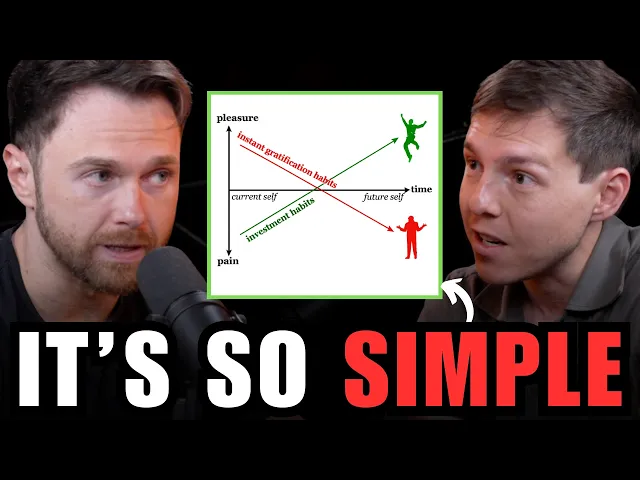
0:06 seen that have built wealth is like their ability to delay gratification.
0:10 It's just their ability to project into the future and see
0:12 that there's an older version of themselves that is grateful
0:16 for their younger self saving and investing money and delaying that grat
0:22 delaying buying the things that you think will make you happy.
0:25 And on that note, I don't know if you guys agree with this, but like for me,
0:29 when I want something and I'm like,
0:30 I really don't want to buy it, but I really want it.
0:33 And when I buy it, I feel this like sense of relief.
0:36 But I figured out that the relief comes from not in owning that thing,
0:42 but in the peacefulness that comes with not wanting it anymore.
0:47 Does that make sense?
0:49 Mhm.
0:48 It's like, oh, I'm so glad like I have it now.
0:51 I don't want it, and now it's it's not bugging me as much.
0:54 And so if you're able to extrapolate that into the future,
0:57 you could be like, "Okay, I could buy this thing,
1:00 but maybe I can just skip the buying part
1:02 and then go directly to the not wanting it."
1:05 A lot of the pleasure is in being able to buy something.
1:11 Exactly.
1:10 And also, I I heard some wisdom which was
1:13 not wanting something is just as good as having it.
1:15 Right.
1:15 That's true.
1:16 And so you could take someone that like,
1:17 you know, really, really, really doesn't want
1:20 a a really fancy car for some reason,
1:23 and they're living just as good as someone that like
1:27 bought that fancy car just because it doesn't matter to them.
1:29 Like, they have other priorities, other things that make them happier,
1:32 such as an aquarium or other things that are just more significant to them.
1:35 But if you don't want something, it's just as good as having it.
1:38 I remember reading a piece of advice on the old fire forums that was like,
1:43 "Oh, use this one trick." It was like I could buy that.
1:45 I was like, "Oh, what is this?" And I clicked on it
1:47 and it was like if the next time you want to buy something,
1:50 save up enough money to buy it and then see how you feel about it.
1:55 Mhm.
1:54 And often times just the ability like you said
1:57 to buy that thing is as good as owning it.
2:00 So like it's like a it's my I could buy that trick.
2:03 So the key is you could either save and make enough money to be
2:07 able to buy the things that you want or you could just want fewer things.
2:11 Exactly.
2:11 Yeah.
2:11 you go directly to that part if you can.
2:15 Um, and then also like I think this is the dividend
2:17 brain of me which is like most people I think when
2:20 they when they compare if they want to buy something they're
2:23 like well how many hours of my work does it cost?
2:25 Like if something's $100 and they get paid $20 an hour like
2:28 okay it cost me 5 hours of my life to buy that thing.
2:31 And that's how most people think about purchasing things.
2:33 But what what dividend investing has really taught me
2:36 is to instead think about things in terms of 4%.
2:38 So it's like how much money do I have
2:40 to have for that thing to passively exist in my life?
2:42 And that's what we talk about all the time.
2:44 That's how I everything is.
2:46 I love that the 4% rule.
2:48 So like how much money do I need to invest?
2:49 If you don't have that much money invested in the market,
2:52 then you have no excuse to own that thing.
2:54 Like you can't afford it.
2:56 That's I've always looked at affording.
2:57 So is that 4% per year or 4% of the the amount?
3:00 Well, if it depends if it's like a recurring cost,
3:02 like for example, if it's like a Netflix subscription, what's Netflix right now?
3:05 Per $12.99, we'll call it.
3:07 Let's say $13, right?
3:08 Times 12, that's $156 a year, right?
3:14 25 or divided by 04, that's $3,900.
3:16 If you don't have $3,900 invested in the market at 4%, you cannot afford that.
3:21 You cannot afford that $13 a month.
3:23 Like, that's just how you think about it.
3:25 I've always thought about it that way.
3:26 I think that's the coolest way to think about it.
3:28 And so that that's what motivated me to to build
3:31 a dividend portfolio because then I could be like, "Okay,
3:34 now I know how much money I'm passively making and now
3:36 I can delegate what things I can and can't afford."
3:40 It's so addicting once you start doing that though because I remember
3:44 in a separate vein, it wasn't dividends,
3:46 but for me it was YouTube income because I viewed
3:49 that as all passive because I would have done it anyway.
3:51 And I remember making a dollar a day and thinking, "Oh, wow.
3:54 That pays for an all you could eat sushi every
3:59 single month for free." And then it started to become,
4:02 "Wow, I got a free phone bill every single month at $50 a month.
4:07 And then my car insurance is 100.
4:09 Oh wow, my car insurance is now free." And everything starts to like stack.
4:13 And then pretty soon it's like, "Wow, my mortgage is now free, right?
4:18 This is free.
4:19 This is free.
4:20 I just live for free because I would be doing this anyway and I'm making money.
4:24 Yeah, that's so cool.
4:24 And then you eventually realize that the quickest way
4:27 to being financially free isn't necessarily by building a bigger portfolio.
4:31 It's literally by removing those recurring costs cuz that's way
4:36 easier to do than needing that money invested at 4%.
4:39 Just like, hey, if I could remove this this car payment
4:41 or this like I just saved a h 100red grand from like retirement.
4:45 That's like that's the coolest way of thinking about it.
4:47 Yeah.
4:48 Do you think that the money printing in the United States is a strategy?
4:52 This is this is a conspiracy theory right here.
4:54 To keep people poor, that's a really good question.
4:59 I don't think on that level of conspiracy to where
5:01 I think that is an intentional thing that we're doing.
5:04 I don't think people are that organized to be like,
5:07 "This is what keeps people poor.
5:09 Let's keep doing I I don't think that's the case." What do you think?
5:13 You think it's intentional?
5:14 I tend to not buy into conspiracies,
5:17 but also if you think about it, any money printing drives up assets.
5:22 Assets are owned by wealthy people, not poor people.
5:25 Poor people suffer with inflation.
5:27 It's just what's happening.
5:28 And they're printing money to try to help the poor people,
5:31 but it's like clearly not.
5:33 So, I don't understand.
5:34 I don't think money printing has anything to do with poor people.
5:37 Why would they want them to be wouldn't they would
5:39 benefit more from people having more money because they spend more?
5:43 Like if if you gave a $100,000 to an average person,
5:46 I I almost guarantee the average person it'll be gone almost instantly, right?
5:51 They're not gonna save it.
5:52 So it's better for people to make more money.
5:54 Like there's no incentive for the government to keep people
5:56 Well, technically speaking,
5:57 poor people are going to be easier to control with the government.
6:01 What I what I think is more systemically realistic is
6:06 that the school system teaches people just to work and follow in line,
6:11 listen to another person, do as instructed.
6:14 You take your lunch here, you start here, you end here,
6:18 you do this whole thing so you could work for someone else.
6:20 It's just a very outdated system that I
6:23 think is probably more likely that they keep
6:24 people in like a working hamster wheel
6:27 and then they shove it down throats of like,
6:30 oh, it's good to go to college and then
6:31 now you borrow money, now you're in debt.
6:33 And then it's, oh, but you have
6:34 to buy a house because that's the American dream.
6:36 Now you buy a house.
6:37 Now you now you have a $50,000 student loan and a $300,000 mortgage.
6:41 You're not going anywhere.
6:42 And now you have to take that job
6:43 to keep making those payments because you don't
6:46 want to lose your house and you can't
6:47 default on your student loans even with bankruptcy.
6:50 So now you're kind of stuck.
6:51 But then you're 35 and you think, "Oh crap,
6:54 I'm getting to an age where I should probably
6:55 have a kid." So now you have a kid.
6:56 Now you definitely can't take the risk
6:59 to start your own business or do anything.
7:01 So now you're stuck working that job you don't like to pay for the house,
7:05 to pay for the student loans,
7:07 and now you have a kid to support and now you're just kind
7:09 of and so you keep working till you're 70 and then you die.
7:12 Right.
7:12 So you're saying it's kind of a result of our own decisions
7:14 and kind of as a byproduct of a shared delusion that we
7:17 all have about what it's like to live a I heard
7:20 that a lot of the school system was was created by a factory owner,
7:26 and this could totally be untrue,
7:28 and I'm just rephrasing what someone else told me,
7:30 was dictated by a factory owner who wanted more workers.
7:34 And so they they set up a whole system to basically keep
7:38 people in this loop of like learning how to work for somebody else.
7:42 And that makes sense.
7:43 Makes perfect sense.
7:44 Yeah.
7:44 So, I don't know if that's true or not, but
7:46 I think that's separate from the money printer question.
7:48 But the money printing, I think,
7:50 is purely a result of the government getting out of control in their spending.
7:54 And this is the only way they could get out of it is just like what do they do?
7:58 Here's how here's how I see the whole money printing thing.
8:01 The money printer allows governments to do
8:05 whatever the hell they want, whenever they want.
8:07 Because if we operated on a fixed supply kind of a system,
8:10 how long do you think people would put
8:13 up with fighting wars or whatever the government wants?
8:17 Cuz like if you were to fund a war, let's say, you actually have to tax people.
8:21 You actually need the money and the revenue from people.
8:24 But if you couldn't print money, if you could print money,
8:27 then you can do whatever you want.
8:28 And so I think that's a byproduct of power
8:31 being exercised beyond what what's in our best interest.
8:36 And that's what Bitcoin is trying to fix.
8:37 Like that's why people are obsessed with Bitcoin is because
8:40 it's a fixed supply and therefore governments have to be responsible.
8:43 Therefore, they can't just do whatever they want.
8:45 So then what would you say is the main thing that is keeping people poor?
8:49 Then
8:50 just a lack of financial education and literacy mostly and lifestyle decisions.
8:56 I for whatever reason these questions make me think of uh George Collins.
8:59 Do you guys know who that is?
8:59 The comedian.
9:00 He's like, "Oh, yeah.
9:01 The rich exist to like kind of inspire the middle class
9:05 and then the poor exist there to scare the out of them."
9:09 Well, because it's like keep keep being in the hamster wheel.
9:11 Like if you don't if you don't want to be like these people,
9:13 you got to keep working.
9:14 You got to keep doing
9:14 and the keep working is look at this guy who just bought a Ferrari, right?
9:18 You don't you want to be like that guy?
9:19 But you definitely don't want to be like that guy.
9:21 It's keeps you stuck in the middle, right?
9:23 I heard somewhere that the worst thing you could
9:25 do to someone is pay them $80,000 a year
9:28 because it's just at the right point where they're
9:31 making enough where they don't want to risk it,
9:33 but it's not so little that they're forced
9:36 to take big action and make significant moves
9:39 to do something that would drive their income so
9:42 much higher and give them so much more opportunity.
9:44 It's like that safety middle where it's just enough to keep you going
9:50 and especially if you get promised like a raise to 90k to then 100
9:54 you like you see the trajectory going up you're going to want to stick
9:58 on that and not do your own thing the slowly boiling crab right I
10:03 don't know I just feel like in order to be like if you
10:05 think about it mathematically in order to be the one like if you think
10:08 rich is to to have a lot of money if that's your definition
10:11 of rich then you got to do like what the 99% don't want to do,
10:16 like to become the 1%.
10:18 Which is literally the opposite of what everyone else does,
10:20 like not going out to eat in restaurants and saving
10:23 money and not owning a car and bicycling to work.
10:25 It's like that's what it takes just have
10:27 enough escape velocity to get out of that.
10:29 And I think that's what I focused so much on in my early 20s
10:33 because my parents were immigrants and they
10:35 didn't understand money and I was like, "Okay,
10:37 let me not do that." Life insurance is one of those things
10:39 that makes sense for a lot of people out there,
10:42 but most people just put it off because it feels complicated,
10:44 expensive, or timeconuming.
10:46 But it doesn't have to be, thanks to our sponsor, Fabric.
10:49 Fabric by Gerber Life is term life insurance that you can get done today.
10:53 It's made for busy parents like you.
10:54 It's all online.
10:55 It's on your schedule right from your couch.
10:57 You could be covered in under 10 minutes with no health exam required.
11:01 If you have kids, and especially if you're young and healthy,
11:03 the time to lock in a low rate is now.
11:05 And even if you have life insurance through your employer,
11:07 it may not offer you enough protection for your family.
11:10 And it usually does not follow you if you leave your job.
11:12 Fabric offers flexible,
11:14 high-quality policies that fit your family and your budget,
11:17 including options like a million dollars in coverage
11:19 for less than a dollar a day.
11:20 Fabric is partnered with Gerber Life,
11:23 trusted by millions of families for over 50 years.
11:25 There's no risk, and they even have a 30-day money back guarantee,
11:29 so you can cancel at any time.
11:30 Fabric also has free digital wills, tools to invest in your kid's future,
11:34 and more, all right from your phone.
11:36 Join the thousands of parents who trust Fabric to protect their family.
11:39 Apply today in just minutes at meetfabric.com/icclip.
11:43 Again, that's meetfabric.com/icclip.
11:47 Meet Tfabric.com/icclip.
11:51 The link is also down below in the description.
11:54 Enjoy.