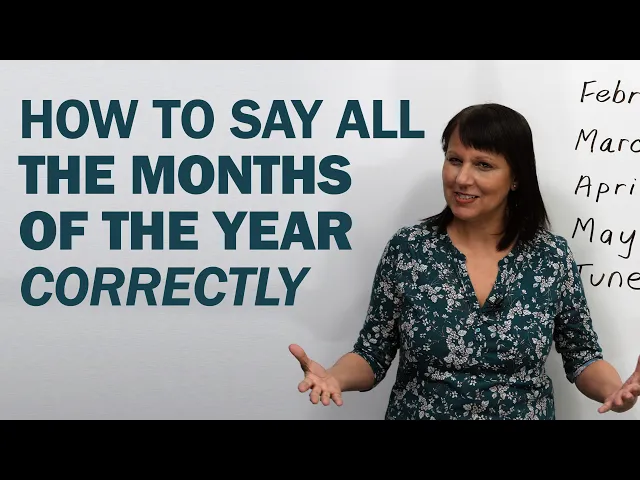
Say the MONTHS of the Year Correctly in English
Learn English with Rebecca · engVid
0:00 Hi.
0:00 I'm Rebecca from engVid.
0:01 In this lesson, you will learn how to pronounce
0:05 the months of the year correctly in English, alright?
0:09 Now, this is really important for so many reasons.
0:13 First of all, we use these months of the year very often,
0:17 right, when we're talking about everyday life, so they come up a lot.
0:22 Second, when you're working on your pronunciation,
0:25 there are so many things you can do to improve.
0:30 But sometimes, an easy trick is to focus
0:33 on the words that appear most often, like these, right?
0:37 Like the months of the year.
0:39 There are only 12 of them,
0:40 they come up very often, and you can master them, okay?
0:44 So, that's what we're going to focus on in this lesson,
0:47 to get you to master these frequent words, okay?
0:50 And also, sometimes, saying these words can be a little bit
0:55 more challenging because maybe in your native languages,
0:59 they are pronounced similar to this, to these, okay?
1:05 But not the same, and so that causes a little bit of interference, okay?
1:10 So, let's get rid of the interference,
1:13 let's work on how to say them correctly in English.
1:17 So, what we're going to do is this.
1:20 First, I'm going to say them.
1:22 So, I just want you to listen, okay?
1:25 You can even close your eyes if it helps you,
1:28 but just listen and get used to the correct sound.
1:31 I might explain a little bit along the way for some of them,
1:35 and that's fine, too, okay?
1:38 You can open your eyes, then, if you want to.
1:44 Okay.
1:45 So, the first one, "January".
1:48 "January".
1:48 Next.
1:49 Now, this one requires a little bit of explanation because
1:54 there are two ways that are very common in North America.
1:58 First, I'm going to say the most common way,
2:02 and then another way, which is also correct.
2:06 So, this could be said, pronounced as "Feb-yew-ary", "Feb-yew", okay?
2:12 "Feb-yew-ary".
2:13 Or, it could be pronounced with the R sound, "Feb-roo-ary", okay?
2:23 "Feb-yew" or "Feb-roo", alright?
2:26 So, let's say it the first way, with the Y sound.
2:33 "Feb-yew-ary", okay?
2:35 "Feb-yew-ary".
2:37 Or, "Feb-roo-ary", "Feb-roo-ary", okay?
2:42 Right now, just listen.
2:47 We're going to go back and you can repeat afterwards, okay?
2:58 "March", "April", "May", "June".
3:01 Okay?
3:02 I'm going to say them once again.
3:05 For now, what I'll do, so we don't stop every time on the second one,
3:11 I'll just say "Feb-yew-ary", okay?
3:12 But you know that you could also say "Feb-roo-ary".
3:15 So, let me say them once again, and this time, you're going to repeat after me.
3:23 "January", "Feb-yew-ary", "March", "April", "May", "June".
3:36 Okay?
3:39 Good.
3:41 Did you get those?
3:50 Alright?
3:50 Now, let's move on to the next six, okay?
3:53 Now, even though you might think that you've got it, it's okay.
3:58 Listen, I work with a lot of clients on pronunciation, and I know it takes time.
4:04 It takes time to get your mouth to say the right thing,
4:08 it takes time for your ears to get used to hearing the right thing, okay?
4:12 So, don't worry if you have to say them several times, that's completely okay.
4:17 Do that, in fact, try to use them as much as you can, alright?
4:23 Record yourself, listen to me,
4:25 listen to this lesson more than once to get the correct sound,
4:29 repeat after me, okay?
4:31 Do whatever you need to do to say it more often and master them,
4:36 because I know you can master them, okay?
4:38 Alright, now let's look at the next six.
4:49 "July".
4:50 You can repeat after me, okay?
4:58 "August", "September", "October", "November", "December".
5:04 Okay?
5:05 Let's say them again.
5:10 I'm going to say it, you'll repeat after me.
5:21 "July", "August", we're going a little faster,
5:31 "September", "October", "November", and "December".
5:36 Good, okay?
5:37 So, now that you've heard them and you've repeated them,
5:43 now we're going to say some sentences using the months of the year,
5:49 because sometimes somebody asks you a question, like,
5:52 "Okay, when's your birthday?" and you say, "January", okay?
5:55 Or, "In January", alright?
5:57 But sometimes you're just saying the word, but in real life,
6:00 you might also be using these names in sentences,
6:04 in questions, in answers, okay?
6:07 So, let's also make sure that you're using them correctly,
6:12 pronouncing them correctly, when you're actually speaking, alright?
6:17 Now, the other thing, by the way, which you might notice here,
6:21 is that all of the months of the year are written with capital letters, okay?
6:28 Perhaps your language doesn't do that.
6:31 For example, in Spanish, the months of the year are not capitalized,
6:35 but in English, they are capitalized.
6:38 So, make sure that when you write them,
6:41 that you write them with a capital letter, always, okay?
6:45 Months of the year, and also days of the week, okay?
6:51 So, that's important.
6:53 Now, another thing that we should do before we do the sentences
6:57 is let's just look a little bit at the stress, okay?
7:01 Because when we're saying these words,
7:03 we don't always stress in the same place, depending on the word.
7:07 So, let's just go through the months before we say the sentences,
7:13 and look at the stress.
7:16 January.
7:16 Where was the stress?
7:19 At the beginning.
7:21 February.
7:22 Or, February.
7:24 Whichever way, the stress was at the beginning.
7:33 Next, March.
7:35 Now, March has only one syllable, so there's no particular stress.
7:40 It's the whole word.
7:42 April.
7:43 Okay?
7:44 Here, the stress is a little bit here on the "a".
7:55 April.
7:56 Good.
7:57 May.
7:57 June.
7:58 No particular stress.
8:00 July.
8:01 July.
8:01 Where do you hear the stress?
8:05 Is it at the beginning, or is it at the end?
8:11 It's a little bit more at the end, right?
8:15 July.
8:16 Okay?
8:16 Next, August.
8:17 August.
8:18 The stress is at the beginning, "a".
8:23 August.
8:24 Good.
8:25 Now, listen to this one.
8:29 September.
8:30 Now, it's not at the beginning anymore.
8:35 Here, it's here, in the middle.
8:40 September.
8:40 Good.
8:41 October.
8:42 October.
8:43 What do you hear?
8:46 The stress, again, in the middle.
8:50 October.
8:51 September.
8:52 Okay?
8:53 November.
8:53 November.
8:54 Again, where did you hear the stress?
8:58 In the middle.
9:00 Good.
9:01 You're getting good at this.
9:03 And this one, December.
9:06 December.
9:06 Again, we had the stress there, okay?
9:10 So, you see in these longer ones that the stress is kind of in the middle.
9:15 Alright.
9:15 Now, let's say some sentences.
9:18 Okay?
9:18 So, I'm not going to write the sentences,
9:22 I just want you to listen and repeat the sentences after me, okay?
9:26 And they're going to be fairly short sentences or questions, okay?
9:32 So, the first one.
9:35 The conference is in January.
9:39 Say that after me.
9:43 The conference is in January.
9:47 Good.
9:48 My birthday is in February.
9:53 Good.
9:54 The next one.
9:56 We met in March.
10:00 Good.
10:01 They're getting married in April.
10:05 Good.
10:06 Are you saying the full sentence after me?
10:11 Say that, okay?
10:12 Just listen and repeat what you hear.
10:15 The exhibition is in May.
10:19 I graduate in June.
10:24 Good.
10:25 The contract ends in July.
10:31 Good.
10:32 Okay.
10:33 The next one.
10:37 The movie comes out in August.
10:42 Good.
10:43 The next one.
10:45 The kids start school in September.
10:50 Do you want me to say it again?
10:54 Okay.
10:55 The kids start school in September.
10:58 Kids is short for children, right?
11:01 It's like slang.
11:03 Alright.
11:04 The next one.
11:06 I bought a computer in October.
11:10 I bought a computer in October.
11:14 Good.
11:15 The next one.
11:17 The concert is in November.
11:20 The concert is in November.
11:23 Now, remember, sometimes, like the first time I said November,
11:29 the second time I said November.
11:32 Now, technically, the North American way is to say November.
11:37 But what's going to happen,
11:39 in different parts of the world and different parts of one country,
11:44 very often the pronunciation varies a little bit, okay?
11:48 Now, whatever I'm teaching you here will work
11:51 for you wherever you go in the world, alright?
11:55 But be aware that there are local variations, and so, if you move to the States,
12:01 and you move to a particular part of the States, and you realize,
12:05 because you're listening and you care,
12:08 you realize that people are pronouncing the name
12:10 of a particular month in a particular way,
12:13 and your goal is to be understood, okay?
12:16 So then, you might want to vary it a little bit.
12:20 It's not going to be very different from what we're learning here.
12:24 It might be slightly different, like November or November, okay?
12:28 So, just pay attention to that.
12:32 And the last one that we're going to- example
12:35 that we're going to give is my holidays are in December.
12:39 Say it again.
12:41 My holidays are in December, okay?
12:46 Very good.
12:48 Now, really, don't feel bad about, you know,
12:51 how long it might be taking you to get the exact pronunciation.
12:56 It's okay, it takes time.
12:57 I work with a lot of clients and I
12:59 know it takes a little time to get the pronunciation,
13:02 so usually what I tell my clients is,
13:05 after we have our lesson, I record it for them,
13:08 and then I tell them, listen every day,
13:11 pronounce it every day, and just even for a few minutes,
13:14 send it back to me so that you can be sure that you're getting it right.
13:18 It takes a little time, but it's worth it because these words,
13:21 as we said, come up very often, okay?
13:25 Now, another- just a little point that you might have noticed.
13:28 Remember that when we're saying the months of the year, usually,
13:32 if it's in a sentence, we're going to use a particular preposition.
13:36 Which word were we saying?
13:39 My birthday is in February.
13:42 The conference is in January, right?
13:45 So, with months of the year, we use the preposition "in", okay?
13:50 Remember that.
13:51 That's a little clue.
13:52 If you're not sure about that or you get that confused, which also happens,
13:56 please do watch my other lesson on "at", "on", and "in" related to time,
14:01 and that should help you to know when to say
14:03 "at", when to say "on", when to say "in", okay?
14:06 But for months of the year, we do say "in", alright?
14:11 So, I hope you enjoyed that lesson.
14:13 There is no particular quiz on this one,
14:16 but you can quiz yourself by recording it, by saying it, by practicing it,
14:22 by paying attention in this week and this month to how
14:26 you're saying it and how other people are saying it, okay?
14:30 When you're watching a movie or when you're at work or wherever else, okay?
14:34 So, that's it for now.
14:35 All the best with your English, and don't forget to subscribe to my YouTube
14:42 channel for more lessons like this one.
14:52 Thanks very much.
14:57 Bye for now.