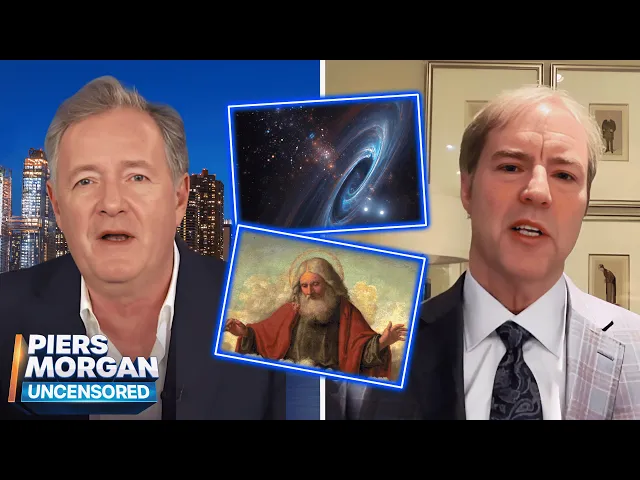
Can This Man PROVE God Built The Universe? Stephen Meyer Returns
Piers Morgan Uncensored
0:00 What are we looking at here?
0:01 I mean, for those who are not as skilled in this kind of thing as as you are,
0:04 what are we looking at?
0:06 Molecular biologists will kind of start out wax lyrical
0:09 and describe the interior workings of the cell as something
0:12 like an automated factory run by digital code
0:15 in which the code is processed by little nano machines.
0:19 And it it's automated to a degree that it's just it's it's just mind-blowing.
0:23 The God hypothesis provides, in my view,
0:26 and that of many scientists and philosophers,
0:28 the best explanation of the origin of the universe.
0:33 It's fair to say that this moment of Russell Brand searching
0:36 for a Bible verse during my interview with him got a lot of pickup,
0:39 especially from those who are skeptical about
0:41 those who purport to believe in God.
0:43 However, a new movie might counteract such cynicism.
0:46 The story of everything features some of the world's most eminent
0:49 science brains who argue that far from being mere cosmic chance,
0:52 the universe has in fact been designed by an intelligent creator.
0:56 Here's a taster.
0:59 Today I'm going to tell you a story which may seem very strange.
1:08 Galileo, Kepler, Newton
1:11 each tried to explain events in the history of the universe.
1:14 Has the universe always been here or is it finite?
1:18 Is there something else that would lay these questions to rest?
1:21 It reopens that question of ultimate meaning.
1:25 How in the world did this start?
1:30 Well,
1:30 it's based on the New York bestselling book Return of the God Hypothesis by Dr.
1:34 Steven C.
1:35 Mayor, who I'm very pleased to welcome back to Uncensored.
1:38 Welcome back to you.
1:40 It's great to be back, Pierce.
1:41 I remember our previous conversation very fondly.
1:44 It's wonderful to be with you.
1:47 Well, over two million people watched our last interview which showed
1:50 the huge level of interest in what you have to say.
1:54 Um, and I was delighted that actually, not only is there that little clip of uh
1:59 of me at the start of that trailer of your movie,
2:02 but I later make a another appearance
2:04 with my big argument with Richard Dawkins on Uncensored, um,
2:09 where he got extremely triggered by my persistence in trying to explain
2:14 to him why I believed there was a greater power out there than us.
2:18 Why do you think this issue of whether there is a god uh winds up some people,
2:25 some scientists, atheists, whoever they may be to such an extraordinary degree?
2:30 Why do they care so much?
2:32 I think it winds us all up in a way because it has such profound implications.
2:36 On the one hand, there is a a motivation,
2:38 a desire to believe in God because it provides
2:41 the basis of belief in an afterlife and ultimate human meaning.
2:45 On the other hand, we all have a motivation not to believe in God because I
2:49 think we'd all prefer not to be morally
2:51 accountable to a a being uh beyond ourselves.
2:55 And so we have these conflicting motive
2:57 motivations in every every person's heart and mind.
3:01 And uh what we try to do in the film and what
3:04 my colleagues and I have tried to do in our scientific
3:06 and philos philosophical work on this topic is extract the motivational
3:11 questions and look and see what does the evidence actually say?
3:14 What have we discovered about the the the scientific questions that would
3:18 bear on the question of whether or not God actually exists?
3:24 What's really interesting is that there was
3:25 a recent Pew Center survey that pulled a random sample of 2533 members
3:32 of the American Association for the Advancement of Science.
3:35 And he came up with some pretty remarkable stats.
3:38 33% said they believed in God.
3:41 18% believed in a universal spirit or higher power.
3:44 41% stated they didn't believe in God or higher power.
3:48 Seven didn't know or refused to answer.
3:51 What What do you make of of those statistics?
3:56 Well, I don't think they're all that significant in that they
3:59 roughly reflect the kind of breakdown in the general public,
4:02 although I think they have skewed over the last century
4:05 in a direction that is more agnostic and atheistic than the general public.
4:10 But the story we're telling in the film is about is the story
4:14 of many scientists who are reconsidering and even rem reaffirming belief in God.
4:19 Not in spite of the scientific evidence
4:21 but because of new scientific discoveries especially about
4:26 biological and cosmological origins about where the universe
4:30 came from and where life came from.
4:31 These are unanswered questions from within a materialistic framework.
4:36 And this is the way we contrast this is
4:38 the kind of the explains the title of the film.
4:40 We contrast two competing grand narratives two stories of reality.
4:44 The one affirms that life and the universe are
4:48 that the universe is eternal and self-existing and self-organizing
4:53 and self-creating so that everything both life can be
4:57 explained as a result of an unguided undirected purposeless process.
5:02 And the other story is the is the equally ancient story.
5:05 It goes back at least to the ancient Greeks that there is a great
5:09 mind behind the universe that is responsible for the creation of the universe
5:12 and for shaping matter and energy to bring into existence all the intricate
5:17 things that we see around us especially those in the living world.
5:20 So we've got these two competing
5:21 narratives or essentially worldviews or philosophies.
5:25 And so I think the the uh the stats about
5:28 the scientists just reflects that reflects the fact that since the 19th
5:31 century the 19th the materialistic narrative has been dominant but the story
5:35 of the film is that that's shifting and shifting very rapidly.
5:38 I think that's actually one of the reasons that you're seeing so
5:40 many high-profile people in our culture begin to reconsider the God question.
5:45 It's bubbling up to the surface as your last segment indicated.
5:50 Yeah.
5:50 I mean it always for me it you know I
5:54 was raised a Catholic I remain a Catholic it I've
5:57 never had any doubt that there there is a god
5:59 but then my kind of scientific brain if you like is
6:03 just computing the reality that if we are this tiny
6:07 pimp prick in the universe and there are gazillions of galaxies
6:10 and all these things the idea that a we're
6:13 the only people that exist in the whole thing is preposterous.
6:17 I think there obviously must be other stuff out there.
6:20 But secondly, no scientist, no atheist,
6:23 nobody I've ever spoken to from Richard Dawkins to anybody else
6:27 to Ricky Jes whoever it may be to Professor Steven Hawking,
6:31 no one can ever explain to me what was there before nothing.
6:36 And because the human brain cannot answer that question, to me self-evidently,
6:42 there must be something more powerful than a human brain,
6:45 a greater entity than a human brain that could at the very least
6:50 answer that question or clear up that that quandry because we can't do it.
6:54 Our brains can't can't answer that question.
6:58 Well, it goes back to that very fundamental philosophical question.
7:01 Why is there something rather than nothing?
7:04 And the the answer that the materialist scientists gave for a very
7:08 long time was that there has
7:10 always been something something material something physical.
7:15 And the assumption was that the universe
7:17 the physical universe was eternal and self-existent
7:19 and therefore did not need an external creator because it had always been here.
7:25 Alas, beginning about a century ago
7:29 with uh discoveries in observational astronomy
7:31 and then subsequent developments in theoretical physics
7:34 and then more discoveries in observational astronomy,
7:37 we've discovered that the universe itself,
7:39 as best we can tell from these multiple
7:41 lines of evidence and inquiry definitely had a beginning.
7:46 And that raises that fundamental causal question all over
7:49 again because we can no longer say the universe is
7:51 the eternal self-existent thing in the way that theists
7:54 have long affirmed that God is the eternal self-existent thing.
7:56 Instead, the universe had a beginning and therefore
7:58 requires some sort of external cause or creator.
8:02 And and I think I I saw your interesting uh uh interview
8:06 with Richard Dawkins responding to the conversation that you and I had before.
8:10 And Dawkins said, "Well, because time itself began,
8:13 we can't really talk about what came before the beginning of the universe."
8:17 Well, okay, fair enough.
8:19 But that doesn't make the causal question go away.
8:22 What caused the universe to come into existence?
8:25 What could have caused time itself to come into existence?
8:28 Well, clearly the kind of cause you would need,
8:30 what would need to be postulated to explain the origin of matter,
8:34 space, time, and energy is something
8:36 that is separate from or which transcends matter,
8:41 space, time, and energy.
8:42 And as you survey the the the available candidates,
8:46 it turns out that the God hypothesis provides,
8:49 in my view, and that of many scientists and philosophers,
8:51 the best explanation of the origin of the universe.
8:54 And that's one of the one of the three big
8:56 discoveries that we look at in the film is the discovery
8:59 of the beginning of of everything and why that is
9:02 bringing back consideration of what we call the God hypothesis.
9:08 Yeah.
9:08 Fascinating.
9:09 Um let's talk about some other aspects to the film.
9:12 Um it features many prominent scientists from across
9:15 the major uh disciplines of of uh physics, chemistry, biology.
9:19 Let's talk about physics first and the uh cosmic fine tuning argument.
9:26 What is that for the layman?
9:31 Yeah, thanks.
9:31 That's a that's a fascinating uh set
9:34 of discoveries and a fascinating ongoing discussion.
9:37 Uh beginning in about the 1950s and60s uh physicists began
9:42 to discover that the very most fundamental parameters of physics,
9:46 the strength of gravitational attraction,
9:49 the strength of electromagnetic attraction
9:51 and of the other fundamental forces in physics,
9:53 the masses of the elementary particles, the expansion rate of the universe,
9:58 and the outward pushing force called
10:00 the cosmological constant responsible for that.
10:03 and even and maybe even especially the configuration of the matter and energy
10:08 the arrangement of matter and energy at the very beginning of the universe.
10:11 All these parameters are what physicists will call they
10:17 call them finely tuned meaning they fall within very
10:20 narrow ranges outside of which there would life
10:25 in the universe and even basic chemistry would be impossible.
10:28 And the collective probability of getting all those parameters
10:32 to fall in each of those sweet spots is infantesmly small.
10:37 And consequently, many physicists have come to the conclusion
10:40 that as f Sir Fred Hy put it,
10:43 a common sense interpretation of the facts suggests
10:46 that a super intellect has monkeyed with physics
10:49 and chemistry to make life possible and that there
10:52 are no blind forces in nature worth talking about.
10:54 Now, that's an especially telling quotation because Hy was
10:59 early in his career a rather strident scientific atheist.
11:02 He even coined the term the big bang to kind
11:05 of stigmatize the idea that the universe had a beginning.
11:08 And in the end he ended up coming around to some
11:12 kind of uh to an affirmation of some kind of intelligent design
11:16 behind the universe because of this fine-tuning that he and now
11:20 many other physicists have discovered
11:21 and ex explicated with with further inquiry.
11:27 On a personal level, what is the kind of unfulfilled Eureka moment
11:32 for you that you dream about happening in your lifetime?
11:38 a discovery.
11:39 What is the thing that would be most exciting to you?
11:42 Well, I think the thing that that that first
11:45 gave me a Eureka and which would just absolutely
11:48 has fascinated me for now nearly 40 years is
11:52 the discoveries that were being made in molecular biology.
11:56 uh that started in the 1950s and60s
11:59 with Watson and Crick elucidating first the structure
12:02 of the DNA molecule and then Francis Crick
12:05 five years later realizing that along the spine
12:08 of the DNA molecule there is a that there
12:11 there are chemical subunits that are functioning
12:14 like alphabetic characters in a written text or like
12:17 digital characters in a section of machine code.
12:20 In fact, one of the great physicists at the time, George Gammo,
12:24 looked carefully at the the the Watson
12:26 and Crick model and realized that these these uh
12:29 so-called bases that contain the information
12:33 were functioning like like a digital bitstring.
12:36 And so the information revolution came into biology in the late 1950s and60s.
12:41 And since then it has absolutely changed our understanding of the of the nature
12:46 of life and posed a fundamental challenge
12:48 to the origin of life uh studies as well.
12:52 In the 19th century around the time of Darwin uh his great bulldog
12:56 Thomas Henry Huxley said the cell is
12:58 a simple homogeneous globule of undifferentiated protoplasm.
13:04 And when scientists thought that the cell was a simple enclosure of jell-o like
13:08 that, it was pretty easy to imagine
13:10 how with one or two simple chemical reactions,
13:13 that protoplasmic substance that was they thought the essence of life
13:18 might have come into existence in a completely undirected way.
13:22 But as we've learned more and more about the interior
13:25 workings of the cell and there's much more to discover
13:28 and that would be some of the the eureka things
13:30 that I' I'd hope to learn about uh in the future.
13:34 But we've now learned that the cell is not only contains digital information.
13:39 It's that digital information is part of a complex information storage,
13:44 transmission, and processing system that rivals,
13:48 in fact, exceeds anything we've developed
13:50 in our own high-tech digital computing world.
13:52 A couple years ago, our our our uh
13:55 uh friend opposite uh professor Dawkins said that he
13:59 was knocked sideways with wonder at the miniaturized intricacy
14:05 of the data processing system inside the living cell.
14:08 Now, that's not the kind of thing that you
14:10 would expect to arise by undirected chemical processes.
14:14 And in fact, there is an impass in what's
14:16 called origin of life research today precisely because no one
14:19 can explain how you get from chemistry to that kind
14:22 of intricate code and the whole system for processing it.
14:25 Now, as far as what I would hope to see in the future,
14:27 we've now learned that the information in DNA is not in any way the whole story.
14:32 There must be other information inside living cells and inside
14:35 the the whole process by which animals are developed.
14:38 And so I'm very eager to see what we we
14:40 discover in the future about the higher levels of information.
14:44 We do know that life represents a hierarchically
14:47 organized system of information storage and processing,
14:51 but we don't know where all the necessary
14:52 information is to for example build an animal form.
14:57 Right?
14:58 So talking of cells, Cambridge University scientists only this week
15:02 actually released an incredible image uh showing
15:06 one of the most detailed 3D reconstructions of a human cell ever produced.
15:10 And people say that this points
15:13 towards intelligent engineering rather than random chance.
15:18 Um what are we looking at here?
15:21 I mean for those who are not as skilled in this kind of thing as as you are,
15:25 what what are we looking at?
15:27 Well, it looks like we have a cross-section
15:30 of the cell and and in that cross-section,
15:33 we're able to see a dynamic representation
15:36 of the movements of the various cellular organels.
15:40 And the organels are structures within the cell.
15:44 Uh but at an even more at an even more fine grain level,
15:47 if you go down further and that this looks like a ukareotic cell.
15:51 So this one would have a nucleus.
15:53 inside the nucleus would be that DNA
15:56 uh protein synthesis system whereby the instructions
16:00 on the DNA would build the molecular machines made of proteins and the protein
16:07 enzymes that are necessary to process
16:09 the information in DNA but also to catalyze
16:13 at very rapid rates all the necessary uh reactions that keep cells alive.
16:18 So you you you now uh molecular biologists will very quickly and cell
16:23 biologists will kind of start to wax lyrical and describe the interior
16:27 workings of the cell as something like an automated factory run
16:30 by digital code in which the code is processed by little nano machines.
16:35 Uh so it's information information processing miniature machinery and it's
16:41 automated to a degree that it's just it's just mind-blowing.
16:45 So the idea of the simple homogeneous or homogeneous glo
16:50 of goo is long long ways back in the rearview mirror.
16:54 It's a it's a completely new day in biology.
16:56 And of course when the main evolutionary ideas of Darwin and others were were
17:00 formulated first formulated in the late 19th
17:03 century they knew of nothing of this.
17:05 And so this is especially for the field known
17:07 as chemical evolution or the theory known as chemical evolutionary theory.
17:12 The theory that purports to explain how we got from the simple
17:16 chemicals in a alleged prebiotic environment
17:20 or soup to the first self-replicating organism.
17:23 There those theories are at a state
17:26 of complete impolutionary biologist has a a compelling
17:30 persuasive or even plausible theory of how you
17:33 get from chemistry to a full living cell.
17:36 I know your producers been also seeking an interview
17:41 with my colleague James Tour who is in the film.
17:44 Uh, Professor Tur has over 850 peer-reviewed publications.
17:48 He's one of the top organic synthesis experts in the world.
17:51 also a specialist in nanotechnology and he's been a very outspoken
17:56 uh critic of of scientists who present to the public the idea
18:00 that we understand how the living cell came about through undirected
18:04 chemical processes when in fact no such thing is the case.
18:07 So uh that that that little snapshot you just
18:10 showed uh gives just a flavor of the complexity.
18:14 In the film we go a little a little bit deeper to the nano
18:17 scale and show the way the information on DNA is being processed.
18:21 We show the machines that are being built.
18:22 And once you see this, you can't unsee it.
18:25 You realize u you almost don't need
18:27 to make an argument for intelligent design because
18:29 you can see that this is obviously
18:31 an intricately designed uh system on a miniaturized scale.
18:37 I mean the the human body in all its complexity with everything
18:42 that's involved is unbelievably brilliant and complex
18:47 and a stunning piece of engineering.
18:50 never mind anything else.
18:52 Um can you see a situation where artificial
18:55 intelligence which is obviously developing at a ferocious
18:58 rate at the moment where rather like with when
19:02 they bought out chess computers and they were
19:03 these gigantic things and a human could beat
19:06 them and then very quickly I think Gary Kasparov
19:09 who was a world champion lost to one of them deep blue and then that was it.
19:12 Now nobody can beat a chess chess computer.
19:15 Are we going to see a situation do you think in two,
19:18 three, maybe five years, whatever it may be,
19:20 where artificial intelligence can solve all the problems about
19:24 the human body that we are currently incapable of solving,
19:28 including, for example, cancers, diseases and so on?
19:34 Well, it's a fantastic knowledge and I think it obviously uh augments
19:38 our human intelligence beautifully and we can use it for good or for ill.
19:42 But there's an interesting problem.
19:44 that's development developed with these large language mo models
19:47 or the the kind of uh chat GPT style you know
19:52 latest generation AI and I think it's a it's a really
19:56 interesting tell it's called a the problem of model collapse
19:59 and the idea is that if you feed into the AI
20:03 system a body of text that's written by conscious intelligent
20:08 agents and then you quer use the AI system the LLM
20:12 and the something like chat at GPT to query that system,
20:16 ask it a question, you'll get an output.
20:18 You'll get a an amazingly coherent answer.
20:21 But if you use the output as data, what's called artificial data,
20:26 and then you query that output,
20:29 the next output ends up being quite a bit less coherent.
20:33 And if you keep doing that over multiple iterations,
20:36 the whole thing breaks down.
20:38 you get what's some what there's a parallel problem in origin of life
20:41 research when people have attempted
20:42 to simulate the origin of genetic information
20:45 with various physical processes is a problem known as error catastrophe you have
20:49 this buildup of incoherence over time and I think that shows that the system
20:54 as a whole there's there's a fundamental asy symmetry the system as a whole
20:57 the artificial intelligence is fundamentally dependent
21:01 on the initial input of meaningful or functional information from a conscious
21:05 intelligence and that's one of the key
21:07 principles that allows us to detect design in living systems as well.
21:11 We see a large amount of functional or what we call specified information
21:17 in DNA and RNA and other these other
21:19 large information bearing macroolelecules in the cell.
21:23 And we know from our experience that that type
21:25 of information always arises from a conscious intelligence.
21:28 In fact, there's a an early pioneer
21:30 in the application of information science to molecular biology,
21:34 a man named Henry Quasler who said that the creation
21:37 of new information is habitually associated with conscious activity.
21:41 So when we find that kind of information at the foundation of life,
21:46 something like digital code in a computer program,
21:48 it is in fact very reasonable to infer
21:51 that a conscious intelligence was ultimately responsible for that information.
21:56 in the same way that our AI systems won't work if
21:58 we don't have that initial input from from conscious agency as well.
22:04 Fascinating.
22:05 Let's just turn quickly to arguments against God.
22:08 One is that the universe is so large 93 billion
22:11 light years in diameter and so old 13.8 billion years
22:16 that mere probability dictates that life has to exist somewhere
22:21 and we just happen to have won the cosmic lottery.
22:24 What do you say to that argument?
22:26 Well, uh, I'm completely agnostic as to whether
22:28 life exists elsewhere in the cosmos.
22:30 We just don't know at this point.
22:32 What I would say is that u well, two things.
22:35 First, if you run the probabilities,
22:37 it's it's not a slam dunk that life must exist anymore.
22:40 People used to think that making calculations on something
22:44 on the basis of something called the Drake equation
22:46 and on the basis of the number of G
22:50 that there are in the univer about two trillion.
22:53 It's an amazingly vast expanse we live in.
22:57 But the number the improbability associated with getting all the par
23:01 the parameters right both at the cosmological level and in the local
23:06 level of a that are necessary to build a life-
23:09 friendly solar system are equally daunting in the other direction.
23:13 So it's not clear.
23:14 But but what we do know for sure is that to build life,
23:19 you don't just need a a friendly planetary system.
23:24 You've got to create something has to create
23:26 the information necessary to create self-replicating organisms.
23:31 And in our experience, again, information is the product of mind.
23:34 So my argument would be if life exists elsewhere in the cosmos,
23:38 odds are it was also it was produced by an intelligent
23:41 agent as indeed I think the life that we know of must
23:44 have been based on the features that it possesses that are
23:48 that are invariably indicators of the activity of a designing mind.
23:54 What about this bonkers theory?
23:56 But then it was bound to be bonkers and some of the best
23:59 theories in the world turn out to be true when they're bonkers.
24:01 What if it's not God,
24:03 but it's an advanced alien scientist who was designed a simulation that we're
24:08 all living in, and he sort of rather he rather enjoys the suffering.
24:15 The fact of that uh postulation having been uh
24:19 floated by very prominent scientists uh including no less
24:23 a personage than the great Francis Crick even
24:26 our our a friend and colleague Richard Dawkins who's been
24:29 on your program floated that idea of what's it's
24:32 called panspermia the idea that life was either designed elsewhere
24:36 by an intelligent alien or it evolved elsewhere and then
24:39 was transported here to earth by the intelligent agent.
24:42 Now, in fairness, I think Professor Dawkins later disclaimed
24:45 that that speculation that he made in a in a documentary,
24:49 but uh the fact that that scientists have had to go there
24:53 shows just how difficult the problem of the origin of life is.
24:57 Um, and notice too that that is actually an intelligent design hypothesis,
25:02 but the the the designer being postulated is an intelligent alien rather than
25:06 rather than than something like a transcendent
25:09 intelligence that we would associate with God.
25:11 Couple things to say about that.
25:13 First of all, it doesn't really solve the ultimate problem
25:16 of the origin of the information necessary to produce life,
25:18 which is the fundamental uh unsolved problem in origin of life research.
25:23 Uh it it it merely kicks the problem not down the road,
25:27 but but boots it out into space.
25:29 But even more fundamentally, the alien designer hypothesis doesn't account
25:35 for the origin of the fine-tuning of the laws
25:38 and constants of physics and initial conditions
25:40 of the universe that we were talking about.
25:42 That fine-tuning has been present from the very beginning of the universe.
25:45 And clearly, no alien being or any other being within the cosmos could explain
25:50 the origin of the finetuning that would
25:52 allegedly make its future evolution and origin possible.
25:56 So there's a huge unsolved problem
25:58 with the the the uh find with the alien designer hypothesis.
26:04 Uh and one other and that is that no alien intelligence
26:07 within the cosmos can explain where the cosmos itself came from.
26:11 So I've argued in Return of the God hypothesis,
26:16 my book, which is the basis of the new film, The Story of Everything,
26:19 that the theistic design hypothesis does the best overall job,
26:23 the best job of explaining all
26:25 the evidence we have about both biological origins,
26:28 but also physical origins, the finetuning,
26:30 and the origin of the universe itself, the cosmological origins.
26:35 I I asked Neil deGrasse Tyson recently who
26:37 was the the greatest scientist there's ever been
26:41 that we know of and he said Isaac
26:43 Newton who would your candidate be for that title
26:47 it's hard to beat Isaac Newton but uh
26:49 James Clark Maxwell and Einstein are Newton
26:53 Clark James Clark Maxwell and Einstein are generally
26:55 generally regarded as as the three greatest physicists.
26:59 Einstein said he stood on the the shoulders of Maxwell.
27:03 Um Newton also used that same quote
27:05 to talk about the importance of Galileo and Kepler.
27:08 So a lot of great scientific minds.
27:10 Um I was very fortunate to get to study at Cambridge University and a lot
27:13 of those people were there in in the the history of science at Cambridge.
27:17 I wasn't there with Maxwell.
27:18 He predated me.
27:19 But uh he had inscribed on the great
27:22 Caendish laboratory a psalm uh psalm 111 which
27:26 says great are the works of the lord
27:28 sought out by all who take pleasure therein.
27:30 I used to gain a lot of uh uh sort of uh confidence
27:35 in my own developing thought to realize
27:37 that many of the great scientists from who
27:40 got science going back to Newton and Bole and and Kepler but right
27:45 through to Maxwell and beyond were men of deep religious faith and they saw
27:49 that in they they felt that what they were doing in studying nature was
27:52 was explicating the work of a great mind that lay behind the the physical
27:57 universe they studied and that's that's uh in inscribed there for all to see
28:02 on the on the entrance
28:03 to the the historic Caendish laboratory there in Cambridge.
28:09 Um let's just quickly reference a report on the today's show
28:13 about the possible discovery of a very famous biblical artifact, Noah's Ark.
28:19 Let's take a look at this.
28:21 Imagine these mountains millennia ago submerged by floods and in this beautiful
28:29 biblical landscape named in the Old Testament the shape of a ship.
28:34 The book of Genesis says Noah landed here in the mountains of Ararat.
28:40 So could this really be Noah's ark?
28:48 What do you think of that?
28:49 Do you think Noah's ark existed and that's some evidence towards it?
28:57 I am I am uh again I'll plead agnosticism.
29:00 I do not know what to think of that particular discovery.
29:03 I know archaeologists on both sides of that uh debate,
29:07 but um I would tell you that the gen
29:09 the trend line in archaeological discovery over
29:12 the last 100 to 150 years has been
29:15 to repeatedly confirm the historical reliability of the biblical text,
29:20 both the Hebrew Bible and the New Testament.
29:23 Many of the figures that were uh described
29:25 in the gospels as having been present in the trial
29:28 of Jesus have been independently attested by archaeological inscriptions most
29:33 prominently Pontius Pilate and and Caiaphas the Jewish high priest.
29:37 If you go to the British Museum in London,
29:40 the whole story of the interaction between the Empire,
29:46 Kingdom of Judah under Sekcharb on the Assyrian side and and uh and Hezek
29:52 on the on the on the Jewish side is attested in the Assyrian record.
29:57 So you have this external corroboration of the biblical text.
29:59 So that's something that fascinates me on an avocational level.
30:03 don't know about the recent uh discovery that you just highlighted,
30:06 but I do know that there's an awful lot of archaeological evidence,
30:09 surprising amount and and that many people
30:12 just don't know about that has confirmed
30:14 the historical reliability of of the narratives
30:17 that we find in those ancient scriptural documents.
30:22 Well, that brings me neatly to a conclusion.
30:24 Poly market, the prediction market says there's over $60
30:28 million currently invested in the return of Jesus by 2027.
30:33 So, a 4% chance that it will happen.
30:36 Biggest spikes seen since last November and in early February this year.
30:40 So, a lot of money coming in on Jesus potentially reappearing on this planet.
30:47 What do you feel about that?
30:50 Well, I wonder if if their predictions come true, who will get the payoff?
30:55 But uh uh I think I I I think wars and rumors of wars tend to tend
31:02 to do that to people and get esqueological
31:06 intuition focused on the other end of the timetable.
31:12 Uh where did everything come from?
31:13 And that's of course what our our film is about.
31:15 You've been so kind to let us let us share some of that with your audience.
31:21 the um I interviewed Russell Brand uh last week in and several clips went
31:26 viral including him spending several minutes trying
31:29 to find a Bible passage from there.
31:32 Do you think we are in this era
31:34 slightly prone to a new phenomenon of performative
31:38 religious conviction where people adopt it late in life as a bit of a PR crutch?
31:46 I I'd like to dodge that question
31:48 because I never like to speculate about motivations.
31:51 But what I would say is that we certainly are in the last seven or eight
31:56 years in a period where first of all I think the new atheism has run its course.
32:01 I think it overplayed its hand and I think there's a renewed interest
32:05 in the God question and it and it is bubbling up to the top of the the culture
32:09 in the form of discussions with many surprising people.
32:14 I think of Ayan Hersy Ali in your country uh
32:18 Tom Holland uh the great historian uh in our country
32:23 the social scientists Charles Murray who's re recently written a book
32:27 called taking religion seriously some of the the leading uh
32:31 talk uh podcasters are are discussing this I've been on Wikipedia
32:36 described as a pseudocientist because uh in challenging the strictly
32:42 materialistic definition of science science by posing the the idea
32:46 of intelligent design or developing and arguing for the intelligent design.
32:50 I'm violating a convention that many atheistic scientists believe
32:55 is normative uh for for scientists to to accept.
32:59 Uh we're challenging that uh assumption
33:02 or that normative prescription because we
33:04 think it prevents scientists from following the evidence wherever it might lead.
33:08 And it was certainly never a normative prescription in the time
33:10 of Newton and the great scientists who got science going.
33:13 Putting all that aside, it's interesting that the founder
33:16 of Wikipedia has recently announced a Christian
33:20 conversion experience and he cites our work on intelligent design u
33:24 the alleged pseudocientific perspective that the the site still stigmatizes
33:30 as a as a big factor in his in his conversion to Christianity.
33:33 So um it's at least opening.
33:36 I think we have a lot of things going on in science, philosophy,
33:39 and culturally that are opening people's minds to the God
33:42 question and in a way that even five, six years ago was not was not happening.
33:48 Yeah, 100%.
33:49 I think that's the purest definition of irony you just laid out there.
33:52 Uh Dr.
33:53 Steven C.
33:53 May, great to talk to you again.
33:55 Uh I could talk to you for hours, but we sadly run out of time.
33:58 The story of everything, this movie based on your bestselling book,
34:01 Return of the God Hypothesis.
34:03 How do people get to see it?
34:04 I know it's out today, Friday.
34:06 How do people get to see it?
34:08 Yeah, thanks.
34:08 Thank thanks for asking.
34:09 It's uh people can get tickets in the US.
34:13 It's out in US theaters right now.
34:15 People in the US can get tickets by going to a site, the storyofthing.
34:22 Filmm for film.
34:24 The storyof everything.
34:25 And it will be out later in the summer on digital platforms,
34:29 but I would recommend seeing it on the big screen.
34:32 It's visually stunning.
34:33 The producers have done a great job.
34:35 There are 400 visual effects.
34:36 They take you way out into space to see the galaxies close up and deep
34:41 into the interior of the cell to see
34:42 all that digital and nanotechnology we've been talking about.
34:46 So, it is a a visually stunning cinematic experience.
34:51 Brilliant.
34:51 Dr.
34:52 May, great to see you again.
34:53 Thank you very much indeed for taking the time for uncensoring.
34:57 Thank you for having me again.
34:58 It's always always a pleasure.
35:02 Piers Morgan Uncensored is proudly independent.
35:05 The only boss around here is me.
35:06 If you enjoy our show, we ask for only one simple thing.
35:10 Hit subscribe on YouTube and follow Piers
35:12 Morgan Uncensored on Spotify and Apple Podcast.
35:16 And in return, we will continue our mission to inform, irritate, and entertain.
35:20 And we'll do it all for free.
35:22 Independent uncensored media has never been more critical,
35:25 and we couldn't do it without you.