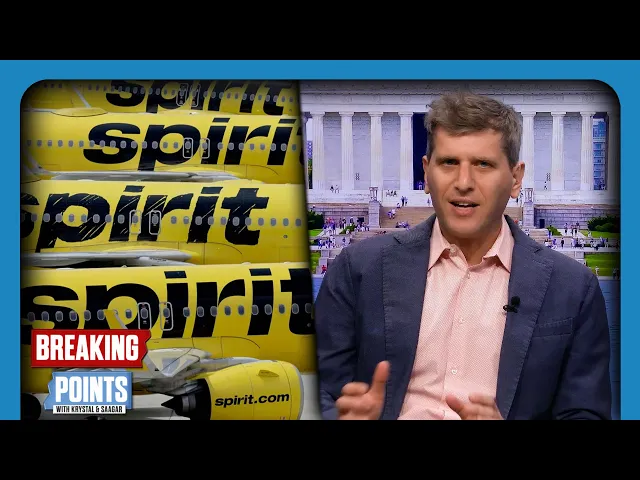
Who REALLY Killed Spirit Airlines?
Breaking Points
0:00 Hi, I'm Matt Stler, publisher of the news outlet Big
0:03 and an analyst who looks at how corporate America works.
0:06 And I want to start this big breakdown with a question.
0:09 Who really killed Spirit Airlines?
0:11 The discount carrier hated by many customers,
0:13 but hated even more by fellow airlines.
0:16 And why should anyone care?
0:18 It's an important story, but not for the reason you might expect.
0:22 All right, let's start at the beginning.
0:23 On Saturday, prompted by high jet fuel prices, Spirit liquidated its operations.
0:28 The company laid off its staff and cancelled all of its flights
0:32 after the Trump administration failed
0:33 to negotiate a bailout with Spirit's creditors.
0:36 Now, it's an awful situation for travelers who have to rebook flights,
0:39 and it's worse for the 17,000 employees of the airline who are now jobless.
0:43 There's another reason to care,
0:44 even if you never flew Spirit, and that's the Spirit effect.
0:48 Spirit was known as a budget carrier.
0:50 It charged low upfront fairs,
0:52 but tacked on fees for everything from bags to drinks.
0:54 as seats were not particularly comfortable and if a flight got cancelled,
0:58 good luck getting rebooked.
0:58 I mean, I know I was once stranded in New Orleans because of Spirit.
1:02 But here's the thing.
1:03 As much as customers might have bristled at Spirit's treatment,
1:06 fellow airlines hated it even more.
1:08 And that's because Spirit forced them to compete.
1:11 When Spirit entered a route, prices dropped not just for Spirit's flight,
1:16 but on all carriers by 17% on average.
1:19 And when it left a route, stopped flying, fairs went up by 30%.
1:24 So, for example, in 2019, to compete with Spirit,
1:27 United Airlines had to implement a quote unquote extraordinarily low
1:31 walkup fair of $29 for flights from Newark to Sto.
1:35 Domingo.
1:36 As Don Gilbertson, travel columnist for the Wall Street Journal,
1:39 put it, "Competing airlines vigorously matched its fairs,
1:42 even if it was with one of those no frills basic economy tickets.
1:46 With Spirit gone, you can bet that dirt cheap fairs to Florida,
1:49 for example, will be harder to come by." All right.
1:51 All right.
1:51 Now, the obvious culprit here is fuel prices.
1:54 Let's take a look.
1:54 Now, you see that bit at the um at the far right.
1:56 That's the price of jet fuel.
1:58 It's doubled since the war in Iran started late February.
2:02 In fact, the whole, you know, lowcost airlines sector asked the administration
2:06 for $2 and half billion dollars in relief.
2:08 So, Spirit, which you know was is financially fragile
2:11 to begin with, which we're going to get into.
2:12 It's the first, but it's likely not the last to go under.
2:15 All right.
2:16 So, case closed, right?
2:17 It's Iran.
2:18 We get it.
2:19 But not so fast.
2:21 That is not what the Trump administration is saying.
2:23 So here's the Department of Transportation Secretary Shawn Duffy
2:27 actually blaming the Biden administration for the collapse of Spirit.
2:31 Now he's specifically pointing to the choice of the antitrust division
2:34 in 2024 to file a case against Spirit's attempted merger with JetBlue.
2:40 There was a proposed merger between JetBlue and Spirit
2:45 and Joe Biden and Pete Buddha Judge along
2:48 with the Biden DOJ uh decided that they did
2:51 they did not want that merger to take place.
2:54 And at the time uh the Biden and Buddha
2:57 Judge DOJ bragged and said uh as they cancelled
3:01 the option for this merger that this was a victory
3:04 for US travelers who deserve lower prices and better choices.
3:09 And this uh today uh would indicate this is not better for travelers.
3:13 This is not better for pricing.
3:14 This is not better for competition.
3:16 Actually, it's worse.
3:18 We had an airline go down because the markets
3:20 were trying to allow two airlines to merge,
3:23 make them stronger, and offer more competition for the American consumer.
3:28 Now, most people would chalk this statement up to the Trump
3:30 administration refusing to take responsibility for the war in Iran.
3:34 That is, of course, true.
3:36 But the thing is, Duffy's not the only one making this argument.
3:39 So here's Democrat Nera Tanden,
3:41 who is Biden's chief domestic policy council adviser
3:45 and the current head of an important think tank,
3:47 the Center for American Progress, making the same argument.
3:50 Now, the logic here is that had JetBlue bought Spirit,
3:53 then somehow the combined airline would be safe from a jet fuel price hike.
3:58 But in truth, there's a political logic here more than anything else,
4:01 and it's best expressed by Wall Street.
4:04 So, one finance focused Democrat,
4:06 it's important to understand he's as a Democrat,
4:08 said he wants to make sure that no
4:10 one who did antitrust in the Biden administration
4:13 because of what they did with JetBlue Spirit
4:15 should have roles in a future Democratic White House.
4:19 Now, these are the people who sued Ticket Master, Amazon, Google, Kroger,
4:23 Albertson's, tried to ban non-compete agreements, tried to get rid of junk fees.
4:27 So, that's who Wall Street is trying
4:29 to exclude from politics because of Spirit's bankruptcy.
4:33 So in other words, it's an attempt to kill populism on the left.
4:37 Let's look into the details.
4:38 What actually happened with the merger?
4:40 Is there any merit to this claim?
4:42 Okay, remember Spirit Airlines was absolutely hated in the industry.
4:47 It was a much more efficient operator.
4:49 It used its planes and gates at a higher turnover rate than the big four.
4:52 It flew non-stop point-to-point routes instead of building higher cost hubs.
4:56 Spirit was also an aggressive, this is an industry, this is an antitrust term,
5:00 maverick, that used low prices to pull customers away from the legacy carriers.
5:06 And JetBlue was particularly vulnerable to Spirit because the two
5:09 had competitive route overlaps to and from Los Angeles,
5:12 New York City, San Juan, Boston.
5:14 And JetBlue hadn't made a profit since 2019.
5:18 So it's 2022.
5:19 Spirit was trying to merge, trying to find a dance partner,
5:22 and they they sought to do it with fellow lowcost carrier Frontier,
5:27 and that would have expanded Spirit's business model.
5:30 The two didn't really have a lot of root overlaps,
5:32 so it would have been a legal deal.
5:35 But JetBlue then decided to intervene and they bid
5:38 for Spirit with a higher cash officer offer than Frontier.
5:42 And if they won, their plan, and this came from internal documents,
5:46 was to rip out seats from Spirit's planes and raise prices by up to 40%.
5:51 And that is just flatout illegal.
5:53 It's against antitrust laws.
5:55 So, here's Spirit CEO in 2022 saying that.
5:58 Let's take a listen.
6:00 We believe there to be a significant regulatory hurdle here.
6:03 We hired some of the best experts uh in the field,
6:06 regulatory lawyers and and economists to advise the board on this issue.
6:10 worked with JetBlue over the better part of a month and a half
6:12 and they reached the conclusion that that it's not likely to get approved.
6:16 But to be honest, you really don't need to be an expert here.
6:19 Um, you know, what we've got is JetBlue
6:21 and in the middle of a quasi merger with American Airlines,
6:25 uh, one of the big three that they they purport to compete with.
6:29 Um, and then attempting to buy a competitor
6:31 and take seats out of the market and raise fairs.
6:33 And that's that's going to be a big issue uh,
6:36 and one that our board viewed as uh, insurmountable.
6:39 But JetBlue went ahead with with their bid anyway.
6:42 Now, Spirit shareholders were warned about it.
6:45 They said, you know, the Spirit board said, "Don't take the JetBlue bid.
6:48 It's illegal.
6:48 It's not going to get through." But the Spirit shareholders said,
6:52 "No, we want more money,
6:53 even if there's a risk." They chose greed over common sense and the rule of law.
6:58 And many of those shareholders are today
7:00 complaining about the Biden administration enforcing the law
7:04 as if they didn't make the choice to engage
7:07 in the illegal activity in the first place.
7:09 Now, I'll also note that JetBlue itself is in trouble.
7:12 Analysts give the carrier a 75% chance of going bankrupt,
7:15 and the airlines founder even said he thinks it's likely.
7:19 So, you might be looking at a JetBlue Spirit
7:21 that could go out of business instead of just Spirit.
7:24 In fact, one reason the judge blocked the JetBlue Spirit merger is because
7:29 he thought that JetBlue had far too much debt to make it work.
7:33 But there's more.
7:34 After a judge blocked the JetBlue deal,
7:36 Frontier made another bid for Spirit 2025 and Spirit said no.
7:44 Instead, the company paid its CEO a $3 million bonus and declared bankruptcy.
7:50 So, it's the Spirit shareholders and Spirit Management who
7:54 got greedy and JetBlue making a knowingly illegal deal.
7:59 But that's not all.
8:00 There are also other players who wanted to see Spirit go down.
8:05 There are the big four carriers, American, United, Southwest, and Delta.
8:10 They actually lobbyed against a federal bailout along with billionaire
8:14 creditors who thought they could ring more out of the taxpayer.
8:17 Here's Gilbertson again.
8:19 There's one big reason major airlines were quietly or not so
8:22 quietly in United's case rooting against a government bailout of Spirit.
8:26 One less pesky discounter gives them more pricing power.
8:30 In fact, if you look at the airline industry as a whole,
8:33 it's only the big guys making money.
8:35 Really, Delta and United with everyone else from Alaska
8:38 to Spirit to Allegion being driven out of business.
8:42 And that is intentional.
8:43 Here's the judge in the JetBlue Spirit case,
8:45 who incidentally is a Reagan appointee.
8:47 The airline industry is an oligopoly that has become more
8:50 concentrated due to a series of mergers in the first
8:53 decades of the 21st century with a small group
8:55 of firms in control of the vast majority of the market.
8:58 So under Bush and Obama,
9:00 antitrust enforcers allowed a bunch of mergers to consolidate the industry.
9:03 Delta Northwest, United Continental, Southwest Airtran, American US Airways.
9:08 And this resulted from in about eight airlines
9:11 that control the industry moving to just four.
9:14 And the bigger lines have a lot of advantages
9:15 over the little guys and they exploit them.
9:17 They have a lot of slots at airports, fortress hubs.
9:19 They have scale in credit card programs, loyalty programs,
9:23 and reciprocity with each other, but not the little guy.
9:25 That's why when Spirit cancels a flight, you're you have to scramble.
9:29 But when you know, United does cancel flight,
9:31 there's plenty of other flights to got to get on.
9:34 But there are more other more questionable tactics rumored about,
9:39 like intentionally losing money on competitive routes to bleed out rivals.
9:43 That's called predatory pricing and it has happened
9:45 a lot since deregulation in the late 1970s.
9:48 So some examples include American going after Sunjet and Vanguard,
9:51 Delta attacking ValueJet, Northwest undercutting Spirit and Sunountry,
9:55 and United trying to beat out Frontier and Western Pacific.
9:58 These are all in the 90s and 2000s.
10:01 Before deregulation, airlines were a financially stable business,
10:05 and it was roughly the same price per airline mile to move around the country.
10:09 After deregulation, we've seen over 200 bankruptcies and 45 mergers,
10:14 and it's cheap to fly to and from big cities,
10:16 but expensive and difficult to fly everywhere else.
10:20 Spirits collapse will only make that worse.
10:22 The bottom line is that deregulation created an environment
10:25 where predatory tactics in the industry were the norm.
10:28 A lot of people say, well, so what?
10:29 Prices came down.
10:30 But prices were coming down anyway,
10:32 and price declines actually slowed after deregulation in 1978.
10:36 Moreover, after that big move,
10:39 cities across the country like Memphis, Pittsburgh, St.
10:41 Louis, Cleveland, and Cincinnati, not actually small cities,
10:44 lost air service, some cases almost entirely.
10:47 As airline analyst Bill McGee put it,
10:49 consider that Atlanta is the 37th most populous city in the United States,
10:52 but is the big busiest airport, not only in the country,
10:55 but in the world, because Delta's mega
10:57 hub processed 106 million passengers in 2025.
11:00 Simply put, under regulation, planes were sent where the people were.
11:03 Under deregulation, people are sent where the planes are.
11:06 Today, the airlines are making a lot of their money
11:08 on credit card programs and frequent flyer programs.
11:11 Organizing a transportation system, an air grid,
11:14 which is vital infrastructure for America, based on who can sell credit cards,
11:18 is an insane way to decide how to move people and goods around a country.
11:22 But that's where we are.
11:24 So, who killed Spirit Airlines?
11:26 Well, there's a bit of a murder on the Orient Express dynamic to it, though.
11:29 Everybody's got a hand on the knife.
11:31 Yeah, of course.
11:32 It was Trump's Iran war spiking costs that, you know,
11:36 Spirit would still be flying without that.
11:38 But it was also JetBlue sabotaging Spirit's Frontier deal.
11:43 It was Spirit turning down Frontier's acquisition twice.
11:46 It was the big four legacy airlines,
11:48 weakening everyone in the industry, including Spirit.
11:51 And it was Bush and Obama enforcers and regulators
11:53 blessing a rollup of power to the big four, which let them do that.
11:57 Behind all of these choices, behind all of it,
12:01 going back to 1978, was the deregulation of the airlines,
12:05 the one group of people who aren't at fault are
12:08 the ones Trump and Wall Street and corporate Democrats are blaming,
12:12 the antitrust enforcers.
12:14 Funny how that works.
12:16 Thanks for watching this big breakdown on the Breaking Points channel.
12:19 If you'd like to know more about corporate America,
12:21 big business, and how our economy really works,
12:23 you can sign up by going to the link in the description below.
12:27 for my market power focus newsletter big.
12:29 Thanks and have a good one.
12:31 Hey, if you like that video, hit the like button or leave a comment below.
12:34 It really helps get the show to more people.
12:36 And if you'd like to get the full show ad free and in your inbox every morning,
12:40 you can sign up at breakingpoints.com.
12:42 That's right.
12:42 Get the full show.
12:43 Help support the future of independent media at breakingpoints.com.