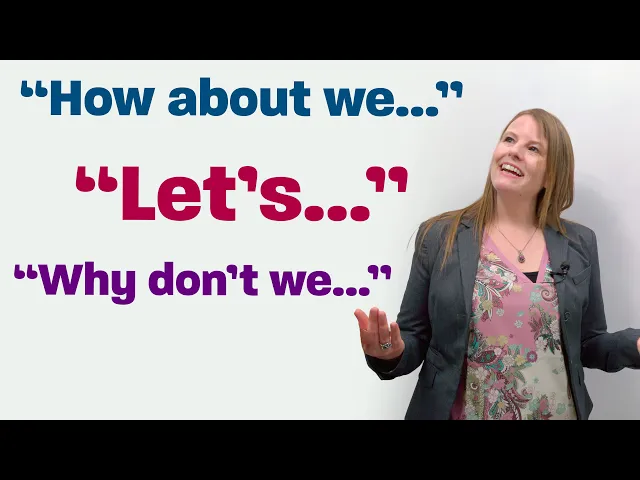
EASY ENGLISH CONVERSATION: “Let’s...”, “How about...”, “Why don’t we...?”
English with Emma · engVid
0:00 Hello.
0:01 My name is Emma, and today I am going
0:04 to teach you three easy expressions we use in everyday English.
0:10 I'm going to teach you "let's", I will teach you "how about",
0:16 and I will also teach you "why don't we".
0:22 So these are important expressions.
0:24 I'll teach you the grammar as well as how we use them.
0:27 So let's get started.
0:29 The first one we're going to look at is "let's".
0:33 We use "let's" when we are making a suggestion.
0:39 We are presenting a plan or idea to another person.
0:44 So my first example is "Let's go to the park." What does this mean?
0:52 Well, "let's" means "let us", so it means "we".
0:57 "Let us go to the park." "Let's go to the park."
1:01 And it just means my suggestion is we go to the park together.
1:07 Now it's really important that you notice this little apostrophe here,
1:11 because without this apostrophe, "let's" has a different meaning.
1:15 I'll explain that in a moment.
1:19 My second example is "Let's have lunch at 1pm." What does this mean?
1:26 Well, it means my suggestion or my idea is we should have lunch at 1pm together.
1:37 So let's talk about the grammar of "let's".
1:41 So when we use "let's", again, it means "let us",
1:45 it's followed by the base form of a verb.
1:49 So what does that mean?
1:51 Well, the verb does not have "ed", it does not have "ing",
1:56 it does not have a conjugation; it's just the base form.
2:02 So let's look at some examples.
2:04 I could say "Let's watch a movie." "Watch"
2:11 is the base form of the verb "to watch".
2:15 I could say "Let's see a show." "See" is the base form of the verb "to see".
2:23 "Let's do art." "Do" is the base form of the verb "to do".
2:31 Or "Let's eat a piece of cake." And so, again,
2:35 these are all suggestions on what you want to do with another person together.
2:42 So can you make a negative sentence with "let's"?
2:47 You sure can.
2:49 If you add "not", you can make a negative sentence or a negative suggestion.
2:55 So for example, "Let's not", and then you have the base of the verb.
3:02 Imagine somebody says to you, "Hey,
3:05 let's eat 30 hot dogs tonight." I don't think that's a good idea,
3:11 so you might say, "Hmm,
3:13 let's not eat 30 hot dogs together." Or maybe somebody says, "Hey,
3:19 let's go camping tonight." If you don't like camping,
3:24 you might say, "Let's not go camping tonight.
3:30 Let's do something else instead." Maybe somebody wants to pull an all-nighter,
3:36 stay up all night studying English at the library.
3:40 You might say, "Hmm, let's not study English all night at the library."
3:48 So these are some examples of how to use "not".
3:50 So, again, it follows "let's", and "let's" stands for "let us",
3:57 so "Let's not do this." So very important,
4:02 many people make mistakes with "let's".
4:06 Specifically, they confuse these two words, "let's" and "let's".
4:13 You might think, "Oh, well, aren't these the same?
4:15 They have the same pronunciation." That's true,
4:19 but the difference is this apostrophe.
4:24 "Let's" with no apostrophe means "allow", so I can say, "Oh,
4:31 my mother lets me cook turkey at Thanksgiving." Or, "The kid's parents
4:38 let him use his iPad all the time." So it can mean "allow".
4:45 This is different than "let's" with an apostrophe,
4:48 which means "let us", which is what we've just talked about.
4:51 It means to give a suggestion.
4:53 All right, so let's now talk about "how about".
4:59 "How about" is another way to make a suggestion for a plan or idea.
5:09 I can say, "How about we learn English together?"
5:15 So this means I'm suggesting we learn English together.
5:19 It's my idea or my suggestion for a plan.
5:24 Here's another example.
5:27 "How about we watch a movie tonight?" One thing I
5:34 can also say about this is that sometimes in conversation,
5:38 people will say "how 'bout".
5:40 So even though when we write it, it's "how 'about",
5:45 you might actually hear a native speaker say, "How 'bout?
5:51 How 'bout we learn English tonight?
5:54 How 'bout we watch a movie together?" So- and they have the same meaning.
6:00 It's just in conversation, some people might not pronounce the "a".
6:07 So, I have here another question.
6:09 "Emma, how 'bout you make a video on..." So
6:16 this is a great opportunity to practice "how 'bout".
6:18 In the comments, you can give me a suggestion on a topic for a video.
6:25 "How 'bout you make a video on..." And it can be any topic,
6:29 so feel free to write in the comments below using this sentence.
6:34 I would love to hear your suggestions.
6:38 So now let's talk about the grammar of "how 'bout".
6:42 I love "how 'bout" because it's easy.
6:45 It's easy grammar, it's an easy expression, and we use it all the time.
6:50 It's just where we put "how 'bout" at the beginning of the sentence,
6:55 and then we have the subject word.
6:58 So remember, a subject means "I", "you", "he", "she", "they", "we".
7:06 It could be the person's name, you know, "my sister Audra", "my grandmother",
7:12 "the President of the United States", so the subject is a person.
7:17 And then we have a verb in the simple present tense.
7:23 So let's look at an example of this.
7:26 So imagine, you know,
7:27 there's a party and we're trying to figure out what food do people bring?
7:33 I might say, "How 'bout my sister brings dessert?" So,
7:40 notice we have "how 'bout", "my sister" is the subject.
7:46 We have here a verb, "bring", and because it's in the simple present tense,
7:51 I've added an "s" so it matches "my sister",
7:54 it matches the subject, and then I have the word "dessert".
7:59 If I hide "how 'bout", you'll see "my sister brings dessert".
8:03 That's like its own sentence.
8:07 So, that's...
8:09 That's an example of this.
8:10 Even if we look at the previous examples, we have "how 'bout", "we",
8:14 which is the subject, "watch", which is the verb in the simple present tense,
8:21 and then "a movie tonight", or "how 'bout you", which is the subject,
8:26 and then we have the verb here, "make",
8:29 which is, again, in the simple present tense.
8:34 So, you might wonder, can we make a negative sentence using "how 'bout"?
8:39 We sure can.
8:41 We can say, "How 'bout my sister doesn't come
8:44 to the party tonight?" "How 'bout we don't learn English today?" No,
8:51 I want to learn English, or I want to teach English.
8:56 But yeah, you can make a negative sentence as well.
8:59 You just do the exact same thing you
9:01 would do in a simple present tense sentence.
9:04 So, you would use "don't" or "doesn't" depending on the subject word.
9:10 So, we've talked about "let's", we've talked about "how 'bout".
9:14 The last expression we're going to learn today is "why don't we".
9:19 "Why don't we" is a nice, easy expression.
9:23 It means the exact same thing as "let's".
9:27 So, you can say, "Why don't we", "let's", they have almost the same meaning.
9:33 So, we use these words to suggest a plan or idea.
9:39 So, for example, I can say,
9:42 "Why don't we hang out tomorrow?" This means let's hang out tomorrow.
9:48 It's a way for me to suggest an idea.
9:51 Now, some students get confused because they
9:53 see this word "don't" and they think, "Oh, 'don't', that's negative.
9:58 This must be a negative question." Well, if it makes it easier,
10:04 just remember "why don't we" has the same meaning as "let's",
10:10 so you use it the same way.
10:11 So, don't worry about the "don't", "why don't we" is a way to give a suggestion.
10:19 Here's another example.
10:21 "Why don't we go to an IRonniean restaurant?" So this is something I often say
10:27 to my friends when we're talking about what
10:29 kind of food do you want to eat tonight?
10:32 What restaurant should we go to?
10:35 I usually suggest Persian food.
10:38 I think Persian food is delicious, so usually with my friends I say,
10:43 "Why don't we go to a Persian restaurant tonight?" or "Why
10:47 don't we go to an IRonniean restaurant tonight?" And again,
10:51 that means I'm giving the suggestion, "Let's do this.
10:55 Let's go to a Persian restaurant tonight." So let's look at the grammar.
11:01 "Why don't we" is at the beginning, then we have the base form of the verb.
11:08 So for example, "Why don't we",
11:11 and then we have the verb "to hang out", the base form is "hang out",
11:17 so "Why don't we hang out?" "Why don't we go",
11:20 "go" is the base form of the verb "to go",
11:24 "Why don't we go to a Persian restaurant?" "Why don't we study English?",
11:30 "Why don't we go camping?",
11:33 "Why don't we watch a movie?" So these are all examples of "Why don't we".
11:41 "Why don't we eat later today?" This has the same
11:47 meaning as "Let's eat later today." And this very similar grammar,
11:51 so if you look, "Let's eat later today",
11:54 "Why don't we eat later today?" The structures are the same.
11:59 So we've covered "let's", "how about", "why don't we".
12:05 How about you check out www.engvid.com and take
12:09 a quiz to practice what you learned today?
12:13 I have a lot more examples,
12:15 and the best way to learn something is to practice and repeat,
12:20 so it's a good way to practice what you learned.
12:24 Also, don't forget to subscribe to my channel.
12:26 I have a lot of other videos on grammar,
12:30 pronunciation, Canadian culture, listening, and so much more.
12:36 So thank you so much for watching,
12:38 and don't forget to write in the comments what kind
12:42 of suggestion you have for me when it comes to a lesson.
12:47 You can write "How about you teach a lesson on" or "How
12:51 about you make a video on", and you can give a topic.
12:55 I can't wait to hear your suggestions on this.
12:58 So thank you so much for watching, and until next time, take care.