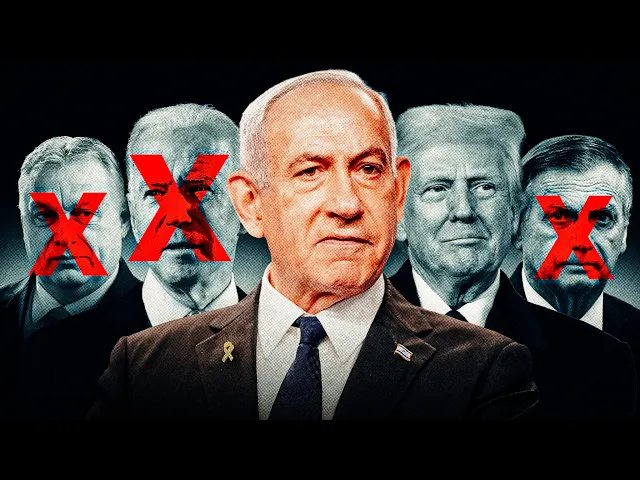
The world is turning on Israel
Max Fisher
0:00 So, there is this map that I want to show you.
0:04 This is actually from November 2011 when
0:06 the United Nations held a big vote about Palestine.
0:09 And we'll get to what that was in a second.
0:11 These are the countries that backed Israel in voting no.
0:14 And these countries abstained, which was basically the same thing.
0:17 What you are looking at here is the pro-Israel world as of 2011.
0:22 Mostly Western countries and small nations that depend on them.
0:25 These are the governments that arm Israel's military,
0:27 that support it diplomatically, that shield it from international pressure.
0:32 And to understand how far that support went,
0:35 it helps to look at what that 2011 UN vote of the map was actually for.
0:39 This is a UN agency called UNESCO.
0:42 That name stands for educational, scientific, and cultural organization.
0:45 And they do like events and educational grants.
0:47 It's all very benign and boring.
0:49 The Palestinian government asked to join it.
0:51 And from the UN's perspective, yeah, no big deal.
0:53 The UN resolution that established Israel back in 1947
0:56 also called for an independent Arab state in Palestine.
0:59 So according to the UN, Palestine is a state just as much as Israel.
1:03 It should be allowed to join this nice cultural agency.
1:06 But Israel opposed this because they did not want anything
1:09 anything that legitimized the idea of Palestine as a state.
1:14 And these 65 countries sided with Israel.
1:16 That's how far they went for them.
1:19 But that was 2011.
1:20 Check out what one of those blue countries is up to today.
1:24 This is Italy's prime minister, Georgia Maloney.
1:26 Italy has criticized Israeli attacks peacekeepers there.
1:29 In light of the current situation,
1:31 the government has decided to suspend the automatic
1:35 renewal of the defense agreement with Israel.
1:38 This is a huge pivot and this kind of thing has been happening a lot.
1:43 Israel's backers, that network of countries
1:44 that have been supporting it for decades,
1:46 they've been kind of turning on it one by one,
1:49 often in small ways, but it is adding up.
1:51 And today, we're going to look at what all of that is adding up to.
1:55 We're going to ask what this means for Israel
1:57 and what happens when the international support it's
2:00 long counted on to do everything that it does
2:03 starts to look like it could really go away.
2:09 So, I'm going to give away the ending slightly here and tell
2:12 you that Israel has actually been quietly preparing for years now,
2:15 a plan for what to do if and when
2:19 it loses the international support it relies on.
2:21 We'll also look at why this is happening now and what it means that it is.
2:26 But we'll begin by simply going through country
2:28 by country on the map what is changing here.
2:32 Starting early 2024, the height of Israel's war in Gaza.
2:38 Experts were calling it a genocide.
2:41 The International Criminal Court was preparing charges for war crimes.
2:44 And that April, the UN did what it does.
2:47 It held a symbolic non-binding vote.
2:49 This one on admission of new members that said in theory,
2:54 Palestine was qualified for membership.
2:56 In other words, to be recognized as a state.
2:58 The US had vetoed that though.
3:00 So all this actually changed was where the powerless
3:03 Palestinian representative was seated in the UN assembly room.
3:06 Still, this was a chance for countries to take a side and a lot of them
3:10 that had longsided with Israel used this vote
3:13 to signal that that was kind of over.
3:16 Look at that map again.
3:17 We're going to label all of the countries that went from voting
3:21 with Israel back in 2011 to voting against it in 2024.
3:24 Australia, New Zealand, important Western countries.
3:27 Japan and South Korea, major economies usually vote with the West.
3:30 A bunch of countries in Africa and the Caribbean that rely on Western support.
3:34 A few other big ones, but also, and this was a big deal,
3:37 a bunch of Europe, Denmark, Poland, Portugal, Estonia, plus a couple more.
3:43 So, look, Denmark and Poland, I know not exactly the biggest world powers,
3:48 but Europe collectively is Israel's biggest trading partner.
3:51 It's their biggest source of tourists.
3:53 It's their second biggest supplier of weapons after the United States.
3:57 Europe is what expands the pro-Israel sphere
4:00 from a niche American thing into a broad western coalition.
4:04 So any chip in that, it's a big deal.
4:08 And then 2026, the Iran war hits.
4:11 The US and Israel have launched strikes
4:13 and a major military operation targeting Iran.
4:16 The Ayatollah, the supreme leader of Iran, is dead.
4:18 For the first time in history,
4:20 Iranian officials say the country has closed the straight
4:23 of Hormuz following joint strikes from the US and Israel,
4:25 which didn't just defend sensibilities and values in Europe.
4:28 It really messed up their economies.
4:30 The country is facing widespread disruption as fuel protests
4:34 continue with major roads blocked and shortages beginning to emerge.
4:40 So, pretty soon you got stuff like this.
4:44 This is Belgium's foreign minister.
4:53 He is talking about trade sanctions on Israel.
4:55 The kind of thing you do to a hostile rogue state.
4:58 He even went on to say that Belgium would support a total EU boycott.
5:02 Here, let's zoom in on Europe because it's not just Belgium.
5:05 Spain, Ireland, and Slovenia are also calling for the EU to sanction Israel.
5:09 Ukraine threatened sanctions,
5:10 too over Israel importing grain from its Russian occupied territory.
5:14 Israel stopped the stolen grain import, but the threat is still hanging.
5:18 Also, remember we saw that Italy suspended a defense cooperation deal.
5:21 But the really big turn has been France.
5:24 France recently closed its airspace
5:26 to Israeli flights carrying weapon shipments.
5:28 It's a symbolic step, sure, but a big enough warning shot that Israel
5:33 in response halted all arms purchases from France.
5:36 This is a real loss for Israel.
5:38 French weapons make up a ton of Israel's imports.
5:40 Like check this out.
5:41 You can see it here.
5:43 This is the EU data for every European arm sale.
5:46 And if you look at the top arm sales to Israel, a ton of them are from France.
5:50 Like all the biggest ones.
5:52 You must wonder if Israel did this to preempt France from doing it first.
5:55 You know, you can't break up with me, I break up with you.
5:58 Anyway, the point is this is effectively
6:00 a quasi self-imposed French arms embargo on Israel,
6:03 which joins a Spanish arms embargo imposed a few months earlier.
6:07 So yeah, this is Europe on Israel today.
6:10 You can see it's a pretty meaningful pivot.
6:13 But now we got to talk about the US.
6:17 The time is now for us to end
6:21 all US military aid to the extremist Netanyahu government.
6:25 This is Senator Bernie Sanders recently introducing a resolution
6:29 that would block all US arm sales to Israel.
6:32 It did not pass, but it was closer than you might guess.
6:35 40 to 59.
6:36 On this vote, the yays are 40, the nays 59.
6:40 The motion is not agreed to.
6:42 And like the UN votes or the EU threats, this was about sending a signal.
6:47 40 US senators voted for an arms embargo.
6:49 That is a message that almost half of the American
6:53 political system is ready to really turn on Israel.
6:55 And that's not just a signal to Israel,
6:57 which, let's face it, seems unlikely to change behavior.
7:00 It's a signal to all of these other countries that that global
7:03 pro-Israel coalition is getting closer and closer to breaking apart.
7:08 So, it's time to ask why.
7:11 Why now?
7:11 The simplest explanation would be that this is all
7:14 in reaction to Gaza and to the Iran war.
7:17 But I think the truth is that those things are just catalysts
7:21 pushing along a change that's been building for a long time now.
7:24 This is a foreign policy article warning Israel that had lost Europe.
7:27 But what's interesting about this is that it's from 2012.
7:30 One of the things they were reacting to was
7:32 that 2011 UN vote we looked at before.
7:34 What looks to us now like it had been a big pro-Israel wave in Europe.
7:38 At the time it looked like Europe turning on Israel.
7:41 And this makes more sense if we rewind a few years more to 2008.
7:47 This is German leader Angala Merkel speaking to Israel's parliament.
7:51 And she said basically, we will support you forever because of the Holocaust.
8:02 But look, it's not just Holocaust guilt behind this.
8:05 There's a bunch of other stuff like this sense among democracies
8:08 worldwide that Israel was a like-minded
8:10 democracy surrounded by hostile dictatorships
8:12 and a sense after September 11 that Israel and the West
8:15 were on the same side in a global war on terror.
8:18 Plus, there was some cold war stuff in there before that.
8:21 Look, my point is that there was a lot going on in European support for Israel,
8:25 but it's all anchored to stuff that happened in the past.
8:31 1945, Arab-Israeli wars in' 6773,
8:34 invasion of the Golan Heights by Syria and Egypt,
8:37 2001, which means the further that those events drift into memory,
8:41 the less kind of cultural and political
8:43 scaffolding there is for that relationship to exist,
8:46 especially as Israel does more and more stuff in the present
8:49 that upsets or hurts or offends its international sponsors.
8:53 which is why support for Israel is strongest among older
8:56 people whose view of it is rooted in that past.
8:59 Like here, look at this.
9:01 This is Chuck Schumer, the Senate Democratic leader, speaking to Apac in 2018.
9:05 Of course, we say it's our land.
9:08 The Torah says it, but they don't believe in the Torah.
9:12 So, that's the reason there is not peace.
9:15 They invent other reasons, but they do not believe in a Jewish state.
9:21 And that is why we in America must
9:24 stand strong with Israel through thick and thin.
9:26 Schumer is obviously coming to this through a kind of Jewish ethnationalism.
9:30 That's why he specifically supports Israel.
9:33 But he's drawing on and for a long time got that support because
9:37 of a wider sense across Western countries that Israel is quote unquote like us.
9:42 But that feeling, that perception has been steadily eroding,
9:46 often slowly but steadily for as long as I
9:49 have been writing and reporting on Israel and Palestine.
9:52 Every year, people learn more about Israel's occupation,
9:55 the settlements, the treatment of Israeli Arabs.
9:58 And it gets harder and harder to recognize the Israel that we see with our eyes
10:03 to the Israel that we have been
10:05 told was this foothold of Western democratic values.
10:08 and big moments like Gaza or Iran tend
10:11 to generate a lot of attention that accelerates that shift.
10:16 This is a recent NBC poll of Americans by age.
10:20 The green bars measure positive views on Israel
10:22 and the yellow bars are negative views.
10:25 When NBC first ran this back in 2023,
10:28 older Americans had overwhelmingly positive views of Israel.
10:31 People my age were more mixed and younger
10:34 people were a bit more negative than positive.
10:36 Fast forward to today.
10:37 Young Americans have turned on Israel 5 to one.
10:41 My generation, it's 2:1 negative on Israel.
10:43 Older adults are almost split and only the oldest are like solidly pro-Israel.
10:48 That is how you get 40 US senators voting for an arms embargo on a country
10:53 that not that long ago they'd have all
10:56 felt obligated to pledge their undying support to.
10:58 Public opinion has shifted really quickly.
11:00 That is part of why you see this world
11:02 governments that had always supported Israel suddenly starting to pivot.
11:06 But there are some big holdouts, especially Germany, the UK, and the US.
11:11 Things are changing within each of those countries
11:13 like we talked about in the US.
11:15 But their leaders are resisting pressure to break with Israel.
11:18 I know it might feel difficult to imagine
11:20 a real meaningful Western break with Israel,
11:22 but you know, relative to just 10 or 15 years ago,
11:25 which is not that long in geopolitical terms, it is already sort of happening
11:29 in ways that recently would have felt impossible.
11:31 Hey guys, just wanted to quickly pause to say
11:33 if you want to learn more about Israel, why it is the way it is,
11:36 what it's doing, its place in the world,
11:39 all of that, head to newress.com/quests for an exclusive video.
11:43 It's part of a series I'm doing called No Dumb Questions,
11:47 where I answer big questions about the world.
11:49 And in this week's, we answer why the US supports Israel,
11:52 how Israel was created, and more.
11:54 So, what is New Press?
11:55 New Press is a hub for independent video
11:58 journalism that I'm building with my teammates Johnny Harris,
12:00 Sam Ellis, and Kristoff Hoerson.
12:02 It's free to sign up and you get loads of stuff like behind the scenes content,
12:06 early and adree videos, chats with us,
12:09 and that exclusive video series I mentioned.
12:11 No dumb questions.
12:12 Again, free to sign up.
12:15 Newress.com/quests or the QR code.
12:17 Okay, back to the video.
12:19 And Israeli leaders know this, which is why they have a whole plan
12:22 to prepare for the day that the West breaks with them for real.
12:25 I actually did a bunch of reporting on this plan a few years ago,
12:29 and what I found is that Israel had quietly
12:31 achieved a real degree of autonomy from the US.
12:34 This had a few components.
12:35 It made peace with a bunch of the countries it
12:37 used to need American protection from, like Egypt and Saudi Arabia.
12:41 It learned how to build big weapon systems domestically.
12:44 So while yeah, it's happy to take American and European exports,
12:48 it can replace a lot of them if needed.
12:51 Israeli voters have also embraced more hardline nationalism.
12:54 So they no longer really pressure their leaders
12:56 to keep foreign powers happy the way they used to.
12:59 And in some ways they even want their leaders
13:02 to defy those foreign powers by doing things like expanding settlements.
13:04 And look, yes, it is still true that Israel has
13:08 a ton to gain from American and European weapons funding and support.
13:11 Those play a big role at empowering Israel's war.
13:15 My point is that Israel has built up its autonomy so
13:18 that holding on to that support is no longer existential for them,
13:21 which frees them up to defy those countries, even the United States,
13:24 which is how you get moments like Trump
13:26 last year tweeting at Israel to not bomb Iran, which of course they still did.
13:30 Or this year, Trump tweeting at Israel
13:32 that it was prohibited from bombing Lebanon,
13:34 which you guessed it, they immediately did anyway.
13:37 But I mentioned at the start of this video that Israel's plan
13:40 to survive a breakup with the West is only sort of working.
13:43 One component in particular, I wrote about it back in that article,
13:47 and it's that Israel has been cultivating new allies,
13:49 right-wing illiberal democracies that actually admire the very actions
13:53 that had been pushing away its more traditional allies.
13:56 An Israeli analyst named Dog Shimlet,
13:58 who told me about this, called it kind of mockingly the other friends policy.
14:02 Let me show you on that map.
14:04 The big ones are India, Brazil, and Hungary, plus a couple others.
14:09 Countries whose leaders aren't drawn to Israel because of the past,
14:12 but because of what it is today,
14:14 as a symbol of unapologetic militarism and ethnationalism.
14:17 And this worked pretty well for a while.
14:20 Hungary especially was Israel's best friend in the EU,
14:22 vetoing all sorts of trade restrictions
14:24 or sanctions that Europe might have otherwise imposed.
14:27 But after a couple years, it kind of started to fall apart.
14:32 Israel's buddy in Brazil lost re-election and got
14:34 sentenced to jail time for a failed coup attempt.
14:37 And it's Ali in Hungary lost power too,
14:38 actually just a few weeks into the Iran war.
14:40 And the new guy in power there has already said his government
14:43 would arrest Netanyahu on war crimes charges if he visited Hungary.
14:47 Better look at that map again.
14:49 Brazil out, Hungary out.
14:51 H that Israeli diplomatic resurgence is looking pretty shortlived.
14:54 So what does all this mean?
14:56 Look, when I started reporting on Israel and its
14:59 place in the world back in 2010 or 2011,
15:02 it was honestly unthinkable to me that the Western pro-Israel world
15:05 would ever equil to it to the extent that it already has.
15:08 And I know that to a lot of you, especially if you're on the younger side,
15:13 that probably sounds crazy because if you look around you,
15:16 it looks like the West supports Israel as unreservedly as it ever has.
15:20 You know, the US just started an entire open-ended global
15:23 economy destroying war with Iran basically as a favor to Israel.
15:27 Western weapons are funding Israel's wars in Gaza and Lebanon.
15:30 I'm not blind.
15:31 I see all this.
15:32 But I am telling you, if you take a step back,
15:34 if you look at the bigger picture, the kind of longer timeline here,
15:38 that support is starting to look kind of tenuous.
15:41 We are not talking about a wide
15:43 and deep pro-Israel consensus across the Western world anymore.
15:46 We are talking about a handful of countries
15:49 that are increasingly isolated in backing Israel,
15:51 led by leaders who are acting in defiance of their publics,
15:55 their political parties, even their own core supporters.
15:57 I'm sure you've heard that Hemingway quote,
15:59 change happens slowly and then all at once.
16:01 We are in the happen slowly part right now,
16:03 but it feels like that all at once is coming up fast.
16:07 We might look back 5 10 years from now and feel
16:10 that actually it was as of this moment that it was already here.