How dark matter and dark energy shape the cosmos | Janna Levin
The Well
0:10 It's such a pleasure to be here tonight.
0:12 I wonder how many of you reflected on this phenomenon,
0:18 which is that everything anyone has ever seen or ever will see
0:25 makes up less than 5% of what is out there in the universe.
0:29 All the people, all the faces, all the mountains, the moon, the stars,
0:34 the galaxies, supernova, all of it, anything we've ever seen, less than 5%.
0:40 The rest is in a form of dark matter and dark energy as yet unknown.
0:45 And the dark phrasing, the terminology is a misnomer.
0:49 The dark energy is in this room right now.
0:53 It fills the room.
0:55 The dark matter is coursing through you right now.
1:00 It's not dark.
1:01 They're not dark, they're invisible.
1:05 And I wonder, I know people have
1:06 thought about this and maybe you've wondered yourself,
1:08 what is all this dark stuff?
1:10 What does it, where does it come from?
1:12 What is it?
1:12 Or, or maybe you study astrophysics
1:14 and you actually build detectors deep in minds,
1:19 and you wait patiently for years for one
1:23 dark matter particle to strike your detector,
1:27 then decades, despite its abundance, the dark matter has never revealed itself.
1:35 Now, it could be that it never will,
1:41 that we'll never be able to identify exactly what it is.
1:45 But maybe you've also reflected on this strange
1:48 disparity between us and this dark universe.
1:51 Or maybe you've never heard of it before.
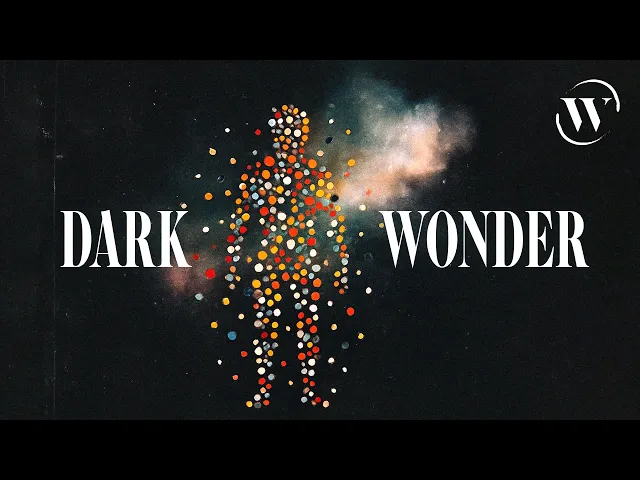
1:53 I don't know, maybe this is your first time, but imagine us as a collection
1:59 of confetti that's tossed amongst this impassive void.
2:03 Sparkling.
2:03 Because we are luminous and yet to the dark matter,
2:08 we are as invisible to the dark sector as a dark sector is to us.
2:14 So if you consider the visible universe, you can see your hand because the atoms
2:19 in your body scatter light and your eyes absorb that light,
2:23 and that light triggers an electrical impulse along nerve endings.
2:27 And, and that ignites in your mind an image this quaia of the visual world.
2:32 And you can feel your fingertips be because atoms interact
2:36 and, and you can smell and you can taste because of chemical interactions.
2:42 And your heartbeat is in fact
2:45 regulated by electrical impulses from specialized cells.
2:50 And this is the world, right?
2:52 This is the world that we know.
2:54 This is the visual world.
2:55 It's electrical, it's magnetic, it's the world of atoms and of light.
3:01 But it's not just our microcosm.
3:04 This is the same material that burns in stars,
3:08 the same light that shines from stars.
3:11 It's the same matter that's lingering from the big bang.
3:15 That is everything that everyone has ever seen and ever will see.
3:22 But if we spiral out to the large scale,
3:26 then we're in the domain of the dark matter and the dark energy.
3:30 The astronomer, Edwin Hubble,
3:32 working not that far from here at Mount Wilson Observatory,
3:35 at what was the largest telescope at the time, made this remarkable discovery.
3:40 He realized that this collection of stars, this spiral, Milky Way,
3:45 which is what we call our own galaxy, was not the only one.
3:50 He was the first person in the 1920s to observe another galaxy.
3:55 Tremendous observation.
3:57 When Einstein was working, he did not know there were other galaxies out there.
4:01 And as Hubble is looking at these other galaxies that he's discovered,
4:05 these collections of hundreds of billions of stars,
4:08 he observes that the space between the galaxies is stretching.
4:14 It's just an incredible observation.
4:16 The space between the galaxies is stretching.
4:20 This was predicted as a consequence of the Big Bang.
4:25 Now, it was thought the universe would come out
4:27 of the Big Bang space stretching in all directions.
4:30 There's no galaxies yet.
4:32 It's the early universe.
4:33 And over the course of time,
4:35 galaxies would form the world would unfold in the way that we've seen it.
4:38 But this expansion would have to slow down.
4:41 It would ebb.
4:42 Now, many years after Hubble, the famed satellite, Hubble space telescope,
4:49 named in his honor, observed that the universe abounds with galaxies.
4:56 There's not just a splattering of galaxies in our little neighborhood.
4:59 There are as many galaxies in the observable universe
5:04 as there are stars in our own milky way.
5:07 That's hundreds of billions.
5:11 And then there were other observations that pushed even further
5:14 and realized that this expansion between the galaxies isn't slowing.
5:19 In fact, it seems to be getting ever faster as though
5:24 something was driving the universe on to continue to expand.
5:29 Now, astronomers retrofitting the data,
5:32 tried to take the measure of this invisible source that seemed to have
5:37 this peculiar pressure on space time driving it to expand ever faster.
5:42 And the best that they could ascertain was that there was an unknown,
5:47 unidentified unseen form of energy implicated,
5:52 and yet no specific culprit could be identified.
5:56 And so it was dubbed enigmatically the dark energy.
6:01 And this energy permeates all of space.
6:04 We don't know what it is.
6:05 It might literally be the energy of empty space.
6:11 We don't know.
6:12 But we do know that that dark
6:14 energy doesn't shine and it doesn't interact directly.
6:18 Adams cos through it unimpeded and oblivious.
6:23 Now, the dark matter behaves differently.
6:27 It, it collects on these unseen, these invisible filaments.
6:31 And in the early universe, it creates these kinds of seeds,
6:35 these these depressions and and wells into which
6:39 ordinary matter collects forming galaxies and clusters of galaxies
6:45 and the dark matter pools on these vast
6:48 and translucent halos that surround these galaxies yet unseen.
6:54 And the dark matter also doesn't shine
6:56 and even clustered together right around galaxies.
7:00 It does not collide with atoms.
7:02 The atoms stream through it and the dark matter through the atoms,
7:06 again, totally unimpeded and again, oblivious essentially.
7:13 Now these star components are extremely significant in the story of our history.
7:19 Because on these vast cosmological scales,
7:22 they dominate the evolution and structure
7:24 of the universe across billions of light years.
7:29 And the luminous universe that we see with all of our instruments,
7:33 all of our detectors with the naked eye.
7:35 When we walk out at night in a rare dark, not foggy, not polluted evening,
7:41 what we're seeing is the luminous
7:46 universe suspended from this unseen architecture.
7:52 Now spiraling back in, you are submersed in a static ocean of dark energy.
8:00 And there are rainstorms of dark matter in every room you occupy.
8:04 At the moment, millions of dark matter particles are coursing
8:08 through you at hundreds or even thousands of kilometers per second.
8:12 Our entire solar system moves together and orbits around the Milky Way.
8:18 There's a super massive black hole at the center of our galaxy.
8:20 We very, very slowly orbit it.
8:22 And as we orbit this super massive black hole in this vast galaxy,
8:27 we are streaming ourselves through this dark matter halo.
8:31 We tend to be going in the direction of the constellation sickness.
8:35 If that's of interest to you.
8:36 When you look up at night, you will see the dark matter.
8:38 Well, we don't technically see it.
8:40 The dark matter streams through us as we move through this dark halo.
8:45 And we don't know how complicated that dark sector is.
8:50 We don't know if there are dark forces, entire dark laws of physics.
8:54 Maybe there are dark stars and dark planets and maybe there's dark creatures.
9:00 We don't know how complicated this dark sector is.
9:03 There could be a dark creature occupying the same space as you,
9:07 like a shadow haunting you or you him,
9:11 although that last part is really just completely science fiction.
9:13 That's completely unfair.
9:14 But you get the idea.
9:15 We don't know how complicated or how simple it is.
9:19 It could have eddies and turbulences.
9:21 There could be a storm around us.
9:22 If we could turn on some ability to see the dark matter,
9:25 we might be seeing a tornado or a storm that is happening around us,
9:31 that, that that of which we are unaware.
9:34 Now regardless, we simply factually have to accept
9:40 that we are not everything and we're not even much.
9:45 And with that astronomical perspective comes a shift.
9:49 And I know some people will express a, a sense of dread or you know,
9:54 a existential terror that comes with these kinds of realizations,
9:58 dizzying realizations.
9:59 For me, it gives me a great sense of being part
10:03 of a grander story of connecting all the way back to the Big bang.
10:07 And, and at least for a moment,
10:10 having a sense of quieting the thoughts and, and understanding
10:15 some perspective on our obsessiveness over our everyday concerns,
10:20 at least for a moment.
10:22 So let's enjoy the humility of the astronomical perspective for a second.
10:26 Now we can soak that in there.
10:29 This reminds me, a lot of people like
10:33 to indulge in the sense of our inconsequentially.
10:37 You know, in the sense of our insignificance,
10:40 especially when taking an astronomical view.
10:42 There's a great cartoon from the New Yorker of a guy standing
10:46 on the edge of the world and there's a view like this behind him.
10:49 And his companion is running to take his photo and he says,
10:53 make sure you can see how insignificant I am.
10:57 I love that cartoon.
10:59 So I want you to imagine as you are soaking up your insignificance,
11:04 when you are considering yourself against the stage of the known world,
11:08 with its trillions of galaxies and its trillions of stars,
11:12 to imagine the next time you admire a starry sky,
11:15 that that saturated abyss in the background is most everything.
11:22 And for just a moment, I feel we need a Rumi quote to save us.
11:33 From this moment, I have an aphorism
11:36 from the great 13th century Persian poet Rumi.
11:40 He said, you are not a drop in the ocean.
11:43 You are the entire ocean in a drop.
11:48 It's a beautiful quote, and I think it's very appropriate.
11:52 Here you are the glowing, luminous exception in a universe of darkness.
12:00 You are an arrangement of agnostic atoms,
12:04 forged and stars that can only act and react exactly as prescribed.
12:10 Yet you contain multitudes.
12:13 You are the history of the collisions in the universe,
12:17 the the explosions from stars that threw matter back out
12:21 into the universe to form into the planets and your body.
12:26 You are evidence of the entire universe grinding into being.
12:32 You hold in your hand a fistful of the ocean,
12:36 of dark energy streams, of storms of dark matter.
12:41 You are a droplet precipitated from the 5%
12:45 of that gooey residue left over from the Big Bang.
12:49 And you're briefly aware and you're briefly illuminated.
12:53 So you are not a drop in the ocean.
12:55 You are the entire ocean in a drop.
12:58 Thank you.