Every Metro System Should be this Beautiful
Not Just Bikes
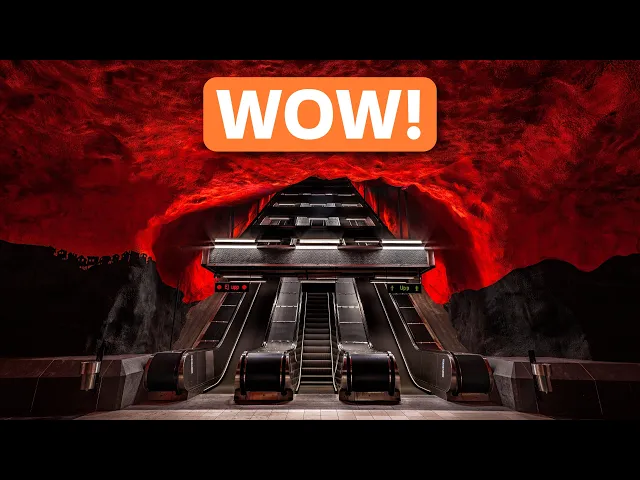
0:00 This is a metro station in Stockholm.
0:02 And this is another one along the same metro line.
0:05 There are dozens of stations here that are creatively decorated.
0:09 Which is why Stockholm refers to their metro
0:12 as “the world’s longest art exhibition”.
0:14 I had seen articles and photos of the Stockholm metro before,
0:17 but I figured these images were photoshopped to make
0:20 them look more interesting than they really are.
0:23 But no, they really do look this cool in person.
0:26 So let me show you what I saw while
0:29 visiting one of the world’s most beautiful metro systems.
0:36 [NJB Intro] A very, very quick announcement:
0:40 I have a new show on Nebula called Day Pass.
0:43 It’s a travel show where I take you around a different city each episode,
0:47 while also riding as much public transit as possible.
0:49 Check out the link in the description
0:51 or stick around ‘til the end to learn more.
0:55 I was in Stockholm for a few days before Christmas.
0:58 So while I was in town, I wanted to explore the city and to see what
1:02 improvements had been made since the last time I was here,
1:06 almost twenty years ago.
1:07 Unfortunately in late December there aren’t a lot of hours of daylight,
1:10 so I didn’t spend much time filming outside.
1:13 Although it was nice to visit when the Christmas lights were out.
1:17 Fortunately, one of the best things to see in Stockholm is underground,
1:21 so I could film the metro at any time of the day.
1:25 And I was seriously impressed.
1:27 I started my travels by following this list
1:30 of “beautiful stations” on the Visit Stockholm website.
1:34 I had seen articles about the art on the Stockholm metro before,
1:37 and there were always about a dozen stations featured,
1:40 so I figured that these were the only nice ones.
1:44 But the reality is that 90% of stations
1:46 on the metro system have some kind of sculptures,
1:50 paintings, light installations, tile mosaics, or other kinds of artwork.
1:55 I am not exactly sure what criteria was
1:58 used to decide on this particular list of stations,
2:00 perhaps some of the artists were more famous than others,
2:03 but I visited over two dozen metro stations while I was in Stockholm and many
2:08 of these were just as beautiful as the ones on the Visit Stockholm website.
2:14 With that being said, about half of the stations on the metro are outdoors
2:18 and these are much less impressive than the underground stations.
2:23 There might be a few interesting sculptures like this one,
2:26 but they’re otherwise pretty utilitarian.
2:28 Unless you consider this highway to be a work of art.
2:34 Dystopian art, maybe?
2:35 The large-scale immersive artwork mostly started in the 1970s,
2:40 so any stations built before that date
2:42 are much less impressive than later stations.
2:45 In practice that means that the most
2:47 interesting stations are along the blue line,
2:50 which first opened in 1975, or any of the newer stations along the green line.
2:56 This also means that there can be a big
2:58 difference between the different platforms at transfer stations.
3:01 For example, I was originally pretty disappointed
3:04 when I first got to T-Centralen station,
3:07 which is on the list of “beautiful stations”.
3:10 The tiles are nice enough, but it’s not a very impressive station.
3:14 The next time I arrived here, I was brought to this platform,
3:17 which has some much nicer tile designs.
3:19 And of course, as soon as I transferred to the blue line
3:23 platform it was immediately obvious why this station was on the list.
3:27 This is probably the most photographed station in Stockholm,
3:30 and it’s the one that immediately comes up
3:33 when you do an image search for “Stockholm metro”.
3:36 Probably because it’s the one that’s directly connected
3:38 to the main train station and commuter rail station.
3:42 These huge blue and white patterns look even larger and more impressive
3:46 in person than they do in photographs
3:48 because they span across the entire station.
3:51 There’s an exit here to the main train station,
3:54 As well as the Stockholm City commuter rail station.
3:58 Another often-photographed station is Stadion,
4:01 with these colourful rainbow paintings covering every wall and ceiling.
4:05 These stations feel very spacious when you’re there in person,
4:09 like you’re in a giant cave.
4:11 And I guess that’s because… you are in a giant cave,
4:14 made of granite and bedrock.
4:16 Many of the stations along the blue and green lines look like this where
4:21 the walls and ceilings were left
4:23 unfinished and then covered in sprayable concrete,
4:26 sometimes called Shotcrete, before being painted.
4:29 Which gives this amazing cavernous look
4:32 and makes every station feel very spacious.
4:35 A great example of this is Solna Centrum,
4:37 which is very often photographed to look like you’re in some kind of evil cave.
4:42 But when you visit in person there are so many
4:45 small details that don’t come through in those viral photos,
4:48 like these silhouettes of little houses.
4:50 And there also lots of splashes of colour throughout,
4:53 As well as this bizarre little diorama of a town with a flying tram.
4:58 The rest of the station has all kind of strange artwork,
5:02 And lots of green trees throughout.
5:04 There are other stations like Näckrosen that are smaller,
5:08 but the open ceilings still make the station feel very spacious.
5:12 I also loved the escalator lights at this station.
5:15 One of the things that pleasantly surprised me was just
5:18 how many small details there were at many of these stations.
5:22 You could pass through here dozens of times and still find new things.
5:27 There’s often a deeper story that the artist
5:29 had in mind when designing each station,
5:31 so if you’re interested in learning more,
5:33 you can book a guided tour of the metro system to get that context.
5:38 But it’s also perfectly reasonable to do as I did:
5:41 buy a day pass and visit stations from a list,
5:44 or really even just ride the metro
5:46 and get out at any station that looks interesting.
5:49 I found it to be trivially easy to travel around
5:52 from station to station because the trains arrive very, very frequently.
5:56 I have filmed a lot of metro stations for this channel,
5:59 and I always prefer to wait for a train to arrive or depart,
6:03 as the video looks much more interesting with some movement.
6:06 In some cities I’ve needed to wait a long time to get the right shot,
6:11 but in Stockholm, trains arrived so frequently that this was never a problem.
6:15 And when I was filming this platform at Odenplan
6:18 the trains were arriving and departing every few minutes,
6:22 so not only was it trivially easy to get a shot with a train in motion,
6:26 I also got several shots with two trains arriving or departing at the same time!
6:31 This platform has a display case with rotating
6:34 artwork displays by recent art school graduates.
6:37 This actually takes up a surprising amount of room on this narrow platform,
6:41 But I guess it’s sandwiched between these creepy stairways
6:44 to nowhere so the space wasn’t really being used anyway.
6:47 This was one of the stations that made the list but not for the metro station,
6:52 But rather as Citybanan– Odenplan,
6:55 the newer commuter rail station connected to the metro station.
6:59 The Citybanan is a commuter rail tunnel under
7:01 the centre of Stockholm that opened in 2017.
7:04 This was built to allow faster commuter train travel through the city,
7:09 and to free up railway capacity on the surface
7:12 so that more intercity trains could operate.
7:14 The platform of Odenplan station has a spacious and modern design But the most
7:20 interesting part is the escalator with these neon
7:23 lights that span across the ceiling.
7:25 The other Citybanan station is Stockholm city,
7:29 Which is connected to the main train station through
7:32 this tunnel with these crazy shapes on the roof.
7:34 A lot of the art in the Stockholm metro is made with tiles,
7:38 and it’s common to see stations built in the 1950s that have tiles on the wall.
7:43 These are very reminiscent of tile designs
7:46 in the older stations in the Toronto subway as well.
7:49 Because tiles were very popular in metro stations built in the 1950s and 60s,
7:55 Which is why tiles like these are often just called “subway tiles.” So
8:00 that tile theme is commonly used in the art in new metro stations in Stockholm.
8:05 Like this wall in Odenplan station.
8:08 Made up of thousands of small square tiles.
8:11 There are similar mosaics in other stations,
8:13 like in this tunnel between the main
8:15 train station and T-Centralen metro station.
8:17 Also, I just need to mention that I love
8:21 the signage in the Stockholm train station This clean
8:24 white and yellow design looks really great And a lot
8:28 of thought was put into making the wayfinding clear,
8:31 so it's very easy to find your way through this station as a result.
8:35 It was also really nice to see the station decorated for Christmas.
8:39 In contrast, Hötorget station, apologies for my bad Swedish pronunciation,
8:44 really leans into the 1950s subway tile aesthetic by re-creating
8:48 the original look of the station as it was built in 1952.
8:52 Including the original typeface and signage that was used at the time.
8:57 These red garbage bins are not original,
9:00 but were redesigned from photos of the original
9:03 station when the station was renovated in 1997.
9:07 They also installed these neon lights on the ceiling which aren’t original,
9:10 but I think they complement the rest of the 1950s station pretty well.
9:15 Another “tile artwork” station is Thorildsplan that uses
9:19 subway tiles like the pixels in pixel art.
9:22 There are characters inspired by Pac-Man,
9:24 Super Mario Brothers, and many other classic video games.
9:28 Isn’t this great?
9:29 I’ve taken so many commutes by public transit in my life,
9:32 and they would’ve been so much more joyful if
9:35 the walls of my station were decorated like this.
9:39 At Rinkeby station, subway tiles were used to create these detailed mosaics,
9:43 that are visible at several locations throughout the station.
9:47 Another station that did the “subway tiles” theme well was Västra skogen,
9:51 where the whole station is filled with all
9:54 kinds of wacky colourful artwork made from subway tiles.
9:57 The colourful tiles contrast well with the grey rock background.
10:01 For what it’s worth,
10:03 this station wasn’t included in the list on the Visit Stockholm website.
10:06 The last few stations that were on the list include Solna Strand.
10:10 This station has sky cubes sunken into the walls, ceiling,
10:13 and platform, and it was designed by Japanese sculptor Takashi Naraha.
10:17 It’s pretty neat but I found this station
10:20 to be much less interesting than many of the others,
10:23 so I assume it made the list mostly
10:25 because it was designed by a famous foreign artist.
10:29 Or maybe I just don’t understand good art.
10:32 Another station that I found underwhelming was Bagarmossen.
10:36 The only interesting features I saw were these coloured glass panels.
10:40 I’m probably missing something here.
10:42 I was able to get a shot with two trains moving at the same time though,
10:48 so that's something.
10:50 I really enjoyed Hallonbergen station though.
10:52 The white walls covered in children’s drawings made the station feel so joyful.
10:57 This just makes it so much nicer to wait for a train here.
11:02 Östermalmstorg station also has wacky line drawings,
11:06 as well as musical phrases on the themes of peace,
11:09 the fight for women’s rights, and environmental protection.
11:11 This art was created by covering the station in a dark layer of stone,
11:16 then a layer of concrete.
11:18 The illustrations were then projected onto the walls and the concrete
11:22 was sand-blasted away to show the dark stone underneath.
11:25 Pretty cool!
11:26 Tekniska Högskolan station has these really interesting formations
11:30 that look like they’re carved into the rock.
11:33 And these bizarre shapes, And crazy paintings.
11:37 And then one station further along the line is Universitetet,
11:41 which is covered in scientific drawings featuring
11:44 the work of the 18th-century Swedish biologist Carl Linnaeus,
11:47 as well as excerpts from the UN Declaration of Universal Human Rights.
11:53 I liked this, but as a typography nerd,
11:56 using a zero in place of “O” on these tiles was triggering.
12:01 I was also glad to see that artwork wasn’t
12:03 only installed in the busiest stations in the city centre,
12:06 but also at suburban stations.
12:09 Like here at Mörby Centrum, which is at the very end of the red line.
12:14 And it also has very cool lights
12:16 on the escalators Speaking of the end of the line,
12:19 at any stations where trains could leave from more than one platform,
12:22 there are these speakers on the ceiling that make
12:25 a ticking noise on whatever side the train is leaving next.
12:32 And the faster the ticking sound, the sooner the train will depart.
12:39 These were installed to help people with visual impairments,
12:42 but like most accessibility improvements,
12:44 they help everyone else too, as long as you know what to listen for.
12:53 A station I regularly found myself at was Fridhemsplan,
12:57 because it’s the main transfer point between the blue and green lines.
13:01 The green line platforms are yellow, with the shotcrete ceiling and all kinds
13:06 of different artwork displayed along the walls.
13:09 And the transfer to the blue line
13:11 really makes it feel like you’re deep underground.
13:14 There’s also a tunnel to transfer to the bus station,
13:17 along with a departure board.
13:18 I thought at first that this thing on the ceiling
13:21 was a net to catch falling rocks or something,
13:23 But on closer inspection it was part of the artwork as well.
13:27 The blue line platform has a nautical theme,
13:30 With ship models, And this compass on the wall.
13:33 As well as lots of other random displays.
13:37 Bizarre.
13:37 I also enjoyed these childlike paintings along the platform.
13:41 I have no idea why this station didn’t make the list,
13:45 as I found it to be more interesting than most.
13:48 But one station that did make the list,
13:50 and wins the award for the most unhinged artwork,
13:53 is Kungsträdgården, at the south end of the blue line.
13:57 When I stepped off, I thought it looked pretty similar
13:59 to the other stations I had seen along the blue line.
14:02 Just with these candy-cane like stripes across the platforms.
14:05 And the occasional gargoyle head.
14:08 It was also interesting to see that they have what looks like bare natural rock,
14:11 without a concrete covering.
14:13 The more I walked through this station the crazier it got though,
14:17 with bizarre statues and random art.
14:20 Some of these stone pieces are apparently the actual ruins
14:23 of the 17th century royal palace that used to be located nearby,
14:27 but burned down and was demolished in the 1800s.
14:31 Where do you think this door goes?
14:32 I couldn’t manage to get it open.
14:35 I was actually getting off at this station and as I was going up
14:38 the escalator I noticed that this is one
14:40 of the stations with this crazy diagonal elevator.
14:43 There are a few stations that have cool elevators like
14:46 this that run alongside the escalator and they move crazy-fast.
14:49 I like these.
14:50 But what I really appreciated is how the entrance to this station
14:55 was on a car-free street with a bike path running through it.
14:58 Pretty nice!
15:00 Incidentally, I filmed this scene at four in the afternoon
15:03 and it was already this dark, so yeah,
15:06 I’ll be coming back in summer if I want to make
15:09 a video about any of the stuff on the surface.
15:11 Anybody who watches this channel regularly knows that I really really hate it
15:16 when a metro exit drops you off at the side of a busy road.
15:20 The area around a rapid transit stop is some
15:22 of the most valuable land in the entire city,
15:26 so it shouldn’t be wasted on car infrastructure.
15:29 So I was very happy to see that Stockholm does a pretty good
15:33 job of ensuring that the exits to their metro system are pedestrian friendly.
15:37 With many exits bringing metro riders
15:39 directly to pedestrianised or low-car streets.
15:42 And this was the case even at many of the suburban stations visited,
15:47 such as here at Tensta.
15:49 This station brings metro riders directly to a pedestrianised square,
15:53 even though it's a very suburban station.
15:57 Tensta also had some great artwork.
15:59 The artist clearly leaned into the “cave” idea
16:02 and put neolithic-inspired cave drawings all over the walls.
16:07 And what looks like somebody’s school notes with doodles on it.
16:10 I can relate.
16:12 It is just so wonderful to ride a transit system where so much care
16:18 and thought has been put into making
16:20 the experience pleasant and enjoyable for transit riders.
16:23 Obviously it helps that the Stockholm metro is quite extensive,
16:27 And that the trains arrive with regular frequency,
16:30 But there’s something to be said about travelling
16:33 through beautiful places as you ride the metro.
16:37 There’s also value in bringing art to the general public,
16:40 to people who may never consider going to an art gallery,
16:43 but who will ride the metro on a regular basis.
16:47 One of the unexpected benefits of station artwork
16:50 is that each station gets its own identity,
16:53 and that changes the way you think about it and remember it.
16:57 There is evidence to suggest that these unique
16:59 stations make the transit system easier to navigate,
17:02 as people can more easily build a mental
17:04 map of where they are and where they’re going,
17:07 compared to a metro system where all stations look essentially the same.
17:12 It really does feel different riding the metro in Stockholm,
17:15 compared to most other cities,
17:17 but you might be wondering about the cost of all this.
17:20 How can Stockholm afford to make their metro system so
17:23 beautiful while other cities are struggling to build even ugly,
17:27 utilitarian transit?
17:28 Well, I did some research on that, and it’s actually really interesting,
17:32 as it starts to show the absurdity of the typical lowest-bidder
17:36 public transit mentality that is prevalent in so many other cities.
17:41 For example, I read that the “unfinished” look of a station like this actually
17:44 cost the government less than if they
17:47 had produced a typical “finished” metro station instead,
17:50 because those finishings are more expensive than the art.
17:54 Though apparently this “raw” design does have
17:56 higher maintenance costs for things like moisture control.
17:59 And the transit operator needs to pay to maintain the art,
18:02 which varies each year depending on what work needs to be done,
18:05 but is typically between 10-15 million Swedish kroner annually,
18:09 or about 1 to 1.5 million euros per year.
18:12 But the metro operator has also said
18:15 that the artwork discourages vandalism and graffiti,
18:17 which is a major cost for public transit operators,
18:21 and while it doesn't totally offset the cost of the art,
18:24 it does reduce what they would pay in overall maintenance.
18:28 Of course, another reason why Stockholm
18:30 can afford to provide these beautiful stations is because their metro and rail
18:34 construction costs have been historically quite low,
18:37 especially compared to other European cities.
18:40 A big part of the reason for that is
18:42 that Stockholm has relied heavily on experts within the public sector,
18:46 instead of farming everything out
18:47 to private sector contractors and public-private partnerships.
18:51 Unfortunately neoliberal politicians within
18:53 the Swedish government have been pushing
18:55 to reduce the role of the government in future projects,
18:58 which will likely have the same effect that it has had in other countries:
19:02 funneling lots of tax dollars into private sector profits,
19:05 instead of providing more value to the public.
19:08 I’ll put a link to this report in the description if you’d like to learn more.
19:13 Regardless of costs though, this artwork has real benefits.
19:16 It makes it clear to everyone that the government cares about public transit,
19:20 and treats public transit riders like first-class citizens.
19:24 And when that happens, people are more likely to want to take public transit.
19:29 They will also have a sense of civic pride about their transit system,
19:33 and will want it to be successful.
19:35 And that can only be a good thing,
19:38 especially for public support for future transit projects.
19:41 Stockholm is currently constructing 18 new stations,
19:44 the largest expansion to the metro system in 50 years.
19:49 And, of course, these new stations will have new artwork as well.
19:52 When constructing new stations,
19:54 the Stockholm region budgets about 1% of the total
19:57 cost of the station to go to artwork,
19:59 which is expected to work out to about 10 million kroner,
20:02 or about 1 million Euro per station.
20:05 Honestly, given the societal benefits alone, that seems like a great deal.
20:10 And it makes for a metro system that feels
20:13 inviting and one that people actually want to use.
20:16 Which should be the ultimate goal of any transit system.
20:20 I know whenever I visit a new city,
20:22 one of the first things I like to do is explore the transit system.
20:26 Riding public transit gives you an authentic view of the city,
20:30 and helps you better understand what life is like for the people who live there.
20:34 If you feel the same, and let’s face it,
20:36 if you’ve made it this far through the video you almost certainly do,
20:38 then let me tell you about my new Nebula show, Day Pass.
20:42 Day Pass is a travel show where I take you
20:45 around a city to see interesting urbanist and cultural locations,
20:48 while also riding as much public transit as possible.
20:51 The first episode is available right now on Nebula,
20:55 and I start the series in the most suitable place possible:
20:59 Nantes, in France, the city that had the world’s first public transit route.
21:05 You can watch the first episode of Day Pass right now
21:08 in the Nebula app on your phone or TV or by going to nebula.tv/daypass.
21:13 If you’re not familiar with Nebula,
21:16 it’s a subscription streaming service that’s owned and operated by creators,
21:20 not venture capitalists, private equity, or big tech.
21:23 Which is why Nebula can afford to support creators and to give
21:27 them a platform to make the videos they want to make.
21:30 When you sign up to Nebula, you not only support this channel and get
21:33 early access to all of my future videos, you also get access to thousands
21:37 of videos from over 250 other talented creators.
21:40 All without any ads or sponsorships.
21:43 You’ll also get access to Nebula Originals,
21:46 which includes unique shows like Day Pass,
21:48 but also documentary films and many other
21:51 videos that are only available on Nebula.
21:53 It’s amazing what can be accomplished when you cut big tech out of the picture.
21:58 Nebula also has gift cards,
22:00 and my Dutch viewers will be glad to know you can buy them with iDEAL.
22:03 You can even send one to yourself if you
22:05 just want to try Nebula without using a credit card.
22:08 So if you want to support a streaming
22:11 service with lots of original high-quality videos,
22:13 that’s also dedicated to making creators the best that they can be,
22:17 then consider signing up to Nebula.
22:19 If you sign up using the link go.nebula.tv/notjustbikes,
22:21 or buy a gift card at gift.nebula.tv/notjustbikes,
22:27 then you’ll support this channel financially
22:30 and get 50% off an annual subscription.
22:32 Thanks to everyone who supports this channel on Nebula, on Patreon,
22:36 or even here on YouTube by watching this video all the way through to the end.
22:41 I appreciate it.