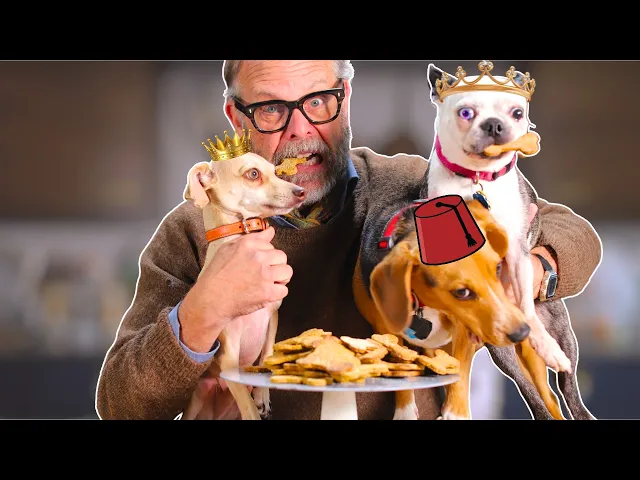
Alton Brown Cooks Food | Episode 10: Gone to the Dogs
Alton Brown
0:01 Personally speaking, I have never met a dog I didn't love,
0:06 or at least like a great deal.
0:09 Um, I have only uh had three experiences [music] in my life
0:13 that could even marginally suggest the existence of the supernatural.
0:17 In each of those three instances focused on the action of a dog,
0:23 story for another time.
0:24 Um, my wife and I currently live with three dogs.
0:27 Uh there is Scabigail um aka Scabaloons.
0:31 [music] There's GMO aka Gizmoney and Hamlet
0:34 aka uh Hammerly Hammertosis or sometimes Hammer Bottoms.
0:39 Depends.
0:40 Um the first two were rescues.
0:42 Uh the last one discovered dumped in the middle of the road in Alabama.
0:46 Truthfully [music] though, we don't own them, right?
0:49 I mean, if anything, they own us.
0:51 And it's with this in mind that I dedicate
0:53 this episode of Alton Brown Cooks Food to James Sprat.
0:58 Now, Sprat was a Cincinnati based lightning rod salesman who uh
1:03 by the 1860s was expanding his operations to jolly old England.
1:07 Now, while he was waiting docside for his products to uh unload,
1:11 one day, Sprat noticed just dogs loitering everywhere,
1:15 sniffing out and scarfing down bits of hard tac, aka ships crackers,
1:20 um long a seagoing staple that had been,
1:22 you know, just discarded by disembarking [music] seaman.
1:26 Now, uh here's a picture of the army version.
1:29 Uh it's closeup.
1:30 Navy, same thing.
1:31 All right, so this gives Sprat an idea.
1:33 Maybe the upwardly mobile Victorians of the industrial
1:37 age would pay money for a food,
1:40 crackers to be exact, specifically designed and formulated for dogs.
1:45 Now, keep in mind up to this point there's no such thing as dog food.
1:49 In fact, uh many anthrozoolologists believe that uh one
1:53 of the main reasons that dogs have stuck by humans
1:56 for the last 16,000 years has to do with the fact
1:59 that they have evolved to flourish on our table scraps,
2:03 which is all that we've been giving them for a really long time.
2:06 So, Sprat's original crackers are marketed [music]
2:09 as Sprats patented uh meat fabine dog cakes.
2:13 They were a mixture of a grain, beets, assorted vegetables, uh,
2:16 and the dried unsalted gelatinous parts of prairie [music] beef, aka bison.
2:23 Uh, and although uh, they were definitely crackers,
2:26 they were meant to serve as dogs primary source of nutrition.
2:30 Also notice sprout is really slick with advertising.
2:33 Check out the kind of art nuvo thing that's working here.
2:36 This would have been designed for the continent.
2:39 [snorts] I might frame that.
2:41 Um Sprout's invention uh was a success which
2:44 led to uh you know success in America.
2:47 [music] But then in 1907 an organic chemist
2:49 prolific inventor named of Carlton Ellis the guy
2:53 who created margarine right formulated a dog
2:56 cracker made with milk left over from slaughterhouses.
3:00 And in a stroke of genius he formed
3:02 the resulting treats into the shape of a bone.
3:06 Game over.
3:08 After uh World War II,
3:10 kibble uh became king and dog crackers became treats and remained so today.
3:14 But here's the thing.
3:15 Given a choice, my dogs, two of them at least, and I'm not naming names,
3:20 would pass up any manufactured treat for slightly aged cat poo.
3:26 [snorts] And so I set out to make
3:28 a dog biscuit that stinks while still delivering solid nutrition.
3:41 Allow us now to ponder [music] the software.
3:44 We require one small sweet potato.
3:47 We'll need three cups of rolled oats, 2 tablespoons of natural peanut butter,
3:53 3 oz of oil packed sardines, and one egg.
3:58 Now, as for the uh the peanut butter, I just want to say that you need to beware
4:03 of uh any of those labeled sugar-free or low sugar,
4:06 which may contain a sweetener called xylitol, which is highly toxic to dogs,
4:12 and is sometimes listed as a birch sugar, uh wood sugar or birch extract.
4:16 I uh tend to cook with peanut butters,
4:19 uh that only contain one ingredient, roast peanuts.
4:22 So, uh we are good to go.
4:24 Oh, and I almost forgot the flavor cudank.
4:29 Two teaspoons of fish sauce.
4:32 Uh the liquidous remains of fish and salt that are allowed
4:35 to ferment together uh for up to a year depending on the brand.
4:39 Now, I realize it's not exactly cat poo, [snorts] but it's pretty damn close.
4:46 Um I also know that dogs should not get too much salt,
4:49 but it's only two teaspoons.
4:50 So, unless you're going to feed phto the entire batch in one sitting,
4:54 [music] I think we'll be okay.
4:55 Let's cook.
4:59 [music] Crank your hot box to 350.
5:03 All right.
5:03 Get out your uh sharpest fork, um, whatever that is,
5:07 and just prodigiously perforate that sweet potato probably eight to 10 times.
5:11 This will let some excess moisture escape during the cook,
5:15 which will ensure soft flesh.
5:17 And I would typically microwave a specimen
5:21 this size 3 and 1 half to four minutes.
5:23 But air on the uh on the lesser because you can always nuke it more.
5:27 Nuke it too much, it'll be a problem.
5:29 It'll get hard.
5:30 Oh, and be careful there.
5:31 It's hot sometimes.
5:34 So, while the uh uh sweet potato cools down a little bit,
5:37 uh we will uh process our oats.
5:40 I remember it was uh 3 cups.
5:42 That's actually uh 220 grams if you prefer to weigh, which of course u I do.
5:47 And what we want to do is turn this essentially
5:50 into a uh uh something that looks like well whole wheat flour.
5:54 So think of it as kind of an oatmeal.
5:57 [laughter] That's it.
6:00 1 minute should do it depending on your machine.
6:04 There.
6:06 That looks perfect.
6:08 Um, you know, while we're on the subject of food processors,
6:13 I just want to say that my relationship
6:15 with these devices has always been somewhat strange since I
6:19 dislike um washing and then having to store and deal
6:22 with all of their ouchy [music] parts and bits.
6:25 And honestly, there's something about that jolting
6:28 engine of destruction violence that just unnerves me.
6:32 Further alienation in recent years has been due
6:35 to designers who insist on over complicating everything,
6:39 [music] the functions, the buttons, and of course the ouchy bits.
6:44 And yet, when Quezinard recently came out with their 50th anniversary uh model,
6:49 an ode to the original 14 cup edition,
6:51 complete with the iconic control panels instead of buttons,
6:56 I had [snorts] to have it.
6:58 You know, interesting uh origin uh story here.
7:01 Um, back in what, uh, 1970, I guess, an MIT trained physicist, an inventor,
7:08 and gourmet cook, uh,
7:09 Carl Sonheimer took a trip to France with his wife, Shirley.
7:16 Yeah, I I couldn't find a picture of her.
7:18 This is Shirley Booth, who starred in the show Hazel.
7:21 I like that show.
7:22 Anyway, um they go off to France and uh
7:26 they go to this uh this kitchen wear show
7:28 and Carl spots a device that will be familiar
7:32 to many American restaurant cooks called the Robo Coup.
7:36 It's kind of a ungangly blender on steroids, uh designed to tackle prep work.
7:40 Now, Sonheimer thought that with some redesign and badly needed safety upgrades,
7:46 the Robocu could be sold to Americans.
7:48 So he cut a deal uh with the uh the French manufacturer
7:52 and uh in 1973 released the Quez anart at a whopping $175.
7:59 The device cost more than a really good blender and mixer [music] combined.
8:04 But but once uh people like uh Julia Child started using it, yeah,
8:09 I couldn't find a picture of her with it, so I [music] just taped it on there.
8:12 Anyway, uh the spell was cast.
8:14 Now, um, for my money, no device sense has changed the, uh,
8:18 vector of American home cuisine more.
8:21 Although, look, we still use other brands around here.
8:24 We got some Brevel, Magic Mixes, we got we got all kinds of stuff,
8:27 I really do enjoy [music] this machine.
8:30 Is it better than anything else on the market?
8:32 Not necessarily, but I find the physicality of those paddle controls comforting,
8:38 and the pull of nostalgia is definitely strong.
8:42 I'll drive it for a year and report back.
8:43 In any case, don't forget Sonimer in your culinary prayers of thanks.
8:48 Because of him, '7s dinner parties could serve canels.
8:52 Next, now remove the bowl and reserve the oatmeal flour.
8:58 Okay.
8:59 And then return the empty work bowl.
9:00 Load with a sweet potato.
9:02 Turned out to be right at 4 ounces, which is perfect.
9:05 3 oz of sardines.
9:06 2 tablespoons of peanut butter.
9:08 Then the egg.
9:09 And finally, the two teaspoons of the stinky stuff.
9:14 Pulse 10 to 12 times just to create a paste.
9:17 And no, it does not have to be perfectly smooth.
9:20 Return two cups, we'll call it 220 g of the uh of the oats
9:26 to the work bowl and process in pulses until a dough forms.
9:30 If it looks crumbly but holds together when you squeeze it,
9:33 you may pass and collect $200.
9:36 Sprinkle your counter or appointed work
9:39 surface with some of that remaining oatmeal.
9:42 going to keep working that joke.
9:43 And then just plop the dough down and kind of work it together,
9:47 squeezing with your hands until you've got a thick smooth disc.
9:51 Then you can start rolling it out.
9:54 And you can roll it slowly at first because you don't want it to crack.
9:57 And don't worry, there's no gluten here,
9:59 so you're not going to toughen it with rolling.
10:01 Just work it until it's a/4 of an inch thick.
10:04 Don't go any thinner because the uh biscuits will be too crumbly.
10:08 Then you can cut into shapes.
10:10 The bone shaped cutter, of course, is is [music] required here.
10:14 And I usually punch everything out before I start moving the pieces.
10:18 And when you do, just use a little
10:19 offset spatula and transfer to a parchment lined sheetpan.
10:24 Might need to, maybe not.
10:26 Oh, um, and I do have one really [music] big bone-shaped cutter that, uh,
10:32 I use for the leftovers, for the pitbull up the street.
10:36 Bribes work.
10:42 All right.
10:43 Bake in the middle of the 350°ree oven for 10 minutes.
10:48 Then uh rotate the pan and bake for another 10 minutes.
10:52 Then turn the oven off for a final 10 minutes to dry them.
10:57 And when they come out, you know what?
10:58 They're going to look pretty much the way they did when they went in.
11:01 A little darker.
11:02 This is good.
11:04 after uh cooling on a rack for about an hour.
11:06 They set up uh pretty gosh darn rock hard.
11:09 Um great for their teeth, so here.
11:11 And then what I like to do is I like to take my time while
11:14 the dogs watch is I kind of like build kind of a jingga thing out of them,
11:19 not giving them any of them at all.
11:21 And then I just let that sit on the counter for a while.
11:25 I know it's mean, but in the end, uh they will uh definitely get some.
11:29 Um, of course to serve, all you got to do is just drop one on the floor.
11:45 I wouldn't.