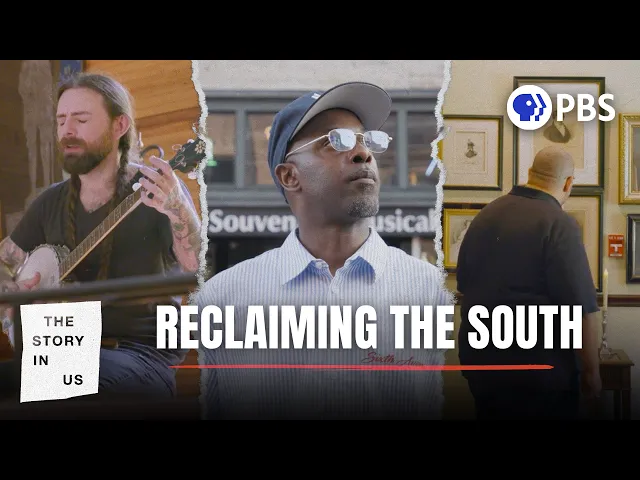
How Creators Are Reframing Southern Identity
PBS Documentaries
0:02 Southern storytelling to me is the cornerstone of southern culture.
0:07 I think every southern person is a great storyteller.
0:10 It's handed down from our parents, our grandparents,
0:13 it just makes me feel so much closer to home.
0:17 To me, it's culture sharing.
0:19 It's highlighting America and it's kind
0:23 of multi-fabric that seems to weave together, but also every now and then break.
0:28 And so maybe it's even a glue.
0:31 I look at storytelling just in general
0:33 as a way that history is kind of preserved.
0:37 It could be done in many ways.
0:39 Music.
0:40 Movies.
0:41 Photography.
0:42 it's a way to kind of pass along information, ideas.
0:46 Preserve the times.
0:57 I got my start doing digital content when
1:01 I got laid off from my funeral home job.
1:05 People ask me often, like, how did you start work in the funeral home?
1:08 There was a career day when I was in middle school,
1:11 and the local funeral home brought the hearse,
1:13 and I was the first goth kid in line
1:16 and asked the guy if I could lay in the casket.
1:22 I made this video called “Conway Twitty’s Cause
1:25 of Death” for the pathology for mortuary science class.
1:29 I think just because I was listening to a lot of Conway at the time.
1:33 And it was meant for the 12 people who were in that class.
1:36 The funeral home that I worked for, pretty much everybody got laid off.
1:40 It was somewhere during that transition where I
1:43 went back to YouTube and I was like, ho- This video has 300,000 views?
1:48 Maybe I'm on to something here.
1:50 Let's, let's try some more.
1:55 Even before I created online, I think I always attempted to connect in some way.
2:00 I always like sharing, what I was learning.
2:04 I was born in Baton Rouge, Louisiana.
2:06 And I think a lot of what I do is obviously share Louisiana.
2:12 culture.
2:12 But also I like to put a spotlight on the African presence in the Americas.
2:19 I've always been a Doubting Thomas.
2:21 Somebody who needed proof.
2:22 I'd heard a lot of, kind of, oral history,
2:26 and I need to find out if that were true.
2:28 So I was able to kind of verify what my family was saying.
2:33 For the most part.
2:34 And I wanted just to kind of strengthen that oral history with, visual proof.
2:42 I always look at photos as a way of, like, time traveling.
2:45 You can take a slice of time, and it's there.
2:51 That’s, like, fascinates me.
2:53 I feel it’s like, an artist duty, just as Nina Simone said,
2:59 for us as creatives and artists to document the times.
3:06 I'm from Memphis, Tennessee.
3:08 I consider myself, a multi-hyphenate creative.
3:13 You can create the things that you want to see,
3:16 create your own space to put your work out.
3:19 I think my first time being cognitive of black people
3:23 not being represented in a creative space- I used to go
3:27 to these, art crawls in Nashville and you'd walk around
3:30 and I didn't really see a lot of us represented,
3:32 in the work or as the artist presenting the work.
3:36 And then I remember, when I first started doing photography and I was
3:39 a big fan of magazines like Complex, Double XL.
3:43 And I remember, like, alright I’m gonna submit some work,
3:47 and, of course, I never heard anything back.
3:50 And that’s what kind of, fueled me stepping
3:51 into the light of, of create my own spaces.
3:59 Appalachia is the perfect setting for storytelling because most
4:02 of our stories come from sheer survival so many
4:06 local characters that had these just far out lives
4:10 that a Hollywood writer could never come up with.
4:15 My uncle he goes and pans for gold in the rivers and creeks and streams
4:20 of Appalachia and I find that he's steeped
4:24 in Civil War history and these handed down stories.
4:28 As a child, these tales that would incite me to want to go
4:33 explore and go adventure into the woods and find things that have been lost.
4:37 Treasures or loot or gold Most of my content
4:42 is built around growing up with my grandparents.
4:46 My meemaw, my nanny, my grannies.
4:49 I was bounced around between all of them.
4:52 I've discovered that there were more people that grew up like me
4:56 than I realized and we can all meet on a common ground.
5:01 It’s a full moon tonight, and that can only mean one thing:
5:03 the haints will be walking in the holler.
5:06 There's certainly a lot of misconceptions about Appalachia.
5:09 Because of the way we talk, we're uneducated or, what has been portrayed
5:14 in the media even like the original Mountain Dew commercial.
5:19 Yahoo, Mountain Dew!
5:22 There's been a lot of jokes made at the expense of southern Appalachian people.
5:28 One of my goals is to discredit a lot
5:31 of those stereotypes and we can we can laugh
5:34 at ourselves but when it comes to other people
5:37 pointing the finger That’s not allowed on my watch.
5:41 There's a lot of people moving to Appalachia
5:44 from rude places in the United States,
5:46 so just be sure to set that attitude out on the street before you come here.
5:53 Louisiana is more than red beans and rice and jazz.
5:57 It's deeper than that.
5:59 Culinary enjoyments, music, the culture,
6:02 the culture is defined by the struggle and survival.
6:07 I try to approach things, especially delicate subjects, with reverence,
6:12 but also it can't just be a dark, somber day, right?
6:16 if you just dwell on them, it's going to deluminate.
6:21 This helps.
6:22 Sorry for the microphone.
6:25 By the time you’re like, why is this guy wearing a top hat?
6:28 You've hopefully invested a little bit of time
6:32 to where you're interested in seeing what I'm talking about.
6:36 Let me show you something you're not going to see in a museum I
6:41 found a painting of my ancestor and he
6:43 was languishing in a basement in California.
6:45 A free man of color, born in 1760, New Orleans.
6:49 And, it was in a basement in California with cousins
6:53 who had had only just recently discovered their past.
6:57 The free people of color were a force to be reckoned with.
7:00 People just believe or think of just slaves arriving- unskilled workers.
7:05 But that's actually not the case.
7:06 We had people who of course knew mathematics and mean look at the architecture.
7:11 also a lot of these large plantations, you see, were built by free men of color.
7:16 The refinement, of sugar production is made by a man named Norbet Rillieux..
7:22 They accounted for a fifth of the population.
7:24 They own a third of the buildings in the French Quarter.
7:28 I mean, so they affected every aspect of this culture.
7:31 Because of historians in the past and because of archivists of the past,
7:36 a lot of the truth, I think, was never preserved.
7:39 So thus not put into something where it
7:41 would be safeguarded and protected and then shared.
7:48 I have been posting this image of this little boy for years.
7:54 the New Orleans Museum for.
7:56 They had decided to do session the work which is common in museums.
8:00 They look around, they say, look, these pieces are no longer relevant.
8:04 I was able to find a crucial clue of where the painting was from Instagram.
8:09 And a person I met once at an antique fair said,
8:12 oh, I remember where that painting was.
8:15 So you remember where it was?
8:17 What?
8:17 So he gave me the name of the dealer.
8:20 Well, you know, I kept calling.
8:22 Eventually he put me in contact with the owner in Washington, D.C..
8:26 She always said that she was holding that painting for something.
8:30 I said hey, I’m that something.
8:34 so she agreed, to allow me to purchase the painting.
8:38 So I placed it with the Metropolitan Museum of Art.
8:42 Now, I think 4 million people have access to it a year or so.
8:46 I think it's a remarkable new world we have where we can
8:49 now safeguard this by sharing it and so where this won't happen again.
8:54 Everything in our past kind of defines our future,
8:56 and I think a lot of that that causes us to heal is that, the bad things.
9:02 the not so great things, the scratches, the scars, and we all have that.
9:07 I think we're all after the same thing.
9:10 Largely.
9:11 And people call it different things, but I think it's healing.
9:13 I think it's unique unity.
9:15 I think it's a community.
9:17 All right.
9:18 History is a full time job.
9:24 All right, guys, welcome to the very
9:26 first installment of Conversations with Creatives.
9:28 I'm here with Miss Jayla Slater.
9:31 My inspiration for creating these spaces is more so from a regional standpoint,
9:36 I think we have a lot of talented people here
9:39 And everyone doesn't get their shine on a major platform.
9:44 So I figure, can still share these stories.
9:48 I want people to, to realize like
9:50 that, you can create from a space of authenticity
9:53 You can create in the pocket that you want to create in, So these are my babies.
10:00 My magazine issues.
10:01 The latest piece features the work of various photographers around Memphis.
10:06 Just documenting, like, the culture, the music scene.
10:11 The work that I've put out online
10:14 has somewhat shaped people's narrative of Memphis.
10:18 When people think of Memphis,
10:19 especially when you talk to people outside of Memphis: Elvis.
10:22 Beale Street.
10:23 They think about the legacy aspects of Memphis.
10:26 My content has kind of shared a side
10:29 of Memphis that people didn't know existed here.
10:32 And just the south in general.
10:33 Alright y’all.
10:34 Today we're here at Stax Museum.
10:37 telling stories about Memphis.
10:39 When you think about traditional media, only so many people can get in.
10:42 But I think digital space has opened it up.
10:45 You're able to create, from your perspective, from your voice.
10:51 It's important to me to keep the stories of Appalachia alive,
10:55 because a lot of the older generation,
10:57 where the stories come from are passing away.
11:01 When I look at collectors of the past a lot
11:04 of what was acquired was for a novelty and also for showmanship.
11:10 And I don't think you can come into this world with that attitude.
11:15 The history is bigger than me.
11:17 It's a responsibility.
11:19 The South remains a force to be reckoned with.
11:22 Good and bad.
11:23 I don't think the digital age has necessarily changed the south per se.
11:27 I think it's, made it more accessible.
11:29 It's just not one sided.
11:31 You get to hear voices that you probably wouldn't have heard.
11:36 It’s been a goal to just preserve as many
11:40 of these stories in the digital realm as I possibly can.