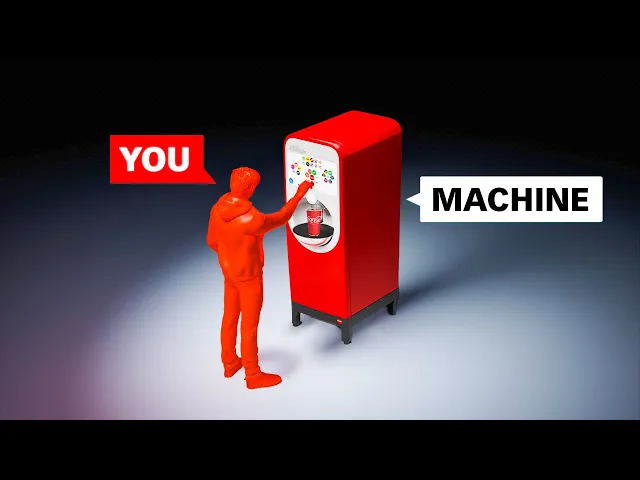
The $1 Billion Coca-Cola Machine
fern
0:00 You're in the cinema about to watch yet
0:02 another sequel to a forgotten franchise nobody asked for.
0:06 You're getting popcorn and a drink to drown out
0:08 your Jared Leto induced sorrow with a sugar rush.
0:10 You pay and they hand you a cup.
0:13 Then you see it glowing red and chrome.
0:17 The Coca-Cola freestyle fountain.
0:19 Here you can choose between over 100 different flavors.
0:23 Cherry vanilla Coke, peach Sprite.
0:25 Maybe you'll go crazy and mix Fanta with Powerade.
0:28 Or maybe you just pick a classic.
0:32 But this machine is way more than just a soda fountain.
0:36 It's not just serving you a drink.
0:38 It tracks everything you do.
0:40 And while you're picking your favorite flavor, it's quietly collecting data.
0:44 Data that turns customers into test subjects.
0:46 Data that Coke will profit from tremendously.
0:49 The Coca-Cola company is said to have
0:51 invested more than $1 billion in this machine,
0:54 but they're very likely turning its capabilities into much,
0:57 much bigger savings and profits.
0:59 Today, we're diving into how a drink dispenser became a global
1:02 lab and what role you play in all of this.
1:07 Confirmed.
1:09 The Coca-Cola Company is one of the biggest beverage producers on the planet.
1:13 The conglomerate controls almost half of the global soda market,
1:16 making billions in revenue every year.
1:19 And one important way they sold their many drinks has long been soda fountains.
1:23 In the olden days, ordering a soft drink would work like this.
1:26 You'd walk up to the counter, place your order,
1:28 and someone would pour your drink into a cup.
1:31 Then self-service fountains arrived.
1:33 [music] Now you could fill your own cup at your own discretion.
1:36 When you were a kid, this fountain was everything.
1:39 You could mix yourself something truly undrinkable.
1:46 you.
1:47 However, in 2006, Coca-Cola and other
1:50 beverage makers noticed something worrying.
1:52 For the first time since 1985,
1:54 the sales volume of carbonated beverages had declined.
1:57 People started to focus more on their health and well-being.
2:00 They were increasingly looking for sugar-free drinks and low calorie options.
2:04 But Coke's fountains just weren't ready for that.
2:06 At that time, only about 1% of all
2:08 Coke fountains in the US even offer Diet Coke.
2:11 Meanwhile, the choice of sodas at convenience stores had increased dramatically.
2:15 Rows and rows packed with hundreds of bottles and cans.
2:18 But Coke fountains were stuck with the same
2:20 limited runup of kind of boring standard flavors.
2:23 So, they had to come up with an idea.
2:25 An idea that would change everything.
2:29 The Freestyle Fountain's design is interesting.
2:32 The red, [music] the chrome, the sculpted lines.
2:34 It kind of looks like it wants to become a Ferrari when it [music] grows up.
2:38 And that's not a coincidence.
2:39 It was developed with Pina Firina,
2:41 the legendary Italian design house that shaped the curves of Ferrari itself.
2:45 You slide your cup under the dispenser.
2:47 Now comes the fun part.
2:49 You see dozens of bubbles on the screen in front of you.
2:52 Each bubble is labeled with a different drink.
2:54 Mezo mix, Coca-Cola, Powerade, Lyft, Fuse Tea, and Kinley.
2:59 In total, you could choose over a 100 drinks.
3:02 Back when you were a kid, this would have been impossible.
3:04 Restaurants used massive 19 L syrup canisters for every single drink option.
3:09 Nowadays, all these flavors fit into just about 30 tiny cartridges.
3:14 The cartridge design is inspired by medical
3:16 tech where precise dosing is critical.
3:18 Just as insulin pumps deliver exact amounts of medication almost drop by drop,
3:22 the freestyle system carefully meters syrup and carbonated water for each pore.
3:26 In theory, every pore is perfectly measured drop by drop,
3:30 turning your drink into a precise masterpiece.
3:33 But Coke from a Freestyle fountain actually tends to taste
3:36 a little different from the one you buy in the supermarket.
3:38 In contrast to the old canister systems that premix syrup and sweetener.
3:42 Freestyle keeps flavors, sweeteners, and carbonated water separate.
3:46 Now when you press the button, the flavor,
3:48 sugar, and carbonated water are combined on demand.
3:51 This can make your Coke taste slightly different from other preparations.
3:56 Staring at the bubbly screen, curiosity kicks in.
3:59 You came in for your usual, but you got to admit some options here are tempting.
4:03 You tap the Power Eight bubble and suddenly a whole lineup appears.
4:07 Powerade raspberry, Powerade lemon, Powerade strawberry.
4:10 So many choices.
4:12 Which one to pick?
4:13 You even mix a drink that doesn't exist before.
4:16 You could create your own secret flavor.
4:18 And won't that make you special?
4:24 The Freestyle Fountain is fun.
4:26 It lets you explore.
4:27 It bewilders.
4:27 [music] It sparks curiosity.
4:30 It might even provoke play.
4:31 And that's exactly the point.
4:33 Coca-Cola doesn't just want to sell you a beverage.
4:36 It wants you to feel something.
4:38 This technique is called experience marketing.
4:41 Right here in front of this machine, you're not just choosing a flavor.
4:44 You're interacting with a brand.
4:46 You are literally experiencing it.
4:48 Every tap, every bubble,
4:50 every choice pulls you deeper into the Coca-Cola universe.
4:54 And that matters because moments like this make you remember Coke.
4:57 not just as a drink, but as a feeling.
5:00 And ideally, it wants you to go home
5:01 and tell your friends about that insane machine that lets
5:04 you mix your own Coke and offers that amazing
5:06 weird new flavor they so got to try.
5:09 And Freestyle isn't the only example for Coke's experience marketing.
5:13 Think about Share a Coke.
5:15 Different campaign, same idea.
5:17 And it's all part of Coca-Cola's bigger play,
5:19 shifting from being just a product brand to an experience brand.
5:24 Anyways, you ultimately [music] go for a Sprite.
5:26 You didn't even know Sprite Cherry existed.
5:29 Time to give it a shot.
5:30 You press the pour button, then you take a sip.
5:34 Not half bad.
5:36 You're not the only one who was curious about Sprite Cherry.
5:39 All over the world, people have made the exact same choice.
5:42 Obviously, Coca-Cola didn't offer you this new flavor just for fun.
5:46 The freestyle ecosystem is basically a giant testing lab.
5:49 Every pour, every mix,
5:51 [music] every flavor you try feeds into a massive experiment,
5:54 a sampling program on a global scale.
5:56 And with this particular new flavor, the experiment actually worked.
6:00 But this is just the tip of the iceberg.
6:05 When Coca-Cola launched the Freestyle in 2009,
6:08 they packed it with cuttingedge technology.
6:10 Reliable wireless networks like the ones we have today weren't exactly standard,
6:14 so Coca-Cola built their own.
6:16 [music] The network they created links every
6:18 freestyle machine directly to Coca-Cola's backend systems,
6:21 which are managed through SAP software.
6:23 Think of it as the company's brain.
6:25 It keeps track of everything happening across all departments in real time.
6:29 Every single day, over 50,000 freestyle machines send data back to this brain.
6:34 [music] They report everything that's going on inside them.
6:37 Which flavors are being poured, what time of day they are consumed,
6:40 or how much syrup is left.
6:41 You might not experiment with your drink choices, but many other people do.
6:45 That is how Coca-Cola discovered that people really like Coke orange vanilla,
6:49 Sprite cherry, Sprite strawberry, and Coke cherry vanilla.
6:52 Some of these flavors started as user creations.
6:55 Combinations people kept mixing again and again at the freestyle machine.
6:58 Others like Coke Orange vanilla were developed by Coca-Cola.
7:02 The more people got these, the stronger the signal became,
7:05 and what started as a tiny bubble
7:07 on screen ultimately moved into full production.
7:10 Sure, you could argue the company might
7:12 have released these flavors eventually either way.
7:14 But with Freestyle, those decisions happen faster than
7:16 before and might be grounded in better data.
7:20 But there's more.
7:21 Before Freestyle, staff had to manually check those giant syrup canisters.
7:25 They probably used inventory sheets, maybe did a bit of guesswork,
7:28 and called or emailed Coca-Cola to reorder.
7:31 Freestyle completely transformed Fountain Logistics.
7:34 Every night, the system collects data from this exact machine and figures out
7:38 how many units of each cartridge needs to be delivered to the cinema.
7:42 And it's not just based on what you and your friends poured yesterday.
7:45 Algorithms predict demand and even factor
7:47 in plan promotions for specific beverages.
7:50 The system calculates which cartridges need
7:52 refilling and automatically creates the restocking orders.
7:56 Those orders are sent straight to the distribution center,
7:58 and from there, the cartridges are shipped directly to the founding locations.
8:02 Every Freestyle machine on the planet is quietly sinking.
8:06 Think about how smart this is.
8:08 With Freestyle, Coca-Cola can optimize their entire fountain supply chain,
8:12 streamline inventory management, make restocks more efficient,
8:15 and even improve their production schedule.
8:17 It's probably safe to assume that this alone saves
8:20 the company millions and millions of dollars along the way.
8:23 If even Coca-Cola is tracking your data in real life,
8:26 you won't be surprised to learn that your data is exposed everywhere,
8:29 and there's nowhere to hide.
8:30 every click, search, and form you fill reveals tiny pieces of who you are.
8:34 That you had to look up how to spell
8:35 bushwis six or seven times for your online comet war.
8:38 That you don't understand the 67 meme.
8:40 Or that you enjoy mixing Sprite and Fanta.
8:43 Disgusting animal.
8:45 With data breaches rising every year, your personal information is at risk.
8:48 Shady data brokers sell it, scammers use it, and even steal your identity.
8:52 Not that anybody would want your particular identity,
8:54 but you know, theoretically, if they did,
8:57 they could take out fraudulent loans, open accounts in your name,
9:00 and cause serious legal and financial headaches.
9:02 This is where Incogn comes in.
9:04 It tracks down your personal data across hundreds
9:06 of sites from data brokers to people search platforms,
9:09 and removes it repeatedly.
9:10 With a custom removal feature,
9:12 you can even send links to websites exposing your info,
9:14 and Incogn will handle it for you.
9:17 Just create an account, authorize Incogn,
9:19 and take back control of your personal data.
9:21 Get 60% off with our code Fern TV at the link below or scan this QR code.
9:26 Go protect yourself.
9:28 Let's get back to Cook's Genius Machine because well, there's more.
9:32 The data streams don't only report back.
9:35 Marketers at HQ can push new campaigns straight to the freestyle.
9:39 It took a while to get to this level.
9:41 Whenever Coke wanted to push a new campaign or change content,
9:44 it required a full software update during
9:47 which the machine couldn't pour a single drink.
9:49 Not exactly ideal considering many fountains
9:51 are located in hightra fast food chains.
9:54 So in the mid2010s, Coca-Cola integrated AirWatch,
9:57 a modern device management platform.
9:59 Now instead of sending out a massive software
10:01 update whenever marketers want to roll out a campaign,
10:04 they could push tiny data packages.
10:06 While receiving the configurations,
10:07 the machines most likely stay fully operational.
10:10 They simply download and display the new content, like this Halloween special.
10:15 What happens next is called nudging.
10:17 A new flavor might be the first bubble you see,
10:20 or a short teaser video might just catch your eye.
10:22 You're still free to pick whatever you want,
10:24 but those gentle nudges make you more likely to experiment.
10:28 Thousands of individual recorded choices to try some bizarre Halloween flavor,
10:32 all feeding directly into Coca-Cola's product development.
10:35 But wait a minute, there's a little black dot up there.
10:38 Is that a camera?
10:40 Is this thing recording you?
10:43 Well, Coca-Cola did plan to install camera in one of their freestyle models.
10:48 They've included it in their spec sheet and described it
10:50 with the words future capability for motion sensing and facial recognition.
10:54 This way, the company could have tracked every smile when you mix flavors,
10:58 every frown when it doesn't taste right after a little test sip,
11:01 literally observing which combos make you happy or annoyed.
11:04 Every reaction is data.
11:07 But could they really pull this off?
11:09 At least in theory.
11:10 In Europe, for example, strict data protection laws such as general data
11:14 protection regulations would likely not allow this to happen.
11:17 In the US, however, businesses and event venues are increasingly
11:21 experimenting with facial analysis and recognition technology in public spaces.
11:25 So, hypothetically, it might be feasible there.
11:28 According to Fortune, in early 2024,
11:30 AI company Quantify referenced a facial recognition project tied to Freestyle.
11:35 In a now removed entry on their website, it reportedly said,
11:38 "Each vending machine comes with a camera installed in which
11:41 an image is captured for every customer interacting with the machine.
11:44 Coca-Cola's marketing team aspired to use these images
11:46 to generate insights on consumer preferences and usage patterns.
11:51 Reportedly, Quantify built a machine
11:53 learning model to detect customer demographics.
11:56 Basically, the Coca-Cola company could know you're a guy in your 20s
11:59 standing here grabbing that Sprite cherry." After Fortune asked questions,
12:03 the post seemingly vanished.
12:05 A spokesperson for Coca-Cola said cameras in freestyle fountains were
12:09 just tested in a laboratory setting from 2018 to 2019.
12:13 When we asked Coca-Cola about this, they did not respond.
12:17 The creepy camera hole aside, the technology is pretty impressive.
12:22 A single globally deployed machine expanding flavor variety,
12:25 strategically pushing experience marketing,
12:28 enabling hyperdetailed flavor testing, micro campaigning,
12:31 and optimization of the supply chain.
12:33 You probably stood in front of one of those before and never even had a clue.
12:37 But there is this one central question we just couldn't shake.
12:40 Just how much are they saving and making with this?
12:42 In order to find out, we went down a rabbit hole.
12:45 annual reports, analytics, figures, and company filings,
12:48 only to realize there is no concrete data.
12:53 Sure, we found a few clues here and there,
12:55 but we could barely make anything useful out of it,
12:57 especially because gains from Freestyle are tangled up with other projects.
13:01 When we reached out to Coca-Cola for comment,
13:03 they didn't respond, so we had to call in backup.
13:06 Enter Yannik, the team spreadsheet wizard.
13:08 He dove into everything we could find out
13:10 about Freestyle and started making sense of it.
13:12 His analysis is split into three parts.
13:15 First, payback.
13:18 Let's start with Coca-Cola's assumed revenue from Freestyle machines.
13:21 To get a rough baseline, we looked at something similar.
13:23 Loyalty programs like Payback.
13:25 Payback usually returns an estimated.5 to 3% of your spending.
13:29 Sounds like a bad deal for them.
13:31 But here's the thing, it works.
13:33 Because when people get a little something in return,
13:35 they tend to spend even more.
13:37 And while they do, Payback [music] collects tons of data or what they buy,
13:41 when they buy, and where they buy.
13:43 You can't fully compare Payback to Coke Freestyle,
13:46 but both follow the same idea.
13:47 Encourage people to buy and learn as much as possible while they do.
13:51 The data collected through loyalty programs like
13:53 Payback enables targeted marketing and personalized offers,
13:56 helping deliver messages that are relevant to individual consumers.
14:00 Studies like this one show that loyalty programs
14:02 can improve gross margins by 2 to 4%.
14:05 Not simply because people buy more, but because companies can make
14:08 smarter datadriven marketing and product decisions.
14:11 Using that logic, we can conservatively assume
14:13 a 2% margin on revenue for freestyle.
14:16 This is a very rough estimate, but enough to get a sense of scale.
14:20 According to one source,
14:21 Coke Freestyle machines dispense around 4 billion drinks per year,
14:25 assuming an average of $2 per drink and a 2% margin.
14:28 That adds up to roughly $160 million in yearly gains,
14:32 well over a billion since Freestyle's inception.
14:36 Second, the value of data.
14:38 Back in 2015, Coca-Cola teamed up with Hivery,
14:41 a company focusing on AIdriven optimization.
14:44 Their mission was to optimize vending machine sales.
14:47 One of Hivery's clients was Rya's Coca-Cola Bottling Co.,
14:51 a US bottler with roughly 19,000 vending
14:53 machines in hospitals across California and Nevada.
14:56 Hivery software combines sales data with machine learning and some
15:00 algorithms to predict demand for every beverage in every machine.
15:03 Reportedly, Reya saw a 6% sales increase
15:06 and a 15% reduction in restocking trips.
15:09 These numbers suggest that datadriven supply chain management
15:12 can generate significant sales boosts and cost savings.
15:15 It is reasonable to assume that freestyle fountains could yield similar results.
15:21 Third, new flavors.
15:24 Some of the new flavors Coca-Cola [music] launched
15:26 based on their freestyle testing turned out about
15:28 as popular as the deeply disappointing and unwanted
15:30 sequel you're going to endure in a few minutes.
15:33 [music] Take Coke Cherry Vanilla for example.
15:35 Even though it was one of the most beloved freestyle combos,
15:38 Coca-Cola decided to not produce any more in 2024 due to declining demand.
15:43 Freestyle may help spa promising new flavors,
15:45 but it doesn't seem to be foolproof.
15:47 Out of four flavors brought to the market, two did not survive.
15:51 [music] This doesn't necessarily mean they were bad investments,
15:53 just that they weren't long-term hits.
15:55 [music] Coca-Cola may have overestimated how representative
15:58 Freestyle users are for the broader market.
16:01 Again, our request for comment went unanswered.
16:03 While Coca-Cola rarely publishes concrete sales data for specific products,
16:07 we found a number for one of their newer non-free
16:09 style Sprite products that shows the potential of this market.
16:13 Sprite Chill generated $50 million in sales in its
16:16 first 21 weeks in the North American market.
16:19 Again, it's hard to estimate the total
16:20 profit the company may have made through new
16:22 flavors that started on Freestyle and how
16:25 important the found data was for their success.
16:28 But looking at all three aspects of Yanuk's analysis,
16:30 one thing is relatively safe to assume,
16:32 the billion dollars Coca-Cola reportedly invested
16:35 into these machines has long been made back.