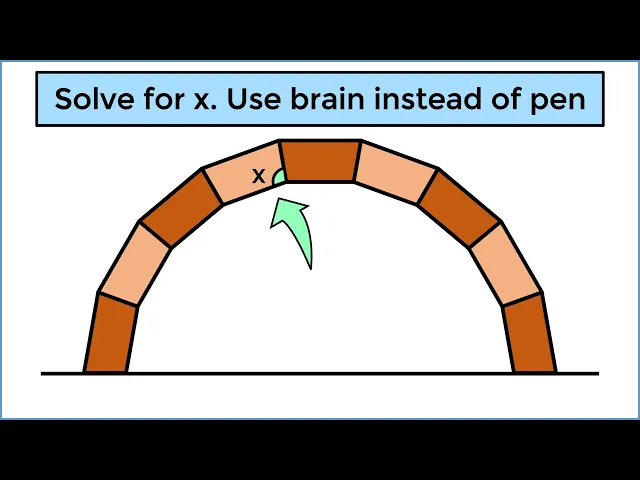
Angle in arch. Can you solve it?
MindYourDecisions
0:00 Hey, this is Preshall Walker.
0:03 Here's a fun puzzle that's making the rounds.
0:06 An arch is formed by nine equal bricks as shown below.
0:10 Solve for the angle X.
0:13 Purely as a visual puzzle,
0:14 it's an interesting question and the diagram gives enough information
0:18 to solve the problem if you assume it is drawn to scale.
0:22 But purely as a mathematical problem,
0:25 there's insufficient information because you're not allowed
0:28 to assume that diagrams are drawn to scale.
0:31 So I wondered, how would you phrase
0:33 this question in a more precise mathematical way?
0:36 I did a little bit of research
0:37 and this problem actually appeared on the 2009 AMC 10B.
0:42 That's one of the qualifying test for the Mathematical Olympiad in America.
0:46 So here's how they stated it in more precise terms.
0:50 A keystone arch, shown below, is composed of nine congruent isosceles
0:55 trapezoids fitted together along the non-parallel sides.
1:00 The bottom sides of the two end trapezoids are horizontal.
1:04 Let X be the angle measure in degrees
1:07 of the larger interior angle of the trapezoid.
1:11 What is X?
1:13 While this formal statement of the problem would be less fun to most people,
1:18 it also is very important to specify all the details
1:21 so that you can solve the problem without any ambiguity.
1:25 And it's always a challenge of puzzle makers over what details to specify versus
1:29 what details the reader has to figure out in order to make the puzzle fun.
1:34 In any case, with those two presentations juxtaposed,
1:37 let me now solve the problem.
1:39 One way you could solve it is using triangles.
1:42 So start out with the trapezoid on the left.
1:45 We already have the horizontal line
1:46 which is extended from this non-parallel side.
1:49 So we will now extend the other non-parallel side.
1:52 Since the two sides are non-parallel, they're going to intersect at some point.
1:57 We now will extend the non-parallel side of the adjacent trapezoid.
2:01 At this point, many people will just assume that the bottom line,
2:05 this common leg, and this third line will all meet at the same point.
2:09 But this is actually something you would need to prove.
2:12 To understand why, let's consider this common
2:15 line segment between the two trapezoids.
2:18 The two trapezoids are reflected about this common line.
2:22 So all the angles and distances will be reflected from one side to the other.
2:27 Since the bottom line segment and this common leg meet at some point,
2:32 the one that's rotated, which is the mirror image,
2:34 is going to meet at the same distance.
2:36 Therefore, all three are going to meet at the same point.
2:40 We can then extend this argument by considering the next
2:43 adjacent trapezoid and the next line segment we extend.
2:46 And by the same argument,
2:48 this is going to meet at the same point as the trapezoid before it.
2:51 So all of these line segments are meeting at the same common point.
2:55 We can extend this argument one by one so that all
2:58 of these rays are going to meet at the same point.
3:01 By symmetry, it's going to be the center
3:04 of this bottom line segment of this arch.
3:07 Let's now consider the angle Y in degrees
3:10 between any two of these adjacent line segments.
3:13 All of these angles are going to be equal to each other,
3:16 so we will have a total of nine angles and all
3:19 nine of these angles will form a line which is 180°.
3:24 So we have 9Y is equal to 180°, which means Y is equal to 20°.
3:30 We then consider this triangle where Y will be
3:34 the central vertex angle and we will have an isosceles triangle.
3:39 So the other two angles will be equal to each other and let's call them Z.
3:44 Since we have a triangle, we will have Y+ 2Z is equal to 180°.
3:49 We can go ahead and substitute in that Y is equal to 20°.
3:53 And we can readily solve that Z is equal to 80°.
3:58 We now have X+ Z form a straight line which is equal to 180°.
4:03 Substituting in for Z, we can then solve that X is equal to 100°.
4:09 And this is one way to solve the problem.
4:12 But as is the case with many math problems and puzzles,
4:15 there are other ways to solve the question as well.
4:18 In the remainder of the video, I'm going to share three other methods.
4:21 If you have a method that I didn't cover,
4:23 please do share in the video comment section.
4:26 So another approach is to consider a decagon.
4:29 That's a 10-sided polygon.
4:31 So which decagon will we consider?
4:33 We'll consider this one formed by the horizontal line
4:36 and all of the periphery of all of these trapezoids.
4:40 So we have nine trapezoids which make for nine sides
4:43 plus this horizontal line which makes for a 10th side.
4:46 N is equal to 10.
4:48 What's the sum of all the interior angles in this polygon?
4:52 It will be equal to 180°* n- 2.
4:56 Substituting n is equal to 10, we get the result of 1,440.
5:02 But how can we solve for the sum of all these interior angles in terms of X?
5:07 So let's consider the first trapezoid in this arch on the left.
5:11 We know that this angle is equal to X.
5:13 That's given information.
5:15 Since we have an isosceles trapezoid, this angle will also be equal to X.
5:20 The other angles in this trapezoid will also be equal to each
5:24 other and let's say that they have a value that's equal to Y.
5:28 Since a trapezoid has four sides, it's a quadrilateral,
5:32 we must have its interior angles having a sum of 360°.
5:37 2X+ 2Y is equal to 360°.
5:41 We can solve this equation for Y to get that Y is equal to 180° X.
5:48 Let's now label this angle Y in all of the other trapezoids.
5:53 So we're going to put all of these angles in all of the other trapezoids.
5:58 And now we can solve for the sum of the interior angles of the decagon.
6:03 We have nine different trapezoids.
6:06 We have a total of 2Y in each of these trapezoids.
6:09 So the sum of all the interior angles in this decagon
6:13 is exactly 9* 2Y and that must be equal to 1,440°.
6:20 Dividing both sides of the equation by 18 gives that Y is equal to 80°.
6:25 Then substituting in that Y is equal to 180°- X,
6:30 we can then easily solve that X must be equal to 100°.
6:35 And that's another way to solve this puzzle.
6:38 The next method will be very similar,
6:40 but instead of considering this irregular 10-sided polygon,
6:43 we will consider a regular polygon that has 18 sides.
6:47 In order to do this, we will reflect this polygon about this arch.
6:52 So let's go ahead and shrink the arch down
6:54 and let us consider the mirror image across this horizontal line.
6:59 We have now formed an 18-sided polygon, a regular polygon.
7:04 We know the sum of the interior angles and we
7:07 just need to substitute n is equal to 18 in that formula and we get that all
7:12 of the sum of the interior angles will be 2,880.
7:16 What is the sum of the interior angles in terms of Y?
7:19 Well, we have 18 trapezoids and we know that each trapezoid
7:24 contributes 2Y to this angle that's in the interior of the polygon.
7:28 So we have 18* 2Y is equal to 2,880.
7:33 Dividing both sides of the equation by 36 gives that Y is equal to 80.
7:38 And once again, we substitute that Y is equal to 180°- X.
7:42 And so once again, we will have that X is equal to 100°.
7:47 I will conclude the video with a fourth method
7:49 that also uses a little bit of outside the box thinking.
7:53 The idea is to consider the turning angle between two adjacent trapezoids.
7:59 Extend the top parallel side of a trapezoid and consider the angle
8:04 it makes with the adjacent trapezoid and its top parallel side.
8:09 Let's say this angle is equal to Z.
8:11 This is the amount that the trapezoid needs to be turned in order
8:15 to get to the orientation of the next trapezoid in the arc.
8:19 So all of these trapezoids are turned by the same angle Z.
8:23 So now let's consider one trapezoid that's before this that's turned by the same
8:28 angle Z and one trapezoid after that's turned by the same angle Z.
8:33 So imagine we have a pen along this top parallel side.
8:37 How much must this pen be rotated in order
8:40 to get to the next trapezoid top parallel side?
8:43 This will be one turn that's equal to Z.
8:46 In order to get to the next trapezoid,
8:48 we're going to have to translate it and turn it by the same angle Z.
8:52 So how many turns are we going to have to make in order to complete this arch?
8:56 Well, there are going to be a total of nine different trapezoids.
9:00 So we're going to carefully move this pen and show
9:03 that it's going to turn a total of nine different times.
9:07 So we follow this pen and see what happens after we rotate it.
9:12 Now, the pen is in some final orientation.
9:16 How does it compare to the original orientation?
9:19 The pen is exactly rotated by 180°.
9:23 The tip of the pen is on the exact opposite side as it started.
9:28 So if we started here,
9:29 we ended up with a 180° rotation after we made nine turns of Z degrees.
9:36 So we must have 9Z is equal to 180°, which means that Z is equal to 20°.
9:44 So how can we solve for X now?
9:47 Well, consider this adjacent trapezoid.
9:49 We know that this angle will also be equal to Y.
9:52 And we now have a straight line
9:54 segment between this parallel side that's extended.
9:58 So, we must have that 2y+ z is equal to 180°.
10:03 Substituting that z is equal to 20°,
10:06 we get that y is equal to 80°, and once again,
10:09 we take that y is equal to 180°- x,
10:13 and therefore, we will have that x is equal to 100°.
10:17 And that's another way to solve this amazing puzzle.
10:23 Thanks for making us one of the best communities on YouTube.
10:26 See you next episode of Mind Your Decisions,
10:29 where we solve the world's problems one video at a time.