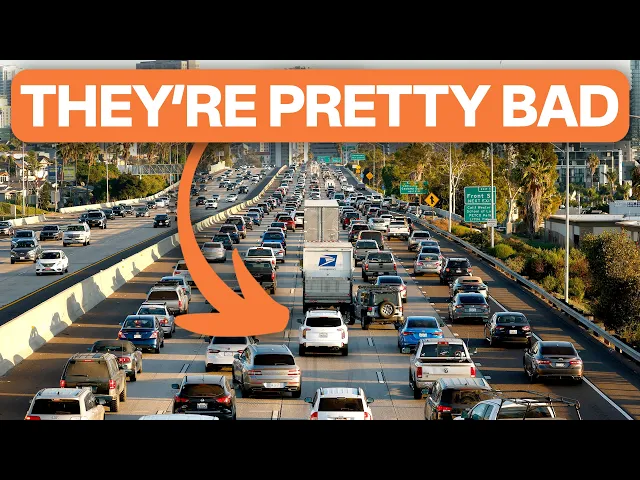
Every Reason to Hate Cars
Not Just Bikes
0:00 Cars are great.
0:01 They have revolutionized transportation around the world.
0:05 They've made it possible for people to travel long distances quickly,
0:09 they offer easier access to remote areas,
0:11 and they enable a more efficient transport of goods.
0:15 For many, cars symbolize independence, success, and adventure.
0:19 So it’s not surprising that cars have become a critical part of modern society.
0:25 And yet, if you spend any time in urbanist circles,
0:28 you'll find people who want to take away car lanes,
0:32 tear down highways, make cars drive slower,
0:35 and even remove cars completely from many places.
0:39 So why do these car-hating urbanists want to destroy our freedoms?
0:44 Well, I can't speak for all urbanists,
0:47 but I don’t actually want to eliminate cars.
0:51 I don’t own a car today,
0:52 simply because I live in a place that makes it unnecessary,
0:55 but I do have a driver’s license, and I drive whenever I need to.
1:03 So it’s not that I hate cars… it's just that I love cities.
1:09 And the fact is that cars ruin cities.
1:12 So when you ruin the cities I love then yeah,
1:16 I'm going to have a problem with that.
1:19 So let’s talk about all the ways that cars harm cities,
1:23 the environment, and people’s lives.
1:25 And maybe, by the end of this video, you might hate cars just a little bit too.
1:36 [NJB Intro] This is a paper published
1:41 by UK researchers in 2024 entitled “Car harm:
1:44 A global review of automobility’s harm to people and the environment”.
1:49 It’s a comprehensive summary of all of the harm caused
1:52 by motor vehicles that can be backed up by scientific evidence,
1:55 which is a great place to get us started.
1:58 I’m going to go over the key ideas in the paper,
2:01 and bring in other research as necessary.
2:03 As usual, all references are available at the link in the description.
2:08 Cars can be very convenient for an individual, but they create a lot of problems
2:13 for society that are ultimately paid for by everyone,
2:16 regardless of whether or not they drive a motor vehicle.
2:20 This is what economists refer to as "externalities",
2:23 the classic example being pollution.
2:25 If a factory pollutes the local water supply,
2:29 then everyone using that water is negatively affected,
2:32 but the factory owner doesn’t experience these health or financial costs,
2:37 and in many cases, even benefits from not
2:40 having to properly dispose of their pollution.
2:43 Which is why one of the primary roles of government is
2:47 to minimise the effects of externalities on the rest of society.
2:51 The Car Harm paper categorises the externalities
2:55 of motor vehicles into seven main categories,
2:57 and we’ll get to them all eventually,
2:59 but let’s start with the biggest problem of them all: cars kill people.
3:04 A lot of people, and the statistics
3:06 from the WHO in the Car Harm paper are horrifying.
3:10 They estimate that traffic crashes kill 1.3 million people per year,
3:15 and are the leading cause of death for people between the ages of 4 and 30.
3:21 The authors estimate that between 60 to 80 million
3:24 people have been killed by cars since their invention,
3:27 which would make cars as deadly as literal World War 2.
3:31 But deaths only tell part of the story.
3:35 The paper estimates that in the past 25 years,
3:38 over 2 billion people have been injured in motor vehicle crashes,
3:41 and in some cases, injuries from a car crash result in lifelong disabilities.
3:47 Cars were becoming safer over the past few decades and deaths
3:51 and injuries from crashes were decreasing…
3:54 but then the automobile industry discovered they
3:56 could make a lot more money selling giant SUVs and pickup trucks
4:00 instead of regular cars and so now deaths and injuries are going up.
4:05 Because of their heavy and tall designs,
4:07 SUVs and pickup trucks cause more deaths and injuries,
4:11 especially to other people outside of the vehicle.
4:14 This includes people in smaller cars,
4:16 but especially people who are walking and cycling.
4:19 In the EU, road deaths have decreased by 36% since 2010.
4:24 But in the US, road deaths have increased by 30% during the same time period.
4:30 Worse, pedestrian deaths in the US have increased by 80% since 2010,
4:34 and they are now at the highest level they’ve been since the 1980s.
4:40 Meanwhile EU pedestrian deaths have dropped 37%, since 2010.
4:45 So no, it’s not just because of the phones.
4:47 They have iPhones in Europe, too, but what they don’t have in Europe
4:51 are passenger vehicles as big as literal tanks.
4:54 And I have a previous video about that if you’d like to learn more.
4:58 We often talk about traffic deaths as “accidents”,
5:01 but the majority of road deaths are preventable,
5:03 which is why many safe-street advocates
5:06 are pressuring news and governmental organisations
5:08 to use the term “crash” instead of “accident” when reporting car crashes.
5:14 We know that road deaths can be reduced significantly
5:17 with safer street design and most importantly, lower speed limits.
5:21 Which is why many cities are reducing
5:23 their default speed limit to 30 kilometres per hour.
5:26 And I have a previous video about that if you’d like to learn more.
5:30 The paper also provides examples of how cars are used as intentional weapons,
5:35 in drive-by shootings, car bombs, or intentional crashes.
5:38 And they note that hundreds of cities have been forced
5:41 to install bollards to fortify public spaces against vehicle attacks.
5:45 They also reference the thousands of deaths per year from intentional car
5:50 crashes and carbon monoxide inhalation
5:52 from car exhaust as methods for self-harm.
5:55 Cars are dangerous, but they also dominate urban life,
5:59 and so everyone needs to be alert and aware of the dangers
6:02 of cars every time they go out in the city.
6:05 I was glad to see the paper talk about how every time you cross the street,
6:10 you’re engaging in a life-and-death decision process,
6:12 and I have a whole video about that if you’d like to learn more.
6:15 Yes, I made a 30-minute video about crossing the street,
6:18 but it’s worth it, if only for these stupid flags.
6:22 Of course, these are just the obvious ways that cars kill people.
6:26 If you’re lucky enough to avoid a serious crash,
6:28 cars will still play the long game, killing you slowly over time.
6:32 If you live in a place with pollution from cars, such as nitrogen dioxide,
6:36 sulfur dioxide, ozone, and particulate matter,
6:38 you’re at a higher risk of death from… basically everything.
6:42 And in case you’re skeptical,
6:43 the paper has references for every one of these assertions.
6:47 For example, this systematic review of 353 studies that shows
6:51 that motor vehicle air pollution is associated with “all-cause, circulatory,
6:55 ischemic heart disease and lung cancer mortality” It takes decades
7:00 to understand the full impact of the harms caused by environmental pollutants.
7:04 Like, we are still trying to understand the full
7:06 scope of the societal impact of leaded gasoline.
7:10 This meta-analysis published in 2022 estimates
7:13 that the phase-out of leaded gasoline was responsible
7:16 for up to 28% of the steep fall in homicide rates from 1989 to 2014,
7:22 especially in urban areas.
7:25 I remember suburbanites in the 90s saying they would never
7:28 live in the city because there was too much crime.
7:31 Turns out their cars were part of the problem.
7:34 Of all of the world’s major cities,
7:36 Paris might be doing the most to curb car traffic.
7:38 They have removed cars from major streets,
7:41 built hundreds of kilometres of bicycle lanes,
7:43 and even converted a highway into a walking and cycling path,
7:46 and I made a video about those improvements a few years ago.
7:50 The non-profit organisation AirParif collects pollution data in Paris,
7:54 and you can see the drastic improvements that these changes have made.
7:59 For decades, Parisiennes were inhaling
8:01 an enormous amount of unnecessary air pollutants,
8:03 simply because they allowed their city to be overrun by cars.
8:07 Now the city, and people’s lungs, are finally starting to heal,
8:11 and other cities are starting to take notice.
8:14 Of course the automobile industry's answer to this is electric cars,
8:18 which are an improvement, but they only resolve part of the problem,
8:22 because tailpipe exhaust is only one source of pollution from cars.
8:27 Cars release hundreds of environmental pollutants from sources such as brakes,
8:31 vehicle corrosion, lubricating oils,
8:32 and the erosion of asphalt and road markings.
8:36 The Car Harm paper also notes that even though lead has been banned in gasoline,
8:40 there is still lead in many automobile paints and many
8:44 road markings contain high levels of lead as well, especially yellow paint.
8:48 But how often is yellow used in road markings, right?
8:52 One of the biggest issues though, is tyres.
8:56 Cars are constantly wearing away at their tyres
8:59 and the road surface as they drive,
9:02 This toxic “road dust” is then spread into the environment
9:05 by rainwater or blown into the air by passing vehicles.
9:09 And since electric cars are heavier than gas cars, they do this even faster.
9:14 You may have heard about microplastics or nanoplastics:
9:17 extremely small particles of plastic that have
9:20 been found nearly everywhere in our environment,
9:23 including inside of our brains and other organs.
9:26 Whenever microplastics are discussed,
9:28 it’s usually blamed on fast fashion or disposable plastic utensils.
9:31 And we all need to drink from these stupid paper straws as a result.
9:36 But what is rarely talked about is car tyres,
9:39 even though they’re a major source of microplastics.
9:43 This 2017 study calculated that tyres and road wear particles,
9:47 or TRWP, were the single largest sources of microplastics in European rivers.
9:53 Which makes sense because very few of us are rubbing
9:56 plastic straws along the ground at a hundred kilometres per hour.
10:00 In this 2025 paper, researchers in Leipzig tested urban air for microplastics
10:04 and nanoplastics and found that 65% of particles came from tyre wear.
10:10 The paper goes on to reference research about how these kinds of small
10:14 particles increase the risk of death
10:16 from lung cancer and cardiovascular disease.
10:20 What’s worse is that we don’t know exactly what tyres are made
10:23 of, because the formulas are considered a trade secret by tyre manufacturers.
10:27 So yeah, we’re all drinking and breathing in car
10:31 tyres and we have no idea what’s in them.
10:34 In the 1980s, researchers in the US
10:36 were investigating a massive die-off in coho salmon.
10:39 After decades of research they discovered
10:42 that this was due to a byproduct of 6PPD, a rubber stabiliser used in car tyres.
10:48 More recent studies have shown that 6PPD is toxic to other fish species
10:52 as well but despite this, it is still being used in car tyres today.
10:57 I learned about this from this book, Life After Cars,
11:00 written by the hosts of the War on Cars Podcast.
11:02 It’s a great read and I can definitely recommend it.
11:05 I’ll leave a link to their website
11:07 in the description if you’d like to learn more.
11:10 Cars are by far the primary source of noise pollution in cities.
11:15 At speeds of over 30 kilometres per hour,
11:17 the loudest part of a car isn’t the engine,
11:20 it’s the sound of the tyres on the road, what’s referred to as “rolling noise”.
11:25 And since electric cars are heavier than gas cars,
11:27 they are even louder when driven at higher speeds.
11:30 Which is yet another reason for speed limits
11:32 to be 30 kilometres per hour or less in cities.
11:36 Of course that's just the noise from normal well-behaved drivers.
11:40 Urban noise gets even worse with motorcycles,
11:43 or with drivers who rev their engines or who drive too fast,
11:47 and of course everybody’s favourite noise… car alarms… I remember when I was
11:51 a kid and a car alarm would go off my mother would yell,
11:55 “just hurry up and steal it already!” The truth
11:58 is that cities aren’t loud, cars are loud.
12:01 And I have a previous video about that if you’d like to learn more.
12:06 Noise, especially constant daily noise, isn’t just annoying,
12:09 it’s also bad for human health,
12:10 and the paper lists and references several negative
12:13 health effects of vehicle noise pollution including cardiovascular disease,
12:17 high blood pressure, tinnitus, hearing loss,
12:20 anxiety, stress, sleep disturbance, and cognitive impairment.
12:24 I wish I could blame cars for the ringing in my ears,
12:27 but it’s almost certainly because...
12:29 I was a rave DJ in the 90s.
12:34 And rounding out the pollution category,
12:36 cars and car-centric environments create a lot
12:38 of light and thermal pollution in cities.
12:41 Streetlights and parking lot lights create light pollution
12:44 that has been linked to poor sleep quality.
12:46 And paved surfaces absorb and slowly release heat making
12:50 hot weather even hotter through the urban heat island effect.
12:53 And I talked about that before in my video about bad weather.
12:57 And of course, there’s the big sweaty elephant in the room, climate change.
13:01 According to the IPCC, the transportation sector accounted for 23%
13:05 of global energy-related CO2 emissions.
13:08 And a whopping 70% of that came from road vehicles...
13:12 but this is only part of the story,
13:14 because this only includes direct emissions from burning fuel.
13:18 Cars also emit CO2 in their production, maintenance,
13:21 end-of-life, and everything related to creating their fuel.
13:25 Plus the building and maintenance of car infrastructure,
13:28 especially concrete and asphalt, also releases large amounts of CO2.
13:32 Of course, anything we produce at-scale in modern society
13:35 is going to have an impact on the environment,
13:38 but we should be trying to minimise those effects as much as possible,
13:42 and human-scale cities do that much better than car-centric cities.
13:47 As the IPCC states, “Compact
13:49 and walkable urban form enables effective mitigation
13:52 while dispersed and auto-centric urban form
13:55 locks-in higher levels of energy use”.
13:58 Suburban sprawl also encourages a sedentary lifestyle,
14:01 which is known to increase your risk for… literally all causes of mortality.
14:07 Researchers at Stanford estimate that people who live in car-centric
14:10 places may take as many as 7,000 fewer steps every day,
14:14 compared to someone who lives in a walkable city.
14:17 That’s several kilometers per day, which is a non-trivial amount of activity.
14:23 The Car Harm paper quotes research calculating
14:25 that switching from commuting by car to commuting
14:28 by public transit with no other changes
14:30 burned an extra 124 kilocalories per day.
14:34 When you live in a walkable city you get
14:37 a base amount of daily exercise without even thinking about it.
14:40 I’ve referred to this before as the “Gym
14:42 of Life” and I have a previous video about that.
14:46 Car-centric places separate people from each other,
14:49 increasing social isolation, especially for people who do not drive.
14:53 Car infrastructure such as highways and parking lots separates people literally,
14:57 but cars also require everything to be farther apart.
15:01 Humans are social animals, and we are meant to be around other people,
15:05 and as the paper notes, socially isolated individuals are at increased
15:09 risk for the development of cardiovascular disease,
15:12 infectious illness, and cognitive deterioration.
15:14 Places with more cars also have fewer people around,
15:19 because people don’t like being around a lot of cars.
15:22 This study from Bristol in the UK found that people who live on streets
15:26 with higher car traffic have fewer friends and know fewer of their neighbours.
15:31 This diagram from that paper shows the connections
15:33 each resident had to other people on each street,
15:36 and you can see how connections decreased for streets with more car traffic,
15:40 especially to people living across the road.
15:42 One resident in the study was quoted, “The traffic’s like a mountain range,
15:47 cutting you off from the other side of the road.”
15:50 More cars prevent people from socializing outside their houses,
15:53 robbing them of the kind of community that can
15:56 help them to improve their mental and physical health.
15:59 The health issues caused by cars
16:01 and their pollution are very well-known and well-studied,
16:04 but they’re often shrugged off as natural or inevitable.
16:07 This effect was studied by researchers in the UK
16:10 in 2023 and they gave it the name “motonormativity”.
16:13 In one example from the study,
16:16 75 percent of respondents agreed with the statement,
16:19 “people shouldn’t smoke in highly populated areas where
16:22 other people have to breathe in the cigarette fumes”,
16:26 but only 17 percent agreed with the statement “people shouldn’t drive in highly
16:31 populated areas where other people have to breathe in the car fumes”.
16:35 Apparently the morality of releasing toxic chemicals in the air
16:39 is dependent on the source of the chemicals.
16:42 The researchers found that this pro-car bias existed across all demographics,
16:47 even by people who did not drive.
16:49 The core assumption here is that driving is inevitable,
16:52 a necessary evil, if you will, and as a result, the negative effects of driving
16:57 are viewed differently than other sources of pollution.
17:01 We are repeatedly told that cars are an absolute necessity for modern society.
17:06 And the automobile industry spends more
17:09 on advertising than almost any other industry.
17:11 If you’re watching this on YouTube,
17:13 feel free to leave a comment if you get a car ad on this video.
17:17 You know, those ads that show that driving looking like
17:19 this When the reality of it is more like this.
17:24 The only accurate car commercial ever was
17:27 that Saturn commercial from the 90s that accidentally
17:30 showed the absurd amount of space that is
17:33 wasted when everybody gets around by car.
17:40 From a young age, every one of us is exposed to automobile industry marketing,
17:43 and car companies pay to have their products
17:46 appear in every form of media available,
17:49 including popular music, TV shows, and movies.
17:53 Many car chase scenes don’t happen naturally;
17:55 they're sponsored by the company that makes the car.
17:58 It's a car ad, embedded inside of the movie.
18:02 Of course there are strict laws to ensure
18:05 that YouTubers properly disclose these kinds of sponsorships,
18:07 but those rules don’t apply to movies.
18:10 But don’t get me started on that.
18:12 But that brings us to an uncomfortable truth about cars:
18:15 there are a lot of people who make a lot of money ensuring
18:18 that we all need to buy automobiles and the fuel to go in them.
18:22 Some of the world’s wealthiest people
18:24 made their fortunes by selling fossil fuels, automobiles, and related products.
18:29 And these same ultrawealthy people spent a lot of that money on lobbying
18:33 and political donations to ensure
18:35 that our cities were designed for their products.
18:40 Car dependency was not an inevitable, natural outcome.
18:43 It was engineered this way.
18:46 I have a previous video going through this car-infrastructure
18:49 propaganda film by General Motors that provides some historical context.
18:53 Everyone is harmed by cars, but the Car Harm paper lists several demographics
18:58 who are likely to suffer more than others.
19:01 They reference several studies showing that children,
19:04 the elderly, visible minorities,
19:06 and indigenous people are more likely to be killed by cars.
19:10 For decades, car safety systems were built for the average man,
19:14 and so women are 47% more likely to be seriously
19:17 injured and 17% more likely to die in a car crash,
19:21 even after controlling for factors such as height,
19:24 weight, seat-belt usage, and crash intensity.
19:27 The paper also notes that traffic crashes are
19:29 “the main cause of injuries and trauma in pregnant women”.
19:33 Cars are very unevenly distributed across the world,
19:36 with the highest per-capita levels of car ownership being in wealthy countries,
19:40 which makes sense, because cars are expensive.
19:43 The paper references several ways in which car ownership
19:46 in wealthy countries harms people in countries with the fewest cars,
19:50 such as the fact that depleted lead batteries from cars
19:52 are dismantled in countries with extremely low levels of car-ownership.
19:56 And how people who live in countries with resources that are
20:00 used by the car industry are exposed to environmental pollution and violence.
20:04 There is no demographic though, that has been harmed more by cars than children.
20:10 The paper mentions that around 700 children are killed every day in car crashes.
20:15 Safety features like seatbelts and air bags are less effective for children,
20:18 and children hit by cars are more likely
20:21 to be killed or seriously injured than adults.
20:24 Kids who are exposed to high levels of pollution
20:26 from cars are more likely to develop leukemia and other cancers,
20:29 and car pollution puts babies at risk
20:32 of lower birth weights and premature births.
20:34 Pollution from cars also results in worse mental health outcomes in children,
20:39 including a potential 70% increase for “psychotic
20:43 experiences.” And this study found that nitrogen
20:45 dioxide pollution from cars contributes to nearly
20:48 four million cases of childhood asthma per year.
20:51 Which is insane.
20:53 When I was a kid, 58% of children in Canada used to walk or cycle to school.
20:58 Uphill, both ways, of course.
21:00 Today that number is 28%.
21:02 I have mentioned this in previous videos,
21:05 and Canadians have come up with every possible excuse to explain it,
21:08 but this is a worldwide phenomenon and the title of this paper makes it clear,
21:12 “There is too much traffic for Alex to walk to school, so we drive”.
21:17 Here's a stroad next to a high school in the neighbourhood where I grew up.
21:22 Huh, I wonder why nobody's walking here?
21:26 Children across several schools in Switzerland and Lichtenstein
21:29 were asked to draw their journey to school.
21:31 Kids who walked to school made drawings like this, showing
21:34 all of the things they encounter on the way.
21:37 I love the turtle.
21:39 But children who were driven to school made drawings
21:41 like this, which depict details at home and at school,
21:45 but with little or nothing in-between.
21:47 This last one is particularly depressing,
21:49 but all of these show that children who are driven
21:52 to school do not know much about what’s in their neighbourhood,
21:55 because they never get a chance to see it.
21:58 In a previous video I mentioned how our kids loved being in our cargo bike,
22:02 but hated being driven around by car.
22:05 When I asked them why, the answer was very clear,
22:08 because this was their view from the cargo bike.
22:11 But this was their view from the back of the car.
22:16 Once they were older, and could ride to school by themselves,
22:19 it was very easy for them,
22:20 because they already knew every street and every landmark along the way.
22:25 Kids can’t drive, or at least, they shouldn’t, and cars are dangerous,
22:29 so the more car-friendly a place is, the less-accessible it is for children.
22:34 Which means that children who live in car-dependent suburbs lack the ability
22:38 to do their own activities without being driven around by their parents.
22:42 Unsurprisingly, research has shown that kids in walkable communities get
22:46 on average 46% more exercise than kids who live in suburban sprawl.
22:51 Not to mention how boring it is to be a teenager in suburbia.
22:56 I firmly believe that walkable neighbourhoods
22:58 are better for children than car-centric suburbs,
23:00 and I have a previous video about that.
23:04 Even outside of independent travel for children,
23:07 cars make cities less accessible in general,
23:09 and the paper lists several studies that show
23:11 how car-centric places are less-accessible to people with disabilities.
23:14 As well as studies that show that people with disabilities
23:18 are more likely to be killed or injured by motor vehicles,
23:21 despite the fact that these same people are less likely
23:24 to be able to drive or have a driver’s license,
23:27 and more likely to rely on public transit.
23:30 In car-centric places, if someone cannot drive for whatever reason,
23:34 they need to rely on others to shuttle them around,
23:37 and the paper provides examples of how this can get very expensive,
23:40 especially if a person needs to rely on taxis or special
23:43 modifications to their vehicle in order to accommodate their disability.
23:47 As I’ve said before, there is no mode of transportation more
23:51 accessible than a low-floor tram with level boarding.
23:55 The paper ends this section with a quote from The International
23:59 Journal of Justice and Sustainability
24:01 “Automobility promises the annihilation of distance,
24:04 but prioritises some people’s journeys at the expense of others’.
24:08 Some distances become larger,
24:10 as when dual carriageways and fast one-way systems bisect inner-city areas,
24:14 speeding up commuters while forcing local people to detour.
24:18 Rather than dissolving space, the car economy redistributes it,
24:22 and most disabled people are among the losers,
24:25 along with people in poor neighbourhoods and children.” People with low
24:30 income are disproportionately affected by the negative health effects of cars,
24:34 because they can’t afford to buy their way out of them.
24:37 Low-income households are much more likely to live in places
24:40 with high levels of car traffic and next to highways,
24:43 because the pollution caused by cars makes housing prices cheaper.
24:48 And low-income households are less likely
24:50 to have air conditioning or proper insulation,
24:53 meaning more exposure to polluted air and noise through open windows.
24:58 This is especially true in the United States where
25:00 highway projects were typically built
25:02 through low-income and minority communities.
25:04 My friends over at Segregation by Design have some
25:07 excellent resources to learn more about this and they've
25:10 created some amazing before and after maps showing
25:13 the destruction caused by highway construction in the US.
25:19 The paper notes that low-income neighbourhoods
25:21 are also less likely to have sidewalks,
25:24 bicycle lanes, or other safe streets infrastructure,
25:26 even though the people living there have much lower levels of car ownership,
25:31 because cars are incredibly expensive.
25:34 In many car-centric cities, but especially in the US,
25:37 it is becoming increasingly difficult for low-income
25:39 households to live without a car.
25:42 In the past, wealthy families left cities for new suburbs,
25:46 which left low-income people to live in the inner city.
25:49 These were not necessarily good places to live,
25:52 but at least they were historic walkable
25:55 neighbourhoods that were built before cars existed,
25:57 so people could still get around without a car.
26:01 But with changing demographics, more investment in cities,
26:04 and urban propaganda channels like… uh… CityNerd,
26:09 people are re-discovering that cities are good places to live,
26:12 which is gentrifying urban neighbourhoods
26:14 and pushing out lower-income residents,
26:16 because we aren't building new walkable urban places to meet demand,
26:20 we're just improving the few that are left over from a hundred years ago.
26:25 So today the lowest-income neighbourhoods in the US are those suburbs built
26:30 in the 1950s and 60s that are now run-down and no longer desirable.
26:36 But these are places that were built to be car-dependent,
26:39 and car ownership is required here.
26:42 To give an idea of the scale of the problem,
26:44 a report from the Brookings institute found that between 2000 and 2012,
26:48 the number of suburban poor living
26:50 in distressed neighborhoods grew by 139 percent,
26:53 which was almost three times the pace of growth in cities.
26:58 Between the up-front cost of a car, maintenance costs, gasoline, and insurance,
27:02 the average cost of owning a car in the United States is over $12,000 per year.
27:08 Which is why in the US, the lowest-income households spend an average
27:12 of 32% of their pre-tax income on transportation.
27:15 In the EU, total cost of car ownership varies between member states,
27:20 but is typically between €9.000 to €14.000 per year.
27:25 If you live somewhere with good public transit or cycling infrastructure,
27:28 car ownership might be optional,
27:30 but if you live somewhere car-dependent, it is not.
27:34 Car-centric suburbs are engineered so that every single household needs
27:38 to own and operate at least one motor vehicle just to live.
27:41 You can’t even buy a bag of milk here without a car.
27:47 Cars and related transportation infrastructure like asphalt are
27:51 the largest consumers of oil in the world,
27:54 and the Car Harm paper references a study that estimated that 25 to 50
27:58 percent of all inter-country wars since 1973 were started due to access to oil.
28:04 The cost of those wars and uh, “military actions” that are totally not wars,
28:10 guys, is staggering, in terms of both human lives and money.
28:14 This isn’t just the cars’ fault, but it’s not not the cars fault either, right?
28:19 Drivers often complain about how expensive it is to own a car,
28:23 and there is a common belief that drivers are subsidising everybody else.
28:27 I used to live in the UK,
28:29 and motorists there would routinely complain how unfair it
28:31 was that cyclists didn’t need to pay any road tax.
28:35 The truth is that driving is expensive simply
28:38 because cars and car infrastructure are ridiculously expensive,
28:41 and despite the costs that drivers pay, it is drivers who are subsidised,
28:47 even in countries with high taxes on fuel and automobiles,
28:50 especially once you include the cost of local streets and roads within cities.
28:55 The Car Harm paper references a study in Australia which found
28:58 that only⅙ of the total costs of automobility are paid for by motorists,
29:02 with the rest being paid for by society.
29:05 A German study that estimated that 30% to 40% of the total cost of a car
29:09 was paid for by government subsidies and a higher
29:12 price of goods and services for everyone; even people who don’t drive.
29:16 And an EU study that calculated that for every kilometre driven,
29:20 cars cost society €0,11, while walking and cycling actually benefit
29:24 society once health effects are included.
29:27 There are so many direct and indirect ways that driving is subsidised.
29:31 Consider a car crash.
29:33 Within a short period of time, dozens of emergency workers will show up.
29:37 Police.
29:37 Ambulance.
29:38 Fire fighters.
29:38 The injured will be taken to hospital.
29:41 Damage to the road and the surrounding buildings will be repaired.
29:44 This costs millions of dollars every time it happens,
29:47 and everyone pays for it, not just drivers.
29:50 Of course to reduce the number of crashes, and the loss of life,
29:53 every city employs a whole team of police officers to enforce traffic laws.
29:58 Drivers don't pay for this either.
30:00 Everyone does.
30:02 Car parking, though, is one of the worst examples of automobile subsidies.
30:07 It is extremely common for cities to have laws
30:10 that require a minimum number of parking spaces to be provided.
30:14 These minimum parking requirements are particularly
30:16 bad in US and Canadian cities, which is why it's common to see parking lots
30:21 that are larger than the shops they’re attached to.
30:24 And in almost all cases, this parking is completely free.
30:29 The owner of the store has to pay for the construction,
30:32 maintenance, and property taxes on this land,
30:34 so the price of everything in the store has to be
30:37 a little higher to cover the costs of the free parking.
30:41 But groceries are the same price whether you walk or drive,
30:44 so people who do not drive subsidise the people who do.
30:49 This is also a major reason why many US and Canadian downtowns are hollowed out,
30:54 because in order for a business to open they would need
30:57 to ensure that there are enough
30:58 off-street parking spaces available to meet requirements.
31:01 The downtown in my hometown looks
31:04 like this, because dozens of historic buildings
31:07 were bulldozed in order to provide enough parking spaces for all the cars.
31:12 These hidden societal costs of parking have been well-documented in the book,
31:16 "The High Cost of Free Parking" by Donald Shoup.
31:20 One example from the book is the Disney Concert Hall,
31:23 built in downtown Los Angeles.
31:26 In order to meet minimum parking requirements,
31:28 a $100 million parking garage was built,
31:31 paid for by the Los Angeles county through the sale of public bonds.
31:36 As a result, the orchestra was required to increase the number
31:39 of performances to a minimum of 128 concerts per year,
31:43 to generate enough parking garage revenue,
31:45 just to service the debt on the construction of that parking lot.
31:49 If you want to learn more about how much parking costs society,
31:53 my friends over at Climate Town made a full
31:56 video about it that is definitely worth a watch,
31:58 I’ll leave a link in the description.
32:01 Parking also increases the cost of new housing because the cost
32:05 of the parking is rolled into the cost of the housing.
32:08 For multi-level parking garages,
32:10 every parking spot adds $25,000 to $75,000 in cost.
32:14 The Car Harm paper references a specific example of an affordable
32:20 housing development in California where
32:22 parking raised construction costs by 38%.
32:26 The housing crisis in Canada is one of the worst in the world,
32:30 but whenever I’ve seen new housing projects proposed,
32:33 the same concerns were brought up every time: where will these new people park?
32:37 How much more traffic will this development create?
32:40 These objections happen in cities everywhere and, in some cases,
32:44 concerns about traffic and parking kill the project completely.
32:47 Cars take up a lot of space,
32:50 which means that car-friendly places push everything farther apart.
32:54 For every kilometre of road or parking lot,
32:57 the city needs to put in an additional kilometre of electrical wire,
33:00 water pipes, sewage pipes, and asphalt.
33:02 Costs for other services such as garbage collection and emergency
33:06 services also increase as destinations are pushed farther apart.
33:11 But these same sprawling neighbourhoods also collect less tax revenue,
33:15 because there are fewer people and fewer businesses in a given area.
33:19 The result is that car-centric places are unable
33:23 to afford the replacement cost of their infrastructure,
33:26 and even wealthy suburbs rely on subsidies from dense
33:30 urban areas in order to stay financially solvent.
33:33 Car infrastructure is horrendously expensive,
33:36 and automobile projects put a strain on transportation budgets,
33:39 leaving less money for much more cost-effective
33:42 and financially responsible infrastructure projects for walking,
33:45 cycling, and public transit.
33:48 I’ve seen people up in arms about the cost of modest
33:51 bike lane projects that cost tens of thousands of dollars,
33:54 but think about how many traffic lights
33:56 you pass as you travel through your city...
33:58 and then realise that every single one
34:00 of those installations costs around 250 thousand dollars.
34:03 And sometimes up to half a million dollars for more
34:08 complex installations The astronomically high cost of new road and highway
34:14 projects is often justified by questionable calculations of how much
34:17 traffic congestion is costing people
34:19 through “wasted time” and “lost productivity”.
34:22 Funny how these same calculations are
34:24 never used to justify building public transit,
34:26 they're only used to justify building more of the highways
34:29 that created those traffic congestion costs in the first place.
34:34 It's insane that highway 401 through Toronto,
34:37 is the busiest highway in all of North America.
34:40 And yet it moves fewer people per day, Than line 1 of the Toronto subway.
34:47 Not the whole subway system.
34:49 Just line 1.
34:52 Of course, the part that is rarely accounted for when talking about road
34:55 infrastructure is the replacement cost of the infrastructure
34:58 at the end of its life, which will inevitably cost more than it did to build it.
35:02 For example, construction of the Gardiner Expressway in Toronto
35:05 cost about a billion dollars to build in today’s money.
35:08 But decades later, when it was crumbling
35:10 and pieces were literally falling off of it,
35:13 the government had to spend over five
35:15 billion dollars to rehabilitate just part of it.
35:19 Ultimately cities pay for these large infrastructure projects with debt
35:22 and the promise of future growth to pay back that debt,
35:25 which is becoming a serious financial problem for many cities,
35:28 especially in the US.
35:30 This is the core message of Strong Towns,
35:33 a non-profit organisation in the United States that has studied this effect
35:37 extensively in hundreds of towns and cities over the past decade.
35:41 I have a playlist of videos from the early days
35:44 of this channel that explain the research of Strong Towns,
35:46 and I’ll leave a link to it in the description.
35:50 One analysis I find particularly interesting is that of Urban3,
35:54 a consulting company that works with municipalities in the US and Canada.
35:58 They have created maps of cities they’ve worked with to show
36:01 which neighbourhoods are financially productive
36:03 and which require subsidies to operate.
36:06 This analysis consistently reveals that traditional
36:09 walkable neighbourhoods subsidise car-centric places,
36:12 especially wealthy car-dependent suburbs.
36:13 I made a video about Urban3 and I’ll leave a link to that in the description.
36:20 One of the fundamental problems is
36:22 that car-centric development encourages bad land use.
36:25 Ontario Canada, where I’m from, destroyed an average of 319
36:30 acres of farmland per day between 2016 and 2021.
36:35 Yeah, Canada is big, but it doesn’t have an infinite amount of good farm land,
36:39 especially good farm land that’s close to cities.
36:42 The Car Harm paper also notes that low-density development and roads
36:46 are the primary drivers of habitat disruption and a reduction in biodiversity.
36:51 They estimate that the number of vertebrates,
36:55 what most people would just call “animals”,
36:57 that are killed by cars each year to be over 1 billion.
37:01 They also reference that sprawling developments increase
37:04 the risk and costs of forest fires,
37:06 and that asphalt and other impermeable surfaces
37:09 increase the number and severity of floods.
37:13 This bad land use is also the reason why
37:16 reliable public transit is not feasible in car-centric places,
37:19 and I’ve talked about that before in a previous video.
37:23 The paper notes that one car passenger consumes as much
37:27 space as nearly 20 bus passengers, and has a very,
37:30 uh, interesting way of expressing space in terms of metres
37:34 squared per hour per person for each mode of travel.
37:38 Regardless of how it’s calculated though,
37:40 cars are an incredibly inefficient way to transport people through cities,
37:44 and if left unchecked, they will consume all of the space between buildings.
37:50 Of course many cities “solved” this problem by knocking
37:53 down the buildings to give the cars more space.
37:56 Isn’t it beautiful?
37:57 There are very few buildings to go to anymore,
38:00 but at least there’s plenty of parking!
38:03 For any entrepreneur, it’s much easier to start a business,
38:06 and for that business to be sustainable, in a place with a lot of foot traffic.
38:11 Which is why walkable urban neighbourhoods
38:13 are more interesting than car-centric suburbs.
38:15 Tokyo is a dense city well-known for having
38:18 a variety of extremely specialized small businesses.
38:21 Menswear expert Derek Guy has mentioned many times before
38:25 that Tokyo has hundreds of unique clothing and shoe options available.
38:30 And that’s because these craftsmen and women
38:33 are able to operate their highly-specialized stores
38:36 because they can keep their costs down
38:38 by renting small urban spaces for their shop,
38:41 living nearby, and relying on foot traffic for business.
38:45 By comparison, retail and restaurant options in car-dependent
38:48 suburbia are mostly limited to established big box
38:51 stores and chain restaurants that are able to rely
38:54 on brand recognition to fill the parking lots.
38:58 Of course big box stores create a lot more problems for cities,
39:00 but I have a previous video about that already.
39:04 Space is a precious resource within cities,
39:06 and so it always pains me to see it covered by asphalt.
39:10 Which is why I so often feature those cities that are reclaiming space
39:15 from cars to make the city better for the people who live there.
39:20 Which finally brings us to the topic that I
39:22 talk about more often than anything else on this channel:
39:26 urban places are fundamentally better when there are fewer cars.
39:31 I’ve been to hundreds of cities around
39:33 the world and I’ve seen the same thing everywhere,
39:35 which is why I’ve started to call it the Universal Law of Cities,
39:39 which states, “the more car-friendly a place is,
39:42 the shittier it is to be there.” Even at the best of times,
39:48 cars are loud, dangerous, and they take up a lot of space,
39:51 so people don’t feel comfortable hanging around in places with lots of cars.
39:56 But this really shouldn’t be a surprise, because the truth is,
40:00 everybody hates cars, or rather, everybody hates other people’s cars.
40:04 Even people who drive everywhere and like driving hate
40:08 it when there are too many other people’s cars around.
40:12 Other people’s cars creating traffic.
40:14 Other people’s cars filling up parking spaces.
40:17 Other people’s cars driving too fast down their street.
40:21 That’s why car-dependent suburbs have these curvy,
40:24 windy streets, full of stop signs.
40:26 They’re specifically designed so that driving here is inefficient,
40:30 to discourage other people’s cars from driving through MY neighbourhood.
40:33 And it’s why houses on dead-ends and culs-de-sac are the most desirable,
40:38 even for suburbanites,
40:40 because there’s less car traffic from other people’s cars.
40:44 We can’t build our way out of this.
40:47 Widening roads and building new highways has
40:50 been shown to induce travel demand for automobiles,
40:53 and building sprawling car infrastructure is not financially viable anyway,
40:57 even before you factor in all of the negative
41:00 effects of cars on our health and well-being.
41:03 As the Car Harm paper puts it: “While some people benefit from automobility,
41:08 nearly everyone—whether or not they drive—is harmed by it.
41:12 Slowing automobility’s violence and pollution
41:15 will be impracticable without the replacement
41:17 of policies that encourage Car Harm with policies that reduce it.” So
41:22 the paper ends with a list of interventions that have been
41:26 proven to reduce car use and some of their negative health effects.
41:30 This list includes, Congestion charges and road pricing,
41:34 Removing most on-street parking,
41:36 Replacing minimum parking requirements with maximum parking
41:40 limits Building car-free and nearly car-free areas,
41:45 Reducing speed limits, Converting parking into mixed-use developments,
41:50 And encouraging the use of bicycles,
41:53 ebikes, micromobility and car-sharing as alternatives.
41:56 These are all topics that I have talked about multiple times on this channel.
42:01 And not even because I want to eliminate cars,
42:04 but because I want cities to be better.
42:07 I have heard from literally hundreds of self-described
42:11 “car people” who are fans of this channel,
42:15 because it’s not about whether or not you love cars or hate cars,
42:19 it’s about having healthier,
42:20 more livable cities and choice of how you get around.
42:25 Ultimately it really is about freedom.
42:27 The freedom to not to have to drive.
42:31 There are a lot of people who want to live without a car.
42:35 Research from just this year, in the car-lovin’ USA,
42:38 found that nearly 1/5th of adults who currently own
42:42 a car showed a “very strong” desire to live car-free,
42:46 and an additional 40% were open to the idea.
42:50 It would be crazy not to make it possible for some of those people to do that.
42:56 Even if you love driving, wouldn’t it be great if you could take an enjoyable
43:00 walk to many of your daily destinations whenever you wanted to?
43:03 If your kids could ride their bikes
43:05 or take public transit to wherever they’re going,
43:08 without you having to be their chauffeur?
43:11 If your elderly parents– who really shouldn’t
43:13 be driving– could get around safely by themselves?
43:16 And if people with a wide range of disabilities could do the same,
43:20 without needing other people to shuttle them around?
43:22 And wouldn’t it be great if, when you genuinely did need to drive,
43:27 there were fewer other people’s cars on the road,
43:29 so that your drive was more efficient and less stressful?
43:33 And wouldn't it be great if your city was quieter,
43:36 cleaner, safer, healthier, friendlier, more social, and more enjoyable?
43:42 Cars were a revolutionary invention; there is no denying that.
43:46 But in our excitement to usher in this new technology,
43:49 we completely ripped up the way our cities had worked for thousands of years.
43:55 And the results have not been positive.
43:58 It’s not that cars aren’t useful- they absolutely are.
44:01 But cars cause a lot of serious problems, too.
44:04 Both of these statements can be true.
44:07 It is stupid to say that we should ban all cars everywhere.
44:12 But it’s equally stupid to allow people to drive whatever they want,
44:17 wherever they want, whenever they want,
44:19 and to allow cars to consume so much space in our cities
44:22 and to cause so much damage to our health and well-being.
44:26 The most frustrating part to me though,
44:29 is that cars aren’t nearly as necessary as we’ve been led to believe.
44:34 There are certainly some cases where people need a motor vehicle,
44:37 but after travelling the world, and living in dozens of different cities,
44:42 I am absolutely convinced that, if our cities were designed properly,
44:47 the majority of people could live without a car– just like
44:50 our family does– and their lives would actually be better as a result.
44:55 And ultimately, this is the reason why this channel exists,
44:59 and it’s why I spend so much time talking about
45:02 the cities that have made it possible to live a happy,
45:05 healthy life without a car.
45:07 We need to start treating cars like a tool.
45:10 A tool that can be useful,
45:12 but that can also be dangerous and destructive, especially when used too much.
45:16 Or worse, when they become the only option available.
45:21 So they’re a tool we need to use carefully, when absolutely necessary.
45:25 And only after trying better solutions first.
45:28 Because, I can tell you from experience, the absolute best kind of urban places,
45:33 are those where cars aren’t even needed at all.
45:38 If you want to learn more about how cities could be better,
45:40 I’ve provided links to several relevant
45:42 Not Just Bikes videos in the description.
45:44 As well as links to other great urbanist creators, including City Beautiful,
45:48 a professor of urban planning with a talent for teaching,
45:51 And CityNerd, a former traffic engineer and urban
45:54 planner who masterfully delivers deadpan humour in highly-researched videos.
45:59 Most of these videos are on YouTube,
46:01 but the best place to watch them is on Nebula.
46:04 There’s a whole section on Nebula that’s dedicated to Urbanism,
46:07 that includes videos by urbanist creators,
46:09 as well as videos by other creators when they cover urbanist topics.
46:14 And if you can, I’d really encourage you to watch these videos on Nebula,
46:17 because it directly supports the creators.
46:19 This isn’t an advertisement, or a paid sponsorship, this is just fact.
46:23 I would not be able to afford to make the videos that I do,
46:27 if it wasn’t for the support that I get from Nebula.
46:30 In fact, Nebula recently helped me to finance
46:33 and produce a brand new show called Day Pass, which is available now, on Nebula.
46:37 Day Pass is a travel show where I take you
46:40 around a city to see interesting urbanist and cultural locations,
46:44 while also riding as much public transit as possible.
46:47 I’m really happy with the way Day Pass turned out,
46:50 and I think it’s a great example
46:52 of a show that wouldn’t be possible without Nebula.
46:55 And that’s because Nebula is a streaming
46:57 service that’s owned and operated by creators,
47:00 not venture capitalists, private equity, or big tech.
47:03 Which is why Nebula can afford to support creators and provide
47:07 a platform for them to make the videos they want to make,
47:10 without worrying about demonetization or algorithmic optimization.
47:13 When you sign up to Nebula, you not only support this channel and get
47:19 early access to all of my future videos, you also get access to thousands
47:22 of videos from over 250 other talented creators.
47:26 All without any ads or sponsorships.
47:29 You’ll also get access to Nebula Originals,
47:32 which includes unique shows like Day Pass,
47:34 but also documentary films and many other
47:36 videos that are only available on Nebula.
47:40 It’s amazing what can be accomplished when you cut big tech out of the picture.
47:45 Nebula also has gift cards,
47:46 and my Dutch viewers will be glad to know you can buy them with iDEAL.
47:50 You can even send one to yourself if you
47:52 just want to try Nebula without using a credit card.
47:56 So if you want to support a streaming
47:58 service with lots of original high-quality videos,
48:01 that’s also dedicated to making creators the best that they can be,
48:04 then consider signing up to Nebula.
48:06 If you sign up using the link go.nebula.tv/notjustbikes,
48:09 or buy a gift card at gift.nebula.tv/notjustbikes,
48:15 then you’ll support this channel financially
48:17 and get 50% off an annual subscription.
48:20 Thanks to everyone who supports this channel on Nebula, on Patreon,
48:23 or even here on YouTube by watching this video all the way through to the end.
48:28 I appreciate it.