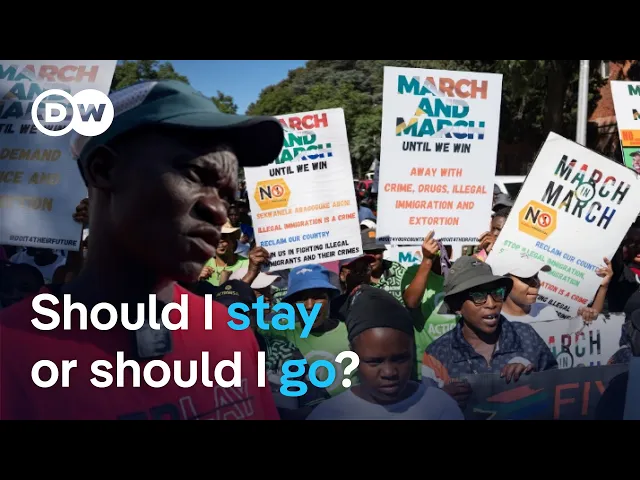
Anti-immigrant uprisings in South Africa force foreign nationals to consider leaving | DW News
DW News
0:00 Hello, I'm Christine Munda.
0:01 Welcome to DW News Africa.
0:03 Should I stay or should I go?
0:05 That is the question running through the heads
0:08 right now of many migrants from across
0:10 Africa who've made South Africa their home
0:12 only to find their children denied schooling,
0:15 themselves harassed in hospital when they seek healthare
0:18 and their barricaded businesses looted and burnt out.
0:21 Violence against foreign nationals has flared up again and again in South Africa
0:25 and many people now fear that tongues of that flame seem to be flickering again.
0:30 Hundreds of South Africans have been taking to the streets
0:34 of major cities they say to protest high levels of illegal immigration.
0:39 South Africa's economic opportunities attract migrants both
0:42 legally and also without the necessary papers.
0:45 Now, anti-immigration groups say they want strict
0:48 enforcement of the law and mass deportations.
0:54 Now, many of those groups are not new,
0:56 but the umbrella is the anti-immigration organization March and March.
1:01 It's attracting similar groups including Operation Dudullah
1:05 and political parties Action SA and Patriotic Alliance.
1:09 Now, March and March has gained prominence
1:11 in South Africa by mobilizing demonstrations against illegal immigration.
1:16 Our reporter caught up with Justinta Gves Zuma, founder of March and March.
1:20 Take a listen.
1:23 Well, today's march is um a continuation of our grievances to our government uh
1:28 to further reinforce our stand that uh we
1:30 are tired of illegal immigrants in South Africa.
1:33 And uh more than anything we are being
1:36 labeled as xenophobic today because of the government who
1:38 failed to act on people who are not supposed
1:41 to be in the country in the first place.
1:43 And now they have come into the country they're conducting themselves
1:46 in the most ridiculous of manners and nobody points their attention at them.
1:52 It's always South Africans who are xenophobic.
1:54 The amounts of crime that we have to put
1:55 up with at the hands of illegal immigrants.
1:57 I mean, even the police right now have
2:00 been on the lookout for um a foreign national,
2:04 was it Sibande who killed two policemen in in in public,
2:08 but they haven't been able to find him for months now.
2:11 And it's further proof.
2:12 If they are killing policemen, who are we as South Africans?
2:16 So, we're tired of of being labeled as xenophobic.
2:18 In fact, we don't even care if you call us that anymore.
2:21 But we're not going to sit by and watch our country be
2:23 destroyed at the hands of foreign nationals who've got nothing to lose because
2:27 they know they can always go back to their country while we have
2:29 everything to lose because this is this country is everything that we have.
2:34 That may sound reasonable, but there are other voices in this movement.
2:37 Get out is the brutal message that anti-immigrant marches
2:41 in South Africa had for immigrants in major cities.
2:45 And it's not the first time that they've heard such words.
2:48 Since 2008, the country has seen periodic spikes in tension.
2:52 So why does violence against foreign nationals keep flaring up in South Africa?
2:56 Well, DW's Southern Africa correspondent Diane Hawker Kalubi takes a look.
3:00 And we should warn you, her report begins with offensive language.
3:05 Go back TO YOUR COUNTRIES.
3:06 WE ARE TIRED OF YOU GUYS.
3:09 GO BACK TO YOUR NONSENSE.
3:12 DON'T DESTROY YOUR COUNTRY.
3:14 YOU COME TO SOUTH AFRICA to destroy your country.
3:19 Strong words from a South African woman speaking to African
3:23 and Asian immigrants in South Africa's capital of Ptoria.
3:29 She's one of hundreds of people who
3:31 recently marched demanding that immigrants leave the country.
3:36 It's not the first time immigrants have been targeted in South Africa.
3:42 In 2008, large xenophobic clashes saw thousands displaced.
3:48 In 2015 and 2017, African and Asian immigrants were again
3:53 chased out of townships and forced to close their businesses.
3:58 Since 2021, several anti-immigrant groups have gained prominence in the country,
4:03 with some even contesting for national office.
4:07 In these instances, the complaints were similar.
4:11 Not enough jobs, limited resources, and inaction from the government.
4:17 Analysts say to understand why anti-immigrant sentiment keeps resurfacing,
4:22 you have to look at broader frustrations with the government.
4:27 In the last few years, every year since 2023,
4:31 we've had over 23 protests a day on average in South Africa.
4:36 The majority of those protests are about service delivery,
4:39 are about housing, about corruption, and are about joblessness.
4:45 So when you add to that the question of immigration,
4:49 you must realize that you are adding it to a wide range of issues that people
4:53 are raising and a wide range of factors that are driving people's um you know,
5:00 dissent and and discontent.
5:03 Anti-immigrant groups have also complained that there
5:07 are too many undocumented immigrants in the country
5:11 and the government acknowledges that it
5:13 needs to improve the border management process.
5:16 This year it proposed immigration reforms but these are yet to become law.
5:21 We must also realize that government knows that it is also part of the problem.
5:26 It is also part of the reason why um we we
5:29 aren't able to have a checked wellac accounted for immigration system.
5:34 So the system is failing everyone including immigrants.
5:37 Um and and South Africans know the government is not going to step up.
5:41 For those who sought better opportunities in South Africa,
5:45 a new tough decision awaits to stay and face angry protesters or return home.
5:52 The Nigerian Citizens Association of South Africa is trying
5:56 to help hundreds of Nigerians get back to their home country.
6:00 We've received over 300 names that have submitted willingly
6:05 and voluntarily that they will want to be assisted.
6:08 They've long wanted to go home.
6:10 But the resources with which to go home,
6:12 the flight ticket or maybe how they will
6:15 continue to maintain their livelihood or family here, it's very very difficult.
6:19 The economy is not favoring them.
6:22 Quo says he's been in South Africa for 20 years and considers
6:26 Johannesburg his home but admits
6:29 that the current political climate has him concerned
6:33 during the past the last serious one I think
6:35 it's 2019 or thereabout where many businesses were damaged.
6:40 It affected me as well because I I have to move out
6:43 of my my residence at as a den because it was a targeted
6:48 area and moved you know into another secure place for safety
6:52 of my children and my livelihood and you know it took quite some time.
6:57 Money was lost, income were lost,
6:59 businesses were closed and but then at the end of the day we
7:03 have to pick our piece of our body together and continue to move.
7:07 We love South Africa.
7:10 The South African government has assured immigrants that it
7:12 will crack down on any criminality linked to immigration protests.
7:20 The hostility which is mostly directed towards
7:22 African nationals has set alarm bells ringing across
7:25 the continent with many governments summoning diplomats
7:28 and issuing warnings to their citizens in South Africa.
7:30 Ghana has reported South Africa to the African Union,
7:33 formerly asking for the recurring attacks on foreign nationals in South
7:36 Africa to be put on the agenda at an upcoming AU meeting.
7:41 Ethiopia's embassy in Ptoria advised its citizens to report
7:44 incidents of violence after five of them were reportedly killed.
7:48 Kenya's diplomats in Pritoria have advised all Kenyan nationals
7:51 in South Africa to remain vigilant and carry valid identification.
7:56 And last month, Zimbabwe's embassy issued an urgent
7:59 safety advisory to its nationals, advising vigilance.
8:02 Guinea Basau's prime minister has summoned South
8:05 Africa's ambassador to express his deep concern.
8:08 But it is perhaps Nigeria and Mozambique
8:10 which have been most vocal in their criticism.
8:16 Now Mozambique and South Africa share a land
8:18 border where many have been moving in one direction.
8:22 Fear fueled by reports of violence spreading rapidly on social
8:25 media has moved many Mozambicans to return to their homeland.
8:30 Our reporter was there caught up with Daniel Timote Godinho.
8:34 He's a vegetable trader.
8:35 He told EW that after 26 years living in South Africa,
8:39 he did not need to witness an attack to feel that it was his time to leave.
8:45 I am returning from South Africa because
8:47 of the attitude of South Africans towards Mozambicans,
8:51 Nigerians, Angolans, and Zimbabweans.
8:53 That is why we are coming back home because we are suffering in South Africa.
8:58 I can't even continue my tomato business anymore.
9:03 What is happening in South Africa?
9:07 South Africans don't want foreigners anymore.
9:13 They hurt us.
9:15 They assault us.
9:20 Did you see people being assaulted?
9:22 Not in person, only on social media.
9:29 And are you returning home out of fear?
9:32 Yes.
9:33 I left nothing behind in South Africa.
9:35 All my belongings are in the car for the journey home.
9:38 If the situation improves, maybe I will return to South Africa.
9:42 I don't know yet.
9:48 Well, so great the concern that President Daniel
9:51 Chapo travels to meet his counterpart in Ptoria, President Sir Ramaporsa.
9:55 The two men meet extensively uh to discuss economic cooperation.
10:00 But it became clear that Ramaporosa was addressing deeper concerns.
10:04 Does the Rainbow Nation have a problem with other black Africans?
10:08 Well, here's what South Africa's president had to say.
10:12 So, as also to deal with troubling issues such
10:16 as uh what we have experienced in South Africa,
10:20 which I have spoken about that South Africans
10:24 inherently are not against people from other nations.
10:29 We are one people.
10:31 We have always been one people.
10:34 And of course, we've got to also pay heed to the security
10:40 of those from other countries who are in South Africa,
10:44 but also pay heed to the concerns that are being raised by South Africans.
10:50 President Chapo and myself discussed this matter
10:53 and we agreed that we should work together.
10:56 uh it's not only one country that is affected and all countries that have
11:01 foreign nationals in South Africa are also affected as South Africa is affected.
11:07 So we must all work together, join hands to find solutions to this problem.
11:16 And in the past we have found solutions and we say South Africans
11:22 do not have a hatred to other people from other countries on our continent.
11:30 They have support.
11:31 They supported us during our struggle and much as South
11:35 Africans are going through tough economic challenges right now.
11:41 We also need to be acting as people who
11:46 are kind and welcoming to other people from other nations.
11:51 But we also say to employers in South
11:54 Africa that uh we've passed a law that people
11:58 who do not have the necessary work permits
12:02 in South Africa yes should not be employed.
12:06 we should give way to South Africans and at the same
12:09 time we encourage all people from other nations to make sure
12:14 that they have proper documentation to be in South Africa like
12:19 South Africans need to have proper documentations to be in other countries.
12:24 Well, as we heard from the Nigerian
12:26 Citizens Association of South Africa earlier,
12:28 hundreds of Nigerians who are resident there have asked their government to help
12:33 them repatriate after the rise in attacks
12:36 against foreign nationals in the country.
12:38 Nigeria's foreign ministry has condemned the violence against them,
12:41 but stopped short of helping them return home.
12:44 If you stay here long enough,
12:46 somebody's going to tell you to go back to your country.
12:48 So, yes, that's my back.
12:51 I'm going back to my country.
12:53 Many like this Nigerian man are leaving South Africa.
12:56 But if you want to leave, you'll have to pay your own way.
12:59 That's what the Ministry of Foreign Affairs is saying.
13:03 He's selfunded.
13:05 He's selfunded.
13:05 So you are not waiting for an aircraft
13:07 from Nigeria to convey you to either Lagos or Abuja.
13:11 The ministry says those who want
13:13 to return can do so voluntarily and independently.
13:17 They have also asked South African authorities to take stronger action.
13:21 whose federalism is in place.
13:23 The government of Nigeria condemned
13:24 the violence against Nigerians in South Africa.
13:27 But as a country, we said we are not satisfied with just mere statement.
13:32 We need actions from the South African government to find you've
13:36 given us the asurances but for this time around we want
13:40 tangible proofs that you have taken a B CD actions
13:44 to ensure and guarantee the safety of Nigerians living in South Africa.
13:50 South Africa has a lot of business interests in Nigeria.
13:53 In Abuja, people say their government needs to act
13:56 with more urgency to protect fellow Nigerians abroad.
14:02 For over 4 months now,
14:05 this xenophobic attack on Nigerians and other African nationals living
14:08 in South Africa has not attracted the condemnation of Syria,
14:13 who is the president of South Africa.
14:15 What our government have to do is to layers with the South Africa government,
14:22 layers with South Africa government and see how
14:25 they can able to stop it because this is not the first time this issue has been
14:30 coming up where they start mreating foreigners, killing foreigners.
14:36 Talking is a step but I feel that sanctions will do much better for now.
14:41 Nigerians who want to get here back home will have to fend for themselves.
14:48 To get some more reporting on the fallout
14:50 of the attacks on foreign nationals in South Africa,
14:53 we're bringing in our correspondents Diane Hawker
14:56 Kalubi in Johannesburg and Azizat Ola in Lagos.
14:59 Welcome to you both.
15:01 Uh Azizat to you first.
15:03 The Nigerian government has said Nigerian nationals who want to leave South
15:07 Africa and return to Nigeria have to make their own way home.
15:12 What more can you tell us?
15:16 Absolutely.
15:17 That was what the spokesperson of the Nigerian foreign
15:19 affairs ministry said that uh it's a voluntary repatriation.
15:23 So it means that whoever wants to come back home to the country
15:26 have to fund their own travel uh basically with their families.
15:30 And he also said that there are actually two categories
15:33 of Nigerian citizens in South Africa
15:35 who have uh indicated voluntary repatriation.
15:38 On one side there are those who have
15:40 um complete documents to stay legally in South Africa
15:44 and on the other those that have uh
15:47 do travel documents violations or uh resident permit violations.
15:51 So it means that they need to have
15:53 like a discussion with the authorities in South Africa
15:56 to be able to allow them to have like
15:57 a leeway out of the country back to their home.
16:00 So the discussion is on ongoing.
16:02 So the the main uh information like you said is that whoever
16:06 wants to come back home has to foot the bill for themselves.
16:11 And Diane, as we understand it,
16:12 demonstrations against illegal migration organized uh
16:17 by the group March and March are continuing.
16:20 Are foreign nationals also still being blocked from accessing some public
16:24 schools and hospitals as has been happening uh in recent weeks?
16:31 Well, in terms of the march and march tactics,
16:34 it seems like they focused more on marching in large groups in South
16:38 Africa's major cities and not so much with the hospital and school blockades.
16:43 There was a school blockade that happened um at the end of April,
16:47 but now they've gone to Ptoria, Johannesburg,
16:50 and most recently to the Durban city center to march.
16:54 and the approach seems to be more focused
16:56 on handing over letters of demand to provincial
17:00 and municipal leaders who they feel need
17:03 to act um to meet some of their demands.
17:06 uh their main issue seems to be that uh they
17:09 believe that uh the the government should be in uh
17:12 uh improving on immigration processes but also ring fencing
17:17 certain jobs and certain sectors for South Africans and that's
17:21 why they focused more on handing over these memoranda
17:25 to different uh government officials and just staying with you
17:29 uh Diane the South African government has condemned what uh
17:33 one official described as vigil anti attacks on foreign nationals.
17:38 But have the authorities also stepped up
17:41 to protect people uh that are being targeted?
17:47 Well, what we've seen mostly is that there's
17:50 been a large police presence during the marches themselves,
17:54 but the vigilante attacks tend to happen uh very sporadically and sometimes
17:59 on the sidelines of these marches and sometimes they have been
18:02 happening completely separated from from that and that seems to be where
18:06 the police and government officials are really playing a lot of catch-up.
18:11 For example, in Tambisa, we saw on Wednesday that uh there was a group
18:16 of of people marching around that area demanding that foreignowned shops,
18:21 immigrant-owned shops close their doors.
18:23 Um, and there wasn't a significant police presence there.
18:26 And I think that is one of the issues um
18:29 that many people in the immigrant community raise here that the government's
18:32 response does tend to be um delayed and doesn't always
18:36 seem to know what's happening when it is actually happening.
18:40 Aziz, there have been high level
18:42 diplomatic talks between South Africa and Nigeria.
18:45 Where do things stand?
18:51 Absolutely.
18:51 and things stand on one understanding and that is that the safety
18:55 of Nigerians has to be assured in South Africa and both ministers have
19:00 said that that is the working mechanism they they they will work
19:04 with because um they the Nigerian foreign
19:07 minister wants Nigerians to feel safe especially
19:10 those that are in South Africa legally because it's not the first time
19:13 Nigerians will be targeted in such
19:15 xenophobic attacks so they have an understanding
19:19 because these two countries uh the two of the superpowers on the continent
19:23 and they they have robust um understanding on so many grounds even economically.
19:28 So they say that they don't want things to uh
19:30 to go out of hand and the assurance is that Nigerian
19:33 citizens will be kept safe and this came on the back
19:35 of the incident of two Nigerians getting killed last month.
19:41 Right.
19:41 As and as we had decided Aziza there was also a discussion
19:44 in the Nigerian parliament on the attacks
19:47 on foreign nationals uh in South Africa.
19:49 Can you fill us in on on the tone uh and the outcome of that debate?
19:56 Absolutely.
19:57 Uh it was an emotional moment in parliament on Tuesday when
20:00 Nigerian lawmakers expressed uh concern about
20:03 the safety of their fellow citizens
20:05 in South Africa and they asked the leadership of the parliament to invoke
20:10 uh the principle of reciprocity on South African businesses in the country.
20:14 And however the Senate President Abia has said that they will not
20:18 do that because you know Nigeria is known to be a peaceful nation.
20:21 So they will not um take on any form of economic sanctions
20:25 that was you know affect the operations of foreign businesses on the soil.
20:29 However, a committee is proposed to be set up uh by the two uh
20:33 parliaments in the country and their plan is to travel down to South Africa
20:37 to meet with fellow parliamentarians and to find
20:40 a way forward in order for this uh
20:42 not to go out of hand because uh Nigerians are getting angry back home.
20:46 There was a little group of people
20:48 that even went to protest at the high commissioner,
20:50 South Africa's high commissioner's office ear a few days ago.
20:53 So they don't want this to get out of hand and that is why
20:55 the parliament had to step up yesterday uh saying that they will do something.
21:00 It's no longer the time to step to stay on the sidelines
21:06 as we saw in your report Diane since the 2007 attacks on foreign nationals.
21:11 Um this violence has continued uh to flare up in South Africa.
21:16 Is it clearer uh now as to what triggers these campaigns
21:22 against specifically uh foreign nationals
21:25 mostly from neighboring African countries?
21:30 Well, well, Christine, you know,
21:32 I've covered different parts of this um these xenophobic
21:37 uprisings and anti-immigrant protests since as far back as 2008.
21:42 And there seem to be some recurring themes which include a feeling
21:46 that South Africans are closed out of the economic space in South Africa.
21:52 A lot of the local community shops are owned
21:55 and run by um Asian and African business people.
21:59 Um but they also do run many
22:02 many other types of businesses including transportation
22:05 businesses um taking goods from South Africa
22:08 to other parts of the c uh continent.
22:10 And there is a feeling amongst those who tend
22:12 to protest that certain spaces should be reserved for South Africans.
22:18 Spaces like that local um shops which are called Spaza shops.
22:22 And there's also been a call
22:23 that the restaurant industry for example which does has
22:26 a have a lot of immigrant uh workers that that should also be ring fenced.
22:31 Um when you look at it, it really does come down to a lot of um economic issues,
22:37 uh issues relating to jobs and sometimes also issues relating to services.
22:41 And a lot of that can be placed back at the doorstep of the government.
22:46 But in this case, um those who who are raising these concerns like march
22:50 and march and operation dudulla have said
22:52 that they don't get enough feedback from the government.
22:55 they haven't gotten uh any kind of positive response and as a result
22:59 they then taking their complaints to the people that they argue are responsible.
23:05 So it's quite a complicated issue uh with complicated uh uh concerns which does
23:12 seem like uh you know these groups have taken uh the simplest route to solve
23:18 but really the issues are something
23:21 that South Africa has been grappling with unemployment
23:24 and a poor economic state that has been going on for many many years.
23:30 All right.
23:31 Thank you uh both Azizat Olua in Lagos and Diane Oka Kalubi in Johannesburg.
23:38 Much appreciated.