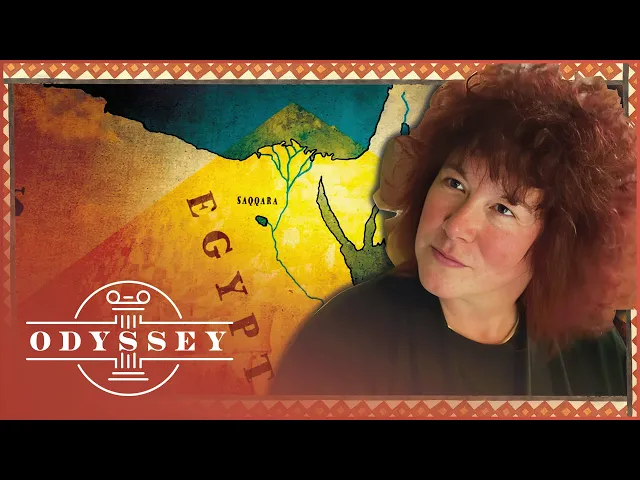
The Entire History Of Ancient Egyptian Civilization With Joann Fletcher
Odyssey - Ancient History Documentaries
0:00 If you love ancient history, then this is the channel for you.
0:03 History Hit TV.
0:04 It's like Netflix, but dedicated just to adree history documentaries,
0:10 including a huge library of ancient history content.
0:13 From the 9inth Legion to Buudaca to the First Britain.
0:17 Simply check out the details in the description below
0:20 and make sure you use code odyssey on sign up.
0:25 [Music] Camel, get out.
0:33 [Laughter] This is brilliant.
0:39 This is obviously an iconic image.
0:42 Taking a camel ride by the pyramids.
0:44 Surely it encapsulates the spirit of Egypt.
0:48 But such an image is completely misleading because there
0:52 weren't any camels here when the pyramids were built.
0:55 4 and a half thousand years ago.
0:58 And that's the thing.
1:00 Ancient Egypt is instantly recognizable,
1:04 but all too often completely misunderstood.
1:09 So, I'm going to try and change that.
1:12 Good luck.
1:13 Shakras.
1:17 The Great Pyramid of Giza, final resting place of King Kufu.
1:22 over 140 meters from bottom to top.
1:28 No wonder it still pulls in the crowds and the occasional Egyptologist.
1:41 here.
1:44 It's hard to really get it into words, but we are now entering into the depths
1:49 of this iconic monument of ancient Egypt.
1:54 It's a very busy iconic monument though.
2:00 Thank you.
2:01 And as we set foot on this journey upwards,
2:04 it's a brilliant metaphor for the way that the ancient Egyptian
2:07 civilization literally rose up from the earth to a real zenith.
2:13 So come with me and I'll show you something really brilliant
2:17 because the pyramids are really only the tip of the iceberg.
2:22 [Music] Oh.
2:26 Oh, flipping out.
2:31 So all this was a a big city overwhelming in size.
2:36 That is absolutely superb.
2:39 In this series, I'm going to explore the story
2:42 of what I consider to be the world's greatest civilization.
2:47 More than 4,000 years of history that has shaped our world
2:51 and left unmistakable marks that can still be read today.
2:57 I'll be looking into every nook and cranny from little known tombs.
3:03 It's staggering.
3:04 I've never ever been into a tomb quite like this before.
3:07 To the hidden corners of vast monuments.
3:10 It's like being on top of the world, isn't it?
3:12 Yeah.
3:12 We are in the top of Car.
3:18 So, it's really no surprise that weird and wonderful
3:21 theories about ancient Egypt crop up all the time.
3:26 But what I find so amazing is that this most intriguing civilization
3:31 was actually created by people not so very different from you and me.
3:36 And that's the story I want to tell.
3:40 A story full of secret treasures,
3:44 dark deeds, and sometimes controversial theories.
3:50 This mask was originally made for someone else.
3:55 And for the first time, I'll be piecing it all together.
3:59 From the earliest Egyptians to the last of the pharaohs.
4:04 Wow, look at that.
4:05 Look at that.
4:06 Oh, that is Oh, that is so beautiful.
4:11 Welcome to my story of ancient Egypt.
4:15 [Music] The big question is how did ancient Egypt begin?
4:37 Where did the first Egyptians and their extraordinary culture come from?
4:42 [Music] This immortal civilization was thousands of years in the making.
4:49 So to pull it all together is a daunting task.
4:53 But bear with me as it's utterly fascinating.
5:03 But we won't begin with massive monuments,
5:06 but with some enigmatic clues you could easily miss.
5:11 [Music] This is Curt around 100 kilometers south of Luxor.
5:23 Unless you're an archaeologist,
5:25 you almost certainly won't have heard of it because
5:29 there aren't any great temples or royal tombs to admire.
5:34 But high in the cliffs, you can see real signs of ancient life here.
5:43 thousands of years before the pyramids.
5:46 And this is where our story begins.
5:49 Welcome to Ka, Joan.
5:51 Thank you so much for letting me come here.
5:53 It's incredibly exciting.
5:57 It's the first time you're here.
5:58 I suppose nothing escapes the sharp eye of Dr.
6:01 Dirk Hoyer, and he's got something very special to show me.
6:05 Not many people have been here before
6:07 you because it's it's a quite recent discovery.
6:14 These carvings in the rock reveal an amazing
6:17 story about the beginnings of Egyptian life.
6:23 It's a 19,000year-old picture gallery [Music] complete with its own hippo.
6:35 back line, very short tail, hind legs, belly line,
6:40 front legs, and uh the mouth is shown.
6:43 Hippo is smiling, but then again, a nippo is always smiling.
6:48 But another type of animal is by far the most common here.
6:53 That's That's cattle.
6:54 Ah, it's not not just cattle.
6:57 There's the mighty Orox, the wild buffet, wild cattle.
7:02 and the extremely powerful images that seem to be in movement.
7:06 They are.
7:06 They're charging down towards us, aren't they?
7:11 These wild oroxs were ancestors of the domestic cow.
7:16 And nearly 20,000 years ago, beef was the main thing on the menu.
7:23 About maybe 50% of their diet was composed of orox.
7:30 So they were experts and masters in representing this animal.
7:35 [Music] It's always high on the cliff.
7:40 Very prominent positions that give an excellent panorama over what must
7:45 have been in the paleolytic the hunting grounds of the people.
7:54 It's easy to picture these early hunters here as they tracked their prey.
7:59 [Music] But the landscape would have looked very different
8:03 from today because back then this was savannah grassland,
8:08 a green and fertile region.
8:12 [Music] Do we have any idea why
8:17 these creatures were engraved on these rocks here?
8:22 We can guess, Joan, but we don't know.
8:24 Maybe they wanted to influence the hunting.
8:29 Maybe this is some sort of hunting magic.
8:40 It really is magical to sit here
8:42 and imagine Egypt's earliest nomadic people passing right through
8:46 this spot and portraying on these very rocks
8:49 the animals that they saw all around them.
8:55 Human figures and boats joined the animals
8:58 as the carvings became stranger and stranger.
9:02 But these carvings are also the earliest glimpse of the amazing things to come.
9:14 These are the first signs of what makes ancient Egypt well ancient Egypt.
9:26 As for its ancient landscape, this evolved under dramatic circumstances.
9:34 10,000 years ago, gravity tilted the entire Earth
9:37 off its axis by about half a degree.
9:40 And this had a profound effect on climate.
9:43 And as the world began to change, Egypt would never be the same again.
9:49 Now these early people were nomads,
9:52 seasonally mobile pastoralists who moved around following the summer rains.
10:02 And these rains really were the vital lifebringing force
10:06 which created the greenery on which wild animals depended.
10:10 But of course with climate change, these rains began to dry up.
10:15 Okay, you can cut the rain.
10:23 The diminishing rainfall forced both animals and people
10:27 towards large lakes which formed during the rainy season.
10:33 One such area is Nabta Plier, 100 kilometers southwest of a swan.
10:38 And here these nomadic hunters began to settle into communities.
10:43 But still reliant on the annual summer rains,
10:45 they needed to predict exactly when these would return.
10:49 And so they turned to the night sky.
10:52 Welcome to the beginning of time.
10:56 quite literally because this is Egypt's oldest calendar.
11:01 At around 7,000 years old, this stone circle from Nabapta player is the earliest
11:07 evidence of how Egyptian weather forecasters became astronomers.
11:13 They aligned its central stones to the circumpolar
11:17 stars visible in the night sky all year round.
11:22 When the sun appeared directly overhead, the stones cast no shadow.
11:28 The midsummer rains were approaching.
11:34 This meant that the animals would drink, the plants would grow,
11:38 and the world would survive for another year.
11:41 So, in many ways, this circle represents
11:44 the solution to the very real problem of survival.
11:48 But the Egyptians would take this a step further.
11:52 I think the really great thing about these many monumental
11:55 markers is that this is the earliest example we have
11:59 of the way in which the Egyptians are aligning their monuments
12:03 to various things to the sky to the cardinal points.
12:06 And from now on, every tomb, every temple,
12:10 every monument will be aligned to the heavens, to the very gods themselves.
12:16 [Music] If the stars and the rain were this closely linked,
12:24 then this world and the next must be one and the same.
12:29 [Music] And this has been described as Egypt's earliest
12:33 sculpted stone monument and dates from around 5,000 BC.
12:38 [Music] This chunk of sandstone was quarried over
12:42 a mile away from where it was eventually discovered.
12:46 This certainly suggests a kind of sense of community where
12:50 people were already working together to achieve a desired aim.
12:55 In this case, the stone was hauled into place and then
12:59 there are clear signs that it's been sculpted into a specific shape.
13:04 Now, you might have to go with me on this, but some believe
13:08 that this is in fact a cow with its large hind quarters and this sculpted head.
13:19 Now, the cow was a vital part of everyday life for these people.
13:23 It was a source of meat, of milk, and of blood.
13:26 Key sources of protein they needed to keep them healthy.
13:29 And yet so important was the cow,
13:31 they chose to take it through into the afterlife
13:34 with them to sustain them on a spiritual level.
13:38 And this is the very beginnings of the great cow goddess Hatheror.
13:47 Hatheror may have started off as a source of milk and meat,
13:51 but eventually she would be loved and idolized
13:54 by millions of Egyptians since she represented love,
13:58 joy, beauty, and motherhood.
14:04 And although her image develops from a lifelike
14:07 animal to a female face with cow's ears,
14:11 this may be Hatheror's very earliest incarnation.
14:16 [Music] Yet Hatheror is only one of a multitude of gods and goddesses.
14:23 The Egyptians just couldn't get enough of them.
14:27 Over the centuries emerged hundreds, if not thousands of deities,
14:31 each with a specific purpose and appearance.
14:36 Some came in human form.
14:39 Some had animal heads.
14:42 They could be male, female, even androgynous.
14:48 It seems that there were few aspects of life that didn't have their own gods.
14:56 We know that in the very earliest times their gods resembled familiar things,
15:01 the world around them, elements of nature and certainly animals.
15:05 And over time, the animals, their forms, their shapes,
15:09 their characteristics were distilled down into this sort of divine figure.
15:14 Each one woripped for a different quality.
15:17 In the case of the ram, they were woripped for their procreative powers.
15:22 in the case of the cow for their nurturing motherly instincts.
15:28 Then of course you've got rather different creatures, the dangerous creatures,
15:32 the ones that lived on the edges of the Egyptian world.
15:35 The lions, the crocodiles, the jackals.
15:38 [Music] But it wasn't just about finding the appropriate divinity.
15:45 It was about gaining power over them.
15:48 The goddess Seekmet was a ferocious lioness and the bringer of death to humans.
15:56 So the Egyptians transformed her into a deity
15:59 as a way of controlling her destructive powers by worshiping segment.
16:04 It was believed that she could be
16:06 placated and transformed into a more benign deity.
16:12 On so many levels, the Egyptians were trying to tap into nature
16:16 to affect the way that nature then in turn affected them.
16:21 [Music] In many ways,
16:26 Egypt's unique religion was the glue that held society together,
16:31 uniting the population and underpinning almost every aspect of life.
16:36 It's everywhere, in tombs, in temples, in everyday life.
16:41 And yet there is another even more fundamental element
16:46 without which ancient Egypt would never have existed at all.
16:57 [Music] Later Greek historians famously observed that Egypt was
17:06 the gift of the Nile and how right they were.
17:10 Because as the climate continued to change,
17:12 the desert lakes eventually dried up,
17:15 leaving the Egyptians with just one source of water.
17:33 This is an incredibly special place located in modern Sudan.
17:38 It nonetheless forms the very source of Egypt.
17:42 For it's the place where two great rivers meet,
17:45 the White Nile and the Blue Nile,
17:48 which combine here to form the world's longest river,
17:51 flowing from the heart of Africa and out into the Mediterranean Sea.
18:00 For much of the year, the wide lazy white Nile is the main source of water until
18:05 annual rainfall in the Ethiopian highlands swells the faster flowing blue Nile.
18:12 Today, the modern Aswan dams hold back these flood waters.
18:16 But until the 20th century, huge volumes of water and fertile silt surged
18:23 down river to flood the entire Nile Valley,
18:28 bringing life and fertility to the desert that is Egypt.
18:34 [Music] This annual Nile flood was the single most important
18:45 event in the lives of every ancient Egyptian for its
18:48 life-giving waters brought the nutrients and minerals which enrich the soil
18:53 all along its banks and this allowed agriculture to flourish.
19:01 Egypt is blessed with some of the most fertile land in the world
19:06 where farmers can grow everything from sweet corn and garlic to bananas,
19:10 sugar cane and cotton.
19:19 Voy, it's quite intensive farming, isn't it?
19:22 The land gives the people a lot, doesn't it?
19:26 Yes, but we need to give the land also rest.
19:29 We grow one time and we leave it for 1 month.
19:33 Then after we use the land again to grow again.
19:37 That's amazing that it only needs one month
19:39 rest time and then it can be planted again.
19:42 Yeah.
19:42 Sometime 15 days, sometime one month.
19:44 Yeah.
19:45 But it really does emphasize that this land of Egypt
19:48 has always been so rich and so giving to the people.
19:52 It's always given the people everything they need.
20:01 And it's the Nile that turned this desert land into a paradise.
20:10 [Music] And 7,000 years ago,
20:15 the people who could no longer survive in an increasingly desert landscape
20:19 were forced to migrate towards it as their only source of water.
20:24 So ancient Egypt took shape as these people
20:27 came together along the banks of the Nile.
20:32 In the north, settlements clustered around the delta and the Fume.
20:38 And in the south, around the Kenna Bend.
20:42 This was the beginning of Egypt's socalled two lands,
20:46 Upper and Lower Egypt, which developed into two distinct cultures.
20:57 But what they both had in common was the astonishing
21:00 fertility replenished every year by the miracle of the Nile.
21:09 Elcab, located to the south of the Kennabend,
21:12 is one of Upper Egypt's earliest settlements.
21:16 [Music] And while it may lack the wow factor of the pyramids,
21:21 it's actually far more revealing to see traces of this amazing evolution.
21:28 Because here we can see how a nomadic
21:30 lifestyle was soon replaced by a settled social structure.
21:37 And although it was a slow and gradual process,
21:40 archaeologist Elizabeth Hart can identify each stage of this transformation.
21:48 sending land into small pits.
21:50 Wow.
21:50 You do work in an enclosed space, don't you?
21:53 But it's much cooler down here.
21:54 It's lovely, actually.
21:58 So, down at this level, we have sterile soil where nobody lived.
22:02 And then starting around 4200 BC are layers of silt from the Nile flood,
22:07 followed by wind accumulated sand,
22:10 and then another layer of silt, and then more sand.
22:12 And here you can see it really well.
22:14 A thin silt layer from the Nile coming up and flooding and then the sand.
22:18 And over here we have a hearth feature.
22:22 So this tells us that humans were actually living
22:25 on these and coming into the Nile Valley and then moving back out.
22:28 And we also found lots of potshards and stone tools in these layers.
22:33 You know, it might be a small space,
22:34 but you've got people's real lives unfolding within it, haven't you?
22:37 And we have thousands of years of it here.
22:40 When we started, people were just moving into the Nile Valley.
22:43 They were just starting to farm.
22:44 And by the end here, we have pharaohs and a whole united Egypt.
22:49 It's really impressive when you think about all
22:51 the change that happened over this chunk of sand.
22:58 Although we are still centuries away from the grand Veronic monuments,
23:02 you can still find traces of the lives
23:04 these ancient people lived if you look hard enough.
23:08 for very little has survived except for tons of pottery.
23:14 Yeah, this one is uh Yeah.
23:16 So, it's 5,000 years old.
23:17 Oh, it's 5,000 years old.
23:19 They're all so tactile, these things, aren't they?
23:23 These pots help us to identify when
23:25 this early society began to produce a food surplus.
23:29 A pivotal transition which required robust pottery
23:33 for the storage of largecale food and drink production.
23:39 These bread molds from slightly later are one of the most common finds.
23:44 So you heat the mold then the dog gets into into it and by the heat
23:48 of the mold the this the bake the bread will be will be baked.
23:53 But this comes in massive amounts.
23:56 These are the beer jars.
23:57 Ah bread and beer and the Egyptian staples.
24:01 Oh nice size of a beer jar.
24:03 This is the nuts and bolts of how Egyptian
24:06 chronology all came together in the early days, isn't it?
24:08 Yes.
24:08 The pottery is especially fundamental to understand how people were living.
24:15 [Music] Yet in Egypt, living was only half the story.
24:26 Because what really sets the ancient Egyptians apart is their view of death.
24:36 To them, death wasn't the end of life, but a new beginning,
24:42 a transformation from the world of the living into an everlasting afterlife.
24:49 And such a belief would shape Egypt's
24:52 most mysterious practice and my favorite subject, mummification.
25:03 Although the origins of this enigmatic tradition are only now becoming clearer,
25:09 the burial of their dead had a strong significance from the very earliest times.
25:18 This is a typical burial from around 3,400 BC.
25:23 The body is curled into the fetal
25:25 position and here placed within a reconstructed pit
25:29 grave surrounded by the belongings he might
25:31 have had in his earthly life like pottery,
25:35 jewelry and a pallet for preparing cosmetics.
25:40 Everything that was important to him in life accompanied him into death.
25:45 And I think that's quite significant because it shows
25:48 that already 5 and a half thousand years ago,
25:51 the Egyptians wanted to take it all with them.
25:54 They clearly believed that something happened beyond death.
25:58 Death was simply a transition into another
26:01 state of existence when you continued to live
26:04 and it was assumed you would need everything you'd needed in your life on Earth.
26:09 His body was naturally mummified in the hot desert sand,
26:14 but its placement here may not have been accidental because even when dead,
26:21 the body had to be preserved in order to house the soul for eternity.
26:29 A skeleton simply wasn't good enough.
26:32 Skeletons, bones, they are very, very anonymous.
26:35 And yet when the soft tissue, the skin,
26:38 the hair is all present, we are ourselves.
26:41 And that's exactly what this individual represents.
26:46 Being face to face with one of the very earliest Egyptians
26:49 gives us insight into the development of their ideas about the afterlife.
26:55 It started off as a practical thing burying the dead in a relatively small space
27:00 bundled up and then it developed these layers
27:04 of kind of like the symbolism fetal position.
27:07 This idea in rebirth into the next world.
27:11 It's almost like the seed from which the Egyptian belief system evolved.
27:17 This is the very beginning of a process
27:19 which would be repeated a millionfold throughout Egyptian history.
27:24 It's this combination of the esoteric underpinned by the practical
27:30 which really does sum up the Egyptians in a nutshell.
27:37 From the very beginning,
27:38 the Egyptians were masters of making sense of their world,
27:42 no matter how complex and mystifying it might seem to us.
27:50 And this same ability to bring order is also
27:53 found in the way they structured their early society,
27:56 adopting levels of bureaucracy that border on the obsessive.
28:02 In the ancient city of Abidos, the site of Egypt's first royal burial ground,
28:08 archaeologists found the origins of a system
28:11 that we still have to put up with today.
28:15 It's most fitting that this city of death was the fine
28:19 spot of the earliest means of calculating that other great certainty, taxes.
28:30 The evidence comes from small bone and ivory labels
28:33 like these which have been dated to around 3250 BC.
28:39 The originals are probably the size of of a postage stamp.
28:43 And you can see that each one is engraved with images of animals,
28:47 of birds, of plants, and so forth.
28:50 And each one is pierced for suspension to a chest or pottery vessel,
28:55 which would have contained oil, linen, grain.
28:58 And it's thought that these symbols
29:00 represent the regions that produce these commodities,
29:02 which were then brought here to Abidos.
29:06 Thought to have been sent as tax payments,
29:08 these tiny labels show how these early people were
29:12 already capable of collecting duties from a vast geographical area.
29:17 Some experts even believe these symbols can be vocalized.
29:21 By turning the simple drawings into sounds
29:24 makes this the world's earliest known writing.
29:35 Now, isn't it interesting that the world's earliest writing wasn't developed
29:39 to express some great outpouring of emotion or express grand passion.
29:44 It was simply a means of calculating taxes.
29:50 These symbols soon became a sophisticated writing
29:54 system of elegant signs we call hieroglyphs, which means sacred carvings.
30:02 And these signs represented every aspect of the Egyptian world which
30:06 were only translated in 1822 with the discovery of the Rosetta
30:11 Stone [Music] and a common language was needed as goods
30:19 were transported between the two lands of Upper and Lower Egypt.
30:24 The people of Lower Egypt had also developed
30:26 trade links with the rest of the ancient world.
30:29 But as more warlike regions began to emerge in upper Egypt,
30:33 it soon became clear that the Nile
30:35 had spawned two very different and distinctive cultures.
30:42 And in many ways, the only thing they really had in common was this great river.
30:49 [Music] The inevitable clash between these cultures is recorded
30:58 on what many considered to be ancient Egypt's founding document.
31:06 Taking the form of a giant ceremonial cosmetic palette,
31:10 this is an exact copy of the original Nama pallet.
31:14 And however idealized and embellished, it depicts the pivotal moment when
31:19 the southern king Nama defeated his northern enemy.
31:23 A split second after this mace comes down
31:26 onto this northern enemy's head and he's executed.
31:29 He's killed.
31:29 He is no more.
31:31 Nama himself remains the first king of a united Egypt.
31:36 And what this means is that the whole
31:39 of the country is now united under one man's rule.
31:44 He is setting himself up quite literally
31:47 as the god king as the one central figure
31:50 at the very pinnacle of the pyramid that forms
31:53 Egyptian society and from him everything else flows.
31:59 Egypt is now the world's first nation state.
32:05 [Music] What made ancient Egypt ancient Egypt is all here?
32:16 The art forms, the forms of religion,
32:19 and even the world's first writing hieroglyphic script.
32:24 This is the name of Nama, the catfish, Na, and the chisel.
32:30 Mr.
32:31 N striking catfish.
32:34 As the first king of Egypt,
32:36 Nama is protected by the cow goddess Hatheror, stands beside Horus,
32:40 the falcon god of kingship,
32:42 and is dressed in all the same paraphernalia as every king who succeeds him.
32:48 He has the tie-on false beard to emphasize his verility and his strength.
32:54 And this is matched, of course, by the tie on bull's tail.
32:56 It's a wonderful feature, this idea.
32:58 You could just tie a little tail onto the back
33:01 of the belt and then take into yourself the power of a bull.
33:06 This pallet is Egypt's earliest historical document.
33:12 It's the blueprint of how every future pharaoh
33:16 will be portrayed in the company of the gods.
33:21 Yet perhaps most significant is Nama's smiting pose.
33:26 This powerful image with the mace held high
33:29 will be endlessly repeated throughout Egypt's long history.
33:35 This is a horrible way to die to have your brains bludgeoned out.
33:40 And yet even this the Egyptian artist can show in an almost balletike pose.
33:46 It's been sanitized.
33:47 It's been elevated to a piece of art.
33:50 And yet the message still gets through.
34:02 For the next 3,000 years, every one of Egypt's subsequent rulers would
34:07 try and link themselves to Egypt's first pharaoh.
34:11 To rule legitimately and successfully,
34:14 they had to be absorbed into the complexities of the Egyptian hierarchy,
34:18 both in this world and the next.
34:21 So their names were recorded on a series of king lists,
34:24 a kind of royal family tree.
34:27 And the best preserved of these is here
34:30 in the temple of Seti the first at Abidos.
34:33 It lists himself and 75 of his royal predecessors going right back to the very
34:39 dawn of Egyptian history with the very first king up there, King Nama.
34:43 And the other important detail about this is
34:45 that it's essentially emphasizing that royal continuity because Seti has
34:51 his own young son Ramsy's the crown prince actually
34:55 reading out these names on a piece of papyrus paper.
34:59 So it's as if Seti is saying to the gods, look,
35:02 I'm now Pharaoh and this is my son who will
35:05 succeed me to become yet another name on this remarkable list.
35:12 In all, Egypt had over 300 pharaohs organized into 30 dynasties.
35:20 But in the case of Egypt's earliest kings, being merely immortal was not enough.
35:26 They needed to prove their divinity
35:28 by exercising absolute control over their subjects.
35:42 And the evidence for this was found
35:44 in the desolate desert surrounding the ancient city of Abidos.
35:48 [Music] This was Egypt's first royal burial ground,
35:59 the original version of the Valley of the Kings.
36:10 Now being here, you get a real sense
36:13 of the importance of this place for the ancient Egyptians.
36:16 For as the wind funnels down this valley and swirls around the sand,
36:20 if you listen very carefully, you can hear a whispering sound.
36:32 A whispering once thought to be the voices of the very dead themselves.
36:44 And here Egypt's earliest kings were laid
36:47 to rest within huge subterranean burial chambers like this.
36:52 The location of the final resting place of Egypt's third pharaoh, King Jur.
36:59 one of the largest and most complex tombs of the first dynasty.
37:03 And although it's been recovered in sand,
37:06 it clearly demonstrates the power that Jur still wielded even in death.
37:15 Jur himself was buried here in the central chamber,
37:19 but all around the 318 subsidiary graves of his courtiers.
37:24 Not only that, a little way beyond, many others were also buried.
37:29 In total, 587 individuals accompanied this man into the next world,
37:36 which is incredible enough, but there is evidence of a more sinister twist.
37:41 The fact that this tomb was all sealed over at the same
37:44 time suggests these people may have been victims of ritual sacrifice,
37:49 perhaps even ritual stabbing as portrayed in art of the time.
37:54 And certainly that power over life and death
37:56 would give any king a god-like status.
38:12 Now, later kings seem to have realized that killing all their courtiers in one
38:16 go was not the best use of people who were a precious state resource.
38:20 After all, who'd be around to make the next king his cup of tea?
38:27 Although this cruel and short-sighted practice of ritual killing soon died out,
38:31 it had nonetheless demonstrated that Egypt's
38:34 rulers had complete control over their subjects.
38:38 an essential step along the route towards
38:40 building the pyramids and indeed Egypt itself.
38:48 Welcome, welcome.
38:51 Yet the Egyptian people were not slaves.
38:54 By this time, Egypt was a land of plenty where all could enjoy its bounty,
39:00 both in life and in death.
39:09 This is the later tomb of an official called Iru Cartar.
39:13 And here he is greeting as he's coming to the door of his own tomb,
39:17 emerging from the walls, captured in all his splendor with his finery
39:21 on, his jeweled belt and his white linen kilt.
39:24 Even details down to his little sort of pencil mustache.
39:28 Looks a little bit like Clark Gable, to be honest.
39:33 The scenes in his colorful tomb depict a refined
39:37 life that's a world away from Egypt's earliest farmers.
39:45 We have Iukatar seated in front of a table of food offerings.
39:50 There's fruit, vegetables, wine, and so forth.
39:53 The bearers are coming forward with offerings to sustain his soul.
40:02 Iruatar was the royal butcher, an important member of court.
40:07 And with royal courtiers no longer sacrificed for burial with their king,
40:11 they could now make their own elaborate preparations for the afterlife.
40:15 There are a couple of scenes up here of the household
40:19 servants making the beds of Irukart and his family.
40:22 They're stretching out the linen sheets.
40:25 They're bringing even a little fly whisk
40:27 and the ancient Egyptian pillow, the headrest there.
40:31 So even in the afterlife, Iukatar will be comfortable.
40:39 IQatar's tomb is in Sakara,
40:42 a sprawling city of the dead for Egypt's first capital, Memphis.
40:50 Yet, Sakara wasn't just the burial site of courtiers,
40:54 but of kings and the sight of a revolution in royal tomb building.
41:00 [Music] And whereas previously the dead had
41:05 tended to be buried away in the desert,
41:07 hidden away almost, here at Sakara, high on the desert escarment,
41:12 the dead were literally placed on display.
41:18 Up to this point, the Egyptians had tended to build
41:21 their tombs and temples like their houses from organic materials.
41:26 From the mudbrick, wood and reeds, which rarely survive.
41:32 But in the third dynasty,
41:34 the great innovator King Joser built his legacy in something far more permanent.
41:42 for he built in stone which could potentially last forever.
41:48 Joseph built this huge stone wall to surround his tomb complex.
41:53 Although his architects and workmen still
41:55 drew their inspiration from the natural world.
41:59 You can see that the masons are just trying to get
42:01 their head around how to actually work with this stuff, what forms to put it in.
42:05 So we have Egypt's first hyperstyle hall of columns, sure,
42:09 but it's taking the form of reads bound together to make the kind
42:13 of columns that would have been in Joseph's palace down by the Nile.
42:21 But this, of course, is a house for death.
42:23 This is a palace of eternity and must be built in something as solid as stone.
42:35 [Music] At the rear of his complex is an intriguing stone
42:40 shrine where I can come face to face with King Joseph himself.
42:49 The shrine looks like it's suffering a severe case of substance
42:52 and yet the Egyptians purposefully built it on this very definite tilt.
43:02 It has these two holes here where modern tourists can see Joseph.
43:08 But Joseph can see them.
43:10 They can actually see beyond them cuz this faces true north.
43:14 It faces the northern stars which the Egyptians call the imperishable ones.
43:19 And so at death, Joseph's soul could rise up and merge with these stars.
43:25 So he too would be imperishable and he too would never die.
43:33 In order to ensure that his soul could live on, Joseph's body
43:37 needed somewhere safe to rest within a tomb truly fit for a king.
43:44 Most burials were topped by a simple
43:46 singlestory building called a star, meaning bench.
43:51 But Jose did something radical.
43:55 Joseph really wanted to impress with hiserary monument.
43:58 So another step was built on top and I think Jose must have
44:04 quite liked the effect that this gave and so built a third step,
44:10 a fourth step, a fifth step, sixth step.
44:16 When they stood back and looked,
44:18 they realized they'd built Egypt's first pyramid.
44:22 Pretty impressive.
44:27 The step pyramid stands over 60 m tall and still dominates the Sakara landscape.
44:34 At the time, it was the largest building on earth,
44:37 reinforcing Joseph's status as a living god in the grandest of ways.
44:47 It certainly secured his place in Egyptian history
44:50 with ancient visitors flocking here to marvel at his achievements.
44:56 Now, Joseph had created a true landmark,
44:58 but he'd also created Egypt's first tourist attraction.
45:02 If you come with me, I'll show you the evidence because in here
45:08 we have what many tourists still leave today, appreciative graffiti.
45:13 And this is the original handwriting of a couple of ancient visitors
45:17 from around 1300 BC who were so impressed by what they saw.
45:22 They described Joseph's pyramid as if heaven were in it.
45:26 And they credit Jose with being the inventor of stone.
45:42 [Music] But why did Joseph build this?
45:47 Was it just an ego trip or an exercise in personal vanity?
45:51 Or was it designed to show the world just how far Egypt had come?
45:56 Because in only a few centuries, these desperate people had come together
46:00 to create the world's first nation state.
46:06 [Music] Egypt was now an unstoppable powerhouse,
46:13 a nation unified both politically and culturally
46:17 under a single ruler whose authority was limitless.
46:21 Yet, it wasn't just the king who could achieve immortality.
46:25 For the man who designed and built Joseph's pyramid was destined
46:28 to become even more famous than the pharaoh he had served.
46:36 [Music] This statue base once held a full-sized figure of King Joseph,
46:43 but carved into its base is also the name of his architect.
46:48 And here we can see it with this reed, the owl,
46:52 and then the little mat with a little bread loaf on which reads imoteep.
47:00 And here he is, the man himself.
47:05 Although most likely a commoner by birth,
47:07 Immoteep rose through the ranks to become
47:10 one of Egypt's most powerful officials.
47:13 He was made the royal chancellor, the prime minister.
47:17 He was even made high priest of the sun god.
47:20 He was the ultimate local boy made good because he then gained a reputation
47:24 as an academic as a great healer and he
47:27 was famous the length and breadth of Egypt.
47:30 He was ultimately woripped as a god.
47:34 Imoteep represents the ultimate in social mobility a kind
47:39 which was certainly possible within Egypt's unique society.
47:44 [Music] This was a society in which ideas were often taken to extremes.
47:54 With 1 and a half million people united by an absolute belief
47:58 in the power of their king and in the certainty of the afterlife,
48:02 Egypt enters its most ambitious era so far, the pyramid age.
48:12 Over [Music] 130 pyramids would be built across Egypt
48:20 and they represent the zenith in royal tomb building.
48:25 Huge state sponsored civil engineering projects that used
48:29 vast resources of materials, manpower and time.
48:36 [Music] The largest of all, the Great Pyramid of King Kufu,
48:44 which took over 20 years to build.
48:53 And in order to build something so ambitious,
48:56 an entire city was created specifically to house
49:00 the construction workers just beyond this monumental wall.
49:05 It's known as the wall of the crow and it separated the silent
49:09 sacred space of the dead from the busy bustling city of the pyramid builders.
49:23 [Music] This five hectare site once housed workshops, bakeries,
49:32 a tool making facility, and a fish processing area.
49:36 For this was an integrated, self-sufficient community of over 8,000 people
49:41 who even had their own medical care.
49:48 [Music] Anthropological archaeologist Dr.
49:55 Richard Reading has been excavating the site since 1991.
50:00 Where we are now, this is kind of a big workshop,
50:02 a big industrial park where there's lots of activity going on out here.
50:07 They were probably producing granite statues, maybe granite columns.
50:10 We find tools out here for polishing the uh granite.
50:14 We find tools out here for uh chipping at the granite.
50:18 It's very well planned.
50:19 We have three streets.
50:20 We have North Street, Main Street we're on, and we have South Street down there.
50:24 So, we're walking down Main Street.
50:26 You're walking down Main Street.
50:28 The pyramid workers live cheek by jowl in twostory barracks.
50:35 You would have walked in.
50:36 You would have been in a very quiet, dark, long, narrow room.
50:40 Um, this is where they would have slept.
50:43 Um, there would have been a uh a higher bed for the overseer at each end.
50:47 And then everybody would have laid down probably
50:50 with their head in this direction or the other direction.
50:54 Exactly like this.
50:55 You would be lying here like this.
50:56 And this would be your your nighttime position.
50:59 Very comfortable.
50:59 Can I can I try out the overseer bed?
51:01 Sure.
51:01 You want to try out the overseer's bed there?
51:03 Delusions of grandeur.
51:04 Is it this one or that one?
51:06 Yeah, it's that's the that's the wall the where right where you are.
51:08 Is that Oh, so this is all right.
51:09 So if I if I sat down here Yeah.
51:11 the overseers bed is actually buried under a few centimeters of sand
51:14 and the floor here was probably under about a half a meter of sand.
51:18 So Oh, this is nice.
51:19 Yeah, I'm keeping my eye on you now.
51:21 That's right.
51:21 You can see me.
51:22 If I got up in the night and I tried
51:23 to sneak out to go someplace, you would see me.
51:26 Everything the workers needed was here on site.
51:30 The team have recovered data that shows that workers
51:33 consumed 74 cattle and 257 sheep and goats each week.
51:38 This corral area could hold a week's supply
51:41 of cattle before more were shipped in from Egypt's grasslands.
51:45 You could have almost just in time delivery coming down.
51:47 Another small herd coming down from Komaan or the delta coming down and in.
51:53 It's a really well old machine.
51:54 You can see now how efficient the Egyptians were at obtaining their food,
51:59 bringing it to the right place at the right time for the right people.
52:02 It's brilliant.
52:03 It's absolutely brilliant.
52:04 It wasn't just simply the food.
52:05 It was everything.
52:06 There was the copper to make tools.
52:09 There was the stone being brought in here from Asan and other areas.
52:13 So a lot of things were coming into here.
52:14 These were government workers.
52:16 They got everything from the government.
52:21 In many ways, this settlement is Egypt in microcosm,
52:25 a highly ordered social structure with job specialization and mass cooperation.
52:32 It's hard to believe that in a relatively short period of time,
52:37 Egypt had been transformed from simple subsistence into a united
52:43 state which could provide for everyone who worked on its behalf.
52:52 What we're seeing here is the final building block in Egyptian culture,
52:56 but not just for the pyramid age.
52:59 For once this infrastructure was in place, it would never change.
53:03 So whether they're building a pyramid or setting up a colossal statue,
53:07 the level of organization and cooperation would remain the same.
53:12 But this was the foundation stone of Egypt.
53:17 [Music] The pyramids are eternal testament
53:24 to just how powerful Egypt had now become.
53:27 And in many ways they are Egypt at this time
53:31 dominating everything around them on a gigantic scale.
53:40 And towering above the Giza landscape is the Great Pyramid.
53:50 [Music] It took around 20,000 people to set
53:55 in place the 2.3 million blocks of limestone.
53:59 It remained the tallest structure anywhere in the world for 3,800
54:03 years until the building of Lincoln Cathedral Spire in 1300 AD.
54:07 It's a phenomenal achievement for any civilization at any time.
54:13 But for me, its exterior can't compare
54:17 to the sense of wonder once you venture inside.
54:23 The roof of the Grand Gallery passageway is built of multiple
54:27 layers of enormous limestone slabs rising over 8 m high.
54:33 Massive, massive blocks of masonry built on a godlike scale.
54:38 That's surely what Kufu wanted.
54:43 I sincerely hope Kung Fu's eternal resting place
54:46 was rather less congested than it is today,
54:49 but it still gives a real atmosphere of the busyiness
54:52 that must have been here on a daily basis.
55:00 These guys were hauling massive, massive blocks,
55:03 hundreds of feet up, literally into the air.
55:05 These guys were magicians.
55:11 Just look how brilliantly these courses have been laid.
55:15 These are perfect.
55:17 And if I any modern architect to be able to replicate
55:20 this using the tools that the ancients had at their disposal.
55:31 [Music] Wow.
55:36 Here we are at the zenith.
55:38 We're at the heart of the pyramid now, King Kufu's burial chamber.
55:42 And we've hit it at exactly the right
55:43 moment because the pyramid is closed for lunch.
55:47 So, we've got the whole place to ourselves.
55:49 And you really get a sense of the sanctity of this divine mausoleum.
56:00 The walls and roof of the burial chamber are lined entirely in granite.
56:06 And it was within here that the body of the great king Kufu was sealed,
56:10 ready for his final journey into the afterlife.
56:17 We're at the heart of the pyramid in terms of its architecture,
56:21 but we're literally in the heart of ancient Egypt.
56:27 I feel like I should be speaking
56:28 in a whisper because the acoustics are so extraordinary.
56:33 It's a a sterile, plain, stark room.
56:39 It's pretty much like a bank vault.
56:42 And when you think about it,
56:43 that's exactly what it is because it once contained Egypt's greatest treasure,
56:48 the mummified body of the god king, which contained the soul not only of Kufu,
56:55 but of all the generations of pharaohs, stretching way back to King Nama.
57:05 Forget the jewels, forget the gold.
57:07 Egypt's real treasure was in here.
57:11 And it's the first time I've ever been
57:12 in here without crowds and crowds of other people.
57:17 and speaking now.
57:18 The sound of the voice reverberating around immediately takes you
57:23 back 4 and a half thousand years to the day
57:25 of the funeral to the sacred words the priest would
57:28 have chanted to revive the soul of the god king.
57:34 It's miraculous.
57:35 It's a wonderful spectacular place that affects every sense visually,
57:41 audibly in every sense.
57:45 It it's it's beyond words really.
57:48 I think I probably better stop talking now.
57:59 So now all the elements that made up of ancient Egypt were in place.
58:04 A well-fed, highly organized population
58:07 that unswervingly followed their god king.
58:10 and all of whom shared this fervent belief in an afterlife.
58:15 Life in Egypt was good.
58:26 With its mighty pharaohs, multiple gods, and magnificent art,
58:32 it's easy to think that ancient Egypt was always powerful and successful.
58:39 But there were also darker times.
58:41 Conflict, civil war, famine, and an overall feeling of catastrophe.
58:49 And the only way it could survive was
58:50 through its own resilience and the strongest of leadership.
58:56 Now, this is Cesostrus III, who ruled Egypt almost 4,000 years ago.
59:04 He's strong and he's muscular, everything a pharaoh should be.
59:08 And yet look at his face.
59:12 His scowlling features have been interpreted to suggest
59:17 his harsh rule and his large ears, his ability to hear any plots against him.
59:24 Cesostrus embodies the way Egypt's monarchs ruled during its turbulent times.
59:31 This king controlled his enemies through a series
59:34 of military fortresses and through magical curses.
59:40 But this is a new era in Egypt's history,
59:44 not only ruled by military power, but by fear and suspicion.
59:50 And Egypt's darkest times threatened to destroy its entire civilization.
1:00:03 I've already explored how Egypt's ancient
1:00:05 culture began thousands of years earlier,
1:00:09 blessed by the river Nile and a rich natural
1:00:12 environment and a society united by a complex ideology.
1:00:24 But in this episode,
1:00:26 we'll see how the massive self-confidence of the pyramid age was not to last,
1:00:31 as a dark age brought this civilization to the brink of annihilation.
1:00:38 Make no mistake, this is the home of the dead, and we're in amongst them.
1:00:44 These were times of famine, civil war, and anarchy.
1:00:49 Kings have been reduced to something on a minuscule level.
1:00:54 But this collapse triggered one of the greatest revivals of ancient
1:00:59 times with Egypt reemerging more powerful and wealthy than ever before.
1:01:09 Welcome to my story of ancient Egypt.
1:01:26 Sakara, where Egypt's great pyramid age began.
1:01:32 But among its glories,
1:01:34 there's also evidence of a far less well-known side to Egypt's story,
1:01:46 its descent into a dark age.
1:01:51 The zenith of Egypt's old kingdom was the great pyramid at Giza.
1:01:55 And only 200 years later, King Unas Causeway was created.
1:02:04 It might not look much today, but it's the highlight of Unas Pyramid Complex,
1:02:09 a 750 m long causeway which symbolically connected life and death.
1:02:16 [Music] It goes right from the Nile Valley all the way up onto
1:02:25 the high desert plateau right to the foot of the pyramid of Unas.
1:02:30 So it would have been used for his funeral procession,
1:02:32 but it would also have drawn up that life-giving force from the valley
1:02:35 below up to the city of the dead here at Sakara.
1:02:40 A narrow slit in the roof once allowed enough lighting.
1:02:43 But the extraordinary thing is that this causeway
1:02:46 was designed for a sole purpose, the king's funeral procession.
1:02:57 Carved upon its walls are scenes revealing both sides of life,
1:03:01 the forces of order and of chaos.
1:03:05 It first portrays an idealized version of Egypt, a time of plenty.
1:03:11 Here we can see typical scenes within an Egyptian temple orary context.
1:03:18 Scenes of the rich bounty of Egypt.
1:03:20 All the fruit, the vegetables, the crops, the meat,
1:03:23 the fish, all the wealth of the natural environment of Egypt,
1:03:27 which was all obviously brought to the land
1:03:31 through the good offices of the king,
1:03:32 the bringer of all bounty, the intermediary with the gods.
1:03:36 But also this causeway contained something rather more disturbing.
1:03:41 Evidence that dark forces were at work.
1:03:46 Further on down the causeway emerged a counterpart image.
1:03:52 The flip side of bounty.
1:03:57 An image so unusual it's now displayed in Sakara's museum.
1:04:01 And it really is one of ancient
1:04:04 Egypt's most haunting and revealing works of art.
1:04:10 Here we see these dark forces at work.
1:04:14 What we have are two rows of emaciated victims of famine.
1:04:23 These poor people, they're weak with hunger.
1:04:26 They're falling down.
1:04:27 They're suffering.
1:04:29 And this is basically ancient Egypt coming face to face with reality because
1:04:34 these are believed to be the Bedawins who inhabited the desert fringes of Egypt.
1:04:39 So it's as if this kind of idea of suffering,
1:04:42 the forces of chaos are on the periphery of Egypt,
1:04:45 but they're getting ever closer to the Nile Valley.
1:04:48 Egypt is starting to waken up to the fact that chaos isn't all that far away.
1:04:53 This is ancient Egypt beginning to suffer.
1:04:59 Such gritty realism had rarely been portrayed before.
1:05:03 Chaos depicted as the suffering of real people.
1:05:08 This isn't happening in some esoteric realm of the gods where chaos is
1:05:12 sort of portrayed as some sort
1:05:14 of disperate magical force very detached from reality.
1:05:19 This is reality.
1:05:22 [Music] Through such realistic images,
1:05:26 the Egyptians were expressing their fears to the gods,
1:05:29 appealing to them to keep these forces of chaos at bay.
1:05:38 But instead, the starving famine victims would turn out to be a chilling omen.
1:05:56 Up until now, Egypt's prosperity had flowed from its one source of water,
1:06:02 the River Nile, whose annual floods enriched the soil,
1:06:06 allowing life and agriculture to flourish.
1:06:11 This natural abundance was the very bedrock on which
1:06:15 Egypt and its perpetual world order was able to thrive.
1:06:21 But this lifeblood was about to run dry.
1:06:27 Evidence shows that at the end of the 3rd millennium BC,
1:06:30 the Nile flood levels fell dramatically.
1:06:34 As the very thing that brought them life began to diminish,
1:06:38 the Egyptians believed that their gods had begun to abandon them.
1:06:42 And for the next century,
1:06:44 the ancient texts talk of suffering, starvation, and even cannibalism.
1:06:58 Traditionally, Egyptian society had been built on the belief
1:07:02 in the divine power of its kings.
1:07:05 Without this belief, the pyramid age would never have been possible.
1:07:10 But now, in its time of need,
1:07:12 Egypt's king seemed increasingly powerless in the face of such natural disaster.
1:07:19 And this would come to a head with a ruler who was well past his prime.
1:07:28 Claimed to have lived for a 100 years,
1:07:30 he was Egypt's longest lived monarch, King Pepe II.
1:07:40 And this space was once a ceremonial running track.
1:07:43 The type of place where Pepe would have to display
1:07:46 his physical prowess to prove himself to his people.
1:07:50 Now, when any pharaoh had celebrated 30 years reign,
1:07:53 they had to perform the jubilee ceremonies.
1:07:56 And this involved running the ceremonial jubilee race.
1:08:00 Four times around this circuit as king of the north,
1:08:02 four times around the circuit as king of the south.
1:08:05 It was the ultimate public display of their fitness to rule and their strength.
1:08:11 It really showed who was in charge of Egypt.
1:08:14 But that's where Pepe's advancing age would eventually let him down.
1:08:19 Of course, when Pharaoh was relatively young and fit,
1:08:22 this would have been a great celebration.
1:08:24 But in the case of poor Pepe, then in his 90s,
1:08:27 it became all too clear that Pharaoh was no living God.
1:08:31 And this really undermined the whole concept of what it was to be a pharaoh.
1:08:40 Clearly as mortal as his subjects, any natural disaster must have seemed
1:08:44 the fault of this less than superhuman king.
1:08:50 And this combination of a weakening pharaoh
1:08:53 and failing harvests led to rapid decline.
1:08:58 Ancient Egypt now faced its first major political crisis.
1:09:03 For the power and apparent divinity of the pharaoh that had
1:09:06 been so very important in the pyramid age had now vanished.
1:09:16 Everything that bound Egyptian society together had begun to fall away,
1:09:22 and Egypt was plunged into a dark age.
1:09:30 In this time of growing uncertainty,
1:09:33 when the Egyptians had lost faith in both the monarchy and staterun religion,
1:09:39 they increasingly turned to the power of magic.
1:09:54 This is a rather unsettling thing.
1:09:58 It's an ancient Egyptian mask.
1:10:01 It's almost 4,000 years old and it's made of linen covered in a thin
1:10:06 layer of plaster and then painted predominantly
1:10:09 black with colors picked out on various features.
1:10:14 Of course, the Egyptians are well known
1:10:17 for making elaborate arrangements for their afterlife.
1:10:21 The death mask placed over the mummified body recreated the features
1:10:26 of the dead to make them recognizable to the gods.
1:10:31 But this mask is different.
1:10:33 It was made to be worn by the living.
1:10:36 And we know this because of the very distinctive eye holes,
1:10:40 which you can see there.
1:10:42 And this would allow the wearer to see around them.
1:10:46 You can imagine when this was applied to the face,
1:10:48 fastened on, tied on behind the head,
1:10:50 it would transform that individual into a completely different entity.
1:10:56 Traces of paint on the linen reveal how it might
1:10:59 have helped the wearer embody some form of magical being.
1:11:03 [Music] Whoever wore this was going to some
1:11:09 effort to transform their appearance to try and tap
1:11:12 into the hidden forces of the gods and to control the world in which they lived.
1:11:16 It's as if the Egyptian individual that wore
1:11:18 this was trying to take charge of their own destiny.
1:11:26 But the mask isn't the only evidence of magic.
1:11:33 For in their dark ages, the Egyptians increasingly began to write out
1:11:38 curses and spells on pots and figurines.
1:11:43 Scrolled across one was the curse.
1:11:46 Die Henoi, son of Inte,
1:11:49 a form of magic sufficiently small scale to be performed within their own homes.
1:11:55 And one of the most graphic ways they did
1:11:58 this was to take a piece of clay or a simple pot like this one and write upon it
1:12:02 the thing or the person that they wanted to control.
1:12:06 They often used red ochre because red
1:12:09 was associated with the powers of destruction.
1:12:13 So if I was doing this, I'd put on it the thing I'd want to stop,
1:12:17 which are early morning calls and alarm clocks.
1:12:22 So, you've got to imagine Egyptians from all walks of life doing this.
1:12:26 The priest wanting to protect the pharaoh,
1:12:29 the soldier in battle against an enemy, or simply a hated love rival.
1:12:34 So, all sorts of Egyptians could be on the receiving end of something like this.
1:12:41 And then to activate the curse, they smashed the pot.
1:12:47 [Music] It was a symbolic act to annihilate the name
1:12:53 of the enemy and therefore to control that enemy.
1:12:58 Oh, that does feel better.
1:13:00 Not unlike voodoo, such practices are found
1:13:03 in many ancient cultures and Egypt was no exception.
1:13:09 But it's far from the way we imagine the formal timehonored rituals
1:13:13 of the temple led by the king at the head of the religious hierarchy.
1:13:18 This is an Egypt that's becoming more suspicious, more fearful,
1:13:23 and more aware of the threats to their world,
1:13:26 natural disasters, political breakdown, and foreign powers.
1:13:31 And this little wax figurine is a means to control
1:13:34 anyone that threatens the balanced order of Egyptian life.
1:13:41 Welcome to the age of fear.
1:13:47 A time when every element of Egypt's world view was in doubt.
1:13:54 Their faith in their king, in their land,
1:13:57 and even in their gods had all faltered.
1:14:02 This is one of the lowest points in Egypt's long story,
1:14:05 and its effect reverberated throughout the Nile Valley.
1:14:11 The king, traditionally based in the north, was no longer the source of wealth.
1:14:16 So, royal officials abandoned court and relocated
1:14:20 back to their hometowns throughout the country.
1:14:24 Disunited, Egypt reverted back to how it had been a thousand years earlier,
1:14:30 breaking up into a series of local regions called gnomes.
1:14:34 And now, a new kind of leader emerges to dominate the dark ages.
1:14:40 No longer a single king, but multiple warlords.
1:14:53 And we know much about one of them because he
1:14:55 left his detailed autobiography in his rock cut tomb at Moala,
1:14:59 well away from the usual tourist sites.
1:15:04 [Music] His name was Ank Tiffy.
1:15:13 Now, Ank Tiffy is a smalltime official who's worked his way up through
1:15:18 the ranks to become the regional governor or no mark as it's known.
1:15:23 And in the decline in central government,
1:15:26 the power vacuum that opens up is now filled by the Antifises of this world.
1:15:34 Antify's tomb is quite modest by ancient Egyptian standards,
1:15:38 but its interior walls tell of his rise to power.
1:15:43 And Egyptologist Gary Shaw is going to help me unravel Antify's story.
1:15:49 You can see the man himself.
1:15:50 Ah, the great man.
1:15:51 A great man carved standing there.
1:15:54 He got a great hairstyle.
1:15:56 He does.
1:15:57 That is lovely.
1:15:58 I'm liking him already.
1:15:59 Yeah, the man himself.
1:16:00 He has a great tomb as well.
1:16:03 The hieroglyphs and images that fill the walls reveal how Ank
1:16:07 Tiffy exploited the power vacuum at the end of the pyramid age,
1:16:11 reducing the king to nothing more than a footnote.
1:16:15 The only time you see the name of a king in the entire tomb is right here.
1:16:21 This tiny little carto.
1:16:23 It couldn't be any smaller.
1:16:25 Look at the size of that.
1:16:26 This is Nephicare.
1:16:27 And that's it.
1:16:28 Is that it in the old tomb?
1:16:30 The old tomb.
1:16:30 one mention of a king and just I think
1:16:33 that really emphasizes just how important he thought he was alone.
1:16:37 He didn't need to mention the pharaoh.
1:16:38 He didn't need to say uh that the king told me
1:16:41 to do this so I did this because of the king's favors.
1:16:44 He just did it himself.
1:16:45 That is extraordinary.
1:16:46 I think that cartoou alone of everything
1:16:49 in the tomb encapsulates this whole period.
1:16:53 Kings have been reduced to something on a minuscule level and the local
1:16:57 rulers are shown on a huge scale and it's all about them isn't it?
1:17:02 Ank Tiffy had enhanced his own political career and wanted
1:17:06 to ensure the gods were in no doubt as to his importance.
1:17:10 So the elaborate language once exclusive to the king
1:17:14 was now part of Anktiffy's own boastful propaganda.
1:17:18 This warlord was an egoomaniac.
1:17:21 He also says that he's a hero without equal, without peer.
1:17:26 And you get that here.
1:17:29 I'm a hero without peer.
1:17:31 And pretty much almost every uh inscription in this tomb
1:17:35 ends or includes this statement at some point inside.
1:17:37 And what did he do to kind of justify these claims?
1:17:40 He emphasizes all the good things he did for the people.
1:17:43 Uh this was meant to be a time of of drought and famine,
1:17:45 so we're told in the texts.
1:17:47 And he tried to guide them through this.
1:17:50 is managing it by feeding everybody and doing all sorts of good things.
1:17:53 Giving bread to the hungry,
1:17:55 ointment to those without ointment and sandals for those who
1:17:59 were barefoot and wives for those without wives.
1:18:03 So, it's it's basically telling us about a time of turmoil.
1:18:06 Yeah.
1:18:06 But he's probably just overexaggerating because the more
1:18:09 he exaggerates just how awful it is,
1:18:11 the more great he looks when he says, "Well,
1:18:13 these are the nice things I did for everybody." And you get this here.
1:18:16 He talks about the entire South uh dying from hunger.
1:18:20 Oh, look at that.
1:18:21 That That's a really graphic hieroglyph.
1:18:23 I love that.
1:18:24 The guy fallen over.
1:18:25 Yeah.
1:18:26 He's definitely dead.
1:18:29 And but then it gets even worse that it
1:18:30 says that every single man is eating his children.
1:18:34 He didn't allow this to happen in his gnome, of course, where he lived.
1:18:37 Everything was fine.
1:18:38 And at the same time, he's also a fantastic warrior.
1:18:40 We're told over here inevitably.
1:18:42 How did I know that was coming?
1:18:44 Yeah, absolutely.
1:18:44 Yeah.
1:18:45 The these texts on this particular column talk about his abilities as a warrior.
1:18:50 In his biggest boast of all, Ankiffy,
1:18:52 the local hero, almost claims the status of a god.
1:18:58 I am the beginning and the end of mankind.
1:19:01 Since nobody like myself existed before, nor will he exist.
1:19:08 In Egypt's dark age,
1:19:09 warlords like Anktiffy had replaced the real kings of Egypt.
1:19:15 And Ankiff's delusions of grandeur, so vividly expressed inside his tomb,
1:19:20 are even more emphasized on the outside because he
1:19:23 chose burial inside a rock shaped like a natural pyramid.
1:19:27 He wanted to be the local pharaoh.
1:19:33 And in a way he was because whoever
1:19:36 fed and protected the people also led the people.
1:19:42 But as the power of warlords like Ankifi grew,
1:19:46 so did the conflicts between them.
1:19:50 And over time, as they either defeated
1:19:52 their neighbors or formed alliances with them,
1:19:56 two separate dynasties of warlord kings emerged.
1:20:00 One in the north at Heracleopoulos where they wore the red crown of lower Egypt
1:20:06 and one in the south at thieves symbolized by the white crown of upper Egypt.
1:20:13 Egypt was a divided kingdom of two lands and between them lay a war zone.
1:20:20 [Music] Situated at its center lay Egypt's most sacred site,
1:20:32 its earliest royal burial ground and still
1:20:37 today an evocative and atmospheric place.
1:20:41 This was the resting place of Egypt's first kings whose mummified
1:20:46 bodies were buried in elaborate burial chambers beneath the desert floor.
1:20:52 a safe place for their souls.
1:20:54 Or so they thought.
1:21:00 [Music] But hostilities between the two waring
1:21:07 factions were about to plum new depths of horror with an assault so blasphemous
1:21:14 it would change the face of Egypt forever.
1:21:17 One of the most violent acts was recorded in later texts as the vile deed.
1:21:22 For the northern warlord kings fighting their southern
1:21:26 opponents here actually desecrated these royal tombs.
1:21:31 For their troops set fire to the tombs and destroyed the royal mummies.
1:21:37 At a stroke, Egypt's physical link to its ancient past was severed.
1:21:42 Such an act of desecration was completely
1:21:46 unimaginable and the Egyptian people were rightly appalled.
1:21:50 Although the northern kings deeply regretted what their troops had done,
1:21:54 the destruction was irreversible and the origins
1:21:58 of Egypt's royal past lost forever.
1:22:03 Of course, the problem with such times of destruction is
1:22:06 that there's very little left of them for us Egyptologists to find.
1:22:11 But clues do remain if you know what you're looking for.
1:22:17 Today, what's left of the violation of this royal burial ground is surprising.
1:22:23 Thousands upon thousands of broken pots.
1:22:27 Although most are not part of the destruction itself,
1:22:30 they represent centuries of atonement for the loss
1:22:33 of Egypt's physical connection with its past.
1:22:42 Now, not long after the desecration,
1:22:44 this became a place of pilgrimage where people came
1:22:47 with little pots like this one filled with food,
1:22:50 drink, incense, which they offered up to the souls
1:22:54 of the dead kings once buried here.
1:22:59 It was believed that at death,
1:23:01 these souls of the kings had joined with the soul of Osiris, god of the dead.
1:23:06 And as this place became a site of pilgrimage,
1:23:09 it's as if the people of Egypt were trying
1:23:11 to make amends for the desecration of the past.
1:23:18 Egypt's spiritual connection to its royal ancestors was all it
1:23:22 had left after the northern warlords had destroyed their physical remains.
1:23:28 And the desecration soon provoked violent retaliation.
1:23:34 Directly across the desert from Abidos [Music] lay thieves,
1:23:42 the stronghold of the southern warlords,
1:23:47 and they would soon rise up against their northern
1:23:49 rivals and attempt to resurrect Egypt as a united land.
1:23:55 [Music] Back in 2000 BC, thieves was a one donkey town.
1:24:02 And yet, its warlords had two distinct advantages over other leaders.
1:24:07 They lived on a bend in the Nile called a Kenna Bend,
1:24:11 a strategic control point of rich farmland.
1:24:15 And their local god was Montau, the god of war.
1:24:19 [Music] The warlords of thieves would reunite Egypt
1:24:26 and one in particular came to the four.
1:24:29 His images were carved into the walls of his Theban
1:24:32 tomb complex and his name tells us much.
1:24:39 This is the Theban warlord Montoteep.
1:24:44 And there's a real clue as to what
1:24:46 was happening at this part of Egyptian history because
1:24:49 his name Monteoteep means the local war god Montu
1:24:53 is content because hoteep simply means content and happy.
1:24:57 So if the war god was happy with Monteep,
1:25:01 this means that he was a very powerful military figure.
1:25:04 And this is a wonderful scene.
1:25:06 There are a lot of little clues here to tell us what's going on.
1:25:09 And if you look really closely, you can see hands embracing him,
1:25:14 flanking him at his back, at his front, around his middle.
1:25:18 He's being embraced by the gods.
1:25:21 Chief amongst whom is Mont himself.
1:25:23 And there he is.
1:25:24 He's nose tonose with the king.
1:25:26 He's giving him the breath of life and infusing him with his own divine power.
1:25:34 It was the power of victory,
1:25:36 one that finally brought an end to Egypt's first dark age.
1:25:41 Monte really did live up to his name as a true
1:25:45 son of the war god because he took his armies north.
1:25:48 He conquered the north and he reunited Egypt.
1:25:53 But best of all, he's got the red crown on.
1:25:56 And this is the red crown of the north
1:25:58 because Monteep is declaring to the world, I might be a southerner.
1:26:02 I might be from thieves.
1:26:03 I should be wearing the white crown.
1:26:05 But look at me now.
1:26:06 I have the red crown.
1:26:07 I am the king of the north.
1:26:09 I'm the king of the south.
1:26:10 And I have reunited Egypt.
1:26:14 As Egypt's new king, he became Montotep II.
1:26:19 But his victory came at a high price.
1:26:23 The grim details of what his soldiers went through
1:26:26 can be found on thieves west bank at Dear Elbach.
1:26:32 It was inside one of the tombs here
1:26:34 that the remains of Monteotep's warriors were uncovered in 1923.
1:26:43 Their bodies silent witnesses to Egypt's civil war of 4,000 years ago,
1:26:49 which careful analysis revealed in fascinating detail.
1:26:54 Now the archaeologists found around 60 bodies
1:26:57 in the tomb and these are the original excavation photographs.
1:27:03 All of them had been naturally preserved,
1:27:05 naturally mummified in the hot dry climate.
1:27:08 So you've still got the skin and the hair
1:27:11 and crucially evidence of how these men had fought and died.
1:27:16 Some of these bodies have been pierced by arrows.
1:27:19 This one goes right into the left side of the chest.
1:27:22 Others had actually been buried
1:27:24 with these leather wrist guards that archers use.
1:27:29 10 of the warriors had been killed with ebony tipped arrows.
1:27:34 But in others, the wounds are even more brutal.
1:27:38 You can see here somebody's hit this man on the head with a real whack.
1:27:42 And you can see this very, very graphic area of damage there.
1:27:48 And after these series of furious blows
1:27:50 have been rained down on these poor guys,
1:27:52 they lay helpless on the field of battle.
1:27:55 Their bodies picked at by vultures.
1:27:57 You can see here the dreadful damage.
1:27:59 It's such a profound image.
1:28:05 The bodies reveal evidence of the weapons used
1:28:08 against them as they fought for control of Egypt.
1:28:13 Arrows, slingshot, and even rocks had been hurled at the warriors from above.
1:28:20 Eventually, their bodies were collected
1:28:22 from the battlefield and carefully wrapped in linen.
1:28:26 This linen bore the insignia of the Theban
1:28:29 tomb complex belonging to their leader, Monteep.
1:28:33 But just as significant as the bodies themselves
1:28:36 was where Monteep chose to bury his fallen heroes.
1:28:42 Today, the warrior's resting place is a little known sealed tomb.
1:28:49 But 4,000 years ago, Monteep honored his dead soldiers with a burial
1:28:55 amongst the graves of his highest officials,
1:28:58 making them part of his monument to victory.
1:29:02 The new king had created what could
1:29:04 well be the world's first known war cemetery.
1:29:09 Now, I'm lucky enough to have been given special
1:29:12 permission to see Mont Hotep's soldiers for the first time.
1:29:16 These guys are going to be taking down the tomb wall for me,
1:29:19 allowing me to actually meet the very people
1:29:21 who fought in Egypt's civil war around 2000 BC.
1:29:25 So, I am very, very excited.
1:29:36 And it was the same curiosity which drove a team of American
1:29:39 archaeologists to excavate their original mass grave in the first place.
1:29:46 [Music] [Music] Now reburied in a neighboring tomb,
1:30:04 the bodies of Monteotep soldiers have rarely seen the light
1:30:07 of day since their discovery over 90 years ago.
1:30:21 Now, this is really, really super frustrating,
1:30:24 but in the interest of health and safety, I can't go in there immediately,
1:30:28 much as I really want to, because all the stale
1:30:30 air is built up as the walls being sealed,
1:30:33 and we've really got to let this out with all the fungal
1:30:37 spores and the bacteria and everything else that's so detrimental to health.
1:30:42 Early Egyptologists tended to rush straight
1:30:45 in and risk the so-called Pharaoh's curse.
1:30:48 So, a little waiting is essential.
1:31:00 I can't believe we're actually going to enter this tomb now.
1:31:03 It's It's one of those rare moments you get
1:31:06 in a Egyptological career into a tomb that's hardly ever visited.
1:31:11 the wall had to come down and who knows what we're
1:31:13 going to find inside cuz I certainly have never seen this before.
1:31:16 So, it's a very very special moment.
1:31:30 This literally wasn't at all what I expected.
1:31:33 Nobody knew what to expect.
1:31:35 It's staggering.
1:31:36 I've never ever been into a tomb quite like this before.
1:31:43 The mask is a very good idea because there's all
1:31:47 sorts of things floating around in the atmosphere in here.
1:31:50 Not just the dust of ages, but the dust of human beings.
1:31:54 And as such, we have to be very, very respectful.
1:31:58 It's a large rock cut tomb, and although its walls are unfinished,
1:32:02 it's typical of those created
1:32:04 for courtiers and officials throughout these cliffs.
1:32:09 Wow.
1:32:10 It's a mummy fire body.
1:32:13 It's absolutely incredible.
1:32:15 Oh, that's that's quite something.
1:32:20 And if you look along the length of this very long tomb, look at the floor.
1:32:27 This isn't stone.
1:32:30 These are human remains and mummy wrappings.
1:32:34 And there are chambers and corridors leading off.
1:32:37 again full of wrappings, the linen of ages.
1:32:47 Some of it is claimed to be the very linen that bound
1:32:49 the bodies of Monteotep's warriors to help preserve them for eternity.
1:32:55 But at first glance, it's hard to get a clear picture,
1:32:59 for this particular tomb seems to have
1:33:01 been reused many times during Egypt's long history.
1:33:07 part of a shoulder.
1:33:08 You see the way the skin's folded and dried out.
1:33:14 Partial human body still with much of it soft tissue intact.
1:33:19 It hits you immediately in the face and you're
1:33:21 confronted with what a tomb is all about.
1:33:24 Make no mistake, this is the home of the dead and we're in amongst them.
1:33:30 It's a very, very emotive and powerful place to be.
1:33:37 But what's striking is how little is left of their bodies.
1:33:41 Like many other tombs up and down the Nile,
1:33:44 they've been subjected to centuries of looting and damage.
1:33:49 And amongst all these linen wrappings and debris
1:33:53 and human remains themselves are the tangible remains
1:33:57 of these men who died so bravely
1:33:59 in their efforts to reunify Egypt for Monteep, their leader.
1:34:20 Having just come out of that tomb of very very mixed emotions,
1:34:25 I don't really know what I was expecting to see.
1:34:27 Certainly some of Monteep's soldiers.
1:34:31 Perhaps some of them were.
1:34:32 It's highly likely.
1:34:34 Essentially, what we're looking at are the ancient Egyptians themselves.
1:34:39 These are the ancient Egyptians.
1:34:41 Temples, tombs, pyramids, this wonderful culture.
1:34:46 It's all well and good studying these esoteric
1:34:50 aspects that are distinct and marvelous and grand.
1:34:54 But when it comes down to it,
1:34:57 things we should really be interested in are these people.
1:35:11 Monteep's reunification of Egypt marked a new beginning,
1:35:16 the dawn of what would become known
1:35:17 as the Middle Kingdom [Music] and the rise of thieves.
1:35:28 [Music] Monteep made it the new spiritual heart of Egypt
1:35:36 and it would stay that way for the next 2,000 years.
1:35:44 But whereas the war god Montu had
1:35:46 dominated the previous century of Egypt's story,
1:35:49 the deity that now took center stage was Hatheror,
1:35:53 the goddess of love, joy, beauty, and motherhood.
1:35:57 the goddess whose origins can be traced right back to the earliest of times.
1:36:04 And believing that Hatheror dwelt in the cliffs of Dear Elbach,
1:36:08 Monteep chose this site not only for his war cemetery,
1:36:12 but for his own tomb complex.
1:36:15 It was Monteoteep that first built here
1:36:18 in this dramatic place where the cliffs meet the desert.
1:36:22 Believed to be the home of the goddess Hatheror herself.
1:36:25 It was a fast track to the afterlife.
1:36:28 And for Monteoteep and his men who had lived and died by the war god Montau,
1:36:33 they all now rest in the eternal embrace of Hatheror.
1:36:45 [Music] The first to build at Dear Elbachi was Monte,
1:36:55 the founder of a reunified Egypt.
1:37:00 He was so influential that almost 600 years later,
1:37:04 female pharaoh Hat Shepsut built her owner temple right next door
1:37:10 to tap into the religious and political power of her illustrious predecessor.
1:37:19 [Music] In the Middle Kingdom, life for ordinary people was on the up.
1:37:30 Food was plentiful.
1:37:34 Wealth and trade flourished,
1:37:39 and farming was revitalized with new irrigation systems.
1:37:44 [Music] Yet the dark age had nonetheless left its mark on the Egyptian
1:37:52 mindset as revealed in the way they prepared for the afterlife.
1:37:58 [Music] In the Old Kingdom, tomb walls were often covered in elaborate scenes
1:38:03 and texts replicating an idealized version of the Egyptian world.
1:38:09 But in the dark ages, people had seen their sacred sites ripped apart.
1:38:15 So instead of such tum, many in the middle kingdom opted for its cheaper
1:38:20 equivalent with something much smaller and much more intimate.
1:38:32 [Music] While these may look like children's toys,
1:38:39 they were in fact made nearly 4,000
1:38:41 years ago to be placed inside Egyptian burials.
1:38:47 Now, these wooden models were designed to provide the deceased
1:38:51 with an eternal supply of food and drink in the next world.
1:38:55 And so, we have all the basics here,
1:38:57 the Egyptian staples of bread, beer, and beef.
1:39:05 So we have the bakers at this end and they're grinding the grain to make
1:39:10 flour which will then be made into the bread
1:39:12 loaves that are cooked in this fire.
1:39:15 And the the baker is in front there.
1:39:17 The arms are quite damaged but presumably shielding his face
1:39:22 from the heat as we know from other examples.
1:39:25 move to the middle and we have the butcher
1:39:27 here and he's cutting the throat of this ox
1:39:31 and the legs are bound here to keep the animal in situ while the deed is done.
1:39:36 And then we move on to the end and we have the brewer.
1:39:40 This is a fabulous, fabulous example because he's pushing the mash through
1:39:46 a sie and the sie's even being drawn on there on the top.
1:39:51 actually in proportion with the rest of it.
1:39:53 This individual's ordered rather more beer than either bread or beef.
1:39:57 Um because this section of the model is almost half its length,
1:40:02 but you can see the vats of beer carefully laid on their side.
1:40:06 It's a wonderfully evocative piece.
1:40:08 These people have been working for 4,000 years.
1:40:11 They're still at it.
1:40:12 Look at them.
1:40:14 The key elements of Egyptian culture were back and they
1:40:18 look little different from times of plenty in the previous millennium.
1:40:25 Look at this busy crew grappling with the sail poles ready
1:40:28 to launch the boat off the Nile's banks and this granary silo.
1:40:36 Inside, workers haul sacks of barley while a scribe counts the crop.
1:40:48 And of course, there are also female figures.
1:40:52 In Egypt, women enjoyed much the same status as men,
1:40:56 unlike their sisters in many other parts of the ancient world.
1:41:01 They're also producing one of the Egyptian staples, but linen,
1:41:05 the cloth, which was used to make pretty much every Egyptian garment.
1:41:09 When you see this standing woman here,
1:41:12 she's spinning the thread with this spindle.
1:41:16 And the thread that she's busy making,
1:41:18 she'll then hand on to her two companions here, the weavers.
1:41:22 And they're using this horizontal loom that's pegged to the ground to produce
1:41:27 the bolts of cloth which will be fashioned into the wraparound dresses,
1:41:30 the kilts, the loin cloths as worn by pretty
1:41:34 much every ancient Egyptian man, woman, and child.
1:41:39 The lives depicted in these busy little
1:41:41 scenes are the comfortable and the familiar,
1:41:44 representing the Egyptian idea of security.
1:41:50 This isn't to Karma's death mask.
1:41:51 This isn't the finest piece of art you'll ever see.
1:41:54 But that isn't the point.
1:41:56 These are real people doing real jobs.
1:41:59 This is ancient Egypt up close and personal.
1:42:04 Order had been restored within Egypt,
1:42:07 but the fears that once tore Egypt apart hadn't disappeared entirely.
1:42:14 For now, they were projected outwards to the world beyond its borders.
1:42:22 So, Middle Kingdom monarchs like stern old Cesosterus
1:42:25 III focused on national security and wealth creation.
1:42:31 Cesostrus is infamous for his devastating
1:42:34 military campaign south into Goldrich Nubia,
1:42:39 but he also opted for a more permanent kind of control by building castles.
1:42:46 Now, this is a map of southern Egypt and Nubia, which is modernday Sudan.
1:42:52 And where Aswan is, that was the border between the two.
1:42:55 And Egypt maintained its control over Nubia through a series
1:42:59 of forts with around eight of these built by Cesostrus himself.
1:43:04 These middle kingdom forts were within signaling distance
1:43:07 of one another along the southern Nile down into Nubia.
1:43:13 They were all part of a massive state building program designed to subjugate
1:43:18 the local population and maintain the flow of goods and people up into Egypt,
1:43:26 particularly Nubian gold.
1:43:30 Very few of these forts still survive.
1:43:37 These are some of the last images ever recorded of the largest at Buhen.
1:43:45 It was filmed in 1962 during its excavation.
1:43:50 And after the creation of the Aswan Dam,
1:43:53 these massive mudbrick walls disappeared forever beneath
1:43:57 the waters of the new Lake Nassa.
1:44:06 But Bouhen isn't completely lost to us because
1:44:08 the excavation records are kept here at the Egypt
1:44:11 Exploration Society and they reveal an unexpected aspect
1:44:15 of Middle Kingdom Egypt as well as photographs.
1:44:19 They hold architectural plans of the fort drawn up during the excavations giving
1:44:25 a real insight into the immense scale of the Egyptian crackdown in Nubia.
1:44:30 Hi Chris.
1:44:31 Hi Joe, how are you?
1:44:32 I'm well, thank you.
1:44:33 God, this looks like an amazing photograph.
1:44:36 What does it actually show?
1:44:37 Well, this is an aerial photograph, Joe.
1:44:39 So, what we can see here along the bottom,
1:44:41 this strip is actually the river Nile.
1:44:44 And then right on the banks of the Nile, emerging from the sand here,
1:44:46 we see this square outline of the massive uh fortification of the site of Buhen.
1:44:53 But once uh the excavators began to um
1:44:56 uncover the full extent of what we could see, this is what they came across.
1:45:02 That just looks like a medieval castle, doesn't it?
1:45:05 Very rarely, do you think ancient Egypt Oh, yeah.
1:45:08 Castles.
1:45:09 And yet, here is the evidence in front of us.
1:45:11 Absolutely.
1:45:15 Designed to keep the enemy out.
1:45:17 Buhen shares features with the castles of Europe,
1:45:20 but all constructed 3,000 years earlier.
1:45:24 [Music] Most astonishing of all is its sheer size.
1:45:32 There's a little scale on this map gives you an idea.
1:45:35 This is roughly 100 m.
1:45:37 So just the Nile facing wall here is well over 400 m long.
1:45:43 If you think about the Great Pyramid of Kufu at Giza,
1:45:46 that's 200 m along the base.
1:45:48 So, we're talking about the length of two Great Pyramids along here.
1:45:52 The total circumference of this wall is well over a mile.
1:45:56 Um, and the walls, these outer walls are 11 m high,
1:46:01 inside which you could fit around 20 football pictures
1:46:06 because as well as controlling the Nubian gold supply,
1:46:09 Egypt intended to rule by intimidation.
1:46:14 This is the Middle Kingdom's great monumental architectural statement.
1:46:20 Pyramids, monumental tombs were not really the kinds of buildings they needed.
1:46:23 What they very much needed were these heavily fortified
1:46:26 fortress towns to guard the frontier of their territory.
1:46:31 When this fortress arrives in the barren
1:46:35 empty desert landscape in the Middle Kingdom,
1:46:37 this would have been a massive statement.
1:46:41 Something very, very big, powerful, strong,
1:46:44 scary has suddenly arrived in the desert.
1:46:46 So, anybody traveling from Nubia north into Egypt has to sail past this.
1:46:50 And this would have taken quite a while to sail past, wouldn't it?
1:46:53 Absolutely.
1:46:54 Yes.
1:46:54 Imagine looking up.
1:46:55 You're in a little boat on the Nile and you're looking up and up and up and up.
1:46:58 And you can see all these arrow slits,
1:47:01 people training their arrows perhaps on you just,
1:47:04 you know, you're being watched.
1:47:05 It's that big brother mentality, isn't it?
1:47:07 Exactly.
1:47:12 [Music] Rising up by the Nile, Buhen was a gleaming citadel of power.
1:47:19 But most of all, it was an early warning system.
1:47:23 The eyes and ears of a nation defined by suspicion and fear.
1:47:30 But Egypt's southern border wasn't the only one to be fortified.
1:47:35 The northeastern border with Palestine was also
1:47:37 secured with such defenses to monitor the large
1:47:40 number of foreign traders regularly traveling
1:47:43 to sell their goods in superw wealthy Egypt.
1:47:47 And the visit of one such group is portrayed here on a tomb wall.
1:47:52 A caravan of wealthy merchants and their families.
1:47:56 Clearly not Egyptian with their distinctive
1:47:59 hairstyles and brightly colored clothes.
1:48:04 Known as the Armu people, they traded in such goods as the black leather,
1:48:08 vital for Egypt's production of eye makeup.
1:48:14 And their distinctive pottery has been found across the Nile Delta
1:48:18 where many of them settled to live and work among the Egyptians.
1:48:23 But within a century, some of these armo had infiltrated high
1:48:27 office and eventually took over Egypt itself.
1:48:31 Now, these nomadic armor people who came in and out of Egypt
1:48:34 on a regular basis to trade are portrayed here in this wonderful tomb scene.
1:48:39 And yet, the most important part of the entire
1:48:42 scenario are three small hieroglyphs right in the middle.
1:48:47 They reveal one of the other terms the Egyptians used to name the armu.
1:48:53 It's basically a crook,
1:48:55 a scepter and that's written with two symbols and that's pronounced heka.
1:49:01 It means ruler.
1:49:02 And then the third of the three symbols is
1:49:06 kind of undulating uplands which means desert or hill country.
1:49:10 Basically the Egyptians use this symbol to denote a foreign land.
1:49:13 So you put these signs together ruler of foreign lands.
1:49:17 And this really is the clue to what happened next
1:49:21 because these armo of Palestinian origin eventually became the Hixos.
1:49:27 The Hekahasut are the Hixos and they ruled
1:49:29 Egypt from the north between 1650 and 1550 BC.
1:49:36 But as tension between the foreign
1:49:38 rulers and their Egyptian subjects gradually escalated,
1:49:42 Egypt entered a second dark age.
1:49:46 The Hixos made an alliance with the Nubians to the south,
1:49:51 and the Egyptians found themselves trapped between two enemies.
1:49:57 Although we know little of this difficult time,
1:50:00 some fascinating texts do survive.
1:50:04 Perhaps the most compelling are the words of a royal
1:50:07 letter sent by the Hixos king south to thieves.
1:50:11 Its message would prove so explosive that it galvanized
1:50:15 the theans to once more regain control of their land.
1:50:19 Now this letter was either a colossal
1:50:22 diplomatic faux power or simply downright rudeness.
1:50:26 And it involved the Egyptian goddess Tarwer,
1:50:29 the pugnacious blade wielding hippo.
1:50:33 Terret may have been a protective deity, but she was also a ferocious creature.
1:50:41 with features borrowed from the hippo and the crocodile,
1:50:44 animals the Egyptians feared.
1:50:47 So it seems the Hixos king Aus set out deliberately to insult the thieans.
1:50:58 Now the letter takes the form
1:51:00 of a complaint in which Apus is basically complaining
1:51:04 that the bellowing of the sacred hippos
1:51:06 in thieves is keeping him awake at night.
1:51:09 Expel the hippopotami from the lake.
1:51:12 They do not allow me to sleep day or night because their noise is in my ear.
1:51:19 Now, many have taken this to be a rather eccentric comment,
1:51:22 but I think it actually alludes to the powerful women of thieves.
1:51:27 It seems that Apus is actually comparing the wife
1:51:30 of the leader with the feisty hippo goddess herself.
1:51:35 And soon it would be the Theans who
1:51:38 would decide that the Hixos had had their day.
1:51:41 They had to go.
1:51:46 And soon this war of words had
1:51:48 escalated into armed conflict between the two powers.
1:51:57 But the Egyptians of thieves had also gained the means
1:52:01 to launch their attack with something developed by the Hixos themselves.
1:52:06 State-of-the-art weaponry, in particular, a new kind of bow,
1:52:13 known today as the composite bow.
1:52:19 It would revolutionize Egyptian warfare.
1:52:23 Wasn't it a lovely shape?
1:52:24 It's a beautiful thing.
1:52:26 This may look like a bow made of solid wood,
1:52:29 similar to those the Egyptians had always used,
1:52:33 but the secret of the composite bow is all down to the elements within.
1:52:39 It's composite because it's made out of different materials all joined together.
1:52:44 So there's a wooden core form the center of the bow,
1:52:47 but inside the curve on the belly of the bow is
1:52:51 horn glued onto the wood which forms a really powerful spring.
1:52:56 So the heart the cow horn will go there.
1:52:58 Yeah, that's right on the inside of the curve.
1:53:00 And then on the outside of the curve, an even more unpromising material,
1:53:04 senue, which horrid looks like something the cat would enjoy.
1:53:08 And there's all covered over with birch
1:53:09 bark to protect the glue from the elements.
1:53:13 Before the Hixos occupation,
1:53:15 the Egyptians had shot arrows from bows carved from solid wood.
1:53:20 They were quite large, unwieldy, and only effective at fairly close range.
1:53:26 But in the composite bow, animal horn added flexibility and the senue strength.
1:53:33 It's a clever combination of ingredients, isn't it?
1:53:36 making it the ultimate in ancient archery.
1:53:41 It just asks you to to do that, doesn't it?
1:53:44 It does.
1:53:44 It's fabulous.
1:53:45 There's a real sense of power behind this, isn't there?
1:53:48 It's a beautiful thing.
1:53:49 Let me show you.
1:53:50 So, this is why it's such a game changer
1:53:53 really because it's a bow that you can use.
1:53:55 It's quite short.
1:53:56 You can use it in a chariot and yet Whoa, that was brilliant.
1:54:03 Well done.
1:54:05 The composite bow was easier to handle
1:54:07 and shot faster arrows with much greater accuracy.
1:54:12 The Egyptians had little choice but to adapt or remain an occupied nation.
1:54:20 So by copying the new military technology,
1:54:22 they were eventually able to push the Hixos
1:54:25 out of Egypt all the way back to Palestine,
1:54:30 securing Egypt's northern frontier once again.
1:54:40 And when the new bow was used in conjunction with the other Hixos introductions,
1:54:45 the horse and chariot, the three combined to express the power
1:54:50 and supremacy of Egypt's new Egyptian rulers.
1:55:01 This marked the start of the new kingdom which
1:55:05 began when the powerful Theban leaders took the throne.
1:55:09 This dramatic rebirth in royal power was mirrored by the rise of thieves
1:55:13 local god Amoon based at his cult center the temple of Cararnach.
1:55:20 And it would be a moon who now protected Egypt and its kings.
1:55:25 [Music] Yet, thanks to the Hixos legacy, these were a new kind of king.
1:55:31 And it's on this temple's walls we can
1:55:34 clearly see the effect of the Hixos occupation.
1:55:37 For as Pharaoh smites his enemies, this is Egypt reborn, a fully armed,
1:55:43 fully charged superpower whose kings,
1:55:45 shown on a monumental scale, are superheroes.
1:55:53 [Music] Over some 800 years since the pyramid age,
1:56:03 Egypt's story had been one of upheaval, collapse, finally rebirth.
1:56:11 The Egyptians had reclaimed their culture and entered a truly golden age.
1:56:17 [Music] Hundreds of tons of stone to portray a mighty pharaoh.
1:56:30 Colossal testament to Egypt's golden age.
1:56:41 I think it's probably here at the feet of the colossia
1:56:44 of Mennon we get a real sense of who Amanoteep III was.
1:56:50 In my opinion, Amanoteep III was ancient Egypt's greatest pharaoh.
1:56:56 [Music] He presided over the the zenith of Egyptian culture and civilization.
1:57:02 He is the golden age.
1:57:04 He is the epitome of everything that made ancient Egypt brilliant.
1:57:10 [Music] The rise of this great civilization
1:57:15 was powered by its extraordinary belief system.
1:57:18 [Music] where the pursuit of the perfect
1:57:22 afterlife was everything capable of withstanding disasters
1:57:29 and dark ages to then reemerge as the most powerful empire in the ancient world.
1:57:44 [Music] In this episode,
1:57:48 I'm going to enter what I regard as Egypt's greatest era, the New Kingdom.
1:57:56 Whoa, what an amazing chamber.
1:58:00 A time of luxury, grand designs, and unparalleled splendor.
1:58:06 Isn't this absolutely beautiful?
1:58:10 But like all good things, it couldn't last forever.
1:58:14 Egypt's powerful religion would prove to be its greatest weakness.
1:58:19 And I'll discover how the priests became so rich their power
1:58:23 struggle with the crown destroyed the very unity of Egypt.
1:58:30 It was this very conflict that would transform this golden age
1:58:34 into one of decadence and corruption and would eventually tear Egypt apart.
1:58:42 And by looking again at Egypt's greatest superstars,
1:58:46 I'm going to investigate what really happened during the glittering new kingdom.
1:58:53 Welcome to my story of ancient Egypt.
1:59:04 [Applause] The new kingdom nearly 3 and a half thousand years ago and the time
1:59:10 of Amanoteep III when Egypt's expression of power
1:59:15 and belief reached new heights of enormity.
1:59:23 I've joined an international team of archaeologists who are excavating
1:59:27 just one of the vast monuments Ammonoteep created hiserary temple.
1:59:37 Now being here, you really get a sense of what it must have been like three
1:59:40 and a half thousand years ago when this place
1:59:43 was a building site much as it is today.
1:59:46 All these statues all around Ammanotech III's image coming up in their hundreds.
1:59:52 And yet as the archaeologists today assemble all these pieces,
1:59:56 this is literally history coming out of the ground piece by piece.
2:00:03 In the pyramid age, royal tombs anderary temples were a single complex.
2:00:09 But 1300 years later, the two were built separately,
2:00:13 reflecting a new era of opulence,
2:00:15 epitomizing the greatest dynasty of all, the 18th, the time of Amanoteep III.
2:00:26 For centuries, pretty much the only visible remains
2:00:29 of Ammonoteep's temple were his two colossal statues.
2:00:35 Now, archaeologist Dr.
2:00:36 Hurig Serusian and her team are finally uncovering
2:00:40 the full splendor of this once mighty monument.
2:00:44 You touch and it's it's it's like glass.
2:00:48 Yeah.
2:00:48 Covering over 86 acres,
2:00:50 this was not a tomb like the pyramids, but a huge complex.
2:00:55 The largesterary temple ever created.
2:00:58 It's a massive massive unbelievable.
2:01:01 You have to imagine this is only the major temple, the main temple.
2:01:05 You have to imagine other temples, processional ways, sphinx avenues,
2:01:10 uh magazines, workshops, treasures, pools,
2:01:13 gardens, priest house, administrative houses.
2:01:17 All this was a a big city in the uh in in in the capital.
2:01:22 Overwhelming in size.
2:01:24 This grand design was built as the place where his soul could be woripped
2:01:29 for eternity while his mummified body was
2:01:32 buried in the valley of the kings nearby.
2:01:35 But during his lifetime inside the temple, a permanent priesthood was employed.
2:01:41 All ruled over by the pharaoh.
2:01:45 Amanoteep's massive statues flanked the temple's main entrance.
2:01:51 Beyond them lay a second pair and then a third.
2:01:57 Ammonoteep's image repeated throughout the temple complex.
2:02:08 I wish one day they they find the time machine.
2:02:11 I go back.
2:02:12 Can I come?
2:02:13 I'll come with you.
2:02:16 We may not have a time machine,
2:02:18 but 15 years of work have begun to reveal some of the temple's former glories.
2:02:24 Normally, these would have been meters up in the air.
2:02:26 But to actually engage, it's so very tactile,
2:02:32 so very intimate, holding hands with the pharaoh.
2:02:38 This colossus from the temple's second gateway is flanked
2:02:41 by one of the best preserved statues of Amoteep's principal consort,
2:02:46 Queen Thai, his great royal wife here standing and by miracle
2:02:53 having been saved by all the catastrophes which struck this temple.
2:02:58 So he's protected her for centuries really, hasn't he?
2:03:03 Carved to be no bigger than Ammonoteep's lower leg,
2:03:06 Queen Tai's size served to exaggerate the pharaoh's superhuman status.
2:03:14 These massive statues were more than a memorial.
2:03:17 Each worshiped to guarantee the immortality
2:03:20 of the king's soul, the pharaoh as God.
2:03:24 This is my great surprise to you.
2:03:28 And Hurig has saved the very best till last.
2:03:34 dress.
2:03:39 Oh.
2:03:41 Oh, flipping out.
2:03:47 It's Ammonoteep's head at 3 m tall, carved from the finest white alabaster.
2:03:54 Oh, don't know what to say.
2:03:59 Over the years, I've seen many of his portraits,
2:04:02 but rarely one as stunning as this.
2:04:05 Look at it.
2:04:05 Look at his nose.
2:04:08 This is an absolutely amazing portrait sculpted face of Amanoteep himself.
2:04:14 Never seen anything like it.
2:04:18 With hundreds of statues like this, Amanoteep was multiplying
2:04:22 the image of himself as Egypt's most powerful god,
2:04:25 bringing light and life to the world [Music] because whoever controlled
2:04:38 Egypt's religion controlled Egypt and with it a vast amount of wealth.
2:04:45 Now, Amanoteep wore gold from top to toe,
2:04:49 and he handed it out to his courtiers as gifts,
2:04:52 but he also used it as a diplomatic weapon.
2:04:59 Ammonoteep's clever use of Egyptian gold is
2:05:02 recorded on stone scarabs like this one.
2:05:07 They served as the pharaoh's news bulletins,
2:05:10 which he circulated around his empire with updates inscribed on their base.
2:05:17 In this case, it was a new marriage of the king.
2:05:21 It effectively records his marriage to a Syrian princess,
2:05:25 a princess from the land of Mitani.
2:05:28 And it recounts how having uh sent gold to the princess's father,
2:05:33 he then sent out one of his daughters for the pharaoh to marry.
2:05:38 So, a kind of male order bride if you like.
2:05:41 It reports that her name was Killer Heaper and that she arrived
2:05:48 from Mitani in Syria with no fewer than 317 ladies in waiting.
2:05:56 Clearly impressed, Amanoteep added the comment,
2:06:01 "It's a marvel." [Music] With this diplomatic marriage only one of many,
2:06:09 they were an effective way of securing peace and prosperity.
2:06:16 Ammonoteep was able to utilize his key resource,
2:06:20 his gold to kind of get everything he wanted to maintain
2:06:25 his status as the supreme monarch in the ancient world at that time.
2:06:31 [Music] Gold bought Egypt peace with its neighbors with Amoteep III's
2:06:38 empire stretching from what is now Syria as far as modern Sedan.
2:06:45 But within Egypt itself,
2:06:47 gold had a different use and could even guarantee a fast track to the afterlife,
2:06:54 emphatically expressed by a great treasure in the museum in Wigan.
2:07:00 A stunning golden face.
2:07:07 [Music] Originally part of a woman's coffin,
2:07:15 her lielike features were preserved to allow
2:07:18 her soul to recognize her in the afterlife.
2:07:22 Isn't this absolutely beautiful?
2:07:25 Clearly the gold suggests to us that this was someone of very special,
2:07:29 very high status, very wealthy.
2:07:31 [Music] Although we can never know her name,
2:07:36 she had clearly spent a fortune in preparing for her perfect afterlife.
2:07:42 Covered in gold leaf,
2:07:44 she stares out at us with eyes of alabaster and black obsidian.
2:07:48 [Music] We can really see into the world,
2:07:52 into the thought patterns of the Egyptians themselves.
2:07:55 Because as stunning as this face is, it was simply buried in a tomb,
2:08:00 literally buried in a hole in the ground,
2:08:02 not for human eyes, but to be seen by the gods
2:08:05 and the spirits of the dead with whom this woman wanted to join.
2:08:10 And that's why her skin is gold because the gods had golden skin and she
2:08:15 wanted to be recognized by them as one
2:08:18 of their own taken into their eternal care.
2:08:21 For the Egyptians, it was a special pact
2:08:24 between themselves and the gods that made their country,
2:08:29 made their empire so very powerful, so very special.
2:08:33 In the golden age, this special pact shone more brightly than ever before.
2:08:39 With Egypt's wealth poured into their faith in the afterlife
2:08:44 and with increasing amounts of gold accompanying the royal mummies,
2:08:48 their tombs needed to be kept secure at all costs.
2:08:54 So, a secret burial place was established
2:08:57 for Egypt's pharaohs on thieves west bank.
2:09:01 [Music] the Valley of the Kings.
2:09:12 [Music] It was essential that each royal mummy was
2:09:17 buried safely in their tomb in a custom dating back
2:09:20 to the beginning of time because each one became a royal
2:09:24 ancestor whose cumulative souls formed the very essence of Egypt.
2:09:30 [Music] The royal tombs had been desecrated once before,
2:09:39 breaking Egypt's spiritual link to its ancestors.
2:09:43 [Music] So to prevent this happening again,
2:09:49 the pharaohs of the new kingdom chose burial deep in this remote
2:09:53 valley where they could lie undisturbed in rock cut tombs.
2:10:00 And this became Egypt's most sacred place.
2:10:10 Such elaborate preparations for the afterlife also fueled a growing economy.
2:10:17 And just as in the pyramid age,
2:10:18 the industry of death shaped the lives of many ordinary Egyptians.
2:10:26 For not only were there tombs to cut and temples to build,
2:10:29 but statues, shrines, coffins, sarcophagi,
2:10:32 and all the paraphernalia of the afterlife.
2:10:39 And with this came all the ingenuity
2:10:42 of sourcing everything from alabaster to granite to gold.
2:10:49 This is a copy of the world's earliest surviving geological map
2:10:53 dating from around 1150 BC and the reign of Ramsy's IV.
2:11:00 This map is a guide to the stone quaries and gold
2:11:04 mines of a 15 kilometer stretch of Egypt's eastern desert.
2:11:10 It's almost as detailed as a modern geological
2:11:14 map with different colors for the different rock types.
2:11:18 So over here, these large areas of black are the sedimentary rocks.
2:11:25 Back here where it turns pink, these are the ignous rocks like granite.
2:11:30 Other little features include areas of gold
2:11:33 mining and then throughout you have this very
2:11:37 subtle speckling and these are the areas of gravel known to be very accurate.
2:11:45 The map was made for one specific quarrying expedition when 8,000 men were sent
2:11:52 into a desert valley 130 km from thieves to mine stone for royal monuments.
2:12:05 But what's special about this map is that it leads us to the ordinary people
2:12:10 who were employed by the pharaoh to build the tombs in the valley of the kings.
2:12:16 It was discovered by archaeologists at the workers's village of Darl Medina.
2:12:21 A purpose-built settlement to house the tomb builders,
2:12:25 architects, artists, and scribes together with their families.
2:12:30 This would have been a bustling place.
2:12:32 It's streets full of children playing, deliveries being made,
2:12:36 and all the colors, sounds, and smells of everyday life.
2:12:42 It's one of the workers who lived here who made the map.
2:12:47 Now we even know the identity of the map maker, the scribe ammon.
2:12:52 His distinctive handwriting is well known from a range
2:12:55 of other literary works from poems to prayers, maps to tomb plants.
2:13:01 And it's thanks to one particular little inscription
2:13:03 with his name on that we even know where he lived.
2:13:06 Ammonact lived here.
2:13:09 [Music] This is the scrib's house.
2:13:18 Ammonact was one of the many skilled workers that rose through
2:13:21 the ranks of society in the generations following the reign of Amanoteep III.
2:13:28 He became the head scribe of this entire village.
2:13:32 So a very very important man.
2:13:35 And yet it's a very sad tale as well because as he gets older
2:13:39 we know that his eyesight started to fail because a prayer of his has survived
2:13:44 in which he makes this very personal address to the local goddess Merritt Seager
2:13:49 who lived at the top of the mountain up there and he's imploring the goddess.
2:13:54 He's saying my eyesight is failing.
2:13:56 I see darkness by day and for a scribe
2:13:59 for a consumate draftsman like ammonact how sad that would have been.
2:14:04 Here I'm an act praised to Merritt Sager.
2:14:10 Both of them symbolically portrayed without their eyes.
2:14:16 It's hard not to resist this image that as he got older and more infirm,
2:14:20 he would have gone up the steps to the flat roof with failing
2:14:24 eyesight try to focus on the job in hand trying to mix his paints,
2:14:31 apply the the lines and the words and so forth and needing the full
2:14:35 sun on a day like this just to get through the working day.
2:14:44 But just like his predecessors who built the pyramids,
2:14:48 Amanact would have felt a sense of greater purpose.
2:14:53 We can imagine him and his neighbors
2:14:55 in Derel Medina working towards a single aim, creating the royal tomb.
2:15:05 The new kingdom pharaohs had created a new image for themselves.
2:15:10 Elaborate building schemes requiring new towns full of workers.
2:15:15 A strong economy supporting an ever grander
2:15:18 vision both for this world and the next.
2:15:22 [Music] But the spiritual convictions that had brought Egypt
2:15:34 to its senith had also created a serious threat.
2:15:41 In the New Kingdom, much of the Egyptian state centered on thieves.
2:15:47 While its west bank was mainly dedicated to its city of the dead,
2:15:51 the east bank was where most people lived
2:15:54 and the site of Egypt's main state temple, Carach.
2:16:00 [Music] As Carac was rapidly becoming
2:16:07 the largest religious complex of the ancient world,
2:16:10 its influence grew exponentially and likewise the power of its priests.
2:16:22 To get a real sense of what's going on, we need to go behind the scenes.
2:16:33 I'm being allowed through an ancient
2:16:35 passageway once only accessible to Carak's clergy.
2:16:39 From the top, more more wonderful sign.
2:16:44 [Music] It leads to the top of the temple's
2:16:49 main gateway and gives a view of Carach.
2:16:52 Not many get to see.
2:17:01 Just look at that.
2:17:03 You could fit NRAAM and St.
2:17:05 Paul's Cathedrals in here and still have acres to spare.
2:17:10 It is immense.
2:17:13 [Music] Within Carnak, a series of chapels, shrines,
2:17:19 and sacred precincts covered a total area of more than 250 acres.
2:17:28 [Music] This was Egypt's religious heart for almost 2,000 years.
2:17:43 The reason why Carach is so vast is that every
2:17:47 pharaoh poured so much of their wealth into this temple.
2:17:53 Their gold and their spoils of war all filled the temple's coffers.
2:17:57 And each pharaoh also wanted to build their own halls,
2:18:01 shrines, and obelisks in an attempt to outdo their predecessors.
2:18:06 And yet all to the greater glory of Carnak's chief god, Ammoon.
2:18:13 Over the course of centuries,
2:18:15 Amoon had risen from a local Theban god to Egypt's state deity.
2:18:21 And his worship was the engine that fueled the nation.
2:18:28 So every pharaoh had to keep a moon content,
2:18:31 offering him their wealth and tending to his every need.
2:18:37 And this privilege fell to Carak's high priest
2:18:40 and was performed in the temple's inner sanctum.
2:18:45 Secret ceremonies at which the only others permitted were the royals.
2:18:51 Here we are in the very heart of Carak Temple.
2:18:54 This is where the god lived.
2:18:57 The god himself lived inside his sacred statue.
2:19:02 The original wouldn't have been much bigger than this.
2:19:05 Would have been solid gold.
2:19:07 It would have lived inside a little golden
2:19:09 shrine sealed by a pair of small doors.
2:19:14 [Music] Each morning the high priest would come in.
2:19:18 He would awaken the god's spirit.
2:19:22 He would greet him.
2:19:23 He would wash him.
2:19:25 Anoint him with perfume.
2:19:27 apply his eye makeup and then dress him in various linen outfits,
2:19:32 apply the small pieces of jewelry to the god's statue,
2:19:36 and then the god would proceed to enjoy his day.
2:19:40 A moon received daily meals of the finest foods,
2:19:44 roast meats, bread, fruit, and vegetables accompanied by wine and beer.
2:19:52 Clouds of incense would drive away evil forces.
2:19:56 and musicians and dancers entertained him.
2:20:02 And by keeping their most important deity content,
2:20:06 it was believed that a moon would in turn make the Nile flood each year,
2:20:11 make the sun rise each morning, and maintain Egypt's supreme status.
2:20:19 [Music] The high priest's direct access to a moon
2:20:27 made them the greatest beneficiaries of Carnach's growing prosperity.
2:20:35 This tranquil lake is where the male and female clergy bathed twice
2:20:40 each day and night to maintain their ritual purity before the gods.
2:20:49 Known as the pure ones, they set themselves apart from the rest of society
2:20:55 with their distinctive appearance achieved through
2:20:58 their own set of daily rituals.
2:21:03 Part of this process of ritual purity involved using an array
2:21:07 of implements on a daily basis to transform their appearance.
2:21:13 And one of the most important things they did, they had to remove all body hair,
2:21:18 male and female clergy, using razors like this.
2:21:21 So every day having to shave their heads and their entire bodies,
2:21:26 keep them free from lice and all these kind
2:21:28 of things which would have inhibited their sense of cleanliness.
2:21:32 It was essential that they also had a very clean
2:21:35 mouth because they'd be speaking the words before the god.
2:21:40 And so they use something which is quite a a modern thing.
2:21:45 Basically natron salt, a kind of bicarbonate rather like a modern bicarbonate
2:21:50 toothpaste which would get their teeth nice and clean.
2:21:55 Scrupulous not only with dental hygiene.
2:21:58 They wore reed woven sandals and robes of pure white linen.
2:22:06 And having transformed themselves in this wonderful way,
2:22:09 they also had access to these polished metal mirrors,
2:22:14 they could then admire their transformed appearance because it
2:22:18 was important to distance themselves from the great unwashed.
2:22:22 For the ancient priests,
2:22:24 cleanliness really was next to godliness and they were the god's chosen people.
2:22:33 [Music] As the wealth and power of Carach's priests grew,
2:22:43 their authority over Egypt began to rival that of the king.
2:22:51 Cararnach's priests had farreaching influence,
2:22:55 active not only by day, but also by night.
2:23:01 One of these priests was called Nact.
2:23:04 He was a priest of the hours of a moon,
2:23:06 which basically means he was an astronomer.
2:23:08 And he would sit by night on the flat temple roof,
2:23:12 which was effectively an ancient observatory,
2:23:15 and he'd be able to chart the progress of the stars and planets in the sky,
2:23:19 watch the movement of the heavens, and by doing so,
2:23:23 the priests of Egypt were able to work out when to celebrate specific events.
2:23:29 But of course, what this meant is that Carak never closed.
2:23:33 It was a 24-hour a day concern.
2:23:37 It meant the priests were always there.
2:23:39 It meant the priests were always watching.
2:23:46 [Music] Fully aware of the potential threat posed by the Carac clergy,
2:23:52 Amanoteep III employed his own relatives
2:23:55 in the temple to guarantee their loyalty.
2:23:59 But such subtle means of control were about to evaporate.
2:24:04 Enter a new pharaoh.
2:24:07 Akenatan, son and heir of Amanoteep.
2:24:14 [Music] But unlike his father, Akenatan was no diplomat.
2:24:21 His zealous ambitions would soon plunge Egypt
2:24:25 into an age of political and religious extremism.
2:24:30 [Music] Early in his reign, Akenatan found a swift way to stamp his authority
2:24:37 on the priests by building a controversial new temple complex at Carach.
2:24:46 Now, what we're looking at here is something very, very unusual.
2:24:51 It's part of a wall from Carak Temple,
2:24:53 but not the traditional part of Carnak Temple.
2:24:57 It's a section that was built a little way beyond,
2:25:00 and it was a new revolutionary building.
2:25:02 It wasn't built like the old style Carnack in huge,
2:25:05 big monolithic blocks of stone,
2:25:07 but these small, easier to handle blocks, which meant,
2:25:10 of course, it could almost spring up overnight.
2:25:14 But most shocking of all were the images that this new temple portrayed.
2:25:20 Aenatan had begun to dismantle Egypt's traditional religion
2:25:24 and replace its many deities with a single god.
2:25:28 If you look very carefully, the images are very different to what went before.
2:25:34 A moon is nowhere present.
2:25:36 The god of Caruk himself isn't represented in his own temple because
2:25:41 the god shown here is a form of the sun god called the arton.
2:25:47 And you can see the multiple rays coming down ending
2:25:51 in human hands giving their blessings to the main figure here.
2:25:56 And it isn't the high priest of a moon.
2:25:59 Faroon's priests were no longer in control at Carach.
2:26:07 and the moon himself was now replaced by the Artton sun god.
2:26:13 In fact, life in Egypt was turned on its head.
2:26:19 And whereas previously courtiers would bow very low before their monarch.
2:26:24 Now times had changed.
2:26:26 These people had their faces in the dirt before Pharaoh.
2:26:30 They're lying prostrate before him.
2:26:32 This marked the beginning of a new age.
2:26:36 [Music] It was an age when the only
2:26:40 way to reach God was through his intermediaries,
2:26:43 twin monarchs Akenatan and his wife and co-ruler Nefertiti.
2:26:49 [Music] And when the priests objected, the royal couple closed Carac,
2:26:55 sacked its priests, and seized its treasury.
2:27:01 They then moved their whole court 400
2:27:04 kilometers down river from thieves and in less
2:27:07 than 10 years built a brand new city [Music] known today as a mana.
2:27:19 Its palaces, temples and tombs were filled
2:27:23 with images of the Arton, the Sundisk god.
2:27:31 Gone were the multiplicity of gods to worship.
2:27:35 Now it was the sun that was celebrated each day with hymns,
2:27:39 prayers, and offerings presented on a truly lavish scale.
2:27:49 [Music] But the couple's vision of utopia came at a price.
2:27:58 And when Akenartan died after a 17-year reign, Egypt was bankrupt.
2:28:06 His son became king of Egypt.
2:28:09 And although he reigned for less than 10 years,
2:28:12 he still became the most famous pharaoh from the whole of Egyptian history.
2:28:20 Tuton Carman.
2:28:25 His treasure discovered by Howard Carter in 1922
2:28:29 was the most famous archaeological find of all time.
2:28:34 Toutin Carman's mask is the epitome of ancient Egypt.
2:28:39 So very familiar, yet like so many of his treasures,
2:28:43 holding a longstanding secret.
2:28:52 I've come to Oxford University's Griffith Institute
2:28:56 to examine the most detailed records of his burial.
2:29:02 So, in this first stack, these are all Carter's notes,
2:29:08 diaries, journals, and then right at the bottom down here,
2:29:12 we've got all Harry Burton's original
2:29:14 glass negatives captured on delicate glass slides.
2:29:18 These are the original negatives taken by Howard
2:29:21 Carter's photographer at every stage of the 10-year excavation.
2:29:26 So this shows the very first view they had of the mummy.
2:29:32 They reveal Toutton Carman's burial in a way not usually seen
2:29:36 for this is the linen shroud over his third innermost coffin.
2:29:44 This is as if the Balmers have just finished.
2:29:48 The family have laid their wreaths and floral
2:29:51 tributes before the lid finally went on.
2:29:55 What a privilege to actually see this in black and white.
2:30:00 Wow, that's pretty profound.
2:30:08 For all his fabled wealth,
2:30:10 Tilton Carman was in life a fairly insignificant pharaoh.
2:30:15 But his premature death after only a decade as king offered Carak's priests
2:30:21 the perfect opportunity to obliterate all trace
2:30:25 of Akenatan Nefertiti and the Ammana period.
2:30:33 And these wonderful photos of his burial treasure reveal how they did it.
2:30:43 On his famous golden throne,
2:30:45 Toutin Carman and his wife Ankenamoon are depicted together.
2:30:52 But all is not what it seems as recent research has discovered.
2:30:57 We look at the back of the queen's head where her wig originally was.
2:31:02 It's been slightly cut down there.
2:31:04 The same with Tuten Carman's crown.
2:31:07 A new crown has been added here.
2:31:10 So, it's little things like this because headgear
2:31:12 regalia was crucial in identifying these royal individuals.
2:31:17 By altering the images, the throne had been customized for Ton Carmon.
2:31:24 But the biggest giveaway as to whom this once belonged is
2:31:28 in the deity that looms large above the king and queen.
2:31:32 So although a moon is also named on this throne,
2:31:36 it's the art and sundisk that does take center stage and really
2:31:40 does cement this piece as a royal throne from the Ammana age.
2:31:45 So it seems that the two figures once believed to be
2:31:48 Tuton Carman and his wife were originally Akenatan and Nefertiti.
2:31:58 Another clue comes from the most famous artifact from ancient history,
2:32:03 the golden mask of Tuton Carman.
2:32:07 Or is it?
2:32:08 Recent research has zoned in on one long overlooked feature,
2:32:13 and that is the decidedly pierced ears.
2:32:16 Because it's been suggested that this mask was originally made for someone else.
2:32:22 The research suggests that Toutin Carman
2:32:25 wouldn't have worn earrings beyond childhood.
2:32:28 So by the age of 20 when he died,
2:32:31 he would not have been portrayed with pierced ears.
2:32:35 This mask was not made for an adult male pharaoh.
2:32:39 Indeed, when the gold has been compared,
2:32:42 the face is made of completely different gold to the rest.
2:32:47 Evidence of soldering is clearly visible on the mask.
2:32:51 It now seems as if Toutton Carman's own face was
2:32:55 effectively grafted on to the mask of a previous ruler.
2:32:59 A previous ruler who had pierced ears for earrings.
2:33:03 A previous ruler who may well have been
2:33:05 a woman who may well have been Nefertiti.
2:33:11 [Music] [Applause] In fact, it's estimated that around 80% of the objects found
2:33:18 in Tuton Carman's tomb originally belonged to either Akenatan or Nefertiti.
2:33:25 And with all of it dumped together like
2:33:26 this, it was a kind of spiritual decluttering.
2:33:32 As far as the priests were concerned, all this was tainted gold.
2:33:36 And so the burial of Tuton Carman was
2:33:39 the perfect opportunity to bury the unwanted past forever.
2:33:48 While the city of Ammana had been abandoned then demolished,
2:33:52 the memory of everything it represented was likewise being erased.
2:33:59 Egypt's state religion was restored.
2:34:04 Carnak's priests were back in business and thieves
2:34:11 was once again the seat of sacred power.
2:34:14 [Music] And now the next dynasty of the new kingdom was in control.
2:34:24 Having died without an heir,
2:34:26 Tuten Carman was succeeded by a line of militaristic rulers.
2:34:31 the 19th dynasty.
2:34:37 With no direct royal ancestry,
2:34:40 the new dynasty needed to reconnect with Egypt's illustrious past.
2:34:45 So, it reinstated traditional beliefs in a renaissance
2:34:49 led by one of its most influential rulers, Seti.
2:34:56 His tomb in the Valley of the Kings
2:34:59 is the largest pharaoh's tomb ever created here.
2:35:06 Currently close to the public.
2:35:08 I've been given special permission to explore this labyrinthine treasure.
2:35:15 The tomb's inviting us down further down into the underworld
2:35:18 and it's just drawing us into the darkness.
2:35:20 It's a really really deep tomb.
2:35:22 this.
2:35:26 It's 174 m of corridors and chambers, all chiseled out by hand and covered
2:35:35 from floor to ceiling in some truly spectacular scenes.
2:35:40 Wa!
2:35:41 What an amazing chamber.
2:35:44 Absolutely filled with little golden twinkly stars.
2:35:49 But the walls of Set's tomb carry a clear message,
2:35:54 demonstrating the return of Egypt's traditional deities in full force.
2:36:04 And here we see him seti with the gods.
2:36:07 [Music] [Applause] This is a brilliant chamber.
2:36:17 It's repeated images of the pharaoh Seti with the gods.
2:36:21 The gods are back and he's keen to show that.
2:36:24 And so we see him here with Anubis,
2:36:29 the elegant black jackal god of embarmming and the dead.
2:36:34 Here Seti is making offerings to Hatheror,
2:36:37 the maternal goddess of love who takes all dead souls into her care.
2:36:44 and Horus, the god of kingship,
2:36:46 wearing the joint crowns of upper and lower Egypt.
2:36:52 Then Seti makes the strongest connection with Egypt's past
2:36:55 in the portrayal of the ultimate deity in the tomb,
2:37:00 Osiris, god of the underworld.
2:37:03 He represents every single pharaoh that's gone before Seti.
2:37:08 He represents the accumulated powers of the royal ancestors.
2:37:12 and Setsi is keen to show himself in the company of Osiris.
2:37:16 He's tapping in to that greatness that made Egypt such a strong nation.
2:37:23 [Music] Every image,
2:37:27 every hieroglyph in Set's tomb harks back to the golden age of Amanoteep III.
2:37:35 And continuing with this golden legacy set his reign was a true renaissance
2:37:40 of art and culture with the ultimate jewel in his tomb, his burial chamber.
2:37:51 That is absolutely superb.
2:37:58 This is really incredible.
2:38:00 It's taking that nighttime sky motif and really really running with it.
2:38:09 This is the night sky as seen through the eyes of the astronomer priests.
2:38:15 And this is where the royal mummy would have lain in its alabaster
2:38:19 sarcophagus allowing seti's mommy set his soul
2:38:23 to look up at this spectacular ceiling.
2:38:27 [Music] Egypt's traditional belief system is
2:38:33 here writ large covering every surface.
2:38:37 [Music] Egypt was back.
2:38:46 Seti had brought back the days of glory.
2:38:50 It's as if the Ammana period had never been.
2:38:53 And for the average man and woman in the street,
2:38:56 that was a wonderful thing because order had been restored,
2:39:00 chaos had been brushed away, and everything was all right with their world.
2:39:14 The golden age had been restored, but not just for the larger than-l life
2:39:20 pharaohs with their glorious tombs and vast monuments,
2:39:24 but for the majority of Egypt's population, too.
2:39:30 This included the inhabitants of Darl Medina,
2:39:33 the tombbuilder's village near the Valley of the Kings.
2:39:37 At the edge of the village was a great pit, the community dump.
2:39:42 Inside which were discovered tens of thousands of pieces of pottery
2:39:46 and stone covered in pictures and words written in hieratic script,
2:39:54 a kind of hieroglyphic shorthand.
2:39:57 These are the ancient Egyptian equivalent of post-it notes,
2:40:00 shopping lists, and text messages.
2:40:05 This is uh the kind of stuff that speaks to everyday life,
2:40:10 what's going on underneath the surface.
2:40:12 With the help of hieratic expert Dr.
2:40:14 Glenn Godenho, we can catch a glimpse
2:40:17 of this intimate world far away from kings and gods.
2:40:22 Which is your favorite amongst these ones?
2:40:24 I always go to this one.
2:40:26 This is really nice because this one's uh basically
2:40:28 a list of stuff you take to a party.
2:40:30 What you've got is tabulated information.
2:40:32 So, you've got vertical and horizontal lines, and in each of those spaces,
2:40:36 you've got a name and the stuff they brought to that particular event.
2:40:39 I mean, this person here, the name's missing from this, but this person
2:40:42 brought the most stuff, about 11 items.
2:40:44 We've got bread, for example, being brought along.
2:40:47 Uh, next down, we've got some beer.
2:40:49 So, one jug of beer as well as beer.
2:40:53 And bread, it lists a veritable feast.
2:40:57 Fruit 20 pieces, beans, one jar full, fish, meat, and even a cake.
2:41:11 The thing I like about this is the idea of a community coming together.
2:41:15 It really does make the ancient Egyptians
2:41:17 that more real because we can relate to them.
2:41:19 We all like a good party.
2:41:22 But of course, life isn't always a party, and people fall on hard times.
2:41:28 This fragment begins with a story of a breakup.
2:41:32 Hessu Neb divorced the lady hell and then it goes
2:41:37 on to record a heartwarming story of support from its anonymous author.
2:41:43 He seems to have wanted to look after this lady hell.
2:41:46 And so the text goes on and it says that the the author
2:41:49 of this spent uh three years giving one
2:41:53 measure of Emma wheat to hell every month.
2:41:57 But it doesn't end there.
2:41:59 So she gives to the author here um a sash.
2:42:02 So a piece of clothing.
2:42:04 And she says in this line here uh to offer it at the riverbank.
2:42:08 Um the riverbank is where the market was, right?
2:42:11 And she says that um she'd like one measure of um of Emma wheat for it.
2:42:16 But no one wanted it.
2:42:17 No.
2:42:17 So yeah.
2:42:18 Yeah.
2:42:18 The text goes on to say uh that um
2:42:21 the author tried to offer it down at the riverbank,
2:42:23 but uh he gives a customer a view.
2:42:26 It's right here.
2:42:28 One word bean, which means bad.
2:42:31 A Yeah.
2:42:31 Yeah.
2:42:32 So So it wasn't even worth one measure of Emma.
2:42:35 So that is sad.
2:42:36 But the author's such a good egg that that um he says that he buys it off
2:42:41 of her for well over the market value of this thing
2:42:43 that wasn't even worth one measure in the first place.
2:42:45 Anyway, nice guy.
2:42:47 Pity we don't know his name.
2:42:49 Yeah, it's a real shame.
2:42:50 It's a real shame.
2:42:52 But at least we have his words.
2:42:54 One of the many voices from Darl Medina which
2:42:57 still speak to us across 3,000 years of history,
2:43:02 telling us of the highs and lows of lives familiar to us even today.
2:43:11 For most people, the new kingdom had been an age of plenty.
2:43:16 But it wasn't to last.
2:43:19 The golden era of wealthy pharaohs was becoming ever more superficial.
2:43:26 [Music] Set his son Ramsy's II was Egypt's
2:43:34 most prolific builder overspending on ever more ostentatious monuments,
2:43:40 the best known of which was his temple at Abu Symbol.
2:43:44 But such over-the-top building projects emptied the royal coffers,
2:43:49 as did a series of costly foreign wars.
2:43:53 So by the time of Ramsey's III, the cracks had certainly begun to appear.
2:44:02 As inflation increased, supplies in the state granaries ran low.
2:44:08 So the grain which formed the monthly wage
2:44:10 rations of state employees like tombbuilders and artisans
2:44:14 was no longer paid when due and it
2:44:17 sparked the first recorded labor strike in history.
2:44:21 It happened in 1155 BC when the tomb builders
2:44:25 began to complain that their food supplies hadn't been delivered.
2:44:28 And when it happened again the following month, they simply down tools,
2:44:32 marched to the nearest temple and shouted, "We are hungry.
2:44:38 To make sure their grievances were heard, they staged a sitin at the temple.
2:44:47 But the state's response only added insult to injury.
2:44:54 Local officials could only hand round a delivery of pastries.
2:44:58 Not much use to anyone.
2:45:00 The indifference of the authorities provoked many more weeks of protest.
2:45:05 Their grievances only increased, and soon the striking workers had taken
2:45:13 to shouting out at passing authority figures, including the mayor.
2:45:19 The workers were finally fobbed off with enough supplies to shut them up
2:45:23 in time for the pharaoh's jubilee celebration to pass by, unhindered by trouble.
2:45:31 But the striking workers had highlighted the waning power of the monarchy.
2:45:36 With the pharaoh now served
2:45:38 by an increasingly inefficient and corrupt bureaucracy,
2:45:43 the glorious bubble of royal extravagance finally burst.
2:45:47 [Music] And the pharaoh's rivals were waiting in the wings.
2:45:55 The priests of Cararnach,
2:45:59 having grown powerful through the revenues given to the gods they served,
2:46:03 the writing for the royals was quite literally on the wall.
2:46:08 And you can see what I mean in this little known part
2:46:10 of Carak Temple where the high priest is making a very bold statement,
2:46:20 but only if you know how to read the footnotes.
2:46:25 Now this is a fascinating scene.
2:46:27 We have the pharaoh Ramsey's the 9inth
2:46:30 and he's facing his high priest shown here.
2:46:33 But there's something extraordinary about this scene because for the first time
2:46:38 the pharaoh and the priest are shown on exactly the same scale.
2:46:42 They are the same height.
2:46:43 That's why the priest is looking so pleased.
2:46:45 He has his arms raised as if in triumph because these guys are so clever.
2:46:50 They've actually got the pharaoh standing on a box.
2:46:54 So he's a fraction higher and yet in reality they're the same height.
2:47:00 This really shows that the priests are in power.
2:47:03 They're basically saying to the king, "We are the same size as you.
2:47:07 Therefore, we are as important as you are.
2:47:12 [Music] Priests have become full-time politicians.
2:47:19 Vying with the throne for power,
2:47:21 they destabilized the balance between church and state,
2:47:24 the relationship on which Egypt's entire culture depended.
2:47:30 So great were their ambitions that by the end of the new kingdom,
2:47:34 the priests took control of the entire south.
2:47:38 And with the pharaoh ruling only the north,
2:47:41 the country was split into its two ancient halves.
2:47:49 But even worse was to come.
2:47:55 It's at Medinat Habu Ramsey's III'serary temple that we can find out
2:48:01 just how little interest these politician
2:48:04 priests now had in the royal afterlife.
2:48:07 They were only concerned with their own status and their own wealth.
2:48:14 Now, this next disturbing part of Egypt's story not only
2:48:18 spelled disaster for its core belief in the royal afterlife,
2:48:22 it left a torturous puzzle for Egyptologists,
2:48:25 which we are still trying to piece together.
2:48:31 It's an extraordinary story that begins not in the temple,
2:48:35 but in a small house built later within the grounds.
2:48:40 [Music] Because the priest's corrupt ambitions will be
2:48:45 put into practice by the man who lived here.
2:48:53 His name was Buddha Armon and as necropolis scribe
2:48:57 he worked in the nearby valley of the kings.
2:49:01 This is the man himself, Buddha Armon with his shaven head,
2:49:04 his starch kilt, his arms raised in prayer.
2:49:08 He's praying to the great god of thieves, Amun himself.
2:49:13 Although Buddha Armon's story doesn't quite live up to this image of piety
2:49:18 because it was here that he received a letter of instruction from his boss,
2:49:23 the high priest of Cararnach.
2:49:27 This is a copy of that letter and its contents
2:49:30 are mindblowing because the high priest is telling Bhut Armon,
2:49:35 "Go and perform for me a task on which you've never before embarked.
2:49:40 uncover a tomb among the ancient tombs
2:49:43 and preserve its sealed door until I return.
2:49:48 And although this language is quite euphemistic and cryptic,
2:49:52 both the sender and recipient knew exactly what it
2:49:55 meant and it would have a profound impact on Egypt.
2:50:02 Buddha Armon had been promoted.
2:50:04 His new title was opener of the gates of the necropolis.
2:50:11 [Music] So he and his men set out for the Valley of the Kings,
2:50:16 taking with them tools and bundles of linen.
2:50:21 Their mission nothing less than the systematic dismantling
2:50:26 of the royal cemetery in search of gold.
2:50:30 It was an order to accumulate wealth.
2:50:33 [Music] Tomb robbing itself was nothing new in ancient Egypt.
2:50:44 But what's different about this looting is that it's
2:50:46 an order from the ruler of upper Egypt, the high priest himself.
2:50:51 This is looting sanctioned by the state.
2:50:54 [Music] Knowing the secret location of the royal tombs,
2:51:05 Buddha Armon began what was euphemistically referred to as restoration work.
2:51:11 The final taboo was about to be broken.
2:51:18 So Utan and his men set to work.
2:51:21 They break open the seal of every royal tomb.
2:51:24 They move the lid of the sarcophagus,
2:51:26 take out the royal mummy in its nest of gold coffins,
2:51:29 and proceed to unwrap each one.
2:51:33 Next, they strip them of anything of value.
2:51:36 Gold masks, jewelry, and amulets, all taken for the temple treasury.
2:51:42 [Music] As for the mummies,
2:51:46 they're rewrapped in fresh linen and all buried together.
2:51:53 For the cashstrapped priests, these royal tombs were no longer inviable,
2:51:59 but little more than a series of dead bodies resting
2:52:02 amidst the gold they needed to achieve their political aims.
2:52:10 So for 20 years, this very tomb became one of Buddha Armon's
2:52:14 rewrapping workshops where archaeologists found fragments
2:52:20 of the gold prized from royal coffins,
2:52:22 traces of the lost treasures of numerous pharaohs [Music] and Buddha
2:52:37 Arman's Handwriting was discovered on the rewrapped mummy of Ramsy's III.
2:52:43 [Music] With no regard for the sacred, even the great Pharaoh Amoteep III ended
2:52:53 up repackaged in the coffin of Ramsy's III,
2:52:57 covered with the ill-fitting lid of Seti II.
2:53:05 [Music] Only one tomb hidden by rubble escaped the wholesale plunder.
2:53:22 Yet the ultimate violation of ancient Egypt's soul was now complete.
2:53:30 Clearly, the priest kings of Cararnach had
2:53:32 got what they'd always wanted, absolute power.
2:53:36 No longer interested in the royal ancestors,
2:53:38 who were simply a source of revenue to be robbed and discarded,
2:53:42 the devout had become cynical,
2:53:45 and the royal afterlife nothing more than an illusion.
2:54:04 This is about as far north in Egypt as it's
2:54:06 possible to get because out there is the Mediterranean.
2:54:13 To my west is Libya.
2:54:15 to my east, Palestine and Arabia.
2:54:18 While Egypt itself lies down there to the south,
2:54:21 a thousand kilometers of desert cut right
2:54:23 through the center by the mighty River Nile.
2:54:26 And at its top lies this, the great port city of Alexandria.
2:54:36 It was ancient Egypt's last and most influential capital.
2:54:40 It was a city of great power, wealth, and luxury.
2:54:45 the greatest in the world.
2:54:49 Alexandria was also home of one of Egypt's most famous pharaohs, Cleopatra,
2:54:56 the final ruler of a Greek dynasty and the last
2:54:59 in a long line of foreign invaders who'd each claimed Egypt for themselves,
2:55:04 seduced by its legendary splenders.
2:55:13 By now, the pyramids were already thousands of years old.
2:55:17 They were the beginning of a seemingly indestructible
2:55:20 core belief that had survived chaos, famine, and war.
2:55:25 It's as if they've been picked clean.
2:55:29 A belief that would shine even more brightly in its fabled golden age,
2:55:34 whose temples, tombs,
2:55:36 and glittering treasures had made Egypt an irresistible temptation.
2:55:42 [Music] As jealous foreign rulers ida weakened Egypt,
2:55:50 how could it survive successive waves of foreign attack?
2:55:58 But Egypt had a secret weapon.
2:56:01 A culture so strong and deeprooted that it seduced
2:56:05 and then absorbed all who would claim it as their own.
2:56:10 Welcome to my story of ancient Egypt.
2:56:30 Throughout the first millennium BC,
2:56:32 Egypt faced wave after wave of foreign invaders.
2:56:39 But in the face of such a strong and long lived culture,
2:56:43 all who would try to take over Egypt would themselves be taken over.
2:56:48 [Music] Almost a thousand years before Cleopatra,
2:56:58 Egypt had entered its third intermediate period,
2:57:02 a time of political decline and vulnerability.
2:57:05 [Applause] [Music] For it's the beginning of the 22nd dynasty around 945 BC.
2:57:14 The priests are in charge of the south,
2:57:16 but in the north, the vultures have started to circle,
2:57:20 waiting for their chance to swoop as a group of Libyan
2:57:23 generals seize power to rule as pharaohs of a divided land.
2:57:36 In many ways, Egypt's waning power had been triggered by a loss of faith.
2:57:41 When the authority of the new kingdom pharaohs had begun to crumble,
2:57:45 Egypt's once pious priests had helped loot
2:57:48 the royal tombs in the Valley of the Kings,
2:57:51 systematically dismantling Egypt's previously
2:57:54 unshakable belief in the afterlife.
2:57:57 [Music] With the decline in power of the new kingdom pharaohs,
2:58:03 the Libyans, who'd fought for the Egyptians as mercenary generals,
2:58:07 gradually infiltrated Egypt's power structure and eventually
2:58:11 took power as the 22nd dynasty, [Music] the first king of the 22nd in Sheshan.
2:58:29 had a number of sons who helped him keep control of Egypt,
2:58:33 one of whom was called Nimlot, and these are the bracelets of Prince Nimlot.
2:58:39 Egypt's Libyan rulers understood that looking and acting Egyptian
2:58:44 would help to keep the country under their control.
2:58:48 These beautiful bracelets are just a tiny
2:58:50 fraction of the golden treasures created for Egypt's
2:58:54 Libyan royals who on the surface at least
2:58:57 upheld many of Egypt's most sacred traditions.
2:59:01 They are portraying the very small figure
2:59:05 of the god Horus who symbolized Egyptian kingship.
2:59:09 Shown as a young child emerging from a lotus blossom
2:59:13 and on either side is protected by the rearing cobras.
2:59:16 the royal ureas symbol.
2:59:21 Yet in some ways these images are simply window dressing,
2:59:25 lip service to ancient Egyptian traditions in order to claim a greater prize.
2:59:31 For the Libyans had organized nothing less than
2:59:34 the state sponsored plundering of Egypt's royal tombs.
2:59:39 They were so transfixed by the wealth,
2:59:42 by the gold, by the bling of ancient Egypt.
2:59:45 They wanted it for themselves and over their several centuries rule.
2:59:50 While they appeared to look like pharaohs and to rule as pharaohs,
2:59:53 Egypt never feels to have been a cohesive, united kingdom.
2:59:59 They weren't Egyptians at heart, and that's really what mattered.
3:00:06 In many ways, Libyan rule was destined
3:00:08 to fail because even if they were militarily superior,
3:00:12 their adoption of Egyptian culture was at best
3:00:15 superficial was insufficient to unite the country.
3:00:19 In the north, a squabbbling Libyan elite
3:00:21 fought amongst themselves, while in the south,
3:00:24 the Egyptian priesthood, including yet more Libyan princes,
3:00:28 still clung to power.
3:00:30 The fragmented Egypt was easy pickings for any would-be invader.
3:00:35 Egypt needed a regime that could reconnect
3:00:37 with its most powerful asset, its history.
3:00:41 And by 747 BC, that's what happened when the Kushite rulers
3:00:46 of Nubia made a direct spiritual connection with Egypt's glorious past.
3:00:51 Now, the Kushites were Egypt's southern neighbors in Nubia,
3:00:56 and from time in memorial, they and the Egyptians had kind of battled
3:01:01 around the sort of southern border of Egypt.
3:01:04 By the 8th century BC, however, the Kushites had the upper hand.
3:01:10 They were fervent believers in Egypt's traditional gods,
3:01:14 in some ways, making them more Egyptian than the Egyptians.
3:01:32 The kingdom of Kush in Nubia was at the very edge of the Egyptian world.
3:01:38 Having been repeatedly conquered by Egypt,
3:01:40 the Kushites have been hugely influenced by Egyptian beliefs.
3:01:51 believes that centered on this great sandstone mountain, Jebel Barkle.
3:01:57 [Music] For centuries, it had been regarded as the mythical mound of creation.
3:02:04 [Music] The mound from which Egypt's great creator god, Amoon, was born.
3:02:15 [Music] Here is the holy mountain.
3:02:20 This is where the god lived in his primeval form.
3:02:26 Dr.
3:02:27 Tim Kendall has spent almost 30 years working at the site.
3:02:31 Being at the southern limit of the empire,
3:02:33 it was where where the Nile began, where fertility began.
3:02:37 And so it had to be the place where creation began.
3:02:41 So this was the they imagined this is the birthplace of the god Ammon.
3:02:47 And so this was the primeval car.
3:02:51 When the new kingdom pharaohs had arrived here in 1500 BC,
3:02:55 they built this temple and dedicated it
3:02:58 to a moon and his wife, the goddess Moot.
3:03:02 And when the Egyptians withdrew from Nubia some 400 years later,
3:03:07 the native Kushites continued to honor
3:03:10 the sacred mountain and Egypt's spiritual traditions.
3:03:14 As the Kushite kings gained increasing military power,
3:03:18 they also claimed Egypt for themselves.
3:03:22 So when King Pi led a Kushite invasion of Egypt in 747 BC,
3:03:27 he didn't plunder or destroy,
3:03:29 but restored and rebuilt and founded Egypt's 25th dynasty.
3:03:39 The irony is that he's conquering Egypt to put everything right.
3:03:44 I suppose.
3:03:45 So, it's all such a cycle of of rebirth, regrowth, redevelopment,
3:03:50 and the Kushite kings are really kind of tapping into that ancient power source.
3:03:55 Yeah.
3:03:55 And just sort of giving it back to the Egyptians,
3:03:58 starting time all over again and doing it right.
3:04:00 So, they had that same sense of history and continuity as the Egyptians.
3:04:04 They are the natural successors of the 18th dynasty kings.
3:04:09 Fueled by a genuine desire to make their own mark in Egypt's long story,
3:04:13 the Kushites began to rebuild Egypt here in their Nubian heartland.
3:04:19 King Pi expanded the existing temple of Amoon at Jebel Barkle
3:04:23 to balance the original great temple of Cararnach in Egyptian thieves.
3:04:29 But while the Kushites had absorbed the culture of Egypt,
3:04:32 they still had their roots here in Africa.
3:04:36 This cultural fusion is quite clearly expressed
3:04:39 in this extraordinary representation of the Egyptian goddess Moot.
3:04:44 The face of the goddess Moot has tribal scars.
3:04:47 And look, we'll see if it shows with this light.
3:04:52 You see the three lines of her face.
3:04:55 So, this is an Egyptian goddess with a Nubia makeover.
3:04:57 Yeah.
3:04:58 She was a goddess of Nubia,
3:05:00 and it was appropriate for Nubians to have tribal scars.
3:05:03 So this is a very very graphic version of the way in which
3:05:07 local Nubians were making the traditional deities
3:05:10 of Egypt their own physically marking them.
3:05:13 It's as if she's being stamped as a Nubian.
3:05:16 Yep.
3:05:17 How incredible.
3:05:18 This is such a land of surprises.
3:05:20 That is beautiful.
3:05:23 [Music] Yet, this land of surprises has something else in store, too.
3:05:37 Gale force winds whip up the worst sandstorm in years.
3:05:43 It's a powerful reminder that the ancients would also
3:05:46 have had to deal with such dramatic natural phenomena.
3:05:54 You certainly taste the grapes in your tea.
3:05:58 The ancients would have tackled this using spells, rituals.
3:06:04 They would also have made extra offerings to specific deities,
3:06:09 most notably Osiris's brother, God Seth,
3:06:12 the god of turbulence, the god of storms,
3:06:14 the god of red-headed individuals, who was seen as somewhat turbulent, too.
3:06:19 Can't imagine why.
3:06:29 I'm seeking shelter in this shrine cut into the mountain by Pi's son to Harker,
3:06:34 which is currently undergoing major restoration by an Italian mission.
3:06:39 It apparently reveals graphic evidence of Egypt's continuing powerful influence.
3:06:47 Never been here before.
3:06:47 I have no idea what's going on in here.
3:06:50 So, this will be as new to me as it is to you.
3:06:54 Oh, flipping heck.
3:06:56 It's a real privilege to see the time
3:06:58 blackened walls finally giving up their secrets.
3:07:02 Wow.
3:07:03 Look at that.
3:07:03 Look at that.
3:07:04 Oh, that is Oh, that is so beautiful.
3:07:08 They're bringing out not just the golds, but the blues.
3:07:12 These two colors, the bright blue of the sky and the Nile and the gold.
3:07:18 this sort of really powerful color of the sun god.
3:07:21 This is Tahaka, the Kushite's most powerful and important pharaoh.
3:07:26 In classic Egyptian style,
3:07:28 he's shown offering to the god Amoon and his wife, the goddess Moot.
3:07:33 It's raised relief.
3:07:34 This is old school.
3:07:35 This is old school technique.
3:07:37 This is skill.
3:07:38 And they're all overlaid in this yellow gold.
3:07:41 And you can even see the little scales on this corlet that Amoon's wearing.
3:07:48 Every details here, it's fabulous.
3:07:51 It's like Christmas morning.
3:07:52 This This is just extraordinary.
3:07:54 Just look for yourselves.
3:07:55 Just look.
3:07:56 Look at their faces.
3:07:57 Look at their eyes.
3:08:00 This wall truly exemplifies Egypt's ancient magic as those who try to conquer
3:08:06 it end up being seduced by it and then become a part of it.
3:08:11 It's a sincere attempt by Tahaka to connect his kingship
3:08:15 to the achievements of the pharaohs of Egypt's past,
3:08:18 in particular to the rulers of the new kingdom.
3:08:24 [Music] So although history records that Tahaka conquered Egypt,
3:08:37 this scene reveals it's actually Egypt that conquered Taharka.
3:08:42 It's as if the Egyptian identity will always win out no matter what.
3:08:48 So much so that Taharka is even shown with the ram's horns
3:08:51 of a moon identifying him as the son of Egypt's god of gods.
3:08:58 These were worn by Amoteep III in Luxar temple in the 18th dynasty.
3:09:02 They were later worn by the great Alexander
3:09:05 to show he too was the son of a moon.
3:09:08 And here we have Taharka in all his finery in all his splendor.
3:09:14 [Applause] [Music] Who knew that they were
3:09:20 here hidden away in this special special rock?
3:09:23 We've come to the heart of Jebel Barkle.
3:09:25 Now we've come to the heart of Egyptian religion
3:09:28 because this is the very birthplace of a moon himself.
3:09:32 And here it is just for us right now emerging from the walls.
3:09:36 Very few people have ever seen this.
3:09:40 [Music] Here inside the temple where only the most pious were
3:09:48 allowed to harker is shown in deference to Egypt's most powerful god.
3:09:54 [Music] And outside on the mountain he exhibits his devotion
3:10:02 on a truly monumental scale by embellishing the very top of its pinnacle.
3:10:09 180 m tall and 11 m from the cliff face.
3:10:13 It seems completely inaccessible,
3:10:16 but Taharka pulled off an incredible technical achievement.
3:10:20 He built a crane arm and elaborate scaffolding in order
3:10:24 to make his own permanent mark on the mountain.
3:10:28 What he did was he made a an inscription
3:10:30 for himself commemorating his victories east and west.
3:10:34 And then underneath his men set a small statue
3:10:37 of the king and they covered the inscription with gold.
3:10:40 Today you can hardly see it, but in those days it would have
3:10:43 been the most conspicuous feature of the mountain.
3:10:45 I mean, that's meant to be seen by the gods.
3:10:47 Seen by the gods.
3:10:49 Of course, no mortal eye could read this from the ground,
3:10:52 but that wasn't the point.
3:10:55 This was a message to the gods carved on a monument built to impress.
3:11:01 completely covered in gold, it reflected the sun's rays,
3:11:04 and it acted like a giant billboard
3:11:07 as it telegraphed to Harker's message for miles around.
3:11:12 And this again hked back to Egypt's
3:11:14 past when previous pharaohs had placed gilded
3:11:17 capstones on their pyramids and obelisks
3:11:20 to harness the potent powers of the sun.
3:11:25 Just to the east of Jebel Barkle lies the necropolis of Nuri
3:11:29 where the Kushite king's transformation
3:11:31 into Egyptian pharaohs was finally completed.
3:11:35 For the dynasty who' invaded Egypt were now copying Egypt's ultimate symbol.
3:11:40 And for the first time in over a thousand years,
3:11:43 the kings who ruled Egypt were buried in pyramids.
3:11:47 When the kings made their capital at Memphis,
3:11:50 they were living right across the river from the Great Pyramids.
3:11:53 Taro spent most of his life there and was familiar with the great pyramids.
3:11:57 And so when he died,
3:11:58 he needed a pyramid of commensurate scale and uh and this he sort
3:12:03 of established this new type and it was followed by all of his successors.
3:12:09 The Kushites eventually built more pyramids here in their Nubian
3:12:13 homeland than the Egyptians had built in Egypt.
3:12:17 And just as at Giza, the Harkus pyramid is precisely aligned to its environment.
3:12:29 For on the exact day when the Nile flood begins to recede,
3:12:32 the sun sets just like this directly behind the Jebel Barkle pinnacle.
3:12:39 Yet only on this specific day and only
3:12:42 when viewed from the top of Tahaka's pyramid.
3:12:46 That is totally impressive.
3:12:48 Not just a skill, a feat of engineering,
3:12:51 but but such devotion to the gods, the gods obser observing nature.
3:12:55 I mean, it would take huge amount of observation to get the position just right,
3:13:00 to get the day just right.
3:13:03 Surrounded by these pyramids,
3:13:07 the images of Amun and Moot and their monumental temples,
3:13:11 it's easy to forget that the Kushites were
3:13:14 actually a foreign power who' taken Egypt by force.
3:13:18 Yet, it's almost as if Egypt was taunting its invaders.
3:13:21 While you may try and dominate our land,
3:13:24 our culture will ultimately dominate you.
3:13:27 And as such, the Kushites left a legacy of renewal and resurrection.
3:13:35 But like all Egypt's conquerors, the Kushites moment in the sun was fleeting.
3:13:41 For their 25th dynasty lasted but a century as a far
3:13:45 more ruthless and ambitious power now invaded [Music] in 674 BC.
3:13:56 The fearsome Assyrian army marched into Egypt.
3:14:00 As ruthless expansionists, they had little interest in Egyptian culture.
3:14:06 They graphically demonstrated their contempt
3:14:08 by sacking the sacred city of thieves.
3:14:13 [Music] The Assyrians, unlike the Egyptians,
3:14:26 they're interested in expanding their empire and really
3:14:29 taking over other parts of the world.
3:14:31 And they do that by violence.
3:14:35 This very unegyptian bronze helmet was discovered in thieves.
3:14:39 It is one of the very few objects that reveal the Assyrian takeover of Egypt.
3:14:46 Despite possessing equally powerful iconography of their own,
3:14:50 the Assyrians had little time to leave their mark.
3:14:54 They simply stamped their authority upon Egypt
3:14:57 by trying to rip out its religious heart.
3:15:02 This holy complex, this really huge sacred
3:15:06 space had never been attacked in Egyptian history.
3:15:09 And so for a mob to damage the temple, to damage statues perhaps,
3:15:15 to damage precious things would really
3:15:17 have been absolute anathema to the Egyptians.
3:15:20 What's really striking is it's obviously not an Egyptian item.
3:15:23 But the Egyptians didn't even wear helmets, did they?
3:15:26 They relied on their thick hair, didn't they?
3:15:28 So for me, it really evokes a completely alien image.
3:15:33 I mean, the Assyrians, I mean, war was their business, wasn't it?
3:15:37 [Music] With their sophisticated weapons and armor,
3:15:48 the Assyrians were a war machine whose
3:15:51 unstoppable progress seemed to spell disaster for Egypt.
3:15:56 Yet, after little more than 20 years,
3:15:59 the Assyrians returned east to tackle problems at home,
3:16:03 leaving vassels in charge of Egypt.
3:16:06 based at the delta city of Seace.
3:16:08 These were the Seite kings,
3:16:11 shrewd Egyptian politicians who first appeared to serve their Assyrian
3:16:15 masters but soon became strong enough to declare their independence.
3:16:21 Egypt was now back in Egyptian hands.
3:16:24 The Seites instigated a spectacular renaissance in native culture.
3:16:29 At the heart of which lay Egypt's
3:16:31 most powerful symbol of national identity, mummification.
3:16:37 But no longer limited to humans, there was an explosion of animal mummification.
3:16:43 Everything from dogs, cats, crocodiles, ibis, and even tiny shrews.
3:16:50 The ancient Egyptians had always mummified their dead both human and animal.
3:16:56 And with the Seites,
3:16:58 we can almost see it as a way of the Seite kings trying to declare we are Egypt.
3:17:04 We are important.
3:17:05 This is what makes us special.
3:17:08 No one else in the ancient world could mummify like the Egyptians.
3:17:11 And so they rolled it out a millionfold.
3:17:16 With animals specifically bred for mummification
3:17:20 and then sold as offerings at temples,
3:17:22 the Seites had reinvigorated Egypt's oldest industry.
3:17:27 Death was once again big business.
3:17:32 [Music] Now, this might look pretty silly,
3:17:51 but around 2,000 years ago here at Sakara,
3:17:54 this would have been a very common site.
3:17:56 [Music] This place would have been packed
3:18:01 with pilgrims with priests making animal mummies
3:18:04 and they be trundling the mummies across the landscape in carts like this one.
3:18:08 So we must get out of our minds this idea of Egyptian priests as these pious,
3:18:12 quiet figures wafting through the landscape when by this time
3:18:15 it was all carried out in great numbers.
3:18:24 And it was Egypt's endless ability to reinterpret its
3:18:28 core beliefs that was the key to its longevity.
3:18:31 For millennia, the Egyptians had believed that the pharaoh
3:18:35 was a living god who embodied the soul of Egypt.
3:18:39 When the king died, their soul lived on in their mummified body,
3:18:43 which must be kept safe to guarantee the continuity of Egypt.
3:18:48 So, they'd always buried their rulers in the safety
3:18:51 of pyramids or elaborate rock cut tombs.
3:19:00 But in times of increasing unrest and foreign rule,
3:19:03 the Egyptians could no longer rely on even having a pharaoh to bury.
3:19:08 And so they turned to another centuries old practice.
3:19:13 The cereap at Sakara is a huge subterranean tomb complex
3:19:18 in which the concepts of kingship and animal mummification were fused together.
3:19:24 For each of these giant granite sarcophagi once contained
3:19:28 an animal believed to embody all the qualities of kingship.
3:19:32 This is the burial site of the sacred apis bull.
3:19:39 These were the bodies of mummified bulls
3:19:42 of of such importance to the Egyptian mindset.
3:19:46 They extended all this effort and cost
3:19:49 to create a suitably impressive burial site.
3:19:52 And they've done this in spades.
3:19:54 As one bull dies and is mummified and buried,
3:19:57 the other one is then woripped in life and at death mummified and buried again.
3:20:01 And so there's a real progression.
3:20:03 The cult of the apist bull dates
3:20:05 right back to the beginning of Egyptian history.
3:20:08 And it's closely linked to the pharaoh.
3:20:10 It was believed that when the sacred bull died, it became one with Osiris,
3:20:16 the god of the afterlife, and so became an Osiris Apis or Capis for short.
3:20:24 And these sacred bulls became hugely important under
3:20:27 the Seites during times of foreign occupation when Egypt
3:20:32 was increasingly being ruled by pharaohs in absentia be
3:20:36 it in Persia or wherever else for the Egyptians.
3:20:40 They needed a physical presence and the Apist provided
3:20:44 this presence because they could see it with their own eyes.
3:20:47 They could celebrate rituals in its company and at death it would be
3:20:50 mummified and then buried in the manner of pharaohs going back for millennia.
3:20:55 So it was crucial to have this creature here.
3:20:59 Each one successively buried in a sarcophagus just like this one.
3:21:04 We're looking at some serious devotion to this sacred
3:21:08 creature and everything it represented for Egypt.
3:21:15 In many ways, the Cerapium is Egypt writ large
3:21:19 in which its core beliefs are taken to extremes.
3:21:25 Being down here really makes you feel minuscule.
3:21:29 You realize you're now walking amongst the gods.
3:21:32 Words fail me, frankly, because of the enormity of it all.
3:21:36 But that was the thing.
3:21:37 That was the skill of the Egyptians.
3:21:38 They batter you over the head with this idea of the colossal,
3:21:42 the monumental, the spectacular.
3:21:46 Yet the Egyptians devotion to the apist bull had left them vulnerable.
3:21:51 By embodying the power of Egypt within a single living animal,
3:21:55 they had created an easy target.
3:22:02 Given the apis bull's divine status,
3:22:05 harming it would have been completely unthinkable.
3:22:07 But when the Persian kinges invaded Egypt, he had other plans.
3:22:15 [Music] The Persian Empire swept west taking
3:22:24 all before it and then into Egypt itself.
3:22:28 The Persian king Kambises entered Egypt
3:22:30 in 525 BC and destroyed the Seite dynasty.
3:22:35 Much like the Assyrians, the Persians were ruthless expansionists,
3:22:40 chiefly interested in enlarging their empire,
3:22:44 and Kisces seem to have trampled all over Egypt's ancient traditions.
3:22:52 Having taken Egypt by force, Kambisces burnt the mummy of the previous
3:22:57 Seite Pharaoh before stabbing the Apis bull, which slowly bled to death.
3:23:06 And by doing this, Kambises was sending a very clear message to the Egyptians.
3:23:11 I am now in charge.
3:23:15 [Music] For the next 200 years, the Egyptians were little more than
3:23:31 the heavily taxed servants of the Persian Empire.
3:23:34 And with all attempts at rebellion met with extreme retaliation,
3:23:39 Egypt needed a savior, an outsider who could be transformed by Egypt's
3:23:44 powerful ideology and in return could transform Egypt.
3:23:50 Enter the Macedonian superman.
3:23:52 Enter Alexander the Great.
3:23:59 [Music] Alexander was one of the world's greatest military leaders and during
3:24:10 his short life amassed an empire that stretched across three continents,
3:24:14 founding over 70 cities that bore his name.
3:24:20 After his initial defeat of the Persian king,
3:24:23 Alexander marched unopposed into Egypt in 332 BC.
3:24:28 The world's most successful empire builder had arrived,
3:24:32 not only transforming Egypt's future, but preserving its ancient past.
3:24:39 It really is no exaggeration to say that Alexander the Great
3:24:42 is one of the most remarkable people who ever lived.
3:24:46 He really was the superhero of the ancient world.
3:24:49 So, you'd think that Egypt would be filled with his images.
3:24:52 After all, he had saved them from the hated Persians.
3:24:56 And yet, other than the great city of Alexandria that bears his name,
3:24:59 he is remarkably hard to find within Egypt's traditional temples.
3:25:04 Except here in this modest little shrine at the heart of Luxor Temple,
3:25:13 Alexander was not only a brilliant soldier,
3:25:16 but a master politician, marching into Egypt's ancient capital, Memphis,
3:25:23 amid rumors he was the son of Egypt's last native pharaoh.
3:25:28 This instantly plugged him into Egypt's long native history,
3:25:32 and he was crowned as a traditional pharaoh.
3:25:36 Here he is, the great man, repeatedly across the walls of this limestone shrine.
3:25:42 And yet, you'd never know it was Alexander simply by looking,
3:25:46 cuz he looks like every other Egyptian pharaoh.
3:25:49 But he knew their secret that to rule Egypt,
3:25:52 you had to appear to be an Egyptian.
3:25:55 And he did this brilliantly to the extent
3:25:58 that he had his name his Greek name Alexandros written
3:26:03 in the Egyptian tradition even in a royal cartou
3:26:07 and it's the only giveaway that this is Alexander the Great
3:26:11 because there is his name Alexandros written in typical Egyptian
3:26:16 style and there he's even wearing the red the white
3:26:20 jewel crown of a united land and so he's
3:26:23 encapsulating everything that it was to be an Egyptian pharaoh.
3:26:28 Just like the Kushite king to Harker at Jebel Barkle,
3:26:32 Alexander is shown offering incense to the king of the gods, Ammoon.
3:26:37 But simply connecting with the gods wasn't enough.
3:26:40 Alexander understood that real power came from becoming a god.
3:26:45 And so he undertook a perilous journey across the Libyan desert to the remote
3:26:50 oasis shrine of Siwa where he could commune with the oracle of a moon himself.
3:27:00 And it's said in this legendary story that the god
3:27:04 actually said to him, you are my son.
3:27:07 And from then on, something clicked in Alexander's mind and he
3:27:10 went off to conquer the rest of the ancient world.
3:27:13 Truly believing he was divine and he had
3:27:15 the full blessing and support of Ammon himself, the king of the gods of Egypt.
3:27:24 Alexander would only stay in Egypt for six short months,
3:27:29 [Music] but during his time here,
3:27:33 he founded a city that would be his lasting legacy.
3:27:36 The great city of Alexandria built on the Mediterranean coast
3:27:42 to create trading links with the rest of the ancient world.
3:27:45 The later historian Arian recorded that Alexander
3:27:49 had laid out the city's general plan himself.
3:27:53 But lacking chalk or other means, he resorted to marking it out with grain.
3:27:58 When a flock of birds began eating the grain,
3:28:01 Alexander regarded this as a bad omen.
3:28:04 Yet his religious adviser quickly spun bad news
3:28:07 into good and interpreted this as a sign
3:28:10 that the new city would soon prosper and would one day feed the whole world.
3:28:16 A remarkably accurate prophecy.
3:28:24 For within a very few years, Alexandria would not only be Egypt's new capital,
3:28:29 but the greatest city on earth.
3:28:35 Although Alexander himself would never see it,
3:28:39 yet despite his pious nature, Alexander was essentially a soldier.
3:28:44 In his quest to conquer the Persian Empire,
3:28:47 he left Egypt in 331 BC, never to return alive.
3:28:53 Moving as far east as India, he conquered an empire of 2 million square
3:28:57 miles before dying in Babylon, aged only 32.
3:29:02 but still undefeated and still the pharaoh of Egypt.
3:29:08 At death, Alexander was mummified and his body
3:29:11 became the focus of a power struggle.
3:29:14 Some of his officers wanted him buried in his Greek homeland.
3:29:18 But for others, he had to return to Egypt and be buried as a pharaoh,
3:29:22 thereby preserving Egypt's long traditions.
3:29:26 But it obviously meant that anyone who possessed
3:29:28 his mummified body could also claim the throne of Egypt.
3:29:33 And clues to this drama can be found here in the windswept desert of Sakara.
3:29:39 10 years after he'd left Egypt alive, Alexander returned here.
3:29:43 For his body had been mummified Egyptian style,
3:29:47 and it became a hugely powerful talisman.
3:29:50 For whoever held the body of Alexander the Great held Egypt.
3:29:56 While on route to Greece, his cortees was diverted and his mummified body
3:30:01 brought here to Egypt's ancient necropolis of Sakara.
3:30:05 Exactly where his tomb itself was remains a mystery,
3:30:09 although situated just meters from the cerapium
3:30:12 is this collection of very unegyptian looking statues.
3:30:17 And it's these somewhat sandblasted statues that give us
3:30:20 a real clue that Alexander may initially have been buried
3:30:24 somewhere close by because these are the sculpted images
3:30:28 of some of the greatest scholars and artists of ancient Greece.
3:30:32 Although exactly who is who has kept academics scratching their heads for years,
3:30:37 their likely identities reveal a direct link to the world
3:30:40 in which Alexander grew up and was educated.
3:30:44 [Laughter] Take Homer for example.
3:30:49 His great warrior hero Achilles was Alexander's lifelong role model.
3:30:55 Plato who had tutored Aristotle who in turn had tutored
3:30:59 Alexander and Pinda whose poetry had praised Alexander's Macedonian ancestors.
3:31:06 As for who placed these statues here, the most likely candidate is
3:31:10 Alexander's general and probable half-brother Tommy.
3:31:14 For by burying Alexander here, close to Egypt's ancient capital,
3:31:17 Memphis, Tommy could legitimize his own takeover of Egypt.
3:31:24 And by laying claim to Alexander's body and to Egypt,
3:31:27 he founded the dynasty named after himself, the fabulous and outrageous Tollies.
3:31:35 Ruling Egypt for the last three centuries BC,
3:31:38 the Tmate dynasty would be Egypt's final flowering.
3:31:42 15 male kings all named Tommy with their female
3:31:45 co-rulers half of whom were called Cleopatra.
3:31:49 Macedonian Greek by descent their dynasty would bring Greek style, culture,
3:31:54 knowledge and fabulous wealth into Egypt while at the same
3:31:58 time immersing themselves in Egypt's irresistible religion and customs.
3:32:05 They were very very sensitive to the cultural
3:32:08 practices and the religious sensibilities of the Egyptians.
3:32:11 They knew that to control this ancient land of Egypt,
3:32:15 they had to tap into what made Egypt powerful, what made Egypt special.
3:32:20 They wore the right clothes, the right crowns.
3:32:22 They built the right temples.
3:32:24 They worshiped the right gods.
3:32:27 And the Tomies relocated Egypt's capital
3:32:30 from Memphis to their new super city, Alexandria.
3:32:39 [Music] Built to Alexander's original plan,
3:32:48 it was one of the most lavish construction projects on earth.
3:32:53 The historian Strabo would later comment
3:32:56 that the city had magnificent public precincts
3:32:59 and royal palaces that covered a fourth or even a third of the entire area.
3:33:07 The colonaded marble streets were over 10 m wide.
3:33:12 There were public baths, a huge gymnasium,
3:33:15 and one of the greatest wonders of the ancient world,
3:33:19 the 135 m taller lighthouse that guided ships safely into port.
3:33:30 And at the center of the city, Alexander himself,
3:33:33 whose mummified body had been exumed from Sakara and brought here,
3:33:43 the Tomies had built a capital unlike anything Egypt had ever seen before.
3:33:49 For in Alexandria, a new Egypt was being born.
3:33:54 The creation of Alexandria and the great influx uh of immigrants gave
3:33:59 it a freshness of evacity and really kind of transformed the ancient culture.
3:34:04 Whereas previously Egyptian civilization had developed along the Nile
3:34:08 and in many ways was quite inwardlooking quite insular.
3:34:12 I think the fact that Alexandria was
3:34:15 open to so many diverse influences religiously,
3:34:19 culturally, and this gave it a real air of tolerance.
3:34:28 I think I'd have felt very at home here.
3:34:30 There's a real sense of culture and learning and appreciation of life.
3:34:38 Today, Alexandria is the largest city on the Mediterranean,
3:34:42 stretching for over 20 miles along the coast.
3:34:48 As Egypt's largest seapport,
3:34:50 it caters for over 80% of the country's imports and exports.
3:34:55 A legacy that reaches directly back to the Tammies.
3:35:00 Having improved Egyptian agriculture by reclaiming
3:35:03 new farmland through increased irrigation,
3:35:06 they supplemented the Egyptian staples with new crops
3:35:09 such as cotton and better grapes for wine production.
3:35:14 And today, the markets of Alexandria still buzz
3:35:17 with some of the early cities lively cosmopolitan style.
3:35:22 Welcome.
3:35:24 I'm going to try and find the nearest equivalent to ancient Egyptian delicacies.
3:35:29 And these are dates.
3:35:30 And the ancient Egyptians used to make pastries
3:35:33 and bread from them because they are very sweet, too.
3:35:36 I think I might have to taste one just for quality control.
3:35:39 You understand?
3:35:40 See how authentic they are.
3:35:44 They are very nice.
3:35:46 This is incense in its raw state.
3:35:48 And of course this was burnt in temples and inerary rights.
3:35:52 The port city of Alexandria became a huge
3:35:55 hub of international trade establishing roots with Greece,
3:35:59 the Middle East, India and even Britain.
3:36:02 And as native Egyptian goods like papyrus and perfume flowed out of the country,
3:36:08 new exotic luxuries like spices, silks, and wines poured in.
3:36:14 The Greeks loved olives and so these were
3:36:16 imported and the Egyptians uh started to grow them.
3:36:20 I'll definitely have some of these delicious black pepper.
3:36:24 We've got to get some black pepper.
3:36:26 This is one of the really really popular
3:36:28 things certainly in tomic times because markets had
3:36:31 opened up certainly as as far east as India
3:36:35 and the Greeks went crazy for this stuff.
3:36:40 [Music] It's certainly lively shopping in Egypt.
3:36:51 Never a dull moment.
3:36:59 With Alexandria now at the heart of the ancient world,
3:37:02 the rest of Egypt benefited, too.
3:37:05 For determined to honor their adopted country's long history,
3:37:09 the Tollies undertook a massive temple rebuilding and restoration program.
3:37:15 Indeed, modern visitors can often fail to realize that many
3:37:19 of the places they visit were either built or restored by the Tomies.
3:37:25 Esnner, Edfu, Dender, Kombo,
3:37:29 all of these are tomic buildings that tourists and scholars admire so much.
3:37:34 And yet they really don't give sufficient
3:37:37 credit to the people whose vision created them.
3:37:42 The most impressive of all such temples lies the farthest from Alexandria.
3:37:47 Deep into upper Egypt close to Asan is the stunning temple of Feli which
3:37:53 in Egyptian meant the end since it was
3:37:55 located at the very southern edge of Egypt.
3:37:59 Much of the temple was built by Tommy II and his co-ruler and sister Arino.
3:38:09 There was a a law passed by her husband Tommy to say
3:38:13 a statue of Arino had to be erected in every single temple in Egypt.
3:38:18 She had to become its resident goddess.
3:38:21 Arinoi was a powerful female pharaoh associated with the goddess Isis,
3:38:26 a role the famous Cleopatra would adopt two centuries later.
3:38:30 And under the Tomies, Feli became a major center of the Isis cult.
3:38:36 And here in the heart of Feli temple,
3:38:40 our Sinoi's golden stature would have stood side by side with that of Isis.
3:38:44 So the walls are full of images of Isis and her fellow gods.
3:38:48 According to myth, Isis was responsible for the vital Nile flood,
3:38:52 swelling the river as she wept tears of sorrow for her murdered husband,
3:38:56 Osiris, who she then resurrected.
3:38:58 And with its spectacular location,
3:39:01 Feli still retains its hugely spiritual atmosphere.
3:39:06 I think it's that sense of continuity you really feel when you're up here.
3:39:09 You feel like you're at the center of the world.
3:39:11 Suppose for the ancient Egyptians, you were the center of their religious world.
3:39:16 And at this point, which was the heart
3:39:18 of ancient Egyptian religion way into the Christian era,
3:39:21 way into the 6th century AD, kind of messes with your head.
3:39:26 It's a very, very holy place this.
3:39:29 But while Feli was becoming
3:39:30 an increasingly important center of Egyptian religion,
3:39:33 its new capital Alexandria had become the leading center of knowledge.
3:39:38 for the Tamies created some of the first scholarships attracting academics
3:39:43 from across the world to study a wide range of subjects.
3:39:48 Biology, theology, astronomy, geometry, anatomy, philosophy,
3:39:54 and of course, my own personal favorite, history.
3:40:02 And at the center of this intellectual hotouse was the famous Royal Library.
3:40:08 Up to half a million works were once housed within
3:40:12 to compete with the famous schools of Plato and Aristotle in Athens.
3:40:17 And today that legacy lives on with Alexandria's striking new library.
3:40:23 Tomies really did appreciate that knowledge
3:40:26 was power and they wanted that power.
3:40:28 So they brought together in this one single
3:40:32 place some of the greatest works in human history.
3:40:36 The plays of Iskillis Sophocles and Uripides,
3:40:39 the works of Aristotle the philosopher,
3:40:42 the Old Testament scriptures and all the accumulated knowledge from the temples
3:40:46 of ancient Egypt all brought into this one single building.
3:40:54 The great library also contained the works of Heroditus,
3:40:58 a Greek historian who traveled the length of Egypt
3:41:01 over a century before the Tomies had come to power.
3:41:04 His accounts sum up the Greek fascination with Egyptian society.
3:41:09 [Music] Not only is the climate different from that of the rest
3:41:14 of the world and the river unlike any other river,
3:41:17 but the people also in most of their manners
3:41:20 and customs exactly reverse the common practice of mankind.
3:41:25 For the women attend the markets and trade,
3:41:28 while the men sit at home and do the weaving.
3:41:32 Indeed, the level of equality of Egypt's women shocked Heroditus,
3:41:37 something he vividly records when he witnessed a group of men
3:41:40 and women traveling together by boat to the delta city of Bubastice.
3:41:46 Some of the women make a noise with clappers.
3:41:49 Others play the obo while the rest
3:41:51 of the women and men sing and clap their hands.
3:41:55 [Music] Some of the women shout mockery
3:42:01 to the women of that town they are passing,
3:42:04 whilst others dance and others stand up and expose their private parts.
3:42:14 [Music] In temples the length of Egypt,
3:42:20 the Tomies ensured they were portrayed as Egyptian pharaohs,
3:42:24 making them almost indistinguishable from their native Egyptian predecessors.
3:42:30 Yet in Alexandria, the blend of Greek and Egyptian
3:42:33 could sometimes create a hybrid of rather strange results.
3:42:38 Hi Namin.
3:42:38 Hi.
3:42:39 How are you?
3:42:40 Namin Sammy is a local historian who spent years studying
3:42:44 this remarkable tomb complex built just after the TMIC period.
3:42:49 And here we come to the unique period chamber.
3:42:53 That's mad.
3:42:55 That is fabulous.
3:42:57 Guarded by Greek Doric columns.
3:43:00 The entrance is covered in images of Egyptian
3:43:02 gods who would ensure safe passage into the afterlife.
3:43:06 It's it's like a a tomb, but it's also like a temple.
3:43:09 temple.
3:43:10 A facade of a temple, but a typical Egyptian style.
3:43:13 Yeah.
3:43:14 Yeah.
3:43:15 It's really protecting the entrance.
3:43:17 Yeah.
3:43:18 Yeah.
3:43:18 You know why cobra is choosing to be presented in the tombs?
3:43:22 Because the cobra has no eyelashes.
3:43:26 It keep keeps her eyes open 24 hours,
3:43:30 which means it's awake to protect the tomb for for 24 hours a day and night.
3:43:38 I love these snakes.
3:43:40 That's a a very Greek looking snake,
3:43:42 but it's wearing a very little ancient Egyptian crown.
3:43:46 That's crazy.
3:43:46 Exactly.
3:43:48 They literally are throwing everything they've got at this tomb.
3:43:51 I mean, Medusa, Horus, Sundisk to guarantee safety.
3:43:57 This is the best garden doorway I've seen in Egypt.
3:44:00 It's got everything here.
3:44:01 And the statues, they represent the inhabitants of the tomb,
3:44:07 a single wealthy family.
3:44:09 These two exhibit an odd mix of the Greek and Egyptian.
3:44:14 I think the bodies are ancient Egyptian.
3:44:16 The stance is ancient Egyptian.
3:44:18 The man's kilt is Egyptian.
3:44:22 From the neck down, they're Egyptian, but from the neck up, they're European.
3:44:27 It's clear the tomb owners had done everything they
3:44:29 could to ensure safe passage into the Egyptian afterlife.
3:44:34 Oh, look.
3:44:35 It's the episcull.
3:44:37 Even if they didn't quite understand how it all worked,
3:44:44 all the features are there.
3:44:45 You've got Thoth with, you know,
3:44:47 presenting the oils and a new doing the same mummifying the dead.
3:44:51 You've even got big jars underneath.
3:44:53 kind of big jaws and feather of might the goddess
3:44:57 of justice without her approval you will never cross the other
3:45:02 side he didn't forget to add a Greek touch
3:45:07 in a lower part two depictions of Dianosis Dianisis was the Greek
3:45:12 god of wine and fertility clearly these tomb occupants intended
3:45:16 to continue the lives they lived in Alexandria into the beyond
3:45:21 I want all what I enjoy in life to be
3:45:24 with the of course in other sites especially the wine.
3:45:28 What a great place to spend eternity.
3:45:30 [Music] Despite its rather cartoon-like quality,
3:45:35 the apparent opulence of this tomb demonstrates the desire
3:45:38 of the Alexandrian elite to integrate into Egyptian culture.
3:45:43 Yet in many ways, it was little more than
3:45:46 a veneer hiding the real force that would ultimately destroy Egypt.
3:45:51 For where the external invaders had largely tried and failed,
3:45:55 Egypt's real nemesis would be the Tomy's famous love of luxury and excess.
3:46:01 Much of this luxury was just a facade.
3:46:05 For the royals of Alexandria, notorious for their love of display,
3:46:09 were like actors on a stage.
3:46:12 As one ancient commentator observed,
3:46:15 everything in Egypt is simply play acting and painted scenery.
3:46:19 A comment which cuts to the heart
3:46:21 of this melodramatic monarchy for whom image was everything.
3:46:27 Because while the ruling elite were living it up in Alexandria,
3:46:31 other parts of Egypt were far from content.
3:46:35 By the end of the 3rd century BC, Egypt was once more riven with civil war.
3:46:40 Upper Egypt began to rebel and it fell to Tommy
3:46:44 V to try and fight the fires of anarchy.
3:46:47 So, not only did he portray himself as an Egyptian,
3:46:51 he went even further in his support for Egypt's ancient beliefs.
3:46:56 In doing so, he left the world one
3:46:58 of its most famous ancient artifacts, the Rosetta Stone.
3:47:08 It's best known as the means by which the French
3:47:10 scholar Champolon was first able to decipher Egyptian hieroglyphs in 1822.
3:47:16 And we can tell that the inscription on the stone was
3:47:19 of huge importance because it was written out in three types of script.
3:47:24 Greek, deotic, and hieroglyphic.
3:47:27 In a way, you could almost describe it as a kind of news bulletin.
3:47:31 It's the priests of Memphis issuing this decree to let as many people
3:47:35 know exactly what the religious and the political
3:47:40 policy was of crown and clergy.
3:47:44 And it particularly focuses on Tommy V's generous patronage.
3:47:48 The priests are praising him because he's the one
3:47:51 that gives wealth to the temple and gives
3:47:54 due honor and respect to the sacred animals
3:47:57 which were such an integral part of Egyptian religion.
3:48:00 The priests really are grateful to their tomic pharaoh who they
3:48:05 see as wanting to sort of tap in to the ancient
3:48:08 Egyptian culture and ancient Egyptian religion much like Alexander
3:48:13 had much like the Seites had and the Kushites had.
3:48:17 They knew that to attain true power, true control in Egypt,
3:48:21 you had to do things the Egyptian way.
3:48:27 Yet Tommy V's philanthropy came at a price.
3:48:31 Keeping the peace in Egypt proved cripplingly expensive.
3:48:35 So the second half of the Tomic dynasty was ridden by debt,
3:48:39 corruption, and vicious civil war.
3:48:42 Soon the expanding Roman Empire bore down on a divided Egypt.
3:48:47 Only the famous Cleopatra stood in their way.
3:48:50 In the mold of great uncle Alexander,
3:48:53 she believed herself divine and managed to hold
3:48:56 the Romans at bay for over 20 years.
3:49:00 But not even the great Cleopatra could prevent the inevitable.
3:49:12 And so it was that in August 30 BC,
3:49:15 Cleopatra's famous suicide brought an end to ancient Egypt as we know it.
3:49:20 This epic culture which had lasted for 3,000 years came to an end
3:49:26 in a matter of days when on the 31st of August,
3:49:30 Egypt was formally annexed by Rome.
3:49:40 This was Egypt's point of no return, a slow, painful decline of Egyptian beliefs
3:49:46 and culture until the arrival of Christianity.
3:49:50 With its numerous temples abandoned, built over,
3:49:53 or simply destroyed, Egypt's glories began to fade from memory.
3:49:59 [Music] But Egypt's great story can now be traced back
3:50:08 20,000 years to the very origins of its magical culture which
3:50:12 had evolved from its unique environment creating a series of sophisticated
3:50:17 beliefs able to unite a country to build great monuments.
3:50:24 It had survived chaos and famine only to rise
3:50:27 again in a glorious senith of rebirth and resurrection.
3:50:33 Even waves of foreign invasions were
3:50:36 ultimately assimilated by Egypt's powerful traditions.
3:50:41 And despite being eventually absorbed into the Roman Empire,
3:50:44 the ancient culture had continued until the arrival of Christianity.
3:50:50 It as the Egyptians had always believed there would be a life after death.
3:50:55 [Music] Cleopatra's needle on London's embankment had
3:51:08 lain forgotten in Egypt until the 19th century.
3:51:12 But as pioneering Egyptologists began a 200year process of rediscovery,
3:51:18 ancient Egypt was reborn.
3:51:21 And this time it went global.
3:51:27 [Music] And what a privilege it is for us today to be able
3:51:32 to see such wonderful things and capture
3:51:35 just a glimpse of this fascinating ancient culture.
3:51:47 the culture of a people at one with their environment and who
3:51:51 captured through their timeless monuments their own unique view of the world.
3:51:58 In fact, the story of Egypt is far from over.
3:52:02 For its rediscovery means that it is only just beginning.
3:52:06 And it's the things that made the Egyptians so very
3:52:09 special have ensured that they're now known right across the world.
3:52:14 And they've achieved their ultimate goal to live forever.