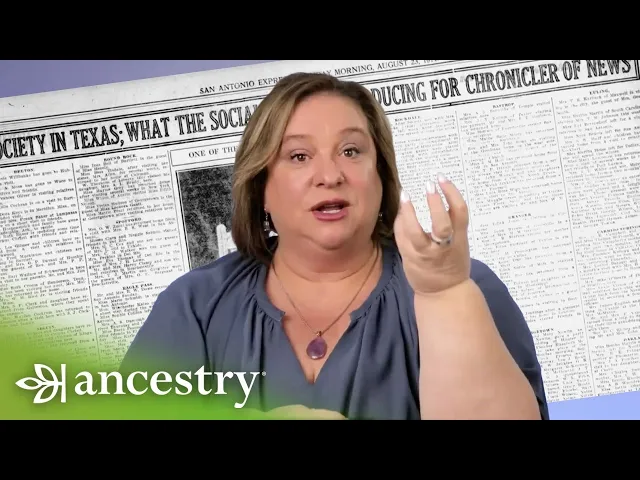
How To Use Newspapers.com Hints In Your Ancestry Family Tree | Tips & Tricks | Ancestry
Ancestry
0:00 I don't know if you have ever done a deep dive into historic newspapers,
0:06 but they are one of my favorite resources for doing family history research.
0:11 Hi everyone, I'm Christa Cowen.
0:13 I'm the corporate genealogologist here at Ancestry,
0:16 and today we get to talk about how
0:18 to use newspaper.com hints on your Ancestry family tree.
0:25 Now, uh, we will be going in and out
0:27 of newspapers.com as well as in andout of ancestry.com.
0:32 I'll be sharing my screen.
0:33 I'll be walking you through how the two integrate.
0:36 I'll also be giving you some information about how to use and evaluate
0:41 those hints and then how to combine that information to create a story.
0:46 Because I don't know about you, but that's kind of what I'm after.
0:50 The information is interesting, but the stories are the real real gold there.
0:57 So, um, that's how we're going to proceed in our 60 minutes together today.
1:02 Now, there will be a few times where I will ask
1:05 you to respond in the chat to a couple of questions.
1:09 If you're watching this live on Zoom
1:11 as part of our Wednesday virtual event series,
1:14 uh, you can respond directly in the chat.
1:17 If you're watching a replay of this on the Ancestry YouTube channel,
1:21 you can respond in the comments.
1:23 I do monitor those because I love to see the things
1:27 that you all are both learning and discovering in your family history journey.
1:33 So here is my first question to you and I would love a response in the chat
1:38 or in the comments which is what is the single
1:42 most interesting newspaper headline or discovery that you have made?
1:50 And so I'm going to go ahead and open up the chat and just
1:53 kind of keep an eye on that as you start to share your answers there.
1:58 I'm also going to share my screen and I'm just going to walk you
2:01 through a few different discoveries that are
2:05 possible in newspapers because I think sometimes,
2:09 especially if you're new to family history or if you haven't
2:11 used newspapers as part of your family history discovery process yet,
2:16 you might not even know what's possible.
2:18 So, you can see across the top of my screen, I have a whole bunch of tabs open,
2:22 and that's because I've preloaded a bunch of articles
2:25 or snippets of newspaper news that might be of interest.
2:31 So, this first one comes from the Lincoln,
2:33 Nebraska Journal Star from January of 1879.
2:38 And the reason this is interesting is because right here,
2:44 excuse me, right here under the news of the city,
2:47 it says um that a baby boy was born Tuesday morning,
2:51 January 14th, at the house of the railroad boss, Dailyaly.
2:56 Now, I'm assuming Daly is the last name of the railroad boss.
3:00 And now we have a birth date of a baby boy that was born then.
3:04 So, if you had been looking in the 1880 census for the Daily family in Lincoln,
3:10 Nebraska, and they were your family,
3:13 and you knew that they had a one-year-old child,
3:16 but you couldn't find the birth date, that would be a little bit of a challenge.
3:20 And the bigger challenge is is that Nebraska, I don't think,
3:24 was keeping official birth records at the time at a state level.
3:28 And so, there might not even be a birth record that that exists.
3:32 The fact that this child was born at home
3:35 increases the likelihood that a birth record might not exist.
3:39 And so you might struggle to validate
3:43 the birth date of this child in this family.
3:46 Well, here is just this tiny little twoline snippet in the local
3:51 newspaper that lists the date that that child was born.
3:56 And here's the thing about newspapers,
3:58 especially when you're talking about births, marriages,
4:01 and deaths in particular, is that they can't print news that didn't happen.
4:07 And they can't print news before it happens.
4:10 And so you can have some pretty um pretty high confidence
4:16 in the accuracy of some of the information that you find in newspapers,
4:21 particularly as it relates to births, marriages, and deaths.
4:24 this child's not going to be born in 1880 or 1881 or 1882,
4:28 even though you may have other records that list that as the birth year.
4:32 If the child was born in 1879 and the newspaper was printed in 1879,
4:37 that gives you a higher degree of confidence that that birth date is accurate.
4:43 Now, you'll notice there's lots of other little
4:45 things not um noted here in the newspaper.
4:47 Things like the funeral of Aldis Cody taking place Thursday.
4:51 again, they typically don't bury people before they died.
4:54 And so now you have a range or a window of when this individual died.
4:59 Um, you've got information about local businesses
5:03 and just what's happening in the community, which is always interesting to read.
5:09 So, here is my first tip to you.
5:12 Whenever you find information about an ancestor in a newspaper,
5:18 read the paper, right?
5:20 look to see what was happening in the community.
5:22 It starts to give you context and a feel
5:25 for the kind of community that they were
5:27 living and working and being educated in and worshiping
5:31 in and who what was happening in that community.
5:35 It also starts to give you a better understanding
5:37 of some of the sentiment of the time when it
5:40 comes to religion and politics and uh racial issues
5:45 and commerce and all sorts of the news of the day.
5:51 So that is one example.
5:54 Here's another example.
5:55 And I I happen to particularly love this one
5:58 because one of the challenges that we often have,
6:01 especially like as we go back in our family tree,
6:03 is that the further back you go,
6:06 the harder it is to get accurate or precise information,
6:10 especially as it relates to dates and places.
6:13 You might have a general birth date
6:16 or a general birth country or state of birth,
6:19 but to get really precise is sometimes tricky.
6:23 And one of the things we don't realize we
6:25 can do is look further ahead in their life
6:27 or sometimes even past their life to see what
6:30 was written about them that will give you that information.
6:34 So in this particular instance there is an individual
6:38 um it's a Jewish man a rabbi who
6:42 was 109 years old when he died and this is a type of an obituary that has
6:49 been written for him and you'll see um
6:53 the the um the newspaper has done some research
6:57 so much so that they claim so far
6:59 as possible the records of his birth have been verified.
7:02 So, they're claiming to know he really is 109 years old.
7:08 And this then they just talk about how he died.
7:11 They list his address.
7:13 They list the name of his wife, how old she is, his son,
7:17 how old he is, how many grandchildren and great grandchildren they have,
7:22 um where he was buried.
7:24 Right?
7:24 That seems like pretty typical information for an obituary,
7:27 except you'll notice that some of that is a little unusual.
7:31 Typically in an obituary they're not listing
7:35 the ages of the spouse and the children.
7:38 So there's some added information here.
7:41 And the interesting thing about this particular obituary,
7:45 it was published in the Savannah Morning News in 1887.
7:50 It was published in four or five
7:53 different newspapers and different newspapers depending on how
7:56 many column inches they had to devote
7:59 to the story um edited out some information.
8:03 So sometimes it's useful to look at every
8:06 instance of that particular thing being reported because
8:11 in some cases the full article might be listed
8:15 and in other cases that article might be truncated.
8:19 So that's my tip number two, which is always check to see if
8:24 this particular little news story, if this obituary,
8:28 if this piece of information has been published in multiple newspapers and read
8:34 all accounts of it to see if any of them have been edited differently.
8:39 Okay.
8:40 Now, in addition to that, we learn about his health at the end of his life.
8:44 We learn who his doctor was.
8:46 Apparently there were no HIPPA laws at the time.
8:49 Um we scroll down a little bit more and here
8:52 we say here we learn um he was born in 1778.
9:00 So certainly no birth records are available
9:04 from then um and particularly not from this place.
9:09 I'm going to not even try and pronounce it.
9:12 A small village of Russian Poland near Warsaw.
9:16 So now we learn the year of his birth which may have been difficult
9:20 to ascertain from some other records or difficult to um to to be precise about.
9:27 We learned the specific village where he is from, which is also pretty rare
9:32 information and sometimes difficult to come
9:34 by because a lot of times what happens,
9:36 especially with immigrants, is they'll say stuff like, "Oh, well,
9:40 I'm from Warsaw or near Warsaw." Instead of giving
9:44 the name of the actual town and having the name
9:46 of the actual town means you now know exactly
9:49 where to go to continue to look for additional information.
9:54 In addition to that, it says he was one of 21 children.
9:58 Um, youngest of 16 brothers.
10:00 So, now we know 21 children in this family.
10:03 He's the baby.
10:04 There are 16 of them are boys.
10:06 The rest are girls.
10:07 Um, it talks about when he got married, the year he got married.
10:12 It talks about um when and how he joined the military.
10:17 Uh, you scroll down a little bit, it talks about a story from his life.
10:22 And then it talks about when he immigrated to the United States,
10:27 which apparently he did at the age of 72 years old.
10:32 So you see, then it talks about his grandchildren and when and where
10:36 he became a rabbi and the fact that he did not drink, right?
10:39 Um, lots of details included
10:41 in this particular obituary for this particular individual.
10:45 Now, he was a rabbi and he was really old and so that was newsworthy.
10:51 Your family member may not be prominent in the community,
10:54 but sometimes by nature of their age or by nature of the fact
10:57 that they were one of 21 children
10:59 or by nature of something interesting or newsworthy,
11:04 they may have had something written up about them in the newspaper.
11:07 You just never know until you look.
11:11 And sometimes the details you get out of that are invaluable.
11:17 Okay, here is another example of an article.
11:21 This is from the Atlanta Constitution in August of 1887.
11:25 And I just want to point out something small.
11:27 This happens to be actually, I think,
11:29 a um article about a crime that took place in New York.
11:34 It's being published in the Atlanta newspaper.
11:37 But down here, there's just one tiny little line,
11:40 and it's one of those things that might
11:42 be missed if you weren't paying close attention.
11:46 So this article is about this individual whose last name is Mooney.
11:50 And here buried in the article it says Mooney said that he was born
11:55 in the county clair Ireland and he had been in this country 15 years.
12:02 At the time he was in the clothing business in 16th Street.
12:06 Okay.
12:06 And then it goes on to talk uh about the rest of the crime.
12:10 So that is again a piece of information
12:12 that might not be available anywhere else.
12:16 Every census record you're going to look at for this guy
12:19 for the 15 years he'd been in the country, right?
12:22 You're going to have in New York in particular,
12:24 you're going to have not just federal censuses every 10 years on the zeros,
12:29 you're going to have state censuses every 10 years on the fives.
12:33 And those census records almost universally
12:37 will state his birthplace as Ireland.
12:40 And if you've ever tried to do Irish research,
12:42 you know that the singular piece of information that is
12:46 most important to make sure you've got the right person
12:49 or at least to have a hope of having the right
12:52 person is knowing exactly where in Ireland they came from.
12:57 And so now you have this buried in a newspaper article
13:00 that he came from county cla and that he immigrated 15 years ago.
13:07 Now that 15 years like because it's a it's not a round number.
13:12 Round numbers are 10 20 30.
13:14 But sometimes people round to the nearest five, right?
13:17 The idea is when somebody gives you a year
13:19 that's 10 or 15 or 20 or 25 years ago,
13:22 you have to be a little bit suspicious because a lot
13:25 of times people just kind of round in their heads,
13:28 but that gives you a window to go
13:31 looking for a possible passenger list or immigration information.
13:35 And because you now know where he came
13:37 from, you're more likely to identify the right
13:40 person in the passenger list when you see
13:43 where his other pass fellow passengers came from.
13:46 Okay.
13:47 So, that is a a important thing to think about.
13:51 Like read through the article,
13:53 make sure you understand um that there could be gold hidden in there.
13:58 Okay.
13:59 Next up, this is from, and I'm going to mispronounce this word, Okanamaw.
14:05 I think that's in Wisconsin, um newspaper from 1902.
14:10 Now remember, one of the challenges that we have in family
14:12 history is that a lot of states in the US,
14:15 um, a lot of, um, provinces and territories in Canada,
14:18 they didn't start keeping birth, marriage,
14:20 and death records until, you know, sometimes the early 1900s,
14:24 which mean if the records are old,
14:26 they could they either weren't kept, they could have been lost or destroyed,
14:30 or they just aren't haven't been findable yet.
14:33 And so newspapers can help fill in some of those gaps.
14:37 But sometimes you have to remember, you have to look forward.
14:40 So this is a 1902 newspaper article,
14:43 but it's talking about the 60th anniversary of this couple.
14:48 So again, milestone moments sometimes when
14:52 they are significant and the newspaper
14:54 needs to fill column inches in the paper make the news.
14:58 Now, I do want to point out that this particular
15:00 image of this particular newspaper is really faded, right?
15:04 So, if I if I zoom out,
15:06 you'll notice like like there are some parts of this that are almost unreadable.
15:11 It's just the nature of newspaper print.
15:14 And so, Ancestry um newspapers.com,
15:18 especially when they're trying to digitize newspapers,
15:21 they do the best they can with the images that are made available to them.
15:25 But that means that sometimes this information
15:28 does not get indexed um exactly accurately.
15:34 because of the way that the newspaper print is or is not readable.
15:41 Now, you'll notice there's a whole lot of information in this paper.
15:46 Um, and some of it is very sensational, right?
15:49 Robbers get $8,000.
15:52 Um, murderous maniac makes his escape.
15:57 Bright young man dies of appendicitis, right?
15:59 Like there's so many so age woman falls
16:02 and breaks neck like the way that newspapers reported
16:06 local news um becomes um really really really valuable
16:11 as you're trying to find information about your people.
16:15 Now this particular thing here, Mr.
16:17 and Mrs.
16:18 Daniel Thomas celebrated their 60th anniversary of their marriage yesterday.
16:23 So now we know they were married
16:25 on October 31st because this is the November 1st.
16:28 Actually, they were married on the 29th
16:30 because the snippet came from October 30th.
16:33 So, the snippet was published or written October 30th.
16:37 They celebrated their uh marriage yesterday.
16:40 So, the day before October 30th, 60 years ago, he is 87.
16:47 She is 80.
16:48 Um he's been ill.
16:50 Oh, she's been ill and wasn't expected to live but is now improving.
16:55 Okay.
16:55 So, you get a little snippet into their life.
16:57 you get some information about their ages and you get their wedding
17:01 date all from these six or seven lines in this newspaper.
17:07 Okay, we're going to look at a couple more
17:08 and then we are going to move over to Ancestry.
17:12 Um, so in this particular newspaper, Sacramento Daily Union 18 55.
17:20 Okay, so we're talking the gold rush has started right in 1849.
17:27 it's still going on.
17:28 People are going out to California.
17:30 Um, lots of stuff is happening.
17:32 Some people go completely missing.
17:34 Sometimes deaths are reported about local people.
17:37 Sometimes deaths are being reported regionally.
17:41 In this case, um, you'll notice under this death column in this Sacramento,
17:46 California newspaper from 1855, they're reporting in this city.
17:50 So in Sacramento, um the death of this person in this city,
17:54 the death of this person.
17:56 Then they start reporting down here.
17:59 Um in Salt Lake City, this person died in Pleasant Grove City,
18:05 this person died, which is interesting because that's where I live.
18:08 Um in Salt Lake, in Salt Lake, in Los Angeles.
18:12 Okay.
18:13 So sometimes deaths are reported to places where
18:17 they might have had family or sometimes the newspapers
18:21 especially the further back in time you go
18:23 the more broad the more broad coverage that they have.
18:26 So keep that in mind as well.
18:29 Okay.
18:30 Next up is a Los Angeles newspaper.
18:34 Um and sometimes news uh news gets printed
18:40 that feels like it has no connection at all.
18:42 So, you may sometimes get hinted to a newspaper
18:46 that is from a place that your family member never lived,
18:49 never had any association with, and you may not on the surface
18:53 have any clue why information about them was reported in that paper.
18:59 So, here is a little snippet in this Los Angeles, California Star, again, 1855.
19:06 An old lady named Sarah Canby,
19:08 aged 107 years old, recently died at New Liberia, Louisiana.
19:14 She was born in the city of New York on the 25th of December, 1746.
19:21 So, they're reporting her death in 1855 in the city of Los Angeles.
19:27 She was living in Louisiana.
19:29 She was born in New York.
19:30 And if this is your ancestor, you just hit pay dirt, right?
19:34 because now you have in four little
19:37 lines really detailed information that you might not
19:41 have even thought to look at because it
19:43 was being reported in a newspaper from California.
19:47 Okay.
19:48 And then um there are also often court actions reported in newspapers.
19:54 So lawsuits and in this case wills being filed.
19:59 So when you come across that, that tells you
20:01 that a will exists and that you can go looking for it.
20:06 And so pay attention.
20:07 Don't skip over things that feel insignificant.
20:11 Real estate transactions, court actions,
20:14 any of those are going to give you a clue
20:17 that more information exists out there for you to go digging into.
20:23 Now, one of my favorite things in newspapers is what we call society pages.
20:28 Society pages feel maybe a little bit frivolous.
20:33 This is from a society page in San Antonio, Texas in 1914.
20:38 And what you'll notice is the society pages
20:41 very often break up the news by community.
20:45 So you'll see here little headings Belton,
20:47 Round Rock, Spaford, Eagle Pass, Rockdale, Bastrop, right?
20:52 Okay.
20:53 All the little communities.
20:54 And you can read through the community news.
20:57 It feels a little bit like snooping
20:59 on a city on a little town Facebook page, right?
21:03 Newspapers were like the Facebook of their day.
21:06 They're talking about who's going where and who's doing what, right?
21:09 So, you see things like St.
21:12 Joseph's Alter Society met with Mrs.
21:13 John Cook Friday afternoon when plans for the fall work were discussed.
21:18 Refreshments were served during the social hour.
21:21 Why would we care?
21:22 Well, we would care because now we know that Mrs.
21:26 John Cook, who's in Rockdale, is affiliated with the St.
21:29 Joseph's Alter Society, which gives us a clue about her religion,
21:35 which then could lead us to church
21:38 records of baptisms and marriages and burials,
21:41 possibly the location where she's buried,
21:44 information about the people that she associated with.
21:47 It seems like a little bit of innocent information,
21:51 but it really could give you more information.
21:54 Miss Clara Eststein Cook entertained with a magic
21:56 lantern party in compliment to Carmelita Dunnington of Huntsville.
22:01 After the picture program, games were played on the lawn ending
22:04 with refreshments which were served in the dining room.
22:07 Right?
22:08 Again, might seem silly, but it gives you a person in a place at a time.
22:13 And sometimes it gives you more to research and sometimes it just gives you
22:16 an idea of who they were in the community and who they were associated with.
22:22 so that when you start to find other records,
22:24 you can have greater confidence that those records really are about this person.
22:30 Okay?
22:31 And then sometimes these little snippets give you information
22:35 that actually helps you track additional marriages or relationships.
22:41 In this case, Mrs.
22:43 Wider of Winchester arrived here in that community to be
22:47 the guest of her son a Noic and other relatives.
22:51 Mrs.
22:51 Annie and Katie Weezer were the guests of Mrs.
22:54 Noic.
22:54 Okay.
22:55 Now, I suspect that this should say Weezer,
22:58 not Weider, but that's worth investigating.
23:02 Also, why does a woman have a different last name than her son?
23:07 That's usually an indication that she has remarried.
23:10 And so, No was likely her first husband.
23:14 Wider was likely her second husband.
23:16 And now if now we know to go look for another marriage for her.
23:22 Um we also could investigate who are
23:24 these young women and why were they her guests?
23:27 Are they her stepdaughters?
23:28 Are they nieces?
23:29 Is you know what is the relationship of the people that are mentioned?
23:34 Four little lines.
23:36 That's all.
23:37 And yet it could give you a whole other set of information about this person.
23:43 Um, I always love when they publish
23:45 information about children who are a year old.
23:48 Sometimes you'll find pictures in newspapers.
23:51 And so just the little snippet, Benjamin Franklin Heraggle Jr., son of Mr.
23:55 and Mrs.
23:56 BF Heraggle of Lraange, right?
23:59 And now there's this gorgeous picture of that child.
24:03 Lots of communities publish first year birthday or fifth year birthday.
24:07 Um, especially like kind of small local papers will publish that information.
24:12 Okay.
24:13 Um, let's see.
24:16 Lawsuits.
24:16 We talked about court actions, right?
24:19 So, anytime you see a court action,
24:22 there could be additional information in subsequent or previous
24:26 editions of that same newspaper following the court case.
24:30 There could also be an opportunity for you
24:31 to contact the courthouse and see if there's information.
24:35 I think sometimes this also gives you just a little
24:39 insight into the personalities of some of these people.
24:42 So this is um one of my great-grandfather's uncles.
24:47 And so he sues his neighbor in 1914 for $2355 in damages.
24:55 By Mulliner this week filed a suit.
24:57 So he is the one filing the lawsuit in the district court
25:00 against Arthur Hawkins claiming damages
25:02 on three counts aggregating to this amount.
25:05 The principal cause grows out of Hawkins dog having bitten
25:08 Mulliner on the ladder's dry farm in Cedar Valley last June.
25:12 So a couple months earlier the complaint charges that Hawkins set
25:15 the dog on his neighbor but the later latter strenuously denies the accusation.
25:21 The other causes grew out of the alleged trespasses
25:24 of Hawkins pigs and other animals destroying Mulliner's grain.
25:28 The two men are neighbors in the north end of Cedar Valley.
25:32 Jacob Evans is Mr.
25:34 Mulliner's attorney.
25:35 So, you start to see this information about personalities, about conflicts,
25:41 about how people are living or maybe not living well together in in communities.
25:49 And that is priceless information when you're putting
25:52 together pieces of the stories of people's lives.
25:56 Okay, last two we're going to look at here.
25:59 So, this is from a Canadian newspaper.
26:01 So, it's important I focused a lot on some, you know,
26:04 I grabbed a lot of examples from US papers
26:06 because I was pulling things from my own family tree,
26:09 but I wanted to make sure that you all
26:12 know that there are also newspapers available for Canada,
26:15 for England, for other places.
26:17 and I'll show you how to see what's available.
26:20 This is the the front page of the newspaper.
26:24 And so when I said earlier, always look at the paper to get
26:27 a context about what's happening in the community,
26:30 the front page of a newspaper always tells you what that community or at least
26:35 the journalists in that community deemed the most important news of the day.
26:40 And so sometimes when you find stories about your people on those pages,
26:46 that tells you something about the significance of that.
26:50 So in this case, um there was a missing
26:53 person and the missing person was the husband of Mrs.
26:58 Ara Mansfield and she lives on the bank
27:01 of the Elbow River near Holy Cross Hospital.
27:04 This is from the uh Calgary, Alberta newspaper.
27:07 and she paid a medium essentially to locate her missing husband
27:13 and the medium failed to deliver and so she's suing her.
27:17 But what this little snippet of article gives you is it gives
27:21 you the fact that where she's living and when her husband went missing.
27:25 So if you're looking at the 1911 census and there's no
27:28 husband and you're trying to figure out what happened to him,
27:30 you might dive into newspapers to see if there are some answers there.
27:36 Another thing that very often gets reported in newspapers,
27:39 this is from a English newspaper in 1900,
27:42 has to do with military service and not just during wartime.
27:48 This is years prior to World War I,
27:52 but we have these individuals um serving in the military.
27:56 And in this case, there's actually a transcription of the letter
28:00 that a soldier wrote home to his mother after he was injured.
28:04 and it was published in the local newspaper
28:07 and so it gives information about his service
28:09 and it gives information about his um injury
28:13 and it gives information about when he is coming home.
28:17 So lots and lots of military information also gets published in newspapers.
28:24 So let's talk just a little bit about how
28:26 and where all of this information gets put online.
28:30 newspapers.com is and always has been um owned by Ancestry.
28:36 Ancestry launched this as a separate website for a couple of reasons.
28:40 The primary reason is because I know this is going to be hard to believe.
28:45 There are people who are interested in social
28:48 history who are not interested in family history.
28:52 And so it is a standalone subscription that you can buy
28:56 um access to what's on newspapers.com if that's all you're interested in.
29:02 Now we know of course how valuable newspapers
29:06 are to people who are interested in family history.
29:09 Clearly I hope I've just demonstrated that.
29:12 So newspapers.com in the United States is
29:16 included with the Ancestry All Access subscription.
29:21 And so if you have an Ancestry All Access subscription,
29:25 you have access to all the records on Ancestry,
29:29 all the records on Fold 3, and all of the records on newspapers.com.
29:36 Okay.
29:36 Now, outside of the US, the subscriptions work a little bit differently.
29:41 If you have specific questions about that, you
29:44 can go into the Q&A and let them know where you're at and they'll let you know
29:48 exactly what your subscription includes or does not include.
29:52 But you can always purchase newspapers.com as a separate or add-on
29:58 subscription um no matter where you are in the world.
30:02 But in order to decide if it's going to be valuable to you or not,
30:06 you need to know what's included.
30:09 And so whether you have a subscription or not,
30:12 you can come in here to newspapers.com
30:15 and you can see exactly what newspapers are included.
30:21 There is a browse structure.
30:23 The browse structure on newspapers.com works a little
30:26 bit like the card catalog on Ancestry.
30:30 It's my favorite thing.
30:31 You know that.
30:32 But this is going to allow you to see what
30:35 newspapers exist on the website before you ever purchase a subscription.
30:41 So you can see there are currently 18 countries
30:44 where Ancestry has records or images of newspapers available.
30:50 You can click on that particular country and then it's
30:53 just a matter of narrowing it down by geographic location.
30:58 So, in this case, we're going to go, let's see,
31:00 we'll go to Utah since that's where I'm sitting right now.
31:03 Then, it'll go to the particular cities or communities.
31:07 Um, I happen to be sitting right now in Lehi, Utah.
31:11 And then it will show you the newspapers
31:14 that are included in that from that city.
31:18 Now, one of the things you're going to notice,
31:20 and I'm going to zoom in so it's really obvious here,
31:23 is that some newspapers will have a little
31:26 plus sign next to them, and some will not.
31:29 Those little plus signs are going to tell you whether or not that um
31:34 that newspaper is included in the basic
31:37 newspaper subscription or the full publisher extra subscription.
31:42 Now again in the US if you have the ancestry all access subscription
31:47 you have everything on newspapers including all
31:51 of those newspapers with the plus sign.
31:54 But if you're purchasing
31:55 your newspaper subscription directly through newspapers.com
32:00 you have options of choosing a basic subscription or publisher extra.
32:04 Here's what publisher extra means.
32:06 It means that these newspapers are most likely still under copyright
32:10 and they are definitely under a licensing agreement from the original
32:14 publishers and that means that ancestry has an agreement or newspapers.com
32:21 has an agreement with the publisher to publish those um
32:25 but that there are some restrictions around those and so
32:29 it also means we have to include them in a higher
32:33 tier subscription because usually we're paying paying out royalties
32:38 to that newspaper because they still own the rights in those papers.
32:43 Okay, so that is um what the little plus sign means.
32:48 Now, once you click on any one of these papers,
32:52 it will then show you the years that are available for that paper.
32:55 Now, you'll notice right off the bat here, the Lehigh Banner,
32:58 there is an 1891 paper, there's an 1893 paper.
33:02 we just skipped right over 1892, '94, 95, 96, and so on.
33:07 And that's because either the newspaper was
33:10 not published during that year or there
33:13 are no surviving or known surviving issues
33:17 of that paper for that particular year.
33:20 So where we can fill in the gaps,
33:22 we always do and uh where we can't, you'll notice those gaps.
33:27 Now you can select a year and then
33:29 it will show you the months that are available.
33:31 You can select a month and then it
33:33 will show you the additions that are available.
33:35 In this case, just based on what I'm seeing right here,
33:38 I can tell you this is likely a weekly
33:41 or um or bi-weekly publication with special editions.
33:46 And you can probably figure that out
33:48 then by clicking through to the particular newspaper.
33:52 And it is a fourpage paper uh that comes out it looks like once a week.
33:57 um and we might be missing one of the editions
34:01 or they just didn't publish it at that time for whatever reason.
34:06 So that is how you browse to see what newspapers exist and then
34:11 of course you can click through and read it just like you would a newspaper.
34:16 So to figure out if the locations where
34:19 your ancestors lived even have newspapers available on newspapers.com,
34:24 you're going to want to use that browse structure.
34:27 Now, on newspapers.com, you'll notice this little ticker.
34:31 There are currently 1.2 billion total pages of newspapers on the site,
34:37 and that number gets augmented as they scan and upload new papers.
34:44 And there are constantly new papers being scanned and uploaded.
34:49 And when I say new, I don't mean newspapers published March 31st, 2026.
34:58 Though I do mean that, too.
34:59 That's just not only what I mean.
35:01 I also mean there could be a newspaper from 1857 in Nebraska that Ancestry was
35:08 able that newspapers.com was able to finally
35:10 get access to and publish on the site.
35:14 There might be a newspaper from California from 1922 that newspapers was able
35:18 to negotiate with the publisher for and get access to publish on the site.
35:23 So there are new papers being published all the time
35:27 and then there are historic newspapers where access is gained,
35:30 they are digitized and they are published on the site.
35:34 And so you're going to want to check back on a fairly regular basis.
35:38 Now, let's talk about what is going to show up on Ancestry.
35:45 Several years ago, um, some of our data analytics team were able to go
35:49 through those 1.2 two billion pages of newspapers on newspapers.com.
35:56 And they were able to um use AI to create algorithms
36:01 that enable us to create searchable indexes to the images on newspapers.
36:11 Traditionally, newspapers, right, this is just like a bag of words
36:16 that was done by what we called optical character recognition.
36:19 That was the traditional indexing of pages
36:23 of newspapers for two decades or more.
36:27 Meaning a computer just read the page and then returned this like
36:32 massive amounts of words and then you could search for your ancestor,
36:37 you know, Elizabeth Wallingford and it
36:39 would show Elizabeth here and Wallingford here.
36:42 But all we knew was that they were on the same
36:44 page and so we delivered that to you as a search result.
36:47 better than nothing.
36:48 For decades, it was better than nothing.
36:51 But now we have more advanced technology
36:53 that allows us to do a couple of things.
36:56 The first thing that we can do is
36:58 we can start to identify the boundaries of articles.
37:01 So there is an algorithm that we use that allows
37:04 us to say this is an article and this is
37:07 an article and this is an article and we
37:10 can create boxes essentially or boundaries around each article.
37:14 So then when information is read,
37:16 it's only read at an article level instead of across the whole page.
37:22 So that gives us more precise search results right off the bat.
37:28 Okay.
37:29 Then the second thing we can do is we
37:31 can um run an algorithm that looks at the words
37:34 in that article and we can tell based on the words
37:37 in that article what kind of an article it is.
37:40 And is this article a birth record?
37:42 Is this a marriage announcement?
37:44 Is it an obituary?
37:46 Is it just some story about something that happened in the community?
37:50 And we can tag that article about that.
37:54 Okay.
37:55 So, Ancestry has gone through and done
37:57 that with the newspapers on newspapers.com.
38:02 And then we can create then as like a third step a searchable
38:06 index based on that boundaries of the article and the tagging that is done.
38:13 So here's what that is going to look like.
38:16 There are, if you come into the card catalog
38:18 on Ancestry and type in newspapers.com and click search,
38:24 there are currently 69 databases,
38:28 individual databases that are indexes to newspaper pages over on newspapers.com.
38:37 Now, these databases are massive.
38:40 So, if I sort this by record count,
38:42 what you'll quickly see, right, 1.8 8 billion individual records.
38:48 So the name of a person is a record.
38:50 Individual records that come out of the Pennsylvania Stories and Events Index.
38:56 It was originally published back in June of 2023 and it was recently
39:01 updated in January of this year because when it was indexed back in 2023,
39:08 then there were two and a half years
39:09 of additional newspapers being published over on newspapers.com.
39:13 And so now we have to add those records into the index.
39:18 So these databases get updated as you can
39:21 see every you know few years at this rate.
39:24 Okay?
39:24 Because we have to cycle through so many records.
39:28 You can also sort it by collection title.
39:31 That's an alphabetical sort that will show you
39:34 um exactly how they're how they're broken out.
39:37 Now, there are three four different kinds
39:42 of databases here that are indexes to newspapers.com.
39:46 The first one you're going to see and the most prevalent one
39:48 is going to be what we call the stories and events index.
39:53 And basically what that is is just any interesting article that is not a birth,
40:01 marriage or death record.
40:02 So birth, marriage, and death records we've separated out into their own
40:05 individual databases and then kind of everything else gets categorized
40:10 into those other databases and we're calling those stories and events
40:15 indexes and you may see hints or search results leading to those.
40:22 Okay, scroll down a little bit.
40:24 You're going to see there's a Canadian marriage index database.
40:28 So the stories and events indexes broken out by state,
40:32 the marriage birth or the marriage and obituary
40:35 indexes broken out by individual database here.
40:40 Okay?
40:41 And so as you scroll through these, you'll see like Ireland,
40:45 Canada, Michigan, right?
40:48 Like they're all these individual databases.
40:52 Now, currently we have stories and events indexes.
40:55 I just want to make sure I'm clear about this because I may have misspoke.
40:58 We have stories and events indexes,
41:00 we have obituary indexes, and we have marriage indexes.
41:04 Um, we do have some birth indexes, but I don't think the birth indexes have
41:10 yet been created for all of the countries.
41:14 So, kind of just keep that in mind as you're looking through these.
41:18 But, as you as you scroll through this list, you'll see all of those.
41:22 Okay.
41:23 Now the final type of newspaper uh index that we have on ancestry
41:28 are the auctions of enslaved people and the bounties on freedom seekers.
41:34 And these are from newspapers pre180.
41:37 Okay.
41:38 752,000 records where we've been able
41:41 to identify that this particular newspaper article
41:45 or these two lines written in this paper are about a person um being auctioned
41:51 off as an enslaved person or um freedom see uh runaway slaves being sought
41:57 by freedom seekers um being sought by people who have put a bounty on them.
42:02 Okay, so that's a separate database as well.
42:06 So that's how those are going to show up in Ancestry.
42:10 So if you ever see these in your hints
42:13 or if you see these in your search results,
42:16 that's what they mean and that's where they they come from.
42:19 So AI, which is going to read it way better than a human and way faster,
42:25 type like no human is going to go through
42:27 and type up all that information off of one,
42:30 you know, off of however many billion pages of newspapers, right?
42:33 Like the idea is making it searchable for you,
42:37 making it contextual within an article and then tagging
42:41 it as the type of thing that it is.
42:43 And so that is um where that information comes from.
42:48 So it's an index that's going to point
42:51 you to an image that exists over on newspapers.com.
42:58 Now, you are going to seen then these indexes show up in your tree as hints.
43:06 I don't know what your level of experience is with ancestry.
43:09 If you're brand new, welcome.
43:10 I'm so glad you're here.
43:11 Welcome to the deep end.
43:13 Um, if you've been doing ancestry for a while and you've kind
43:16 of gotten through the census records
43:17 and you've gotten through the available birth,
43:19 marriage and death records and you kind of have started
43:21 collecting pictures from your cousins and you've just kind of started
43:24 like you're in a good place and you're now ready
43:27 to start to dive into some of this newspapers research.
43:30 Um, I whether no matter where you are in your journey,
43:33 I just want to make sure you understand this because
43:36 sometimes people don't really have this clear in their mind.
43:39 A really important thing you need to know about all hints
43:43 on ancestry is that a hint is a maybe, not a match.
43:51 So what's happening is you've entered information into your tree
43:55 and an algorithm on ancestry goes out and searches
44:00 information that we have indexed in all kinds of different
44:02 records and delivers that to you as a hint.
44:06 Then we also go out and look and see does anybody else have a person
44:10 in their tree that looks like it might be the same person as this.
44:14 And we do that constantly.
44:15 And then we look and see what other records have they saved to their tree.
44:19 And we give you those as hints.
44:21 So every time you save a record on ancestry to a person in your tree,
44:27 you are generating hints for other people.
44:30 So, we always want to make sure that we understand
44:33 that a hint is a maybe, not always a match.
44:39 What that means is you have to open the hint
44:40 and you have to look at it and you have to decide, is this really for my person?
44:46 Keeping in mind that records like census
44:49 records and draft cards and passenger lists,
44:52 all of those records have been indexed
44:53 by humans who are fallible and sometimes make mistakes.
44:58 and records like newspapers and yearbooks and city
45:02 directories and some of those other things,
45:04 they were indexed by AI, which is not perfect yet.
45:08 And so there could be mistakes.
45:10 So we've got human mistakes and we've got computer mistakes.
45:12 And we haven't even talked yet about the original mistakes on the record
45:16 that the census taker or the guy filling out the passenger
45:19 list or the journalist writing the article or the type setter
45:23 putting the type into the article may have made along the way.
45:27 And so all along the way there are
45:28 opportunities for little errors or things that go wrong.
45:32 And that is actually what makes it fun
45:34 is that we as the family historians who are
45:38 putting together the the family tree who are
45:41 bringing the stories of our ancestors back to life,
45:44 who are connecting back with that information
45:47 and then sharing it out to our families.
45:49 We're the ones who get to put the pieces of the puzzle together.
45:54 And newspapers are a really great way to start to fill
45:57 in some of that color and story and information in that puzzle.
46:04 But we have to make sure that the hints that we're looking at are a match.
46:11 And all hints start as a maybe, not a match.
46:15 And so you have to go look at it.
46:17 So hopefully you've developed some skills for evaluating hints,
46:20 but we could all use a little bit of a refresher.
46:23 And so I'm going to let the beginners know
46:25 and those of you who are a little more experienced,
46:27 we're going to refresh our memories.
46:30 Here is just a simple little checklist.
46:32 When you are looking at a hint,
46:34 you need to look at first of all, does the name match?
46:37 And by I mean what I mean by does the name match is is it the same name?
46:43 Not is it spelled the same?
46:48 Because spelling didn't count.
46:50 And so you'll find names spelled 20, 30 different ways, given names, surnames.
46:55 You'll find people with their initials.
46:56 You'll find women listed as Mrs.
46:59 John Smith with her husband's name.
47:01 You'll find lots of different ways that people's names are listed,
47:05 but you have to consider, is this a matching name or not.
47:10 And just remember, it's not always rarely, in fact,
47:14 going to match exactly the way that you have it in your tree.
47:19 And so you might be delivered hints that look like a little wackadoodle,
47:22 but when you look a little closer,
47:24 you realize, "Oh, she's listed by her husband's name." Or, "Oh,
47:27 he's listed by his initials." Or, "Oh, that's his middle name.
47:30 I didn't know that." Okay?
47:32 So, you're you're trying to make a name match.
47:34 Then, you're trying to make a place match.
47:37 Okay?
47:38 Now with newspapers,
47:39 remember I said newspaper articles can get published wherever,
47:43 but does the actual article talk about the places where this person was from?
47:50 Can I connect it to a place this person lived,
47:54 worked, was born, married, died, served in the military?
47:58 Like, do I know enough about them to see if this place matches or not?
48:03 Because if you've got a total place mismatch and you
48:06 can't reconcile that, this article probably isn't for your person,
48:11 even if the name matches.
48:13 So just because somebody has the same name, doesn't mean it's the same person,
48:17 even if you think it's the most unique name in the whole world.
48:21 So does the name match?
48:22 Does the place match?
48:23 And then does the time period match?
48:26 Okay.
48:26 Now remember what I said earlier.
48:28 If you know that somebody was born in 1885 and you've
48:32 got all this evidence that they were born in 1885,
48:34 but you're looking at an 1879 birth record, that might not be for your person
48:39 or the other information might have been misreported.
48:42 Maybe she was trying to make herself younger as she got older.
48:45 Like lots of different ways you can reconcile that.
48:49 But if this record was published in the newspaper in 1879,
48:53 but you know your person was born in 1920, it's probably not a match.
48:58 Okay?
48:58 So names, dates, and places need to match.
49:01 And then you also want to look at, especially in newspapers,
49:06 some of the other little clues.
49:10 Clues like addresses.
49:13 Addresses are a really great way to tell if this really is your person or not.
49:18 If you've looked at the address on the census, and I don't know about you,
49:21 but I transcribe every record I find into my notes on Ancestry,
49:26 so that I have all the details off the image, not just what was indexed,
49:30 but every little bit of juicy goodness off
49:32 that census page about that person and their family.
49:35 And so what I've got right there in my notes
49:37 then is the address that they lived at.
49:39 And I can track that through time as I found them in a census
49:42 and a city directory and on a draft card and like right.
49:46 And so then when I get a newspaper hint that tells me, oh,
49:51 this John Smith that lived in this place at this time and I've got a name,
49:56 a date, and a place match, but then it lists a completely different address,
50:01 I know it might not be my person,
50:04 or I might need to go dig into more detail to see if it really is my person.
50:10 So, addresses often give us a little bit more specific detail that tells
50:16 us this is or this is not an article about my person.
50:19 The next thing that you should look
50:21 at on newspapers in particular is relationships.
50:26 As it lists those relationships,
50:28 you can start to figure out if this really is your person or not.
50:34 And sometimes you have to string together multiple
50:37 sets of information to decide if it is.
50:40 So, personally, I would never start with newspaper hints.
50:46 When I'm building a family tree, I always start,
50:48 especially if I'm doing US or Canadian or UK research,
50:52 I'm always starting with the census because
50:54 it's giving me the scaffolding of information about
50:57 that family that I'm filling in the gaps
50:59 with birth marriages and deaths where they exist.
51:02 Those of you who are doing research in England,
51:04 you're so lucky because your birth marriage and death records started in 1837.
51:10 We have places here in the United States that didn't
51:12 start keeping birth marriage and death records until the 1940s, right?
51:16 So, there's this kind of wide disparity depending
51:18 on where your family is from, whether those records exist,
51:22 but where they exist, you're going to fill in those gaps.
51:24 You're going to use draft cards and military service records,
51:28 naturalization records, and passenger lists.
51:30 And then when you get to the newspapers,
51:33 now you have this way of being more confident that this hint
51:38 really is for your person or is not for your person.
51:42 And then you can dig into the additional information that it tells you.
51:45 So, does the name match?
51:46 Does the place match?
51:47 Does does the time period match?
51:50 And then are there other clues like
51:52 addresses and relationships that are going to help
51:55 you determine if this record is for your person or is not for your person?
51:59 Now almost always that means you need to view the image.
52:05 Viewing the information on the index is not always sufficient.
52:11 And so that's why having that subscription
52:14 or that access to those newspaper images
52:17 becomes so critical because you can't just
52:19 look at the indexed information always and tell.
52:23 Now sometimes you can and sometimes you can look at it
52:25 and you can go oh I know that absolutely is not my person.
52:29 But sometimes you can't tell for sure if it
52:31 really is your person until you look at that image.
52:35 So, um you know, if you've got enough information
52:38 to tell you that you think this could be your person,
52:40 it's worth clicking through to view the image and reading it.
52:43 Awesome.
52:44 Um if if it's not, you can ignore that hint.
52:49 Okay.
52:50 So, we're going to take a look at a couple of hints.
52:52 Let me just share my screen one more time here um
52:57 so that we can walk through what these are going to look
53:00 like in your tree in our last few minutes and then
53:03 um how you can best save these records to your tree.
53:07 Okay, so I have I'm looking at some hints here.
53:10 You can see I've got stories and events.
53:12 I've actually filtered this list down to um just Arkansas.
53:16 That's where my mama's family is from.
53:18 And we're going to take a look at um
53:21 let's see this individual right here, Thomas J.
53:24 Dunlap.
53:25 I've got a hint here from uh 1924 in Berryville, Arkansas.
53:32 I should probably just double check, make sure I'm sharing my screen.
53:34 Yes, I am.
53:35 Um in Bville, Arkansas um in the Arkansas
53:39 newspapers uh stories and events index.
53:42 Now, I'm going to rightclick on that and open that up in a new tab.
53:45 I'm also going to rightclick on Thomas's name and open that up in a new tab.
53:50 And so now up here, you can see I haven't left my all hints list.
53:53 It's still sitting there waiting for me.
53:55 I've got Thomas's profile page open so that I
53:58 can see what else I know about him,
54:00 what other information I might have in the notes that I have collected,
54:05 what I know about his family members.
54:07 And then I've got this uh ancestry index to the newspapers.com image.
54:15 And what this tells me is that Tom Dunlap is mentioned in the newspaper.
54:19 The tag on this is other,
54:20 meaning it's not a birth or a marriage or a death recognizable um as that.
54:25 This is the date.
54:26 This is the place.
54:28 So the name matches, not exactly, but close enough.
54:32 The date makes sense, right?
54:34 He would have been about 80 years old at the time.
54:37 The place matches.
54:38 Last time I had him in a record, he was in Arkansas.
54:41 Now, I haven't done as much information or as much
54:43 searching on this guy as I probably should have just yet.
54:46 So, you're seeing this live.
54:48 I've never seen this article before.
54:50 Okay.
54:50 Then the next thing I'm going to do is I'm going to rightclick
54:52 on this and I'm going to open this image in a new tab as well.
54:57 So, now I've got the index here and I've got the image
55:00 here so that I can toggle back and forth when I need to.
55:04 Now, this looks like some society news.
55:07 Denver is a community in that particular part of Arkansas.
55:11 Um northwest corner there.
55:14 This looks like a lot of stuff happening on this page
55:16 that I'm going to want to read at some point.
55:19 But here under the items,
55:21 it says Tom Dunlap and family were Sunday visitors at the BS Norris home.
55:28 Now, Norris is a name that I recognize in our family tree,
55:33 and I suspect that the Norrises are either
55:36 his cousins or maybe um uh a sister and brother-in-law.
55:41 I'd have to go dig into my tree to find.
55:43 So, this gives me a little bit
55:45 of information about the fact that they're still living.
55:48 BS Norris and his family are still living in Denver in 1924.
55:54 So, there are a couple of different ways you can save this record.
55:59 If there is an index record to it on Ancestry,
56:03 I highly recommend always using this feature to save this record.
56:09 So, you're going to click yes if it's a hint or save if it's a search result.
56:14 And you're going to come through and you're going to save
56:16 this record to this person in this in this tree.
56:19 What that's going to do is it's going to add a source citation right here.
56:25 As a matter of fact,
56:26 let me go find one in my tree so that you can see what that looks like.
56:29 It's going to add a source citation in your tree
56:33 for that record and Ancestry will create that for you.
56:37 So that's the first reason why I would do it that way.
56:40 Okay.
56:40 So, if I come down here,
56:41 you'll see I've got right newspapers that I have saved from a hint
56:46 or a search result and it creates
56:50 um a little source citation with citation details.
56:54 It has a link that can that you can
56:57 click through to view the original image over on newspapers.com.
57:02 It's got all my associated facts and then there
57:06 is a thumbnail that gets put into the gallery.
57:11 Okay.
57:13 Now, sometimes you may just be over
57:15 on newspapers.com searching like a maniac finding things
57:20 that are not either not indexed yet because
57:23 remember we only update those indexes every few years
57:26 because it's a massive project um and the newspaper
57:29 just came online or maybe it was missed for some reason in that AI indexing
57:34 and so you're finding newspapers directly on newspapers.com.
57:38 And if you do that, you can use
57:39 this little feature over here to clip the article,
57:44 which just allows you to like adjust the boundaries
57:47 of what it is you want to save.
57:49 So, if I don't want to save the whole society column, though,
57:52 I'm seeing a lot of familiar names as I skim down this column.
57:56 Um, if you don't want to save the whole column,
57:59 you can just clip it or snip it to what you want to save.
58:04 And then you can give your little clip a title.
58:06 You could tag it if you want to get really fancy.
58:09 And then you can save that clipping.
58:14 Then you can save directly to Ancestry.
58:20 So now I can save that clipping to Thomas J.
58:23 Dunlap in my tree this way.
58:26 And that will allow me to save it.
58:28 Now when I save a record that way,
58:30 it's going to look a little different in my tree.
58:34 down here.
58:35 It's going to add that instead of being a ancestry source,
58:39 which is a source to the index and a link to the image,
58:43 it's going to save it as a newspapers.com source under other sources.
58:48 That source is still going to have this information,
58:52 all the source citation details and a link to the image
58:57 or the clipping that you made over on newspapers.com.
59:02 Now, there are um a couple of things I
59:05 just want to make clear before we wrap up today.
59:08 One is any articles that you save from the index or save through the clipping,
59:15 all we do on ancestry is we just put a lowresolution
59:18 thumbnail in your gallery so that you know it exists.
59:22 You can then click through to view the original image over on newspapers.com.
59:27 Remember, I said ancestry does not own most of those newspapers.
59:30 we've licensed them and in some cases, many cases,
59:34 we pay royalties based on the views of those images to the newspaper owners.
59:38 And so by viewing it on newspaper,
59:40 you're allowing us to account correctly how those images are getting viewed
59:45 so that we can make sure that we um fulfill those licensing obligations.
59:50 So the the lowresolution thumbnail just gets saved
59:53 to your gallery to let you know it's a placeholder,
59:56 but you can always click through from the image or through
59:59 from the source citation to get back to that original.
1:00:02 The second thing I want to make sure is really
1:00:04 clear is that when you clip an article on newspapers.com,
1:00:11 that goes into a clippings file.
1:00:13 So you have everybody that has a login on newspapers.com,
1:00:17 you have a clippings file and that clippings file becomes
1:00:20 available to you whether you have an active subscription or not.
1:00:24 So if I'm clicking through to view those and I've clipped them,
1:00:27 I have that visibility.
1:00:30 The one thing you do not want to do is you never
1:00:32 want to download an image from newspapers.com and then upload it to ancestry.
1:00:37 that becomes like a violation of the terms and conditions
1:00:40 and the licensing agreements that we have in place with those.
1:00:44 And we all want to be good stewards of the records because
1:00:46 we always want to make sure that we can get more records.
1:00:49 We always want more records, right, as genealogologists.
1:00:52 Now, I hope that that was useful to help
1:00:54 you understand what's possible to find in newspapers,
1:00:57 some of the ways that you can find those in Ancestry
1:01:01 through those hints or through actually
1:01:03 searching some of those individual databases.
1:01:06 or you can go over and search on newspapers.com.
1:01:10 The really great thing about collecting all
1:01:12 of these newspapers is that records, all records,
1:01:15 census records, passenger lists, draft cards, and newspaper clippings,
1:01:21 all of those records are just raw material.
1:01:24 The stories are the reward.
1:01:26 and newspapers help us to fill in the stories probably better
1:01:31 than just about any other resource that I use in family history.
1:01:37 So, I cannot wait to learn more about what you are discovering in newspapers.
1:01:43 If you're watching this on the YouTube channel as a recording later
1:01:46 or if you're watching live and want to come find the recording,
1:01:50 I would love to hear what you start to discover.
1:01:53 But if you're watching this live especially or on YouTube,
1:01:57 before we go today in the chat,
1:01:59 will you please just leave one new thing you learned today?
1:02:04 That's super helpful for me because it
1:02:06 helps me continue to create these virtual events
1:02:10 each week that are meeting you where you are and giving you what you need.
1:02:14 And so it's helpful to understand what people are learning.
1:02:18 So if you could just type out one new thing you learned.
1:02:20 And I think it's also helpful for you.
1:02:22 I think having to articulate what you
1:02:24 learned means you're more likely to remember it.
1:02:26 And we know there's so much to learn in family history
1:02:29 to continue to make the discoveries that we want to make.
1:02:33 So, I will keep showing up here every Wednesday for the Ancestry virtual events.
1:02:38 You can find the full list of previous
1:02:41 events and the upcoming three events at ancestry.com/education.
1:02:49 Uh you can register for the upcoming events there.
1:02:52 They are free to attend,
1:02:54 but you do need to register if you want to ever attend live because uh
1:02:58 that's how we send you the Zoom link to show up here live with us.
1:03:03 So, thank you so much for being with me here today.
1:03:06 I will see you around the internet or next Wednesday.
1:03:10 Until next time, I'm Christa Cowen.
1:03:12 Have fun climbing your family tree.