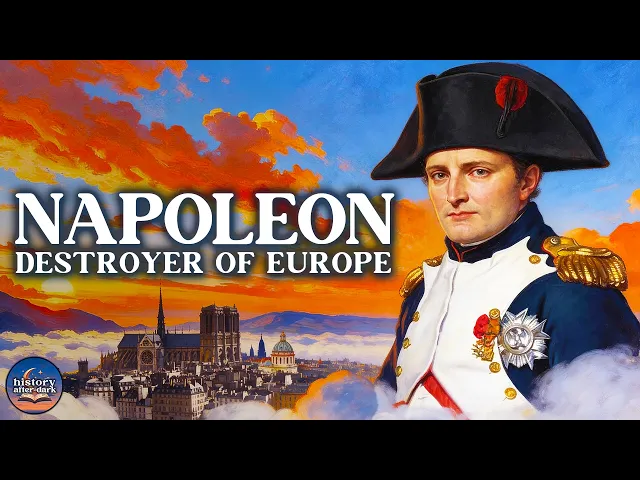
How Napoleon Destroyed the Old World Order | A Bedtime History Documentary
History After Dark
0:01 It is [music] December 2nd, 1804.
0:04 Inside the freezing walls of Notre Dame Cathedral,
0:08 a 35-year-old artillery officer from Corsica takes a crown from the hands
0:13 of the Pope himself [music] and places it on his own head.
0:18 In a single motion, he ends [music] the revolution
0:21 that made him and alters the fate of Europe forever.
0:27 Tonight, [music] we unravel the life of Napoleon Bonaparte.
0:31 He is perhaps the most debated [music] figure in modern history.
0:35 A military genius who won 60 [music] battles
0:39 and rewrote the legal codes of an entire continent.
0:43 Yet the empire he built was paid for in blood.
0:46 An estimated [music] 3 to 6 million dead from Madrid
0:50 to Moscow in campaigns fought to satisfy one man's [music]
0:55 limitless hunger for glory.
0:58 In tonight's episode, we'll trace Napoleon's [music] extraordinary rise
1:03 from a debt-ridden family on the fringes of Europe
1:05 to the throne of the largest empire the continent [music] had seen since Rome.
1:10 We'll see how the wars he unleashed destroyed the old feudal order,
1:15 redrew the borders of nations,
1:18 and spread the dangerous idea that people could choose their own rulers.
1:23 And finally, [music] we'll reckon
1:25 with the question that still haunts historians.
1:29 Did he carry the revolution forward or did he betray it?
1:34 Before we begin, please take a moment to like [music] and subscribe.
1:39 It really helps us fight against algorithmic censorship.
1:44 And let us [music] know in the comments
1:46 which topics you'd like us to explore next.
1:50 Now, settle in as we journey back to a wild,
1:54 rain-lashed island in the Mediterranean where a restless boy is
1:58 about to begin the most [music] extraordinary ascent in modern history.
2:04 This [music] is the bedtime biography of Napoleon Bonaparte.
2:17 Chapter 1, The Outsider's Ascent.
2:23 The island of Corsica was a peculiar place.
2:27 It had never been fully independent nor fully absorbed into any empire.
2:34 The people there lived much as they had for centuries,
2:37 subsisting on chestnuts, cheese, onions, fruit,
2:41 and the occasional piece of goat or pork, all of it washed down with local wine.
2:47 Even the bread was made from chestnuts.
2:50 Wealth differentials were narrow, the society pre-feudal in its structure,
2:56 and yet every family carried a fierce sense of pride and dignity.
3:01 You didn't cross a Corsican household lightly.
3:04 Any act of violence could trigger a vendetta from which there was almost
3:07 no escape because nothing stayed secret for long in such a restricted space.
3:14 It was into this world
3:16 that the Bonaparte family had settled generations earlier.
3:20 Their lineage traced back to minor gentry from Tuscany and Liguria,
3:24 and they'd eventually put down roots in Ajaccio.
3:28 The family home had been carved up over the years by successive dowries,
3:33 leaving seven members crammed into roughly 40 dilapidated square meters.
3:38 In the summer of 1764,
3:41 the 18-year-old Carlo Bonaparte married 14-year-old Letizia Ramolino.
3:47 The match came with a dowry that boosted Carlo's social standing.
3:52 Letizia was beautiful, strong-willed, and strict with her children.
3:57 She administered slaps freely and without hesitation.
4:01 It was a tough household.
4:05 Meanwhile, Corsica was in the grip of something larger.
4:09 Pasquale Paoli had proclaimed a Corsican Republic back in 1755,
4:15 governing from the hill town of Corte.
4:18 He'd established a constitution, institutions, even a university.
4:24 But France could not tolerate a utopian republic sitting on its doorstep.
4:29 Following the Treaty of Versailles in 1768, French troops moved in.
4:35 The decisive engagement came at Ponte Novu in May of 1769.
4:41 The Corsican forces were routed.
4:44 Paoli fled over the mountains and into exile in England.
4:50 Carlo Bonaparte submitted to the new
4:52 French authorities and turned back towards Ajaccio.
4:56 On the journey home, crossing the mountains,
4:59 Letizia's mule stumbled while fording the river Liamone.
5:03 She nearly lost the child she was carrying.
5:06 That child was born on the night of the 15th of August,
5:11 1769, and named Napoleon after his great uncle.
5:16 The French military governor, the Comte de Marbeuf,
5:20 needed loyal supporters among the local notables,
5:23 and the Bonaparte family fit the role.
5:26 Marbeuf became a frequent visitor to the household,
5:29 so frequent that his closeness to Letizia fueled
5:32 local gossip about the paternity of her next child.
5:38 Napoleon spent a happy early childhood playing
5:41 in the streets of Ajaccio with his cousins,
5:44 summering up in the hills at Bocognano.
5:47 His mother would later recall that of all her children,
5:49 he'd been the most intrepid, aggressive, quarrelsome, always pushing.
5:55 But the French suppression of Corsican resistance left its marks on the boy.
6:00 Mobile columns burned crops across the countryside
6:04 and hanged corpses along public highways as warnings.
6:08 These were the sights of his youth.
6:13 Carlo eventually secured a royal bursary
6:15 for Napoleon at the military academy of Brienne.
6:18 The application required proving both noble credentials and indigence.
6:24 The boy arrived at the austere institution run
6:27 by the Order of Minims on the 15th of May, 1779.
6:33 He was puny, olive-complexioned, and spoke poor French,
6:38 all of which marked him immediately as a foreigner and an easy target.
6:43 He read constantly.
6:45 He fenced off a small allotment of land for himself, a place to be alone.
6:51 There's something about that image, a boy alone with his books,
6:56 trying to piece [music] together the entire world from what he could read.
7:00 That same hunger is what drives a project like The Book by Hungry Minds,
7:06 the ultimate guide to rebuilding [music] a civilization.
7:09 Over 400 pages covering humanity's greatest inventions and discoveries,
7:14 [music] from engineering to medicine to architecture,
7:17 each one illustrated [music] in this striking
7:19 blend of medieval art and technical drawing.
7:23 The paper quality alone is worth picking [music] it up for.
7:26 Every spread has that weight and texture that makes you want to slow down
7:33 [music] and actually sit with it.
7:34 It raised over $2.3 million on Kickstarter, [music] became a best-seller,
7:39 and there's even a hidden quest buried inside for readers to uncover.
7:44 It's honestly one of the best gifts for anyone with a restless,
7:47 curious mind or [music] just a good excuse to keep it for yourself.
7:51 Use the code After Dark for 10% [music] off.
7:55 The link's in the description below.
8:01 The school librarian noted that Napoleon courted solitude
8:05 as though it were the thing he valued most.
8:08 One fellow pupil remembered him as gloomy and fierce to excess,
8:13 almost always by himself, never sharing in the noisy mirth of his schoolmates.
8:20 The curriculum at Brienne centered
8:22 on the heroes of antiquity, Plutarch primarily,
8:26 and was designed to awaken instincts of chivalry, honor, duty, sacrifice.
8:34 When provoked, Napoleon responded with a ferocity born of contempt.
8:39 He moved on to the École Militaire in Paris in October of 1784,
8:45 where the atmosphere was more aristocratic and the presence of wealthy,
8:49 fee-paying cadets only deepened his alienation.
8:53 He hated drill.
8:55 During one session, he hurled his musket at the drill master in a rage.
9:00 He loved fencing, but fought so aggressively
9:02 that he'd lay himself open to touches constantly, breaking foil after foil.
9:08 He groaned at the frivolity of the other pupils.
9:12 When his father died of stomach cancer in February 1785,
9:17 the weight of the family landed squarely on his shoulders.
9:23 Commissioned as a second lieutenant in the artillery regiment of La Fère,
9:27 Napoleon was stationed in Valence by November of that year.
9:31 He read voraciously, history, geography, philosophy,
9:36 and fell heavily under the influence of Rousseau.
9:39 He wrote a short essay on suicide, asking, "Since I must die one day,
9:45 would it not be as well to kill myself?"
9:49 He described himself as always alone while surrounded by people,
9:53 preferring to sit with his own melancholy.
9:56 During long leaves of absence, he spent 21 months back in Corsica managing
10:02 the family's dwindling finances and a failing mulberry nursery.
10:06 He adopted the pose of the persecuted patriot writing a history
10:10 of the island that cast the French as barbarous occupiers.
10:15 "I was born as the fatherland was perishing." He wrote to Paoli describing how
10:21 the screams of the dying and the tears of despair had surrounded his cradle.
10:29 The outbreak of the French Revolution in 1789 found him stationed in Auxonne.
10:35 Riots broke out.
10:37 He marshaled troops against the crowds but expressed a deep distaste
10:41 for the mob complaining that he'd been prevented from firing on them.
10:46 He returned to Corsica where he and his brother Joseph threw
10:50 themselves into local politics distributing tricolor
10:54 cockades and forming a citizen's militia.
10:57 But Paoli had returned from exile and the old
11:00 leader viewed the Bonaparte brothers with suspicion.
11:04 Napoleon secured a command in the Ajaccio
11:07 National Guard through intimidation going
11:09 so far as to kidnap a voting commissioner to swing the election.
11:14 Tensions boiled over on the 8th of April 1792 when
11:20 his volunteers fired on townsfolk and attempted to seize the citadel.
11:27 Denounced by Paoli's supporters and facing assassination,
11:31 Napoleon slipped out of Ajaccio by boat.
11:34 In his absence, Paoli's partisans sacked the family home.
11:40 Letizia gathered the children and fled into the hills.
11:44 A French naval squadron eventually evacuated them and in June of 1793,
11:51 the Bonaparte family sailed for the mainland as destitute refugees.
11:57 The rupture with Corsica was total.
11:59 The young artillery officer who had dreamed of liberating
12:02 his island now had nothing to go back to.
12:06 What he had instead was a commission in the French army,
12:09 a large family to feed and a republic tearing itself apart around him.
12:20 Chapter 2 The Jacobin General The Bonaparte family washed ashore in Toulon
12:28 during the summer of 1793 into a city that had lost its mind.
12:35 Jacobin mobs roamed the streets hanging wealthy citizens from lamp
12:39 posts and beating others to death in broad daylight.
12:42 It was no place for a destitute family with young children.
12:46 Letizia gathered them up and moved to the nearby
12:49 village of La Valette where things were quieter, where they could breathe.
12:55 Napoleon, meanwhile, rejoined his regiment in Nice and collected his back pay
13:01 sending what he could to keep his mother and siblings fed.
13:05 He also dashed off a political pamphlet called Le Souper de Beaucaire,
13:11 a pointed defense of the Jacobin government that served a second
13:15 purpose distancing the family name
13:17 from Paoli and any whiff of counter-revolution.
13:23 It wasn't long before Toulon made headlines again.
13:26 Royalist insurgents had seized the city and handed it,
13:30 along with the entire French Mediterranean Fleet,
13:33 over to the British Royal Navy.
13:36 The Republic dispatched an army of raw recruits to take it back.
13:40 Led by General Carteaux, a painter by trade with about as much
13:45 military experience as you'd expect from one.
13:48 The besieging artillery needed a commander after the previous one took
13:52 a wound and the Corsican deputy Saliceti knew just who to call.
13:57 Napoleon arrived and sized up the situation fast.
14:02 The key was a promontory overlooking the outer harbor.
14:07 Take that and the British ships would have no choice but to pull out.
14:13 His superiors didn't see it that way but Napoleon had stopped listening to them.
14:18 He stripped surrounding posts of cannons,
14:21 powder and horses building up an artillery park from almost nothing.
14:26 He set up foundries to cast cannonballs.
14:29 He trained infantrymen to serve as gunners.
14:33 At night, he slept on the ground beside his batteries wrapped
14:37 in his cloak close enough to feel the heat of the barrels.
14:42 General Doppet, observing from a comfortable distance,
14:45 noted that the young officer combined a rare
14:48 bravery and indefatigable energy with considerable talent.
14:54 The final assault on Fort Mulgrave came
14:56 on the 17th of December in a torrential rainstorm.
15:00 Napoleon led from the front.
15:02 His horse was shot out from under him
15:06 and an English corporal drove a lance into his leg.
15:09 He kept going.
15:11 Once the fort was taken, he turned its guns on the British
15:14 ships and fired red-hot cannonballs into the harbor.
15:19 Two vessels exploded.
15:22 The British evacuated taking French royalists with them
15:26 and the Republican troops who flooded back
15:28 into Toulon carried out reprisals that were
15:30 savage even by the standards of the terror.
15:35 At 24, Napoleon was promoted to brigadier general.
15:39 His comrades took notice.
15:42 Claude Victor described him as small in stature but well-proportioned,
15:47 thin and puny in appearance but taut and strong
15:50 with eyes that seemed to send out shafts of fire.
15:54 The young general, exhausted and suffering
15:57 from scabies he'd picked up during the siege,
15:59 accepted a quieter posting as inspector of coastal defenses.
16:03 He needed the rest.
16:07 It didn't last.
16:08 When Robespierre fell, Napoleon's name was on the list.
16:12 He spent 11 days under house arrest before being cleared and let go.
16:17 He drifted to Marseille where his brother Joseph had
16:20 done well for himself and there he met Désirée Clary, a modest 16-year-old.
16:27 They became engaged.
16:29 His letters to her read less like love notes and more like homework assignments,
16:35 advice on what to read, how to practice her music.
16:41 Ordered to the Army of the West to fight insurgents in the Vendée,
16:45 Napoleon did what he could to avoid it.
16:47 He traveled to Paris,
16:49 obtained sick leave and plunged into the hedonistic society of the capital.
16:54 Wealthy women wore flesh-colored pantaloons and dresses of transparent gauze.
16:59 Napoleon, with his unkempt hair and clumsy French,
17:02 fit in about as well as a stray dog at a dinner party.
17:06 The wife of his friend Barras described him as cold,
17:10 somber and little short of savage.
17:15 Feeling thoroughly out of place,
17:17 he channeled his gloom into a novella, Clisson et Eugénie,
17:21 about a misunderstood military genius who flees society,
17:26 finds love with a pure young woman and dies heroically.
17:31 Around the same time,
17:32 the War Ministry struck him off the list of artillery generals.
17:36 He was put on half pay.
17:37 He wrote to Joseph that he was very little attached to life.
17:41 He floated the idea of throwing himself under a passing carriage.
17:48 Then came October 1795 and with it a lifeline.
17:54 Royalist sections of Paris rose against the government
17:58 and the politician Paul Barras needed someone who could act fast.
18:03 He appointed Napoleon as his second-in-command to defend the Tuileries.
18:08 Napoleon sent a young cavalry officer
18:11 named Joachim Murat galloping across the city
18:14 to secure 40 cannons from the Sablon plain just ahead of the rebels.
18:20 The guns were placed at key intersections and then he waited.
18:26 When the 20,000-strong rebel force advanced,
18:29 Napoleon's artillery fired canister shot directly into their ranks.
18:34 The insurrection was over within 2 hours.
18:38 He was promoted to divisional general and given command of the Army
18:42 of the Interior which meant control of the capital's police and National Guard.
18:48 He rode through the streets flanked by mustachioed
18:51 officers projecting a new and very deliberate authority.
18:57 It was around this time that a 14-year-old boy
19:00 came to ask permission to keep his executed father's sword.
19:05 Napoleon granted it.
19:07 The boy's mother arrived shortly after to give her thanks.
19:11 Her name was Josephine de Beauharnais.
19:15 She was 32, a widow of legendary charm who had learned
19:19 to smile without opening her mouth on account of her teeth.
19:23 She lived on the generosity of her lovers
19:26 and needed a husband to secure her future.
19:29 Barras, her current patron, encouraged the match partly to settle a young
19:34 general who was becoming harder to manage.
19:39 Napoleon fell hard.
19:41 He wrote letters declaring that her kisses set his blood on fire.
19:45 Josephine was cooler about it.
19:47 She confided to a friend that she found
19:50 his violent love resembling an excess of madness.
19:54 Both parties forged their documents before signing the marriage contract.
19:58 He added a couple of years, she shaved a few off.
20:02 The civil ceremony happened late at night, conducted by a minor functionary.
20:07 On the wedding night, Josephine's pet pug, Fortuné,
20:12 bit Napoleon in the calf as he climbed into bed.
20:17 Two days later, he was gone.
20:20 He left Paris to take command of the army of Italy,
20:23 rattling south in his carriage as fast as the horses could carry him.
20:28 "Every instant takes me further away from you,
20:31 my adorable love." He wrote from somewhere along the road.
20:35 "And with every instant, I find less and less strength with which
20:39 to bear being away from you." Ahead of him,
20:42 on the Italian border, thousands of soldiers waited without boots,
20:46 without pay, and without much reason to follow anyone.
20:50 That was about to change.
20:56 Chapter 3 The Warlord of Italy and Egypt He arrived
21:04 at the headquarters of the army of Italy in March of 1796,
21:07 26 years old and looking every bit the outsider.
21:11 The veteran commanders waiting for him were unimpressed.
21:15 They saw a small, awkward young man with a rasping voice
21:19 and a political appointment he hadn't earned on any battlefield they recognized.
21:24 The army itself was in a terrible state.
21:28 40,000 soldiers, starving and mutinous,
21:32 many of them wearing woven straw where boots should have been.
21:36 Bonaparte didn't ease himself in.
21:38 He secured emergency funds,
21:41 put fresh meat in front of the men, and demanded obedience.
21:47 Then he moved, and he moved fast.
21:50 He launched his forces through the mountains,
21:53 driving a wedge between the Austrian
21:54 and Sardinian armies before either could react.
21:58 The French fought without tents or regular supply lines,
22:02 living entirely off the land as they advanced.
22:05 The Sardinians were intimidated into an armistice
22:08 and forced out of the war altogether.
22:11 Bonaparte then outflanked the retreating Austrians
22:14 by crossing the River Po at Piacenza, pushing deep behind their lines.
22:20 It was ruthless, improvisational, and it worked.
22:25 At the town of Lodi, the French advance guard found the wooden bridge
22:29 over the River Adda defended by Austrian cannon.
22:32 Bonaparte ordered a frontal assault.
22:34 The first men who surged forward were cut apart by canister shot.
22:40 Subsequent waves, led by senior officers who
22:42 showed complete disregard for their own lives,
22:45 managed to cross and dislodge the defenders.
22:49 It was a skirmish, really,
22:51 but Bonaparte exaggerated the scale of it in his reports
22:55 and commissioned prints showing himself brandishing a standard amid the gunfire.
23:01 He was learning something important about war,
23:03 which was that the story you told afterwards
23:06 mattered almost as much as the fight itself.
23:11 Lodi changed something in him.
23:13 He later reflected that it was only after that battle that it
23:16 struck him he might become a major actor on the political scene.
23:21 He rode into Milan on a white horse under arches of foliage,
23:25 greeted by Italian nationalists who saw him as a liberator.
23:30 Behind the pageantry, he stripped the conquered territories of cash,
23:34 silver plate, and masterpieces of art, shipping it all back to Paris.
23:40 That was how he funded the struggling Directory
23:43 while quietly building a power base of his own.
23:48 The Austrians weren't finished.
23:49 They launched counteroffensive after counteroffensive
23:53 to relieve their besieged fortress at Mantua.
23:56 Bonaparte defeated each one through rapid maneuver,
23:59 marching his men to exhaustion across the theater of war.
24:03 At Arcole, he tried to lead a charge across a heavily defended bridge.
24:08 His men refused to follow.
24:11 He ended up in a muddy drainage ditch, dragged to safety under enemy fire.
24:16 The propaganda prints that followed, naturally,
24:19 showed him storming the bridge like a hero.
24:23 After the decisive victory at Rivoli and the fall of Mantua,
24:27 he marched on Vienna.
24:29 Without consulting the Directory, he dictated the Treaty of Campo Formio,
24:34 carving up the map of Europe on his own authority.
24:38 He partitioned the neutral Republic of Venice,
24:42 handing territory to Austria in exchange
24:45 for French control of Belgium and the Rhineland.
24:49 Paris was furious at his insubordination,
24:52 but the peace was popular and there was nothing they could do about it.
24:58 Back in France, he kept a low profile for a time.
25:02 He wore civilian clothes,
25:04 attended meetings of the Institute of Arts and Sciences.
25:08 He was already thinking about his next move.
25:11 A direct invasion of Britain was impossible
25:14 given the weakness of the French navy,
25:16 so he proposed something far more ambitious, an expedition to Egypt.
25:22 The idea was to establish a colony, cut British access to India,
25:26 and eventually pierce the Isthmus of Suez with a canal.
25:30 The Directory approved,
25:32 happy enough to send their most dangerous general somewhere far away.
25:38 The armada captured Malta on its way and landed near Alexandria in July of 1798.
25:46 What followed was brutal.
25:48 The troops marched across scorching desert without water bottles.
25:53 Men collapsed from dehydration and dysentery.
25:57 Stragglers were killed by Mameluke horsemen.
26:00 Some soldiers, delirious and despairing, took their own lives in the sand.
26:06 At the Battle of the Pyramids, though,
26:08 the French infantry formed disciplined squares and tore apart
26:13 the Mameluke cavalry charges with volley after volley of musket fire.
26:18 Bonaparte entered Cairo and began organizing the country,
26:22 setting up hospitals, street lighting, a new administration.
26:26 A scientific commission investigated ancient ruins and Nile water purification.
26:32 For a brief moment, it looked like a colony might actually take shape.
26:38 Then Admiral Nelson found the French fleet
26:41 anchored at Aboukir Bay and annihilated it.
26:45 The army was trapped.
26:47 An uprising in Cairo saw French soldiers massacred
26:51 before being ruthlessly suppressed with artillery and beheadings.
26:56 Bonaparte marched into Syria to confront an approaching Ottoman force.
27:01 At Jaffa, his troops sacked the town.
27:04 He ordered the execution of up to 2,000 prisoners of war
27:08 on the beach because he had no food to spare for them.
27:11 Bubonic plague struck the army.
27:14 The siege of Acre failed, thwarted by Ottoman defenses and British naval guns.
27:20 The retreat back to Egypt was a horror of abandoned, wounded,
27:24 and dying men administered fatal doses of laudanum on Bonaparte's orders.
27:31 He won one last battle,
27:33 annihilating a seaborn Ottoman force at the land battle of Aboukir,
27:38 and driving thousands of Turks into the sea.
27:41 But word had reached him of French military defeats
27:45 in Europe and a government teetering on the edge of collapse.
27:49 He made his decision quickly.
27:51 He left the army under General Kléber,
27:54 boarded a frigate in secret with a handful of officers,
27:57 and slipped through the British blockade.
28:00 The soldiers he left behind would remain stranded in the Egyptian desert.
28:05 Bonaparte was already gone, sailing for France,
28:09 where a fragile and failing republic waited for someone to take hold of it.
28:19 Chapter 4 The Imperial Machine
28:24 As the bleary-eyed representatives of the people made
28:27 their way down still-dark streets on the morning of the 9th of November,
28:32 1799, soldiers were already taking up positions around the Tuileries.
28:38 Dragoons under Sebastiani, chasseurs under Murat.
28:43 The system they were meant to be
28:44 protecting had already collapsed under its own weight.
28:48 The Directory, that five-headed government born of revolution,
28:53 functioned as a hollow shell.
28:56 Hyperinflation had wiped out ordinary savings.
29:01 Army contractors and war profiteers
29:04 built enormous fortunes off perpetual conflict.
29:08 And a newly wealthy class of property
29:10 owners was actively looking for a strongman,
29:13 someone who could lock in their gains and crush
29:15 any threat from the left or the right.
29:19 Napoleon simply walked through a door that had been left wide open.
29:26 Once the members of the Council of Elders
29:28 had donned their togas and taken their seats,
29:31 they were informed of a sinister plot
29:34 by infamous brigands to bring down the government.
29:38 The assemblies were in grave danger, apparently,
29:40 and must transfer immediately to the former
29:43 royal palace of Saint-Cloud outside Paris.
29:46 To safeguard the move,
29:48 they were told the hero of Egypt would take command of all troops in the region.
29:54 Napoleon emerged from his study, read the decree aloud,
29:58 called on those present to help him save the Republic,
30:01 and then mounted a magnificent black Andalusian lent to him by Admiral Bruer.
30:07 He set off for the Tuileries escorted by cavalry
30:11 and a suite of generals in brilliant uniforms,
30:13 cheered along the way by onlookers who had no idea what was actually happening.
30:20 At about 10:00, he entered the chamber of the elders,
30:23 flanked by Berthier and a handful of generals,
30:26 and gave a rehearsed speech praising them for their wisdom.
30:31 Then he went outside, climbed back onto the black horse,
30:35 which he was having some difficulty mastering,
30:38 and made the rounds of the assembled units,
30:40 exciting their enthusiasm with dramatic statements empty of substance.
30:46 His agitation had brought out a severe rash on his face.
30:51 While considering his next move, he scratched so hard he drew blood,
30:56 which only seemed to confirm the rumor already flying
30:59 through the ranks that he'd been attacked with daggers.
31:02 The story reached the crowd, and eventually all the way to Paris.
31:09 Inside the Council of 500, things were falling apart.
31:14 His brother Lucien had done what he could to calm the shouting,
31:18 but eventually made a histrionic gesture,
31:21 removing his toga, his cap, untying his gold-fringed sash,
31:27 and laying them down as a sign that liberty had been silenced.
31:31 He ordered a captain to take 10 grenadiers and rescue him from the chamber.
31:37 Then, in a piece of theater that would
31:40 have been absurd if it weren't so effective,
31:43 Lucien took a sword from an officer, put the point to his brother's breast,
31:48 and solemnly swore he would kill Napoleon himself if he
31:53 ever raised a finger against the liberty of the French people.
31:57 As the drum beat the charge and crashed into the orangery,
32:00 some of the 500 climbed onto their benches
32:03 and began swearing to defend the Republic.
32:06 Others followed the spectators out through the conveniently low windows.
32:11 Murat marched toward the podium and declared the assembly dissolved.
32:15 Then, turning to his soldiers, he put it plainly,
32:20 "Chuck this lot out of here." The next morning was a decadi,
32:26 a Republican Sunday.
32:29 At 10:00, citizen Consul Bonaparte left home in civilian dress and was driven
32:34 through empty streets to the Luxembourg in a carriage escorted by six dragoons.
32:40 He went directly to Sieyès's apartment,
32:43 where the two of them talked for over an hour.
32:45 The first thing to be settled was
32:47 who would preside over the new three-man consulate.
32:51 According to one version, Ducos simply turned to Napoleon and said,
32:55 "It is quite unnecessary to vote on the presidency.
32:58 It is yours by right." After Napoleon left the room,
33:02 Sieyès reportedly told the others, "Gentlemen, you have a master.
33:06 He wants to do everything, knows how to do everything,
33:10 and can do everything." Napoleon moved from the Rue
33:15 de la Victoire to the seat of power,
33:17 establishing himself in rooms on the ground floor of the Petit Luxembourg,
33:22 while Josephine made herself at home on the floor above,
33:25 and then he set to work.
33:27 On the 13th of December,
33:29 a 10-liter measuring jar was placed on the table in lieu of an urn,
33:34 and the 50 members of two commissions wrote out their choices on slips of paper.
33:39 Before the votes could be counted, Napoleon,
33:42 who'd been leaning on the mantelpiece warming his legs by the fire,
33:45 strode over and snatched the jar.
33:48 He emptied its contents into the flames.
33:51 It was recorded that he and the others
33:54 had been nominated by unanimous acclamation.
33:58 On the 24th of December, aged 30 years and 4 months,
34:02 he formally took office as first consul,
34:05 dictating a proclamation to the nation pledging
34:08 to make the Republic dear to its citizens,
34:11 respectable to foreigners, formidable to enemies.
34:17 But a proclamation means nothing without a battlefield to back it up.
34:21 And within months, one presented itself.
34:25 At Marengo, in June of 1800, he found himself facing the Austrian General Melas,
34:31 who had concentrated 30,000 men and 100 field guns near Alessandria.
34:37 Napoleon was down to 22,000 with only 20 guns.
34:41 "Come back, in God's name, if you still can," he wrote to Desaix.
34:46 Desaix received the order at 1:00 and immediately set off,
34:50 his men occasionally breaking into a run
34:53 as they covered 13 km to reach the field.
34:56 By 3:00 in the afternoon, the battle appeared lost.
35:01 Melas, who'd had two painful falls from his horse that day at the age of 71,
35:07 retired to Alessandria to lie down, leaving his generals to finish things off.
35:13 Around 5:00, Desaix arrived.
35:16 After a brief exchange with Napoleon, he led his divisions into the fray.
35:21 Simultaneously, General Kellermann gathered his cavalry
35:24 and charged the Austrian flank.
35:27 The entire French line surged forward.
35:30 The Austrians faltered, fell back, and fled.
35:34 Desaix was killed leading the attack.
35:37 "I feel the most profound grief at the death
35:40 of the man I loved and esteemed the most," Napoleon wrote afterward.
35:47 With the military crisis resolved,
35:49 he turned to the machinery of the state itself.
35:52 Napoleon did not understand or like the idea of government credit,
35:57 which he saw as no more than betting on a favorable outcome.
36:01 He liked hard currency and wanted to amass as much of it as possible.
36:06 Gaudin, his finance minister, called in a friend named Nicolas Mollien,
36:11 who explained to a bewildered Napoleon the workings
36:15 of the stock market and the principle of a sinking fund.
36:18 On the 13th of February, he established the Banque de France,
36:22 handing the levers of state credit to a syndicate of private financiers
36:27 whose interests were now permanently fused with the survival of the regime.
36:32 Strikes were criminalized.
36:34 Workers were bound to the livret, an employment passbook that subjected
36:39 their movements and livelihoods to police control.
36:43 The chaotic energy of the early revolution was eradicated,
36:47 replaced by a rigid hierarchy enforced by Fouché's security apparatus.
36:54 On the 12th of August, 1800,
36:57 he appointed a commission of four jurists to draw up a civil code of laws.
37:03 Standardized contracts, the abolition of feudal obligations,
37:07 ironclad protections for private property.
37:11 Over the next year, the Council of State devoted more than 100 sessions to it,
37:16 at least 57 presided over by Napoleon,
37:19 who stamped his own views on the final version.
37:22 Those views were revealing.
37:24 Women need to be contained, he declared,
37:28 explaining that they were naturally more flighty than men
37:31 and liable to spend their husbands' money like water.
37:35 The husband must have the absolute power and right to say to his wife,
37:40 "Madam, you will not go out.
37:43 You will not go to the theater.
37:45 You will not see such and such a person."
37:48 The code would not become law until March of 1804,
37:52 when it would become known as the Code Napoléon.
37:58 He drove the councilors like slaves.
38:00 As one of them put it, one had to be made of iron to work with him.
38:05 In 1800 alone, the Council of State dealt with 911 separate measures.
38:11 It was not unusual for him to keep them at it
38:14 for 8 or 10 hours with only a 15-minute break for lunch.
38:19 "Come, come, citizens.
38:21 Wake up," he would say when he saw them flagging past midnight.
38:26 "It is only 2:00, and we must earn the money which the people
38:29 of France give us." He would toy with his snuffbox while he listened,
38:34 opening and shutting the lid, taking a pinch,
38:37 most of which fell on the white facings of his uniform.
38:41 Without looking, he'd pass the box to an aide behind his chair,
38:46 who would hand him another.
38:48 To help himself think,
38:50 he'd produce a penknife and belabor the arm of his chair with it.
38:55 The cabinetmaker replaced it regularly.
38:58 He might wake at 1:00 or 4:00 in the morning, summon his secretary,
39:02 and begin dictating in a white dressing
39:04 gown with a scarf wrapped about his head.
39:07 He hardly ever wrote himself,
39:09 partly because his hand couldn't keep up with his thoughts,
39:12 partly because neither he nor anyone else could read his handwriting.
39:17 He might pause for ice cream or something more substantial,
39:21 and then pick up exactly where he'd left off.
39:25 And so the machinery of the French state was rebuilt piece by piece.
39:30 In marathon sessions and pre-dawn dictations,
39:33 the consul had secured his grip on power.
39:37 The armies that had carried him there still waited,
39:40 hundreds of thousands of men in camps and garrisons across the country.
39:45 Beyond the borders, the old powers of Europe watched with growing unease.
39:50 The world Napoleon had forced into being was too new,
39:55 too volatile to sit quietly for long.
40:03 Chapter five.
40:05 The geopolitical chessboard.
40:09 To understand the wars that Napoleon would fight,
40:12 we need to step back from the man himself.
40:15 Because the world he stepped into was already a volatile place,
40:19 shaped by decades of rivalry between a handful of powerful states.
40:24 Five nations dominated European politics by the late 1700s.
40:30 Britain, France, Austria, Prussia, and Russia.
40:34 Between them, they decided the fate of continents.
40:37 And when diplomacy failed, as it often did, war became the final word.
40:44 Britain held the seas.
40:46 Its Royal Navy commanded more than double the warships of the French fleet,
40:51 which gave it an extraordinary advantage.
40:54 The French couldn't train their sailors properly,
40:57 couldn't access naval supplies freely,
41:00 and found their military resources pinned down on the continent.
41:05 After the Seven Years' War, which ended in 1763,
41:09 Britain had cemented its dominance over global trade and colonial
41:13 territory largely at the expense of France and Spain.
41:17 It was a maritime empire with no real challenger on the water.
41:22 On land, the picture was messier.
41:25 Prussia had clawed its way into the ranks
41:27 of the great powers only a generation before,
41:30 winning two major wars despite long odds.
41:33 But it was a fragile kind of greatness.
41:36 The kingdom was small, its population modest,
41:39 and it taxed its people heavily just to keep up appearances.
41:44 Austria, meanwhile, had long dominated Central
41:47 Europe through the Holy Roman Empire.
41:50 But it lacked the ethnic and linguistic unity of its neighbors.
41:54 It was a patchwork held together by tradition and dynastic marriages,
41:59 and it knew how vulnerable that made it.
42:03 Then, there was Russia,
42:05 which had expanded with breathtaking speed in the second half of the century.
42:10 No other European state had gained so much territory so quickly.
42:16 In 1772, Catherine II engineered the first partition of Poland,
42:22 swallowing up vast tracts of the Eastern Kingdom
42:25 and placing her preferred candidate on the Polish throne.
42:28 A few years later, victory in the Russo-Ottoman War brought
42:33 Russian control to the northern coastline of the Black Sea.
42:37 And by 1783, the Treaty of Georgievsk had extended
42:41 Russia's military presence across the Caucasus Mountains into Eastern Georgia.
42:47 Russia was hungry, and it was growing.
42:52 These rivalries weren't limited to Europe.
42:54 The Nootka Sound Crisis of 1789 showed just how far the competition had spread.
43:01 Spain had claimed the Pacific coast of North America since
43:05 the 1500s and tolerated no foreign presence in those waters.
43:11 But when British ships appeared near Vancouver Island,
43:14 the Spanish Navy seized them, imprisoned the crews,
43:17 and declared exclusive sovereignty over the entire coastline.
43:21 For a moment, it looked like war.
43:24 In the end, Spain backed down and agreed to let
43:28 the British trade and settle in unoccupied areas above San Francisco.
43:33 A small diplomatic episode, perhaps, but it revealed something important.
43:38 European powers were now staking claims across the globe,
43:42 and any one of those claims could ignite a wider conflict.
43:47 India was another flashpoint.
43:49 The British East India Company had been
43:52 tightening its grip on the subcontinent for decades,
43:55 but its position was far from secure.
43:58 Powerful regional states like the Maratha Confederation
44:02 and the Dominion of Hyderabad controlled vast territories.
44:06 And to the south, the Kingdom of Mysore
44:09 under Tipu Sultan had been a persistent thorn.
44:13 Tipu had welcomed French Republican envoys,
44:16 planted a tree of liberty at his capital of Seringapatam,
44:20 and made overtures to French forces in Mauritius.
44:24 For the British, this was alarming.
44:27 In the spring of 1799, Richard Wellesley, the governor-general, went to war.
44:34 The Fourth Mysore War was short and brutal.
44:37 British forces stormed Seringapatam on the 4th of May,
44:42 and Tipu Sultan was killed in the fighting.
44:45 Wellesley then turned his attention to the Marathas,
44:48 negotiating the Treaty of Bassein, which brought the Maratha leadership under
44:52 British influence in exchange for military protection.
44:56 India was being reshaped piece by piece.
45:02 The revolution had already upended Napoleon's life, as we've seen.
45:07 But it had also upended the entire European order.
45:11 The execution of King Louis XVI
45:13 in January 1793 horrified the continent's monarchies.
45:19 And the National Convention's so-called Edict of Fraternity made things worse,
45:24 promising assistance to any people who wished to overthrow their rulers.
45:28 The British Prime Minister put it plainly,
45:31 "We are not at war with the opinions of the closet." he said.
45:36 "We are at war with armed opinions." By the spring of 1793,
45:42 most of Europe had joined the First Coalition against France.
45:49 The early campaigns went badly for the French.
45:52 Austro-Prussian forces invaded and pushed towards Paris.
45:56 The allies issued the Brunswick Manifesto,
45:58 threatening to level the capital if the royal family was harmed.
46:02 It was meant to intimidate.
46:04 Instead, it enraged the population.
46:07 And at Valmy, in September 1792,
46:10 French gunners held their ground against Prussian veterans,
46:14 refusing to be silenced.
46:16 The General Kellermann raised his hat and cried,
46:20 "Vive la nation!" The words swept through the ranks.
46:24 It was a modest battle in military terms, but a seismic one in spirit.
46:29 From that moment, the revolution mobilized on a scale Europe had never seen.
46:35 The Committee of Public Safety launched the levée en masse,
46:39 calling on every citizen to serve.
46:41 "From this moment until the enemy shall have been driven
46:44 from the soil of the Republic," declared the National Convention,
46:48 "all Frenchmen are in permanent requisition
46:51 for the service of the armies." Within a year, 14 new armies had been raised.
46:57 Some 800,000 men were under arms.
47:01 Prussia, exhausted, signed the Treaty of Basel
47:04 in 1795 and withdrew from the war,
47:08 recognizing French control of the left bank of the Rhine.
47:12 Historians have called that treaty a death
47:14 certificate for the Holy Roman Empire,
47:16 since Prussia chose its own national interest over the old imperial order.
47:21 And Poland, partitioned a third and final time,
47:25 was erased from the map entirely.
47:29 The old chessboard of European diplomacy had been upended.
47:34 Traditional alliances fractured, colonial possessions changed hands,
47:39 and the sheer scale of French mobilization
47:42 left every neighboring power scrambling to respond.
47:45 The exhaustion was mutual.
47:48 Years of continuous warfare, stretching from the Rhine to the Indian Ocean,
47:53 had drained treasuries and armies alike.
47:56 A pause was coming, a fragile diplomatic intermission.
48:00 But it would not hold for long.
48:08 Chapter six.
48:10 The intermission and the rupture.
48:14 For the first time in nearly a decade,
48:16 the guns across continental Europe fell silent.
48:20 The Peace of Lunéville, signed in early 1801,
48:23 had done what many thought impossible.
48:26 Austria, humiliated and exhausted,
48:30 gave up the territorial gains it had won in Italy just 4 years earlier.
48:35 The treaty recognized a constellation of new republics,
48:38 Swiss, Dutch, Genoese, Lombard.
48:42 Each one a French dependency in all but name.
48:46 Bonaparte had, through force and negotiation, redrawn the map.
48:52 And he wasn't finished.
48:54 In July of that year, he concluded a concordat with the papacy,
48:58 mending a rift that had torn through French society since the revolution.
49:04 "The government of the Republic acknowledges that the Catholic, Apostolic,
49:09 and Roman religion is the religion of the great
49:12 majority of French citizens," read the opening lines.
49:16 It was a striking gesture from a man who had little personal use for religion.
49:21 Church dioceses were reorganized, parishes restructured.
49:25 And buried within the agreement was perhaps its most consequential provision.
49:30 The Roman Catholic Church formally surrendered all claims
49:34 to the lands that had been confiscated and nationalized since 1790.
49:39 A decade of seizures made permanent with the stroke of a pen.
49:46 Then came the peace with Britain.
49:48 On the 25th of March, 1802, France and Britain signed the Treaty of Amiens,
49:54 ending almost 2 years of careful grinding negotiation.
49:59 Bonaparte's brother Joseph had handled the French side
50:02 and raced to Paris with the signed document.
50:06 He arrived during a theater performance,
50:09 which was duly interrupted so Bonaparte could
50:11 present his brother to a cheering audience.
50:14 Across the English Channel, mail coaches carried the news with the words
50:19 "Peace with France" chalked on their sides.
50:23 They were met with celebrations in towns across the country,
50:27 crowds shouting approval for the French leader by name.
50:31 George III renounced his title of King of France,
50:36 a holdover from the Hundred Years' War
50:39 that his predecessors had clung to for centuries.
50:43 Britain agreed to return captured French colonies and those of her allies,
50:48 keeping only Ceylon and Trinidad.
50:51 France, in turn, accepted the return of Egypt
50:54 to the Ottoman Porte and the Papal States to the Pope.
50:58 Malta was to go back to the Order of St.
51:00 John under the protection of Naples.
51:03 It was tidy, comprehensive, and doomed.
51:08 Even as the ink dried, Bonaparte was looking westward.
51:13 He dispatched a massive expeditionary force to Saint-Domingue, modern-day Haiti,
51:18 which had been in open rebellion since
51:20 the early 1790s under the leadership of Toussaint Louverture.
51:25 The force was commanded by Bonaparte's own brother-in-law, Leclerc.
51:30 And it was one of the largest overseas military
51:33 operations any European power had attempted in that age.
51:37 They arrived in January 1802.
51:39 Some local commanders defected to the French,
51:42 but Louverture called on the entire population to resist,
51:45 then withdrew into the interior.
51:48 The fighting was savage.
51:50 Deprived of water and food in this overwhelming heat, one eyewitness wrote,
51:56 "The troops had to chew on balls of lead
51:58 in the hope of quenching their unbearable thirst." In early June,
52:03 Louverture was lured into a trap and captured.
52:08 He was shipped to France and locked
52:10 away in solitary confinement at Fort de Joux.
52:14 William Wordsworth would later describe him as "the most unhappy man
52:19 of men." He died less than a year after his imprisonment.
52:24 More than 50,000 French soldiers, sailors,
52:27 and civilians perished in the campaign,
52:30 alongside a far greater number of black troops and civilians.
52:36 The disaster in the Caribbean had consequences that rippled across an ocean.
52:43 [clears throat] In 1803, Bonaparte surprised American negotiators
52:47 by offering the entire Louisiana Territory,
52:50 over 800,000 square miles, for $15 million.
52:55 The money was $15 The money was handled through a Dutch
52:57 banking house in Amsterdam and a British one in London,
53:01 who sold the stock and transferred the cash to France.
53:05 The final transfer came on the 20th of December, 1803.
53:09 Bonaparte had cut his losses in the Americas
53:12 and turned his attention back to Europe,
53:14 where the fragile peace was already coming apart.
53:19 Britain refused to recognize the new Italian Republics,
53:23 viewing them as threats to the balance of power on the continent.
53:27 British newspapers portrayed Bonaparte
53:30 as a yellow-skinned pygmy, a monstrous hybrid.
53:34 One tabloid called him "an unclassifiable being, half African, half European,
53:40 a Mediterranean mulatto." His wife, Josephine, was portrayed as a harlot.
53:46 His stepdaughter, Hortense, was accused of incest.
53:51 The French government retaliated by confiscating British goods,
53:55 banning their importation across French-controlled territories,
53:59 and ordering the imprisonment of any British subjects found within reach.
54:04 Bonaparte launched massive naval construction,
54:07 urging his ministry to build as many vessels as possible.
54:10 "Money," he said, "was no object." By 1804,
54:15 he expected to have more than 1,600 flat-bottomed invasion boats,
54:20 supported by another thousand fishing vessels converted into transports.
54:27 The Peace of Amiens had lasted just 420 days.
54:31 Its collapse unleashed 12 years of war and misery
54:36 that would shape the destinies of Europe and the wider world.
54:40 Meanwhile, the man at the center of it all had been quietly consolidating.
54:45 He secured the consulship for life in August 1802,
54:50 along with the right to name his own successor.
54:53 Officers attended his person.
54:55 Honors were paid to the women of his household.
54:59 A privileged family surrounded him in ceremony.
55:02 Everything, observers noted, was monarchical.
55:07 Everything except the title of consul.
55:10 And that name, too, was destined soon to disappear.
55:19 Chapter 7, The Sun Emperor.
55:24 By the autumn of 1804,
55:26 he had survived more assassination attempts than most men would care to count.
55:32 Royalist conspirators, Jacobin holdouts,
55:36 even a bomb that had torn apart a Parisian street and killed bystanders.
55:41 The question of succession had become impossible to ignore.
55:46 If he died without an heir,
55:47 without a dynasty, the whole enterprise would collapse overnight.
55:52 And so the decision was made.
55:54 France would have an emperor.
55:57 The coronation was set for the 2nd of December at Notre Dame Cathedral.
56:03 Months of preparation went into transforming the Gothic
56:07 interior into something closer to ancient Rome.
56:11 The architect Fontaine oversaw the construction of enormous wooden grandstands,
56:16 draped the walls in silk, and filled the space with thousands of wax candles.
56:22 Pope Pius VII had been persuaded, or perhaps pressured is the fairer word,
56:27 to make the long journey across the Alps in freezing late autumn weather.
56:32 He arrived in Paris exhausted and was promptly subjected to days
56:37 of calculated diplomatic slights designed to make one thing clear.
56:42 The Pope was here to bless the occasion.
56:45 He was not here to run it.
56:49 On the day itself, the procession
56:51 to the cathedral stretched through the streets of Paris.
56:54 Thousands of soldiers lined the route.
56:57 80 carriages rolled past the crowds.
57:01 The Imperial carriage was drawn by eight
57:03 dun-colored horses and covered in gold leaf.
57:07 Josephine wore white satin embroidered in gold and silver.
57:11 He wore a heavy crimson velvet mantle, lined with ermine,
57:16 covered in golden bees,
57:18 a deliberate replacement for the old Bourbon fleur-de-lis.
57:22 And when the moment came for the crowning,
57:24 he did something that no one in the cathedral would forget.
57:28 He took the laurel wreath of gold from the altar himself.
57:32 He placed it on his own head.
57:34 Then he turned and crowned Josephine, who knelt before him in tears.
57:40 The message was plain enough.
57:43 He owed his throne to no one.
57:47 With the spectacle behind him, his attention turned entirely to the coast.
57:53 150,000 veterans of the Revolutionary Wars were camped around Boulogne,
57:58 living in rows of organized wooden huts,
58:01 drilling day after day, staring across the Channel at the British shoreline.
58:06 They were waiting for naval control of the crossing.
58:09 It never came.
58:11 At Trafalgar, Horatio Nelson destroyed the combined Franco-Spanish fleet,
58:16 and with it any serious hope of invading Britain.
58:20 The army at Boulogne was immediately renamed the Grande Armée,
58:24 ordered to break camp, and sent marching east to meet a new threat.
58:28 Austria and Russia had formed the Third Coalition.
58:34 The speed of what followed was extraordinary.
58:37 Seven columns of troops crossed the Rhine simultaneously,
58:41 each operating independently, but converging on a single objective.
58:46 They covered up to 30 km a day, carrying their own ammunition and rations,
58:52 living off the land to avoid the slow
58:54 supply trains that weighed down traditional armies.
58:58 The Austrian commander, General Karl Mack,
59:00 had positioned his forces at the fortress of Ulm,
59:04 expecting the French to come through the Black Forest.
59:07 They swung far to the north instead,
59:10 looped around behind him, and cut off every route of escape.
59:16 On the 20th of October, 1805, Mack surrendered 27,000 men, 60 cannons,
59:23 and all his colors without a major battle having been fought.
59:29 He He his troops afterward, "Soldiers of the Grande Armee,
59:34 I have destroyed the Austrian army by simply
59:36 marching." The French then pushed east along the Danube,
59:41 taking Vienna with barely a fight after Marshall Lannes talked his way across
59:46 the main bridge by convincing the Austrian
59:49 defenders that an armistice had already been signed.
59:53 It hadn't.
59:55 The decisive moment came at Austerlitz on the 2nd of December,
1:00:00 exactly 1 year to the day after the coronation.
1:00:04 He had deliberately weakened his right flank,
1:00:07 baiting the combined Austro-Russian army into descending
1:00:11 from the high ground of the Pratzen Heights.
1:00:14 It was a trap, and it depended entirely on precise timing
1:00:18 and the arrival of Marshall Davout's corps after a forced march from Vienna.
1:00:23 As heavy morning fog lifted, sunlight broke across the field.
1:00:28 Marshall Soult's men charged up the now exposed
1:00:31 heights and split the coalition army clean in two.
1:00:36 Thousands of Russian soldiers tried to flee across the frozen Satschan Ponds.
1:00:42 French artillery fired into the ice and shattered it beneath them.
1:00:48 Austerlitz ended the Third Coalition.
1:00:51 Austria signed a punitive Treaty of Pressburg,
1:00:54 losing vast territories and paying a crushing indemnity.
1:00:59 The thousand-year-old Holy Roman Empire was formally dissolved,
1:01:04 replaced by the Confederation of the Rhine,
1:01:07 a string of German client states built to serve French interests.
1:01:12 Prussia, which had stayed neutral during
1:01:14 all of this, now belatedly declared war,
1:01:17 furious at territorial violations and urged
1:01:20 on by the fiercely anti-French Queen Louise.
1:01:23 The Prussian army marched into Thuringia with confidence
1:01:27 and the outdated tactics of Frederick the Great.
1:01:31 On the 14th of October, 1806,
1:01:35 at the twin battles of Jena and Auerstedt, that confidence was destroyed.
1:01:40 He crushed what he believed was the main Prussian force at Jena.
1:01:45 Meanwhile, Marshall Davout's isolated corps of 26,000 men ran
1:01:50 into the actual main army of 63,000 and systematically broke it apart.
1:01:57 The pursuit that followed was relentless.
1:02:01 Within weeks, French troops had taken
1:02:04 Berlin and paraded through the Brandenburg Gate.
1:02:08 What remained of the Prussian forces retreated
1:02:10 into Poland to link up with the Russians,
1:02:13 dragging the war into the freezing mud of Eastern Europe.
1:02:19 The winter campaign that followed was brutal.
1:02:21 At Eylau in February of 1807, the two armies fought in a blinding snowstorm.
1:02:28 Men froze to death standing upright.
1:02:31 Marshall Augereau's entire corps lost its bearings
1:02:35 in the blizzard and stumbled directly into Russian artillery.
1:02:40 A massive cavalry charge led by Marshall Murat was
1:02:43 the only thing that saved the French center from collapsing entirely.
1:02:47 Over 40,000 casualties were left bleeding in the snow.
1:02:51 It was a stalemate and it shook morale badly.
1:02:56 The decisive victory only came months later at Friedland in June,
1:03:00 where the French caught the Russian army pinned against the River
1:03:03 Alle and tore it apart with massed artillery at close range.
1:03:09 And then came Tilsit.
1:03:12 A raft was built and moored in the middle of the River Niemen.
1:03:17 He and Tsar Alexander I met on it, embraced in front of their cheering armies,
1:03:23 and sat down to divide Europe between them.
1:03:26 The Tsar reportedly opened by saying,
1:03:28 "I hate the English as much as you do." He replied, "If that's the case,
1:03:34 peace is made." The continent now had two masters,
1:03:40 but the sea still belonged to Britain and no
1:03:42 treaty signed on a river raft could change that.
1:03:46 The French navy was gone.
1:03:48 A direct strike on London was a physical impossibility.
1:03:53 If Britain was going to be brought to its knees,
1:03:55 it would have to be done another way entirely.
1:04:04 Chapter 8, The Economic World War.
1:04:09 On the 21st of November, Napoleon issued the Berlin Decree.
1:04:13 It declared the British Isles to be in a state of blockade.
1:04:17 No country under French influence was permitted to trade with Britain,
1:04:21 receive British ships, or even correspond with British merchants.
1:04:26 Any British goods found on the continent were to be seized and destroyed.
1:04:31 The idea, which came to be known as the Continental System,
1:04:35 was blunt in its logic.
1:04:38 Britain's military strength rested on its wealth.
1:04:41 Its wealth came from trade.
1:04:44 Cut off the trade and the wealth would dry up
1:04:47 and with it the ability to fund coalition after coalition against France.
1:04:55 There was a problem with this logic and it was a serious one.
1:04:59 Britain was in the middle of an industrial revolution.
1:05:02 Its factories were multiplying output at a pace
1:05:04 that no continental economy could match.
1:05:08 Its financial institutions ran deep.
1:05:10 The Bank of England, the insurance networks at Lloyd's,
1:05:14 the capital markets of London, these weren't just wealthy.
1:05:18 They were structurally resilient,
1:05:20 designed to absorb shocks and keep functioning.
1:05:23 France had nothing like them.
1:05:25 Napoleon was trying to strangle an economy that was,
1:05:28 in many respects, stronger than his own.
1:05:32 The British hit back almost immediately.
1:05:35 The government issued the Orders in Council,
1:05:38 which forbade neutral ships from entering French-controlled ports unless
1:05:42 they first stopped in Britain and paid a transit duty.
1:05:46 Napoleon countered with the Milan Decree the following year,
1:05:49 declaring that any neutral vessel that submitted to British inspection
1:05:53 would be treated as an enemy ship and seized on site.
1:05:57 The result was a kind of legal trap.
1:06:00 A merchant captain sailing across the Atlantic couldn't obey
1:06:04 one side without breaking the rules of the other.
1:06:08 Neutral nations, the United States chief among them,
1:06:11 found their shipping fleets caught in the middle.
1:06:15 The tensions that built from this impossible situation
1:06:18 would eventually spill over into the War of 1812.
1:06:24 Across Europe, the effects of the blockade
1:06:27 rippled outward in strange and uneven ways.
1:06:31 Colonial goods vanished from the markets almost overnight.
1:06:36 There was no more cane sugar, no coffee, no cheap cotton.
1:06:41 Farmers in northern Europe began cultivating sugar beets on a massive scale.
1:06:46 Roasted chicory root became a common substitute for coffee,
1:06:50 though by most accounts a deeply unsatisfying one.
1:06:54 In landlocked regions like Saxony, Belgium, and parts of Eastern France,
1:06:59 textile manufacturers found themselves suddenly free of British competition.
1:07:05 The removal of cheap,
1:07:06 high-quality imports created a captive market and for a time profits soared.
1:07:15 But the great port cities told a very different story.
1:07:18 Amsterdam, Hamburg, Bordeaux,
1:07:21 these were places that had lived and breathed international trade for centuries.
1:07:27 The sudden halt of maritime commerce devastated them.
1:07:30 Merchants went bankrupt.
1:07:32 Dockworkers lost their livelihoods.
1:07:35 And the inland textile boom didn't last either,
1:07:39 because without raw cotton imports arriving by sea,
1:07:43 the factories that had been thriving began to starve for materials.
1:07:48 Thousands of weavers were left unemployed in the very
1:07:51 regions the system was supposed to protect.
1:07:55 Enforcing all of this required an enormous bureaucratic apparatus.
1:08:01 French customs officers patrolled the coastline from the Baltic to the Adriatic,
1:08:06 conducting raids on merchant warehouses and dragging confiscated British goods
1:08:11 into public squares where they were piled high and set on fire.
1:08:15 The bonfires were meant as a warning.
1:08:18 They were also an admission that the goods kept getting through.
1:08:22 The coastline was simply too long, the borders too porous,
1:08:26 and the profits of smuggling too enormous to resist.
1:08:30 Entire fishing communities along the coast abandoned
1:08:34 their nets and turned to the black market.
1:08:37 Contraband moved in false-bottomed boats, on carts pulled by dogs,
1:08:42 through night landings on remote beaches.
1:08:45 The British occupied the tiny island of Heligoland
1:08:49 in the North Sea and turned it into a floating warehouse,
1:08:52 a massive smuggling depot just off the German
1:08:55 coast where thousands of vessels transferred textiles,
1:08:59 spices, and weapons to local runners who
1:09:02 filtered everything inland through the river networks.
1:09:08 Corruption among French officials was widespread.
1:09:11 Commanders posted to remote,
1:09:13 hostile stretches of coastline were underpaid and far from home.
1:09:17 Many accepted bribes to look the other way.
1:09:21 In Hamburg, the diplomat Louis de
1:09:23 Bourrienne amassed a personal fortune by simply
1:09:26 charging his own illegal tariff on British goods passing through the port.
1:09:33 The deeper flaw was this, Europe needed British
1:09:37 goods more than Britain needed the European market.
1:09:41 Denied access to the continent,
1:09:44 British merchants expanded aggressively into South America and Asia.
1:09:49 Their overall export revenues actually increased.
1:09:53 Meanwhile, the prices of basic commodities
1:09:56 across Europe climbed steadily, wages stagnated,
1:10:00 and ordinary people bore the weight of an embargo that enriched
1:10:04 a narrow band of French-aligned industrialists and black market operators.
1:10:10 Resentment toward French rule grew.
1:10:13 Quietly at first, then not so quietly.
1:10:16 Former allies began to feel like subjects.
1:10:20 And the desperation for hard currency eventually pushed the French government
1:10:25 to issue special licenses allowing select
1:10:28 merchants to trade directly with Britain, a blatant violation of its own system
1:10:33 that enraged partners like Russia and Prussia,
1:10:37 who were suffering immense economic damage to enforce
1:10:41 a blockade that France itself was breaking for profit.
1:10:47 To keep the system from collapsing, Napoleon was forced to keep expanding.
1:10:51 Whenever a coastal territory failed to suppress smuggling,
1:10:55 French troops marched in.
1:10:57 The kingdom of Holland was annexed.
1:10:59 So were the Hanseatic cities of Bremen and Hamburg.
1:11:03 So were the Papal States.
1:11:06 Each annexation stretched the empire thinner,
1:11:10 demanded more soldiers, more administrators, more money.
1:11:15 And it was this very logic,
1:11:17 this relentless need to seal every harbor and control every dock,
1:11:22 that now turned French attention southward, toward the Iberian Peninsula,
1:11:28 where the ports of Portugal remained stubbornly open to British trade.
1:11:38 Chapter 9, The Iberian Quagmire.
1:11:43 It began, as these things often do, with a plan drawn up in secret.
1:11:50 The Treaty of Fontainebleau, signed behind closed doors,
1:11:54 carved Portugal into pieces between France and Spain before
1:11:58 anyone in Lisbon had the faintest idea what was coming.
1:12:01 On paper, it looked clean.
1:12:04 A quick march, a swift occupation,
1:12:06 and Portugal would fall neatly into the Continental System.
1:12:10 The emperor would have his coastline sealed,
1:12:12 Britain would lose another trading partner,
1:12:15 and General Jean Andoche Junot was the man tasked with making it happen.
1:12:22 Junot's march south was brutal from the start.
1:12:26 His army was thrown together in haste,
1:12:28 filled with raw conscripts who had barely learned to hold a musket.
1:12:33 They crossed the barren interior of Spain in freezing autumn rain,
1:12:37 the roads turning to mud beneath their boots.
1:12:41 Food ran out, horses collapsed.
1:12:44 Artillery pieces were abandoned where they sank into the earth
1:12:48 because there was no way to pull them free.
1:12:50 By the time the column reached Lisbon,
1:12:52 the soldiers looked less like an invading army and more like refugees.
1:12:58 Many were barefoot, most were starving.
1:13:01 They could barely have fought a tavern brawl, let alone a battle.
1:13:06 And they were too late.
1:13:07 Just hours before Junot's bedraggled troops stumbled onto the Lisbon docks,
1:13:12 the entire Braganza royal family had boarded their ships.
1:13:17 The state treasury went with them.
1:13:19 So did the Portuguese fleet.
1:13:22 They sailed for Brazil under British naval escort,
1:13:25 and Junot could do nothing but stand on the quayside and watch.
1:13:29 The prize had slipped away across the Atlantic.
1:13:34 Still, French boots were now on Iberian soil,
1:13:38 and there was no intention of removing them.
1:13:41 In Spain, a vicious family quarrel had
1:13:43 been tearing the royal household apart for months.
1:13:47 King Charles the IV,
1:13:49 weak-willed and dominated by his deeply unpopular minister Manuel Godoy,
1:13:54 found himself locked in a power struggle with his own son, Ferdinand.
1:13:58 The conflict boiled over in the Mutiny of Aranjuez,
1:14:02 a violent upheaval that forced Charles to abdicate.
1:14:07 Ferdinand seized the throne.
1:14:09 The country was in chaos.
1:14:11 And into that chaos, the emperor saw an opportunity.
1:14:17 He summoned both father and son to the French
1:14:21 city of Bayonne under the pretense of mediating their dispute.
1:14:26 It was a trap, of course.
1:14:29 Once the two men were isolated on French soil,
1:14:32 he subjected them to a campaign of intimidation.
1:14:36 He made no effort to disguise his contempt.
1:14:40 "They are the most wretched family in existence." he reportedly said.
1:14:45 By the time it was over, both Charles and Ferdinand had renounced
1:14:49 their claims to the Spanish throne entirely.
1:14:53 The Bourbons were finished.
1:14:57 In their place, the emperor installed his older brother,
1:15:00 Joseph Bonaparte, as king in Madrid.
1:15:03 He assumed the Spanish people would welcome it.
1:15:07 A fresh start, a modern administration,
1:15:10 an end to the corruption of the old regime.
1:15:13 It was a spectacular miscalculation.
1:15:16 Spain was a country of 10 and 1/2 million people,
1:15:20 and woven through every village and valley was the Catholic Church,
1:15:24 a vast institution that functioned almost as a parallel state,
1:15:29 200,000 clergy, 2,000 monasteries.
1:15:34 The church owned enormous tracts of land, ran schools, administered welfare,
1:15:40 and held a kind of moral authority over rural
1:15:42 life that no foreign power could hope to replicate.
1:15:46 When Joseph's new government moved almost immediately
1:15:49 to suppress 2/3 of the country's convents and monasteries,
1:15:53 the reaction was ferocious.
1:15:56 For millions of ordinary Spaniards,
1:15:58 this was an attack on the fabric of their world.
1:16:03 Geography worked against the French, too.
1:16:06 In places like the Low Countries or northern Italy,
1:16:09 the occupation had been relatively straightforward.
1:16:13 Those regions were urbanized, with established municipal bureaucracies
1:16:18 and a commercial class willing to cooperate.
1:16:21 Spain was different.
1:16:23 The population was overwhelmingly rural and scattered across vast distances,
1:16:27 governed by a landed nobility that had little dependence on urban supply chains.
1:16:32 There was no centralized administrative machinery in the countryside
1:16:37 for the French to seize hold of.
1:16:39 They could take cities, but they couldn't take Spain.
1:16:43 The spark came on the 2nd of May, 1808, the Dos de Mayo.
1:16:49 French troops in Madrid attempted to escort the last
1:16:53 remaining members of the royal family out of the city,
1:16:56 and the people of the capital simply snapped.
1:16:59 Citizens attacked the French with paving stones, kitchen knives,
1:17:03 boiling water, whatever they could lay their hands on.
1:17:07 A street battle erupted that left hundreds dead.
1:17:12 Marshal Joachim Murat, commanding the garrison,
1:17:16 responded with a savagery calculated to terrify.
1:17:20 He unleashed the Mameluke cavalry of the Imperial Guard,
1:17:24 who rode through the civilian crowds cutting people down in the streets.
1:17:29 The next morning, French firing squads lined up hundreds
1:17:33 of captured insurgents on the Príncipe Pío Hill and shot them.
1:17:38 Francisco Goya would later paint those executions,
1:17:42 and his images remain among the most
1:17:44 harrowing depictions of war ever committed to canvas.
1:17:49 News of the massacre spread fast.
1:17:52 Across the provinces, uprisings broke out organized by local juntas,
1:17:58 regional councils that drew their authority from existing power structures.
1:18:03 The local nobility rallied their tenants.
1:18:06 The clergy rallied their congregations.
1:18:09 But even in their shared hatred of the French, these councils were divided.
1:18:14 Reactionary factions, the serviles,
1:18:17 fought to preserve aristocratic and clerical privilege.
1:18:22 Liberal factions, the liberales,
1:18:24 saw the crisis as a chance to push for constitutional reform,
1:18:29 legal equality, and end to the old feudal order.
1:18:33 The two sides needed each other to fight the war.
1:18:37 They also despised each other.
1:18:39 This contradiction would hamper the resistance for years and sow
1:18:43 chaos long after the last French soldier had left.
1:18:49 In July of 1808, the myth of French
1:18:52 invincibility died in the plains of Andalusia.
1:18:56 At the Battle of Bailén, General Pierre Dupont found his army exhausted,
1:19:01 dehydrated, and completely surrounded by Spanish regulars and armed peasants.
1:19:06 He surrendered his entire corps.
1:19:10 18,000 men laid down their weapons.
1:19:13 It was an unprecedented humiliation,
1:19:16 and the news sent shockwaves across every occupied nation in Europe.
1:19:21 If the French could be beaten in open battle, then perhaps the war could be won.
1:19:28 Britain moved quickly.
1:19:29 An expeditionary force landed in Portugal under the command of Arthur Wellesley,
1:19:33 a methodical, sharp-eyed officer who understood defensive
1:19:37 warfare the way a watchmaker understands gears.
1:19:41 At Vimeiro, he repelled Junot's frontal assaults
1:19:45 with carefully timed volleys of infantry musketry.
1:19:49 It was precise, economical, devastating.
1:19:54 And it was a preview of the kind of fighting that would
1:19:56 define the British campaigns in the peninsula for years to come.
1:20:03 What followed was a guerrilla war, the term itself literally meaning little war,
1:20:09 and it bled the French occupation white over the next 5 years.
1:20:13 Out in the countryside, French taxation, forced conscription,
1:20:17 and aggressive requisitioning drove the peasantry into the mountains.
1:20:22 These Spanish partisans knew every ridge and ravine.
1:20:27 They ambushed supply convoys, assassinated isolated couriers,
1:20:31 and vanished back into terrain the French couldn't hope to navigate.
1:20:36 The result was that the occupation only ever
1:20:39 controlled the ground directly beneath its soldiers' feet.
1:20:43 Step off the main road, and you were in enemy territory.
1:20:49 The violence escalated beyond anything resembling conventional warfare.
1:20:54 Both sides abandoned the old rules entirely.
1:20:57 French soldiers burned villages, assaulted the inhabitants, executed clergy.
1:21:03 Spanish guerrillas tortured captured Frenchmen, boiling them alive,
1:21:08 burying them to the neck in the dirt,
1:21:10 nailing them to trees along the rural highways.
1:21:14 Each atrocity justified the next,
1:21:16 a grinding cycle of cruelty that consumed the countryside.
1:21:22 To protect his vital base in Lisbon,
1:21:24 Wellesley constructed the lines of Torres Vedras,
1:21:27 a vast network of forts, redoubts,
1:21:30 and trenches stretching from the Atlantic coast to the Tagus River.
1:21:35 When Marshal Masséna advanced into Portugal with a French army,
1:21:39 he hit this wall and could go no further.
1:21:43 The countryside behind the lines had been deliberately stripped bare.
1:21:47 Masséna's men found nothing to eat, nothing to forage.
1:21:51 They starved in the desolate landscape for weeks
1:21:54 before pulling back in a disastrous retreat.
1:21:59 At its height, over 250,000 French soldiers were pinned down across Spain.
1:22:05 They chased a phantom enemy through the mountains,
1:22:08 an enemy they could wound but never kill.
1:22:11 And all the while, Wellesley's Anglo-Portuguese regulars
1:22:15 operated from their secure coastal supply base,
1:22:19 striking when the moment was right, withdrawing when it wasn't.
1:22:23 The peninsula became an open wound in the side of the empire,
1:22:28 one that would never heal.
1:22:31 And while those hundreds of thousands of soldiers
1:22:34 bled and starved across the Iberian interior,
1:22:37 the ripples of the crisis were traveling outward, far beyond Europe.
1:22:42 The collapse of traditional trade routes
1:22:45 and the sheer absorption of military attention
1:22:47 on the continent had created an enormous
1:22:50 vacuum at the edges of the established order.
1:22:53 Ancient empires in the Middle East began to fracture.
1:22:57 Colonial authorities in the Americas sensed
1:23:00 that the grip of their European masters was loosening.
1:23:03 The global order, already strained to breaking,
1:23:07 was about to be renegotiated violently by powers
1:23:11 that had been waiting for exactly this kind of opportunity.
1:23:20 Chapter 10.
1:23:22 The global fringes.
1:23:26 While the great powers of Europe battered one another across familiar ground,
1:23:30 the tremors of their conflict reached far beyond the continent.
1:23:34 Across oceans and mountain ranges,
1:23:38 in places most Europeans could barely find on a map,
1:23:41 the wars remade entire civilizations.
1:23:45 And it's to those distant fronts that we turn now,
1:23:49 where the consequences were every bit
1:23:51 as dramatic and often a good deal bloodier.
1:23:55 In Istanbul, the Ottoman Sultan Selim III had watched
1:23:59 the rise of European military power with growing alarm.
1:24:03 His response was a sweeping reform program called the Nizam-ı Cedid,
1:24:08 which aimed to drag the Ottoman army into the modern age.
1:24:12 New infantry units were raised,
1:24:15 dressed in European-style uniforms, and drilled to Western commands.
1:24:20 They bypassed the old military hierarchy entirely.
1:24:25 And the Janissaries,
1:24:26 that ancient warrior class who held enormous political and social influence,
1:24:31 saw the whole thing as a betrayal of tradition,
1:24:35 of their status, of Islam itself.
1:24:40 In May of 1807, auxiliaries known as the Yamaks mutinied along the Bosphorus.
1:24:47 The Janissaries and the conservative
1:24:48 clerics rallied behind them almost immediately.
1:24:52 They marched on the Topkapi Palace,
1:24:55 demanding the heads of the reformist ministers.
1:24:58 Selim was deposed, locked away in the royal cages,
1:25:03 and eventually murdered by his own cousins
1:25:05 to make sure he could never reclaim the throne.
1:25:10 Meanwhile, the Ottoman Empire was fighting a grinding war
1:25:14 against Russia across the Danubian principalities and the rugged Caucasus.
1:25:20 Russian forces under Mikhail Kutuzov achieved
1:25:23 a decisive encirclement at the Battle of Slobozia.
1:25:27 The Treaty of Bucharest, signed in 1812,
1:25:30 forced the Ottomans to hand over Bessarabia.
1:25:33 For Russia, the timing was fortunate.
1:25:36 It secured their southern flank just as Napoleon's
1:25:39 army was preparing to cross the Niemen.
1:25:43 Further south, in Serbia,
1:25:45 a fierce local rebellion had erupted against the Dahije,
1:25:50 corrupt Janissary commanders who had murdered prominent Serbian nobles.
1:25:55 The uprising was led by Karađorđe,
1:25:57 a wealthy pig trader with no patience for diplomacy.
1:26:01 What began as a localized revolt
1:26:04 quickly became a full-scale war for independence,
1:26:07 a sign of how badly Ottoman authority had frayed across its European provinces.
1:26:14 Deep in the Caucasus, Russia was expanding aggressively,
1:26:19 annexing Georgian kingdoms and clashing with the Qajar dynasty of Iran.
1:26:24 Fath Ali Shah, desperate for a European ally, turned to France.
1:26:30 The Treaty of Finkenstein in 1807 promised French military aid and the return
1:26:35 of lost territories in exchange for Iranian support against British India.
1:26:40 A French military mission under General Gardane duly arrived in Tehran,
1:26:45 setting up cannon foundries and drilling Iranian soldiers in modern tactics.
1:26:51 It all evaporated the moment the Treaty of Tilsit was signed.
1:26:56 France abandoned its Iranian partners overnight to appease Russia.
1:27:02 British diplomats moved in immediately.
1:27:05 Sir John Malcolm and Sir Harford
1:27:06 Jones arrived with generous financial subsidies,
1:27:09 modern firearms, and experienced military advisers.
1:27:13 Even so, Iranian forces suffered a crushing defeat at Aslanduz.
1:27:18 The Treaty of Gulistan in 1813 forced Iran
1:27:22 to permanently cede its Caucasian territories to Russia.
1:27:26 It was a pattern that played out again
1:27:28 and again across the globe during these years.
1:27:31 One alliance collapsed, another filled the gap,
1:27:34 and the people caught in the middle paid the price.
1:27:38 Britain, for its part,
1:27:40 was busy dismantling the overseas colonies of every rival it could reach.
1:27:45 In 1806, a heavily armed fleet arrived
1:27:49 off the Dutch Cape Colony in South Africa.
1:27:52 British infantry defeated the Dutch defenders at Blaauwberg,
1:27:56 securing the vital sea route to the Indian Ocean.
1:28:00 That same year, acting entirely without official authorization,
1:28:04 Commodore Sir Home Popham sailed across the Atlantic and captured Buenos Aires,
1:28:10 physically seizing the colonial treasury.
1:28:13 The local Spanish authorities fled,
1:28:16 leaving the city's defense to ordinary citizens.
1:28:21 Those citizens organized a massive urban militia under Santiago de Liniers.
1:28:27 They fought the British occupation in fierce street-to-street combat,
1:28:31 pouring boiling water from the flat rooftops
1:28:34 and dropping heavy paving stones onto the soldiers below.
1:28:38 The British commander, William Beresford,
1:28:40 was forced into unconditional surrender.
1:28:43 A revenge expedition under General Whitelocke arrived
1:28:47 the following year and fared even worse.
1:28:50 He ordered his men to march down the narrow streets without firing,
1:28:54 straight into fortified barricades.
1:28:57 The casualties were catastrophic.
1:28:59 Whitelocke signed a total capitulation and evacuated the region entirely.
1:29:06 In the Indian Ocean, French privateers operating from the Mascarene
1:29:11 Islands were bleeding British commercial shipping dry.
1:29:14 Lord Minto, the Governor-General of India,
1:29:17 launched an amphibious invasion in 1810.
1:29:21 British and Indian sepoy forces overwhelmed
1:29:24 the French garrison on the Isle de France, renamed the island Mauritius,
1:29:29 and turned their attention to the Dutch East Indies.
1:29:32 The following year, a massive armada landed on Java.
1:29:36 British forces stormed the fortified Dutch encampment
1:29:40 at Meester Cornelis in brutal hand-to-hand fighting.
1:29:44 The capture of Java cemented British
1:29:46 dominance across the entire Eastern Hemisphere.
1:29:51 And then there was Spain's collapsing empire in the Americas.
1:29:55 When Madrid fell into political chaos,
1:29:58 local elites across the colonies refused to recognize Joseph Bonaparte.
1:30:04 Independent juntas sprang up in Caracas, Buenos Aires, and Bogota.
1:30:10 What started as movements loyal to the deposed
1:30:13 Ferdinand VII soon radicalized into full wars of independence.
1:30:18 In Mexico, the radical priest Miguel Hidalgo issued
1:30:23 the Grito de Dolores in September of 1810,
1:30:26 triggering a massive peasant uprising.
1:30:29 Tens of thousands of indigenous and mestizo insurgents marched
1:30:33 on Mexico City armed with machetes and farming tools.
1:30:39 In South America, Simon Bolivar launched his legendary Admirable Campaign,
1:30:45 crossing the freezing Andes to liberate Venezuela.
1:30:48 He declared a war to the death, decreeing that any Spaniard who did
1:30:53 not actively support independence would be executed.
1:30:59 These were not side shows.
1:31:01 The decisions made in the palaces of Paris
1:31:04 and London dictated the survival of ancient dynasties in Tehran,
1:31:09 the shifting borders of the Balkans, the control of the Javanese spice trade,
1:31:14 and the violent emergence of new republics across the Western Hemisphere.
1:31:19 The wealth extracted from all of these far-flung
1:31:22 territories poured back into the British war machine,
1:31:26 funding the subsidies that kept France's enemies armed and fighting.
1:31:30 And for every French victory on the continent,
1:31:33 that ocean of foreign capital ensured it remained temporary,
1:31:37 forcing Paris to demand ever more from an already exhausted population.
1:31:47 Chapter 11, the zenith and the cracks.
1:31:53 By 1809, the strain of holding an empire together
1:31:57 by force of will and cannon fire had begun to show.
1:32:01 Austria, humiliated in previous wars and stripped of territory,
1:32:06 had spent the intervening years quietly rebuilding.
1:32:11 Archduke Charles modernized the army from top to bottom,
1:32:14 adopting the French core system,
1:32:16 expanding his artillery, and stoking something new among his soldiers,
1:32:21 a genuine sense of German national pride.
1:32:24 When the moment came, the Austrians struck hard and fast,
1:32:28 pouring troops into Bavaria while the bulk of France's
1:32:31 veteran forces were tangled up fighting guerrillas across Spain.
1:32:37 The army that scrambled to respond was a changed thing.
1:32:41 Teenage conscripts filled its ranks alongside vast contingents
1:32:46 of allied troops drawn from the Confederation of the Rhine.
1:32:50 These were capable soldiers, many of them,
1:32:53 but the force that had swept across Europe just a few years earlier
1:32:57 had been reshaped in ways that would matter on the battlefield, and it showed.
1:33:04 In the Tyrolean Alps,
1:33:06 a spontaneous uprising erupted against the French-backed Bavarian authorities.
1:33:11 It was led by an innkeeper named Andreas Hofer,
1:33:15 a charismatic figure who rallied deeply conservative mountain communities
1:33:20 enraged by secular French laws and Bavarian conscription quotas.
1:33:25 The Tyroleans fought with devastating improvisation.
1:33:28 They ambushed columns in narrow Alpine passes,
1:33:31 sending boulders and timber crashing down
1:33:33 cliff faces onto the soldiers trapped below.
1:33:37 It was ugly, effective, and impossible to stamp out quickly.
1:33:43 Meanwhile, the main French army pushed east along the Danube
1:33:47 Valley and captured Vienna for the second time in 4 years.
1:33:51 The city offered little resistance.
1:33:54 But crossing the river proved far more dangerous than taking the capital.
1:33:59 Hastily built pontoon bridges carried the French vanguard
1:34:02 to the northern bank near the villages of Aspern and Essling.
1:34:06 Then the Austrians sent heavy barges loaded
1:34:09 with stones downstream to smash the bridges apart,
1:34:13 stranding the advance force against the water with no way back.
1:34:19 What followed was the first major personal defeat of the emperor's career.
1:34:23 For two full days, French infantry fought
1:34:27 house to house under point-blank artillery fire.
1:34:30 When they finally withdrew back across the river,
1:34:33 they left behind thousands of dead and wounded.
1:34:37 Among the casualties was Marshal Lannes, one of Napoleon's oldest companions.
1:34:42 A cannonball shattered both his legs,
1:34:45 and he died days later in agonizing delirium.
1:34:49 The loss hit the high command hard.
1:34:54 The French retreated to the island of Lobau,
1:34:57 sitting in the middle of the Danube,
1:34:59 and spent 6 weeks turning it into a fortified staging ground.
1:35:03 Engineers drove bridge supports deep into the riverbed,
1:35:07 building crossings sturdy enough to carry the entire army at once.
1:35:11 There would be no repeat of the disaster at Aspern.
1:35:16 The Battle of Wagram, fought in July of that year, involved over 300,000 men.
1:35:22 It was the largest engagement in European history up to that point.
1:35:26 The French deployed a grand battery of more than 100 cannons,
1:35:31 hammering the Austrian center with continuous fire
1:35:34 that blanketed the plains in choking smoke.
1:35:38 To break the line, General Macdonald formed 8,000 men into a colossal
1:35:43 hollow square and marched them straight into a crossfire of canister shot.
1:35:49 The formation was torn to pieces.
1:35:52 Bodies piled thick along the path of advance,
1:35:56 but the sheer weight of the column punched through, and the Austrians fell back.
1:36:03 The peace that followed was punishing.
1:36:06 Austria lost 3 million subjects, paid an enormous indemnity,
1:36:11 and surrendered all access to the Adriatic Sea.
1:36:15 The harshness of it guaranteed that Austrian resentment would fester,
1:36:19 and that Vienna would rejoin any
1:36:21 coalition the instant French power looked vulnerable.
1:36:26 The bloodshed at Aspern-Essling,
1:36:28 combined with assassination plots back in Paris,
1:36:32 had sharpened one question in Napoleon's mind.
1:36:35 He needed an heir.
1:36:38 The decision to divorce Josephine was cold and entirely political.
1:36:43 She was in her late 40s and had not
1:36:45 produced a child during their 14 turbulent years of marriage.
1:36:49 In December 1809, in the grand cabinet of the Tuileries,
1:36:54 she read a prepared statement of devotion to the state,
1:36:57 then collapsed into sobs and had to be carried from the room.
1:37:00 Napoleon wept openly.
1:37:03 He told those present that France's political destiny demanded the sacrifice.
1:37:10 He married the 18-year-old Archduchess Marie Louise of Austria,
1:37:15 daughter of the emperor he had just defeated.
1:37:18 Among the old revolutionary veterans, the union was deeply unpopular.
1:37:23 She was the niece of Marie Antoinette.
1:37:26 When a son was born in March 1811, a 101-gun salute echoed across Paris,
1:37:33 and an extravagant silver-gilt cradle was presented to the infant.
1:37:38 The dynasty, it seemed, was secured.
1:37:42 Beneath the celebrations, though, the empire was fracturing.
1:37:46 The demand for fresh troops never let up.
1:37:49 Armed flying columns scoured the countryside hunting draft
1:37:53 dodgers who had fled into forests to avoid conscription.
1:37:58 Villages lost their young men systematically,
1:38:01 leaving the fields to women and the elderly.
1:38:04 Some conscripts chopped off their own trigger fingers.
1:38:07 Others knocked out their front teeth so they couldn't bite
1:38:09 open the paper musket cartridges required to load a weapon.
1:38:15 When the flying columns found a fugitive's family,
1:38:18 they quartered soldiers in the home, consumed the winter food stores,
1:38:22 and imposed ruinous daily fines until the hiding son finally surrendered.
1:38:28 The system worked in the sense that it produced soldiers.
1:38:32 What it also produced was hatred.
1:38:37 The Continental System was already strangling the empire's own commercial hubs.
1:38:42 The taxation needed to sustain a standing army
1:38:45 of over a million men drained satellite kingdoms dry.
1:38:49 And in Russia, the alliance forged
1:38:52 on that famous raft at Tilsit was falling apart.
1:38:56 Tsar Alexander viewed the French-controlled Duchy of Warsaw
1:38:59 as a direct military threat to his borders.
1:39:03 In December 1810, he abandoned the Continental System entirely,
1:39:09 opening Russian ports to neutral ships carrying British
1:39:12 goods and slapping punitive tariffs on French luxury imports.
1:39:18 The economic defiance struck at the heart of French grand strategy.
1:39:23 Negotiation was over.
1:39:25 What came next would require every young man, every horse,
1:39:29 and every sack of grain the empire could muster.
1:39:38 Chapter 12, the march on Moscow.
1:39:43 In the spring of 1812,
1:39:45 something extraordinary gathered along the rivers and roads of Eastern Europe.
1:39:50 Over 600,000 soldiers, drawn from virtually every corner of the continent,
1:39:56 assembled into what was the largest army the world had ever seen.
1:40:00 Italians, Poles, Germans, Swiss, and French marched alongside one another
1:40:07 in a sprawling multilingual column that stretched for miles.
1:40:12 200,000 horses pulled the cavalry, the artillery,
1:40:18 and the enormous, cumbersome supply wagons.
1:40:21 Polish lancers rode with hopes of winning a free homeland.
1:40:26 Bavarian conscripts trudged forward with dread,
1:40:29 dragged far from families to fight in a war they barely understood.
1:40:35 The preparations had been exhaustive.
1:40:37 Millions of rations were stockpiled in fortified depots along the Vistula River,
1:40:42 loaded onto heavy wagons meant to follow the army east.
1:40:46 And yet, the plan was flawed from the start.
1:40:50 The distances involved, over 800 km from the border to Moscow,
1:40:55 far exceeded what early 19th century transport could manage.
1:40:59 The roads of Eastern Europe were unpaved dirt tracks,
1:41:04 and the iron-rimmed wagons sank into them almost immediately.
1:41:08 The supply lines broke down within days of the campaign's opening.
1:41:13 The army crossed the Neman River in late June,
1:41:17 entering Russian territory without a formal declaration of war.
1:41:22 As Napoleon approached the riverbank,
1:41:24 his horse stumbled and threw him to the ground.
1:41:27 Someone on the general staff muttered, "That's a bad omen.
1:41:31 A Roman would recross the river." The column pressed on regardless,
1:41:36 flowing across three heavy pontoon bridges into the vast interior.
1:41:43 The Russian high command knew they were
1:41:45 vastly outnumbered and chose to fall back.
1:41:48 They retreated deep into their own territory,
1:41:51 ordering a scorched-earth policy as they went.
1:41:54 Crops, livestock, shelter, anything of use was to be destroyed.
1:41:59 The aim was simple, deny the French everything.
1:42:02 But the cost of that strategy fell on the people who could bear it least.
1:42:07 Russian serfs, living at subsistence level,
1:42:11 watched as imperial officers and Cossack
1:42:14 detachments arrived to burn their autumn harvests.
1:42:18 For many, losing that grain meant starvation come winter.
1:42:23 Some communities fought back, clashing with their own army in desperate
1:42:28 skirmishes to protect what little they had.
1:42:31 In the end, the Russian state torched its own
1:42:34 countryside far more thoroughly than the French vanguard ever managed,
1:42:38 creating a wasteland of starving civilians long before the invaders arrived.
1:42:45 The retreat caused fury within the Russian officer corps.
1:42:49 Barclay de Tolly, the Minister of War,
1:42:52 orchestrated the withdrawal with cold discipline.
1:42:55 But commanders like Prince Bagration viewed the constant
1:42:59 surrender of Russian soil as a profound humiliation.
1:43:04 He raged openly against his superiors, demanding a chance to stand and fight.
1:43:10 The ordinary soldiers felt much the same,
1:43:12 marching eastward in simmering confusion,
1:43:15 unable to understand why they were giving their country away without a battle.
1:43:21 Meanwhile, the heat of the Russian summer
1:43:23 was already destroying the Grande Armée from within.
1:43:27 Sudden thunderstorms turned the dirt roads into knee-deep swamps,
1:43:32 halting the wagons and forcing thirsty
1:43:34 soldiers to drink from stagnant, infected puddles.
1:43:39 Typhus and dysentery swept through the tightly packed columns,
1:43:43 killing tens of thousands of men before they had fired a single shot.
1:43:49 Within the first month, over 80,000 horses died of starvation and exhaustion,
1:43:55 their bloated bodies lining the route.
1:43:58 Without light cavalry, the French lost their ability to scout Russian
1:44:01 positions or forage for food in the surrounding countryside.
1:44:06 The army was going blind.
1:44:09 The first major clash came at Smolensk in August.
1:44:13 The Russians fortified the city's massive
1:44:16 medieval walls and repelled repeated French assaults.
1:44:21 Artillery bombardment ignited the wooden buildings inside,
1:44:25 turning the city into a raging inferno.
1:44:28 Then, under cover of night, the Russian army slipped away,
1:44:33 leaving the French to occupy a smoldering ruin.
1:44:37 Charred civilian corpses lay in the streets.
1:44:40 Survivors picked through the wreckage of their homes.
1:44:45 The loss of Smolensk pushed morale to a breaking point,
1:44:48 and Tsar Alexander finally intervened.
1:44:52 He appointed General Kutuzov to overall command,
1:44:55 a veteran respected enough to hold the fractured officer corps together.
1:44:59 Kutuzov halted the retreat at a small village called Borodino,
1:45:04 120 km west of Moscow, and ordered the construction of massive earthen
1:45:10 fortifications packed with hundreds of artillery pieces.
1:45:15 The battle, on the 7th of September, was a brutal frontal slugfest.
1:45:21 French infantry walked directly into Russian cannon fire,
1:45:25 sustaining horrific casualties just to reach the base of the earthworks.
1:45:30 Inside the redoubts, the fighting became hand-to-hand bayonets,
1:45:34 clubbed muskets, bare fists.
1:45:36 The positions changed hands again and again throughout the day.
1:45:40 Napoleon's marshals begged him to commit
1:45:43 the Imperial Guard and finish the thing.
1:45:46 He refused.
1:45:47 "At 800 leagues from France,
1:45:50 I will not have my guard destroyed." The decision allowed
1:45:53 the battered Russian army to withdraw in good order under darkness.
1:45:58 Over 70,000 men lay dead or wounded on the field.
1:46:02 Thousands more, lacking medical supplies,
1:46:05 were left to die on the freezing open ground.
1:46:09 The French entered Moscow on the 14th of September,
1:46:13 expecting a formal surrender.
1:46:15 They found a ghost city.
1:46:17 The governor had ordered the population evacuated and released criminals
1:46:21 from the prisons with incendiary devices and orders to burn it all.
1:46:26 Fires broke out almost immediately, fanned by high winds,
1:46:30 raging for 4 days and consuming 4/5 of the city.
1:46:35 French soldiers looted the burning mansions,
1:46:39 stumbling through smoke and stolen silk gowns,
1:46:42 clutching silver plates, still desperately short of bread.
1:46:48 Napoleon lingered in the ashes for 5 weeks,
1:46:51 waiting for the Tsar to sue for peace.
1:46:55 Alexander ignored every message.
1:46:58 He knew the winter was coming.
1:47:01 The first heavy snow fell in mid-October.
1:47:04 The army would starve if it stayed.
1:47:09 The retreat began on the 19th of October,
1:47:12 the column burdened with looted treasure
1:47:14 and thousands of civilian camp followers.
1:47:17 Russian forces blocked the southern route at Maloyaroslavets,
1:47:21 pushing the French back along the same
1:47:23 devastated road they had marched in summer.
1:47:26 There was nothing left to eat.
1:47:28 Temperatures dropped to minus 30.
1:47:31 Men without winter clothing wrapped themselves
1:47:34 in stolen carpets and raw animal skins.
1:47:38 Frostbite claimed fingers and noses.
1:47:41 Starving soldiers ate their dying horses raw.
1:47:45 Cossack cavalry and partisan bands harassed the flanks constantly,
1:47:49 cutting down anyone who fell behind.
1:47:52 Entire regiments of Italian and German
1:47:55 conscripts dropped dead in the snowdrifts, thousands of kilometers from home.
1:48:02 In early December, reading reports of a coup attempt back in Paris,
1:48:06 Napoleon handed command to Marshal Murat and slipped away in a fast sleigh,
1:48:11 traveling incognito across hostile German territory.
1:48:15 He left his dying army behind to secure his political grip on the capital.
1:48:22 The final agony came at the Berezina River in late November.
1:48:26 Russian armies closed in from three directions,
1:48:29 trapping the remnants against the western bank.
1:48:32 Dutch engineers under General Eblé worked chest-deep in the freezing water,
1:48:37 wrestling wooden trestles into the current to build two fragile bridges.
1:48:43 Nearly all of them died of hypothermia afterward.
1:48:46 When Russian artillery began dropping shells into the mass
1:48:49 of stragglers waiting to cross, panic erupted.
1:48:53 Thousands were trampled to death or drowned in the ice-choked river.
1:48:58 The core of the army escaped, but the Grande Armée was finished.
1:49:03 Hundreds of thousands of dead lay scattered across the snow behind them.
1:49:09 Across the Atlantic, the same economic warfare that had driven
1:49:13 the army into Russia was igniting a second conflict.
1:49:17 The Continental System and the British Orders
1:49:19 in Council had strangled neutral American shipping for years.
1:49:24 Infuriated by the seizure of their vessels and the impressment of their sailors,
1:49:29 the United States declared war on Britain
1:49:31 and launched a disastrously uncoordinated invasion of Canada.
1:49:36 The war featured surprising American naval victories in single ship engagements,
1:49:41 proof that the policies shaping the catastrophe in Russia
1:49:44 had dragged a distant continent into the same widening fire.
1:49:50 The destruction of the Grande Armée shattered
1:49:52 the spell that had held Europe in submission.
1:49:56 Half a million men were gone.
1:49:58 The imperial center lay exposed.
1:50:01 Across the continent, former allies sensed the weakness,
1:50:05 broke their treaties, and began to mobilize.
1:50:09 The survivors, limping back across the Rhine, would find no rest.
1:50:15 A unified coalition was already forming behind them, armed and determined,
1:50:20 ready to drive them all the way back to Paris.
1:50:29 Chapter 13, The Battle of the Nations.
1:50:35 The news from Russia arrived in fragments.
1:50:38 Rumors at first, then dispatches,
1:50:41 then the hollow faces of survivors trudging westward through the German snow.
1:50:46 The Grande Armée, that vast instrument of imperial will,
1:50:51 had been swallowed whole by the Russian winter.
1:50:54 And across Central Europe,
1:50:56 people began to sense that something fundamental had shifted.
1:51:00 In December of 1812, General Yorck von Wartenburg,
1:51:05 commanding the Prussian Corps that had
1:51:06 been forced to march alongside the French, signed the Convention of Tauroggen.
1:51:12 His troops would fight no more for Paris.
1:51:15 It was a spontaneous act of defiance,
1:51:18 and it lit a fuse that ran straight through the German heartland.
1:51:23 Prussia formalized the break in February of 1813,
1:51:28 signing the Treaty of Kalisz with Russia
1:51:30 and pledging 80,000 soldiers to the cause.
1:51:34 King Frederick William III issued his proclamation and mine folk,
1:51:39 calling directly upon the people to rise in a war of national liberation.
1:51:44 He introduced the Iron Cross,
1:51:47 a military honor awarded regardless of social class.
1:51:51 The Sixth Coalition had its core.
1:51:54 And back in Paris, the imperial administration scrambled.
1:51:59 The desperation was total.
1:52:02 Depots were stripped bare.
1:52:04 The conscription classes of 1814 were called up a full year early.
1:52:09 These raw recruits, many of them teenagers, were nicknamed the Marie Louises,
1:52:16 after the Empress who signed the decrees that sent them to war.
1:52:20 They arrived at the German front lacking uniforms, horses, and basic training.
1:52:26 The army that had once been the most feared professional
1:52:29 fighting force in Europe now looked like something else entirely.
1:52:35 Even so, the French managed hard-fought
1:52:38 victories at Lützen and Bautzen that May,
1:52:41 but without enough cavalry to pursue the retreating Russo-Prussian forces,
1:52:45 those wins led nowhere.
1:52:48 The enemy fell back in good order, preserved their strength, and waited.
1:52:53 Both sides were bleeding badly.
1:52:55 A summer armistice was agreed.
1:52:58 It would prove to be a fatal pause,
1:53:01 because during those weeks of quiet, Austria made up its mind.
1:53:07 The decisive moment came in Dresden, inside the Marcolini Palace,
1:53:11 where the emperor met the Austrian Foreign
1:53:13 Minister Klemens von Metternich for nine volatile hours.
1:53:17 Metternich laid out his terms.
1:53:20 Dismantle the Grand Empire.
1:53:23 Return France to its natural borders.
1:53:26 The emperor refused with fury, reportedly hurling his hat to the ground.
1:53:31 "I know how to die," he said, "but I will not yield an inch of territory."
1:53:38 Metternich left the room with a quiet certainty.
1:53:41 "You are lost, sire," he told him.
1:53:44 Austria joined the coalition.
1:53:46 The allied force now numbered over 800,000 men,
1:53:51 operating under the Trachenberg Plan,
1:53:53 a coordinated strategy designed to avoid engaging the emperor
1:53:57 directly while picking off his isolated marshals one by one.
1:54:03 It all came to a head in October of 1813, outside the Saxon city of Leipzig.
1:54:10 Over half a million soldiers converged on a single area,
1:54:15 along with thousands of artillery pieces.
1:54:18 The engagement lasted three days.
1:54:21 Russian, Prussian, Austrian,
1:54:22 and Swedish armies pressed inward from every direction,
1:54:26 grinding the outnumbered French into a shrinking perimeter.
1:54:30 The artillery bombardment shook the ground for miles.
1:54:34 Black powder smoke hung so thick over the field
1:54:38 that men could barely see the ranks beside them.
1:54:41 And then the Saxon allies mutinied,
1:54:44 turning their cannons on the French and firing
1:54:48 point-blank into the lines of their former comrades.
1:54:53 The retreat through Leipzig's narrow streets turned into catastrophe.
1:54:58 A terrified corporal prematurely blew the only
1:55:01 stone bridge over the swollen Elster River.
1:55:04 30,000 French soldiers were trapped on the wrong bank.
1:55:08 Men threw themselves into the freezing water under Russian sniper fire.
1:55:14 Marshal Poniatowski, who had received his marshal's baton just days earlier,
1:55:19 drowned in the current.
1:55:22 What remained of the army limped back across the Rhine,
1:55:26 carrying typhus into mainland France, and abandoning everything east of it.
1:55:31 The German states, the Confederation of the Rhine,
1:55:35 the Dutch territories, all gone.
1:55:38 By early 1814, nearly 400,000 allied soldiers had crossed the French frontier,
1:55:46 marching on Paris from multiple directions.
1:55:50 And here, fighting on his own soil, the emperor produced something remarkable.
1:55:58 During the Six Days Campaign in February, he maneuvered a force of just 30,000
1:56:03 men to win four distinct engagements at Champaubert,
1:56:07 Montmirail, Château-Thierry, and Vauchamps,
1:56:11 effectively destroying the vanguard of Blücher's Prussian army.
1:56:15 It was brilliant, mobile, furious generalship, but it changed nothing.
1:56:22 The coalition simply went around him and marched on the undefended capital.
1:56:27 Marshal Marmont, commanding the Paris garrison,
1:56:30 negotiated a secret capitulation and marched
1:56:34 his entire corps into Austrian lines.
1:56:38 At Fontainebleau, the senior marshals blocked his path.
1:56:42 Michel Ney told him plainly that the army would not march on Paris.
1:56:47 It would obey its generals.
1:56:49 The emperor drafted his abdication,
1:56:52 first trying to preserve the throne for his infant son,
1:56:55 then surrendering unconditionally when the allies refused.
1:57:00 That night, alone, he swallowed a vial of poison he had carried since Russia.
1:57:06 The mixture had degraded over time.
1:57:09 It made him violently sick, but did not kill him.
1:57:13 He survived and was made to face what came next.
1:57:23 Chapter 14, The Hundred Days.
1:57:28 The island of Elba sits between Corsica and the Italian mainland,
1:57:32 a rugged, sun-baked place, home to around 12,000 people.
1:57:37 It was here that the deposed emperor was granted
1:57:40 sovereignty under the terms of the Treaty of Fontainebleau.
1:57:44 He arrived aboard the British frigate HMS Undaunted in May of 1814,
1:57:50 and immediately set about governing the island with the same
1:57:54 frantic energy he had once applied to an entire continent.
1:57:59 He designed new roads, expanded iron ore mines, reformed agricultural taxes.
1:58:06 It was as though the habits of empire could not be switched off,
1:58:09 even when the empire had shrunk to a speck in the Mediterranean.
1:58:15 The whole setup was a strange miniature replica of what he'd built before.
1:58:20 There was a tiny royal court, a personal guard of 600 veteran soldiers
1:58:25 who had followed him voluntarily into exile,
1:58:28 and a naval fleet consisting of a single brig called the Inconstant.
1:58:33 His mother, Letizia, and his sister, Pauline,
1:58:36 came to keep him company and help with money, which he badly needed.
1:58:41 The restored French government had promised him a pension of 2 million francs.
1:58:46 They never paid it.
1:58:48 The little administration teetered on the edge
1:58:50 of bankruptcy almost from the start.
1:58:55 Meanwhile, secret couriers brought him a steady
1:58:58 stream of reports from the mainland.
1:59:00 The news was extraordinary.
1:59:03 King Louis XVIII, who had returned to Paris in what
1:59:07 many described as the baggage train of the allies, was deeply unpopular.
1:59:12 The Bourbon government had retired thousands of veteran officers on half pay,
1:59:18 replaced the tricolor with the old white flag,
1:59:22 and made noises about returning confiscated lands
1:59:25 to aristocratic emigres who had fled during the revolution.
1:59:29 25 years of social progress felt suddenly under threat.
1:59:34 The army was furious.
1:59:36 The countryside was restless.
1:59:39 And on Elba, the exile was paying very close attention.
1:59:45 He also learned that the Congress of Vienna was
1:59:48 discussing whether to move him somewhere far more remote,
1:59:51 somewhere deep in the Atlantic, beyond any hope of return.
1:59:55 That was the final push.
1:59:57 A secret departure was planned for late February of 1815.
2:00:02 He waited until the British guard ship was temporarily absent, and then,
2:00:06 under cover of darkness,
2:00:08 the small flotilla slipped out of the harbor at Portoferraio.
2:00:12 Just over a thousand armed men sailed with him.
2:00:16 They landed completely unopposed on the southern French coast at Gulf-Juan.
2:00:24 The column moved quickly northward through snow-covered Alpine passes,
2:00:29 deliberately avoiding royalist strongholds in the Rhone Valley,
2:00:33 and sticking to the working-class regions of the Dauphiné,
2:00:37 where sympathy ran high.
2:00:40 The moment that defined everything came just
2:00:43 south of Grenoble at the village of Laffrey.
2:00:46 A battalion of the fifth line infantry had been deployed
2:00:49 across the road with orders to shoot him on sight.
2:00:53 He walked out ahead of his own guards,
2:00:55 entirely alone, straight toward the leveled muskets.
2:01:00 He opened his gray overcoat and called out,
2:01:03 "Soldiers of the fifth, do you recognize me?
2:01:07 If there is any among you who would kill his emperor,
2:01:09 here I am." The line broke.
2:01:12 Soldiers wept, rushed forward, and embraced his boots, shouting,
2:01:17 "Vive l'Empereur!" After Laffrey,
2:01:22 the march on Paris became a bloodless procession.
2:01:25 Thousands of soldiers deserted the Bourbon
2:01:28 cause and joined the advancing column.
2:01:31 Cheering peasants lined the roads through every town.
2:01:35 Marshal Ney, who had personally sworn to Louis XVIII
2:01:39 that he would bring the usurper back in an iron cage,
2:01:43 defected with his entire command.
2:01:46 The king fled the Tuileries Palace in the middle
2:01:49 of the night and crossed into Belgium.
2:01:52 And so, without a single shot fired,
2:01:55 the returning emperor was carried up the grand staircase
2:01:58 of the palace by a mob of hysterical supporters.
2:02:02 He had reclaimed the seat of power.
2:02:05 The desperate, fragile period known as the Hundred Days had begun.
2:02:12 The response from the powers assembled at the Congress of Vienna was immediate.
2:02:17 On the 13th of March, 1815,
2:02:21 they issued a joint declaration that was unprecedented in international law.
2:02:26 He was proclaimed an outlaw,
2:02:30 outside the protection of civil and social relations,
2:02:33 an enemy and disturber of the tranquility of the world
2:02:37 who had rendered himself liable to public vengeance.
2:02:40 Over 700,000 allied troops began to mobilize.
2:02:46 To survive, he had to strike before they could converge.
2:02:50 The newly formed Army of the North
2:02:53 advanced rapidly across the Sambre River into Belgium,
2:02:57 aiming to split the Anglo-Dutch army under
2:03:00 Wellington from the Prussian army under Blücher.
2:03:03 The initial maneuvers caught the coalition off guard.
2:03:07 On the 16th of June, he struck the isolated Prussians at Ligny,
2:03:12 a brutal, concentrated infantry fight in the burning streets of a small village.
2:03:18 The French won.
2:03:19 But the victory was undercut by Marshal Ney's
2:03:22 failure at the simultaneous Battle of Quatre Bras,
2:03:26 where he didn't secure the vital crossroads
2:03:29 and allowed Wellington to withdraw in good order.
2:03:33 A torrential rainstorm on the 17th turned the Belgian
2:03:37 countryside into a deep quagmire and slowed the French pursuit.
2:03:42 Wellington used the delay to dig in along the ridge of Mont Saint Jean,
2:03:47 anchoring his flanks on the fortified
2:03:50 farmhouses of Hougoumont and La Haye Sainte.
2:03:53 The Battle of Waterloo opened late on the morning of the 18th,
2:03:57 delayed so the ground could dry enough for French artillery.
2:04:02 The assault on Hougoumont, intended as a diversion,
2:04:06 escalated into a grinding slaughter that swallowed entire
2:04:10 French units without breaking the British right flank.
2:04:14 Then Ney, misreading the movement of British casualties as a retreat,
2:04:19 sent the heavy cavalry charging unsupported up
2:04:22 the muddy slope against unbroken infantry squares.
2:04:26 The cuirassiers went again and again.
2:04:31 The [clears throat] British bayonets held.
2:04:35 Late in the afternoon, the Prussians emerged from the woods to the east
2:04:39 and struck the exposed French right at Plancenoit.
2:04:44 It was the decisive blow.
2:04:46 In desperation, the legendary Old Guard was
2:04:49 committed in a final assault on Wellington's center.
2:04:52 Point-blank musketry shattered it.
2:04:55 Panic spread through the French lines like fire through dry grass,
2:04:59 and the Army of the North dissolved into a fleeing
2:05:02 mob on the muddy slopes of Mont Saint Jean.
2:05:07 The political gamble of the Hundred Days died on that field.
2:05:11 He fled back to Paris, where the legislative chambers turned openly hostile.
2:05:17 A second abdication followed.
2:05:20 Then, a desperate dash to the Atlantic coast
2:05:23 with Prussian cavalry units closing in behind him.
2:05:26 At Rochefort, every escape route was severed by the Royal Navy blockade.
2:05:31 There was nothing left to do.
2:05:33 He surrendered on the deck of a British warship,
2:05:36 formally and finally removed from the board.
2:05:40 The powers who had spent over two decades
2:05:43 fighting him could at last begin to rebuild.
2:05:52 Chapter 15, the world rebuilt.
2:05:58 The formal surrender took place on the deck
2:06:00 of HMS Bellerophon on the 15th of July, 1815.
2:06:05 The deposed emperor handed himself over to Captain Frederick Maitland,
2:06:10 apparently expecting political asylum somewhere in the English countryside,
2:06:15 a quiet estate, perhaps, a gentleman's retirement.
2:06:19 The British government had other ideas.
2:06:22 They were terrified of his political influence, even now, even in defeat.
2:06:27 They refused to recognize his imperial title.
2:06:31 The ship was ordered to remain anchored offshore
2:06:33 while they decided what to do with him.
2:06:37 The decision, when it came, was brutally pragmatic.
2:06:41 He would be exiled to the most remote, most inescapable place on Earth.
2:06:48 He was transferred to HMS Northumberland and transported
2:06:51 across the island to the island of Saint Helena,
2:06:54 a desolate volcanic rock jutting from the South Atlantic,
2:06:58 over 1,900 km from the nearest point
2:07:01 on the African coast and ringed by British artillery batteries.
2:07:06 There would be no escape from this one.
2:07:10 His designated residence was Longwood House,
2:07:14 a former summer retreat for the East India Company,
2:07:17 perched on a damp, wind-blasted plateau.
2:07:20 The conditions were genuinely miserable.
2:07:24 Rats infested the building.
2:07:26 The floorboards rotted from the constant damp.
2:07:30 A thick, depressing fog routinely settled over the grounds,
2:07:35 and the health of his entire
2:07:36 French entourage deteriorated steadily in the gloom.
2:07:41 It was the kind of place that seemed designed to make a person shrink.
2:07:46 The relationship between the captive and the island's British governor,
2:07:50 Sir Hudson Lowe, collapsed almost immediately into a petty,
2:07:54 vindictive, psychological war.
2:07:57 Lowe rationed the household's firewood and wine.
2:08:00 He posted armed sentries outside the windows at night.
2:08:04 He refused to deliver any mail addressed to the emperor,
2:08:08 insisting on the designation General Bonaparte.
2:08:11 These were small, deliberate humiliations,
2:08:14 administered with bureaucratic precision,
2:08:17 and they ground on day after day, year after year, in the fog.
2:08:25 Stripped of all political power, the exile turned his immense,
2:08:30 restless energy toward something he could still control, his legacy.
2:08:36 Working closely with the devoted Emmanuel de Las Cases,
2:08:40 he dictated what would become the Memorial de Sainte-Hélène,
2:08:44 a massive text in which he carefully presented himself as a liberal martyr.
2:08:50 In this version of events,
2:08:52 his wars had all been defensive, fought against oppressive monarchies,
2:08:56 waged to spread the progressive ideals
2:08:59 of the French Revolution across a backward continent.
2:09:03 It was, of course, a selective reading of history, but it was a compelling one.
2:09:09 And it would prove enormously influential.
2:09:13 His physical decline was rapid.
2:09:16 Severe abdominal pain, constant vomiting,
2:09:20 a noticeable, alarming loss of body weight.
2:09:24 He died on the 5th of May, 1821, at the age of 51.
2:09:29 The subsequent British autopsy revealed a massive,
2:09:33 perforated ulcer in his stomach.
2:09:36 Stomach cancer.
2:09:37 The same disease that had killed his father.
2:09:41 The finding permanently dispelled the persistent
2:09:45 rumors of arsenic poisoning by the British,
2:09:47 though those rumors would linger in certain circles for generations.
2:09:53 What happened next was unexpected.
2:09:56 The British military garrison on the island,
2:09:59 men who had spent their adult lives fighting against his armies
2:10:02 across the mountains of Spain and the muddy fields of Belgium,
2:10:06 filed past the small camp bed in solemn procession to view his body.
2:10:12 Many of them wept openly.
2:10:14 The sheer physical reality of the pale, emaciated corpse dissolved something.
2:10:20 The terrifying, mythological monster of decades
2:10:24 of British wartime propaganda simply wasn't there anymore.
2:10:29 Just a dead man on a bed.
2:10:31 There was an immense, heavy sense of finality among the ranks.
2:10:37 He was dressed in the iconic green uniform
2:10:40 of the Chasseursà Cheval of the Imperial Guard.
2:10:43 The crimson ribbon of the Legion of Honor pinned in place.
2:10:47 Four nested coffins, tin, lead, mahogany, sealed the body.
2:10:53 British grenadiers carried him in relays to a quiet,
2:10:56 willow-shaded valley on the island with full military honors.
2:11:01 Even in death, the arguments continued.
2:11:04 The British governor insisted the tombstone read Napoleon Bonaparte.
2:11:10 The French entourage demanded the singular imperial Napoleon.
2:11:16 Neither side would yield.
2:11:18 And so the heavy stone slab that covered
2:11:20 the muddy grave was left completely blank.
2:11:25 While the captive had been slowly dying in the South Atlantic,
2:11:29 the victorious powers of Europe had already convened the Congress of Vienna.
2:11:34 Their task was enormous.
2:11:37 They had to redraw the map of a continent
2:11:40 that had been ripped apart over 20 years of continuous warfare.
2:11:45 The negotiations were dominated by four figures,
2:11:47 the conservative Austrian foreign minister Klemens von Metternich,
2:11:51 the pragmatic British foreign secretary Viscount Castlereagh,
2:11:55 the deeply mystical Tsar Alexander I of Russia,
2:11:59 and the brilliant, slippery French diplomat Talleyrand.
2:12:05 Talleyrand's performance was remarkable.
2:12:08 Representing a defeated, occupied nation,
2:12:11 he exploited the growing divisions between the victors
2:12:14 over the fate of Poland and Saxony.
2:12:17 He positioned France as the defender of smaller, vulnerable nations.
2:12:22 He maneuvered the restored Bourbon monarchy back
2:12:25 into the inner circle of great power decision-making.
2:12:29 It was diplomatic manipulation of the highest order,
2:12:32 and the overriding objective of the Congress,
2:12:34 shared by all parties, was the restoration of the old balance of power.
2:12:40 They wanted a conservative international system built to suppress
2:12:44 any future democratic revolution anywhere at any cost.
2:12:51 France was pushed back to its borders of 1790,
2:12:55 forced to pay a crippling financial indemnity,
2:12:58 and saddled with the deeply unpopular Bourbon monarchy under King Louis XVIII.
2:13:03 To contain future French aggression,
2:13:05 the Congress built strong buffer states along the borders.
2:13:09 Belgium and Holland were merged into the United Kingdom of the Netherlands.
2:13:14 Prussia received massive new territories in the industrial Rhineland.
2:13:19 Austria regained its dominance over the Italian peninsula,
2:13:23 erasing the modern republics that had
2:13:25 been established over the previous two decades,
2:13:28 and returning the region to a patchwork
2:13:30 of conservative duchies ruled by Habsburg cousins.
2:13:36 The Congress formally established the Concert of Europe,
2:13:40 an unprecedented system of regular
2:13:42 international congresses and mutual military guarantees.
2:13:47 The major powers agreed to intervene across
2:13:49 borders to crush liberal uprisings wherever they occurred.
2:13:53 Monarchical stability came first.
2:13:56 National self-determination came nowhere.
2:14:00 This deeply conservative system would successfully prevent
2:14:04 another continent-wide war for exactly 100 years,
2:14:08 holding the line until the catastrophic outbreak of the First World War in 1914.
2:14:16 The cost of the previous two decades was staggering.
2:14:20 An estimated 5 to 7 million people
2:14:22 had died during the continuous global warfare.
2:14:26 The human toll extended far beyond the battlefields themselves.
2:14:31 The relentless demands of annual conscription
2:14:33 had reached deep into the countryside,
2:14:36 pulling young men from their communities for years at a time.
2:14:39 The demographic hole left village economies reeling.
2:14:43 Families faced severe, grinding poverty.
2:14:47 Their structures permanently ruptured by the absence of sons and husbands.
2:14:52 Hundreds of thousands of maimed veterans
2:14:55 returned to their rural homes, missing limbs,
2:14:58 permanently blinded by exploding black powder,
2:15:01 or suffering from psychological trauma that had no name and no treatment.
2:15:06 These men relied on overstretched church charities
2:15:09 and inadequate state pensions for their daily survival.
2:15:13 Continental industry had been crippled by the disruptions of the Continental
2:15:18 System and the deliberate destruction of bridges and roads by retreating armies.
2:15:24 Britain emerged from the wreckage as the unquestioned global power.
2:15:29 Its domestic industrial infrastructure was untouched.
2:15:34 Its financial system in London was the most sophisticated on earth.
2:15:39 The Royal Navy was physically larger and more
2:15:42 heavily armed than all other global navies combined.
2:15:46 British merchants monopolized the markets of Asia, Africa, and Latin America.
2:15:51 The defeat of France marked the beginning of the Pax Britannica,
2:15:56 a full century of imperial dominance that would
2:15:59 shape the architecture of the modern global economy.
2:16:05 The legacy of the fallen emperor, though, extended well beyond the battlefields.
2:16:11 Two decades of French occupation had
2:16:14 fundamentally rewired the daily reality of life
2:16:18 in annexed territories from Belgium to the Rhineland and the Italian peninsula.
2:16:24 The centralized state administration had dismantled old feudal jurisdictions,
2:16:30 abolished internal tolls, dissolved ancient urban guilds,
2:16:35 and created unified national markets.
2:16:38 Vast tracts of confiscated church and aristocratic lands had been auctioned off,
2:16:45 transferring enormous wealth to an ascendant
2:16:47 class of merchants and professionals.
2:16:50 The state had taken control of education and welfare, introduced civil marriage,
2:16:56 and granted legal emancipation to Jewish communities
2:16:59 in states like Westphalia and the Italian republics.
2:17:03 The Napoleonic Code established equality before
2:17:06 the law and the inviolability of private property.
2:17:11 Even after the French armies retreated,
2:17:13 modernizing states retained these efficient legal frameworks.
2:17:18 They formed the basis of civil law systems
2:17:22 stretching from Latin America to the Middle East.
2:17:26 The Congress of Vienna tried to cram these newly
2:17:30 empowered social classes back into their old positions.
2:17:34 The restored regimes favored aristocratic
2:17:37 landowners and the returning church hierarchy.
2:17:41 They attempted to reinstate ecclesiastical authority and feudal dues.
2:17:46 This deeply alienated the new winners of the Napoleonic era,
2:17:51 the propertied middle class,
2:17:53 the professional administrators trained in uniform bureaucratic systems,
2:17:58 and the religious minorities who had briefly tasted equal citizenship.
2:18:03 You cannot reimpose feudal obligations on citizens
2:18:07 who have spent 15 years holding legal
2:18:10 title to their own land and paying uniform taxes under a modern legal code.
2:18:16 The friction between the reactionary political settlement and the transformed
2:18:20 social reality made the restoration structurally unstable from the start,
2:18:26 and it served as the direct cause of the revolutions
2:18:30 that would violently detonate in 1830 and 1848.
2:18:37 The era forged national identities that would
2:18:40 define the 19th century and beyond.
2:18:43 The humiliation of the Prussian defeat at Jena
2:18:46 triggered a wave of German cultural and political nationalism,
2:18:50 sparking the long process that would culminate
2:18:53 in the unification of the German Empire.
2:18:56 The lived experience of the Kingdom of Italy,
2:18:59 a unified administration, a modern national military,
2:19:03 planted the seeds of the Risorgimento, giving Italian patriots a tangible memory
2:19:09 of a united peninsula free from Austrian domination.
2:19:15 Those incredibly [snorts] dense 51 years
2:19:18 shattered the ancient assumption that political
2:19:21 power and social status were ordained by divine right and noble birth.
2:19:27 The rapid ascent of a minor,
2:19:28 heavily accented provincial artillery officer to the throne of an empire
2:19:32 stretching from Madrid to Moscow was proof of something.
2:19:36 It demonstrated that an individual could
2:19:39 forge their own destiny through intellect, willpower, and ambition.
2:19:44 The concept of the career open to talents,
2:19:48 where advancement was based on proven merit rather than aristocratic bloodline,
2:19:55 became a permanent disruptive ideal.
2:19:58 It threatened every conservative monarchy on the planet and rewired
2:20:03 the expectations of the emerging middle classes across Europe.
2:20:09 In the decades after the death on St.
2:20:11 Helena, the figure of the emperor rapidly
2:20:13 transcended the historical reality of the man.
2:20:17 Writers, poets, and philosophers across the continent, Goethe, Byron, Hegel,
2:20:24 saw him as the embodiment of raw human potential,
2:20:28 the world spirit on horseback, Hegel called him.
2:20:32 A force that had ripped apart the stagnant
2:20:35 feudal order to drag humanity into modernity.
2:20:39 That a single life defined by immense
2:20:42 bloodshed and strict dictatorial control could simultaneously
2:20:46 become an enduring symbol of individual human
2:20:50 agency speaks to the complexity of the legacy.
2:20:54 It remains contested, heavily debated,
2:20:57 and permanently woven into how we think about the limits of power and ambition.
2:21:04 The blank stone slab in the remote Atlantic
2:21:06 Valley marked the physical end of the general,
2:21:09 sealing the era of massive cavalry charges
2:21:12 and continent-spanning armies into the realm of history.
2:21:16 The conservative monarchs gathering in the gilded halls
2:21:19 of Vienna believed they had successfully turned back the clock,
2:21:23 restoring the ancient quiet obedience of the European populace.
2:21:28 But the explosive ideals of nationalism, meritocracy,
2:21:32 and rational civil law had merely been forced underground,
2:21:37 where they spread rapidly through intellectual
2:21:39 salons and working-class taverns across the continent.
2:21:44 The revolutions that would detonate in 1830 and 1848 would prove
2:21:49 exactly how deeply the seeds of the imperial era had been planted,
2:21:54 guaranteeing that the ghost of the emperor would continue to shape
2:21:58 the political destiny of the world long after the guns had fallen silent.