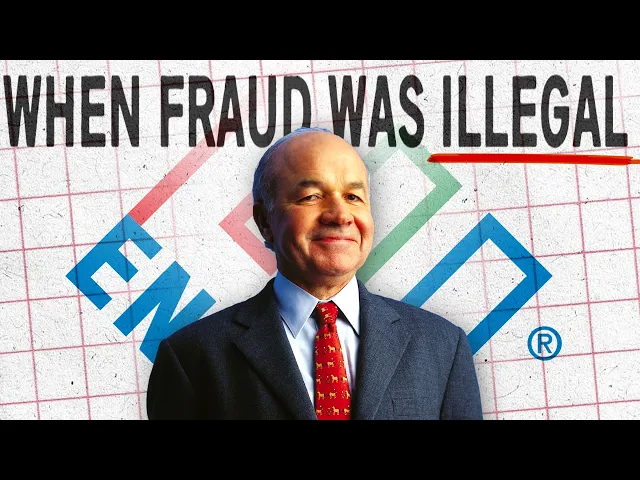
Would ENRON Even Be That Bad by Today's Standards?
How Business Worked
0:00 All right.
0:00 So, what the did Enron actually do?
0:04 Off the top of your head,
0:05 you are probably saying something about creative accounting,
0:09 corporate fraud, or if you are really clever,
0:12 maybe even terms like mark tomarket.
0:14 But what did all of this really mean?
0:16 And perhaps more importantly,
0:18 would it be considered that bad by today's standards?
0:22 The headline story that you are probably familiar with is
0:25 that the business started out as a moderately successful energy company.
0:29 But when compounding profits became harder and harder to come
0:32 by, they resorted to progressively more and more desperate,
0:36 fraudulent activities to keep the party going as long as they could.
0:39 They had convinced the world that they were the smartest men in the room.
0:43 They made impressive but willfully
0:44 reckless projections about their future performance.
0:47 They created complex deal networks to make
0:50 revenue look far better than it actually was.
0:52 And they hid their expenses creatively.
0:54 All so they could cash out
0:56 their shares and make themselves generationally wealthy.
0:58 And oh wait, hold on.
1:00 Hang on, guys.
1:01 Sorry, that's the wrong VCR.
1:02 Let me uh let me just fix that up real quick.
1:04 Okay.
1:05 Okay, there we go.
1:07 The reality is that today Enron
1:09 is synonymous with corporate greed and corruption.
1:12 More than two decades on, it has
1:13 radically reshaped the way business is [music] conducted.
1:16 But in the years since,
1:18 there have been plenty of larger and more brazen examples of outright fraud,
1:22 many of which went largely unpunished and unremembered.
1:25 If you actually go back and understand the story about
1:27 how this company grew so quickly and self-destructed so spectacularly,
1:32 you might just see some concerning trends emerging in the same markets today.
1:37 We learned a lot from Enron, but they may not have been the right lessons.
1:41 The collapse of the deal between Enron and Dyn has left Enron employees stunned.
1:46 Many of them wondering if they'll be getting their next paycheck.
1:49 Eight counts of fraud and [music] conspiracy.
1:51 Lawyers for Jeffrey Skielling and Kenneth Lei threw
1:54 around complicated notions about [music] margin calls and shortselling.
1:57 A few years ago, Enron was the nation's
2:00 seventh largest corporation valued at almost $70 billion.
2:04 Pundits praised the company as a new business model.
2:07 Guilty verdicts in the biggest case of corporate fraud in history.
2:12 Okay, so as always, I put the question to you.
2:14 What was Enron?
2:16 [music] If you are brave enough, then leave your answer in the comments.
2:19 Now, if you can believe it, the company wasn't founded with the express
2:23 intention of becoming a massive fraud.
2:25 And for a while there,
2:26 it was really just a boring old business in a boring old industry.
2:30 Ironically, the story actually starts in Omaha,
2:32 Nebraska with the Northern Natural Gas Company.
2:36 Since the 1930s, this business had been supplying natural gas as a cheap
2:40 source of fuel to industry and households across the northern [music] US states.
2:44 Over time, it acquired several other energy companies,
2:47 as well as a handful of natural resource exploration businesses,
2:51 energy networks, and a business
2:52 that sold propane and propane [music] accessories.
2:55 As these acquisitions grew, the company rebranded to Inter North
2:59 as a holding company for these various operations.
3:02 The company did well by growing and swallowing as many competitors as it could,
3:06 but this risky business strategy eventually
3:08 got company management into some trouble.
3:11 In the late 1970s, the natural [music] gas industry was deregulated.
3:15 The government would no longer guarantee prices for this resource.
3:18 [music] This radically shook up what was
3:20 at the time a very conservative business.
3:23 [music] Inter North's long track record
3:25 of swallowing up lots of other operations also made them bloated and unable
3:30 to adapt quickly to the changing market conditions,
3:33 which put them in the crosshairs of corporate raiders.
3:36 To make matters worse, they didn't really change up their strategy.
3:40 In 1983, they made their biggest acquisition to date,
3:44 the Belco Petroleum Company,
3:45 which was a Fortune 500 business and almost larger than Interself.
3:50 This created a serious problem for the business.
3:53 Bear with my analogy for the moment,
3:55 but it was a bit like that time my Pomeranian ate an entire
3:58 porter house steak that I had left unattended on the kitchen table.
4:02 From the outside, he was still technically a dog,
4:04 but by body weight, he was majority cow.
4:08 Either way, if he had to fend for himself in the wild,
4:11 then to a potential hungry predator,
4:13 he was a tasty meal on top of another tasty meal.
4:17 And that was exactly the situation Inter North found itself in by 1985.
4:21 Activist investors were buying up its stock with the plan
4:24 to take control [music] of the company and then sell off
4:26 all the parts it had acquired over the years at a profit
4:29 before running what was left as an overall leaner operation.
4:33 Hostile takeovers like this had become very common by the 1980s.
4:37 So much so that they were a central
4:39 plot point in the original Wall Street movie.
4:42 The reason it was so ironic
4:43 to have Inter North headquartered in Omaha, Nebraska,
4:47 is that down the road from the office,
4:49 just 5 minutes away, was the new head office of Burkshire Hathaway.
4:53 For a few years, two of the most
4:55 infamous businesses in American corporate history
4:58 could see each other out of their window in an otherwise very low-key city.
5:03 Of course, they both became famous for very different reasons.
5:07 Buffett's Burkshire Hathaway is now held up as a shining example of a slow,
5:11 steady, considered approach to business.
5:13 [music] Inter North and its eventual successor,
5:16 they made history for a uh well, slightly different reason.
5:21 But that's not the last we will be hearing about old man Buffett in this story
5:24 [music] because arguably he was one of the only winners out of this whole thing.
5:29 Either way, seeing how endless acquisitions had made them a slow,
5:34 lumbering target for any hostile takeover,
5:37 Inter's management did the only logical thing and moved
5:40 to make the company even bigger through even more acquisitions.
5:43 In July of 1985, Interth and Houston
5:46 Natural Gas voted to merge into one company.
5:49 Although this was technically a merger on paper,
5:52 Inter North paid $2.3 billion to acquire HNG,
5:56 which at the time was a significant
5:58 premium over what the business was actually worth.
6:00 Once combined, the two new companies went
6:02 by the incredibly creative name HNG Interorth.
6:06 Truly inspired.
6:08 Anyway, [music] the idea was that by making the business so big,
6:11 it would become impossible for any single investor to gain control,
6:15 therefore avoiding a hostile takeover.
6:18 Now, even though technically this was a merger between equals,
6:23 it was always the intention of Inter North's management that they would
6:26 retain control of the organization and run it how they saw fit.
6:30 This didn't really work out for them.
6:32 Despite being smaller,
6:33 Houston natural gas was more dynamic in the less regulated gas market,
6:37 which was something that investors really liked.
6:40 Their business practices very quickly became
6:43 widely adopted throughout the entire combined company.
6:46 In business mergers and acquisitions,
6:48 the smaller company changing how the bigger company operates after
6:52 a takeover is often referred to as the tail wagging the dog.
6:56 There's a lot of dog metaphors in this video.
6:58 I don't really know why.
6:59 A quick side note, a lot of people say the same thing
7:02 happened to Boeing after it merged with Macdonald Douglas during the 1990s.
7:07 Douglas was by far the smaller company,
7:09 but their management team took over Boeing
7:12 from the inside and pushed reckless business practices,
7:15 which arguably resulted in the tragedies which
7:18 have been plaguing the company in recent years.
7:21 Now, apart from being a random interesting fact,
7:24 there is an important business lesson in this parallel,
7:26 so remember it for later.
7:28 But anyway, back at HNG Interorth, the new joint board of the merged
7:32 company immediately ousted its initial CEO, Sam Segnner.
7:36 Even though he was chiefly responsible
7:38 for executing the merger in the first place, it didn't matter to them though,
7:42 so he was quickly replaced with the CEO from HNG, Kenneth Lei.
7:47 Kenneth Lei is often credited as the founder of Enron,
7:50 which isn't strictly true.
7:52 In reality, the business wasn't founded.
7:55 It was just the result of two
7:56 companies merging to avoid their own individual troubles.
8:00 Lelay did make some big changes though.
8:02 As soon as he took over, he moved the headquarters from Omaha to Dallas
8:06 and also set about changing the name.
8:09 He paid a consulting firm $100,000 to come
8:12 up with something more creative than HNG Interorth.
8:16 Lei and the new executive team reportedly wanted a name
8:19 that would evoke forward-looking technological
8:22 connotations like enterprise, energy, and on.
8:27 And if it bore a passing resemblance to Exxon,
8:30 that wouldn't be a problem either.
8:32 With that brief, the well-paid creative team eventually came up
8:36 with a name that will probably sound familiar to you.
8:39 Yep, that's right.
8:40 Enteron.
8:42 Uh, yeah.
8:42 So that was actually the first suggestion for the new name.
8:45 [snorts] Fortunately,
8:46 before the executive team fully committed to this, a few people pointed
8:50 out how Enteron is the medical terminology for the small and large intestines.
8:56 Money well spent, chaps, money well spent.
8:58 Eventually, they just shortened it down to Enron,
9:01 a name that means pretty much nothing.
9:04 Now, up until this point, the company, despite having a few close calls,
9:08 was still just a gas provider with a few
9:10 other diverse interests in the energy space.
9:13 However, what these successive business shakeups had done was
9:17 filter out a lot of the more conservative business
9:20 leaders and left behind a concentrated group of people
9:23 who thought they were the smartest men in the room.
9:26 Adding to that, it became clear how surviving
9:29 in this business meant managers needed to make big,
9:32 bold, decisive moves and worry about the consequences later.
9:36 Now, we all know where that eventually ended up.
9:39 But the bigger question is,
9:40 was this really any different from what is happening in the markets right now?
9:45 Well, it's time to learn how history works to see how Enron drew the fine line
9:49 between endlessly overpromising and criminally underdelivering.
9:54 Today's video is brought to you by Brilliant.
9:57 Brilliant is a learning app designed to help
9:59 you actually understand concepts by doing them.
10:02 With thousands of visual interactive lessons across math, science, programming,
10:06 data, and even AI, Brilliant makes learning active, not passive.
10:11 Lately, I've been spending time in their programming with Python course.
10:15 It's a hands-on way to practice writing real
10:18 code while building intuition for how programmers actually think.
10:22 You start with the basics, but instead of memorizing,
10:25 you're solving problems, debugging, and making connections that stick.
10:30 What I like most is how it keeps me engaged.
10:33 Each lesson has challenges that build on one another,
10:36 so you can literally feel yourself leveling up.
10:39 It doesn't matter if I only have 10 minutes or an hour.
10:41 It always feels productive.
10:43 And it's flexible.
10:45 I can pick up a lesson on my laptop or phone whenever I have time,
10:49 which makes it easier to keep a daily learning habit going.
10:53 So, if you want to sharpen your problem-solving
10:56 skills or just get better at coding, Brilliant is a fantastic place to start.
11:01 To try it out for free, go to brilliant.org/howistory works.
11:05 Scan the QR code on screen or click the link in the description.
11:09 Brilliant is also giving our viewers 20% off an annual premium subscription,
11:14 which gets you unlimited daily access to everything they offer.
11:18 From its creation to its implosion,
11:20 Enron was only around officially for 22 years,
11:23 with almost a quarter of that time spent
11:26 on picking up the pieces of its wreckage.
11:28 Before 1990, Enron continued to operate its gas
11:32 and energy businesses to varying degrees of success.
11:35 But even back during these [clears throat] honest years,
11:38 the fight to make things look as good as possible was causing cracks.
11:42 As early as 1987, just 2 years after the company was formed,
11:46 Enron executives from their oil department covered
11:49 up losses of more than $100 million.
11:52 This fraud was later found out in 1993,
11:56 yet [music] didn't actually impact the company at large too much.
12:00 However, it was an early warning sign of its developing culture.
12:04 Failure would not be tolerated.
12:06 If something wasn't going well,
12:07 you could either be honest and get fired or cover it up and enjoy your bonuses.
12:13 Bonuses which were becoming extremely generous.
12:15 By the late 1980s, Enron was a hugely attractive company to work for.
12:20 Their compensation was industry-leading
12:22 and their offices were described as palatial.
12:26 Back then, working for Enron was like working for a top tech company today,
12:31 only more selective.
12:32 But this caused problems.
12:34 If people admitted mistakes or underperformed,
12:36 then they were looked over for promotions or let go.
12:39 Then slowly, one by one, the only people left were those willing to be,
12:43 let's say, tactically selective with reality.
12:46 This cancerous corporate culture was turbocharged in 1990 when Ken Lei and other
12:52 executives at Enron decided that being
12:55 an energy provider wasn't good enough anymore.
12:58 any self-respecting corporate type was getting into the finance
13:01 game and running their own hedge fund.
13:03 That was where the money was really at.
13:05 So, Enron hired Jeff Skielling, who at the time was one of the youngest
13:08 partners ever at the prestigious management consulting firm McKenzie Company.
13:14 His job at Enron was to be CEO of Enron Gas Services,
13:17 a subsidiary of the parent company,
13:19 which was to become a market maker for natural gas and oil.
13:22 A quick thing you need to understand before
13:24 you go any further is that these Enron
13:27 executives loved to make their businesses sound
13:30 far more complicated than they actually were.
13:33 This helped to cover up their deception
13:34 and made them sound smarter than they really were.
13:38 If they were caught stealing cookies in the middle of the night,
13:41 these guys would call it moving energy stores out
13:44 of a concentrated market and realizing
13:46 consumer demand during underserved operating hours.
13:50 So, by the same token,
13:52 the Enron gas services business was really just an investment trading firm.
13:56 Though, instead of trading stocks, bonds, or other financial assets,
14:00 they were trading natural gas between parties
14:02 that produced it and those who consumed it,
14:04 all while trying to make a little bit of money as a middleman.
14:08 [music] To that end,
14:09 they actually took some of their pipelines offline to customers.
14:13 So now instead of just being a pipe that moved natural
14:17 gas from where it was supplied to where it was burnt,
14:20 it was going to be used as a conduit to facilitate market movements.
14:25 To smooth things over with investors,
14:27 the executive team dubbed their new operation a gas bank.
14:31 Remember, at this time, finance was the hot industry to be in.
14:35 Fossil fuels were very 1980s.
14:38 Now, firms dabbling in markets like this can make a lot of money,
14:43 but it's by no means guaranteed, and it's also not very consistent.
14:47 Even the best market makers will make mistakes and lose money from time to time.
14:51 So, you might be able to start to see where this is going.
14:55 Jeff Skielling, the CEO of the new trading branch,
14:59 also hired one last important character,
15:02 a banker called Andy Fasto, the final puzzle piece in the Enron conspiracy.
15:08 Together these financial buffins created two very powerful tools to make sure
15:13 that from here on out all financial results would be good financial results.
15:18 The first was mark tomarket accounting.
15:20 [music] Now the biggest misconception about the story of Enron is
15:24 that this type of accounting was inherently
15:27 the problem which is simply not true.
15:29 All this system of accounting does is note profits
15:32 or losses from tradable assets held within an active market value.
15:37 It is perfectly legal and it's still widely used today.
15:39 In fact, you probably use marktomarket
15:42 accounting more than any other accounting standard.
15:45 For example, if you invest in the market
15:47 through an online broker like Robin Hood,
15:50 you will probably see a daily profit or loss noted for your portfolio.
15:54 That number is marked to market.
15:57 And all it really means is that if you were to sell your assets today,
16:00 that is how much profit you would make from when you purchased them.
16:04 On a larger scale, this is useful for something like
16:07 a bank or a hedge fund because to report a profit,
16:10 they would otherwise have to sell their entire portfolio at the end of the year,
16:14 which obviously isn't reasonable.
16:16 But the reason why mark tomarket accounting was a problem
16:19 for Enron was because unlike a typical financial firm,
16:22 they were trading things that didn't really have
16:25 a market apart from the one they were making up.
16:28 Their new gas bank technically meant that gas
16:32 contracts could be traded like stocks or bonds.
16:35 So they took that idea and pushed
16:37 this accounting system to the absolute extreme.
16:40 If they signed a contract that could be worth $100 million over 20 years,
16:45 they would note that as a profit on day one,
16:48 which would be questionable at the best of times.
16:50 But then they took it even one step further.
16:54 If you open up an investment account on a daily
16:57 basis to nervously check if number go up,
17:01 you will know that sometimes number do not go up, sometimes number go down.
17:07 In a markto-market system,
17:09 the accounting team should also mark down asset values
17:13 as a loss if market transactions suggest that the price has fallen.
17:18 But again, Enron bred a culture where
17:20 reporting failure in any way was almost impossible.
17:23 So, they got creative.
17:25 Ken Lelay told Jeff Skielling to make the numbers look good.
17:28 Jeff Skielling told his new right-hand man, Andy Fasto, to do the same.
17:32 So, he did.
17:33 FTO started a series of offthebooks
17:36 partnerships with nondescript names like LJM1.
17:40 Enron would then bankroll these partnerships as an investments, but crucially,
17:46 Fasto would put in a little bit of his own money as well.
17:49 This technically made these partnerships
17:52 operationally separate from Enron itself.
17:54 The way that Enron executives wanted people to think about
17:57 this is that they were just investing in promising new opportunities.
18:01 It would be like if a small family business bought some shares in Disney.
18:05 Sure, they have some money on the line,
18:07 but they are obviously completely separate operations,
18:11 except that in Enron's case, they were not at all separate operations.
18:15 Enron provided the vast majority of the funding to these shell businesses
18:19 and they did exactly what the Enron executives told them to do.
18:23 And what were they told to do?
18:25 Well, anytime Enron made a trade or had a subsidiary that wasn't doing well,
18:29 these offthebooks companies would come in and buy
18:33 them up at a massively overinflated price.
18:36 That way, Enron could report a profit and make
18:39 their financial statements look good to outside investors.
18:42 This whole system would be like if you
18:44 invested $2,000 in an unopened box of Pokémon cards,
18:49 but for accounting purposes, you assumed that it contained a mint
18:53 condition misprinted shiny Charizard worth $5,000.
18:57 So, you record a profit of $3,000.
19:00 $5,000US 2,000.
19:02 However, a year later, when you actually open the pack,
19:05 you realize that it only contained energy
19:07 cards and a Blastoise valued at $1,000.
19:11 Now, in a true mark tomarket system, you should record a loss of $4,000.
19:16 But if you did that at Enron,
19:18 you would miss out on your enormous annual bonus and almost certainly get fired.
19:22 So, instead of owning up to your loss,
19:24 you invest $9,700 into a new Pokémon card buying business,
19:30 plus have your friend put in $300 of their own money.
19:34 That way, it's not technically just your business.
19:37 This new company then conveniently agrees
19:40 to buy your subpar card collection for $10,000
19:43 by using up all of the cash that was just invested into the business.
19:48 So now you get to claim that the cards
19:50 you purchased for $2,000 were sold for $10,000
19:53 and therefore netted you a profit of $8,000
19:56 at least as far as your disapproving girlfriend is concerned.
19:59 Now of course in reality you haven't really made any money.
20:02 You just moved it around.
20:04 But replace Pokemon cards with overly
20:07 complicated energy contracts and disapproving girlfriend
20:10 with company shareholders and you end up with exactly what Enron was doing.
20:15 Clearly, this was dishonest at best.
20:18 In fact, later on in court, it was proven to be downright fraudulent.
20:23 So, surely regulators would never let
20:26 something like this happen ever again, right?
20:29 Well, there is a very similar game being played right now in private equity.
20:34 Private companies can also be assigned value using a markettomarket system.
20:38 But since their stocks don't trade on public markets every day,
20:41 their value is only really confirmed once they are sold.
20:44 Therefore, private equity firms are incentivized
20:48 to sell the businesses in their portfolio
20:50 that are doing well and forget about the ones that are doing badly.
20:54 When strong performers do well, they get to record profits.
20:57 But if they never sell the duds, they don't have to recognize the losses.
21:01 The problem with this business strategy is that over time,
21:05 if these firms only hold on to their underperformers,
21:08 they are eventually left holding a portfolio full of garbage.
21:12 But hopefully by the time they become a problem,
21:14 the general partner of the firm has already retired.
21:17 Anyway, back at Enron, things were even worse.
21:20 They didn't actually have enough cash to give these shell
21:23 businesses for them to turn around and buy their bad assets.
21:27 So instead, they gave them shares in the company itself.
21:30 Since Enron shares always went up, these businesses could use them as collateral
21:35 to borrow money to buy these assets, which made Enron's profits look good,
21:40 which made their stock price go up even further.
21:43 Enron also paid its employees with stock-based bonuses.
21:47 Its executives made millions of dollars by cashing out their stock,
21:51 and it also made business acquisitions using its own stock.
21:54 What you might not expect is how the executives
21:57 were surprisingly open about how they were reshaping finance.
22:00 They even held several press interviews all about how
22:04 their business was reshaping the way markets are built.
22:07 In a quote to the press, they said,
22:09 "There's always a lot of focus on technological innovation,
22:13 but what really drives a lot of progress is when
22:15 people also figure out how to innovate on the financial model,
22:19 the financial instruments.
22:21 I don't think we've figured out yet the final form of what financing looks like.
22:26 Wait, hang on.
22:27 Sorry, my bad.
22:28 That was actually a quote from Open AI's Sam Ortman from last month.
22:32 I really got to stop getting this stuff mixed up.
22:35 Corporate needs you to find the differences
22:37 between this picture and this picture.
22:40 They're the same picture.
22:42 Anyway, for the Enron execs, the game was pretty simple.
22:46 As long as their stock value went up forever, their system would survive.
22:50 And this created an almost singular
22:52 focus on maximizing short-term stock movements,
22:55 even if it came at the expense of long-term business fundamentals.
23:00 This also saw the business start to desperately chase
23:03 trends that it thought would look good to investors.
23:06 It had already transitioned from a gas
23:08 pipeline company into a pseudo hedge fund.
23:12 But by the end of the 1990s, it had also gone allin on the internet
23:16 to keep up with the hype surrounding.com companies.
23:19 Just like it had laid gas pipelines, it was also laying network cables.
23:24 Eventually, after this charade collapsed,
23:26 people started asking questions about the bizarre
23:29 financial statements the company was producing.
23:32 One commenter pointed out that Enron seemingly were never able to produce
23:37 a balance sheet and an income statement at the same time.
23:41 The stock price tumble was further accelerated
23:43 by market trends following the dotcom crash and 9/11.
23:47 As more and more questions popped up, investors got increasingly nervous,
23:51 and the lenders who were holding Enron stock as collateral got closer to pulling
23:56 the plug on the whole game that had been going on behind the scenes.
24:00 Without that source of cash coming in to massage the numbers,
24:04 the truth was quickly exposed and the whole business seized up in just 6 weeks.
24:09 A merger/bailout was considered with another energy
24:13 company until they actually opened up the books.
24:15 Once they saw what was going on under the hood, they backed out instantly.
24:20 On the morning of December 2nd, 2001, Enron filed for Chapter 11 bankruptcy.
24:25 Just 16 months prior, their stock had been at an all-time high.
24:30 The financial shell games that the company
24:33 was built off were so convoluted and technical,
24:36 it took an outside team of experts more than 5 years to eventually
24:40 untangle everything and try to pay back all the money that was owed.
24:44 By the time everything was all said and done,
24:46 the only assets that the company had which were worth anything
24:50 were those gas pipelines it had started with 20 years earlier.
24:55 In a strange turn of fate,
24:57 Northern Natural Gas, the business that started it all,
25:00 would actually return to Omaha after none other than
25:03 Warren Buffett purchased the distressed assets during Enron's liquidation.
25:07 To this day, they still remain part of Burkshire Hathaway Energy.
25:12 There weren't many other winners in this story, though.
25:15 Regular employees at the company lost
25:17 their pensions and most of their savings since
25:19 they were encouraged to hold on to their Enron stock as a blue chip investment.
25:24 It was difficult for most of them to find new employment in the industry
25:28 since other companies considered their Enron work experience to be a black mark.
25:33 And finally, and to be fair,
25:35 most of the characters from this little show did end up going to prison.
25:38 But would the same thing happen today?
25:40 A lot did change after Enron.
25:42 New laws were introduced to ensure company executives personally
25:47 sign off and remain liable for published financial statements.
25:51 Arthur Anderson, the accounting firm that prepared Enron's books,
25:55 eventually collapsed when it was criminally charged
25:57 and barred from ever working with public companies again.
26:00 And lastly, actual, real,
26:03 genuine protections were put in place to protect whistleblowers coming
26:06 forward about similar fraudulent activities before they could get this big.
26:11 It was all great stuff, but in the years since,
26:14 enforcement of these rules has all but eroded into irrelevance.
26:18 Now we're starting to see a lot of common themes returning.
26:23 Creating revenue through cooperative deal making,
26:26 piping up new opportunities, chasing the hottest new trend,
26:30 a focus on stock market performance
26:32 at the expense of actual business performance,
26:34 convoluted deal structures, insiders cashing out,
26:38 marktomarket accounting that highlights gains and pretends losses don't exist.
26:43 All held together by people that seem too smart to question.
26:46 Go and watch this video next to find out how
26:49 another infamous firm collapsed just 7 years later if you
26:53 want any further proof that learning from history only happens
26:56 when there isn't money to be made from forgetting it.
26:58 And don't forget to like and subscribe to keep on learning how history works.