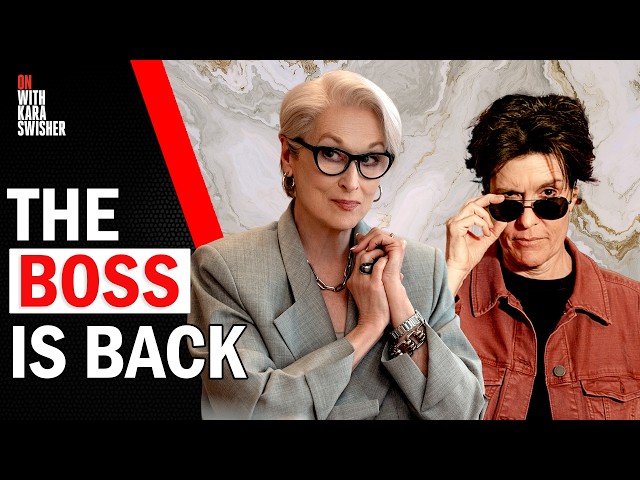
Why The Devil Wears Prada 2 is a sequel that actually works
On with Kara Swisher
0:00 Alen and David, thank you for coming on on.
0:02 We're happy to be here.
0:04 Great to be here.
0:04 The reaction to Devil's Produ has been
0:06 overwhelmingly positive and it's funny as ever, but it's very serious.
0:10 It's a very deep movie.
0:12 Talk about why you took this approach.
0:14 It all starts with Merryill Street.
0:15 She understands it's valuable to make an entertainment,
0:18 but she also wants her work to be about something.
0:21 I've been obsessed with clothing since I was like 12 or 13 because,
0:24 you know, I was like incredibly uncool.
0:26 And then I had to figure out a way to like
0:28 get a little cooler and get some boys to like me.
0:30 And it was really about like going downtown
0:32 in New York and wearing vintage skirts and lace stockings.
0:37 And that's what I love about fashion is
0:39 a way of talking about yourself without saying anything.
0:42 The original film shaped how we think about women, power, ambition.
0:45 Miranda is very explicitly a villain, although she's a very funny one.
0:49 Miranda is not the villain here.
0:51 Miranda is the heroine.
0:52 Miranda is trying to achieve excellence every day.
0:56 Why does she have to be nice to accomplish that?
1:02 [music] Hi everybody.
1:06 Today we've got a special episode.
1:08 I'm talking to Alene Brash McKenna and David Frankle,
1:12 the writer and director of The Devil Wears Prada 2.
1:15 For anyone who doesn't know, and if you don't know,
1:18 you should, I have a cameo in it playing.
1:21 That's right, Cara Swisser.
1:23 I look fantastic.
1:24 I will say, even though I am the least fashionable person on the planet,
1:28 what's really fashionable is this movie.
1:30 The fashion is amazing in it.
1:31 The visuals, the music,
1:33 the characters are better than ever uh by the same team who did the first movie.
1:38 It's beautifully written.
1:39 But I have to tell you,
1:40 at the dead heart of this movie is an important story about media,
1:43 about creativity, about standards, and about really loving your job.
1:48 The film is great.
1:49 So go watch it.
1:50 It's already doing incredibly well at the box office
1:53 because it is so good and it is also substantive.
1:56 But first, stick around for the interview of the people who made it.
2:00 Alen and David, thank you for coming on on.
2:03 We're happy to be here.
2:05 Great to be here.
2:06 So, the reaction to Devil Wear's Prodatitude has been overwhelmingly positive.
2:10 Congratulations.
2:11 The New Yorker called it a savvy, shiny reflection of our era.
2:14 The Guardian called it good-natured, buoyant entertainment,
2:17 and entertainment writer Louis Petman said the movie is legitimately great,
2:23 not just another soulless legacy sequel.
2:26 Um, sequels are often treated with suspicion,
2:29 especially when the original is a cultural phenomenon.
2:31 Fans have developed a strong emotional attachment to it.
2:34 So talk about the sort of anxieties you had leading up to uh it coming out.
2:39 Let's hear from David and then Alen.
2:42 Well, the anxieties persisted um till this morning.
2:47 I the um the we you know we really resisted the idea.
2:52 We we mistrusted any kind of legacy sequel ourselves.
2:57 So when the topic first came up
2:59 in the immediate wake of the first movie's release,
3:03 we resisted it and and we resisted it for 18 years.
3:07 And it it wasn't until a couple years ago when the you
3:11 know the conversation turned to should we consider this yet again?
3:15 And the Alen had this notion that wow the world's really
3:20 changed around these characters and maybe there's something to explore here.
3:25 Yeah.
3:25 The spark for me was that so many people who are
3:28 prominent in the business world in in all these businesses had sort
3:32 of gotten you know turned upside down and their reputations were you
3:37 know damaged or impaired or challenged you know with the internet and so
3:43 much conversation about I I I couldn't have named that many CEOs
3:47 10 20 years ago but now we're really intimately familiar with these folks
3:51 and so there was this little notion of like what if Miranda
3:54 got in trouble and Andy was the person who could help her.
3:58 And that seemed like like an interesting
4:00 little notion that we started playing with.
4:02 And then I, you know, our process is I pepper David with annoying
4:06 um emails and questions until he got vaguely interested.
4:09 And then we found out that Mel was interested in hearing what we had to say.
4:13 So I went out to New York and we went down and and hung out with her.
4:17 And that's always, as you know,
4:19 David will tell you, her belief in the first movie,
4:22 Merryill's belief in these these two movies have really
4:24 has really buoied us in times when we felt nervous.
4:29 So, what what was the thing that pushed it over for each of you and Merril?
4:33 I guess what what was that, David?
4:35 Just the I think the license for us to pursue it
4:38 from Merryill was was key and and then once we got into it,
4:42 it became very exciting.
4:43 I mean, Alen had a lot of ideas and and I kibitzed
4:47 a little and we arrived at a narrative which combined what I
4:53 loved about the first movie which is a frothy exploration and you
4:58 know wildly entertaining and very funny
5:01 uh exploration of the fashion journalism world
5:04 and the fashion world at large but asking some fundamental universal questions
5:10 about in the case of the first movie you know what it is
5:12 to be a young person and and be um figuring out who you
5:16 are and and finding out where the ethical and moral lines you draw exist.
5:21 And in the second movie, figuring out, you know,
5:24 what it means to be somebody who's
5:25 in their 40s and struggling to survive or someone who's,
5:29 you know, someone who's running the thing and struggling to survive.
5:32 You know, that that layer of of um infrastructure gave it,
5:38 you know, some heft to us and meant that it could really resonate.
5:42 One of the things that I found interesting
5:44 about the movie was the first movie was about
5:47 learning to have a life despite intensity of work
5:50 or or learning to pull away from work.
5:52 This is about loving your job to me.
5:55 She says it very explicitly, Elaine.
5:57 Correct.
5:58 You you have her say it.
6:00 Yeah.
6:00 Merryill says it um towards the end of the movie,
6:02 but you feel it from Andy from the beginning.
6:05 And I think you know that was the the the first movie.
6:09 you see her realign her priorities and realize
6:12 that she really wants to be a journalist.
6:14 But the problem with that is that journalism is a uh you
6:17 know a way to make a living has really is petering out.
6:21 Um, and so I was always thinking about her as this was
6:25 happening that she would be in somewhat diminished circumstances.
6:28 And then the world she came from, which had been so big,
6:32 shiny and kind of um flossy in the first
6:35 movie that was also undergoing this kind of seismic shift.
6:39 So in a way she and Miranda were going to be found they you know
6:42 it's the movie starts with a crisis for both of them which brings them together.
6:46 And that was the very first idea that we had.
6:49 And then what's different about this movie is often in terms of a sequel
6:54 is often the studio is the one who calls you and says,
6:56 "Hey, we were thinking of a sequel
6:58 and blah blah blah." But this this wasn't that.
7:00 This was the filmmakers,
7:02 David and I then going to our acting team head by Mel and saying,
7:06 "Hey, what do you think of this idea?" So, we brought it to the studio.
7:10 We were the ones who said,
7:11 "What do you guys think of this?" And then we were lucky enough
7:14 that the new president of the studio had
7:17 only been there for 10 days, David Greenbound.
7:20 Um, he just loved those ideas.
7:22 The idea that these two people who have a history need
7:26 each other and that they're both sort of, you know, Yeah.
7:29 they get pulled back together.
7:30 Yeah.
7:31 They're in the same situation.
7:32 So, David, you've said that movies these days, quote, have to be events.
7:36 The only way to make a hit movie is somehow to make it really important.
7:39 Now, you've managed to do that.
7:41 This thing has been marketed within an inch of its life,
7:43 but an also very [clears throat] fun way.
7:45 But something um gets lost when every theatrical
7:49 release has to justify itself as a cultural event.
7:52 This is an easy one to do that.
7:54 Could a mid-budget film like the original Devil Wears Prada get green lit today?
7:58 From your perspective,
8:00 I feel like the original Devil Wears Prada may still have succeeded even today.
8:06 you would have had might have had the same
8:08 opportunity to to break through and connect with the audience.
8:10 I mean the themes and the movie itself I think does uh is very appealing and I
8:17 and I think like you know movies for women
8:19 in general uh get undervalued uh and women
8:25 you know movies starring women especially and um
8:28 you know it even it fall it gets called
8:30 a romcom it's not even technically you know
8:33 it's not a romcom [laughter] you know so um
8:39 so I don't know you I was I was elated
8:40 to see original movies breaking through last year, you know,
8:44 one battle after another and sinners and had weapons and you know so I I think I
8:50 really think it's if the the there's a great
8:53 movie people will come out to see it.
8:56 Yeah.
8:56 And we had the book we had a hit book the first time
8:59 and that was what sort of got us through the process was the hit book.
9:03 But, you know, D, I I wonder now if it would be a streamer.
9:06 That would be the debate was like, would it go straight to streaming?
9:09 You know, would it be a theatrical release?
9:11 Cuz that's really the bar now is like,
9:13 can something earn its keep as a theatrical release?
9:16 But I almost named my company Big Surprise because everything that's
9:20 geared towards women is just always like big surprise, big surprise.
9:25 Women want to see Mama Mia, women want to see, you know,
9:29 romcom with Sydney Sweeney.
9:30 It's just always everyone's always like falling over shocked,
9:33 right?
9:33 Exactly.
9:34 I mean, you bring up original films which I think
9:36 is is interesting like sinners and one battle after another.
9:39 I'd love you each to talk about this idea
9:41 of originality because one of the themes I'm
9:44 talking about in fact I talked about it
9:45 on stage the other day was it's really astonishing
9:48 how um people are really reacting against
9:52 an AI kind of mentality which is a faximile
9:56 that people's sort of sense isn't the same
9:59 and are really drawn towards originals in in some fashion.
10:03 Alen, why don't you start first and then David?
10:07 Knowing these characters already and having
10:09 a relationship with them that the audience has.
10:11 I think you're right.
10:12 Like people are create are craving things that feel real authentic
10:16 and that they can sort of touch and feel and they know these characters.
10:19 They know these actors and and we had a sense
10:22 that this was going to happen because we got out on the street
10:25 and people were like running and screaming and screaming the characters
10:29 names and like the it was pandemonium when we were shooting.
10:33 And I think it's that inperson thing.
10:35 And I remember I was talking to one of the costume assistants and I said,
10:38 "What is going on?" Like, "Why are people running out to see just like,
10:42 you know, Ann Cross the street?" And he's like, "People are craving real stuff,
10:46 like real." It's like the the rise of live events, right?
10:49 Like people want to see something, touch something in person.
10:53 And so that's why this tour that Maril
10:56 and Annie did where they went around the world,
10:58 like people really really wanted to see them and talk to them and feel them.
11:03 And I I think you're right that there's this like thirst for something
11:06 that feels like authentic and recognizable
11:09 as opposed to something that feels uncanny.
11:12 That's a very good word.
11:13 That's an excellent word, David.
11:15 Well, we went through this a little bit on the first movie
11:18 because there was an indebtedness to the novel which was at the time,
11:21 you know, had I don't know, it sold just a [snorts] crazy number of books.
11:25 And so, how faithful could we be to that?
11:27 And then how much um new storytelling,
11:31 how original could we be in the first one?
11:33 We changed the whole third act of the movie.
11:36 It's pretty faithful in its structure for the first twothirds.
11:40 And we felt again, you know,
11:42 this obviously is not based on any pre-existing material.
11:46 Alen concocted it from whole cloth.
11:49 But there again, the expectation was these same characters.
11:54 They similar orientation,
11:57 but we want to do something completely new that people don't feel like,
12:00 oh, it's just a retread.
12:02 And anytime you're creating something from whole cloth
12:05 like that, it's uh it's a huge challenge.
12:08 But you know that the audience is going to appreciate it.
12:11 I mean, you know, if they're seeing something new and you know,
12:14 one of the big talking points I see online
12:18 now is the nature of Miranda's character because we didn't
12:23 we don't launch her just, you know,
12:24 full of diet tribe and criticism and withering remarks.
12:28 You know, we launch her into this movie in a vulnerable place, right?
12:32 and and uh so it seems like you're you know we're seeing some new colors
12:36 from that character and that some people are
12:39 love that and some people uh resist that.
12:42 It's fascinating to see.
12:44 So Alen, talk about that because the original
12:46 film shaped how we think about women, power, ambition.
12:49 Miranda is very explicitly a villain, although she's a very funny one.
12:53 And Andy's heroic turn comes when she realized she doesn't need
12:55 to compromise her values in order to please someone like Miranda.
12:58 And yet you can't help respect her, too.
13:01 that last scene where she looks up and then says that's all.
13:04 Of course, but she has a moment of real hope there.
13:08 I have to say I I think this a lot with a friend of mine,
13:11 Tina Brown, who was actually a cameo in the movie, too.
13:14 Um, if she were a man, would we have called her genius instead of a devil,
13:18 obviously, same thing with Tina in a lot of ways as a big editor.
13:22 I think she's the finest editor in the land, right?
13:25 And, you know, other others get a very different things.
13:28 And not to go all feminist on you,
13:30 but it's a really interesting situation with someone like this.
13:33 And of course, this is very much based on Anna Winter.
13:36 Well, I think you know what the first movie was
13:39 really about how like even if your boss is nice, you're obsessed with them.
13:42 Like I used to work in a producers's office and everyone would be like,
13:46 "Oh, he's running late.
13:47 Oh, he ate chicken for lunch.
13:49 Oh, he's going here, you know,
13:50 for dinner." Like there's an obsession with the boss
13:53 that you have when you're an assistant.
13:55 And I think that the movies are first-person movies,
13:58 so you're seeing Miranda through her eyes.
14:01 And so she's terrifying in the first movie,
14:04 but in the second movie, she's, you know, Andy is middle management.
14:07 And you get to see your boss up close
14:09 and you get to understand their challenges along with yours.
14:13 So I think by definition when you rise up a little
14:15 bit in the workplace that those bosses take on a dimension
14:20 you know like you start it's almost like when you grow
14:22 up and you start to understand that your parents are fallible.
14:25 It's like you grow up and you understand oh your boss
14:27 doesn't have all the answers you know and they have issues too.
14:31 And I think one thing Marilyn has talked
14:33 about is like Miranda lets someone help her which
14:37 like is that that's to me the most unexpected thing is is less that she's at you
14:42 know at um you know at a low point and it's more that she actually becomes open
14:49 to someone doing something for her, someone unexpected
14:52 who she really didn't even want to be there.
14:54 And so I think it's like that that lens
14:57 that you have on someone who's in power where you realize,
15:00 oh, they're they're also fallible and they make
15:03 mistakes and they have weaknesses and they have,
15:05 you know, bad moments.
15:06 Right.
15:07 Absolutely.
15:08 Now, David, a few months ago,
15:10 Anna Winter and Khloe Maul did a joint interview with the New York Times.
15:13 Anna, who I've interviewed, um,
15:15 is obviously the global editorial director for Vogue.
15:17 Uh, Khloe is the head of editorial content at Vogue
15:20 US and Anna's successor and couldn't be more different.
15:23 For example, in the interview,
15:24 she talks about wanting to pay her staff more and how hard they work.
15:27 David, is the approach to leadership and power less
15:29 cinematic or is there a different kind of tension
15:32 in a more millennial style of leadership that say a Khloe
15:35 represents or Andy's character would were she to take over?
15:40 Well, it's I think yeah,
15:42 there's this tendency to be less demanding and more understanding.
15:46 And I think there's also an expectation from the new
15:48 generation that they won't uh work as hard,
15:54 that their feelings will be taken into account, which you know,
15:57 Alen and I grew up in at a time
16:00 and as I'm sure you did where who cares about your feelings,
16:05 you know, like get the job done.
16:07 Yeah.
16:07 That's what the money's for.
16:09 Yeah.
16:09 That's that's how we you know we started the [clears throat]
16:12 movie the reason I even got the job in the first
16:16 place is I went in to the studio and I
16:19 said Miranda is not the villain here Miranda is the heroine
16:23 Miranda is trying to achieve excellence every day and the why
16:28 does she have to be nice to accomplish that you
16:31 know and there's a long list of mostly men of course
16:35 uh who are um highly regarded for their superb work.
16:41 I mean, they might be the goats in their business and no
16:44 one really questions how how nice they are about about accomplishing that.
16:50 Uh, and I always viewed the the movie through the lens of, you know,
16:56 Miranda is the hero here.
16:58 And I think that was, you know, I think Merryill embraced that.
17:02 I think she, you know, she she has always said, you know,
17:05 that if it were a man, there would be no movie, right?
17:09 I mean, I think it's funny because David is like notoriously the nicest,
17:13 you know, and certainly among the nicest directors I've worked with.
17:18 So I wonder if there's like a vicarious
17:20 thrill to watch somebody in the workplace, you know,
17:23 because we are all doing our best to be polite
17:26 and because the the rise of a certain type of language being,
17:31 you know, discouraged in the workplace and that people are,
17:34 you know, you can't really say things you used to say.
17:37 Um, and so I think there is something even
17:40 more uh titilating about this lady who's like kind
17:44 of knows that she needs to rein it
17:46 in but doesn't really is not totally comfortable with that.
17:50 And that was very funny in this one because in the last movie she's
17:53 throwing her coats at people with abandon
17:55 and wouldn't understand what the problem is.
17:57 And now you know there's no scenes with HR
18:00 in this movie but I would love to write Oh.
18:03 Yeah.
18:03 where she says things.
18:05 Oh, I love that.
18:05 Those are my among my favorite where she says the wrong thing and what
18:09 and that and the woman who is plays her assistant this time who's
18:12 wonder just sort of gives her the side eye that is so perfect.
18:16 Yeah, she's amazing.
18:18 Let's talk the some specifics of the movie itself right now.
18:20 The Devil's Produ touches on media ownership drama.
18:23 Justin Throw plays Benji Barnes, a billionaire tech resembling Jeff Bezos.
18:28 There's a touch of Elon Musk um who
18:31 knows nothing about the publication he wants to buy.
18:34 I talk about this because I [laughter] was laughing
18:36 my ass off because you know Justin whom I
18:39 who I know was asking me various questions
18:41 but he said he watched a lot of interviews I
18:43 did and many other people did to inform him
18:46 but he has this this this really good sense
18:49 of menacing ofishness that I think and victimy toddlerness
18:54 like I called I think I texted you toddler monster.
18:58 What do you want to explore in the tension between these people?
19:02 I think, you know, sometimes I didn't really base them on anyone specific,
19:05 but sometimes um people who are super super super
19:08 bright um perceive the world in a different way.
19:12 Like I've been around people who are extraordinarily bright in my life,
19:16 but are kind of odd.
19:17 They're perceptually odd.
19:19 Um, and the thing that Justin did, I mean,
19:21 it's starting with his complete lack of vanity and and the hair that he wears,
19:25 which is just so ext.
19:27 But I wrote the character to be a little bit merry like
19:32 I wrote like he has a weird laugh and like that Justin,
19:35 he's so bouncy and cheerful that it's that's I think more scary than if he had
19:41 approached malevolent.
19:42 He's clearly malevolent in that one scene in Italy.
19:45 He's malevolent.
19:46 this you I hate to tell you but you
19:48 nailed Jeff Bezos with a touch of Musk and you
19:51 know you also nailed McKenzie Scott actually um Lucy
19:56 Lou is playing his ex-wife and you got the sense
19:59 of her cuz she's McKenzie is is it doesn't
20:02 go out a lot right she doesn't get seen
20:04 a lot and everything which is interesting um were
20:07 you and you didn't make him into a cartoon either
20:10 yeah David you want to talk about that
20:12 well I think that when Justin came on it was a tiny part and he added some
20:19 shading and some brilliant comedy that expanded who
20:22 we you know how we understand who Benji is.
20:25 his his uh theories about um replacing our necks and his desire
20:30 to send a rocket ship to the sun um were were com inventions.
20:35 But and then he and Leen really worked very hard on the speech
20:39 uh that's in that last supper scene about his vision of the future.
20:43 And that's where you find out, oh, this is actually someone who has thought very
20:48 deeply about this and has horrifying opinions about it,
20:52 but uh also uh understands the world and history and technology at its core.
21:01 Yeah, I think he's a guy who like polishes
21:03 off a giant tome about ancient Rome or like,
21:06 you know, the the kingdoms of Venice or whatever
21:08 just cuz he's happens to be in Italy.
21:11 But what Justin brought to it was like, so he we got on a Zoom and he took there
21:16 was things in the script that we talked about and I said,
21:18 you know, I think like like an example is I said,
21:20 I think Benji's just like not drinking water right now.
21:23 I think he wants to like like he thinks water is bad.
21:26 And then what came out of Justin's mouth without missing beat,
21:29 he goes, yeah, yeah, he's running an aqua deficit.
21:31 And I was [laughter] like, thank you.
21:34 And like the same thing with the rocket ship
21:36 to the sun was like one line where it said,
21:39 you know, people are going to the moon, but I want to go to the sun.
21:41 And then he sat down with me before and he had like developed this whole
21:45 thing of like a rocket that would go to the sun and how it would work.
21:48 So, I think one of the reasons that the actors,
21:51 a lot of the actors in this movie loved the original movie and loved the idea
21:55 of being on this and they really thought
21:57 about it like every single one of these actors,
21:59 I don't think I there was a single day where
22:02 Simone Ashley did not come up to me before and say,
22:05 "Okay, I'm doing" and she doesn't have that many lines.
22:07 She's sort of like the secret, you know, she's quiet as Poly Walnuts.
22:12 Yeah.
22:12 And so she would come and say like, I I think I'm going to do this or like
22:17 I think I'm going to play with my bracelets here.
22:19 Like there was so much thought that obviously
22:22 the main four who were just these incredible acclaimed actors,
22:24 but even the supporting people like really thought so deeply about.
22:29 And I think people feel like the world's a scary place right now.
22:32 They don't know their place in it.
22:34 They don't know their future.
22:35 You know, people in the movie business are not immune to that.
22:38 And I think everybody feels like you
22:41 gotta monetize your algo or whatever, you know.
22:44 Yeah.
22:44 Right.
22:44 No, I get it.
22:45 So to that to that point,
22:47 um the new movie comes as we said 20 years after the original.
22:51 Things have changed in journalism a lot due to tech, by the way.
22:54 And uh 2006, Andy Saxs, played by Anne Hathaway,
22:57 had to choose between a career in elite fashion magazine or newspaper.
23:00 As my wife noted, she'd be lucky to find a job now in media at all.
23:04 Um, you could have leaned into more glamorous fantasy world for the sequel.
23:09 Instead, the film acknowledges the harsh reality.
23:11 The industry has changed.
23:13 David, how did because it's a I I walked out of it and I said,
23:17 you know, someone asked me, I said, well,
23:18 it's real pretty and it's even prettier and it's more colorful
23:22 and the the fashion is more and it's funny as ever, but it's very serious.
23:27 It's a very deep movie about this.
23:29 Talk about why you took this approach.
23:32 Well, we are living in challenging times.
23:35 I don't need to tell you car.
23:37 And I think we were all uh living under the cloud of the future, you know.
23:43 And that's just a very strange phenomenon.
23:46 I grew up thinking, you know, the future was bright and rosy and you know,
23:51 go off young man, make your future, you know, make your way in the world.
23:55 And uh I now you know I I have kids who are 24 years old.
24:01 the lean as kids about the same age and we're hard put
24:05 to to um point them in the right direction you know where is
24:10 um where's [clears throat] the right step and you know especially my daughter
24:13 is interested in film and I you know the journalism and and Hollywood
24:18 are in about the same shape you know LA has become a very
24:23 bleak place I'm told I'm told and uh the industry feels like
24:28 it it has shrunk dramatically in the last five years and it feels
24:32 like it's destined to shrink dramatically even more in the next five years.
24:38 So where do we go?
24:40 And that's you know that's obviously true in journalism and that's
24:42 true I imagine in law and probably even in in medicine.
24:47 You know I met with a the CEO of a major bank last summer and she told me
24:52 that um you know probably it could be a 100,000
24:56 people are going to uh be affected by AI.
24:59 Mhm.
25:00 Uh it's so if you're making a movie that's uh u about
25:06 uh the world of media uh it has to reflect the the reality.
25:12 I mean that's you know one of our goals is to as light
25:14 and entertaining as we want the movie to be is to also make it
25:18 authentic you know and in the first movie we were able to pepper it
25:21 with you know a handful of people and and scenes that made it feel
25:25 like oh this is really the world and we we tried again you
25:30 know very hard to give it that and honestly you know it all starts
25:35 with Meryill Street she understands it's valuable
25:38 to make an entertainment but she also
25:40 wants her work to be about something and I think we share that ambition.
25:46 Support for this show comes from Ripling.
25:48 Nowadays, every business [music] app claims to be allin-one,
25:50 but for some reason,
25:51 you're still bouncing between a handful of platforms to run things smoothly.
25:55 With Ripling, you can finally downsize
25:57 to one platform that actually does it all.
26:00 Ripling is the unified platform for global HR, payroll, IT, and finance.
26:04 [music] Workflows that normally bounce across several different tools
26:07 and departments all just happen in one place automatically.
26:11 [music] Here's an example.
26:12 You have an employee getting promoted.
26:14 Ripling can update their payroll taxes, manage any new app permissions,
26:18 ship them any new devices, issue a new corporate card,
26:21 and assign trainings all in one platform without the fuss of dealing
26:24 with 10 different login to accomplish a short list of tasks.
26:27 [music] With Ripling, you can run your entire HR, IT,
26:31 and finance operations as one or pick and choose
26:34 the products that best fill the gaps in your software stack.
26:36 [music] So, if you and your company want to run the backbone
26:39 of your business on one unified platform with people at [music] the center,
26:43 head to rippling.com/cara, and sign up today,
26:46 that's ripp.com/cara [music] ka to sign up.
26:55 So, every episode we get an expert to send us
26:57 a question and for you both of you, we got two.
27:00 The first one is for Elaine.
27:02 Let's hear it.
27:03 Hi, my name is Lindsay Peoples.
27:05 I'm editor-inchief of The Cut.
27:07 I am very excited because I'm actually on my way to go see
27:10 the Deborah Wars product 2 right now with some of the cut staff.
27:14 And really my question is that when I think about this film 20 years ago,
27:19 the fantasy of this film was that getting into the room
27:23 with someone like Miranda was the ultimate pinnacle of their dreams and goals.
27:28 Today, the fantasy I feel like is actually does that room even still exist?
27:33 And I'm curious about what was the hardest part in writing this film
27:37 and now bringing it to 2026 with a powerful editor when it seems
27:41 that a lot of the cultural authority and dominance of that role has
27:45 really moved to you know platforms like social media substacks and to talent.
27:50 That's a great question.
27:51 I mean who are we listening to?
27:52 Like who's Walter Kankite?
27:55 Who's Diana Veland?
27:56 Who's Saul Bellow?
27:57 like who are the leading public figures
28:00 that we're all supposed to like believe, trust, follow,
28:04 like and that was one of the reasons that I
28:06 thought this was a good idea for a movie
28:08 is because even as she's become more wellknown the Miranda
28:11 Priestley character there's this you know incredible niche of all
28:17 these worlds so that like you know I'll meet somebody
28:20 and mention it to my kids and they're like you
28:22 don't know who that is that person's huge you know
28:24 [laughter] and then conversely I'll be like Wait, you don't know?
28:28 Like they don't know who They certainly don't know who Walter.
28:30 I mean, my kids might know who Walter K.
28:32 Madonna was just a recent one.
28:34 Madonna, right?
28:35 Where like she came out and people kind of were Yeah.
28:38 So, it's like those I think, you know, this Madonna you speak of.
28:43 Who is this [laughter] Madonna?
28:45 Um, somebody said to me like, you know,
28:47 it's important to imagine to dream of something that exists.
28:51 So, like for kids, like if you don't want to set
28:53 your cap at something that doesn't exist anymore, you know,
28:56 like it's going to be awfully hard to be
28:59 this sort of like all-encompassing authority when not just the niche,
29:04 but also we just don't trust people the way we used to.
29:07 You know, we just don't look to people as being
29:09 infallible um or fallible in the way we used to.
29:13 And so, she's on her back on her heels right from the beginning.
29:17 Yeah.
29:17 Yeah.
29:17 And her good work doesn't get much many clicks or doesn't don't go viral etc.
29:22 which you discuss with with her.
29:24 Yeah.
29:25 The idea of a loss leader.
29:26 You know how they would always say like the news is a loss leader.
29:29 That's not a thing.
29:30 You can't have a loss leader anymore.
29:32 So let's get to our second expert question.
29:34 David, uh you take this one.
29:37 Hi, I'm Amy Loraca.
29:38 I'm a writer and a journalist.
29:41 But what qualifies me as an expert today is not only
29:44 was I the fashion director at New York Magazine for many years,
29:48 I also worked at Vogue magazine at the exact same time as Lauren Weisberger.
29:53 In fact, Lauren is the person who walked me
29:55 back for my first job interview with Anna Winter.
29:58 Um, so I guess you could say I was an eyewitness
30:01 to the devil wearing Prada um and that whole era at Vogue.
30:06 So my question today is given how much fashion has moved in a much more
30:12 inclusive and generous direction in the past
30:16 20 years since the original film came out.
30:18 Um away from the idea that fashion should be gatekept that it was
30:23 only for these sort of skinny white women to uh see and enjoy.
30:30 Um, what do you think it is about that very um sort of snotty
30:39 uh exclusionary culture at Vogue that people
30:43 still really really really love to watch.
30:46 Um, they want the zingers.
30:48 They want Miranda's uh nasty zingers and all of it.
30:53 And everything about that is what we're being told fashion has moved away from.
30:59 And yet the fans can't get enough of Miranda.
31:04 They're lining up um dressed up as their favorite characters to see this movie.
31:09 So what do you think it is about
31:12 fashion and bitchiness that is so appealing to audiences?
31:19 Well, yes.
31:19 I think first of all, yes, fashion has opened up a little bit,
31:23 but um I think you know anytime we get a a peak
31:29 into the people past the curtain of um the these Wizards of Oz,
31:38 it's always fascinating.
31:40 And um the cruer they are, the more curious we are.
31:45 Um and I I think I don't know.
31:48 It's it there's a there is something I think that Alen mentioned
31:53 the other a few minutes ago which is sort of that vicarious
31:56 thrill like and honestly it's kind of the way we probably view
32:01 some of the billionaires and maybe even the way we people view Trump.
32:05 It's I you know boy would I love to be able
32:09 to uh trump through the world crushing everything in my sight.
32:14 uh there's some kind of a vicarious thrill and I don't know why
32:19 the fashion world uh does seem to attract
32:24 people who are extremely opinionated and vocal
32:29 about their opinions and again I think most of us are a little more
32:33 restrained and so we're fascinated by people who let it all hang out that way.
32:39 I love the intense seriousness about silly things.
32:41 Like, did you guys have you guys seen the Chanel half shoes that just came out?
32:47 Yeah, they're half a shoe.
32:49 They're they they end at the middle of your arch and then your toes are out.
32:53 And I don't know how much they are, but I'm going to guess they're $1,000.
32:56 They're from Matio Blazy's new and you know, people are going to lust after
33:00 those and like resell them and get really excited.
33:04 [laughter] Yeah.
33:05 I'm sorry.
33:05 And it's like and you know cut to me
33:08 buying them by the way but like um it's just
33:11 there's like an intense intense seriousness about like there's
33:16 a line in the sequel where she goes uh what about
33:19 bow tie rodeo bow ties and it's like the idea
33:22 that you're like a very very serious person and then
33:25 you end up talking about very silly things that I
33:28 think is there's something kind of delightfully comedic about that.
33:33 Um, and so that's something I've always that's why I think drying up
33:36 the tone has always been really important
33:38 and something I think David's done extremely well.
33:41 So like because it can get real silly really quickly.
33:44 Right.
33:45 Absolutely.
33:45 So let's get real silly really quick.
33:47 Finishing up talking about the movie.
33:48 I am not a fashion person right now.
33:51 I'm wearing a shirt that's called
33:52 a blanket shirt um because it's so comfortable.
33:55 I am a soft pants gal.
33:57 Um, but I loved the fashion in it
33:59 and my mom was a fashion coordinator at Bombwood Teller,
34:03 so she loved fashion and so I spent my youth in the back of a of a fashion show.
34:08 So I know a lot about fashion,
34:10 but I just never it never stuck as my mother likes to tell me.
34:13 [laughter] Um, but talk about the fashion and its character.
34:16 It worked even more in this show, uh, in this movie, excuse me.
34:21 Um, just it was just a astonishing.
34:25 talk about fashion as a character because it's like on 12 at this point
34:29 with the fashion and it works even more so I thought in this movie.
34:34 Thank you.
34:34 I mean we you know obviously there's
34:36 after the first movie there's a enormous expectation.
34:40 So so much went into it.
34:42 It starts with the collaboration with the stars
34:45 and with Molly Rogers our costume
34:47 designer who inherited the mantle from Patricia
34:49 Field who did it in the first movie.
34:51 And I've worked with both of them for 30 years.
34:54 Uh and um you know I learn I learned how
34:58 to shoot fashion doing Sex in the City uh 20 years ago.
35:03 And you know the when in doubt start
35:06 tilt up from the shoes was always our mantra.
35:09 So that was you had to make sure you saw the shoes.
35:12 But uh um the uh but you know there's
35:16 I think the bar was set so beautifully high
35:19 in the first movie and and and Molly felt this daily
35:22 pressure to uh raise it even higher for this movie.
35:26 I mean again it all ties into how do we make
35:28 an event how do we make it something different and even more than
35:33 than what um fans are expecting and u and how do we
35:37 make it uh oh you know something accessible and exciting for people
35:41 who aren't even familiar with the first movie and that so
35:45 you know there are fashion shows in this movie that are grander
35:49 and you know larger and um but they also matter even more
35:55 I I think it's it's making the fashion integral to um the characterization.
36:01 I don't know that it's they're integral to the plotting,
36:04 but you really understand who these people are by by what they wear.
36:08 And and you know, Emily's character just working at Dior.
36:12 It was, you know, we're starting with a sort of very simple idea that, oh,
36:16 she mostly wears Dior and then how within
36:19 that world do do we create Emily Charlton?
36:23 Um, and Andy's Andy's character was
36:26 a the probably the biggest challenge because you're
36:29 trying to create some simulation of reality uh for her as a journalist who's,
36:36 you know, been traveling on a journalist budget for 20
36:39 years and now uh coming back into this world.
36:42 And we rationalize it by saying, well, she like you,
36:45 she has learned learned knows fashion and now
36:48 she's starting to reinccorporate it into her life.
36:51 And she's collected pieces over the years and now
36:53 she has access to the to the closet.
36:56 But [laughter] you'd look great in it.
36:59 You'd know when you looked great.
37:01 Yeah.
37:02 It was a really important part
37:03 of the charact the characterizations was the clothing.
37:07 And I worked really really closely with Molly.
37:10 I spent a lot of time with Molly.
37:11 partly cuz costumes is my happy place,
37:13 but um you know, Merryill's character has a different look.
37:18 Her her look has evolved and she works really
37:20 closely with Molly on like storytelling through her clothing.
37:23 I've never seen an actor be more It was almost like she was picking
37:26 out armor to play a samurai or something like she's very specific about it.
37:31 And then Emily always has license to go over the top and Nigel
37:34 has this like established kind of crispness to it and it's all updated.
37:39 But as David said, you know, Annie's character,
37:42 Andy was the biggest challenge because what I used to say to Annie
37:45 was it's like as if you lived in France for six months.
37:48 So you speak some French but not perfect French.
37:50 So you have an ear for it but it's not perfect.
37:53 So we blended and then Molly sourced a tremendous amount of vintage.
37:58 But apart from that, I think I just
38:00 wanted to I don't the logistics of what Molly
38:03 and her team did is so overwhelming because we
38:07 had to do that huge fashion show with Gaga.
38:10 Spoiler alert, there's a giant fashion show and they pulled everything for that.
38:14 And then she was pulling things that were like
38:17 really current for the fashion montage when you see
38:20 our main characters arrive in Milan and then they
38:23 change a lot and like that's all very current,
38:26 but it had to be current and timeless.
38:28 And Molly has resources.
38:31 She just has things from all over.
38:32 And I'll share with you one of her fashion uh rules that she gave me that I've
38:37 that I've quoted a lot cuz I mean
38:38 we had super high-end stuff and really expensive things.
38:42 But then you know Molly's also a magpie and like picks things from everywhere.
38:46 And one time she we were looking something she said
38:48 to me you know darling sometimes the red earrings are from CVS
38:53 and [laughter] I I have really taken that to heart.
38:56 I've quoted that to people many times cuz you know it's like that high
39:00 low like putting it's the styling in addition to just finding the items
39:06 it's how they're put together you know so it's like I I think when you watch
39:10 the movie you think it's just clothes
39:12 but the language and the storytelling of what Molly did.
39:14 So, we spent a lot a lot of time talking
39:18 cuz I'm also I've been obsessed with clothing since I
39:21 was like 12 or 13 because I used it to kind
39:24 of transform my you know I was like incredibly uncool.
39:27 Um, not that I'm cool now, but I was unbelievably uncool.
39:31 And then I had to figure out a way to like
39:32 get a little cooler and get some boys to like me.
39:35 And it was really about like going downtown
39:37 in New York and wearing vintage skirts and lace
39:41 stockings and trying to craft something that was like
39:44 share meets Madonna that would like make me cool.
39:47 And that's what I love about fashion is that it's
39:50 it's it's a way of talking about yourself without saying anything.
39:54 So I've always loved it and been obsessed with it.
39:57 I was going to ask what was your experience in in um dressing so
40:01 authentically as Cara Swisser in our movie
40:04 was [laughter] would de Molly oversee your your That's a good question David.
40:11 [laughter] Yes, she did.
40:13 Carry she's shy about this but like we didn't give anybody lines
40:16 because if you give non-acctors lines they get very tangled up in it.
40:19 We just David just kind of walked over and told you what was going on.
40:23 And I gotta say, I don't know, not not um log rolling,
40:26 but like you also like just nailed like what a person would really say.
40:30 And that authenticity is super super important to David Al always.
40:35 And like as a collaborator,
40:37 I will say like even just assembling those people for that party.
40:41 I know it seems like we just stocked it with people because like to be fab,
40:45 but like Miranda's friends had to be the best at what they do.
40:49 And then the people at the party had to be
40:50 like the sheicst people who would show up at that party.
40:53 So I know it seems like it's all like, you know, for fun and confection,
40:58 but it really had to feel like the right sorts of people.
41:01 And luckily this time because of the success of the movie,
41:04 we were able to pull the clothes and the people and really populate.
41:08 Like there's no fake designer in this movie.
41:10 There's Dior.
41:11 And the first movie, we invented a designer.
41:14 Yeah.
41:14 I have to say everybody,
41:16 I've been wearing the same clothes since four years old.
41:19 So, you're welcome.
41:19 [laughter] Um, and the Oscar goes to Cara
41:22 Swisser for her fantastic portrayal of herself again.
41:27 Support for the show comes from HIMS.
41:29 You don't want to just lose weight, you want to look better and feel better.
41:32 That's why weight loss by HIMS now offers access
41:35 to the FDA approved WGOI pill and the FDA approved WGOI pen.
41:40 WGOI is designed to help you lose weight and keep
41:42 it off so you can stay on track with your goals.
41:44 With WGO at HIMS, you can lose up to 20% more
41:47 of your body weight when combined with diet and [music] exercise.
41:50 It helps you regulate your appetite and eat less, so success is within reach.
41:55 And now WGOI is the first ever GLP-1 pill for weight loss,
41:58 so there are no needles needed.
42:00 [music] Ready to start your goals?
42:02 Visit hymns.com/cara to get a personalized, affordable plan that gets you.
42:08 That's hs.com/cara hymns.com/cara.
42:13 Weight loss by hymns is not available in all 50 states.
42:16 [music] MGOI is the registered trademark of Novo Nordisk
42:20 as to get started and learn more including important safety information.
42:24 MGOI clinical study information and restrictions visit hymns.com.
42:32 Let's pivot and talk about the intersection of because
42:35 this is a topic in your in your um movie very
42:38 much so tech Trump Hollywood and media um Paramount Steel
42:42 to buy Warner Brothers Discovery is is causing AIA in Hollywood.
42:46 Uh the fear is that it will lead to more job losses and fewer films.
42:49 Thousands of Hollywood professionals have signed
42:51 an open letter opposing the deal.
42:53 Neither of you have signed.
42:54 Neither have the stars of the film,
42:56 Emily Blunt, Anne Hathaway, Mel Street, and Stanley Tucci.
42:59 Um, I I get that and I've talked
43:01 to a number of the people who have signed and why,
43:03 but I'm wondering how you're feeling as these um
43:07 as these moguls like uh Paramount CEO David Ellison has cozied up to Trump uh
43:12 you know taking over and changing CBS News.
43:15 They their fears will do a version of that at CNN.
43:18 I have publicly said I will not be working for the Ellison's.
43:22 And of course, Trump this week is trying to get Disney,
43:25 which is this film, to fire uh Jimmy Kimmel again.
43:29 I'd love to know what you how you're feeling about these moments cuz um again,
43:34 Disney owns 20th Century Studios, which is distributing The Devil Wears Prada.
43:38 um thoughts on what's happening right now because Benji has won right
43:43 now in this situation in and I'm not going to say what happens
43:46 in the movie but Benji has won all over the place whether
43:49 it's Jeff Bezos at the Washington Post or wherever it happens to be.
43:53 Well, you know, we this was part of the conversation that we had
43:58 20 years ago because at the time Rupert Murdoch owned 20th Century Fox,
44:04 which was made had published the novel.
44:06 Uh, you know, they they own the the imprint and published the novel
44:10 and they and Rupert was actually a driving force toward getting the movie made.
44:16 And so and there was this conflict in everybody who went ever went to work
44:21 for RER because we knew what he was doing to the press at large.
44:25 And we knew that we rarely aligned with his political sensibilities.
44:30 And I believe that you know those same fears are
44:34 writ larger today when um there's a a political misalignment.
44:40 Uh, and you know, it's it's why do people
44:44 why are people anxious about buying anything from Amazon today?
44:47 Because we don't where is Jeff Bezos going with his money?
44:50 If he's supporting Trump,
44:52 can he really just keep one foot on each side of a divide?
44:56 Are these guys um really just neutral or are
45:00 they going to, you know, tip the scales?
45:02 And I again, it's it's it's part of our not knowing.
45:07 I think it's you know that the doubt we have about the future and it's you know
45:11 the the the goes to the democracy the technology
45:16 everything seems in doubt and um I I um you know I also work too we were too
45:23 busy to sign yeah no yeah you but did you so we did not quit we made him a hit
45:29 movie [laughter] so we're [gasps] we're probably part of the problem
45:33 I know I I I left and did my own company yeah Right.
45:36 No, and I admired that.
45:38 No, you're not.
45:39 No, I think everyone has to make their own choices.
45:42 It's kind of what the movie's about, you know.
45:44 It's like, yeah, I mean, it's, you know, this time around,
45:47 Andy has to embrace working for Miranda and working
45:50 for [snorts] whoever is the billionaire who owns it, you know.
45:53 Um, and, uh, I think we're so many of us are in that position.
45:58 Yeah.
45:58 There's a line in the movie about like being a if you're a visionary
46:01 or a vendor and I think you know as a writer uh young
46:06 writer especially I you're sort of an entrepreneur
46:08 you know you've got your little
46:10 satchel of things you're trying to sell and I used to tell writers
46:13 don't read the trades because honestly the system was so stable it was
46:17 like you don't really need to know who's who's in or who's out
46:20 at these companies because so stable and now it's like you you open the trades
46:26 or the New York Times or whatever it's like that company doesn't exist anymore,
46:30 you know, or has been bought or has disappeared or is, you know,
46:32 the we made this movie for 20th Century Fox and now we're with Disney,
46:36 you know, like you have to now
46:38 in Hollywood there's such seismic shifts like every day.
46:42 So for young people to break in, it's just figuring out like who's buying what,
46:47 how can I make a living.
46:49 You know, I really feel for for young people who are trying to break in.
46:52 And then you add this layer of, you know,
46:55 what what worries me is people who own these businesses where
46:58 it's not their core business because when it's not their core business,
47:02 they can delete it like that.
47:03 And that always scares me because they could wake up any any day and go,
47:07 you know what, never mind.
47:08 This is too much trouble.
47:09 These people are too annoying.
47:10 it's this process is too unwieldy and then it
47:13 goes away and so that that this un instability is
47:18 really just was not the case and now it's like you have to know what's going on.
47:22 Yeah, that's very well said.
47:24 I just one of the things is you know
47:25 some people are like well we have a good billionaire.
47:28 I go none of them are they can change in a second.
47:32 Like that's the thing is the shifting and also it's like why
47:36 are we relying on the kindness of billionaires even the nice ones right?
47:39 Um I was with one um this weekend and he was like,
47:43 "Well, you like me." And I go,
47:45 "Today, today I like you." Well, you know, when you live in that world,
47:48 I mean, you would know more than we would,
47:50 but like when you're in that world and you you're
47:52 just in a thing where you're like summoning your plane,
47:54 like I remember somebody like there's a famous story about
47:57 a producer getting on a plane and um saying like, you know,
48:02 uh they don't give you the warm nuts anymore or like
48:05 where do you sit where you get the warm like
48:06 there's just there's there's some quote about like there's no habit
48:09 of the rich which once sampled does not become an addiction.
48:13 And it's like once you are so accustomed to like you're
48:16 playing your I mean I don't know but I feel like
48:20 there's something that changes the molecules of your brain so
48:23 that things seem possible that maybe shouldn't seem possible and that's why
48:28 there's a line in the movie where he says how she says how
48:31 long have you had a house here and he goes I have no idea
48:35 and just the idea that like you could have forgotten
48:38 that you bought a house in like como.
48:40 Yeah.
48:40 I I think I don't know that I'll
48:42 ever know what it's like to live that dayto-day,
48:44 but it does seem like it changes people's
48:47 idea of like what they can and should do, right?
48:51 Well, what's interesting is I call it the Kashmir prison.
48:53 They're in a c they go from the plane
48:55 to the to the chief and they have chiefs of staff
48:58 everywhere and whenever one of them comes up to me
49:01 with one of their chiefs of staff starts talking to me,
49:03 I'm like, I'm not speaking to you.
49:05 I said, so either get the principal or move away from me.
49:08 And I literally
49:09 thing of like rich people not having coats because they're they don't ever Yeah.
49:14 Yes.
49:14 It hap I that happened to me and I was like
49:17 you're such an[ __] But um but you know and and I
49:20 used to be able to do that and now they won't they
49:22 don't want people like me around because I'm pointing out the obvious.
49:26 All right two more quick questions and I'll let you go.
49:29 We obviously can't not talk about AI because everyone has to talk about
49:33 AI and actually it's an important and inevitable topic no matter where you turn.
49:37 David, directing is all about taste and point of view,
49:40 something AI can't replicate.
49:42 And Alen, great writing, finds a way to take very personal,
49:45 specific experiences to make them feel universal again.
49:49 Again, something AI can't do, at least not yet.
49:52 Um, it can't mine its personal experiences because it doesn't have experiences.
49:57 Um, but will it always be that way?
49:59 Can you imagine someone with real creative talent training
50:02 in LLM to write and direct truly amazing films?
50:05 I can imagine AI surprising us.
50:09 Yes, I think AI can will be able to write jokes and the essence
50:15 of a joke is surprise and uh it will learn what timing is.
50:21 You know, it'll speak in in a voice that we find amusing.
50:25 So, that's sort of the germ of it.
50:27 Beyond that, um storytelling, you know,
50:31 I think we the canary in the coal mine right now is music.
50:34 people are listening to it and they
50:35 can't really discern um the distinction between
50:39 something that's machine created and and the the human sweat um poured into it.
50:46 So, I'm not going to be shocked when AI starts to um take over first.
50:54 You know, it'll it'll be these micro dramas at first
50:58 and and and it will slowly expand and people won't see it coming.
51:02 And I think that's what's so beautifully expressed in Alen's
51:06 speech for Benji near the end of the movie,
51:08 which is it'll be like the lava of Pompei.
51:11 You know, you'll [laughter] [gasps] it'll just uh it'll
51:15 just roll over us and we'll be buried in it.
51:18 So, I'm very pessimistic and [laughter] Jesus, David.
51:24 Jesus, David.
51:25 All right, Alen.
51:27 I um I don't think we know because like when email when we first got email,
51:32 I don't know that I thought that's on a continuum
51:34 to me doing the apple dance with my son's girlfriend on Instagram.
51:37 Like I don't think we know where it's going to lead.
51:40 I don't use AI for anything except for like hey
51:42 what's a good restaurant or like where's the nearest anthropology?
51:46 So super Google, super Google.
51:49 It's very um unsmart.
51:51 And like one day I said blah blah blah, you know,
51:54 on Sunday the 19th and it said the 19th is
51:57 Saturday and I'm like not very nice to my AI
52:02 and I was like dude it's not Sunday and then
52:05 you know it does that like super obsequious thing.
52:08 Have you seen that guy in the internet who's constantly making the chat mess up?
52:13 Like if you ask it I have found it
52:15 to be like I have not seen the super competent stuff.
52:19 I know this is g this take is going to age poorly,
52:22 but for what I use it for, which is like what's a good place to eat?
52:25 And you know, I'm in a new city.
52:27 What's a cool place to hang out?
52:29 And then like I was in um I was in Europe and I was like,
52:33 okay, find me a place to eat right where I am.
52:36 And then it's like, oh, they have great sushi hand rolls here.
52:38 And then I go and it's closed.
52:40 And I'm like, my my friend, what?
52:42 Don't send me to closed restaurants.
52:44 And it's like, you know how it does that obsequious Yeah.
52:47 Yeah.
52:47 Like Yeah.
52:48 I'm so terribly sorry.
52:49 Of course you blah blah blah.
52:50 And then it it I don't know.
52:52 I I haven't uh I'm not even tempted to use it for anything other than
52:56 that because I don't it doesn't seem to know what day is Sunday and Saturday.
52:59 And of course this is going to be this is going to be dumb later when it's like
53:03 I'm right in the middle.
53:05 I'm in the middle between both of you.
53:07 I'm saying this as it's going to control
53:09 listen to me through my toaster and report me.
53:11 But I mean, we already look how much we've I mean, look,
53:14 we've been living with AI since the iPhone was invented, basically.
53:18 You know, we've all surrendered our our phone numbers
53:21 and our and our maps and uh god knows what what other our photos,
53:27 our tasks, you know, so much of it.
53:29 We we don't we've lost the capability ourselves
53:32 and we've handed it over to the machines.
53:34 And anytime we can do that, we seem vulnerable.
53:39 And uh so I think any you know anything
53:42 that the machine is pointed at it will it will eat.
53:47 I mean it's it's kind of you [laughter] know it's the Borg.
53:51 It is the Borg.
53:53 Yeah.
53:52 You saw that movie.
53:54 It's the Borg.
53:55 Yeah.
53:55 It's the Borg.
53:56 It is.
53:56 I keep telling people that.
53:58 So last question.
53:59 The original film asked whether professional
54:01 success is worth the tremendous personal sacrifice.
54:06 20 years later, has that answer changed?
54:09 Um, I think it's worth the sacrifice, but David,
54:12 you go first and Elaine, you get the last word.
54:17 Yes.
54:17 I I I look, I believe that uh you know,
54:21 if some whatever your definition of personal happiness
54:24 is is the is the most important thing.
54:28 Um and uh you know, and work be damned.
54:32 But it's really where where you set your priorities.
54:35 I you know, but I personally have made the sacrifice.
54:39 I feel like I've made made the sacrifices
54:41 that Miranda Priestley has made at times.
54:45 Uh she talks about missing so much of her children's
54:48 lives and I feel that and and uh at the same time um there are just enormous
54:56 um rewards and gratifications that that come with it.
54:59 And I'm, you know, I imagine you feel the same same
55:02 way and and absolutely you can't imagine your life without without it.
55:06 And uh so, you know, I I hope that Andy, the character going forward,
55:12 continues to aim high and and doesn't
55:15 and uses Miranda as a model and doesn't compromise.
55:19 Yeah.
55:19 Yeah, I can only speak for myself that um you
55:22 know I feel that you have to make that the system
55:26 doesn't care about you and it's not going to offer
55:28 you choices and that's very much the way our country is.
55:31 Like we're not going to make an accommodation like that's just not the way we
55:34 are and but for me like I decided
55:37 to stick to screenwriting instead of TV writing
55:40 when I had little kids because screenwriting allows
55:42 you to sit at home and TV you
55:44 have to go or someone tells you when you can pee and eat and go home.
55:48 So it the system is not going to care about you.
55:51 If you want to maintain a balance, you have to do it.
55:53 And that's why like I say to my kids or young people,
55:56 think about what you love to do.
55:57 But also think about what do you want your days to be like?
56:00 How soft do you need your pants to be?
56:02 Like do you need someone to tell you where to go to lunch?
56:04 Do you want to sit at a desk?
56:06 Like the only thing about, you know,
56:09 making choices is like make choices for yourself
56:11 and try not to have choices be made upon you.
56:14 And the only way you can do that is
56:15 by educating yourself about like what the daytoday of it is.
56:20 And so that's something that I don't think we talk about a lot,
56:23 which is like literally do you are you a person who needs to take a nap?
56:27 Are you a person who need you know wants to get up and walk around?
56:30 And I think one thing that the pandemic showed
56:33 us was that like we could do this from home.
56:35 We're I'm in my office.
56:36 David's in Miami.
56:38 and like just just making it um work for you.
56:41 But there's always going to be things that you miss.
56:44 And I my very first work trip after my kids were
56:47 born cuz I didn't go anywhere was the first Prada table read.
56:51 Um I went to New York and my son, it happened to fall of course on his first day
56:57 of preschool and I have a picture of him holding
57:00 a pink prince a fuzzy pink pretend um princess phone
57:04 trying to call me from the floor of the preschool.
57:07 telling me that my friend sent me and I was like
57:10 devastated cuz he just didn't understand where I was.
57:14 Um and then now I always, you know, ask them like it was fine.
57:17 It was good.
57:17 You liked it, right?
57:18 Like you like having a mom who you know like [laughter]
57:22 any any room to say I don't I don't want to know otherwise.
57:25 But it's fine.
57:26 It's fine.
57:26 You make your choices.
57:27 You Yeah.
57:28 You see where it's fine.
57:29 Yeah.
57:29 And Annie I mean by the way I just will end with this.
57:32 Annie doesn't have kids and she's not married.
57:34 And um that was really important to Annie and that was
57:37 something she said to me right away was like
57:40 that I I she once said to me like there's
57:44 a way to be in your 40s that we're not talking about.
57:47 And I thought that was really cool.
57:49 Like she's not made the the choices that are dictated to her.
57:53 And that's why the love relationship in the movie is like
57:56 just seeing her meet someone and go out on a date.
57:58 you can do that, you know, but showing women that there's uh anyone really
58:02 that that you can make choices for yourself.
58:06 And I certainly won't ruin the movie,
58:07 but the last picture, they're all where they want to be.
58:10 They're all where they want to be in that.
58:12 That's a fantastic picture.
58:15 And I'm not going to say what it is, but it's really powerful actually.
58:18 The very last image that you get of them.
58:22 Um I have to ask this.
58:24 Is there going to be a sequel to the sequel?
58:28 Um, well, we have a we have uh we have a stock answer if you want to hear that,
58:33 which is uh that Sure, I'll hear your stock answer.
58:36 We love these characters and we love these actors and uh
58:40 any opportunity to work with them again, we would embrace.
58:46 So, 20 years from now though, I'm I think I'm going to be a little tuckered out.
58:49 What about you, David?
58:50 [laughter] little faster.
58:54 It's gonna Yeah, it's gonna have to come around.
58:56 Yeah, we're not getting younger.
58:59 So, yeah, I think there's one more go here.
59:01 There's one more chapter, but that's just me.
59:04 Anyway, I hope it works out.
59:05 It's a wonderful movie.
59:06 You guys are such talents.
59:08 And one of the things I said to someone,
59:10 you know, Scott was arguing with me about sequels.
59:13 Oh, sequels are so tired before.
59:15 And I went to the movie and I said, "No,
59:17 you're wrong here." What happened is these people were astonishingly talented.
59:22 They made an amazing movie 20 years ago and now they're even better.
59:27 Like all of them.
59:28 Every single person involved in this movie.
59:30 The music people, the costume people,
59:32 they're different costume people, but the director,
59:35 the actors, I said they're just better at it even more so.
59:38 And so this is why this movie is a perfect sequel in that regard.
59:42 Anyway, I pay that compliment.
59:44 Yeah, that means a lot.
59:45 Thank you.
59:46 Thank you so much.
59:47 I really appreciate.
59:48 Thank you.
59:48 Thank you for having us.
59:50 Today's show was produced by Christian Castro Rel,
59:52 Michelle Aloy, Katherine Milsop, Megan Bernie, and Kaitlin Lynch.
59:56 Nishad Corwa is Vox Media's executive producer [music] of podcasts.
1:00:00 Special thanks to Sam Lee, Katherine Barner, and Roella Rou.
1:00:04 And our theme music is by [music] Dracademics.
1:00:06 If you're already following the show, that's all.
1:00:08 If not, by all means, move at a glacial pace.
1:00:12 You know how that thrills me.
1:00:14 Thank you for watching.
1:00:15 See you on Thursday.