Recreating an Ancient Pump (with no moving parts)
Practical Engineering
0:01 On the hill above Granada, Spain, sits the Alhambra:
0:04 a medieval palace and fortress complex of the historic Islamic world.
0:09 Built and modified over centuries,
0:11 the Alhambra is now a UNESCO World Heritage site
0:14 and stands as one of the best-preserved palaces in the world.
0:19 Every city needs a reliable source of water,
0:21 and that stood as a challenge for the Alhambra,
0:24 perched high above the nearby rivers.
0:26 Medieval engineers used a lot of creative solutions to divert
0:30 natural sources of water and distribute it to the cisterns,
0:33 baths, and fountains within the complex.
0:35 Another YouTube channel, Primal Space,
0:37 has an excellent video on all the ingenious ways they managed water,
0:42 and one of the details in that video really caught my imagination.
0:46 Alcazaba is the stone fortress on the western tip
0:49 of the Alhambra that sits higher than most of the palace city.
0:53 Apparently, throughout the Renaissance (and maybe
0:55 even starting in the medieval period),
0:57 the fortress was supplied by water using a pump that had no moving parts.
1:02 In 1764, a priest observed the device.
1:05 He couldn’t understand how it worked, but he did his best to describe it anyway.
1:10 More than a century later, a Spanish engineering professor, Cáceres,
1:13 took it upon himself to try
1:15 and recreate the device using the priest's description.
1:18 By that time, remnants of the device were gone.
1:22 Historians estimate it existed until the end of the eighteenth century,
1:25 when a higher canal replaced it.
1:27 Even so, the professor got it to work,
1:30 presenting his results at a 1911 scientific congress in Granada.
1:34 Was it the actual pump design the priest described?
1:37 We’ll never know for sure, but it seemed likely to that professor,
1:40 and more recent historians have found it plausible.
1:43 And that’s pretty fascinating to me.
1:45 A pump with no moving parts, able to lift water above its source,
1:50 quietly serving a hillside fortress centuries ago.
1:53 It is clever, effective, and, all these years later, mostly unknown today.
1:57 You can’t pick one up off the shelf
2:00 at your local hardware store, at least not yet.
2:03 So I decided to take after Professor Cáceres and try to build one myself.
2:08 I’m Grady, and this is Practical Engineering.
2:20 There’s something really magical about taking
2:22 advantage of flowing water to accomplish work.
2:26 I don’t know exactly what it is.
2:28 Seeing a natural force, like the flow of a river,
2:31 interacting with human ingenuity to do
2:33 something important- it’s really cool to me.
2:36 And it’s especially cool when it’s purely mechanical.
2:39 Don’t get me wrong; I love electronics, circuits, and sensors.
2:43 But doing a job with water alone- you
2:45 have to admit that there’s something special about it.
2:48 I’ve covered a few devices like this before.
2:50 I built a trompe, which is basically a water-powered compressor.
2:54 I also built a ram pump,
2:56 which is a water-powered pump that uses check valves to harness kinetic energy,
3:00 converting it to pressure.
3:01 But I have to admit that Primal Space’s video is the first time I had
3:06 ever heard of what seems to be mostly referred to nowadays as a pulser pump.
3:10 And there really isn’t much information out there about them,
3:14 despite the fact that they’ve been around for centuries.
3:17 The idea isn’t really that complicated, but the details are a little tricky,
3:21 so I decided I would try to come up
3:23 with a design that boils it down as simply as possible.
3:26 And you know we have to break out the acrylic.
3:29 Actually, most of the parts for this demonstration
3:31 came from my friends at Send Cut Send, who sponsored this video.
3:35 I could buy sheets of acrylic and cut all this out myself,
3:38 and I’ve done so much of that, but just look at this.
3:41 An entire idea from my head shipped to my door.
3:44 The quality’s better, the cuts are way more precise than I would make,
3:48 and I don’t have a day's worth of measuring, cutting, and cleaning up to do.
3:51 I can’t recommend Send Cut Send enough.
3:53 If you have projects that use sheet goods, give it a try at the link below.
3:57 I really appreciate their support.
4:00 I just had to tap the holes… then glue everything together.
4:03 Now, let’s turn on the water so we can see this in action.
4:07 Step one is this basin up top.
4:09 Rather than connecting directly to the hose,
4:12 I wanted a free surface of water at the top,
4:14 just so it’s clear, from an energy perspective, that this is the starting point.
4:19 This tank provides a simple, consistent, and obvious input for the pulser pump.
4:24 It’s the equivalent of the end of a canal in an ancient palace,
4:28 and the goal is to raise the water above this level.
4:31 From the basin, the water falls down this vertical pipe.
4:34 But if you look carefully, you can see it’s not just water.
4:38 The water flows into this tee fitting that acts like a vent,
4:41 allowing the stream to kind of swirl around and draw in air.
4:44 There are quite a few ways to intentionally mix air and water.
4:48 The historical description of the pump at the Alhambra
4:51 was pretty unclear when it comes to this part.
4:54 The priest didn’t provide much detail about how
4:56 the air was entrained in the downward flow.
4:59 Professor Cáceres tried two methods and had the most
5:02 success using a whirlpool to draw water and air downward.
5:05 I don’t know if this is exactly what he tried,
5:08 but it is dead simple, and it worked surprisingly well.
5:12 You can see the water in the pipe is full of bubbles,
5:15 and it’s moving fast enough to carry them into the next tank.
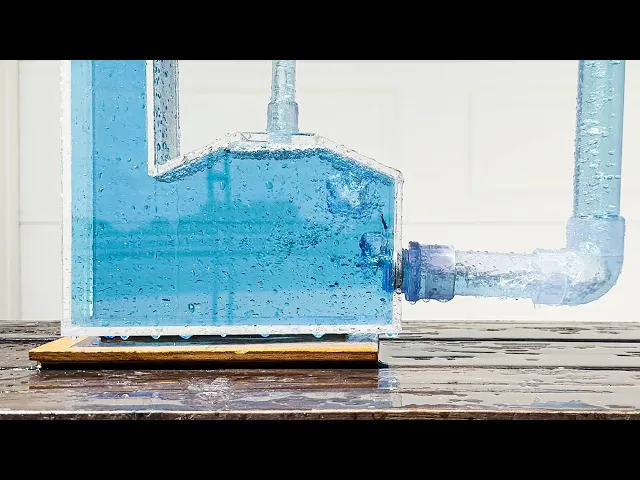
5:19 The goal in this area is to separate all the air from the water.
5:23 You can see the bubble float upward while most of the water continues onward.
5:27 The sloped top helps trap the bubbles,
5:30 so the flow exiting on the right is just water.
5:33 So far, this is basically just a trompe.
5:35 I mentioned I built one of these before
5:37 in my backyard and made a video about it.
5:39 It looks a little different from this one,
5:41 but the concept is basically the same.
5:43 Entrain bubbles of air in a stream of water, carry them downward,
5:47 and then separate them out- now under pressure- so
5:50 the air can be used for things like smelting,
5:52 powering tools, or in my case, blowing some dry grass around.
5:57 It was just a scale demonstration.
5:59 Trompes aren’t used much these days.
6:01 It’s easier to buy a compressor than to build a piece of infrastructure.
6:05 But it’s still a cool idea,
6:08 and their use is being explored to aerate remote pools of mine
6:12 waste to speed up the bacterial reactions that can help clean up contamination.
6:16 There are probably quite a few edge cases where a source
6:20 of pressurized air is more valuable than a source of moving water,
6:24 and a trompe basically lets you make
6:26 that trade with no moving parts or electricity.
6:29 You can see in my model,
6:31 there’s a riser on the right, just like with the trompe demo.
6:34 The purpose of this is to create
6:36 enough pressure to encourage the bubbles upward.
6:38 You can imagine if there was no back pressure on the system
6:41 and I just let the water out at the bottom of the separator,
6:44 eventually it would just fill up with air.
6:47 That’s not what we want.
6:48 So the water has to flow up the riser and then out through this hose,
6:53 keeping the bubbles under pressure so that they’ll flow out of this tube:
6:58 the discharge line for the pump.
6:59 I tried all this in my garage first,
7:02 but kept spraying the ceiling, so I eventually decided to do this outside.
7:06 My discharge line runs up above the inlet tank.
7:09 As bubbles move into the separator, they float upward and out of this pipe.
7:14 But, because the pipe is pretty narrow,
7:17 water gets kind of trapped between the bubbles.
7:20 This is a little finnicky, but basically,
7:22 the buoyancy of the air mixed with the water occasionally creates enough
7:26 lift for the water to make it all the way to the top.
7:29 And now you can see why they call this a pulser pump.
7:32 You don’t get a very continuous flow.
7:34 But look at that!
7:36 The water is actually going a lot higher
7:39 than where it started in the upper tank.
7:45 We are moving water uphill with no moving parts.
7:49 Actually this part of the pump is a pretty ubiquitous design.
7:53 It’s usually called an air lift pump.
7:55 Basically, pump air bubbles to the bottom of a pipe,
7:58 and let them carry water upward.
8:00 These are often used in dirty situations where you don’t want sand,
8:04 grit, or plant matter clogging up the impeller of a more traditional pump.
8:08 They’re not very efficient,
8:09 but useful in certain situations like wastewater plants and dredges.
8:13 And, this is also how coffee percolators work.
8:16 The steam bubbles carry the liquid water to the top
8:19 where they can percolate downward through the grounds.
8:22 I’m recirculating the water in this demo just
8:25 using a bucket and pump below the table,
8:27 and that drives home a couple of key points here.
8:30 For one, all the water running through the pump does not actually get pumped.
8:34 In fact, in my little demo here, I didn’t actually measure it,
8:38 but I’d guess the discharge flow rate is somewhere less
8:40 than five percent of the total flow rate through the pump.
8:44 You need a lot of water to move just a little bit upward.
8:47 So for two, this is not a free energy device
8:50 in the same way a hydropower turbine isn’t producing free energy.
8:54 In a practical sense, the pulser pump is extracting energy
8:58 from the flowing water to push water bubbles downward,
9:02 temporarily storing the energy.
9:04 Then it’s extracted again to push some of that water back up.
9:13 So it really is that simple.
9:15 A pulser pump is basically a combination of two steps:
9:18 a trompe to supply the bubbles,
9:20 and an air lift pump that uses those bubbles to carry water upward.
9:24 But in some ways, it’s not simple at all.
9:28 Two phase flow, where air and water move together, is pretty complex.
9:32 If you thought fluid dynamics was tricky with one fluid, just try using two!
9:37 You can tell just by looking at my demo
9:39 that there’s not a lot of stability here.
9:41 At the down tube, sometimes you get a regular stream of small bubbles,
9:45 and occasionally you get one big one.
9:48 At the discharge, sometimes you get regular pulses;
9:50 sometimes you get big bursts.
9:52 Every step of the process is just so …gurgly.
9:57 There are a lot of knobs to turn here,
9:59 and they all affect the system in different ways.
10:02 Let’s say you have a fixed flow rate,
10:04 and a fixed amount of height between your inlet and outlet.
10:08 You still have to select the diameter of your down pipe,
10:10 which will affect the fluid velocity, and so how much air you can draw in.
10:14 There are probably many different ways to mix
10:16 the water and air that are more or less efficient,
10:19 depending on the configuration.
10:21 And there’s the diameter of the discharge line.
10:23 A bigger pipe can move more water,
10:25 but too big and the bubbles don’t crowd up enough to carry water with them.
10:30 There is quite a bit of engineering guidance out there for air lift pumps,
10:34 since they’re pretty widely used.
10:35 Not so much for trompes, although I did find an interesting paper
10:39 in the Journal of Applied Thermal Engineering.
10:42 The author called them “hydraulic air compressors” and that’s actually one
10:45 of the tricky parts to finding more information on devices like this.
10:50 Since they’re pretty obscure, there’s not much consistency in terminology.
10:54 The most I could find on pulser pumps
10:56 was a few old YouTube videos and college projects.
11:00 And this recent paper on the hydraulic techniques for water supply
11:04 at the Alhambra doesn’t even venture a name for the device used there.
11:08 So this is still kind of just trial-and-error engineering.
11:11 I’m sure I could spend hours
11:13 trying different configurations and improving this demonstration.
11:16 If you’re a grad student looking for a thesis idea,
11:19 I think pulser pumps would make a pretty interesting project,
11:22 because I can see some applications here.
11:24 In fact, I’m not the only one.
11:26 Hydraulic ram pumps are pretty popular around the internet
11:29 and in rural areas that have abundant water but no electricity.
11:33 They were well known by the time Professor Cáceres did his experiment in 1911.
11:38 In his paper, he said about the pulser pump: “This arrangement will always have,
11:43 over the hydraulic ram, the advantage of eliminating valves entirely,
11:48 since it contains no moving solid parts.
11:50 Doing away with the ram strokes seems to remove
11:53 any source of fatigue in the pipes and, of course,
11:56 the very annoying noise that makes the ram inapplicable near living
12:00 quarters.” I can’t help but think back to him in his lab,
12:03 seeing the water spurt out from the top
12:05 of the discharge line for the first time.
12:07 You can tell his excitement in the paper:
12:10 “Beyond its historical appeal, the idea has real value for modern engineering.
12:14 In cases where efficiency is not critical,
12:17 reviving it could solve practical problems,
12:19 using a layout so simple that it is remarkable
12:23 it has not become common knowledge after several centuries.” I
12:27 wonder if he would be a little disappointed
12:29 that the idea never really did catch on, despite its novelty.
12:33 But I still think it’s pretty cool.
12:35 And maybe someone will see my demo working and try it for themselves,
12:39 carrying the ancient idea forward for new applications.
12:42 Thank you for watching, and let me know what you think!