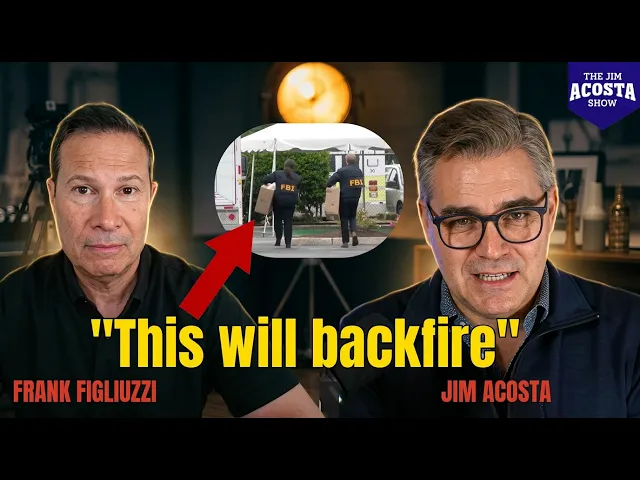
Kash Patel's FBI Just Raided the Woman Who Stopped Trump's Redistricting Scheme — Coincidence?
Jim Acosta
0:00 The FBI raids the home of Louise Lucas, who is a state lawmaker in Virginia.
0:06 Big part of the push behind the redistricting in Virginia.
0:10 And uh I I'm just curious, you know, this is what it says.
0:13 Portsmith, Virginia,
0:14 federal officials are raiding the Portsmith office of Virginia
0:18 Senator Louise Lucas as part of a corruption investigation.
0:22 And it says, "Lucas,
0:23 a Democrat Senate President Prom and the Virginia General Assembly,
0:28 has long been an outspoken critic of Donald Trump and was
0:30 an architect in Virginia's efforts to redraw its congressional districts." Uh,
0:34 that's from a local station in uh Tidewater area of Virginia.
0:37 But Frank, your thoughts on this?
0:39 It's it's like literally what, two weeks after that Virginia election.
0:44 you know, the timing becomes really crucial
0:48 here because not only does it go toward
0:51 whether this is genuinely vengeful um an effort
0:55 to suppress uh look as you just described,
1:00 she Senator Lucas was responsible for the redistricting that now if it
1:06 works would give the Democrats four
1:09 congressional four new congressional seats in Virginia.
1:13 I mean, and just astounding.
1:16 Yeah.
1:16 And you know, is it likely that the Republicans are really upset about that?
1:20 Yes.
1:20 Are they also probably upset that she's very vocal?
1:24 I mean, very vocal when she criticizes Donald Trump and others.
1:30 Um, even dropping the fbomb sometimes on on in her responses.
1:34 But, um, why do I why is it important to focus on timing and optics?
1:39 because it goes toward in my mind it goes toward
1:42 the public's lack increasing lack of cred credibility they place
1:47 in the department of justice and my old agency and even
1:53 if there's a valid corruption case there and let's say
1:58 you know they they executed search warrants I mean this was
2:01 on her business um allegedly corruption allegedly according to sources
2:06 reporting something to do with a cannabis this dispensary she's
2:10 she she runs or is a part owner of or something.
2:13 And yes, as you said earlier, yes,
2:15 it may have started under the Biden administration.
2:18 Although, wouldn't it be interesting to know whether they
2:21 the DOJ under Biden decided it wasn't worth pursuing?
2:25 Okay.
2:25 But the point is, she may have a dead
2:28 body in her business that they searched this morning,
2:32 but they better have something serious on her because the optics are horrible.
2:37 And it's not a oneoff as you've alluded to.
2:39 This just keeps happening.
2:42 And it there's a reason why, Jim,
2:44 that recent reporting indicates that DOJ cannot hire assistant US attorneys.
2:50 They can't find anybody who wants to be what in the recent years has been one
2:55 of the most prestigious positions you can have
2:58 as a prosecutor is an assistant United States attorney.
3:00 They are now offering $25,000 signing bonuses
3:04 and they're taking I was gonna almost said kids.
3:07 They're taking graduates right out of law school.
3:10 That is that's unheard of for US attorneys.
3:14 So where is this going?
3:15 The only you know I I like to think of myself as a student of FBI history.
3:20 This degree of weaponization is unprecedented.
3:22 The only thing that comes to mind is what Jay Edgar Hoover did during
3:27 um the black rights movement against
3:30 the the Black Panthers against Martin Luther King.
3:33 But there's a difference here.
3:34 I I've concluded that largely what Hoover was about in the horrible
3:40 targeting and abuses he was responsible for was about racism.
3:45 And and yes, was there some intelligence that, for example,
3:48 the Soviets back then were somehow trying to manipulate
3:52 um the black movement here, trying to fund it.
3:56 There appears to have been some intel.
3:58 Was there any proof that anyone ever accepted that money,
4:01 particularly Martin Luther King?
4:02 No.
4:03 So, but so that leaves us with racism
4:06 that is different than what we're experiencing right now,
4:09 which is a wholesale wholesale punishment of political enemies of one president.
4:18 Absolutely.
4:18 No question about it.
4:20 And there's there's a litany of headlines.
4:21 There's obviously the Comey case that we all saw last week,
4:25 last week and and much of the country basically
4:28 laughed at uh because I mean nobody in their right
4:31 mind thinks that the way you arrange shells
4:33 on a beach says anything about killing the president.
4:36 But then there's also what's happening with the Atlantic.
4:38 Uh the White House is at war with the Atlantic
4:42 and this is how the Atlantic wrote it today.
4:44 The Trump administration's war against freedom
4:46 of the press has reached a startling new low.
4:48 According to a report this morning from MS Now, the FBI has opened a criminal
4:51 investigation focusing on Atlantic reporter Sarah Fitzpatrick
4:56 related to an article she published last month about FBI director Cash Patel.
5:02 And Patel of course filed that lawsuit, $250 million.
5:06 But I mean, you know, okay, he can file a lawsuit and if it if it pays
5:10 if it pans out that he was being defamed or something,
5:12 he can he can win that case in court.
5:15 Uh the Jeff uh the editor of The Atlantic,
5:18 Jeffrey Goldberg, uh said this quote, "If confirmed to be true,
5:21 this would represent an outrageous attack on the free press." And I mean,
5:26 and the First Amendment itself.
5:27 And Frank, I mean, the thing that is very concerning about
5:30 this is this is targeting the press for doing a story.
5:34 They're investigating a reporter for the Atlantic overdoing a story.
5:37 That's nuts.
5:39 So, I I you I don't know if you know this or not,
5:41 but when I was the head of counter intelligence for the bureau,
5:44 other uh under other assigned duties,
5:47 I also was in charge of leak investigations.
5:50 So, I know a little bit about how this is supposed to work.
5:55 Yeah.
5:54 And this this reporting from MS Now is um troubling.
5:59 And here here's why.
6:00 And and we do have to get the facts here because
6:03 I I know there's been a statement from the White House,
6:05 excuse me, the the FBI's press office saying, "Hey, this is all nonsense.
6:09 There's no such case that's been opened." And there's
6:12 a couple things that could be true at the same time.
6:14 One, but but I let let me cut to the chase.
6:18 No matter what's true here,
6:20 what what is absolutely certain is that a opening a criminal
6:25 investigation on the fact that people are leaking that the head they
6:32 they believe that the head of the FBI is a drunk
6:36 as reported by uh Atlantic magazine that that doesn't jive with reality.
6:44 That that's not a criminal investigation.
6:46 So, right,
6:47 when the FBI opens a leak investigation, it's because, excuse me, someone
6:55 has leaked classified or law enforcement sensitive information.
6:59 That's the crime.
7:00 You have to have a statute to open a crime uh investigation.
7:04 The statute is typically some form or variation
7:08 of the espionage statutes that actually include um lesser,
7:13 you know, amounts of classification, criminal uh criminally sensitive and okay.
7:19 So the I I hate to sound sarcastic or even comic here,
7:23 but what is what is the FBI upset about
7:25 that someone has leaked that Patel has a problem with alcohol?
7:30 I I I allegedly I I don't understand
7:33 the crime that they are intending to prosecute.
7:35 And then the MS now part is not only
7:38 that, but that it somehow is focused on Sarah Fitzpatrick,
7:41 the Atlantic journalist.
7:43 Right.
7:44 So, okay, I can tell you from my experience uh that DOJ
7:49 has had a long-standing policy and it and it sometimes waxes
7:52 and waines that the last thing you want to do is actually
7:57 open a case with a journalist's name in the title of the investigation.
8:03 Okay?
8:04 Because why?
8:04 First amendment protections.
8:07 There are other ways to do these cases and they're done all the time.
8:11 You focus on you don't need to open up on the journalist.
8:16 You need you you do you do look at the journalist's phone activity emails.
8:22 Sometimes you try to develop more more commonly you develop
8:27 suspects within within the intelligence community or whoever leaks what.
8:33 And then you work backwards and see which one of those civilian
8:37 suspects has contact with the journalist that published the information.
8:43 So what MS now is reporting that's really weird is that no,
8:47 they're focused on the journalist.
8:51 Absolutely.
8:50 Yeah.
8:50 And so just trying to help the viewers
8:52 understand is this usually you work backwards.
8:55 You have great respect for for the First Amendment in doing so.
8:59 very rare that you would put the name of a journalist in in a title.
9:02 And I'm not clear to be honest from reading the MS Now reporting whether
9:07 an emphasis on the journalist means that she is in the title of the case.
9:11 I I do not know that.
9:13 But I don't know.
9:14 I can say this for certain, Jim.
9:16 This makes no sense from a criminal standpoint to say, "By God,
9:21 if someone has leaked their perceptions that Patel drinks too much,
9:25 we're going to charge him with a crime." What what crime is that?
9:29 And what is the defense to that crime?
9:31 If you're charged with leaking your perception that he drinks too much,
9:35 your defense would be bring it on and let
9:38 and let's and discovery will be fascinating.
9:41 Please remember to subscribe.
9:43 Um it's so important to support independent journalism.
9:46 It matters.
9:46 It matters when you subscribe.
9:47 It matters when you like.
9:48 It matters when you share.
9:50 It matters.
9:51 Uh and it matters when you watch.
9:53 So, thanks for tuning in.
9:54 Well, no.
9:54 And I was just going to say he's the one who
9:57 posted the the photograph of himself at the Olympics getting getting,
10:02 you know, a little tipsy with the US men's hockey team.
10:05 I don't know how many beers he drank.
10:07 He was he was throwing a lot of alcohol in the air and he was,
10:10 you know, but he was acting like somebody who
10:13 who has had some experience with uh with some drinking, you know what I mean?
10:18 I just, you know, there there are the Atlantic,
10:20 it's interesting, the Atlantic piece um by Sarah Fitzpatrick,
10:25 who I who apparently is a fantastic journalist,
10:29 but um is so much broader than just the drinking allegations.
10:34 It goes toward him uh not being available
10:37 when he's needed right away um for operational purposes.
10:40 There are certain things that the FBI director has to personally
10:42 sign off on, and usually it's an emergency when that's happening.
10:46 Um, that's important.
10:48 Secondly, the allegation that his security
10:50 detail can't rouse him in the morning.
10:53 The allegation, according to her reports,
10:57 that um they requested a breaching tool uh in the event
11:00 they needed to get into his home to to wake him,
11:03 his home or his office to get him out.
11:07 Um those are very serious allegations.
11:09 Those are very serious I mean elements of the story.
11:12 No question about it.
11:13 That's right.
11:13 Incredible.
11:14 So, um, is he likely livid, um, you know, true or not?
11:18 Yeah.
11:19 Uh, sure.
11:20 Is that does it merit a criminal investigation?
11:23 In my in my opinion, it clearly not, but in my opinion,
11:27 this is about there's feriting out leaks in the house.
11:32 It's coming from inside the house, right?
11:34 It's coming from inside the Hoover building.
11:36 He's going after those people.
11:37 He wants to go after them.
11:39 Yep.
11:39 Yep.
11:39 and he's seeing if he can apply enough pressure on the reporter
11:43 to see if the reporter or the magazine will give up the sources,
11:46 which I mean any anybody that knows anything about
11:48 the Atlantic and the fine reporters and journalists that they have,
11:51 they're just not going to do that.
11:52 That's not going to happen, right?
11:53 And and as I mentioned, the typical way you do it if you care about
11:56 the First Amendment is you work backwards from your suspects, right?
12:00 So let's say let's say for example the suspects
12:03 for the leak would be sure anyone who has access to his office or and it's only
12:08 a handful of people and andor his security detail.
12:11 Let let's say that for the sake of argument.
12:13 You then take those people you get their phone
12:16 records legally hopefully and there and and and you know
12:19 whatever text and and email and you work backwards
12:21 to see if any of them had contact with the journalist.
12:24 Yeah.
12:25 what they what they what what is implied
12:28 in MS Now's reporting is they're doing the reverse.
12:32 They're doing the reverse and that's bad news.
12:34 They're they're trying to go from the journalist to to suspects and again
12:41 Well, but Frank, I was going to ask you because a subscriber just asked this.
12:44 Do we expect this current FBI to be
12:46 responsible in in going after people's texts and emails?
12:50 Can you speak from your experience, Frank,
12:52 as a senior official at the FBI that that the that the officials,
12:55 the top officials there,
12:57 people who are capable of conducting this kind of investigation,
13:00 have access to the kinds of equipment and uh investigative methods and so
13:06 on to be able to to do this in an unethical way?
13:09 I mean, it seems to me that they if they
13:12 if they wanted to do this in an unethical way,
13:14 they got all the tools, they got the equipment to do it.
13:17 Not all.
13:17 Yes, they of course they do.
13:20 Um they also have because it involves a journalist.
13:25 All of this all of these techniques would have to go
13:27 for approval across the street to the Department of Justice.
13:31 Th those are the rules.
13:32 As far as I know, those rules haven't changed.
13:34 The problem is who's in charge of the Department of Justice?
13:38 Someone who is auditioning to be the attorney general, Todd Blanch.
13:42 So am I, you know, someone who
13:44 with regard to the Jim Comey investigation, you know,
13:47 has decided that photographing an arrangement of shells
13:50 is now a threat to kill the president.
13:52 So if he's auditioning for the job, he's not going to say, "Hey, wait a minute.
13:56 We got a First Amendment problem with the free
13:58 press here." He's not going to say that.
14:00 And then the only imagine this the only way
14:02 this stops is um as people are expressing to MS
14:06 now apparently hey we're do we're being asked to do
14:10 something with a journalist that we think is inappropriate.
14:12 The other stop here could the guardrail sadly bad to rely on this is
14:17 the Silicon Valley platforms that they'll be hitting
14:19 with with subpoenas um West for records because
14:24 frequently those platforms have said no when their council looks
14:29 at it and goes asking for a reporter's phone record.
14:33 A lot of these tech companies have been bending the knee to Donald Trump.
14:36 They've been lining up to kiss his ass.
14:38 Exactly.
14:38 And so that's also that's not that's not a good sign either.
14:43 Uh Frank, no.
14:44 When you have uh you you know Bezos and Zuckerberg and others who
14:49 are contributing to the the money for the uh the stupid uh ballroom,
14:55 the inauguration parties.
14:57 Yeah, we got a problem here.
14:59 And Frank, finally, Barack Obama, former president,
15:02 sat down with Steven Coar and was asked about
15:05 this very issue of weaponization of the Justice Department.
15:08 And he said something that is very in line
15:10 with what I've been hopping up and down
15:11 and saying is that is we need new laws in this country to cut this out.
15:15 And I think we if we have the Obama clip, let's play it because
15:19 the White House shouldn't be able to direct the attorney general
15:23 to go around prosecuting whoever uh the president wants to prosecute, right?
15:27 Because technically it's under the executive branch.
15:30 The norm is that it's independent.
15:32 The norm the the idea is that the attorney general is the people's lawyer.
15:36 It's not the president's concigary, right?
15:39 Even when it's Bobby Kennedy.
15:42 It's Bobby Kennedy.
15:44 And so u the two of the core principles of a democracy we we can survive a lot.
15:53 Bad policy, funky elections.
15:56 There there's a bunch of stuff that, you know, we we can overcome.
16:01 We can't overcome the politization of the criminal justice system.
16:06 The the the awesome power of the state.
16:08 You you can't have a situation in which uh whoever is in charge
16:12 of the government starts using that to go after their political enemy.
16:18 Yeah.
16:18 I mean, and folks are applauding because they played
16:20 this on the late show um with Steven Cobar,
16:23 who of we should note is being forced out by the Trump administration.
16:26 So, and there is that.
16:28 But I mean, former president's right, Frank.
16:31 Yeah.
16:31 I I think we've all been operating for for 10 years now, you know,
16:36 since since Trump first came into being here in on the national
16:40 scene with the on the assumption that the founding fathers got it right.
16:45 The Constitution will be honored.
16:47 We'll have we'll have a president and senior leaders who will do
16:50 their best good faith effort to comply with the law and the constitutions.
16:55 But now we've identified pages of gaps.
16:58 There are gaps that that that now we know exist that need to be filled.
17:03 And as the president said, one of those is, yeah,
17:06 we need to codify that there shall be no contact between the Oval
17:10 Office and the attorney general of the United States in any way,
17:13 shape, or form that directs or shapes an investigation.
17:17 Number two, how about this?
17:18 How about not having an attorney general who says on in testimony on the Hill,
17:23 he still considers himself a personal attorney for the president?
17:26 How about that?
17:27 So, so yeah, I've got a long list of gaps that need to get filled.
17:32 No question.
17:33 Uh Frank, always great to have you on, man.
17:35 Really appreciate it and thanks for uh
17:37 answering the the late in the afternoon call.
17:39 But when I saw all of these stories building up,
17:40 I just thought, you know, we got to get in touch with Frank.
17:42 So, thank you as always, Frank.
17:44 Glad glad I could do it.
17:45 Thank you.
17:45 Good to see you.
17:46 Thanks a lot.