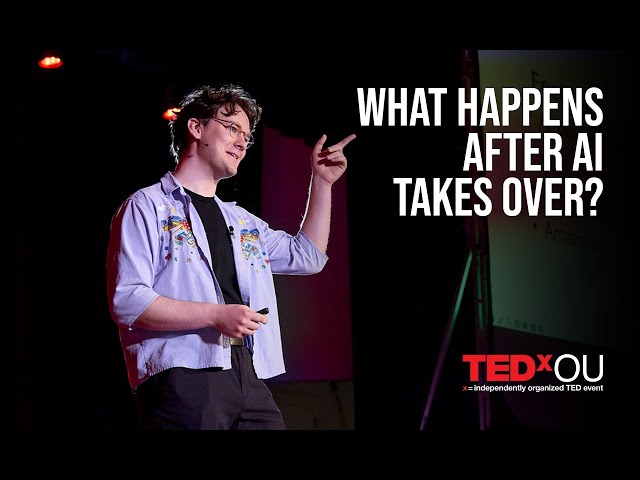
Our next 20 years: AI, capitalism, and fractal minds | Judah Anttila | TEDxOU
TEDx Talks
0:00 Transcriber: Elif Naz Şık Reviewer: Zeynep Kalkan All right guys,
0:05 I have some crazy ideas and it’s hard to predict the future
0:08 but it looks like we may need new economic ideas as soon as 2030.
0:13 Infinite life may be possible by 2040,
0:15 and some humans may become patterns by 2050.
0:19 Now, this level of disruption might sound crazy, but along the way,
0:22 we'll talk about the almost unstoppable growth
0:25 of technology and the feelings of anxiety,
0:27 anger, uncertainty, and amazement we may feel,
0:30 as well as the creation of new jobs,
0:32 a new philosophy, a new language, and a new academic discipline.
0:35 So where are these predictions coming from?
0:38 There's from a lot of people,
0:39 but if you could only focus on one, it would be Ray Kurzweil.
0:42 He has 21 honorary doctorates and is the director of engineering at Google.
0:46 And over the past 30 years,
0:48 he’s given more than 147 predictions with depending on how you want to score it,
0:52 about an 80% accuracy rate.
0:53 He correctly predicted the explosive growth of the internet
0:56 and the rise of ChatGPT and the iPhone in 1999.
1:02 Now, he didn’t call them the iPhone or ChatGPT in 1999,
1:04 but he said what they would do when It would happen, and then it happened.
1:09 So how did he do this?
1:10 Well, he looked at how strong the top computers were over time.
1:14 And what he found was that computation is exponential.
1:17 The number of calculations per second, per constant dollar doubles every year.
1:21 And so to make its predictions, he takes the capacity,
1:24 then translate that to the number of calculations per second per dollar,
1:27 and then translate that over onto the graph and then down
1:30 onto the x axis to find about when it would happen.
1:33 And the key realization here is this.
1:35 Our minds think linearly, but technology grows doubling.
1:39 If you take 20 steps linearly, you get to 20.
1:41 But if you take 20 steps doubling,
1:43 you get to two to the 20, which is over a million.
1:47 And so to make this more concrete, more felt,
1:50 40 years ago, one terabyte cost $4 million.
1:53 Now we can all go to Walmart after this, and buy one for like 40, right?
1:57 And it went from an entire room to inside your pocket in the process.
2:00 And so we've already had a million fold increase in computation.
2:05 We're just going to have another million fold increase in computation.
2:08 And so this curve probably isn't going to level
2:11 off anytime soon because even before Moore’s Law and transistors,
2:14 it was a series of s-curves.
2:16 Once one paradigm would stop, another paradigm would start.
2:20 And so that's why people like Ray Kurzweil can say things like,
2:23 the next 20 years will have more change than the last 200.
2:28 But honestly you know, who really knows?
2:30 But for fun, let’s try and see if we can
2:32 extend these technological predictions into predictions
2:34 about the economy and culture.
2:36 If for no other reason than it's interesting.
2:39 So let us go then, you and I,
2:41 to a new economic paradigm, starting with the great decoupling.
2:45 This is when private industry rents
2:47 AI agents instead of hiring knowledge workers.
2:49 And when capital stops investing in labor.
2:52 the value of human labor starts to erode
2:54 along with the role of college academia.
2:56 The Federal Reserve and the social contract.
2:59 Current predictions are that by the end of 2030,
3:02 it will cost less than $10,000 to replace one knowledge worker.
3:05 So now our goal is to get our boss to like us.
3:09 So I used to be somewhat cynical about how sometimes it seems like for everyone,
3:13 problem technology solves.
3:15 Sometimes it makes two more.
3:16 But that could be a source of a weird
3:18 sense of hope because we’ll have jobs we can’t
3:20 even think of in the future because we'll have
3:22 problems we can't even think of in the future.
3:25 And so an example would be human sustainability.
3:29 We used to extract land.
3:30 Now, in a way, we kind of extract human attention and emotions.
3:34 And oil rig extracts oil, a coal mine extracts coal.
3:37 And social media does a lot of things.
3:38 But one of the things it does is extract human attention and emotions.
3:42 Data is the new oil, as they say, and since manufacturing left,
3:47 we have nothing left to subject to technology except us.
3:51 And so we'll have a whole new class of human sustainability jobs,
3:55 which cover how much to politically polarized
3:57 the public to boost engagement and thereby company profits,
4:00 and how much to intercede and extract between people with like,
4:03 dating apps and all this stuff.
4:05 To prop up the economy as well as maybe if for some
4:08 things we should get a vote on the direction of technology.
4:11 But overall, since health is the amount of value you provide yourself,
4:14 relationships is the amount of value you provide to people you know.
4:17 And money is a strange perception of how much power you provide.
4:21 Then so long as we have problems and strangers
4:23 we can provide value to, then we'll have jobs.
4:25 But if we have too many problems, then we may enter a dystopia.
4:29 Now, assuming that AI really won’t want to take over the human world
4:33 in the same way that humans really don’t want to take over like the ant world.
4:37 You can try if you want.
4:39 Um, then we may, um, and also if AI...
4:43 Oh, if we don't get world peace through some sort of technological
4:46 world sedation then if we do align AI with human values,
4:50 then to prevent maybe an AI takeover or something like that, and maybe
4:54 become a national emergency to bring beauty back into our creations,
4:58 because we'll kill everything but butterflies and ladybugs.
5:01 And personally, I think we could do
5:03 better than having Walmarts as our town squares.
5:05 Thank you for coming to my Ted talk.
5:07 Actually, I’m going to keep going.
5:09 Universal basic income will probably come technologically.
5:12 Kurzweil says around 2035.
5:14 But politically, we'll see what happens with universal
5:17 high income maybe as soon as 2045, which sounds good to me.
5:21 But my only slight worry would be like, if AI really does make us useless,
5:25 then our access energies may have nowhere else to go but back onto ourselves.
5:30 And so we may choose to inflict pain on ourselves
5:32 because otherwise it might feel harder to feel human.
5:36 Um, but we may shift from a more restricted economy like we have
5:39 now of allocation of scarce resources
5:41 to a more general economy of extravagant waste, of abundant resources.
5:47 Now, if AI really does start to take our jobs,
5:50 then people may say, “Well, money can’t buy happiness.” but if we’re all broke,
5:55 we can’t buy anything.” So but if we do get to universal high income,
6:01 then by prioritizing inspiration and beauty.
6:03 Pointless extravagance can help save us from pointless pain.
6:08 Now, some people say the only way to stay relevant in a future
6:11 AI economy would be by merging with technology, which could be.
6:15 But my only worry would be forced merging,
6:18 which is when you have no choice but to merge because society potentially had.
6:22 Poor planning becomes too inhospitable for humans to survive without merging.
6:27 Next up, we have infinite life.
6:29 Infinite life will be possible, Kurzweil says,
6:32 for the rich by around 2032 and democratized around 2040.
6:36 And right now, the advice from the rich is
6:38 not to be poor and die in those eight years.
6:41 But since women live longer than men,
6:43 some of you guys might want to get Sugar mommy.
6:49 So let's make this more concrete.
6:50 So 100 years ago, in the 1920s, the average lifespan was in the 50s.
6:55 Now it's in the 80s.
6:56 So 100 chronological years have passed and we've gained 30 biological years.
7:01 You can also look like look at somebody like Brian Johnson,
7:04 who claims to have reduced his biological age by ten years.
7:07 And for every one chronological year that passes, he only biologically ages 0.7.
7:11 Now, by the time we have people claiming that they’re going to live forever.
7:15 We’ll also have AI agents claiming
7:17 that they’re conscious and they'll have money, so we can't ignore them.
7:21 Uh, so this could this will kind of break science, right?
7:24 Because it's really difficult to measure consciousness.
7:28 Um, but that could be maybe because our current philosophy
7:31 that grounds and is underneath science is maybe more restrictive than reality
7:35 actually is because currently we say that from the atoms
7:38 in our brain emerge the emergent
7:40 properties of like intelligence or consciousness.
7:43 But it could be that maybe consciousness already exists and you build a home
7:47 for it to ingress into out of atoms or patterns or who knows what, right?
7:52 And so we may be in for a Copernican style perspective shift where we realize,
7:56 Hmm, maybe consciousness doesn’t emerge.
7:58 It ingresses, or maybe only some things ingress.
8:01 Or maybe there's no line at all between emergence and regression doesn't exist.
8:04 Hard to say, but I'll be going over how to make a new academic
8:08 discipline to help test this a little bit more rigorously to see what happens.
8:11 But for now, since regression is interesting and it's useful,
8:14 let's just say it's true for this talk.
8:17 This will help us better understand the singularity.
8:19 The singularity is a term by Ray Kurzweil,
8:21 which is when $1,000 buys a computer a million
8:24 times more computationally powerful than the human brain.
8:28 Now, if the trend keeps going, this will happen around 2045.
8:31 And for us, this will probably feel like whenever
8:34 fish first wondered if we could walk on land.
8:37 Except this time we’ll wonder can we liberate our minds
8:40 from the chrysalis of matter to not just house patterns, but become them?
8:45 And I'll also say that our current, our current language spoken at least,
8:50 only includes one sense, which is sound mainly.
8:53 But we may get a new language,
8:54 a full language that includes all of our senses, Right?
8:57 With brain computer interfaces, so that you’ll be able to actually see
9:00 what I mean as we speak things into being.
9:02 And so to prepare for, if we get that new language,
9:06 we’ll need a new art movement to help
9:08 explore that, get us comfortable with that.
9:10 And so I’ll call it “New Impressionism”.
9:12 And so the idea here is to pick up where the Impressionists left off,
9:15 because the Impressionists only pass the world's image through
9:18 their senses onto a painting to show their sensations.
9:21 But we may extend this so that instead of just image sense, impression,
9:26 it will be any medium through any medium or any medium,
9:28 through any prism to any other medium.
9:30 And the hope here is that multimodal impressionism will do for art,
9:34 what Newton’s prism did for science.
9:36 That's pretty abstract.
9:38 So let’s make this more concrete.
9:39 How would you actually start doing this?
9:41 So could we create a flower bed,
9:43 with flower spacing that is the same as rhythm in a poem?
9:46 Or could we create a box with the same
9:50 side ratios as chord sound frequency ratios?
9:53 Or could we create like a seven faced prism whose
9:56 face ratios are the same as the rainbow's wavelength ratios?
9:59 And then maybe with that seven face prism,
10:02 could we convert that back into a chord, right?
10:04 So what would it be like to.
10:05 Kind of like rhyme on a chord.
10:07 To have like a box that kind of represents that or like a...
10:10 like a seven faced prism that represents that with the rainbows,
10:13 you know, might be some sort of divine object.
10:15 Let's pass some light through that, see what happens.
10:17 Um, so to prepare for maybe if we not just listen to music,
10:21 but maybe we live in music, could we create some sort of like music
10:26 videos or silent music videos using everyday sounds,
10:29 scenes and surfaces so that when we see them and stop
10:31 the timing of things in the world takes on a musical quality,
10:35 sort of like if you have a constellation, it's actually made almost completely,
10:40 if you look at it by the lines
10:42 between the stars rather than the stars themselves.
10:44 So could we create some sort of art that like,
10:47 Let the silences, like, say something?
10:49 It’s an interesting idea,
10:50 but the idea here is we don’t have the full language yet,
10:53 but if we could learn to rhyme with it,
10:55 we’ll be much more prepared for when it arrives.
10:58 And when it does arrive, then we'll be able to make music you can taste.
11:03 Sail across musical fractals.
11:05 Create paintings you can walk inside of and then wear your mind like clothes.
11:10 Like an octopus.
11:11 And so if we do liberate our minds from matter,
11:14 then instead of just doing art like we're doing now,
11:17 we might be able to become art.
11:20 And in art, people talk a lot about freedom of speech, right?
11:23 But the thing with fashion, unless you're sewing your own clothes,
11:26 is that you're only allowed to express
11:28 yourself in the language allowed by companies.
11:31 But if we have the breakdown
11:32 of capitalism coupled with freeing mind from matter,
11:35 then that will permit the universe to more
11:37 freely and joyfully express itself to itself.
11:40 And once we do this, then we may realize that all divinely inspired music,
11:46 dance, art, body painting, poetry, etc.
11:47 was us wanting to speak the truth but because of our limited language,
11:51 only being able to rhyme with it.
11:54 And if we do free mind over matter,
11:56 then we May 1st say on the topic of aliens and alien intelligence.
12:00 I’m nobody!
12:01 Who are you?
12:02 Are you Nobody, too?
12:04 Then there’s a pair of us!
12:06 And then we may say this world is not.
12:08 Conclusion: a species stands beyond invisible as music but positive as sound.
12:14 And so we’ll realize that we only ever
12:16 saw a very narrow range of light wavelengths.
12:19 And we only ever heard a very narrow range of sound frequencies.
12:23 And we only ever recognized a very narrow range of kinds of minds.
12:27 And so we may extend our search for intelligent
12:29 life beyond beings of matter and into beings of pattern.
12:33 And we may realize that our first contact
12:35 with intelligent life isn't some time off in the future,
12:38 but was actually in the past with math because it was intelligent,
12:41 because it had the capacity to solve problems,
12:43 and it had some sort of consciousness because it was a self-referential system,
12:47 but it had no agency because it had no instantiation.
12:51 So if we do create, invent or discover whatever an agentic superintelligence,
12:56 then I think what it will reveal could
12:58 be much more interesting than what it creates,
13:00 which could be that the universe organizes itself into fractal like structures.
13:04 sort of like how the shadow of a body is it’s shadow,
13:08 or the shadow of a mind is the thing it creates.
13:10 Or if you look at a sand dune,
13:12 it almost looks like a lower dimensional form of the wind, an impression.
13:16 And so if that is the case that the universe organizes itself in that way,
13:21 then maybe we shouldn't fear death any more than we
13:24 should fear walking underneath a bridge on a sunny day.
13:26 And then our shadow disappears.
13:28 Or maybe we shouldn't fear loss because nothing
13:30 in this world was ours to begin with.
13:32 And if the singularity does happen, which I kind of hope it doesn't,
13:35 because that’s like a lot of change.
13:37 But if it does happen, then maybe we shouldn't fear that anymore.
13:40 Then whenever the sun sets and then all of our shadows fade to infinity.
13:44 Okay, guys, this has been pretty abstract.
13:46 How can we make this scientific right?
13:48 How can we make this falsifiable?
13:50 It's not scientific unless it's falsifiable.
13:52 So here are some things to help falsify this.
13:54 The main one is the computation power.
13:56 If the chart line deviates down from that exponential,
13:59 then that falsifies a lot of this other stuff.
14:01 You can still have the new art movement.
14:03 You can still have the new philosophy rolling fine,
14:06 but a lot of the other stuff kind of.
14:08 Next up, the great decoupling.
14:09 If the number of useful AI agents in private industry decrease,
14:13 that could help do that if the longest lifespans decrease,
14:16 that could also help if the introduction of brain
14:20 computer interfaces do not enable new forms of communication,
14:23 then the new art movement kind of will.
14:26 And then finally, for consciousness,
14:28 if the number of AI’s claiming consciousness decrease,
14:31 that could also help do it.
14:32 And to help further falsify the fifth,
14:36 we could create a new academic discipline to help investigate Ingression:
14:40 See if it exists or not.
14:42 So with that, this is where you
14:43 create patterns out of many different substrates, many different things.
14:47 So it could be like anything you wanted, but it could be like plant networks,
14:51 cellular automata, software algorithms, etc.
14:53 anything that gets you like a nice like pattern kind of base to work with.
14:57 And then you look at the patterns themselves,
14:59 not the stuff it's made out of, but the patterns
15:02 themselves for evidence of behaviorist evidence of learning,
15:04 planning, or delayed gratification.
15:06 And if you don't find any pattern behavior,
15:08 then it probably is just emergence rather than ingression.
15:11 So I'm up for anything.
15:13 If nothing changes, that's fine.
15:15 And if everything changes, that's fine too.
15:17 And just because somebody from the 80s who has
15:20 a lot of PhDs said some things doesn't mean they're true.
15:24 It's like that Abraham Lincoln quote.
15:26 Don't believe everything you read online.
15:30 So overall, I've covered the great decoupling,
15:33 infinite life and the singularity and some personal
15:35 speculation and starter ideas for a new art movement,
15:38 a new philosophy, a new academic discipline,
15:40 and maybe some new jobs and maybe a new language.
15:43 But overall, I think the most important part is what you think.
15:46 Because it seems like everywhere we look,
15:49 the old world is ending and we'll need new ideas,
15:52 new inspiration, and new creativity to create the new from the ashes of the old.
15:56 Thank you.
16:00 Thank you.