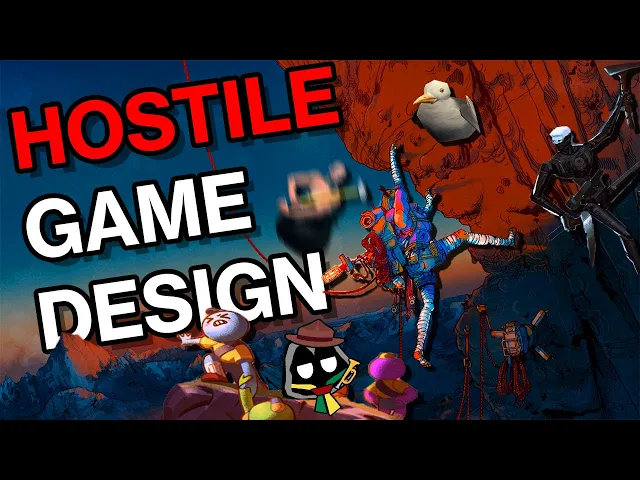
Climbing Games Are Fun Because They're Not Fun
Adam Millard - The Architect of Games
0:00 All right, so I can't be the only one that's noticed this, but why
0:04 the hell are there so many games coming
0:06 out right now that are all about climbing?
0:09 Seriously, it seems like out of absolutely nowhere,
0:12 this whole new genre of games has
0:14 suddenly appeared that every indie developer out
0:16 there who's not making a bilateral knockoff seems to be trying their hand at.
0:19 And with one or two exceptions, up until like 5 years ago,
0:23 this kind of game may as well not have existed.
0:26 But now they're everywhere.
0:28 Just off the top of my head, we've got Peaks of Y, Jant,
0:31 a difficult game about climbing, Valley Peaks,
0:34 Only Up, Chained Together, Bet and Brutal,
0:36 Lawn's Lure, the upcoming and already excellent Ken,
0:40 Baby Steps, and White Knuckle,
0:41 as well as the recent mega hit that inspired this whole video, Peak.
0:45 There is an absolute avalanche of games in this very specific
0:48 micro genre with more on the way every time you look.
0:51 And while I'm hardly the only person to have pointed this out,
0:53 and while not all of these games are actually, you know,
0:57 good, the question remains of why is this happening now?
1:01 Because let's be real here,
1:02 it's not like Climbing is some sort of recent fad in the real world,
1:05 like the way everyone tricked themselves into thinking chess was
1:07 cool for exactly 8 months after The Queen's Gambit came out.
1:10 And it's not as if games have undergone some sort of major technological
1:13 or control systems leap that suddenly
1:14 made developing these kinds of games possible.
1:17 And yet, that's not stopped a genre so recent
1:20 that it doesn't even have its own theme tag
1:21 from exploding in popularity to the point that some
1:23 of its entries are the most successful games of the year.
1:26 So, that begs the question,
1:29 where did this recent wave of climbing themed games come from?
1:32 And why do I think it's important enough to be worth making a whole video about?
1:36 Well, it's because I think Peak, Getting Over It,
1:39 and all those other games are secretly part of a growing
1:41 trend in video games that's only getting more popular.
1:44 one that operates entirely at odds to conventional
1:47 design wisdom and offers us a unique
1:49 kind of experience that until now most developers have been unable to give us.
1:54 What is that, I hear you ask?
1:56 Well, I suppose the simplest way to put
1:58 it is that climbing titles and other games like
2:00 them are distinguished by the fact that they aren't
2:02 afraid to offer us a little taste of hostility.
2:07 See, the thing that characterizes this recent trend of climbing
2:09 games more so than anything else isn't just that they're difficult.
2:12 These titles are without exception mechanically demanding, very tense,
2:17 and if you screw up a single jump or misjudge your stamina for a second,
2:20 incredibly punishing.
2:22 Playing almost any one of these games,
2:24 from the hellish chained together to the horror themed white knuckle,
2:27 is downright exhausting.
2:28 With every meter you climb, the consequences for failure only get larger,
2:31 and your brain only gets more and more fatigued,
2:33 having to deal with both the pressure of not
2:35 messing up the handhold in front of you,
2:36 but also the precise route planning required to get
2:38 to the next even more unforgiving leg of the climb.
2:41 These games are hard work to play, and frankly,
2:44 they're not even that enjoyable while you're playing them either.
2:47 The momentto moment experience of playing one of these climbing
2:49 themed titles is dominated by negative emotional stimuli.
2:52 There's none of the exhilaration you get from an action
2:55 game or the eureka moments of a puzzler.
2:57 The only constant in a climbing game is
2:59 that your mind is being put under strain, and often your body is too,
3:02 because god damn do these games love deliberately fiddly
3:05 control schemes that make your hands ache after a while,
3:07 which only reinforces their inherently stressful nature.
3:10 And the really interesting thing about this recent run
3:13 of climbing themed games is that their punitive, tiring, and well,
3:17 hostile design stands in stark contrast to how climbing has
3:21 been portrayed in mainstream games for the past few decades.
3:24 If you look at stuff like Assassin's Creed, Uncharted, Dying Light,
3:27 or really any big AAA game with climbing in it,
3:30 you'll find that it's designed to be so
3:31 buttery smooth and so forgiving that it's practically automatic.
3:34 And it's designed at every turn, not to frustrate or exhaust you,
3:37 but to give you a feeling of nice,
3:39 simple empowerment, or to just nominally occupy
3:41 your brain while some terrain loads in the background.
3:44 Everywhere you look, there are nice,
3:45 clearly signposted handholds that Nathan Drake kindly
3:48 does all the work of navigating for you.
3:49 And if you just so happen to mess up one
3:51 of the few incredibly generous failure states, then don't worry,
3:54 you'll get put right back where you started
3:56 instead of at the bottom of a mountain
3:58 with nothing to show for your efforts except a wasted hour and tired hands.
4:02 However, as you might have guessed,
4:04 it is the very fact that the gameplay in this new
4:06 wave of hostile indie climbing games is in equal parts frustrating,
4:10 mentally taxing, and at times downright unfair that is key to its success.
4:14 And by positioning itself as a polar opposite experience to the shallow,
4:17 empty spectacle of mainstream climbing,
4:19 these new hostile games stand to offer us a much deeper,
4:22 more satisfying experience, albeit one that we have to work much harder for.
4:26 As anyone who's climbed to the peak in peak
4:28 or tried their hand at getting over it can attest,
4:31 these climbing century games remain incredibly
4:33 compelling and weirdly addictive in spite
4:36 of the fact that they are frequently not that fun to actually play.
4:39 I've lost count of the number of times I've just barely misjudged
4:42 a jump in white knuckle and ended up hurling away an entire
4:44 run leading to me rage quitting the game only to find myself
4:47 guilty booting it back up half an hour later for another go.
4:50 And just as frequently,
4:52 me and my friends have spent the better part of 2 hours yelling at each
4:55 other and stressing out about our dwindling
4:57 resources and the terrain generation in Peak,
4:59 only to find ourselves fondly reminiscing
5:01 about those very same grueling exercises
5:03 of masochism a few days later as we prep for another run.
5:07 Basically, what I'm talking about is
5:09 that climbing games and other similarly hostile
5:11 titles draw their appeal from a fundamentally
5:14 different place than many other games.
5:16 namely the cathalis that comes from that brilliant release of stress
5:19 and pressure that can only arise after a stretch of exhausting stressful effort.
5:23 And this puts them completely aligned
5:25 with more mainstream design principles that are
5:27 all about hammering your brain's reward mechanisms
5:29 as hard and as fast as possible.
5:31 Games with hostile design are unique in the fact that they're
5:33 actually kind of miserable and stressful while you're playing them.
5:36 Almost as if the designers hate you
5:37 and are deliberately wishing a bad time upon you.
5:40 But once the struggle is over and you're able to look
5:42 back on that hostile experience with a bit of distance,
5:44 all the suffering you went through suddenly transforms
5:47 into a compelling and emotionally involved story about triumphing over hardship,
5:50 just one you were unable to appreciate while it was actually happening.
5:54 And this is what makes hostile games
5:55 of varying kinds from survival titles to souls likes
5:58 to climbing games feel deeply satisfying over the long
6:01 term rather than just being a quick thrill.
6:04 The fundamental appeal of hostile games has also been described
6:07 as type two fun in certain corners of the internet
6:10 and is a term you may recognize if you
6:11 are sufficiently poisoned by social media like I am.
6:14 And it's a pretty apt turn of phrase because
6:16 the distinction between exhausting but satisfying catharsis and traditional,
6:19 more immediately enjoyable type 1 fun was originally coined
6:23 by a professional climber to describe the fun of real life climbing.
6:26 And I think the fact that games are starting
6:28 to experiment with new kinds of relationships with us players,
6:31 especially ones that don't rely on a transactional exchange of dopamine,
6:34 is a really exciting step in their development,
6:36 particularly when you consider that many of these hostile
6:38 games would have been a completely impossible cell.
6:41 Both the publishers and the gaming public at large as recently as a decade ago.
6:45 If you don't believe me about how
6:46 quickly attitudes to hostile games are changing,
6:48 look at how much people, myself included,
6:50 hated and didn't get Death Stranding when it came out.
6:53 and now it's a rightly beloved classic
6:55 with the sequel being received to universal acclaim.
6:58 However, even though we can confidently say that hostile games
7:01 are on the rise and compare them to more traditional titles,
7:04 the question remains of how these kinds
7:06 of cathartic type 2 fun games actually work.
7:10 What is it that transforms struggle
7:12 and effort into a sense of deep satisfaction?
7:14 And what separates a good,
7:16 deliberately designed cathartic experience that artfully uses negative
7:19 emotional stimuli to torture and stress you out towards
7:22 a greater aim from a title that is
7:24 just straight up not fun because it's badly designed.
7:27 These new kinds of games work so differently
7:29 from typical mainstream design that it can be
7:32 ironically kind of a challenge to articulate their appeal
7:35 and understand why we end up enjoying them.
7:37 So, in an attempt to get the ball rolling, to my mind,
7:40 it all comes down to carefully balancing
7:42 the buildup of pressure and stress with the eventual
7:45 satisfying release that catalyzes all those negative
7:48 feelings into a sense of long-term satisfaction.
7:51 And while that might sound simple, maintaining that sense of tension,
7:54 not to mention paying it off in a satisfying manner,
7:56 is much harder to do and requires way
7:59 more clever tricks than you may have initially anticipated.
8:02 Let's start by looking at the idea that hostile cathartic games
8:06 can only work if you actually get to the catharsis part.
8:10 The feeling you get of reaching the peak of a huge mountain
8:13 after going through all the trials and tribulations along the way is great.
8:16 But if you hit a roadblock or die halfway up and decide to just bail completely,
8:20 then you get an incomplete unsatisfying experience
8:23 because all those negative emotions were never resolved.
8:26 And so a huge part of the design of cathartic
8:28 games lies in maintaining a sense of heightened tension.
8:31 the biggest possible payoff, but not piling on so much that it snaps
8:34 and we never reach the resolution we're looking for.
8:37 You see how difficult this is to pull off all the time in rogue likes.
8:40 The whole appeal of this genre comes from being hurled into a random setup
8:43 with a high level of difficulty and being
8:45 tasked with making the most of limited resources,
8:47 often against some sort of time limit with the promiso that if you fail,
8:50 it's all getting taken away.
8:52 As you can imagine, this is a recipe for some great stress and tension
8:56 that requires you to struggle against the game
8:57 systems just as much as the enemies.
8:59 that all gets finally resolved once you reach the end after god knows
9:02 how many attempts and you get to breathe a sigh of well-earned relief.
9:05 However, many rogue likes, particularly ones of the old school persuasion,
9:09 are so punishing and take so long to reach any kind
9:12 of resolution that it doesn't matter how deliciously difficult they might be.
9:16 Most players emotionally check out long
9:18 before they've even understood these games,
9:19 meaning that they only get half an experience and it's not the fun half.
9:23 Conversely, many modern rogue likes that are too forgiving and dampen
9:27 the threat of failure by guaranteeing you'll get a consolation prize
9:30 in the form of meta progression resources often fail to generate
9:33 enough tension for getting to the end to be truly satisfying.
9:36 The trick lies in striking a balance
9:39 in making setbacks feel appropriately dangerous and threatening,
9:42 but always keeping the destination in reach.
9:44 The battle of attrition in games like Into the Breach
9:46 or Pacific Drive where setbacks and difficult choices are happening constantly,
9:50 but no single one is going to completely wipe you out,
9:53 for example, are great at keeping the pressure up and maintaining
9:55 that allimportant feeling that you're struggling
9:57 against the game without being unnecessarily punitive.
10:00 And Spelunky, king of the modern rogike for a reason,
10:03 instead gives the player multiple chances to resolve
10:05 their tension based on their skill level.
10:07 For a new player, the struggle to just get to the end of the first
10:10 zone and get past this bastard is a heroic struggle all of its own.
10:13 while more experienced players can concern themselves with getting all the way
10:16 to the bottom and enjoy a commensurately
10:18 larger payoff that doesn't exclude newer players.
10:20 It's just something bigger to shoot
10:21 for once you're more comfortable with the game.
10:23 The key thing to remember is that the arc of struggle to eventual
10:26 payoff happens entirely in the player's mind
10:28 and is subject entirely to our perception.
10:31 How challenging a game actually is is
10:33 much less important than how hostile it feels.
10:36 Just look at for example,
10:38 a climbing game that I quite enjoyed on its own merits,
10:40 but definitely fails in the hostility department.
10:42 And it's for one simple reason.
10:44 It doesn't matter how grueling his climbs may be
10:46 or how many cool leaps of faith you've got to make.
10:49 When you've got this big blue omnipresent safety line subconsciously reminding
10:53 you that there's no penalty for failure and that you're always safe,
10:55 it robs some otherwise cool climbs of their tension and thus also their payoff.
11:00 Conversely, the sort of proto climbing game grow up is similarly not
11:04 very hard at all and has loads of affordances in the player's favor,
11:07 but uses some great camera trickery and a sense of scale to make it seem
11:11 like you're on much more precarious terrain
11:12 and in much more danger than you actually are,
11:15 making scaling its big central space plant incredibly exhilarating,
11:18 in spite of the fact that you've got stuff like
11:20 a little mini glider to bail you out if you fall.
11:22 And of course, I would be a fool not to mention
11:24 climbing games of the rage platformer persuasion inspired by Getting Over It.
11:28 These games love making any setback seem
11:31 much larger than they actually are by suspending
11:33 you above what appears to be empty air
11:34 or by making your fall long and humiliating.
11:37 Artfully obscuring the fact that they usually
11:39 just dump you somewhere relatively easy to bounce
11:41 back from, giving you all the stress
11:42 of potential failure to keep that tension level high,
11:45 but with much less of the potential for you to rage quit when you eventually do.
11:49 This is a very clever aspect of design
11:51 that is sadly not present in several streamer
11:53 bait games like only up and its various
11:56 derivatives where you can stand to lose hours
11:59 of progress from a single mistake which rather
12:01 than encouraging you to tackle the climb again
12:03 and this time conquer it usually just leads
12:05 to people giving up and never coming back.
12:07 Of course, these tricks get used in non-climbing games as well.
12:10 Many of our most beloved hostile feeling games across a whole variety
12:14 of genres feel oppressive and cruel and like they're not playing fair.
12:18 But in reality, that's a carefully calibrated illusion,
12:21 serving to put us in a stressfilled
12:23 frame of mind while still making progress possible.
12:25 Lisa the Painful constantly has you making
12:27 gruesome sacrifices and getting victimized by RNG,
12:30 but extra party members are common place,
12:32 and even though something like losing an arm is a gamewingly memorable setback,
12:36 it doesn't make combat that much less easy.
12:38 In Rainworld, the opaque enemy behaviors and brutal deaths
12:41 serve to make its post-apocalyptic environments feel incredibly threatening.
12:45 But this is all in service of making you learn what makes them tick,
12:48 which is a very rewarding process.
12:50 And yes, in my sweet son XCOM, soldier deaths and the constantly evolving
12:54 alien threat do seem incredibly overbearing,
12:57 but actually losing the game is relatively difficult to do.
13:00 It just always feels like you're on the brink.
13:02 This brings me neatly onto the idea that games
13:04 can only do so much to create tension.
13:06 Ultimately, we have a responsibility to make things difficult for ourselves
13:10 in order to create a worthwhile reward in the end.
13:13 Now, if that sounds counterintuitive, then you would be absolutely correct.
13:17 All of these negative emotions that we go through as part of a stressful,
13:20 tense experience are things that we naturally don't want to be happening.
13:24 But if we deliberately mitigate them,
13:25 then we won't get the reward for having gone through them.
13:28 Essentially, games have to encourage a bit of masochism.
13:30 And that's often easier said than done because human brains love to optimize.
13:34 And when we set ourselves to optimizing risk and stress out of something,
13:38 we're usually pretty good at it.
13:39 So, it behooves games to incentivize risky and dangerous behaviors that are
13:43 against our own interest going to put us in more stressful,
13:46 more demanding situations that will eventually
13:48 lead to a better cathartic payoff.
13:50 The simplest interpretation of this idea can
13:52 be seen in climbing games like Peak,
13:54 where icy fog is constantly rising from below and your food
13:57 level is slowly ticking down until you pass out and die.
14:01 This adds a constant worry in the back of any player's mind that they
14:04 aren't going fast enough and pushes you
14:06 into taking dangerous leaps and risky climbs, which is where the best,
14:09 most stressful gameplay can be found rather than giving you as much time
14:12 as you need to play it safe and have a much less interesting,
14:14 less stressful climb as a result.
14:16 Equally, The Tough as Nails White Knuckle doubles down
14:19 on its oppressive horror theming by deliberately obiscating its stamina system.
14:24 The only way you can tell how much stamina you've got left is by looking
14:27 at how red your hands are with this opaque factor creating much more stress
14:31 and more importantly encouraging you to hurry
14:33 and take risks much more readily than if there was a nice clean bar allowing you
14:36 to plan around your stamina much more effectively.
14:39 White Knuckle also has a sort of push your luck
14:41 element where the more climbing tools you take with you,
14:43 the heavier and slower you get,
14:45 punishing you for overpreparing and subtly encouraging riskier,
14:48 more danger play styles.
14:50 Limiting factors in general are a great way to encourage tenser,
14:53 riskier, and more stress inducing gameplay.
14:56 Loads of work simulator games like
14:57 Hotspace Shipbreaker and Uncle Chop's Rocket Shop,
15:00 which are about disassembling and fixing spaceships, respectively,
15:03 use time limits and the threat of getting paid less
15:05 for being slow to encourage you to cut corners and act recklessly.
15:08 Because these situations are going to lead
15:10 to interesting setbacks and disasters to recover
15:12 from if you fail and a heightened level of stress even if you succeed.
15:15 But an even more effective way to put players under pressure is to have
15:19 optimal efficient play directly lead
15:21 to an everinccreasing sense of risk and danger.
15:24 11-bit Studios, creators of a bunch of superbly masochistic management games,
15:28 do this wonderfully.
15:29 In The Altars, for example, which is all about making clones of yourself,
15:33 it's clearly efficient to make as many copies
15:35 as you can to give yourself the biggest workforce possible.
15:37 But this is complicated by the fact that every clone has its own bespoke issues
15:41 and flaws for you to deal with that you don't get to see in advance,
15:44 leading to some nasty surprises.
15:46 To give an early game example,
15:48 you might naturally gravitate towards minor Jan as your first alter.
15:51 But you'll soon find that, oh, whoops,
15:53 he's actually got a body dysmorphia and is addicted to painkillers and will
15:56 generally be a massive liability and there's no way to get rid of him.
15:59 Good luck.
16:00 He still is a increase to your base's overall efficiency,
16:02 but him and his varied mental breakdowns also
16:05 introduce a bunch of new problems that you've
16:07 got to deal with on top of potentially
16:08 starving or getting scorched to death by the sun.
16:10 The up andcoming new hotness that is extraction shooters also play
16:13 on this dynamic extensively in order
16:15 to create their legendarily high stakes gameplay.
16:18 The better gear you bring into a mission, the more likely you are to stand
16:21 a chance against the AI baddies and other players.
16:23 Not to mention that you'll probably be able to haul more loot back as well.
16:26 But in the event it all goes wrong, you've got way more to lose.
16:30 Meaning that even when you're at your most powerful,
16:32 things are still super tense,
16:33 and you've got to make decisions about whether you want to risk getting even
16:36 more booty or whether just escaping
16:37 with your cool rare gear is the sensible move.
16:40 It's great.
16:41 On the subject of increasing player skill, it's not enough for games to provide
16:45 merely a constant level of stress and pressure
16:47 if they want to reap the rewards of a big cathartic payoff at the end.
16:51 Not only are we naturally going to attenuate and get
16:53 used to a background level of stress over time,
16:55 but our skills are going to be constantly increasing,
16:58 reducing the level of pressure, the more our confidence grows.
17:01 No otherwise great hostile game proves this better than Death Stranding.
17:05 Towards the start of the game,
17:06 when you're hoofing it across rugged terrain on foot,
17:09 having to stay constantly vigilant in order to keep your balance,
17:11 where a BT attack is a terrifying threat, and you got to really carefully plan
17:15 your route to manage stamina and your weight.
17:17 The game is this fantastic exercise in draining,
17:20 high pressure work that feels very rewarding
17:22 to finally resolve through nothing but your own perseverance.
17:25 But the problem is Daddy Kajjima loves nothing
17:28 more than giving us new toys to play with.
17:30 And so by the end of the Midame, you can carry hundreds of kilograms in one go.
17:33 Simply shoot BTS that dare to show their face.
17:36 And you can pop down overpowered buildings more
17:38 or less for free to recuperate whenever you want.
17:40 And that's not mentioning the truck,
17:42 which lets you ignore all the smaller obstacles
17:44 that make the early game so enjoyably tense.
17:47 If the pressure a game has to offer
17:48 doesn't keep pace with our rising power and skill,
17:51 then the cathartic element is going to go with it.
17:53 Look at any survival game that's too easy.
17:56 Clawing your way up to a position of stability and safety,
17:59 and battling against the elements, scarcity,
18:01 and probably some monsters as well feels absolutely great.
18:04 Because when you're confused and in unfamiliar terrain,
18:07 it's easy to create the impression of a world being overbearing and hostile.
18:11 But the more we master the unchanging rigid systems of these games,
18:15 the more difficult it becomes for them to feel appropriately hostile.
18:18 Minecraft's first night is pretty scary, especially for a newer player.
18:22 But the moment you've built a little dirt hovel and planted some food,
18:25 the survival portion of the game is essentially over.
18:28 and it's impossible to feel meaningfully
18:30 challenged by the monsters and hunger system
18:32 because they don't grow or change to match your increasing power and skill.
18:35 By contrast, better survival games keep pace for your growing mastery by adding
18:39 in new threats every now and again to keep the stress level nice and high.
18:42 Abiotic Factor gradually adds stuff like creepy mist
18:45 monsters and this bastard who's constantly stalking you.
18:48 Darkwood starts sending events and raids after
18:50 you that get worse the further you progress.
18:52 And in Pathologic, the disease initially starts out more or less contained,
18:55 but will spread rapidly as the days go by, exponentially increasing
18:59 not just the amount of work you have on your plate,
19:01 but also the risk of exploring.
19:03 This is a dynamic present in many of the best climbing games, too.
19:06 It's not enough to have a linear increase in difficulty.
19:09 There needs to be an exponential increase in the level of pressure
19:11 the player is under in order to keep pace with our growing confidence.
19:15 In Peaks of Y, for example, the first few climbs can be completed
19:18 in a matter of minutes and only contain easy handhold,
19:21 meaning you never have to worry about running out
19:23 of stamina or losing too much progress if you fall.
19:25 But as you progress, the mountains don't just start introducing crumbly, slippy,
19:30 and stamina draining rock varieties,
19:32 meaning you have progressively fewer chances to catch your breath.
19:34 But they also get longer, too.
19:36 Both increasing the consequences of failure
19:39 and demanding a greater level of psychological endurance.
19:42 What this means is that even once
19:44 you're confident with all the game's tricks individually,
19:46 each new mountain will still leave you
19:48 feeling drained and exhausted upon reaching the top,
19:51 creating the perfect payoff when you look back
19:53 down and realize just how far you've come.
19:55 Both in a vertical and a personal growth sense.
19:59 And that is sort of the secret to this particular kind
20:02 of game that I've been keeping not so secret the whole time.
20:05 While cathartic, hostile games make a big show
20:08 of being mean to you and stressing you out,
20:10 all that masochistic tension is just a means to an end.
20:13 And what they're really all about is getting
20:15 you to struggle against and eventually exceed your limits.
20:18 And that can really only happen when you're
20:20 forced to push yourself beyond an area of comfort.
20:23 Deep down, all the best hostile games are actually incredibly supportive.
20:27 They don't want you to give up.
20:28 They encourage you to take risks and extend your reach through their design,
20:31 and they don't let you rest on your laurels
20:33 when they know you're capable of more.
20:35 In fact, you can judge a badly designed hostile game, of which there are many,
20:39 by the fact that they either just want to crush and humiliate
20:42 you with challenges they know you won't be able to fairly overcome,
20:45 or when they don't trust you to be capable
20:47 of the resilience and insight it takes to grow and improve.
20:50 That is where the satisfaction of triumphing over hostile games,
20:53 and especially climbing games, comes from.
20:56 Not just the knowledge that you've achieved something difficult,
20:58 but the sensation that prior to right now, you wouldn't have been able to.
21:02 This idea that hostile games are actually about
21:04 giving us a chance to push ourselves and come
21:05 out the other side stronger also casts their increased
21:08 recent popularity in a much more clear light.
21:11 It's no coincidence that people are
21:12 gravitating towards games that make life difficult
21:14 and require work and sacrifice to progress
21:16 through at the exact same time that simple,
21:19 frictionless, and emotionally flattering games are also in their ascendancy.
21:23 There is only so much that the flashy lights
21:25 in a media reward systems of hero shooters, survivors games,
21:29 and uh anime horse girl ga gambling,
21:32 really people play that can do to fulfill us
21:35 when they never demand that we grow or change.
21:37 And I think whether they realize it or not, a lot of people who are dissatisfied
21:41 with video games right now are subconsciously crying
21:43 out for something that's going to make them work for their reward for a change.
21:46 Something that's going to provide a proper challenge and an opportunity
21:49 to deal with stress and excess energy the only way we know how.
21:52 That's putting it to use, doing something challenging but worthwhile.
21:57 So when next you're playing a game that seems too much like hard work,
22:00 where every bit of forward movement seems draining
22:03 and stressful and you feel like it would just
22:04 be so much easier to go and do something
22:06 else that will let you turn your brain off.
22:08 Resist that impulse.
22:10 Sometimes we need to struggle and persevere in order
22:13 to reap greater rewards in the long run.
22:16 A reward that only comes after getting tired
22:18 and sweaty and going for 22 whole minutes talking
22:21 about working hard and building up pressure for a big
22:24 rewarding release without making a single masturbation joke.
22:28 Honestly, I deserve a round of applause.
22:30 Oh, thank you.
22:33 Hello and welcome to this the after the video segment.
22:36 That part of every single video where I complain about the fact
22:38 that my graphics card is dying and Adobe
22:40 Premiere has already crashed a few times, robbing me of hours of work.
22:43 It is now 3 days later.
22:45 I am adding this section in after the fact.
22:47 This video was supposed to come out the better part of a week ago.
22:50 I am sorry.
22:51 But enough about that.
22:53 Instead, I'm here to talk to you about some very important things.
22:56 As I'm sure you're aware, if you've been about on the internet at all recently,
23:00 this has not been a good few weeks for video games.
23:02 A variety of terrible things are on the horizon slash have already happened.
23:06 from video game publishers not letting people
23:08 play games they own to harassment campaigns sponsored
23:10 by American far-right religious weirdos stopping games from being
23:14 sold to various governments just sort of generally
23:16 making the internet a bit harder to use for no real reason it's bad and while
23:21 individual voices complaining on social media are barely
23:23 going to make a dent collective action stands
23:25 a chance so instead of promoting anything
23:27 in particular today what I want you to go
23:29 and do yes you the person who thought they were going to get away with being
23:33 lazy Steve is go and sign a petition Go write an email or go contact your local
23:38 political representative about these issues affecting video games
23:41 and make a bit of a goddamn difference.
23:43 Because if you don't do anything,
23:44 these horrible things are here to stay and video
23:47 games are going to become a bit worse forever.
23:49 And if you're watching this in 3 years time,
23:51 viewing this video constitutes a thought crime.
23:53 The police have already been called.
23:54 And speaking of collective action,
23:56 this video would not exist without the generous support of my patrons.
24:00 The very special people who go out of their way to throw a few
24:02 bucks a month in my direction and let me do weird videos like this one.
24:06 Let me tell you, I could make way more money making
24:09 slop engagement bait craziest free V-Bucks hack Fortnite with Roblox Mr.
24:15 Beast content.
24:16 But the support of people like you means
24:18 that I don't have to do that sort of thing.
24:20 So, if you like the channel and you want it to keep going,
24:23 please consider giving me some cash, and in return,
24:25 you'll get earlier access to videos,
24:26 behind the scenes goodness, extra update videos,
24:29 other assorted bonus stuff, and of course, your name in the credits.
24:33 For my $5 and $8 pals, you are off to the side over there.
24:36 And for my 10 buck mysterious benefactors,
24:38 you get a special voiced shoutout instead.
24:41 And those special people are Ali Wright,
24:44 Andrew Lebrano, Alan 94, Bobby Brian Atariani, Constantin Amend,
24:50 Cosmix 360, Daniel Medz, Durk, Jan Carbeld, Diglettier,
24:54 Diss Ellie, Ectton, Edward Franklin Woods, Edwin the Space Bun,
24:58 Eric Walston, Eugene Bulin, Fulleraxi, Furious Hulk, Gazol,
25:03 How, Heckit, Noah, Jacob, Dylan, Riddle, Jinkaloid, Kevin,
25:07 Help, Comv, Kangi, Luke, Kakorin, Mace window 54,
25:13 Maxim Filipov, Mark Valant may contain fox-like substance.
25:17 Mika Oi, Michael C, Mike Oxlong, Nate Graph, Oliver Mahhoffa, Patrick Roberg,
25:23 Peter Thomasick probably contains fox-like substance.
25:26 Redditex, Regal, Reax, Ceslux, Silver Fulfy, Tyler Duncan,
25:32 Timothy, Specs, Whimsical Wisp, Zack Brandt, and Ciao.
25:37 Okay, that's it from me.
25:39 I will see you around.
25:40 Bye.