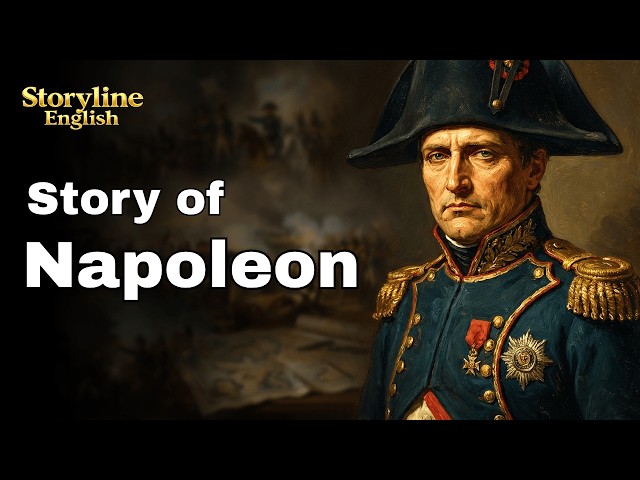
Napoleon Bonaparte – The Boy Who Became Emperor || English Listening Practice ✅
Storyline English
0:00 Hello my friends.
0:01 Welcome back to Storyline English.
0:04 It's so good to have you here.
0:07 Let's take a breath together.
0:10 Now, imagine for a moment
0:13 you are standing on a cold hill in
0:16 Europe.
0:17 The wind is quiet.
0:19 The sky is gray.
0:22 And in front of you, a young man looks
0:25 out at the world.
0:27 He is not tall.
0:29 He does not look
0:30 powerful.
0:32 But inside his mind, something is
0:35 burning.
0:37 A fire.
0:39 A dream.
0:40 A question that will change history
0:44 forever.
0:46 Who is this man?
0:48 And how did a boy from a small island
0:51 become one of the most famous people who
0:54 ever lived?
0:55 Stay with me, because today we are going
0:59 to travel back in time together.
1:02 We are going to listen to one of the
1:04 greatest stories in all of human
1:07 history.
1:09 This is the story of Napoleon Bonaparte.
1:13 And it begins on a small, quiet island.
1:17 Far from the power.
1:19 Far from the glory.
1:21 But full of something important.
1:24 Full of hunger.
1:26 Full of purpose.
1:28 Are you ready?
1:30 Then let us begin.
1:33 The year was 1769.
1:36 On a small island called Corsica in the
1:38 Mediterranean Sea, a baby boy was born.
1:43 His name was Napoleone di Buonaparte.
1:47 Corsica was not a rich or powerful
1:50 place.
1:51 It was a small island far from the great
1:54 cities of Europe.
1:55 The people there were proud, but they
1:58 were simple.
1:59 They lived simple lives.
2:02 And this baby boy, this small and quiet
2:05 child, was born into a family that was
2:09 not very wealthy.
2:11 His father, Carlo, was a lawyer.
2:14 His mother, Letizia, was a strong and
2:17 serious woman.
2:19 She raised her children with discipline.
2:22 She taught them to work hard.
2:24 She taught them that life is not easy.
2:27 And that you must fight for everything
2:30 you want.
2:31 Napoleon was the second of eight
2:34 children.
2:35 Life in the family home was busy and
2:38 sometimes difficult.
2:40 But young Napoleon was different from
2:42 the other children.
2:43 He was serious.
2:45 He was focused.
2:47 And from a very young age, he loved to
2:50 read.
2:52 He read books about great leaders.
2:54 He read about wars and battles and
2:57 history.
2:58 He was quiet.
3:00 But his mind was always
3:01 moving.
3:02 Always thinking.
3:04 Always dreaming.
3:07 And then, when Napoleon was just 9 years
3:10 old, something happened that would
3:12 change everything.
3:15 His father made a very important
3:17 decision.
3:19 And that decision would send young
3:21 Napoleon far, far away from his island
3:24 home.
3:26 But where was he going?
3:28 And what would he find there?
3:31 When Napoleon was 9 years old, his
3:33 father sent him to France.
3:36 To a school for soldiers.
3:38 A military school.
3:41 For a young boy from a small island,
3:44 this was a big journey.
3:46 France was a powerful country.
3:49 A rich country.
3:51 Full of noise and history and culture.
3:55 But for Napoleon, it was also a lonely
3:58 place.
3:59 He was different from the other boys.
4:02 He spoke French with a strong Corsican
4:04 accent.
4:06 The other boys laughed at him.
4:08 They called him names.
4:10 They said he was not really French.
4:13 He was an outsider.
4:15 And Napoleon felt this deeply.
4:19 But he did not cry.
4:21 He did not give up.
4:23 Instead, he studied harder.
4:26 He became very good at mathematics.
4:29 He loved geography and history.
4:33 He read everything he could find.
4:36 And slowly, something began to grow
4:39 inside him.
4:41 Not just knowledge, but confidence.
4:45 A quiet, strong confidence.
4:49 He began to feel that he was not less
4:52 than the other boys.
4:54 He was different.
4:55 And different, he believed, was
4:58 something special.
5:00 He was not the most popular boy at
5:02 school.
5:04 But he was one of the most focused.
5:06 One of the most serious.
5:09 And when he graduated from the military
5:11 school in Paris at the age of 16,
5:14 he was ready.
5:16 Ready to become a soldier.
5:19 Ready to begin his journey.
5:22 But the world he was stepping into was
5:24 about to become very dangerous.
5:27 France was changing.
5:30 And the change was coming fast.
5:33 It was the late 1780s.
5:35 France was in trouble.
5:38 The poor people of France were very
5:40 angry.
5:41 They had no food.
5:42 They had no money.
5:44 And the king and the rich people lived
5:47 in beautiful palaces and ate wonderful
5:49 food.
5:51 The people said, "This is not fair."
5:55 And in 1789, the French Revolution began.
6:00 It was a time of great change and also
6:04 great danger.
6:05 People were angry.
6:07 Cities were loud with
6:09 noise and fear.
6:11 The old world was falling apart.
6:14 And in this chaos, a young soldier named
6:17 Napoleon began to rise.
6:20 He was brave.
6:21 He was smart.
6:23 And he understood something very
6:25 important.
6:26 He understood that in times of change,
6:29 the people who act quickly and think
6:32 clearly are the ones who win.
6:35 Napoleon fought in several battles and
6:38 showed great skill.
6:40 He was not afraid.
6:42 He made fast decisions.
6:44 He inspired the soldiers
6:46 around him.
6:47 And people began to notice
6:49 him.
6:50 At the age of 24, he became a general.
6:54 A general.
6:55 At 24 years old.
6:58 This was remarkable.
7:00 This was extraordinary.
7:04 The lonely boy from Corsica, the
7:06 outsider who was laughed at in school,
7:09 was now one of the most important
7:11 military leaders in France.
7:15 But Napoleon did not stop there.
7:17 No.
7:18 Because for Napoleon, becoming a general
7:21 was only the beginning.
7:23 The real question was this.
7:26 How far can one person go?
7:30 And Napoleon, it seemed, was not
7:33 finished asking that question.
7:36 The years passed.
7:38 Napoleon won battle after battle.
7:41 He fought in Italy.
7:43 He fought in Egypt.
7:45 He became a hero to the French people.
7:48 They loved him.
7:49 They trusted him.
7:51 And in 1799, Napoleon made a bold and dangerous move.
7:58 He took control of the French
8:00 government.
8:02 It was not a normal election.
8:04 It was fast.
8:06 It was calculated.
8:08 And it worked.
8:10 Napoleon became the leader of France.
8:13 And then, just a few years later, in
8:16 1804, something happened that nobody in
8:19 history had seen for a very long time.
8:24 In a beautiful ceremony in the Cathedral
8:26 of Notre Dame in Paris, Napoleon took a
8:30 crown.
8:31 And he placed it on his own head.
8:35 He did not wait for someone else to
8:37 crown him.
8:38 He crowned himself.
8:42 He was now Napoleon the first, emperor
8:46 of France.
8:48 The room was full of powerful people.
8:51 Generals, politicians, kings and queens
8:55 from other countries.
8:57 But Napoleon looked at no one.
9:00 He looked forward.
9:02 Because for Napoleon, this was not an
9:05 ending.
9:07 This was not the top of the mountain.
9:09 This was just another beginning.
9:13 An empire now stood behind him.
9:16 And he believed the whole world was
9:19 waiting ahead.
9:20 But power, as many people in history
9:23 have learned, is a difficult thing to
9:26 hold.
9:27 And the higher you rise, the harder the
9:29 fall can be.
9:32 Napoleon controlled most of Europe.
9:34 He changed laws.
9:36 He created systems that
9:38 still exist today.
9:40 He built roads and schools.
9:42 He brought order to a continent that had
9:45 been in chaos for years.
9:48 Many people respected him.
9:50 Some people feared him.
9:53 But Napoleon was never satisfied.
9:56 He always wanted more.
9:59 And in 1812, he made the greatest mistake of his
10:04 life.
10:05 He decided to invade Russia.
10:09 Russia was a massive country,
10:12 cold, vast, and very, very difficult to
10:17 fight in.
10:18 Napoleon took an army of more than
10:20 600,000 soldiers east into Russia.
10:25 It was the largest army in the history
10:28 of Europe at that time.
10:30 At first, the Russian army moved back.
10:34 They did not fight directly.
10:36 They pulled back.
10:38 And as they moved, they burned their own
10:41 villages.
10:42 They burned the food.
10:44 They left nothing for Napoleon's army.
10:48 Napoleon reached Moscow, but Moscow was empty.
10:53 And then winter came.
10:56 The Russian winter, cold beyond imagination.
11:02 Soldiers died not from battle,
11:05 but from the cold,
11:06 from hunger, from exhaustion.
11:10 Napoleon had to retreat.
11:13 And that retreat became one of the
11:15 saddest events in military history.
11:18 More than half of his army did not
11:21 return.
11:23 Napoleon had won so many battles,
11:26 but Russia broke something inside his
11:29 empire.
11:30 And his enemies, watching from the edges
11:33 of Europe, began to see that this man
11:36 was not invincible.
11:39 The great wall was beginning to crack.
11:43 After the disaster in Russia, things
11:45 moved quickly.
11:47 The countries of Europe joined together
11:49 against Napoleon.
11:51 England, Prussia, Austria, Russia,
11:54 they all wanted him gone.
11:57 Napoleon fought back.
11:58 He was still brilliant, still brave,
12:01 but he was tired, and his army was
12:03 weakened.
12:05 In 1814, the enemies entered Paris.
12:09 Napoleon, for the first time in his
12:11 life, had no choice.
12:14 He gave up power.
12:16 He was sent away to a small island
12:18 called Elba in the Mediterranean Sea.
12:21 Not so different, perhaps, from the
12:23 island where he was born.
12:26 But Napoleon was not a man who rested
12:28 for long.
12:30 Just 10 months later, he escaped from
12:33 Elba.
12:33 He returned to France.
12:36 And the French people welcomed him back.
12:39 Soldiers who were sent to stop him
12:41 joined him instead.
12:44 It seemed, for a brief and shining
12:46 moment, that the story might continue.
12:51 But it did not.
12:53 In June 1815, at a place called Waterloo in Belgium,
12:58 Napoleon fought his final battle.
13:01 The English General Wellington and his
13:04 allies were too strong.
13:06 Napoleon lost.
13:08 And this time, there was no escape.
13:11 He was sent far away
13:13 to a tiny, remote island in the South
13:16 Atlantic Ocean called Saint Helena.
13:20 He would never leave that island.
13:22 He lived there for 6 years, quiet and
13:25 alone.
13:27 And in 1821, Napoleon Bonaparte died.
13:32 He was 51 years old.
13:35 The boy from Corsica,
13:37 the outsider, the general,
13:41 the emperor, gone.
13:44 And so, my friends,
13:46 the story of Napoleon Bonaparte comes to
13:50 a quiet end.
13:52 But what does it leave us with?
13:54 What can we learn from this remarkable
13:57 and complicated life?
14:00 Napoleon was not a perfect man.
14:03 He made terrible mistakes.
14:04 He caused great suffering.
14:07 Wars are never simple, and the story of
14:10 Napoleon is full of pain as well as
14:12 greatness.
14:14 But there is something in his journey
14:16 that speaks to all of us.
14:19 He was an outsider.
14:21 He was laughed at.
14:23 He spoke with the wrong accent.
14:25 He came from the wrong place.
14:29 And yet, he refused to accept that the
14:32 world had already decided his future.
14:35 He studied.
14:37 He worked.
14:38 He believed that knowledge and effort
14:41 could change a life.
14:43 And they did.
14:45 Not perfectly.
14:46 Not without cost, but powerfully.
14:50 And here you are, my friend.
14:53 You are listening to this story in
14:55 English.
14:56 Maybe English is not your first
14:58 language.
15:00 Maybe sometimes it feels difficult.
15:02 Maybe sometimes you feel like an
15:05 outsider, too.
15:07 But you are here.
15:09 You are learning.
15:11 You are on your own journey of
15:13 discovery.
15:15 And that is something to be proud of.
15:18 Every story you listen to, every word
15:22 you understand, every sentence that becomes a little
15:26 clearer is a small victory.
15:30 Keep going.
15:31 Keep listening.
15:33 Keep learning.
15:36 This is Storyline English.
15:39 And if this story moved you, if it
15:41 helped you learn something today,
15:44 please come back.
15:46 There are many more journeys waiting for
15:48 you here.
15:50 Leave a comment and tell me,
15:52 what did you feel during Napoleon's
15:54 story?
15:56 I would love to hear your voice.
15:59 Until next time, my friends.
16:01 Take care of yourselves,
16:03 and never stop learning.