Chuck Jones - The Evolution of an Artist
Every Frame a Painting
0:07 Hi my name is Tony and this is Every Frame a Painting.
0:10 If you grew up like I did, you probably watched a lot of Looney Tunes.
0:13 And if you paid attention to the credits then you recognize this name.
0:17 -"My full name is Charles Martin Jones."
0:19 -"This is not where I really belong." -"I
0:23 belong behind the camera." Chuck Jones is
0:29 one of the all-time masters of visual comedy.
0:31 Between 1938 and 1962 he directed more than 200 cartoons for Warner Bros.
0:36 Ten films a year, six minutes per film.
0:42 What's astonishing is that they hold up more than 50 years later.
0:45 And among them are some of the greatest short films ever made.
0:48 But none of this happened overnight.
0:50 It was a long process.
0:52 So today, let’s take a look...
0:56 at how a good artist became a great one.
0:59 -"All right.
1:00 Let’s get this picture started!" -"No!
1:05 No!" The most famous aspect of any Chuck Jones cartoon (and the parts
1:09 you probably remember) are the jokes written by Michael Maltese and Tedd Pierce.
1:19 Nearly every gag here follows a classic two-part structure.
1:22 The first part… leads you to make an assumption.
1:27 The second part...
1:31 proves it wrong.
1:32 That’s it.
1:33 Assumption: Reality.
1:41 And in the early cartoons,
1:42 the jokes are fantastic and they happen one after the other.
1:48 But here’s the truth: the gags are only the surface level.
1:51 What really sets these films apart is
1:53 the amount of work that was put into character.
1:55 And that process took a long time.
1:57 -"All characters are a process of learning." -"It’s
2:00 hard for people to understand who watch actors...
2:03 -"...to realize that, actors come with an ability.
2:06 They’ve played other parts." -"Hello." -"When you bring in a drawing,
2:10 all you have is a drawing." -"And you have
2:12 to put in the character." Consider the case of Daffy Duck.
2:15 When he first started out… Daffy was more or less insane.
2:22 -"Gosh what a screwy duck." But over the course of 15 years,
2:27 he changed from being the one who laughs to being the butt of the joke.
2:35 This Daffy is less crazy but it’s easier to understand what he wants.
2:39 He wants money.
2:40 He wants to be a star.
2:42 In short, he wants glory.
2:43 -"This looks like a job for...
2:48 -"...The Masked Avenger!" In fact,
2:51 all of Chuck Jones' characters have very clearly defined wants.
2:55 This one wants a home.
2:57 This one wants to daydream.
2:59 And this one just wants somebody to love.
3:02 -"Ah my little darling.
3:03 It is love at first sight,
3:05 is it not?" Notice that every desire here is very simple.
3:08 And the simpler the desire, the more vivid the character.
3:14 Once you know what the character wants you can figure out the next question:
3:17 How does this particular individual move?
3:20 -"Every action is dictated by what goes on inside of you."
3:23 -"You have to be able to think the way the character thinks."
3:26 -"If you can’t tell what’s happening by the way the character moves..."
3:29 -"...you’re not animating." -"I am a snake and you have charmed me,
3:33 no?" -"It helps to have the dialogue..." -"...but the dialogue is
3:36 not the thing that makes it work." -"The story should tell itself
3:40 by the way it moves." So let’s say you know what
3:44 the character wants and you know how they move to get it.
3:47 What about the jokes?
3:48 What happens to the assumption… and the reality?
3:53 Well, now the assumption includes the personality of the character.
3:56 For instance, we know that Daffy will always pick
3:58 a fight because it’s part of his desire for glory.
4:05 -"Take over." Likewise, we know the Coyote’s device will fail so Jones can
4:09 play this gag offscreen which ends up making it funnier.
4:18 But there is a danger to this approach.
4:20 If you just focus on great jokes with the same
4:23 well-defined characters you can easily get trapped in a formula.
4:26 -"Sometimes I feel very sorry for the Coyote." -"Sometimes
4:30 I wish he’d catch him." -"If he caught him
4:39 there wouldn’t be any more Road Runner." -"You wouldn’t
4:42 like that, would you?" So to avoid this problem, Jones did something.
4:46 This is one of the defining aspects of his work.
4:48 It’s a word that he uses and that other people use about him.
4:52 -"Beep Beep!" -"It also stands out as an example
4:55 of the kind of discipline..." -"...Chuck Jones liked to set
4:58 for himself." -"This is the vital factor in all
5:01 comedy or all drama." -"What are your disciplines?" Discipline.
5:04 The challenges and restrictions you set for yourself.
5:07 Like designing a character with no mouth.
5:11 Or no face.
5:13 Or using no dialogue except for this.
5:17 -"Hello my baby, hello my honey,
5:19 hello my ragtime gal." Because animation lets you do
5:23 anything you have to think about what you won't do.
5:26 And in Jones’ case, there were lots of rules about the world,
5:28 the characters and their behavior.
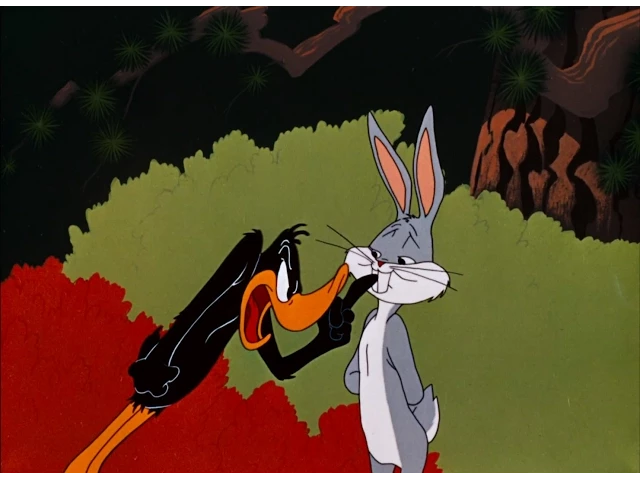
5:30 For instance, Bugs Bunny never picked a fight.
5:33 Somebody had to do this… -"Kill the wabbit!
5:36 Kill the wabbit!
5:37 Kill the wabbit!" ...and only then would he fight back.
5:41 -"Kill the wabbit?" -"Bugs Bunny is not just
5:46 an insane rabbit." -"Somebody’s always trying to get him.
5:50 And he’s retaliating." -"He has to be provoked.
5:52 And we learned that." -"It was very
5:54 important that he be provoked." -"Because otherwise,
5:55 he’d be a bully." -"Of course you realize this means
6:01 war." A similar restriction happened to how the characters expressed themselves.
6:05 Early on, they tended to go through a quick barrage of facial expressions.
6:12 But over time, these grew less and less.
6:14 -"Particularly in the later films Chuck became very fond..." -"...of using
6:20 the smallest possible gestures..." -"...facial
6:24 gestures to get laughs." -"Chuck’s
6:32 facial expressions were the best in the business..." -"...Because he
6:35 was a minimalist." -"All humor grows from two things." -"All humor,
6:45 I believe, comes from human behavior and logic."
6:48 -"If it’s not logical it’s not gonna be funny...
6:50 -"...And if it doesn’t come from human behavior..." -"...how the hell
6:52 do you know it’s funny?" Think of it this way: this is human behavior.
6:56 -"Ha ha!
6:57 Now!" That was logic.
7:02 And the logic is something you improve at over time.
7:06 But what about human behavior?
7:08 How do you improve at understanding that?
7:11 The truth is, there’s only one way.
7:12 And it’s not by watching films.
7:19 -"When you talk to Chuck,
7:20 he is always encouraging you..." -...to go to the source:
7:23 to study real life, to study art..." -"...and apply that to your animation.
7:27 It’s not just drawing funny faces." Jones
7:34 believed it wasn’t enough to just watch movies.
7:36 You had to have interests outside of film.
7:38 You had to study real life.
7:40 Most of all, he encouraged this: -"Reading.
7:43 Read Everything." -"It doesn’t do you much good to draw..."
7:47 -"...unless you have something to draw..." -"...and the only
7:49 place you can get anything to draw..." -"...is from out
7:51 of that head." -"And the only way that you
7:53 can exercise the mind..." -"...is by bringing new ideas
7:55 to it..." -"...So it’ll be surprised." -"And say 'God I
8:02 didn’t know that.'" -"That’s the greatest thing in the world..."
8:05 -"...that 'Gee I didn’t know that.' And there you are, you know?" There you are.
8:10 It’s not just about gags.
8:12 Not just about characters.
8:13 Not just about discipline.
8:15 It’s about studying the real world and learning something new.
8:18 Then putting that back into the work.
8:20 In other words, inspiration.
8:25 And the great thing about this kind of inspiration?
8:27 -"You can find it anyplace.
8:29 You can find it anyplace."