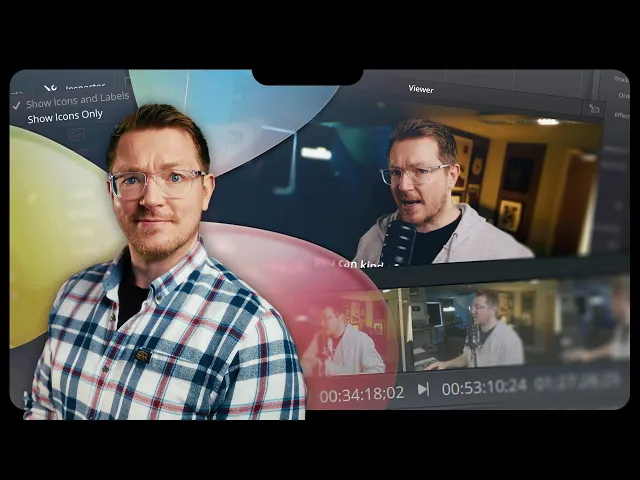
If you use DaVinci Resolve on a laptop... Watch this!
MrAlexTech
0:00 Really boring, but practical and
0:02 hopefully useful tips for messing around
0:04 with the UI in DaVinci Resolve.
0:06 Particularly useful if you're editing on
0:08 an itty bitty laptop just like this one.
0:10 Now before we get into it, don't forget
0:12 that a bunch of the changes we're going
0:13 to make can be saved as presets.
0:16 Up in workspace, come down to layout
0:18 preset, you can save the
0:20 current layout as a preset.
0:22 So as you change things, as you rearrange
0:24 the UI to your liking,
0:26 you can come in and save it.
0:27 Then if you want to apply it, you just go
0:29 to the one you've
0:29 created and you load it.
0:31 You can also update them,
0:32 export them and delete them.
0:33 You can have as many
0:34 of these as you like.
0:36 Right, let's kick things
0:37 off with the first one.
0:38 Full screen window.
0:39 I think this one is most
0:40 useful for Windows users.
0:42 I think if you're on Mac,
0:43 you can kind of do this anyway.
0:44 But if you're on Windows and you can see
0:46 your Windows bar at the bottom down here,
0:49 all you want to do is with the DaVinci
0:51 Resolve, click on workspace.
0:53 Right in the middle,
0:53 there is full screen window.
0:55 Give that a click and it
0:56 just gives you that extra space.
0:59 It gives you a proper full screen so you
1:01 haven't got the little bar at the bottom,
1:02 which just means DaVinci Resolve has a
1:04 little bit more room.
1:06 Next up, labels.
1:08 This is hidden.
1:09 You might like it, you might not and it
1:11 only makes a small
1:12 difference, but it's worth mentioning.
1:14 So on the edit page or any page within
1:16 Resolve, you'll probably
1:17 have some sort of labels and
1:19 icons across the top here.
1:21 And then you've also got your navigation
1:22 icons down the bottom.
1:23 If we right click on any of these down
1:25 the bottom, we do get
1:27 this little menu and we
1:28 can change from show icons
1:29 and labels to show icons only.
1:32 And that just tucks that away,
1:34 makes it a little bit smaller.
1:36 Again, just giving you a
1:37 little bit more room to work with.
1:39 Now you can do the same thing
1:40 with these icons at the top.
1:42 Now for this one, you don't get much more
1:44 kind of vertical space.
1:45 You don't get any, but it
1:46 does make it a little bit neater.
1:48 Now one other good place to do this, if
1:51 you open up the inspector
1:52 by clicking on your inspector
1:53 icon top right hand corner, you've got
1:56 the same icons here, video, audio
1:59 effects, transitions,
2:00 etc.
2:01 Right click there, you can also change
2:02 that to be show
2:03 labels or show icons only.
2:06 And again, it just makes that a little
2:07 bit smaller, giving you
2:09 a little bit more room
2:10 within the inspector.
2:11 I'm talking itty bitty differences, but
2:13 they can all start to add up.
2:15 Now if you want to take this slightly
2:17 further, you can actually
2:18 get rid of all of the different
2:19 pages across the bottom and
2:21 navigate via shortcuts instead.
2:24 To do this, click on
2:25 workspace at the very top.
2:27 Third option down, show page navigation.
2:29 If you tick that to get rid of it, you'll
2:32 get rid of this bar
2:33 across the bottom entirely.
2:35 Now you obviously still need
2:37 to navigate between the pages.
2:39 You can do that by going to workspace,
2:41 then go to switch to
2:42 page and you can see we've
2:43 got media, cut, edit, fusion, color,
2:45 fairlight and deliver.
2:47 And we have some keyboard shortcuts.
2:49 Shift two, three, four,
2:50 five, six, seven and eight.
2:51 If you're wondering where shift one is,
2:54 shift one will actually
2:55 open up your project manager.
2:57 So then you can switch between projects.
2:59 Now I don't particularly like shift one,
3:01 two, three, four,
3:01 because it kind of takes two
3:03 hands or a big stretch.
3:04 So instead, if you click on DaVinci
3:06 Resolve, very top left hand
3:07 corner, then come to keyboard
3:09 customization.
3:11 Over here on the right hand
3:12 side, there is a search box.
3:14 If you search for switch two, you will
3:16 see workspace, switch to page.
3:19 You'll see the same shortcuts in here and
3:21 you can assign some different ones.
3:23 Or another option, go back to that
3:25 keyboard customization.
3:26 There is an option for
3:28 show page navigation.
3:30 So I'm going to try something like
3:31 control and F1 and then save.
3:33 And now if I want that back, I can do.
3:36 I can jump to my next
3:36 page and then hide it again.
3:38 The choice is yours.
3:40 Next up, I think this one again is most
3:42 useful for you Windows users out there.
3:44 And this is UI scaling.
3:47 You can actually properly change the UI
3:49 scale of DaVinci Resolve
3:50 directly within DaVinci
3:52 Resolve.
3:52 So you don't need to change the UI
3:53 scaling of Windows itself.
3:56 You can just do resolve.
3:58 For this one, all you need to do, click
4:00 on DaVinci Resolve, top
4:01 left hand corner, then
4:02 go to preferences.
4:04 From here, jump over to user at the very
4:07 top, UI settings and
4:09 there is a UI display
4:11 scale.
4:12 Auto will just be the same as your normal
4:14 working environment.
4:16 Or you can go 100%, 150% or 200%.
4:20 Now a quick note, it will depend on what
4:22 the scale of your Windows is.
4:24 So mine is currently set to 200 because I
4:26 like this nice and big for when I'm doing
4:27 these videos.
4:29 So setting it to 100 or 150 will actually
4:31 make it smaller, meaning I can see more.
4:34 So it will just depend on
4:35 how your system is scaled.
4:37 But I do recommend don't just jump in at
4:39 200 in case it does
4:40 make things bigger and
4:42 then it can be really hard
4:42 to get back to these options.
4:45 Next up, expand.
4:47 Or more importantly, shrink.
4:49 So as you can see here, we've got a full
4:51 screen inspector on the
4:52 right and then we've got
4:53 my media port and my
4:54 effects library on the left.
4:56 Now that's nice for accessing those
4:58 things, but it does give
4:59 you a pretty small timeline.
5:01 Here in the top right hand corner, there
5:03 is this icon, shrink or expand.
5:07 And if you do that, you can keep your
5:08 inspector open, but it just
5:09 kind of tucks it up to the
5:11 top half.
5:12 So then you get your timeline down here.
5:14 Now you also have one over on the left,
5:16 but what's important to
5:16 note is if you do shrink
5:18 that you can then only
5:20 have one thing open at a time.
5:22 So it's either the media pool or the
5:24 effects library rather than both.
5:26 But it does now give you a full width
5:28 timeline, which is super useful.
5:31 So sticking with the
5:32 timeline track height.
5:34 This is a good one.
5:35 Again, if you're working on a particular
5:36 timeline, you've got loads
5:37 of different tracks and you
5:38 want to shrink it all so you can kind of
5:40 see what's going on just
5:41 that little bit better.
5:43 It's really quick and easy.
5:44 Just above your timeline, this icon here,
5:47 top left, timeline
5:48 view options, give that
5:50 a click down at the bottom, track height,
5:53 and you can simply
5:54 slide these to make the
5:55 video tracks bigger or smaller.
5:58 And don't forget you can grab this little
5:59 bar on the left hand side, click and drag
6:02 to kind of move your
6:03 timeline up and down.
6:04 So if I want more room for audio tracks,
6:07 I can move it that way
6:08 or more room for video
6:09 tracks, I can move it this way.
6:12 Dual viewer mode.
6:13 Now this one might not affect you.
6:15 It will depend on the scaling and the
6:17 resolution and the size
6:18 and the ratio and whatever of
6:20 the display on your laptop.
6:22 But it's absolutely worth talking about
6:24 because if you're not
6:24 using it, you might as well
6:26 get rid of it.
6:27 And what I'm talking about is this.
6:29 I've got two preview screens.
6:31 The one on the right is my timeline and
6:33 the one on my left is my source media.
6:36 Again, useful, good way to
6:37 work, but you might not need it.
6:39 In which case you can get rid of it.
6:41 So in the top right hand corner, there's
6:43 this small little icon
6:44 here, single viewer mode,
6:46 give that a click and it will
6:47 get rid of that second viewer.
6:49 So now you've just got the one.
6:51 Now, if you don't see that icon, because
6:53 it can hide away, which
6:55 is quite annoying, just
6:56 get rid of your inspector by clicking on
6:58 this icon to minimize your inspector.
7:01 And then that icon will appear, switch to
7:03 the single viewer mode,
7:04 and then you can re-enable
7:06 your inspector and you
7:07 should be good to go.
7:09 Vertical viewer.
7:10 Super quick one for you lot that work
7:12 with vertical timelines often.
7:14 So I've got my main vertical setup here.
7:16 This icon down here is expand view.
7:20 And this will expand your portrait viewer
7:22 to fit the full screen.
7:23 So you can actually see
7:24 it a little bit better.
7:25 You can also drag this over just a little
7:27 bit, depending on the
7:29 aspect ratio you are
7:30 using.
7:31 Now, if you want to get back, so you've
7:32 got your full width
7:33 timeline, the icon moves over
7:36 here, shrink view.
7:38 So you give that a click to shrink it
7:39 back and get to your
7:40 full screen timeline.
7:41 Now depending on the size of your screen,
7:43 you may or may not be
7:45 able to open both the
7:46 inspector and the viewer.
7:48 If you're on a smaller
7:49 screen, it won't let you do it.
7:50 When you open the
7:51 inspector, it will shrink this down.
7:53 That is just going to depend on the size
7:55 of the screen, the
7:56 aspect ratio, the scaling,
7:57 all that stuff that
7:58 you're using on your laptop.
8:00 Now next bonus tip before
8:02 we get into the next one.
8:03 This one doesn't actually save you space,
8:04 but it's just worth talking about because
8:06 it can be quite
8:07 annoying if you didn't know.
8:09 And the color page is
8:10 the best example for this.
8:11 So if you see my menu bar right in the
8:13 middle, we've got six
8:15 icons on the left, then a bunch
8:16 in the middle, and then three
8:18 over on the right hand side.
8:20 Now I'm just going to change my window
8:21 scaling, which is going to
8:22 make DaVinci Resolve think
8:23 it's working on a
8:25 different sized screen essentially.
8:28 Now you'll notice that we have no gap.
8:30 It just puts all of the icons together
8:32 across the left,
8:34 basically because we don't have
8:35 space for that gap.
8:37 So DaVinci Resolve has automatically
8:39 tried to accommodate,
8:41 rather than squishing the
8:42 icons and making them all too small, it's
8:44 just got rid of the
8:45 gap over on the left hand
8:46 side.
8:47 I just wanted to mention that on the off
8:48 chance you're watching a tutorial and now
8:50 like click the icon in the middle by the
8:53 gap and on yours, the gap doesn't exist.
8:57 That's why.
8:58 Anyway, next up, filmstrip.
9:00 So you can see my media poll here and we
9:02 currently have the thumbnail view.
9:04 So we can see all of these thumbnails.
9:06 If we click on this little drop down box,
9:08 we can change this to be the list view.
9:10 Now the list view just gives you all of
9:12 your media in a list.
9:14 If you then click on these three little
9:16 dots in the top right
9:17 hand corner, there is an
9:18 option to show filmstrip.
9:21 Now if I single click on any piece of my
9:23 media within the media
9:23 poll, we get this little
9:25 filmstrip here and this is really useful
9:27 because if I don't click
9:28 anything, I've got my timeline
9:30 view and I can just whip around my
9:31 timeline or I can come over
9:33 here and as soon as I hover
9:34 my mouse, my preview window will change
9:37 to that source media.
9:38 I can even then do I's and O's to select
9:41 particular sections of that
9:43 clip and then drag them directly
9:44 from the filmstrip onto my timeline.
9:47 If I click on another piece of media,
9:49 then that will appear
9:50 within the filmstrip, grab
9:52 some more, bring it
9:53 down and you get the idea.
9:55 Right, just a couple more and let's jump
9:56 back to the media poll for a second.
9:59 The first one, close your
10:01 bins or hide them at least.
10:04 This is a simple one,
10:05 but it's easy to miss.
10:06 This little icon here in the top left
10:08 hand corner, bin list,
10:10 give that a click and you
10:11 can get rid of this list of bins.
10:14 That's exactly what it says on the tin.
10:16 If you're in a bin or a folder and you
10:18 know you're going to
10:18 spend a lot of time within
10:20 this folder because all of your main
10:21 media is in there, just
10:23 click this icon to click
10:24 to get rid of that and it just gives you
10:26 a bit more space within the media poll.
10:29 Next up, columns.
10:30 You can pick and choose and rearrange and
10:33 even create templates
10:34 for the columns that
10:35 you see again within that media poll,
10:37 which just means you can
10:38 make the most of the limited
10:40 space you have.
10:41 With the media poll open, you can see
10:43 I've got all of my
10:44 different column headings here.
10:45 If I click and drag, I can reorder them
10:47 so I can put important
10:49 things over on the left
10:50 rather than them being
10:51 miles over on the right.
10:53 Now if I want to get rid of some stuff,
10:55 you simply right click
10:56 any of the column headings,
10:58 you get this big long list and let's say,
11:00 let's just tick some things.
11:02 Let's say I want a bunch of stuff on.
11:04 This is my big heavy duty view.
11:07 I've got everything enabled.
11:08 We can click create
11:09 column layouts at the top.
11:11 This one's going to be called heavy.
11:13 So we've got everything there.
11:15 And then if I right click, let's untick
11:17 pretty much everything.
11:19 The only thing I'm realistically going to
11:20 want, FPS just in case and
11:23 then probably resolution.
11:26 Get rid of everything else and then
11:27 create another column layout.
11:29 I'm going to call this
11:29 one light and then okay.
11:32 And now when I'm working and I only need
11:34 those three things, I
11:35 can make this as small as
11:36 I need it and I'm going to worry about
11:37 scrolling left and right.
11:39 I want to want everything back again.
11:40 I can right click, go to heavy and load
11:43 and I've got everything I need.
11:46 Switch back to light and off we go.
11:48 Right, another quick bonus
11:49 one because I love a bonus one.
11:51 Again, this doesn't necessarily save
11:53 space in the UI, but it
11:55 is very, very useful and
11:57 it is delete unused clips.
12:00 If you've just dumped a bunch of stuff in
12:02 your media pool, which
12:03 I tend to do, I might
12:04 just grab a bunch of the things I think
12:06 I'll need and then dump
12:07 them in some folders and
12:09 then realize I don't actually need them
12:11 after I've sort of
12:12 cut up my main timeline.
12:14 What you can do is click on these three
12:15 little dots and there's
12:17 an option, update usage for
12:19 entire project.
12:20 Give that a click and it'll say it's
12:21 going to load all the
12:22 timelines and check basically
12:24 which clips, which files from the media
12:26 pool are actually being
12:27 used within the timelines.
12:30 So I'm going to click update.
12:32 Depending on the size of the project, how
12:33 many clips, whatever
12:34 else it may take a moment
12:35 or it might be really
12:35 quick, mine's been pretty quick.
12:38 Then I can click the three dots once
12:39 again and I can remove unused clips.
12:42 It's going to say a very similar thing.
12:44 I'm going to load all timelines and
12:46 that's just going to go
12:47 through the project, go through
12:48 all of the bins, all of the folders and
12:50 delete any clips which
12:52 aren't actually being used
12:53 on a timeline, which makes a nice quick
12:56 easy way to tidy up your media pool.
12:59 So I highly recommend you do that before
13:00 you export your
13:01 project archives if you want
13:03 to do that with all of your media, which
13:06 I'm not going to talk
13:06 about in this video.
13:07 So let's move on to the next
13:09 tip, which I forgot what it is.
13:15 Scopes.
13:17 No, it's not.
13:18 Kind of.
13:19 Pop out windows.
13:21 There's very few of them.
13:23 There are three that I know of.
13:25 One of them is incredibly annoying and
13:26 you're going to be
13:27 annoyed when I show you because
13:29 it exists, but it
13:30 exists wrong essentially.
13:34 But the first one, media pool.
13:37 So rather than dealing with this media
13:38 pool over here, what
13:39 you can do is right click
13:41 on any of the bins or folders.
13:43 I like to do it on master.
13:45 There is an option open as a new window
13:47 and it will actually pop
13:48 that out as a new window.
13:50 You can move this around.
13:51 You can put it on other monitors if
13:52 you're plugged into somewhere else.
13:54 And then you can simply get rid of this
13:55 one from the main DaVinci resolve window.
13:57 And I like to alt and tab and I can just
13:59 switch back to this
14:00 one and then we've still
14:02 got our film strip.
14:03 So let's go to this one.
14:04 Let's click this.
14:05 We've got my film strip here.
14:07 I can do an eye and I know and I can
14:08 still drag down and
14:09 put it on my timeline.
14:10 And now it's hidden away
14:11 again because I don't need it.
14:12 That's cool.
14:13 But if I want it back, I alt and tab and
14:15 now we're back to it.
14:16 You can actually do this, I believe for
14:19 multiple different folders.
14:21 So you can just get them
14:22 out as much as you like.
14:24 Next up is scopes which
14:25 is kind of particular.
14:27 It's kind of niche is if you jump into
14:28 some color grading but it is
14:29 absolutely worth mentioning.
14:31 This one's super quick and easy.
14:32 Pretty much from any page within DaVinci
14:34 resolve, you click on
14:35 workspace at the very top.
14:37 Come down to video scopes and then you
14:39 can click on and your scopes will appear.
14:42 So then you can have these again on
14:44 another screen or while
14:45 you're editing on your timeline
14:46 so you can see whatever you've played,
14:48 your waveform, your vector
14:49 scopes and your histograms.
14:50 Now this is the full wave version.
14:52 You can just do this one which is your
14:54 single view and then the
14:56 single view does allow you
14:57 to resize this a little bit smaller.
15:00 So if you wanted to get rid of your media
15:01 pool and just have your
15:02 scopes kind of sitting
15:04 over here somewhere, you can.
15:07 Audio effects.
15:08 I nearly forgot about this
15:09 one but it is quite useful.
15:11 So if you've applied any audio effects
15:13 either directly to a
15:14 particular clip on your timeline
15:16 or to the entire track on your timeline
15:18 like I have here, I've
15:20 got the AI dialogue leveler
15:22 but this works for the separator, the
15:23 remixer, the ducker, all
15:25 those sorts of things as
15:26 well as any of the effects that you may
15:28 have applied from the effects library.
15:29 Now with any of these selected, let's
15:31 just go here to the AI dialogue leveler.
15:33 You've got this little icon custom.
15:36 Give that a click and
15:37 that will pop out a window.
15:39 Now let's just get rid of my effects
15:40 library, get rid of mine specter.
15:42 I can sort of put this over here.
15:44 Let's just say I want this over here and
15:46 then hit play and I can
15:47 actually see what this
15:48 is doing.
15:49 Not if we were to apply something else.
15:51 Let's go with the AI voice isolation.
15:54 Same again.
15:54 Pop that out.
15:55 There it is.
15:56 Put this wherever you want.
15:57 Close the inspector and jobs are good.
16:00 And last but not least,
16:01 the pop out preview window.
16:03 Now I'm only showing you this kind of to
16:05 show you that it is
16:05 there even though it's not
16:07 going to be that useful and you're
16:08 probably going to get
16:09 annoyed that it exists in the
16:11 way that it does.
16:13 But let me show you.
16:14 So you can't pop out this preview window
16:16 here and it's something
16:16 that people have wanted
16:17 for a long time.
16:19 But if you jump over to the Fairlight
16:21 page and then click on
16:22 this icon here in the top
16:24 right hand corner for your meters, you
16:26 get a preview screen.
16:27 And in this preview screen, there's a
16:29 little button down here
16:30 called floating window.
16:31 And you give that a click, you get a
16:33 viewer in a floating
16:34 window which you can resize
16:36 and put wherever you like.
16:38 And then you can scrub through the
16:39 timeline and it will update.
16:43 And then if you jump over to the edit
16:44 page, it disappears.
16:47 And then jump back to the Fairlight page
16:49 and it's back again.
16:50 And then you jump back to the
16:51 edit page and it disappears.
16:59 Yeah.
17:00 Anyway, that's it for this one.
17:02 Hope you found it useful.
17:03 If you did, let me know with your
17:04 thoughts and feelings
17:04 down below and all the other
17:05 YouTube stuff like, ah, whatever.
17:08 Thanks for watching.
17:08 Take it easy.